Are Metros Overrated?

This is from a story in The Guardian:

The ITDP bemoans Africa’s obsession with metros. Lagos in Nigeria – the largest city in the world without a functioning mass transit system – has been trying to build a metro since the 1980s. In the latest of many incarnations, the project was supposed to begin operations in 2012 at a cost of $2.4bn (£1.9bn). Six years after the supposed start date, construction is “nowhere near complete”, says Kost.

Abidjan, the economic capital of Ivory Coast, began construction of a metro last year. The French-financed and -built line is projected to carry 500,000 passengers a day at a cost of $1.7bn. Dar es Salaam’s bus system, by contrast, has capacity for 400,000 people and cost less than a 10th of that – about $150m.

Addis Ababa in Ethiopia opened a Chinese-built and -operated light rail line last year at a cost of $475m. Shenzhen Metro Group has a deal to run it for the first five years.screen shot 2019-01-09 at 4.03.54 pm“With a metro, an international firm will often just parachute in its own system,” says Kost. “Bus rapid transit allows existing stakeholders to get involved. That’s what we did in Dar es Salaam and what we’re planning in Nairobi, where the bus bodies will be built in the city and local operators will look after tickets, fare collection and IT. It’s good for the development of the local economy.”

Regular readers know that I have a bias for Kost’s argument. Read the whole thing here.

H/T Dina Pomeranz.

How can African governments increase their bargaining power vis-a-vis China?

Folashade Soule has answers.

First, a reminder that African governments are not uniformly bad at negotiating with China:

….when you look closely at what happens on the ground, some African countries are much better at negotiating with the Chinese than others. Railway projects in East Africa appear to be a good example. In Kenya, the Standard Gauge Railway is the largest infrastructure project since independence from Britain in 1963. China Eximbank provided most of the finance for the first phase – 472 kilometres of track between Nairobi and Mombasa – at a cost of US$3.2 billion.

In neighbouring Ethiopia, an electric train line from Addis Ababa to Djibouti, which is also Chinese-financed, opened two years ago. The cost for this more expensive type of railway was US$3.4 billion – for 756 kilometres. Kenya claims that its railway cost more for reasons like the terrain and the need to carry higher volumes of cargo. At the same time, however, many believe other issues to have been at play – including failures around the negotiation process.

Second, there are Soule’s suggested remedies:

Involve everyone: When all relevant government departments are involved in a negotiation, it does take longer. The process is more coherent, however, and the resulting project is less likely to breach national regulations.

Empower negotiators: The Chinese often adopt a take-it-or-leave-it approach. In many cases, Africans are not confrontational enough in return. They don’t appreciate that China has a surplus of domestically produced materials they are seeking to offload, for example. Wiser negotiators will play China off against other countries seeking to finance infrastructure projects on the continent, such as South Korea or the United Arab Emirates.

Keep the public onside: China tends to be popular in Africa – more so than the US in around 60% of countries on the continent. Yet the public also see negatives: many think Chinese products are poor quality, while there is a growing perception that dealing with China tends to favour Chinese labourers.

Increase knowledge: African governments are still relatively new to dealing with China; they should take every opportunity to share lessons with one another. There is a role for African universities here. They should set up more centres of Asian studies to close the gap in information and knowledge.

I fully agree.

While it is true that China has geopolitical ambitions in Africa, a lot of Chinese infrastructure plays in Africa are commercial in nature. It is in China’s interest that these projects succeed. That means that African governments could get better deals (in terms of value for money) by doing their homework (on Chinese politics and commercial and institutional architectures) before chasing the money. Similarly, public opinion presents a potential bargaining chip — (the threats of ) transparency and robust public participation should force Beijing’s hand in settling for better deals (from the perspective of African governments). 

All this, of course, is predicated on the assumption that African elites get loans from China to finance infrastructure projects; as opposed to dreaming up projects in order to get loans that then find their way into private bank accounts. 

Read the whole thing here.

H/T Zainab Usman.

Public Debt in African States

This is from the IMF:

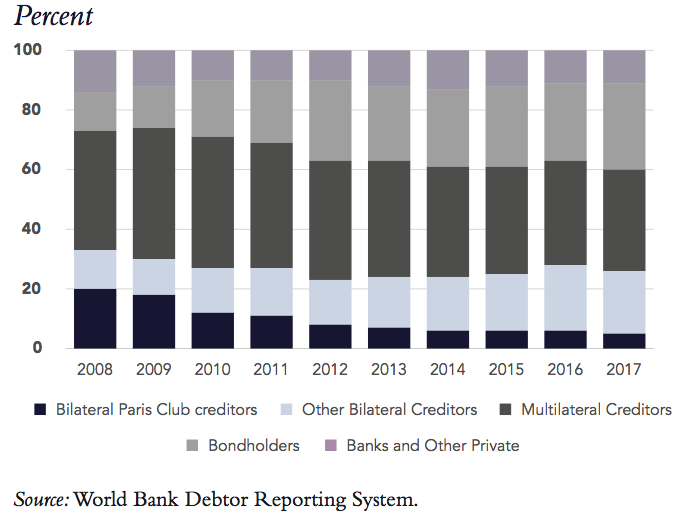
Screen Shot 2018-11-23 at 10.27.45 AMCountries in sub-Saharan Africa accumulated external debt at a faster pace than low- and middle- income countries in other regions in 2017: the combined external debt stock rose 15.5 percent from the previous year to $535 billion. Much of this increase was driven by a sharp rise in borrowing by two of the region’s largest economies, Nigeria and South Africa, where the external debt stock rose 29 percent and 21 percent respectively.

Export growth is not keeping up with rising levels of external debt:

….In 2017, the ratio was largely unchanged from the prior year, at an average of 138 percent. However, this ratio was close to double the average of 70 percent in 2010. Moreover, the average ratio masks wide disparity between countries. At the end of 2017 54 percent of countries in the region had an external debt-to-export ratio over 150 percent, as compared to 28 percent of countries in 2010 and the number of countries where the ratio surpassed 200 percent more than doubled, from 6 countries to 14 countries, over the same period. Most of these countries are ones that benefitted from HIPC and MDRI relief, including Burundi, Ethiopia, Niger, Senegal and Tanzania.

Bond issuance is dominated by a handful of countries:

Bond issuance by sovereign governments and pub- lic-sector entities in the region rose to $27 billion in 2017, a more than fourfold increase over 2016, driven to a large extent by a surge in issuance in South Africa to $19 billion from $4 billion in 2016, 70 percent of bond issuance in the region last year. An important factor was non-resident purchase of bonds issued in the South African domestic market. Bond issuance by other countries in the region totaled $8 billion, a tenfold increase from 2016, reflecting continued investors’ confidence and search for yield. Issuing countries in 2017 were Nigeria ($4.8 billion), Cote d’Ivoire ($2 billion), Senegal ($1.1 billion), and Gabon ($0.2 billion). Nigeria’s $3 billion Eurobond issuance marked the country’s largest such operation to date, and at end 2017, bond issuance accounted for one third of the country’s outstanding external debt.

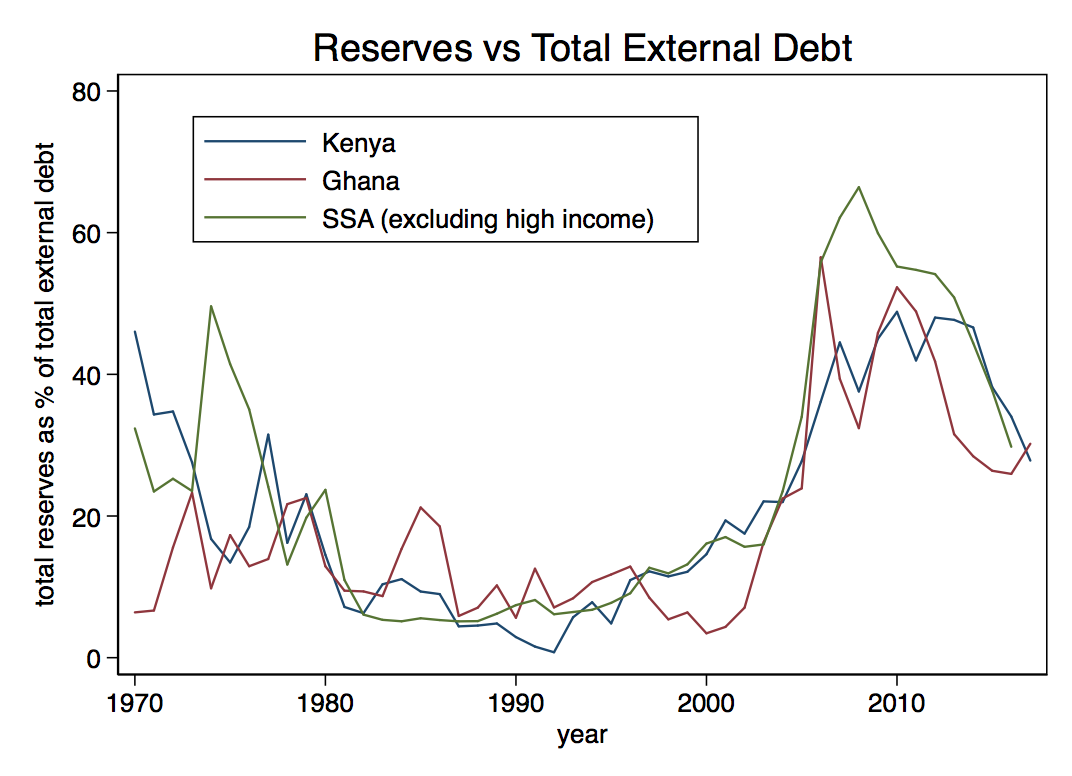
Overall, while the data suggests that things may not be as bad as they were over the lost long decade (1980-1995), the trends are not encouraging. Total reserves as a share of external debt peaked around 2010 and have been in decline since. Screen Shot 2018-11-23 at 10.54.37 AM

It’s getting easier to do business in Africa

At least according to the World Bank Group:

Sub-Saharan Africa has been the region with the highest number of reforms each year since 2012. This year, Doing Business captured a record 107 reforms across 40 economies in Sub-Saharan Africa, and the region’s private sector is feeling the impact of these improvements. The aver- age time and cost to register a business, for example, has declined from 59 days and 192% of income per capita in 2006 to 23 days and 40% of income per capita today. Furthermore, the average paid-in minimum capital has fallen from 212% of income per capita to 11% of income per capita in the same period.

See the 2019 Doing Business Report here.

Here are some questions from last year on the integrity of the Doing Business Index.

The U.S. tops list of FDI projects in Africa

This is from EY’s 2018 Africa Attractiveness report:

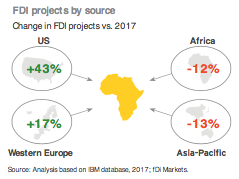
Screen Shot 2018-10-30 at 5.27.43 PMMature market investors continue building on their deep-seated ties to Africa. In 2017, the US remained the largest investor in the continent, with a noticeable 43% growth in FDI projects. Western Europe, another well-established investor, also built on its already strong investments into Africa, up by 17%. However, emerging-market investments fell, with both intra-regional and Asia-Pacific investment declining by 12% and 13%, respectively. This is, in part, attributable to slower emerging markets growth and weak commodity prices.

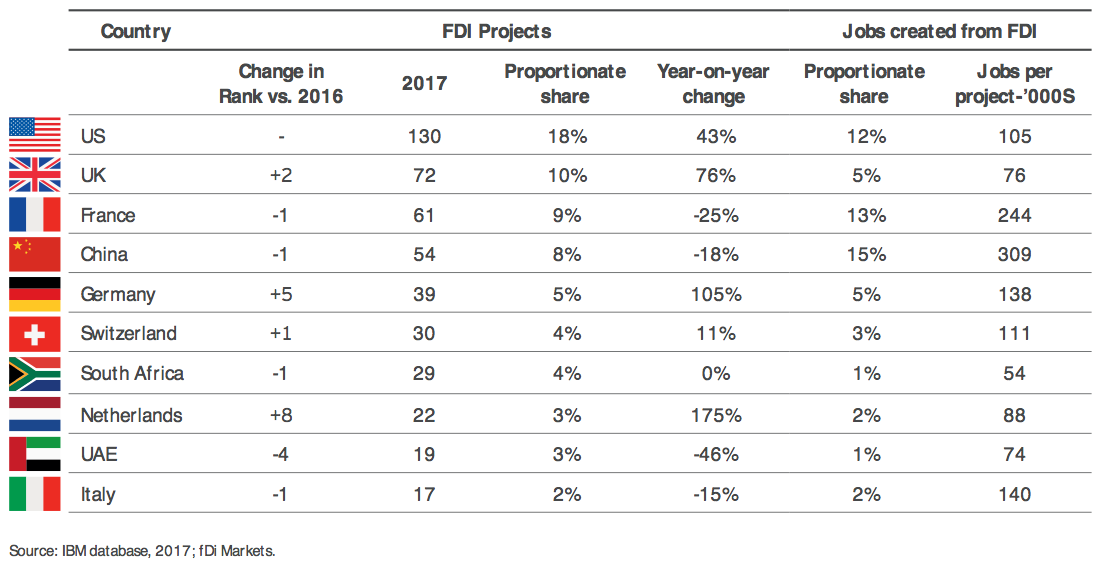
It is odd that this report does not give the dollar values of FDI projects. But it has a summary of the distribution of projects and the number of jobs created. This is an important indicator because it reveals projects’ real impact on the real economy — as opposed to projects designed to create enclave economies. Notice that China is far and away the leader on this metric — with Chinese projects resulting in nearly three times as many jobs as American projects (FDI from Italy appears to be particularly good at producing actual jobs).

Screen Shot 2018-10-30 at 5.40.30 PM

Here’s another interesting observation on the sectoral focus on FDI projects from the report:

Over the past decade, we have discussed a shift from extractive to “consumer-facing” sectors, thanks to Africa’s growing consumer market. Mining and metals, along with coal, oil and gas, previously the major beneficiaries of FDI flows, have slowed, while consumer products and retail (CPR), financial services, and technology, media and telecommunications (TMT) have risen.

In 2017, FDI shifted somewhat, with consumer-facing sector investments slowing, in line with challenging operating conditions. The focus changed instead to manufacturing, infrastructure and power generation.

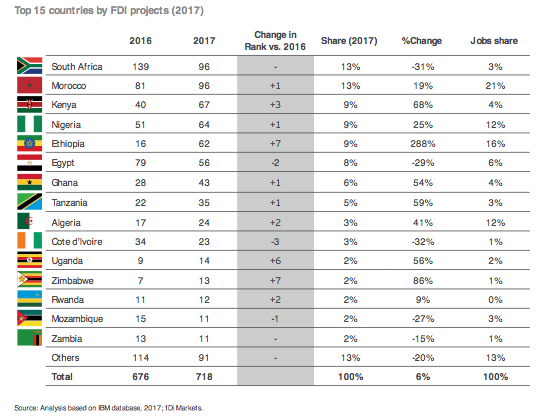
And finally, here are of “FDI-to-jobs” conversation rates. On this measure South Africa and Kenya stand out for their apparent inefficiency in converting FDI projects into jobs.

Screen Shot 2018-10-30 at 5.54.29 PM.pngMore on this here.


Peace is coming to the Horn and beyond

This is from The Economist:

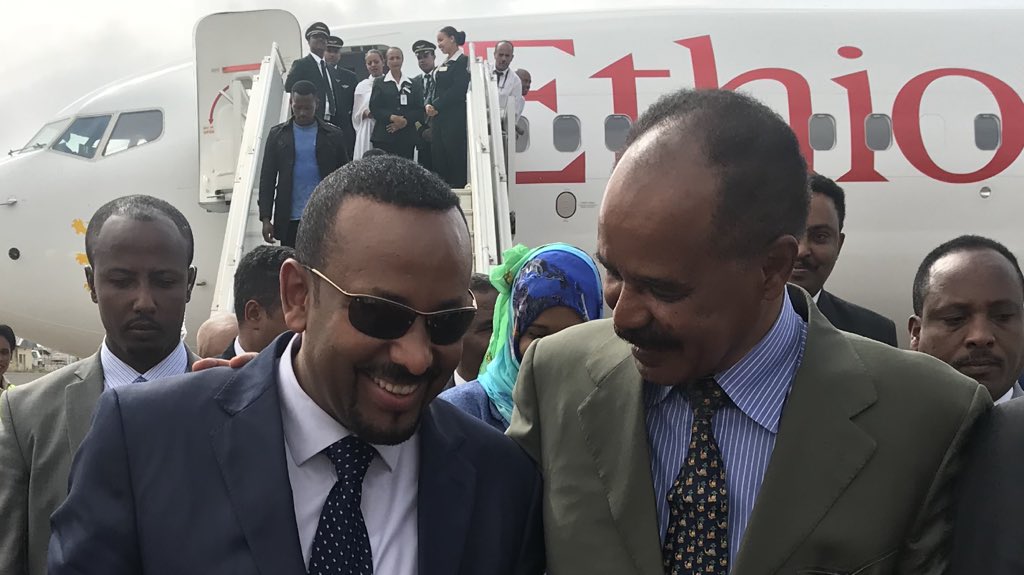
Isaias Afwerki Abiy Amhed Eritrea…. In a display of unexpected warmth, Abiy Ahmed, Ethiopia’s new prime minister, embraced Issaias Afwerki, the ageing Eritrean dictator. In the Eritrean capital, Asmara, which no Ethiopian leader had visited since the war, the two pledged to normalise relations, putting an end to one of Africa’s most bitter conflicts. “There is no border between Ethiopia and Eritrea,” Mr Abiy declared in a televised address. “Instead we have built a bridge of love.”

After a long war for independence, Eritrea seceded from Ethiopia in 1993, following the toppling of the former Marxist regime and a referendum. Ethiopia was the largest trading partner of the newly independent Eritrea. With the first gunshots, though, centuries of commerce abruptly ceased. Lucrative potash deposits straddling the border have since been neglected. Eritrea’s enormous potential for tourism—a sparkling coast and, in Asmara, one of the continent’s most beautiful cities with a wealth of Art Deco buildings—has been mostly squandered. Renewed ties with its much larger neighbour now offer Eritrea’s ailing economy prospects of revival. Ethiopia has already promised to buy a 20% stake in Eritrea’s national airline.

The piece dividend from the end of the Ethiopia-Eritrea war will extend beyond the two countries. Eritrea has been linked to armed groups in Somalia and Ethiopia. Egypt has considered Eritrea as a check on Ethiopia. And Sudan has seen tensions rise with both Eritrea and Egypt as it has drawn closer to Ethiopia.

A theory of Ethiopia’s Abiy Ahmed

Since getting into office, Ethiopia’s Prime Minister Abiy Ahmed has moved swiftly to implement both political and economic reforms. On the political front, he has released political prisoners, unbanned blogs, described violations of human rights by security officers as terrorist acts, and called for term limits for Prime Ministers. On the economic front, he has sounded the alarm over Ethiopia’s $26b foreign debt, wants to privatize important sectors of the Ethiopian economy, and has been working Ethiopia’s neighbors to strengthen economic ties (including ports deals with Somalia and electricity markets in Kenya, Sudan, and Tanzania).

Screen Shot 2018-06-25 at 11.10.38 AM.pngWhy Abiy and why now? It is certainly still early days, but I think he might be a case of a lucky draw at a critical time. In the face of sustained popular protests that began in 2015, Ethiopia was definitely overdue for reforms. But it was not a given that the TPLF (a key player in the EPRDF) would be willing to give power to a popular leader like Abiy. They took a guided gamble with a young former military man and lost (guided because they were somewhat forced to select an ethnic Oromo as Prime Minister).

And as a result the TPLF found themselves with a Prime Minister that is more popular than the EPRDF. That makes him harder to manipulate.

Once in office, Abiy took on the reform agenda with a lot more zeal than they had anticipated. His peripatetic approach to governance can be explained by Ethiopia’s headline economic indicators. The country exports a mere $3b worth of goods (against $18b in imports), which at 6.2% is the second lowest export/GDP ratio in Africa. Ethiopia has also been burning hard cash at a clip, forcing a 15% devaluation of the Birr and a recent $3b lifeline from the UAE. It goes without saying that the country needs to export more if it is going to create jobs at a faster rate for its youthful population. 70% of Ethiopia’s 100m citizens are below 30, and 80% of them live in the countryside.

This is from The Conversation:

The ruling party, the Ethiopian People’s Revolutionary Democratic Front which has been in power for nearly 30 years, is decaying. It lacks the political will to introduce fundamental reforms which would address issues like endemic corruption, the incarceration of journalists and political opponents and widespread economic marginalisation.

These concerns precipitated protests from various segments of society and forced former Prime Minister Hailemariam Desalegn to resign.

Abiy emerged from within the ruling party amid this disarray. His message was markedly different. He spoke the language of the people and tapped into society’s aspirations and fears. While it was expected that he’d be a safe pair of hands for ordinary people as well as the ruling elites, nobody expected him to be as direct and decisive as he has turned out to be in his reform efforts.

These have met with resistance, particularly from the Tigrayan People’s Liberation Front, which is the dominant wing of the ruling coalition. It’s started to act as an opposition from within to Abiy’s work.

The rally at which the attack occurred was called to disentangle Abiy from the establishment and give him a unambiguous mandate to run the country.

People are enchanted with his message of “medemer”, or togetherness, as opposed to ethnic compartmentalisation. They support his systematic and nonviolent removal of corrupt leaders who thrived on spreading fear and using violence to cling to power.

In what appears to have been an assassination attempt, on Saturday a grenade attack killed two people and injured dozens in a rally addressed by Abiy Ahmed. So who might want Abiy gone?

…… one can say with some level of justification that whoever made this attempt must have felt threatened by Abiy’s popularity, message and reform efforts. Ethiopians are accustomed to fearing their leaders. But Abiy is loved.

And despite his refreshingly reformist record so far, it is also worth highlighting the risk of relying on Abiy the individual as opposed to a system of governance that can survive the man:

There is also good reason to question whether or not he is producing supporters who would see him as a cult hero rather than someone who can be criticised, questioned and held to account when he crosses the line.

While this should be a source of caution, the gravest danger to lasting reforms is likely to come not from personalist rule by Abiy but from the TPLF old guard. There is also the real danger that Abiy will under-deliver and create even greater frustration among hopeful Ethiopians.


The Scramble for Somalia

UPDATE:

The Journal has a great piece on the new scramble for Somalia among regional and global powers:

The maneuvering for territory has drawn a motley crew of actors, including U.A.E. state-owned shipping giant DP World; a Turkish conglomerate owned by the family of President Recep Tayyip Erdogan’s son-in-law; and Navy-SEAL-turned-businessman Erik Prince, who wants to develop a port south of the capital Mogadishu. France and Japan have military bases, and Russian entities are scouting for deals.

Since 2011, a number of regional powers have been in a scramble for political and economic influence in (Southern) Somalia. Many of these foreign engagements have come with serious threats to Somalia’s territorial integrity and the capacity of the Federal Government to effectively influence regional governments.

Kenya has strong relations with Jubaland, and prefers a weak federated Somalia. Ethiopia and the United Arab Emirates (UAE) are keen on working with the breakaway region of Somaliland. Somaliland, of course, is thriving as a free electoral democracy with functional institutions.

Turkey and Qatar are focused on supporting the Federal Government and investing in Mogadishu and its environs. And Qatar’s Gulf rival, the UAE, is interested in working with the semi-autonomous region of Puntland, against the wishes of the Federal Government.

It is fair to say that the conflicting interests and goals of Somalia’s friends are not helping the wider stabilization effort under AMISOM.

So far Turkey is miles ahead of every other regional powers in terms of economic influence in Mogadishu. This reality is causing a lot of angst among Gulf states eager to cut Qatar, an ally of Turkey, to size.

Turkey and Qatar will likely win this race.

Turkey invested in Somalia early (since 2011) and in a diversified fashion:

Turkish money and aid – delivered directly to key stakeholders in the Somali Federal Government – ingratiated Turkey with local power brokers and provided Ankara with access and power in Mogadishu. What soon followed is Turkish control and management of Somalia’s most lucrative assets, the airport and seaport.

Parallel to these were unilateral rebuilding efforts, offers of scholarships, renovations of hospitals, and the hosting of international conferences about Somalia. These have largely contributed positively to Somalia’s development and yielded the international acclaim and diplomatic clout craved by President Recep Tayyip Erdoğan and his coterie.


Dangote and Masiyiwa on doing business in Africa


Is Ethiopia in the midst of a green revolution?

This is from Bachewe and co-authors in World Development:

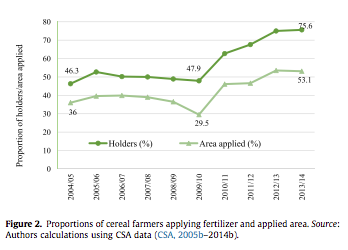
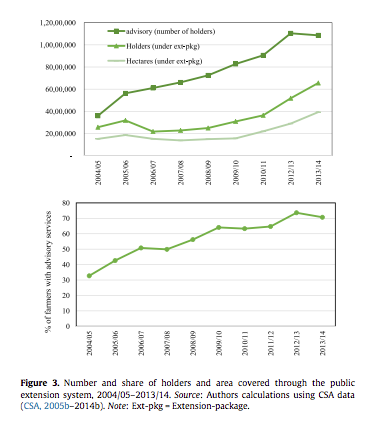
Screen Shot 2018-03-14 at 8.34.44 AMDespite significant efforts, Africa has struggled to imitate the rapid agricultural growth that took place in Asia in the 1960s and 1970s. As a rare but important exception, Ethiopia’s agriculture sector recorded remarkable rapid growth during 2004–14. This paper explores this rapid change in the agriculture sector of this important country – the second most populous in Africa. We review the evidence on agricultural growth and decompose the contributions of modern inputs to growth using an adjusted Solow decomposition model.Screen Shot 2018-03-14 at 8.35.03 AM We also highlight the key pathways Ethiopia followed to achieve its agricultural growth. We find that land and labor use expanded significantly and total factor productivity grew by about 2.3% per year over the study period. Moreover, modern input use more than doubled, explaining some of this growth. The expansion in modern input use appears to have been driven by high government expenditures on the agriculture sector, including agricultural extension, but also by an improved road network, higher rural education levels, and favorable international and local price incentives.

The improvement in agricultural productivity was driven, in part, by deliberate state investment in agriculture:

Ethiopia is one of only four African countries to have implemented the CAADP agreement of a 10% target of annual government expenditures going to agriculture over the 2003–2013 period.

… The GoE has for a long time put agriculture at the center of its national policy priorities. The Agriculture Development Led Industrialization (ADLI) strategy was formulated in the mid-1990s to serve as a roadmap to transform smallholder agriculture in the country. Rural education and health, infrastructure, extension services, and strengthening of public agricultural research were among its top priorities.

These gains are remarkable (if we can trust the state statistical agency data used in the analysis). They are also likely not replicable in other countries across the Continent on account of the high variance in state capacity in the region.

For instance:

[while the] Comprehensive Africa Agriculture Development Programme (CAADP) proposed that African countries allocate 10 percent of their total annual budgets toward boosting agricultural productivity…, only 13 countries [have] signed the CAADP compact (Benin, Burundi, Cape Verde, Ethiopia, The Gambia, Ghana, Liberia, Mali, Niger, Nigeria, Rwanda, Sierra Leone, and Togo).

And out of these 13 only Cape Verde, Ethiopia, Ghana, and Rwanda seem like they have the capacity to translate state fiscal outlays into real productivity gains in agriculture.

Read the whole paper here.

Interesting paper on the privatization of the “Rule of Law” in autocratic China

This is from Stanford’s Lizhi Liu and Barry R. Weingast:

We argue in this paper that, China has begun to fashion an alternative approach to establishing legal market infrastructure, which we call, “law, Chinese style.” Facing the authoritarian’s legal dilemma that constrains formal legal development, the central government has effectively off-loaded a substantial part of the development and enforcement of commercial law to private actors, namely, various online trading platforms. This approach allows the central government to cabin the domain of the legal system to private law.

To elucidate this private development of law, we focus on Taobao, China’s largest online trading platform, owned by Alibaba. We demonstrate that, with over 430 million users and more than 10 million vendors, Taobao is not simply an exchange platform, but a complete market that is in the process of developing a modern legal system. The system includes a very complex reputation mechanism, a credit score, a fraud detection program, and even a jury-like system in which ordinary users can vote to adjudicate cases or to change platform rules. With respect to exchange on the platform, this legal system helps creates law, enforce contracts, protect certain property rights, resolve disputes, and prevent fraud. By doing so, Taobao has begun to supply many aspects of market-supporting infrastructure normally associated with the state.

This the kind of paper that might interest folks in Kigali and Addis Ababa. Or Nairobi, these days.

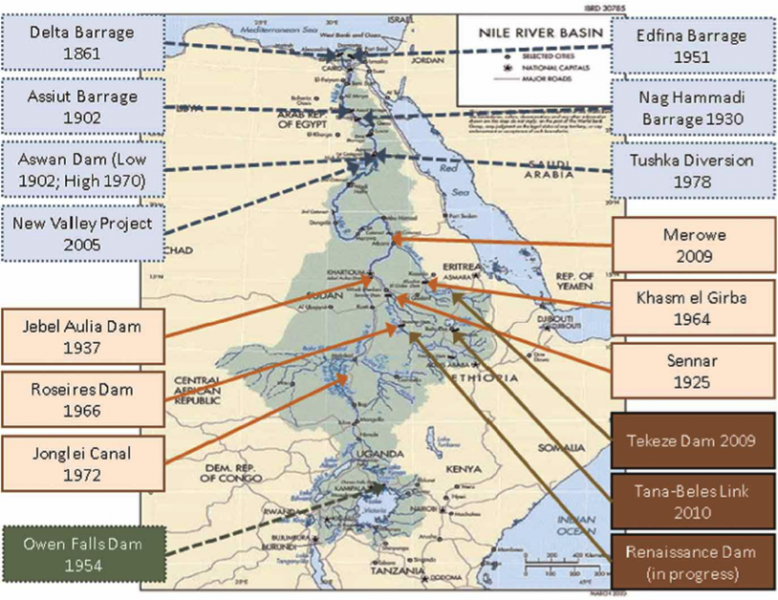
Egypt vs Ethiopia: Hydropolitics of the Nile Basin

I just finished reading John Waterbury’s The Nile Basin: National Determinants of Collective Action. The book offers a concise introduction to the politics of international water basins as well as the various points of contention among the riparian states in the wider Nile Basin.

Here’s an excerpt:

All upstream riparians in the Nile basin, including the Sudan share varying degrees of suspicion towards Egypt and Egyptian motives in seeking cooperative understandings. It seemingly follows that Ethiopia could mobilize these fears and occasional resentments into an alliance of upper basin riparians. The British in fact tried to do just that from 1959 to 1961, as Egypt and the Soviet Union jointly pursued the Aswan High Dam project at the expense of the upper basin (p. 86).

Why would upper basin riparians care about how Egypt uses water that flows up north?

As Waterbury explains, this is because of the international norm of Master Principle of appropriation — “whoever uses the water first thereby establishes a claim or right to it” (p. 28). Therefore, Egypt has an incentive to use as much of the Nile waters as possible in order to establish a future right to high volumes of downstream flows. Increasing domestic water consumption makes it easy for Cairo to demonstrate “appreciable harm” if any of the upper riparian states were to divert significant volumes of the Nile’s flows.

This is principle is in direct conflict with the principle of equitable use that also underpins riparian regimes (which are legion, apparently. Read the book). And that is where inter-state power politics come in.

Waterbury accurately predicted the current problem bothering Cairo:

The ultimate nightmare for Egypt would be if Ethiopia and the Sudan overcame their domestic obstacles to development and to examine coolly their shared interests in joint development of their shared watershed in the Blue Nile, Atbara, and Sobat basins. Given Ethiopian and Sudanese regional behavior in the 1990s, Egypt need not lose sleep yet (p. 149).

Well, it is time for Egypt to lose sleep. Big time.

A resurgent Ethiopia is damming the Abbay (Blue Nile) and is likely to divert more of its waters in the future for agricultural projects.

What’s puzzling to me is why Egypt is not interested in cutting a deal right now. Given that Ethiopia is only likely to get economically and militarily stronger with time, why wouldn’t Cairo want to cut a deal under conditions of a favorable balance of power?

An obvious explanation is that Egyptian domestic political concerns make it harder for the government to sign a deal that diminishes claims to the Nile (Sisi doesn’t want to be the one that signed away water rights!) But this problem will only get worse for Egyptian elites, assuming that Egypt will get more democratic with time.

I am not surprised that Ethiopia is playing hardball.

More Anglophone African Students are Joining Universities in China than the U.S.

This is from Rogue Chiefs:

chinauni.pngTHE surge in the number of African students in China is remarkable. In less than 15 years the African student body has grown 26-fold – from just under 2,000 in 2003 to almost 50,000 in 2015.

According to the UNESCO Institute for Statistics, the US and UK host around 40,000 African students a year. China surpassed this number in 2014, making it the second most popular destination for African students studying abroad, after France which hosts just over 95,000 students.

And it looks like soon Africans will comprise the biggest proportion of foreign students in China:

Chinese universities are filled with international students from around the world, including Asia, the Americas, Europe and Oceania. The proportion of Asian international students still dwarfs the number of Africans, who make up 13% of the student body. But this number, which is up from 2% in 2003, is growing every year, and much faster than other regions. Proportionally more African students are coming to China each year than students from anywhere else in the world.

Also, African students in China are mostly studying mandarin and engineering:

Based on several surveys, most students tend to be enrolled in Chinese-language courses or engineering degrees. The preference for engineering may be due to the fact that many engineering programmes offered by Chinese universities for international students are taught in English.

And they are more likely than their counterparts in the West to go back home after finishing their studies.

Due to Chinese visa rules, most international students cannot stay in China after their education is complete. This prevents brain-drain and means that China is educating a generation of African students who – unlike their counterparts in France, the US or UK – are more likely to return home and bring their new education and skills with them.

Perhaps the much-discussed skills transfer (or lack thereof) from China to African states will take place at Chinese universities instead of construction sites on the Continent.

The recent decline in the number of foreign students applying to U.S. colleges and universities will no doubt reinforce China’s future soft power advantage over the U.S. in Africa.

What does this mean for research in Africa? According to The Times Higher Education:

chinauni2.pngChina’s investment in Africa is having a positive impact on research, citing China’s African Talents programme. Running from 2012 to 2015, the programme trained 30,000 Africans in various sectors and also funded research equipment and paid for Africans to undertake postdoctoral research in China.

…. the 20+20 higher education collaboration between China and Africa as a key development in recent years. Launched in 2009, the initiative links 20 universities in Africa with counterparts in China.

And oh, the Indian government is also interested in meeting the demand for higher education in Africa.

In December 2015, Indian prime minister Narendra Modi also announced that the country would offer 50,000 scholarships for Africans over the next five years.

Notice that all this is only partially a result of official Chinese (or Indian) policy. The fact of the matter is that the demand for higher education in Africa has risen at a dizzying pace over the last decade (thanks to increased enrollments since 2000). To the extent that there aren’t enough universities on the Continent to absorb these students, they will invariably keep looking elsewhere.

According to the Economist: 

Opening new public institutions to meet growing demand has not been problem-free, either. In 2000 Ethiopia had two public universities; by 2015 it had 29. “These are not universities, they’re shells,” says Paul O’Keefe, a researcher who has interviewed many Ethiopian academics, and heard stories of overcrowded classrooms, lecturers who have nothing more than undergraduate degrees themselves and government spies on campus.

In those countries where higher education was liberalised after the cold war, private universities and colleges, often religious, have sprung up. Between 1990 and 2007 their number soared from 24 to more than 460 (the number of public universities meanwhile doubled to 200).

And on a completely random note, the black line on the graph above may explain the otherwise inexplicable persistence of the CFA zone in francophone Africa.

Is Asia Aging Prematurely?

This is from the FT:

China’s working-age population peaked in 2011 but its per capita income was just 20.7 per cent of the US level. Thailand was a little wealthier, at 28.9 per cent, when its working-age share peaked in 2013, but Vietnam was far poorer still, at 10.4 per cent of the US level, when it reached the same point a year later. Malaysia, Indonesia, India and the Philippines are projected to be somewhat better off when they reach peak working-age share, probably between 2020 and 2056, but still some way below the income levels reached in the west, as the third chart shows.

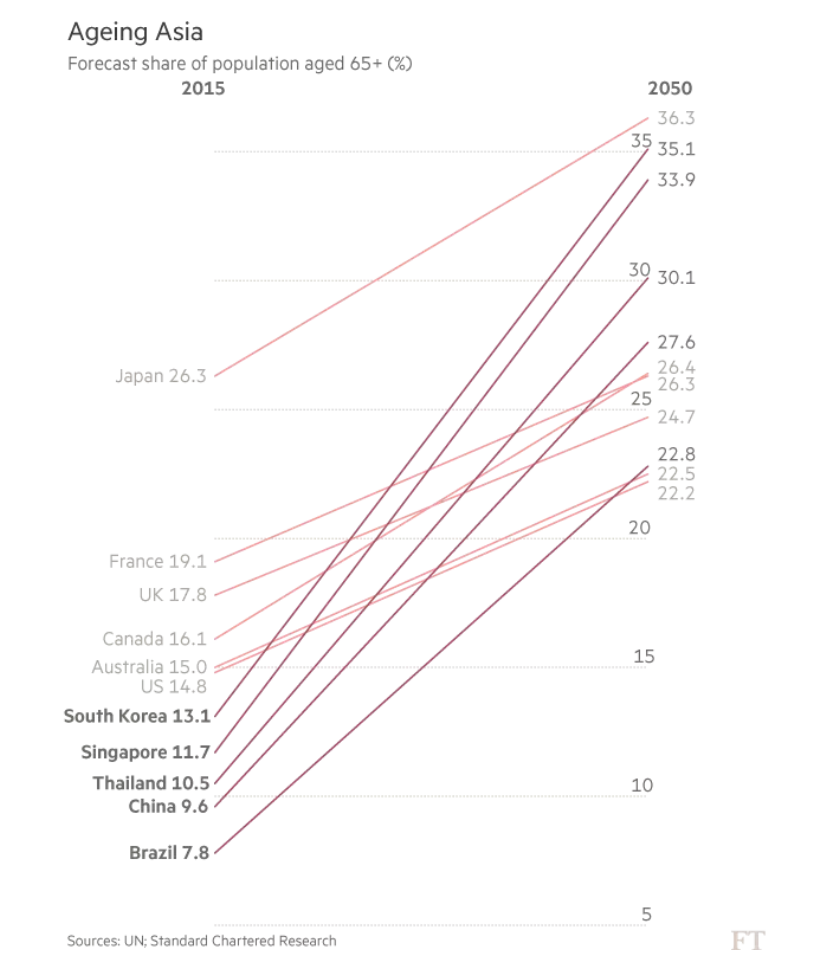
In February of this year, projections by Standard Chartered suggested that, by 2050, the likes of South Korea, Singapore, Thailand and China would have a higher share of pensioners in their population than most developed countries, depicted in the second chart [see below].

Screen Shot 2017-05-17 at 10.25.56 AM.png

These are pretty sobering figures. Basically (East) Asia’s dependency ratios will quickly begin to look a lot more like what obtains in low-income as opposed to high and upper middle income states. And that means a stagnation or even decline in per capita income.

It will be interesting to see how these countries — most of which have historically been averse to immigration — will deal with this demographic challenge.

In addition to the obvious economic challenges, Asian countries will also have to figure out how to take care of the medical needs of an aging population that will likely be living longer.

More on this here.

Is Civil War in Africa Unique?

Paul Staniland raises important questions in his review of Philip Roessler’s latest book (highly recommended):

I just finished reading Philip Roessler’s excellent book for my graduate Civil War seminar. Already a fan of his 2005 piece on electoral violence, I learned a lot from the new book and highly recommend it. But, just as when reading major work by Will Reno, Reno and Chris Day, Jeremy Weinstein, Paul Collier, Jeffrey Herbst, and others, I had the reaction that “This looks nothing like the places I study.” At least in the stylized world of African politics presented in these projects (I have no idea if this is accurate), Hobbesian insecurity preys on all in the absence of any real institutions, ethnic balancing and calculation dominates any other form of politics, and regimes are held in place by fluid, shifting alignments with “Big Men” rooted in local power bases.

As a result, we get shambolic and weak central regimes prone to either coups or revolts, and rebels easily bought off by patronage or co-optation. Weinstein highlights the inability of ideological rebels to overcome waves of material resources that eliminate discipline or politics, Roessler’s regimes are simply what Skocpol calls an “arena” for political competition between social actors rather than possessing any institutions or interests autonomous from social forces, and Reno’s civil wars (with the exception of “reform rebels”) are simply a grim game of bargaining over patronage between states and insurgents that are more similar than different.

Is Africa that different?

Roessler, indeed, argues that Africa has a “unique institutional structure” in which external conflicts are rare and internal disorder common. If Africa is indeed unique, it is hard to know how arguments rooted in the African context can travel beyond Africa.

Read the whole thing here.

I would argue that there is not a uniquely African civil war story. Weak states everywhere, including in Africa, are gonna weak state.

A more useful analytical delineation is what Staniland suggests:

At minimum, I’m becoming increasingly convinced that research on civil war needs to become at least partially bifurcated into work on its dynamics in very weak states (the representation of African conflicts dominant in the literature, plus Afghanistan and a few others) versus those in medium-capacity states (India, Colombia, Indonesia, Russia, etc) that possess large, centrally controlled conventional an

Think of the Nigerian Civil War between 1967-1970. The Biafra War involved a relatively strong state facing a relatively well-organized and disciplined secessionist army — much in the mold of middle income conflicts. In the same vein, countries like Kenya and Ethiopia have managed to quell rebellions in Mt. Elgon & the south coast, and in the Ogaden, respectively, in ways that would look very familiar to Staniland.

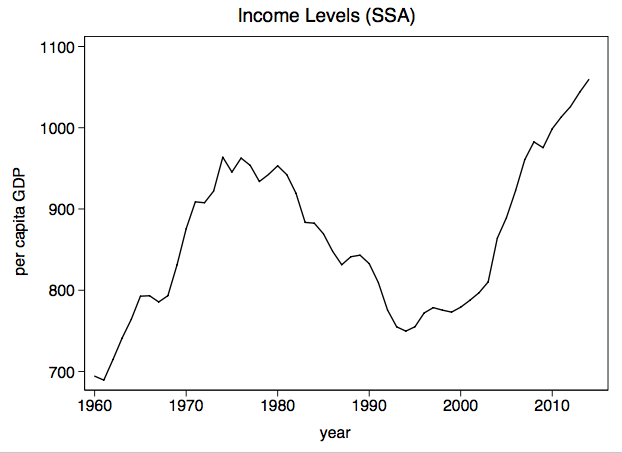
Completely anarchic conflicts involving collapsing states and incoherent hyper-localized rebellions — your stereotypical African conflict, if you will — are a unique historical experience rooted in the states that did really fall apart in the late 1980s to early 1990s (pretty much in the midst of Africa’s continental economic nadir). It is instructive that these states were concentrated in the Mano River region and Central Africa, some of the regions worst affected by the socio-political challenges of Africa’s lost long decade (1980-1995). income

And given recent economic trends in Africa (see image), it is not surprising that conflicts are becoming rarer in Africa (much in line with Fearon and Laitin). I would also expect markedly different kinds of conflicts should they emerge. There is a reason Boko Haram has never posed an existential threat to the Nigerian state, very much in the same way that India’s Maoist rebels are a peripheral matter.

I always remind my students that the Africa they know is more often than not the Africa that existed between 1980 and 1995. We all need to update.