If you are looking for the blog, An Africanist Perspective has moved over to Substack.
I am an Associate Professor at Georgetown University’s Edmund A. Walsh School of Foreign Service. I am also a faculty member of the African Studies Program, the Georgetown University Initiative on Innovation, Development, and Evaluation (Gui2de), Evidence in Governance and Politics (EGAP), and a non-resident fellow at the Center for Global Development.

I specialize in Comparative Politics, with research interests in legislative institutions and political development, subnational administration and government, the politics of education reforms, and elections and democratic consolidation. Most of my research focuses on Sub-Saharan Africa.
My first book titled, Legislative Development in Africa: Politics and Postcolonial Legacies (Cambridge University Press, 2019), answers two simple questions: (i) what explains variation in legislative strength under autocracy? and (ii) under what conditions does the transition to democracy result in the strengthening of legislatures? You can find more material on the book here.
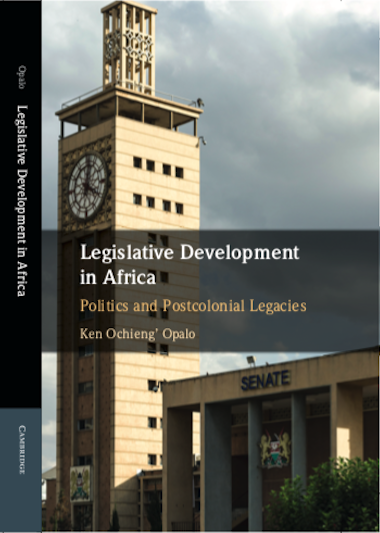
The book speaks to the wider comparative political economy literature on autocratic institutions and the origins of limited democratic government. The main goal of the book is to trace, through quantitative and qualitative research methods, the autocratic origins of democratic institutions.
In addition to a survey of legislative development in Africa from their founding under colonialism to the present, the book also provides detailed case studies of the Kenyan and Zambian legislatures.
My second book project titled, Building the Kenyan State: The Politics of Decentralization and Subnational Government Since 1900, explores the process of colonial and postcolonial state-building in divided societies through the lens of public goods provision. The book answers questions such as: how does ethnic diversity influence government’s state-building strategies? When do governments adopt decentralization as a strategy of state-building? And how does political knowledge shape attribution and electoral accountability under multi-tier government?
I have also began work on a third book titled, Educating Citizens and Workers: Politics and Education Policy in Tanzania Since 1961. This book explains how elites condition levels of popular demand for essential public goods and services through the lens of education policy in Tanzania. For much of its history, the government of Tanzania rationed access to education without incurring significant political consequences. The government also designed the curriculum to primarily cater to political and (socialist) developmentalist ends. The twin legacies of rationing and emphasis of “practical” learning for participatory development continue to shape education policy and outcomes in Tanzania in the present.
I write a newsletter at the Africanist Perspective on Substack.
I received my PhD in Political Science from Stanford and my BA from Yale. I am a proud alumnus of Mang’u High School. Go Wazimba!!!

