Re-assessing Africa’s Resource Wealth

Over at African Arguments Bright Simons tries to debunk the accepted paradox of African poverty in the middle of a natural resource glut. The post is definitely worth reading, and raises some salient questions regarding resource use and development policy in Africa – and by extension, the economic viability of some African states (thinking of Chad, Central African Republic and Niger….)

Of those few minerals that Africa is believed to hold globally significant or dominant reserves, nearly all of them are concentrated in 4 countries: South Africa, Angola, Democratic Republic of Congo and Guinea. When one computes the level of inequality of mineral distribution across different continental regions, Africa pulls up strongly, showing a far higher than average level of distribution ‘imbalance’ per capita or square mile. In very simple terms, it means that mineral wealth is more concentrated in a few countries in Africa compared to other continents. 

Adding that…..

with the exception of bauxite and petroleum, these minerals are not as widely used in industry (or in the same considerable volumes) as a number other minerals, such as tin, copper, nickel, zinc, iron, coal, and lead, that Africa does not produce in sufficient quantities. Indeed, of the top 5 metallic minerals which constitute 62 percent of the total value of global production, Africa is only a significant producer of one of them: gold. Africa has 8 percent of the world’s copper, 4 percent of aluminium, 3 percent of its iron ore, 2 percent of lead, less than 1 percent of zinc, and virtually no tin or nickel. To put these figures into perspective, recall that Africa has about 14.5 percent of the world’s population.

….. Africa’s low production of the ‘hard minerals’ minerals most intensely used in industry compared to the less widely used ‘soft minerals’ reduces its total take from the global mineral trade. But it also makes a nonsense of fashionable policy prescriptions that emphasise import-substitution strategies based on value addition to minerals, rather than export competitiveness through smart trade strategy and the deepening of the financial system to support entrepreneurs.

More on this here.

H/T Africa in Transition.

Persistence of Culture (and Institutions)

“How persistent are cultural traits? Using data on anti-Semitism in Germany, we find local continuity over 600 years. Jews were often blamed when the Black Death killed at least a third of Europe’s population during 1348–50. We use plague-era pogroms as an indicator for medieval anti-Semitism. They reliably predict violence against Jews in the 1920s, votes for the Nazi Party, deportations after 1933, attacks on synagogues, and letters to Der Sturmer. We also identify areas where persistence was lower: cities withhigh levels of trade or immigration. Finally, we show that our results are not driven by political extremism or by different attitudes toward violence.”

That is Voigtlander and Voth writing in the Quarterly Journal of Economics.

Their paper speaks to my previous post on the challenges of institutional engineering given the stickiness of institutions (and by extension the cultures that create and then reinforce them). Of course culture is a dicey subject that is often misused to explain economic and social outcomes. Instead of using the amorphous term “culture” I prefer to hear more about the reward systems that make it beneficial for individuals and communities to engage in certain cultural practices.

On a more positive note, the paper provides some evidence of the power of economic opportunities to dis-incentivize engagement in hateful cultural practices:

“Instead of reinforcing persistence, we argue that economic factors had the potential to undermine it…… Our results also lend qualified support to Montesquieu’s famous dictum that trade encourages ‘‘civility.’’

Where do the poor live, and how do we make them become middle class?

The Economist reports:

“WHERE do the world’s poor live? The obvious answer: in poor countries. But in a recent series of articles Andy Sumner of Britain’s Institute of Development Studies showed that the obvious answer is wrong. Four-fifths of those surviving on less than $2 a day, he found, live in middle-income countries with a gross national income per head of between $1,000 and $12,500, not poor ones. His finding reflects the fact that a long but inequitable period of economic growth has lifted many developing countries into middle-income status but left a minority of their populations mired in poverty. Since the countries involved include giants like China and India, even a minority amounts to a very large number of people. That matters because middle-income countries can afford to help their own poor.”

The article raises important issues that inform the debate on how to tackle problems of poverty and underdevelopment – is it all about politics & governance or all about economic expansion? The answer, of course is that it is a moderate mix of both.

But since political realities often force governments to concentrate on one or the other, a responsible answer is that it is all context-dependent; some places need strong economic expansion first, before political reforms can be anchored in society. In others, political change should be top of the checklist.

The Botswanas and Singapores of this world are lucky in that their leaders were smart enough to know what their countries needed and pursued it with singular ambition, despite the unavoidable mess that came with the choices they made.

This of course goes against the received wisdom among academics (me included) who believe in the strong power of the right types of (liberal, in the classical sense) institutions to put countries on the path to becoming Denmark. The problem with this approach is that it does not tell us how to compress the more than 600 years that transpired between the Magna Carta and the voting reform legislations in England in the latter part of the 19th century. Lest we forget, England (which is every scholar’s favorite source of empirical conceptualization of institutional development) has not always had good institutions.

Institutions take a lot of time to build. A lot more time than the average human life span.

So the question still stands: How do we get the most number of people out of poverty in the least amount of time with the least harm to their political and human rights?

More on this here.

On technology, governance and development

By now many of you have perhaps seen the takedowns of TED talks (see here, highly recommended), which some think have become rather pedestrian (I still find most TED talks insightful, just for the record).

The pushback against the belief among some disciples of TED talks that technology is the answer to all of humanity’s problems (whether this depiction is accurate or not) also speaks to the issues of governance and development. As Shea, the Journal’s blogger points out:

……. Morozov also detects, besides superficiality, a distinctively TED-style attitude toward politics in which institutions and democratic debate are derided and technology is looked to as a deus ex machina that will solve such once-intractable problems as poverty and illiteracy—obviating those pesky voters and squabbling elected leaders.

The global “development sector” has recently seen a wave of tech-inspired attempts to accelerate development by bypassing politics and other socio-cultural inhibitors, with little success (development economists are also implicated here). The lesson that many have missed is that bad governance and underdevelopment are not primarily technical problems that can be fixed by experts. Many have fallen to the temptation of thinking that,

…. technology is an autonomous force with its own logic that does not bend under the wicked pressure of politics or capitalism or tribalism; all that we humans can do is find a way to harness its logic for our own purposes. Technology is the magic wand that lifts nations from poverty, cures diseases, redistributes power, and promises immortality to the human race.

The characterization of governance and development as purely technical risks abstracting too much away from the human beings that development is supposed to help. Think of how scientific communism worked out. Statements like the one below are a reminder that bad ideas die hard.

Using technology to deliberate on matters of national importance, deliver public services, and incorporate citizen feedback may ultimately be a truer form of direct participation than a system of indirect representation and infrequent elections. Democracy depends on the participation of crowds, but doesn’t guarantee their wisdom. We cannot be afraid of technocracy when the alternative is the futile populism of Argentines, Hungarians, and Thais masquerading as democracy. It is precisely these nonfunctional democracies that are prime candidates to be superseded by better-designed technocracies—likely delivering more benefits to their citizens…. To the extent that China provides guidance for governance that Western democracies don’t, it is in having “technocrats with term limits.”

The problem, of course, is that more often than not these “technocrats” in the poor countries of the world (read those with the most and biggest guns, a.k.a autocrats) are woefully incompetent (see here) and never observe their term limits (this classic on dictatorship comes to mind).

The question of what to do with the relatively more competent autocrats will be the subject of a future post.

H/T Ideas Market

On Rwanda’s brand of Developmental Authoritarianism

Many, including yours truly, have a love-hate relationship with Paul Kagame and his RPF regime in Rwanda.

On the one hand, his adventures in eastern DRC; alleged involvements in the assassination of opposition figures both at home and abroad; and overall restriction of political space in Rwanda are cause for concern. But on the other hand, he seems to be doing a marvelous job on the economic front (see here and here, for instance).

Source: Kigali City Official Website

In the latest issue of African Affairs, Booth and Golooba-Mutebi explore the nature of state-led development in Rwanda, with particular attention to how state-run companies are “ice breakers” for private sector firms in different sectors of the economy. The paper also observes Kagame’s strict separation of state and private accumulation of wealth, a fact that is demonstrated by Rwanda’s comparatively good performance on corruption indices. It is definitely worth reading.

Here is part of the abstract:

This article addresses one thematic gap – the distinctive approach of the RPF-led regime to political involvement in the private sector of the economy. It does so using the framework of a cross-national study which aims to distinguish between more and less developmental forms of neo- patrimonial politics. The article analyses the RPF’s private business operations centred on the holding company known successively as Tri- Star Investments and Crystal Ventures Ltd. These operations are shown to involve the kind of centralized generation and management of economic rents that has distinguished the more developmental regimes of Asia and Africa. The operations of the military investment company Horizon and of the public–private consortium Rwanda Investment Group may be seen in a similar light. With some qualifications, we conclude that Rwanda should be seen as a developmental patrimonial state.

I often tell my friends that at the end of the day, really, all that matters is that we bring down infant mortality to under 10/1000 live births [this is a good proxy for quality of life] and improve the standards of living for the average person, everywhere.

With that in mind, the favored retort among anti-democracy crowds in Sub-Saharan Africa – that “you can’t eat democracy” – has some truth in it. I bet most people would rather live in authoritarian Singapore than democratic Malawi (feel free to disagree).

The point here is that good governance (and for that matter, democracy) are means to an end, and we should never forget what the end is – that is, the improvement of the human condition for all. And yes, I agree that democracy, i.e. political freedom, could also be an end in itself, with the qualifier that those most likely to enjoy freedom are those that are already fed, clothed and housed, with a little more time to spare to blog and read Chinua Achebe, Ngugi wa Thiong’o or Okot P’Bitek.

China and Vietnam in Asia, and now Rwanda and Ethiopia in Africa, are cases that will continue to invigorate the debate over how to improve living standards for the largest number of people in the least amount of time.

For now my love-hate relationship with Paul Kagame and Meles Zenawi [of Ethiopia] continues….

On Industrial Policy (In which I concur with Blattman 1001%)

I have made the case before here, here and here.

For more here’s Blattman, commenting on Industrial policy:

“You can’t pick winners” is the knee-jerk retort to the mention of anything that even rhymes with industrial policy. I would call it the triumph of ideology over evidence, except that even “ideology” feels like a generous term. Lazy thinking might be a more accurate description. Some have given the question a great deal of thought, but most have not.

I’m not suggesting that the paper above has the right answer (odds are, like most papers, it does not). I’m also not suggesting that governments can pick winners (probably they can’t). Nor am I forgetting that industrial policy is easily politicized and distorted (as surely it is). So what am I talking about?

More on this here.

World Bank President Doubles as a Rapping Spaceman

Just in case you haven not seen this yet:

[youtube.com/watch?v=-DIMT-auQIA&feature=related]

H/T Erin.

Big vs. Small Development

The Economist raises an interesting question regarding approaches to “development,” claiming that the recent race for the World Bank presidency represented a contest between two broad approaches:

Michael Woolcock, a World Bank staffer, suggests that two rather different models of development have been pitted against one another in the contest for president. On the one hand is what he calls Big Development, whose aim is the transformation of entire countries through investments in national education, justice and public health. Governments are essential to Big Development because they are responsible for the overall policy. And the World Bank is pre-eminently a Big Development institution.

On the other hand is Small Development. “Inspired less by transformational visions of entire countries,” Mr Woolcock argues, “and more by the immediate plight of particular demographic groups (AIDS orphans, child soldiers, ‘the poor’) living in particular geographic places (disaster zones, refugee camps, urban slums), Small Development advocates focus not on building systems in the medium run but on compensating for the failure of systems in the short run. ‘Development’ thus becomes an exercise in advocacy, in accurate targeting, in identifying particular ‘tools’ that ‘work’”.

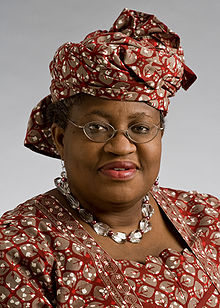
In this scheme of things Mrs Okonjo-Iweala, the former finance minister, represented Big Development; Dr Kim, a public-health advocate, Small. Dr Kim was almost certainly picked because of his passport. But if his background is any guide, his tenure as chief is likely to shift the bank more towards Small Development. Whether that is a good thing on balance remains to be seen.

I take the side of Big Development (if such a dichotomy actually exists) because of my beef with “pro-poor development” as it is currently practiced  (more on this here).

Development is a giant coordination game with a million moving parts. This makes it much harder to coordinate on “scalable” “tools that work” at the micro-level. Indeed, no one has any idea what these tools really do. In addition, focus on “tools” casts the problem of underdevelopment as a technical one that can be fixed by “experts.”

This approach misses the point by miles.

This and this (highly recommended, a cogent critique of Big Development) and this are some of the reasons wby.

More on Obama’s WB President Nomination

Source: Wikipedia

Nigerian Ngozi Okonjo-Iweala is definitely the dream candidate for the Bank. But the realities of U.S. domestic politics and foreign policy concerns are stacked against her nomination to the presidency of the Bank. It will be hard for the U.S. to selflessly relinquish an important tool of foreign policy and influence in the Bank’s presidency.

If Obama backs down, he will be criticized for being soft in the face of international pressure. If he nominates a non-American, he will still be criticized as an apologist for those who hate America (real or imagined) and a believer in American decline.

Obama’s incentive is to get his nominee become World Bank President. Full stop.

Source: Wikipedia

So far those rooting for Ngozi (including yours truly) have questioned Jim Yong Kim’s credibility (he is/was not a fan of neo-liberalism) and competence (he is not an Economics PhD; but a mere MD, PhD) as World Bank president.

You can get Kim’s co-authored book here (or your local library; $97 is a bit pricey), it is on my to-read list (A review of the book is available here).

Here is quoting a post over at the Duck of Minerva for a more balanced take:

If Dr. Kim criticized the growth agenda of the structural adjustment era, so what? This has all become mainstreamed into the Bank’s own philosophy of pro-poor growth.Does it take a PhD in Economics to run the World Bank successfully? If selected, Dr. Kim would be the leader with the most hands-on development experience that the Bank has ever possessed. He would be as or more experienced in the field as serious contenders that were mooted in advance like Susan Rice, Hillary Clinton, or Pepsico CEO Indra Nooyi (ok, maybe Larry Summers knows more but Summers always know more than anybody). As Daron Acemoglu and Jim Robinson pointed out on their blog [Why Nations Fail]: “Perhaps all of Mr. Kim’s critics prefer the status quo where the World Bank is run by ex-warmongers (Robert McNamara), bankers (James Wolfensohn) or career civil servants (Robert Zoelick). Wait wasn’t that the World Bank that they loved to criticize?”

Adding that:

You don’t have to denigrate Dr. Kim to praise the other candidates. The strongest case is that while Dr. Kim is a good candidate, Dr. Okonjo-Iweala is the dream candidate. She’s from a large developing country, knows the issue well, understands the complex world of global finance, and is intimately familiar with the culture and organization of the Bank. And, for her supporters, the changing nature of the international system has made this practice of the U.S. having the automatic right to appoint the Bank’s president an anachronism.

Beating the drum for Ngozi

The Economist has joined a string of internet commentators in endorsing Nigerian Minister of Finance to become the next president of the World Bank. Contrasted against the resume of Obama’s choice for the Bank, Ngozi wins. By miles.

According to the Economist:

The World Bank is the world’s premier development institution. Its boss needs experience in government, in economics and in finance (it is a bank, after all). He or she should have a broad record in development, too. Ms Okonjo-Iweala has all these attributes, and Colombia’s José Antonio Ocampo has a couple. By contrast Jim Yong Kim, the American public-health professor whom Barack Obama wants to impose on the bank, has at most one.

However, it is interesting that in all the debate no one has talked about HOW Ngozi will change the Bank’s operations, besides insinuations that she has hands on experience in transforming Nigeria’s public finances, coupled with her previous experience at the Bank.

More importantly, what would be the cost to Nigeria if they lose Ngozi? Is this important at all?

Ngozi leading the bank will probably make a difference. However, I think that support for her candidacy has thus far been too one-sided. Nigeria, like much of the developing world, does not have much influence on the Bank’s board. Nigeria also stands to lose one of its ablest technocrats just when it is striving to reform its public finances. These considerations should matter too, I think.

Just for the record, I am one of those who think that it would be really cool to have Ngozi lead the Bank (despite the fact that she probably will not).

**********************************************

Update: I just came across some interesting thoughts on Ngozi’s nomination over at Africa is A Country (H/T Chad).

How I would not lead the World Bank – Bill Easterly

For those, like me, who still miss Aid Watch, here is Easterly over at FP:

I would not appoint U.S.-educated elites vetted by their autocratic home governments to represent the underrepresented peoples of the world. I would not negotiate the contents of World Bank reports with governments in either the West or the Rest, except possibly for correcting typos.

I would not lead the World Bank by perpetuating the technocratic illusion that development is something “we” do to “them.” I would not ignore the rights of “them.” If the New York Times should happen to report on the front page that a World Bank-financed project torched the homes and crops of Ugandan farmers, I would not stonewall the investigation for the next 165 days, 4 hours, 37 minutes, and 20 seconds up to now.

More on this here.

And for more on leadership selection at IFIs see CGD’s policy brief here.

A note from Mr. Development Man

Perhaps after experiencing a Bill Easterly moment, a friend of mine (grad student here at Stanford) had this on his facebook wall:

“Hello, my name is Mr. Development Man. I know Africa so much!! I went there one summer and stayed with an NGO. I talked to my servant cook who served me food, so I know African workers. I read a few books written by white Americans about Africa, and remembered their big words. So I know African ideology. African prostitutes talked to me at my hotel poolside, so I know about relationships in Africa. I took pictures of kids at the orphanage, so I know how Africans suffer.

My conclusions: Africans are corrupt. The place is poor because of poor policies. And my knowledge can help them. If they just listened to my smart American knowledge — obtained from the 2 months at the NGO, my white man books, my prostitutes, my few words with my servant cook — they would develop!! Why don’t they listen to me?? I can help them…Stubborn, corrupt African politicians…

Signed, Mr. Development Man. Remember, I am here to help you Africa!!”

I have a sense that Mr. Development Man’s note is directed at both development practitioners and academics alike. Let us all take heed.

Chad, who is into short stories and is also a late night radio DJ, wrote this Letter to Mr development man on the dynamics of the love-hate relationship between donors and aid recipients.

H/T Chad.

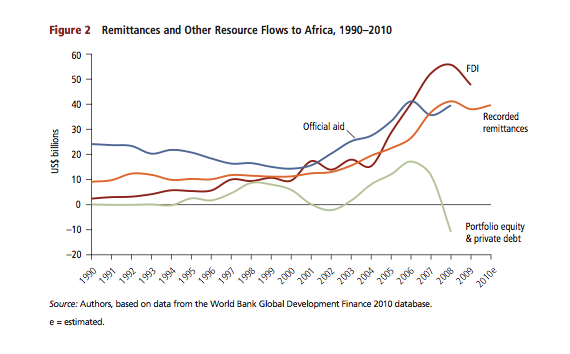
Resource flows in Africa

According to this figure FDI and recorded remittances appear to be trending in the right direction. Official aid and portfolio equity and private debt are not.

For more on this check out the World Bank’s new book (digital copy) on how Africa can leverage immigration to boost its growth prospects.

It’s important to remember that while overall these numbers may look encouraging, the problem of illicit capital outflows still plagues Sub-Saharan Africa (and other developing regions); and serves as an impediment to growth. Between 1970-2008 the region hemorrhaged an average of over $22b annually. Various studies (including this one) estimate that the private wealth held by Africans in tax havens and other shady depositories abroad may be upwards of $270b.

Effects of Conditional Vs. Unconditional Cash Transfer

Baird, McIntosh and Ozler have an upcoming paper in the QJE investigating the differential impacts of conditional and unconditional cash transfer in Malawi:

Starting with schooling outcomes, we find that although dropout rates declined in both treatment arms, the effect in the UCT arm is 43% as large as that in the CCT arm. Evidence from school ledgers for students enrolled in school also suggests that the fraction of days attended in the CCT arm is higher than the UCT arm. Using independently administered tests of cognitive ability, mathematics, and English reading comprehension, we find that although achievement is significantly improved in all three tests in the CCT arm compared with the control group, no such gains are detectable in the UCT arm. The difference in program impacts between the two treatment arms is significant at the 90% confidence level for English reading comprehension. In summary, the CCT arm had a significant edge in terms of schooling outcomes over the UCT arm: a large gain in enrollment and a modest yet significant advantage in learning.

The paper then gets nuanced:

When we turn to examine marriage and pregnancy rates, however, unconditional transfers dominate. The likelihood of be- ing ever pregnant and ever married were 27% and 44% lower in the UCT arm than in the control group at the end of the 2-year intervention, respectively, whereas program impacts on these two outcomes were small and statistically insignificant in the CCT arm.

……….. Our findings show that UCTs can improve im- portant outcomes among such households even though they might be much less effective than CCTs in achieving the desired behav- ior change.

Check it out here.

Projects Without Development

Guest Post by Erin Pettigrew (PhD Candidate, Stanford University)

       Naked Palm Trees and Other Failed Development Projects in Senegal

La Pointe des Almadies is Dakar’s wealthiest neighborhood and it teems with expat NGO workers and the palaces of government officials. Recently, the construction of an immense statue, “The African Renaissance Monument”, a 27 million dollar project commissioned by Senegal’s president, Abdoulaye Wade, has transformed the neighborhood’s landscape. The imposing bronze figure of a muscled man, one arm protectively wrapped around a woman, the other triumphantly holding up his infant child, sits atop a hill overlooking the city.
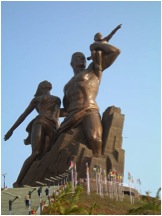
Source: Wikipedia

The statue and Wade’s current projects for the construction of the “Seven Wonders of Dakar” (a section of the capital which will include a  new National Theater, Museum of Black Civilization, National Library; the School of Fine Arts and the School of Architecture and Music Palace) are seen as wastes of government money spent to satiate the President’s desire for a legacy rivaling Senghor or even the grand public projects of France under past presidents Chirac and Mitterand.  Growing discontent with Wade’s attempts to stay in power past the current two-term limit and with what is perceived to be his inability to ensure reliable infrastructure to his country’s population has culminated at times with criticism of “The African Renaissance Monument”.

Most of Dakar’s neighborhoods experience daily power outages and terrible traffic due to poorly maintained and inadequate roads. However, Wade has somehow scraped together enough money to build bronze statues and to build a second national theater to replace the centrally-located and historical Théâtre Daniel Sorano in downtown Dakar.

I am not an expert in development. I am a historian whose interest in West Africa began as a Peace Corps Volunteer in neighboring Mauritania but I have found myself progressively less optimistic about prospects for change in the daily lives of most West Africans I know. On a recent research trip to the northern Senegalese city of Saint-Louis, I was struck with how much more run-down the city seemed to me than it had my first time there in 2003. While Saint-Louis can be picturesque from afar, with its 350 year-old colonial facades built on its central island, the reality is that its infrastructure is disintegrating.
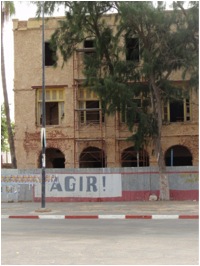
A government building in Saint-Louis (picture by Erin)

Despite the presence of NGOs (visible by the many white SUVs and walled compounds marked by their painted slogans of “Espoir” and “Aide”), it’s hard to see signs of successful projects.  As I walked through the city, I couldn’t help but notice numerous failed plans. I passed dead trees protected by reed fencing where someone had thought plantings along the streets of a popular neighborhood would be a good idea. Talibés (students, or little boys sent out to beg for money and food by some unscrupulous marabouts) are an ever-present part of Saint-Louis streets despite heavy investment by NGOs to provide the boys with reliable food and housing. The shores of the city are lined with old tires, plastic bags, and fish remains.

As I looked in at a dark closet where thousands of colonial documents sit waiting to be organized and made accessible to the public, the regional archivist also told me that plans to build a much needed space to securely house the country’s archives had been shelved years ago in favor of the construction of the Piscine Olympique, Dakar’s largest swimming pool.

Riding in a crowded bush taxi and hitting the crawl of traffic on the way back to Dakar, I couldn’t help but wonder what prevents these initial investments in tree plantings, child welfare protection and road construction from being maintained. From this perspective, much of the failure of such development projects seems to be explained by a lack of investment in the maintenance of current projects.  Perhaps this can be explained by the framework of funding and the reluctance on the part of donors to provide for anything other than new projects. (After all, it’s much more exciting to say that Dakar will benefit from a new, state-of-the-art performance space than the rehabilitation of its old theater space.) Or maybe funding agencies and donors find it difficult to collaborate on projects such that one agency might undertake an initial trash clean-up while another would ensure that a second clean-up is planned a month later.

Possibly there is also a lack of coordination between funding agencies and local governments who, once the preliminary heavy investment has been made by development agencies, could then continue the programs with less funding but with longer term results. Projects initiated by African governments also need to consist of more than an initial flood of money but should also include funding to be set aside for the continued and regular maintenance of such projects so that they remain relevant and useful.
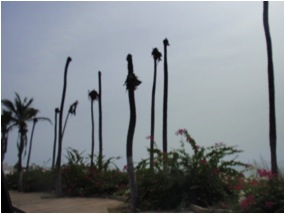
Dakar (picture by Erin)

To emphasize this point and to return to my original starting point of La Pointe des Almadies, one only need to look at the pathetically barren palm tree trunks lining Dakar’s prettiest drive from downtown to the “Renaissance” statue that overlooks the Atlantic Ocean.  Abdoulaye Wade requested the planting of hundreds of palm trees along this drive to welcome delegates of the Organization of the Islamic Conference who met in Dakar in 2008. Now, three years later, the majority of these tress are simply reminders of another failed project. Inadequately or never maintained, the trunks stick out of the ground, their tops bare and exposed, they stand isolated and quivering no longer serving a purpose.

I’m sure they looked beautiful in the first weeks they were planted but have become symbols of the emptiness of similar endeavors. I know that there are successfully sustained projects out there but it’s difficult not to feel disheartened by the many visibly failing projects aimed to satisfy a short-term goal or donor stipulations rather than the actual needs of a struggling population.

Erin Pettigrew is currently conducting dissertation research in Senegal and Mauritania.