Africa’s Billionaires in 2014

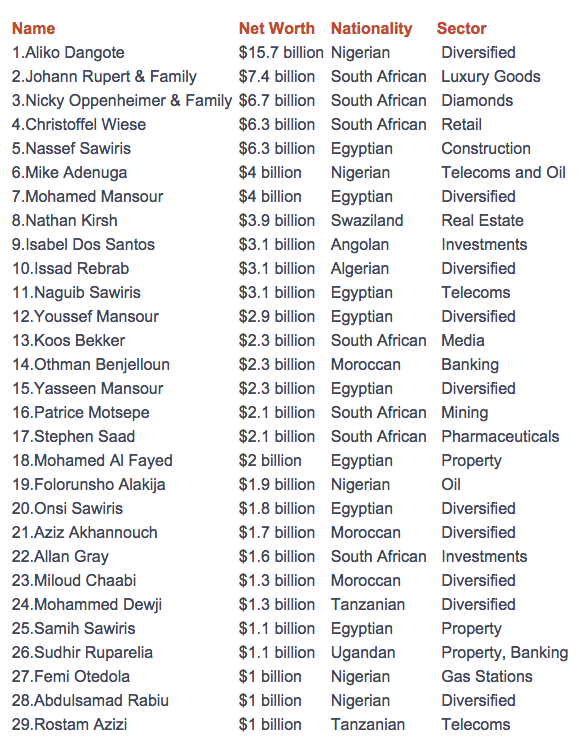
Only 9 out of 54 African countries are represented on the 2014 Forbes billionaires list. There are certainly more than 29 dollar billionaires on the Continent (most of the rest being in politics). Let’s consider this list as representative of countries in which (for whatever reason) it is politically safe to be publicly super wealthy – which in and of itself says a lot about how far Nigeria has come.

Screen Shot 2015-03-03 at 12.24.39 PM

Source: Forbes

Some will look at the list and scream inequality. I look at the list and see the proliferation of centres of economic and political power. And a potential source of much-needed intra-elite accountability in African politics. For more on this read Leonardo Arriola’s excellent book on the role of private capital in African politics.

See also this FT story on the impact of currency movements on the wealth of Nigeria’s super rich. Forbes also has a great profile of Aliko Dangote, Africa’s richest man.

The Anatomy of Tax Evasion in Africa

Africa Confidential has a great piece analyzing leaked documents from PwC, the professional services firm, showing the various arrangements that enable multinational companies to evade taxes in Africa. You can read the whole piece here (gated).

  • One of the measures PwC advised multinationals to take was to create a wholly-owned Luxembourg-based subsidiary which would hold the rights to intellectual property used by the rest of the group. The rest of the group would then pay licensing fees to the Luxembourg-based subsidiary which, by agreement with the authorities, would be granted tax relief of up to 80%……
  • A second tax avoidance mechanism simply involved the companies becoming incorporated in Luxembourg. In 2010, Luxembourg concluded an agreement with several companies of the Socfin (Société financière) agribusiness group, which was founded during the reign of Belgian King Leopold II by the late Belgian businessman Adrien Hallet. The companies chose Luxembourg as their base and made an agreement under which their dividends were subject to a modest 15% withholding tax, a lower figure than those in force where their farms are located (20% in Congo-K and Indonesia, 18% in Côte d’Ivoire).
transfer-pricing

The art of hiding profits

Altogether, Socfin subsidiaries in Africa [in Sierra Leone, Nigeria, Liberia, Cote d’Ivoire, and Cameroon] and Indonesia produced 123,660t. of rubber and 380,770t. of palm oil in 2012. The combined turnover of its main African subsidiaries reached €271 mn. in 2013. The list also includes the 100%-owned Plantations Socfinaf Ghana Ltd. (PSG) and Socfin-Brabanta (Congo-Kinshasa). Socfin also holds 88% of Agripalma in São Tomé e Príncipe and 5% of Red Lands Roses (Kenya).

  • A third mechanism involves cross-border lending within a group of companies. Companies registered in Luxembourg are exempt from tax on income from interest.

According to the Thabo Mbeki High Level Panel report between 1980 and 2009 between 1.2tr and 1.4tr left Africa in illicit flows. These figures are most likely an understatement. Multinationals, like the ones highlighted by Africa Confidential, accounted for 60% of these flows.

Alex Cobhan, of the Tax Justice Network, has a neat summary of the various components of illicit financial flows (IFFs) and how to measure them. He also proposes measures that could help limit IFFs, including: (i) eliminating anonymous ownership of companies, trusts, and foundations; (ii) ensuring that all bilateral trade and investment flows occur between jurisdictions which exchange tax information on an automatic basis; and (iii) making all multinational corporations publish data about their economic activity and taxation on a country-by-country basis.

Alex Cobham blogs here.

The Choices in the Nigerian Election

Alex Thurston over at Sahel Blog has an excellent take on the credentials of the two leading candidates in the Nigerian election – the incumbent President Goodluck Jonathan and challenger Muhammadu Buhari. Thurston, in particular, cautions against simplistic narratives about either candidate that only serve to distract from the universe of issues at stake in this election:

In much international coverage of the race, whether by non-Nigerian journalistsor Nigerians speaking to international audiences, the two candidates have been presented in crude and one-dimensional ways. The narrative at work in such commentaries says that Jonathan is a bumbler – a nice guy perhaps, but ultimately an “accidental president” who is in over his head, too incompetent to deal with problems like corruption or the violence caused by Boko Haram in the northeastern part of the country. Meanwhile, the same narrative tells us that Buhari is a thug – an essentially military man whose record is fatally tarnished by his regime’s actions in the 1980s, and whose prospects for winning the presidency have grown only because of Nigerians’ anxieties about Boko Haram. The narrative goes on to say that Nigerians face two very bad choices for president – perhaps implying that “the devil they know” is the better choice.

The rest of the blog post is here (highly recommended).

In related news Nigeria’s INEC on Tuesday announced that it had hit a 75% PVC issuance rate (or around 52 million people) to the almost 67 million registered voters. This included an average issuance rate of 76% in the three states worst hit by the Boko Haram insurgency (Yobe, Adamawa, and Borno).

Is Nigeria’s Economy Overrated?

Here is Izabella Kaminska of the FT:

Source: Financial Times

Source: Financial Times

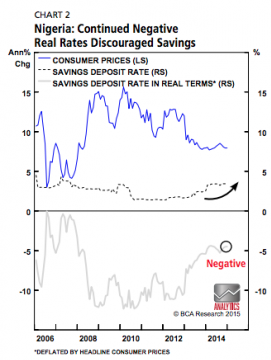
On the surface, Nigeria’s oil sector has dropped in significance to a mere 13% of real GDP, while the services sector has climbed to 40% in real terms. Yet, the reality is that it is the country’s oil revenues that have supported growth and, to a large extent, maintained social order. Without oil, both would fall apart; government spending would be much smaller, interest rates much higher, and the currency’s valuation much lower.

….. the country’s domestic savings rate, at a measly 20 per cent of GDP, is extremely low for a developing economy at this stage. A key reason being the government’s inability to tame chronically high inflation, meaning bank deposits have earned negative real interest rates for most of the past decade.

More on this here (HT Tyler Cowen).

And by the way, on this score Nigeria is not alone.

In an instance of the triumph of hope over experience The Economist recently pronounced the end of the resource curse in Africa. I do not completely buy their argument. Yes, growth and investment across the Continent may no longer be tightly coupled with natural resource cycles. But from Ghana, to Zambia, macro-economic stability (and important aspects of social spending) are still very tightly tied to movements in the global commodity markets.

Furthermore, many of these countries have recently re-entered the global debt markets partly backed by primary commodities as surety. The same applies to debts owed to Beijing. Last year alone foreign debt issues in the region exceeded $6.5b. As I argued in June of 2013, we might be entering another pre-1980s debt bubble.

Tanking crude prices have put Angola on the ropes. The country recently slashed $14b of previously planned spending. The Cedi and Kwacha took a nosedive (26% and 13%, respectively) last year because of sagging commodity prices (gold and copper) and government deficits (fueled by the expectation of future commodity bonanzas, especially in the case of Ghana whose debt to GDP ratio is now a staggering 65%). Even well-balanced Kenya (also a recent eurobond issuer) has had to go to the IMF for a precautionary loan against currency-related shocks in the near future. The current situation has prompted ODI to warn that:

The exchange-rate risk of sovereign bonds sold by sub-Saharan African governments between 2013 and 2014 threatens losses of $10.8 billion, equivalent to 1.1 percent of the region’s gross domestic product, the ODI said. While Eurobonds are typically issued and repaid in dollars, the depreciation of local currencies in 2014 makes it harder for governments to repay them.

All this brings to the fore SSA’s biggest challenge over the next two decades: How to carry out massive investments in infrastructure and human capital, while at the same time maintaining a sustainably balanced macro environment that is conducive to long-term saving.

On the upcoming Nigerian elections

On February 14 Nigerians will go to the polls in what is arguably the most important election in the world this year. Here is a (small) collection of things you need to read before then:

1. Alex Thurston has a great backgrounder for CSIS on the upcoming Nigerian elections. Want to know about the coalitions angling for power in Abuja and state capitals all over Nigeria and how ongoing political maneuvers will impact the outcome of the presidential election? Then click here.

2. Earlier this month Nigerian journalist Tolu Ogunlesi wrote an excellent piece for FT that emphasized the fact that this will be Nigeria’s closest and most unpredictable election yet (a point echoed by Zainab Usman, a Nigerian DPhil Candidate at Oxford, over at African Arguments). The level of competition will no doubt put pressure on INEC, and the losing candidate, to ensure that the legitimacy of the process is not tarnished, regardless of the outcome.

3. Brookings has a nice summary of some of the key political and policy issues at stake in this year’s election.

4. In the only detailed forecast that I have seen ahead of the election, DaMina Advisors project that APC’s Rt. Gen. Muhammadu Buhari will win with 51% of the vote (and get 25% in at least 27 states). There have not been any reliable polling data coming out of Nigeria in this election cycle, so take DaMina’s projections with a Naija size grain of salt.

5. And lastly, here is an op-ed from the former Governor of the Central Bank of Nigeria, Charles Soludo, on the economic dimension of this year’s election, as well as incumbent Goodluck Jonathan’s many failures.

If you have suggestions on interesting analyses ahead of the election please do share in the comments section.

Africa’s First City

National Geographic has a fascinating take on Lagos. And since we are just under two months to the next Nigerian elections, here is my favorite paragraph:

When I asked Kola Karim if the federal government’s sorry reputation made Western investors wary of doing business in Lagos, the worldly CEO elaborately dismissed it as a nonissue. Companies partnered with companies, not with bureaucrats, he maintained. “What does government do for you anyway, apart from charging you more taxes?” he said. “Look, it’s not about who rules anymore. Lagos is a train that has left the station. And you can only slow it down—you can’t stop it. So it doesn’t matter who comes next. This is the fun of democracy! It’s not about [President] Goodluck Jonathan! It’s about progress! Forget politics!” [More here]

From a political economy standpoint, one of the most fascinating things to happen in Africa over the last decade or so has been the quiet property rights revolution. In Nigeria, and a few other African countries, millionaires and billionaires have come out of the woodwork, willing to have their estimated net worth published in Forbes and other similar magazines for all to see. Very few of them have been politicians. Yes, many made their money in no small measure because of their political connections. But the fact that they no longer feel the need to hide their wealth from the ever changing political class means a lot.

It means that entrepreneurship and politics are getting decoupled in Africa’s biggest and most important economies. This transition is important because it will allow the magic of specialization to flourish. For instance, Dangote must be a savvy entrepreneur. But I doubt that he would have created as many jobs across the Continent if he also had to worry about running Abuja.

Also, it matters that Forbes’ Africa list is increasingly dominated by politically relevant high net worth individuals, as opposed to “apolitical” migrant businesspeople. Dangote is Nigerian “through and through.” When the going gets tough, he is more likely to voice his concerns than simply exit. The chaps in Abuja can’t simply revoke his visa or work permit. His political views therefore matter a lot.

One hopes that at some point Nigeria’s Dangotes will start investing in higher quality political talent to ease the cost of doing business and improve human welfare through greater investment in public goods.  But of course there is another possible equilibrium path in which they decide that low quality political talent is what’s best for their business prospects.

Either way I hope to visit Lagos soon.

Working With the Grain in Development

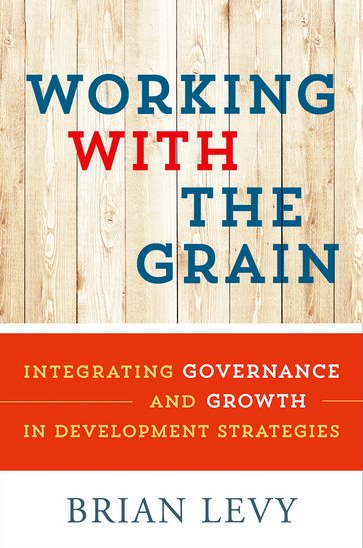
I finally got to reading Brian Levy’s Working With the Grain. It is easily the most underestimated development book of 2014, and should be read alongside William Easterly’s Tyranny of Experts (which it both complements and pushes back against). Like Easterly, Levy worked at the Bank and has insightful case studies and anecdotes from South Korea, to Ethiopia, to Bangladesh, among other countries. The book’s main thrust is that approaches to interventionist development policy ought to internalize the fact that:

… Successful reforms need to be aligned with a country’s political and institutional realities. For any specific reform, an incentive compatible approach begins by asking, who might be the critical mass of actors who both have standing and a stake in the proposed arrangements – and so are in a position to support and protect them in the face of opposition? [p. 142-3]

From a policy perspective, Levy tackles the relationship between governance, regime types, and development head on. How do you deal with the Biyas, Kagames or Zenawis of this world if you deeply care about [both] the material aspects of human welfare – roads, hospitals, schools, electricity, etc., [and] political freedoms and inclusive institutions?

Screen Shot 2014-12-17 at 12.32.06 PM

Levy’s answer is that development experts should work with the grain, focusing on incrementally solidifying past gains in specific agencies and issue areas, instead of engaging in epic battles against ill-defined and equally poorly understood “bad institutions” and evils like “corruption.” He aptly points out that you do not need the full set of the “good governance” bundle in order to continue chugging along on the path to economic prosperity.

In other words, we don’t have to put everything else on pause until we get the institutions right (or topple the bad guys). It is not an all or nothing game. His argument is persuasive (“good governance” has failed as a prescriptive remedy for underdevelopment), albeit at the cost of casting the immense toll of living under autocratic regimes as somewhat ineluctable on the road to economic prosperity. But at least he dares to challenge conventional approaches to governance reform that have at best failed, and at worst distracted governing elites from initiatives that could have worked to improve human welfare in developing countries.

As I read the book I wondered what Levy might think of the current state of development research. We are lucky to live in an age of increasing appreciation for evidence-based policy development, implementation, and evaluation. However, the resulting aura of “objectivity” in development research often leaves little room for politics, and its inefficiencies and contextual nuances. Sometimes the quest for generalizability makes us get too much into the weeds and forget that what is good for journal reviewers seldom passes the politicians’ (or other influential actors’) incentive compatibility test, rendering our findings useless from their perspective.

It is obvious, but worth reiterating, that the outcomes we can quantify, and therefore study, do not always overlap with the most pressing issues in development or policies that are politically feasible.

Perhaps this is a call for greater investment in public policy schools (not two-day capacity building workshops) in the developing world that will train experts to bridge the gap between academic development research and actual policy formulation and implementation (talking to policymakers makes your realize that this gap is wider than you think). Linking research findings to actual policy may sound easy, but you only need to see a “policy recommendations” section of a report written by those of us in the academy to know that it is not.

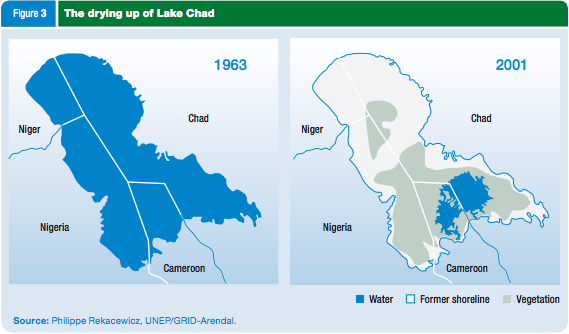
The disappearing Lake Chad, 1963-2001


I have been looking at the African Development Bank’s long term strategy (available here) and one of the figures that caught my eye was the extent to which Lake Chad has shrunk over the last 50 years. Wow.

Image

Africa’s newfound love with creditors: Bond bubble in the making?

I know it is increasingly becoming not kosher to put a damper on the Africa Rising narrative (these guys missed the memo, H/T Vanessa) but here is a much needed caution from Joe Stiglitz and Hamid Rashid, over at Project Syndicate, on SSA’s emerging appetite for private market debt (Africa needs US $90b for infrastructure; it can only raise $60 through taxes, FDI and concessional loans):

To the extent that this new lending is based on Africa’s strengthening economic fundamentals, the recent spate of sovereign-bond issues is a welcome sign. But here, as elsewhere, the record of private-sector credit assessments should leave one wary. So, are shortsighted financial markets, working with shortsighted governments, laying the groundwork for the world’s next debt crisis?

…….Evidence of either irrational exuberance or market expectations of a bailout is already mounting. How else can one explain Zambia’s ability to lock in a rate that was lower than the yield on a Spanish bond issue, even though Spain’s [which is not Uganda…] credit rating is four grades higher? Indeed, except for Namibia, all of these Sub-Saharan sovereign-bond issuers have “speculative” credit ratings, putting their issues in the “junk bond” category and signaling significant default risk.

The risks are real, especially when you consider the exposure to global commodity prices among the ten African countries that have floated bonds so far – Ghana, Gabon, the Democratic Republic of the Congo, Côte d’Ivoire, Senegal, Angola, Nigeria, Namibia, Zambia, and Tanzania.

In order to justify the exposure to the relatively higher risk and lending rates on the bond market (average debt period 11.2 years at 6.2% compared to 28.7 years at 1.6% for concessional loans) African governments must ensure prudent investment in sectors that will yield the biggest bang for the buck. And that also means having elaborate plans for specific projects with adequate consideration of the risks involved.

Here in Zambia (which is heavily dependent on Copper prices), the Finance Minister recently had to come out to defend how the country is using the $750 million it raised last year on the bond market (2013-14 budget here). Apparently there was no comprehensive plan for the cash so some of the money is still in the bank awaiting allocation to projects (It better be earning net positive real interest).

“They are fighting each other. By the time they have projects to finance, they will have earned quite a lot of interest from the Eurobond money they deposited. So, all the money is being used properly,” he [Finance Minister] said.

Following the initial success the country’s public sector plans to absorb another $4.5b in debt that will raise debt/GDP ratio from current ~25% to 30%. One hopes that there will be better (prior) planning this time round.

Indeed, last month FT had a story on growing fears over an Emerging (and Frontier) Markets bond bubble which had the following opening paragraph:

As far as financial follies go, tulip mania takes some beating. But future economic historians may look back at the time when investors financed a convention centre in Rwanda as the moment that the rush into emerging market bonds became frothy.

The piece also highlights the fact that the new rush to lend to African governments is not entirely driven by fundamentals – It is also a result of excess liquidity occasioned by ongoing quantitative easing in the wake of the Great Recession.

I remain optimistic about the incentive system that private borrowing will create for African governments (profit motive of creditors demands for sound macro management) and the potential for this to result in a nice virtuous cycle (if there is one thing I learned in Prof. Shiller’s class, it is the power of positive feedback in the markets).

But I also hope that when the big three “global” central banks start mopping up the cash they have been throwing around we won’t have a repeat of the 1980s, or worse, a cross between the 1980s (largely sovereign defaults) and the 1990s (largely private sector defaults) if the African private sector manages to get in on the action.

African governments, please proceed with caution.

The politics of reforming Nigeria’s oil sector

Nigerian legislators are attempting the impossible – to reform the management of their nation’s biggest cash cow – and failing. Decades of mismanagement and grand corruption have left Nigeria’s oil sector with entrenched and convoluted interests that are almost impossible to untangle and dislodge.

Africa Confidential reports:

Efforts towards comprehensive reform of Nigeria’s oil and gas industry are in tatters some five years after the first version of the Petroleum Industry Bill was presented to Parliament. After several redrafts, the PIB is still on the floor of the National Assembly and at the centre of partisan disputes, as parliamentarians pick over clauses which they claim favour one region of the country over another.Meanwhile, well connected companies and officials continue to benefit from an opaque system of management and operation that has allowed as much as US$100 billion to be siphoned off from state oil and gas revenue over the past decade, according to a report drawn up by the former anti-corruption czar, Nuhu Ribadu (AC Vol 53 No 9).

The failure to pass the reforms mooted in the PIB, which was intended to boost accountability and state revenue from exports, has developmental as well as financial costs. Nigeria has been unable to conduct a licensing round to award new blocks since 2007 because of uncertainties about new regulations and fiscal terms. This has limited new investment, raising the possibility that production capacity, which has been fixed at around 2.5 million barrels per day for a decade, could start to fall in the next few years.

More on this here.

Georgetown MSFS Launches New Africa Scholarship

The application deadline is January 15, 2014. Spread the word.

Starting in fall 2014, the Master of Science in Foreign Service (MSFS) at Georgetown University is offering a full- tuition scholarship for a talented graduate student from sub-Saharan Africa.

Image

MSFS is a two-year, full-time graduate degree program in international affairs. Students will take courses in international relations, international trade, international finance, statistics and analytical tools and history. In addition, students choose an area of concentration such as International Relations and Security, International Development or International Business.

Reason for African Petro-Rulers to be Worried

Africa’s petrorulers (heads of state of Angola, Cameroon, Chad, Congo-Brazzaville, Equatorial Guinea, Gabon, Ghana, Nigeria, South Sudan, and Sudan) may be headed for tough times later this year. According to a piece by (Steve Levine) over at FP, Saudi Arabia – the world’s leading oil producer – is considering flooding the global oil markets with the aim of sticking it to the Russians and Iranians. Saudi action of this nature could lower prices to as low as US $40 a barrel from the current $83.27.

With the exception of Ghana and Cameroon, such a drop in oil prices would almost certainly lead to political unrest in the rest of Africa’s oil producers. Sudan and South Sudan are already facing huge revenue shortfalls due to a dispute over the sharing of oil revenue.

More on “The Coming Oil Crash” here.

Links I liked

I just discovered Chri’s Blog on Madagascar and other Africa-related issues.

For those with a flavor of finance and capital markets and the political economy of development be sure to read Frontier Markets.

Germany is on the hunt for the UN security council seat in Africa.

And lastly, Justice – Uganda style:

Vice president upsets the president during tenure, president fires vice after election. Former vice gets accused of corruption. President declares former vice innocent, but leaves the matter up to the “independent” Inspectorate of Government. Here’s a quote from the president:

“What I know is that there was a power struggle between Bukenya and some businessmen but I found no merit in the case. But since the Inspectorate of Government is an independent body, let them investigate thoroughly.”

Yeah right.

Rants and Raves / Thoughts on the African Union

The African Union (AU) has had a rough few months. The diplomatic failures in Zimbabwe, Cote d’Ivoire, and Madagascar exposed the organization’s incompetence. The misguided anti-ICC crusade continues to cement the image of the organization as nothing more than a club of out-of-date and tone deaf autocrats. To many observers, calls for “African  Solutions to African Problems” amid all this failure has been seen as a cover of impunity and mediocre leadership on the African continent.

It says a lot that the current chairman of AU is President Theodore Obiang’ of Equatorial Guinea; a man who leads an oil-rich country of under 0.7 million people, with a per capita income of more than 30,000; but with more than 70% of its population living on less than $2 a day.

The epitome of the organization’s woes was the total snub it got from NATO before the military campaign against Libya’s Gaddafi, one of the AU’s main patrons. The AU was created by the Sirte Declaration, in Libya. Mr. Gaddafi’s influence ranged from his “African Kings” caucus (in which he was the King of Kings) to investments from Libya’s Sovereign wealth fund. I bet Gaddafi had a hand in the organization’s green flag.

So what ails the African Union?

The AU’s problems are legion. In my view, the following are some of the key ones.

  1. Lack of a regional hegemon(s): The AU faces massive collective action problems. With no regional hegemon(s) to act as the rudder of the organization, most of the organization’s resolutions are not worth the paper they get written on. The rotating chairmanship is a distraction from the real leadership needed in the organization. For instance, I had to google it to find out who’s currently in charge of the presidency of the EU (Poland). Everybody knows that France and Germany run the EU. Their word has gravitas in the Union. In the AU on the other hand, there is no leader. Could it be Navel-gaving South Africa or serially under-performing Nigeria?
  2. Too much political control: Most successful international organizations, despite having political principals, tend to have technical agents that are to some extent shielded from the principals. The AU is political through and through. The key decision-making body is the assembly of heads of state. The council of ministers does nothing. And the commission is all bark and no bite. Cronies of dictators staff most of the key positions in the organization.
  3. Disconnect from the masses: Most Africans have no idea what exactly the AU does. What is the point of the organization? Is it to preserve Africa’s borders? Is it to defend the likes of Gaddafi when the ICC’s Mr. Ocampo comes calling? Giving the people a voice in the Union might force the organization to do the people’s bidding, instead of being a protector of impunity in the name of African sovereignty.

What would reforming the AU entail?

  1. Radical restructuring: Like all inter-state organizations, the AU’s leadership should reflect regional power differences. The current assembly – in which Chad has the same power as Nigeria – makes no sense. There should be a smaller assembly of sub-regional representatives (West – Nigeria; East-Ethiopia; North – Egypt; and South-South Africa) with veto power and the mandate to implement the organization’s resolutions.
  2. Competent staffing: The practice of presidents appointing their sisters-in-law as AU representatives should go. An injection of competent expertise into the organization would go a long way in making it appear to be a more politically independent, competent and respectable organization.
  3. Direct elections to the AU parliament or no parliament at all: Instead of having the members’ parliaments elect representatives to the AU parliament, there should be direct elections. If that cannot happen then the parliament should be scrapped all together. A toothless and unrepresentative parliament is a waste of resources.
  4. Constructive and focused engagement with the rest of the world: Who is the AU chief foreign policy person? Are there permanent representatives in Beijing, Brussels, Brasilia, New Delhi and Washington? Why aren’t they trying to initiate a collective bargaining approach when dealing with these global powers (even if it is at the sub-regional level)? And what with the siege mentality? Not every condemnation of African leaders’ incompetence and mediocrity is a neo-colonial conspiracy, you know. For instance, instead of whining against the ICC’s Africa bias, the AU should clean up its own house. It doesn’t matter that George Bush is not being tried for crimes against Iraqis. The last time I checked none of the leaders of Switzerland was being tried for crimes committed in the German cantons.
  5. A more consistent commitment to progressive ideals: The AU is the only organization in the world that includes in its charter the provision to intervene in its member countries under the principle of responsibility to protect. If the AU were slightly more serious, the disasters in Zimbabwe, Cote Ivoire and Madagascar could have been nipped in the bud. As things stand it is only tiny Botswana that keeps shouting about the organization’s commitment to proper governance and responsibility to protect.

I am not a fan of the idea of the United States of Africa. That said, I believe that a regional organization like the AU can be a force for good. But in order for it to fulfill its purpose, it has to change. The change must reflect the regional power balance; it must increase the competence quotient in the AU and it must increase the voice of the average African within the organization.

Inequality, Terrorism and Governance in Nigeria

On June 17th Nigeria experienced its first ever suicide bomb attack. Boko Haram, a militant Islamic group that seeks the imposition of Sharia Law in all of northern Nigeria, claimed responsibility for the attack.

Although the group’s principal aim – at least according to its press releases – is the imposition of Sharia Law, its motivating factors include economic, social and governance issues that the Nigeria’s infamously kleptocratic elite have so far chosen to ignore. According to the Christian Science Monitor:

The “nationalization” of the Boko Haram problem will intensify pressure on elected leaders and security forces to deal decisively with the group and prevent further attacks. Nigerian officials have proposed solutions ranging from crackdowns to outreach programs to amnesty offers. The government has to some extent pursued all of these options. Yesterday former Kano State GovernorIbrahim Shekarauproposed a hybrid approach of sorts, which would rely on intelligence gathering to defeat the group while advancing employment programs to deal with social and political grievances in Northern society.

Whatever course the government pursues, the Boko Haram problem has already led several Northern leaders, including the newly elected Governor Kashim Shettima of Borno State, to speak quite bluntly about the North’s serious problems of economic stagnation and political isolation. Northerners have been voicing such concerns for some time, but perhaps now these concerns will reach a broader audience and stimulate a debate that goes beyond just the issue of Boko Haram.

Since the unification of Nigeria in 1914, the north has continued to lag the south in a number of socio-economic indicators. Years of military rule by northern generals did not make things any better. Most of the country’s oil revenue wound up in Swiss bank accounts and as investments in properties in European cities – even as regular folk in Kano, Katsina and Maiduguri, and in the wider northern region, continued to wallow in poverty.

In a sense Boko Haram and its ghastly attacks on civilians and government installations is as much a rejection of Western/Christian education (its name loosely translates to non-Islamic education is a sin) as it is an indictment of northern Nigeria’s leadership. Even by Nigerian standards, the north is doing very badly.

Recently, the governor of Nigeria’s Central Bank, Professor Chukwuma Soludo, chastised the northern elite by noting that the “high and persisting level of poverty in the country is a northern phenomenon.” Nearly all northern states in Nigeria have poverty rates higher than 60%, with some at 90%. Prof. Soludo further added that “if you look at all the indications of development, what constitutes today the North seems to be lagging far behind that the gaps seem to have even widened.

It is hard to ignore the fact that regular southerners are inching ahead of their northern counterparts despite the generous revenue sharing arrangements among Nigeria’s 36 states.

What does this mean for national politics and governance in Nigeria?

Well, for one we know that the apparent north-south political divide in the last election was merely an artifact of presidential politics. Gubernatorial elections revealed that northern elites are also aboard Goodluck Jonathan’s gravy train.

Northern Nigerian elites are as much a problem in the north’s underdevelopment as the historical north-south divide.

In light of this, groups like Boko Haram show that the northern elite in Nigeria can no longer play the north-south card while keeping all the money from the national treasury to themselves. The men and women on the streets and in northern rural areas also want their cut.

I hope Abuja will not bury its head in the sand and pretend that Boko Haram is purely a security problem.

Kenya tried doing the same with the Mungiki group (with extra-judicial executions and all) without much success.

To Abuja I say: you must try to solve the problem you have, not the one you wish you had.