Does female empowerment promote economic development?

The conventional interpretation of the observed gender expenditure patterns re- lies on women and men having different preferences.4 And indeed, if all women highly valued children’s human capital whereas all men just wanted to consume, putting women in charge of allocating resources would probably be a good idea. However, we show that the facts can also be explained without assuming that women and men have different preferences. We develop a model in which women and men value private and public goods (such as children’s human capital) in the same way, but that nevertheless is consistent with the empirical observation that an increase in female resources leads to more spending on children.

Our theory does not lead to clear-cut implications for economic development. In particular, we find that empowering women is likely to accelerate growth in advanced economies that rely mostly on human capital, but may actually hurt growth in economies where physical capital accumulation is the main engine of growth.

…… Given that the human capital share tends to in- crease in the course of development, our results imply that mandated transfers to women may be beneficial in advanced, human capital-intensive countries, but are unlikely to promote growth in less developed economies.

That is Doepke and Tertilt in an NBER working paper (HT Marc F. B.)

This paper reminded me of of the BIG vs Small Development dichotomy, and why we should not take cash transfers (despite recent glowing reviews) to be a panacea to poverty and underdevelopment. Cash transfers (whether targeting poor men or women) should be seen as short-term relief whose development impact are, at the very best, highly contingent and long-term (especially if the transfers are used to increase the quality of human capital through schooling for kids). I could be totally wrong, but I think that the promise for real and lasting rapid development lies in creation of mass employment. And on this front the shoots are beginning to show on the Continent.

I wish more development economists were thinking of ways of growing African SMEs into mass employers, even if it meant flirting with the idea of Industrial Policy.

A New TV Show About Aid and Development

Just saw this over at Africa is a Country:

Finally, a new TV show exists to highlight some of the absurdities of the international aid sector. The slyly named The Samaritans is a comedy about the perils – and pleasures – of the “NGO world”. Created by a Kenya-based production company, it chronicles the work of Aid for Aid – an NGO that, in the words of its creator, “does nothing”.

[youtube.com/watch?v=ZTFhFvo3gQI]

H/T D. Waweru

Mapping Nairobi’s Informal Transit System

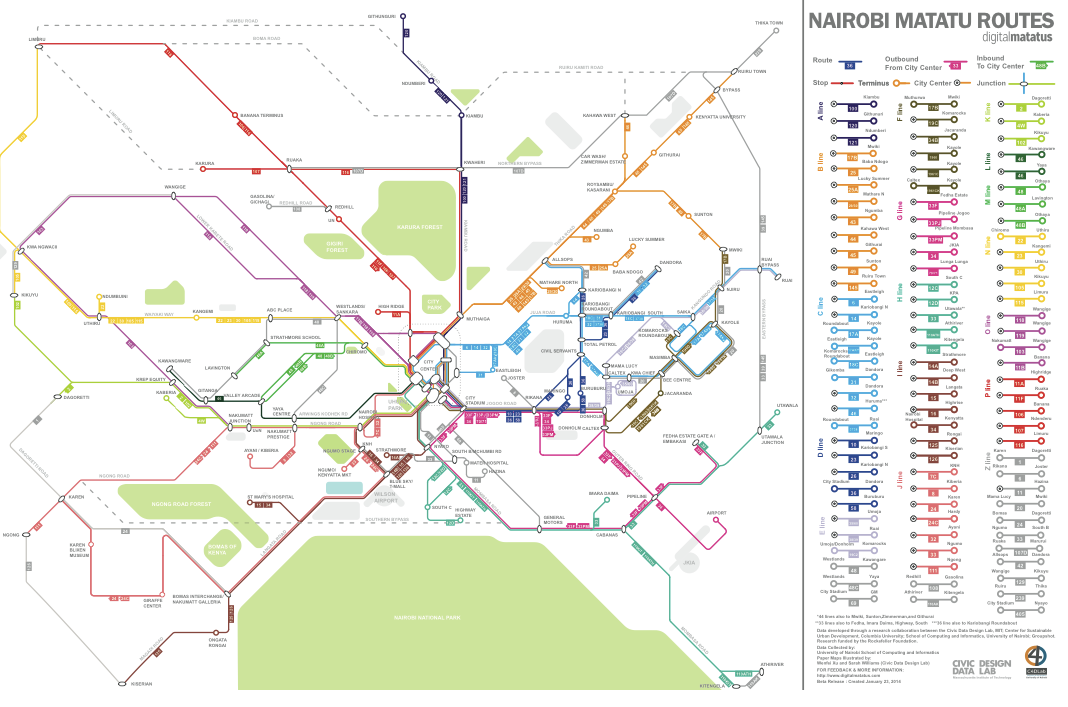
Researchers and students at the University of Nairobi, the Center for Sustainable Urban Development at Columbia University, and the Civic Data Design Lab at MIT produced the map below – and the underlying data behind it – after carrying cell phones and GPS devices along every route in the network. Result? There is order to Nairobi’s seemingly chaotic matatu industry.

Pretty cool stuff. 

Image

 More here.

H/T Amanda R.

RIP Joel D. Barkan

ImageA great Kenyanist and Africanist has passed on. 

I met Joel in DC last September at the Kenya at 50 conference hosted by SAIS. After the conference Joel and his wife hosted a gathering (over nyama and kuku choma) at his residence where I got a chance to talk to him at length about both mine and his research. Joel pioneered research on African legislatures and was a key figure in the African Legislatures Project. I particularly respect and admire Joel’s long-held belief in the importance of studying institutions (and associated dynamics) in Africa, even when many Africanists were fully convinced that personal rule was the alpha and omega of African politics. To echo Nic Cheeseman, Joel might be gone but his work will live on forever.

Here is Nic Cheeseman’s Daily Nation piece in memory of Prof. Joel Barkan.


Understanding Uganda’s Military Adventurism Under Museveni

On January 15th 2014 President Yoweri Museveni finally admitted that Uganda People’s Defence Force troops are engaging in combat operations within South Sudan. Right after the political fallout in Juba and escalation of hostilities between forces loyal to President Salva Kiir and those behind his former deputy Riek Machar, Mr. Museveni threatened Machar with military action if he did not come to the table to negotiate with Kiir. Museveni’s military involvement in the conflict has caused concern in Nairobi and other capitals in the region. For one, Uganda’s military intervention in the conflict may yet jeopardize the ceasefire agreement that was signed on January 23, 2014 in Addis Ababa. The regional body IGAD (Intergovernmental Authority on Development) is supposed to be a neutral arbiter and monitor in the conflict. Museveni’s clear leanings towards the government in Juba may bring to question IGAD’s neutrality in the mediation effort.

For historical reasons (see below) Khartoum fears Kampala’s military involvement in South Sudan. But this time the situation is slightly different, and a little more complex. Bashir has already shown his hand in support of Juba against Machar, possibly for two reasons: (i) Khartoum needs Juba’s help in weakening the rebellion by the rump SPLA (SPLA-North) that is still active in Blue Nile and South Kordofan, regions that border South Sudan; and (ii) Bashir needs to keep the oil flowing in order to ward off internal turmoil within Sudan due to rapidly deteriorating economic conditions (see here). Kiir’s willingness to throw SPLA-N under the bus comes as no surprise since it is an offshoot of the “Garang Boys” (mostly PhDs) who occupied a special place, unlike Kiir and others, in John Garang’s SPLA. SPLM-N’s leader Malik Aggar, shared Garang’s vision of one united reformed Sudan, as opposed to secession by the South. At the same time, however, Khartoum does not want a super strong South Sudan free of rebels. Total cessation of conflict in South Sudan would rob Khartoum of proxies to keep Juba in check. Uganda’s involvement could tip the balance in Juba’s favor vis-à-vis potential Bashir allies.

Meanwhile in Nairobi and Addis Ababa concern is growing over Uganda’s claim that the IGAD should foot the bill of UPDF’s adventures in South Sudan. Both Ethiopia and Kenya prefer settling the conflict at the negotiating table, partly because both have their security forces stretched by domestic armed groups and bandits and the war in Somalia. Kenya has said categorically that it will not send troops to South Sudan, even under IGAD. The wariness in Nairobi and Addis to send troops or cash for a military cause in South Sudan contrasts sharply with Kampala’s choice of military action from the moment the current flare up started in Juba. This despite the fact that Uganda also has troops serving in Somalia.

Which raises the question: What explains Uganda’s international military adventurism under Museveni? The answer lies in the confluence of history, international geopolitics, and Uganda’s internal politics.

Uganda is one of the more militarized states in Africa, with the military having direct representation in parliament (10 seats). It is also interventionist, with a history of combat engagement and support for rebel groups in six neighboring states – Burundi, the Central African Republic (CAR), the Democratic Republic of Congo (DRC), Rwanda, Somalia, and South Sudan. More recently, the nation has been a key advocate for greater integration within the East African Community (EAC). Indeed, Ugandan President Yoweri Museveni fancies himself as a possible head of an EAC political federation should it ever materialize. Uganda is also a key player in the African Capacity for Immediate Response to Crises (ACIRC), a proposed standby force with capacity to rapidly deploy troops to trouble spots in Africa (other key supporters include South Africa, Chad, and Tanzania).
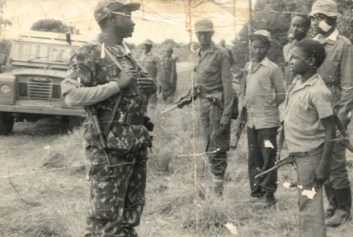
Museveni and his kagogo (little) soldiers

Museveni and his kadogo (little) soldiers

President Yoweri Museveni’s military adventurism and internationalist outlook have deep roots. As a young student in Tanzania, Museveni was involved in exile organizations opposed to Iddi Amin. Indeed, Museveni’s National Resistance Army (NRA), started off as the Popular Resistance Army (PRA) in Tanzania (As testament to its Tanzanian roots, NRA borrowed the idea of political commissars from the Tanzanian military to educate civilians in “liberated” Luweero Triangle). In Tanzania and even after returning to Uganda Museveni made regional connections that he maintained even after he ascended to power in 1986 – including Rwanda’s Paul Kagame, Sudan’s John Garang’, and leaders of Mozambique’s FRELIMO. Before rebelling against Kigali, Kagame was Museveni’s Chief of Military Intelligence. Museveni supported Garang’s Sudan People’s Liberation Army (SPLA).

Once in power, Museveni styled himself as the guarantor of peace and stability in Uganda. Many (both at home and abroad) evaluated his performance relative to the disastrous years under Amin and the ensuing civil war. The resulting peace dividend (albeit restricted to the south of the country) was marked by relative macro-economic stability, with growth averaging about 6% for much of the 1990s. This made Museveni a darling of Western donors and international financial institutions. However, Museveni’s record with regard to democracy and human rights remained dubious. This put him in awkward position vis-à-vis the West, especially since the 1990s was the zenith of Western promotion of liberal democracy.

To this Museveni reacted cleverly, and worked hard to position Uganda as a strategic player in the wider region’s geopolitics. In order to maintain his international stature and secure his position domestically, Museveni labored to bolster Uganda’s relevance to the West.
Museveni enters Kampala (Source)

Museveni enters Kampala (Source)

Beginning in the early 1990s, Uganda got militarily involved in a number of neighboring states. Support for Garang’s SPLA drew the ire of Khartoum, which in turn supported the Lord’s Resistance Army (LRA) in northern Uganda. Subsequently, the Ugandan military conducted raids against LRA bases in Sudan while also offering combat assistance to the SPLA. For instance, the 1997 battle at Yei featured Ugandan soldiers alongside the SPLA against the Sudan Armed Forces (SAF). It is around this time that the seed was planted for future military involvement abroad at the turn of the century (this time in Somalia under the Western-funded AU mission, AMISOM, to help stabilize the country). After US President Bill Clinton designated Sudan as a state sponsor of terror, Uganda positioned itself as an ally in the frontline of “Global War on Terror.” Kampala served as an intermediary for US aid to SPLA, thereby further strengthening US-Uganda military ties. It is telling that in 2003 Uganda was among only a handful of African states that supported the US-led Iraq War. About 20,000 Ugandans worked in US military bases in Iraq (this was also an excellent job creation tool; and a way of earning Forex).

So far Uganda’s most complex military adventure was in the Democratic Republic of Congo (DRC). A mix of strategic geopolitical positioning, the need to secure markets for Ugandan goods, private greed and domestic politics drove Uganda’s invasion of the DRC. The first Congo War (1996-97) was swift, aimed at helping Laurent Kabila oust Mobutu Seseseko (Rwanda and Angola also helped). Soon after Uganda and Rwanda fell out with Kabila, occasioning the Second Congo war (1998-2003), which involved four other African states. It is then that the façade of intervention for regional stability completely broke down. Ugandan and Rwandan commanders exploited existing and new cross-border smuggling and semi-legitimate trade networks to orchestrate massive pillaging of natural resources in eastern DRC (Competition between the two militaries later intensified, resulting in the “Kisangani Wars.”)

For instance, in the year 2000 despite only producing 0.00441 tonnes of gold, Uganda exported 11 tonnes. A UN report indicates that well-connected generals (including Museveni’s half-brother) created entities headquartered in Kampala to facilitate the illicit trade. It’s important to note that Museveni’s tolerance of the semi-autonomous activities by his generals was strategic (it generated revenue through Kampala-based entities and kept the generals happy) and did not lead to fracturing within the military. Indeed, many of those involved were later promoted.
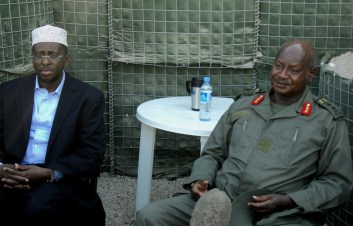
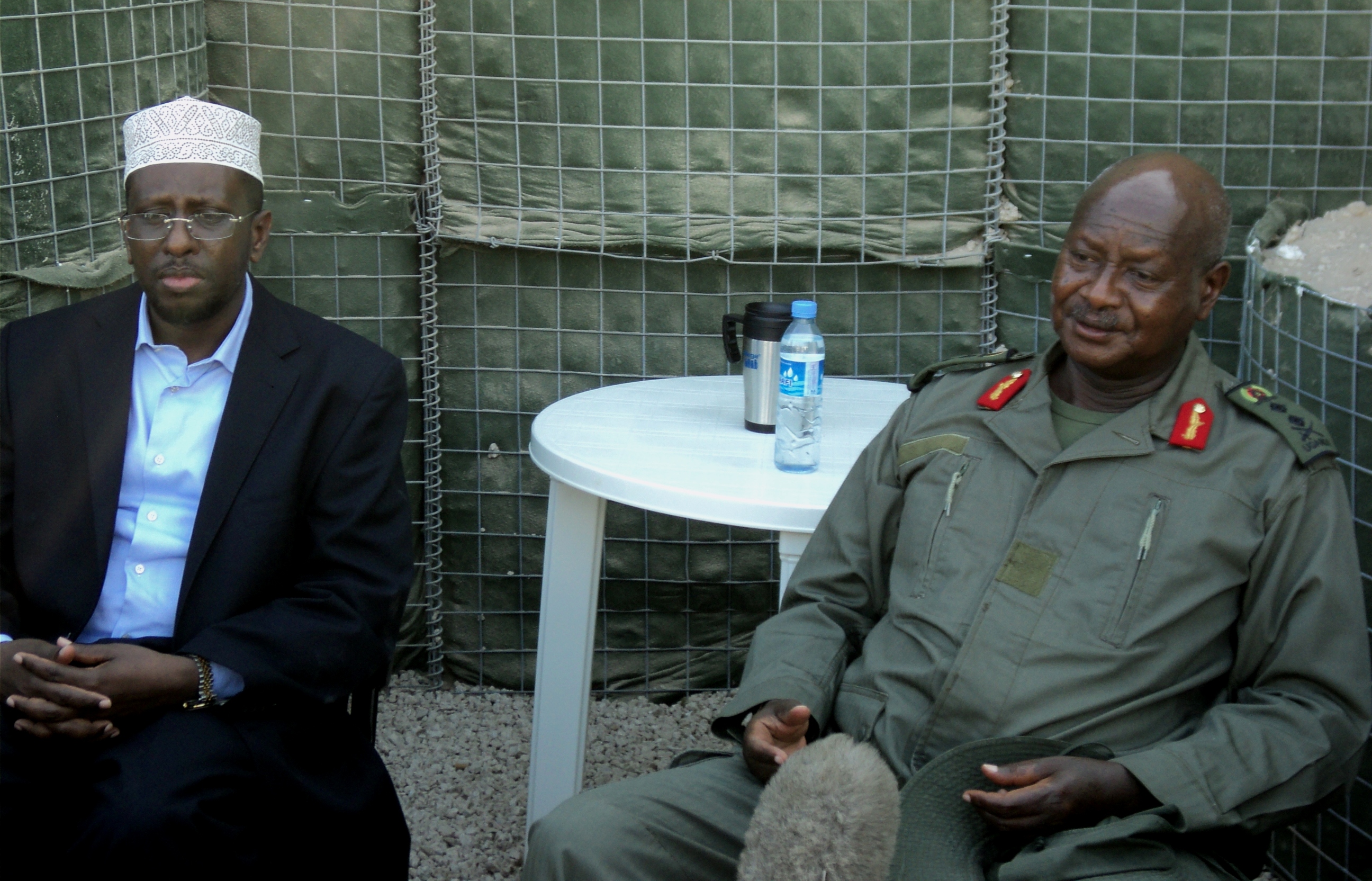
Museveni meets Somali President, Shayk Sharif Ahmed in Mogadishu in 2010


Incidentally, the present involvement in South Sudan also reflects the multifaceted logic of Ugandan international military adventurism. Historical alliances with the SPLA against the LRA and SAF make Kampala and Juba natural bedfellows. But the intervention is also about securing markets for Ugandan goods. According to figures from the Bank of Uganda, in 2012 the country’s exports to South Sudan totaled an estimated USD 1.3 billion. About 150,000 Ugandan traders operate across the border, not to mention countless more primary producers in agriculture who benefit from cross-border trade with their northern neighbor.

The above account explains Museveni’s efforts in the recent past to build an image as the regional powerbroker: heading peace talks between the DRC, Rwanda and eastern DRC rebels; intervening in Somalia to prop up the government in Mogadishu; and in the latest episode siding militarily with President Salva Kiir in South Sudan’s domestic political cum military conflict. Domestically, Museveni’s grip on power is as strong as ever. Recent reshuffles in the military removed powerful Historicals (the original “bush war heroes”) thereby leaving Museveni (and his son) firmly in control of Uganda’s armed forces. There is no end in sight for Uganda’s international military adventurism.

In many ways Uganda’s international adventurism has been a case of agency in tight corners. The country is a landlocked; has neighbors with sparsely governed borderlands that provide rear-bases for Ugandan armed groups; and Kampala needs Western aid to maintain the regime, a situation that necessitates acts of geopolitical positioning – especially with regard to the “Global War on Terror” and maintenance of regional peace and stability. Furthermore, oil discovery along the conflict-prone DRC border on Lake Albert and the need for pipelines to the sea to export Ugandan oil will necessitate even greater regional involvement. So while Uganda’s present outward adventurism is primarily because of Museveni’s peculiar personal history, it is correct to say that even after Museveni (still far into the future) the country will continue to be forced to look beyond its borders for economic opportunities, security, and regional stature.

Let them have “Good Institutions”

The people in poor countries have the same aspirations as those in rich countries — to have the same chances and opportunities, good health care, clean running water in their homes and high-quality schools for their children. The problem is that their aspirations are blocked today — as the aspirations of black people were in apartheid South Africa — by extractive institutions. The poor don’t pull themselves out of poverty, because the basic ability to do so is denied them. You could see this in the protests behind the Arab Spring: those in Cairo’s Tahrir Square spoke in one voice about the corruption of the government, its inability to deliver public services and the lack of equality of opportunity. Poverty in Egypt cannot be eradicated with a bit more aid. As the protestors recognised, the economic impediments they faced stemmed from the way political power was exercised and monopolised by a narrow elite.

…… Making institutions more inclusive is about changing the politics of a society to empower the poor — the empowerment of those disenfranchised, excluded and often repressed by those monopolising power. Aid can help. But it needs to be used in such a way as to help civil society mobilise collectively, find a voice and get involved with decision-making. It needs to help manufacture inclusion.

That is Daron Acemoglu and James Robinson writing in The Spectator on Why foreign aid fails – and how to really help Africa.

I am a firm believer in the fact that “institutions rule” and are “the fundamental cause” of long-run economic growth and political stability.

That said, I think this latest addition to the “Aid Debate” also detracts from the real issues regarding the efficacy of aid. It also runs the risk of creating the impression that the promotion of good institutions is a substitute for all forms of aid, or worse, that aid has led to the persistence of bad institutions and endemic poverty in poor countries.

How would the Central African Republic look today if it hadn’t received any kind of foreign aid over the years? I, for one, don’t think that it would be a bastion of political stability and stellar economic performance.

Strong and stable institutions are absolutely essential for the achievement of political and economic stability and general improvement of human welfare. And we should definitely preach this gospel for all to hear.

But institutions, as equilibria, are fickle, and also take forever to emerge. In addition, they tend to depend on all sorts of localized variables (including culture) that an international institution builder would most certainly miss (also, see here). And in the meantime, we still have to deal with the challenge of making the lives of the poor better (and within their lifetimes, approx. 60 years). Under these conditions, single panaceas (aid-driven or not) will obviously not work, especially if they come in as vague a package as “good and inclusive institutions.”

quick hits

1. Our Man in Africa: A great article on former president of Chad Hissene Habre. Also, is current Chadian president Idris Deby a clandestine state-builder in the Sahel or is all this just empty waste of oil money? Whatever the answer, I think the Chadian state might have reached a point where it can’t be threatened by a bunch of bandits on technicals.

2. On the hunt for human uniqueness: If you dropped a dozen human toddlers on a beautiful Polynesian island with shelter and enough to eat, but no computers, no cell phones, and no metal tools, would they grow up to be like humans we recognize or like other primates? Would they invent language? Without the magic sauce of culture and technology, would humans be that different from chimpanzees? More here.

3. Will e-cigarettes re-normalize smoking? E-cigarettes are already allowed in jails where traditional cigarettes are banned.

4. The Unruled World: Global disorder is here to stay, so the challenge is to make it work as well as possible.

5. and How China is ruled.

We Must Free Our Imaginations — Binyavanga Wainaina

A great thinker. A great artist. A great Kenyan.

Part One (see also Parts Two, Three, Four, Five and Six)

[youtube.com/watch?v=8uMwppw5AgU]

Joyce Nyairo of the Daily Nation has written a stinging critique of Binyavanga’s short documentary. Nyairo takes umbrage at Binyavanga’s bashing of Pentecostals and giving a dumbed down, even simplistic, account of Kenyan history over the Moi years. 

The ultimate tragedy of Binyavanga’s documentary is the ease with which he slides into a diatribe against Pentecostals — as if homosexuality can only be popularised by bashing something or someone else’s conformity…..

Each one of the titles of this six part “documentary” is a quote from Binyavanga’s long and frighteningly convoluted tirade against the hypocrisies of Africa’s discourse on homosexuality.

The quotes are as clever as they are memorable. But they represent isolated flashes of brilliance in a text that is neither articulate nor lucid. Binyavanga struggles too hard to be profound, repetitively swinging from mimicry and lazy stereotyping to banal imagery that does nothing to enlighten. His style is unworthy, an injustice to his subject.

I think Nyairo has missed the point of this short “tirade” by miles. The style of delivery and everything about this documentary show that Binyavanga’s intended audience is not the class of Kenyans who go to Blankets & Wine. He is not trying to preach to the choir – most upper middle class Kenyans already have liberal views on homosexuality and those that don’t often have to hide them behind their middle class civility. Neither is he trying to engage in an enlightened rebuttal of the claim that homosexuality is “un-African.” No. What Binyavanga is trying to do is to take the conversation to the streets, and the homes of regular Kenyans. He is aiming at the middle middle class and lower. Binyavanga knows that this is the demographic that will matter the most in changing Kenya, whether it is economically or in the further expansion of human rights.

Yes, Binyavanga has hoisted up the Pentecostal movement as his ultimate straw man. But that’s just in reaction to the hijacking of the conversation on homosexuality in Africa by religious moralists. It is hard to see how one can have an open conversation about homosexuality in Kenya today without addressing the question of sin and hell and Sodom and Gomorrah. This precedes even the macho talk of “natural African” (read heterosexual male) and “un-African” sexual habits. The language of “rights” alone will simply not fly, and when attempted will most likely result in an ugly backlash. This is what Binyavanga is speaking to.

Downton Abbey goes to Sierra Leone

I couldn’t tell whether Elizabeth McGovern was still in character, as Lady Cora, visiting 1920s British Sierra Leone.

[youtube.com/watch?v=BXSjVnOk7a0]

More hear.

As expected, a lot is being said about the video’s depiction of the savior complex and pre-contact thinking that is pervasive in the aid world. Ruminate on this gem for a second. No, make that three minutes:

“The father lives in another house. But they are still together. I think that he may have two wives.”

”I get the impression that in Africa people have sex far more freely than we do back home,” reflects McGovern. “You see certain cultures where there’s just endemic cruelty to women. I wonder if World Vision would take on the problem of women wearing the burka? And that clitoris thing is awful.”

But I would be more interested in finding out the feelings this video evokes among the political and economic elite, old and young, in Sierra Leone. Do they watch this and go like, wow absent help from elsewhere the Brits could make us their colony again today and there is nothing we could do about it? Do they watch this and go, we have to put the World Visions of this world out of business in Sierra Leone or do they see it as a pressure valve, yet another reason to not care about building functional health and education infrastructure for their people?

Bill Gates on the Aid Debate

Critics are right to say there is no definitive proof that aid drives economic growth. But you could say the same thing about almost any other factor in the economy. It is very hard to know exactly which investments will spark economic growth, especially in the near term. However, we do know that aid drives improvements in health, agriculture, and infrastructure that correlate strongly with growth in the long run. Health aid saves lives and allows children to develop mentally and physically, which will pay off within a generation. Studies show that these children become healthier adults who work more productively. If you’re arguing against that kind of aid, you’ve got to argue that saving lives doesn’t matter to economic growth, or that saving lives simply doesn’t matter [3 Myths].

That is Bill Gates writing in his 2014 annual letter. If you haven’t read it yet, go ahead and read it. He makes some good points.

You should also read Jeff Sachs and William Easterly on their ongoing “debate.”

I think most reasonable people would agree that Sachs kind of oversold his big push idea in The End of Poverty. Or may be this was just a result of his attempt to shock the donor world into reaching the 0.7 percent mark in contributions. In any event it is unfortunate that the debate on the relative efficacy of aid left the pages of journal articles in its current form. It would have been more helpful if the debate spilled into the public in a policy-relevant form, with questions like: under what conditions does aid make a difference? What can we do to increase the efficacy of aid? What kinds of aid should we continue and what kinds should we abolish all together?

Obviously aid alone will not turn the Central African Republic into Denmark. It is also obvious that less corrupt governments do a better job of reducing infant mortality with aid money than their more corrupt counterparts. This is what policy-makers need to know, if they don’t already.

UPDATE: For more on this see Brett’s response to this post. And the BR forum on Making Aid Work.

What is the optimal size of a global terror organization?

It looks like leaders of global terrorist organizations like al-Qaeda could benefit from lessons in organizational theory and on the theory of the firm. As William McCants argues in Foreign Affairs, it looks like al-Qaeda may have expanded too fast under its current leader Ayman al-Zawahiri, thereby resulting in the HQ’s loss of control over its subsidiaries, franchises and affiliates in the Middle East, Somalia and the Maghreb.  

As the political scientist Jacob Shapiro observes in his new book, The Terrorist’s Dilemma, all terrorist groups suffer from infighting for one basic reason. If they want to achieve their goals and to avoid being captured or killed, leaders of secretive violent organizations have to give their commanders in the field some measure of autonomy. When the field commanders become too independent, the leadership attempts to rein them in through various bureaucratic measures.

Without a doubt, Zawahiri is trying to rein in his unruly affiliates. What is striking is that Zawahiri created much of the problem himself by trying to expand al Qaeda too broadly. The one affiliate that Zawahiri did not push into a new arena of jihad, the Yemen-based al Qaeda in the Arabian Peninsula, has, unsurprisingly, avoided infighting. Zawahiri has now allegedly appointed AQAP’s leader, Nasser al-Wuhayshi, as al Qaeda’s ”general manager” and thus his eventual successor. Zawahiri had little choice but to promote from the ranks of AQAP, given the current disarray across the rest of al Qaeda.

But the organizational woes of al-Qaeda and affiliates should not give comfort to the global community. As McCants reminds us in his conclusion, dealing with a centralized terror group with an address (or quasi address) is better than trying to fend off lots of competing franchises [see here]: 

Zawahiri’s knack for creating factions and his unwillingness to part with them when they misbehave could help al Qaeda’s opponents blame the entire organization for the atrocities committed in its name. Over time, perhaps the bloody collage will dampen enthusiasm for joining al Qaeda and even horrify its members. But in the near term, Zawahiri’s poor management is not necessarily a boon to the United States and its allies. The various factions of a once-unified al Qaeda could compete with one another over which group can mount the biggest attack on the West. Whatever the case may be, Zawahiri’s inability to manage al Qaeda’s sprawling organization offers a preview of the infighting to come after his inevitable death.

Anyone know a good paper with a principal-agent analysis of terror organizations? 

RIP Komla Dumor (1972-2014)

[youtube.com/watch?v=DfJn8HCKO8g]

Here’s the BBC story on Mr. Dumor’s passing on.

On the virtues of Tammany Hall?

Tammany Hall — shorthand for the faction that controlled Manhattan’s Democratic Party for most of a 150-year period — has a well-deserved place in the annals of urban misgovernment in the United States. It stole elections, it intimidated political antagonists, and it shook down contractors and vendors. It produced the very face of political corruption, William M. Tweed, known to friend and foe as “Boss.” And it was at best indifferent to the grievances of African-Americans and, later, Hispanics in New York.

But there’s more to the story. Tammany Hall’s leaders delivered social services at a time when City Hall and Albany did not. They massaged justice at a time when the poor did not have access to public defenders. And they found jobs for the unemployed when the alternative was hunger and illness.

……..Tammany Hall certainly was guilty of many of the offenses arraigned against it. But those flaws should not overshadow Tammany’s undoubted virtues. The machine succeeded not simply because it could round up votes. It succeeded because it was unafraid of the grunt work of retail politics and because it rarely lost touch with its voters.

That is Terry Golway, author of a forthcoming book on Tammany Hall, writing in the New York Times

As I keep saying, the factory where time and circumstance build state capacity and accountable democratic government is a nasty place.


Peace, Security & Development Fellowships for African Scholars

The ALC is pleased to announce a call for applications for the Peace, Security and Development Fellowships for African Scholars starting in September 2014. This Fellowship covers an 18-month period, comprising of a rigorous training programme on peace, security and development, which includes a 12-Month Master’s (M.Sc.) programme at King’s College London and an attachment to an African University to undertake an independent research project. The Fellowship programme is designed to expose junior African scholars to the complexities of Security and Development issues facing the African continent. The Carnegie Corporation of New York has provided funding for this programme.

You can apply here, the pplication deadline is Friday March 7th, 2014.

Other fellowship opportunities for African scholars include a visiting fellowship at CEGA, UC Berkeley and the US Government’s Young African Leaders Initiative

Spread the word.

Somalia: Police Development as State Building?

International and local power brokers see police as indicators of legitimacy and international recognition, but the international community’s vision of police development as state building is undermined by Somali politicians, officers, and businessmen sharing a political and entrepreneurial under- standing of the police role. The picture is further nuanced by influential Somalis who regard many of the structures and skills associated with Western policing as desirable, even as they manipulate the values and procedures promoted in its name.

The propensity of donors to see police development as a tool for not only state building, but also social engineering is marked. But so is the pragmatic response of Somalis. Officers in Somaliland and Puntland take what they value, manipulate what they can use, and subvert approaches that offend the sensibilities of their conservative society. Meanwhile, the SPF’s primary concern is to acquire the heavy weapons, vehicles, fuel, and communications equipment it needs to survive today.

Somalia’s experience shows that formality is not required for the governance associated with state building, but relative security and stability are, and there are limits to the role police can play in facilitating this: Somalia remains dangerously insecure. That the three forces are subject to the un- predictability that dependence on local power brokers and international funding introduces suggests that success depends on balancing local security levels and politics against international imperatives in a way that goes beyond current conceptions of state-based governance.

That is Alice Hills in a paper on policing in Somalia in the current issue of African Affairs.