Thoughts on Devolution in Kenya

As Grossman and Lewis show in this paper, a lot of decentralization efforts in the developing world have not resulted in greater capacity or control of policy by the devolved units. But there are exceptions, like in Kenya where since early last year 47 subnational units (Counties) have come into existence with a constitutionally mandated (at least 15%) sharing of ordinary revenue between Nairobi and the counties. In the 2014/5 financial year about 32.4% of the most recently audited ordinary revenues (2011/12) will go to the Counties. The revenue sharing is governed by a strict formula (with population, geographic size, and poverty rate weights) in order to limit the discretionary powers of officials at Treasury.  More crucially, the County heads – a governor and a County Assembly – are directly elected, not appointed as is the case in most of the instances of “fake decentralization” noted by Grossman and Lewis.

ImageThe quote above from the governor of Mandera County in the northeast of Kenya sums the potential impact of Kenya’s brand of devolution.

Yes, in the interim there will be massive corruption, insufficient absorption, weak capacity for implementation and the like.

ImageBut the important point is that Kenya’s new government structure has 47 capitals handling billions of shillings each year. If all else fails, the system will at least create strong politically autonomous regional elites with sufficient power to check Nairobi. And that is a fantastic thing. Already a few governors (including Nairobi, Machakos and Bomet) have broken ranks with their sponsoring parties, evidence that the interests of the national parties and County governments will not always be aligned. And if the last two fiscal years are any indication, the political pressure on the national government to overshoot the 15% minimum requirement will continue to hold. Those perceived to be enemies of devolution will be punished at the polls.

The new system also has another plus: Kenya now has 47 training centres for the job of chief executive. Governors who do well – like the Governor of Machakos – will become very strong contenders for State House in the not so distant future (Also more work for me to study inter-governmental political careers!!)

My biggest concern about the new devolved system of government is its potential impact on the coercive capacity of the Kenyan state (recently the state has been at sixes and sevens in response to rising insecurity and sporadic terror attacks). If there was ever Kenyan exceptionalism in Africa it was on account of its post-colonial inheritance of a strong state. Since for political reasons security cannot be devolved (latent centrifugal tendencies still exist at the periphery), the centre must still guarantee security of life and property. My hope is that the ongoing restructuring of the Provincial Administration will not be as large a swing as to completely gut a system (reviled or not) that helped hold the country together over the last 50 years.

Does democracy cause growth?

William Easterly’s new book, The Tyranny of Experts, argues that positive changes in freedoms are the causes of stable long run growth. But as he admitted to me recently on an Al-Jazeera talk show, the book does not present any rigorous evidence to back the claim, partly because thus far research findings have been mixed on the question of how democracy/autocracy impacts economic growth.

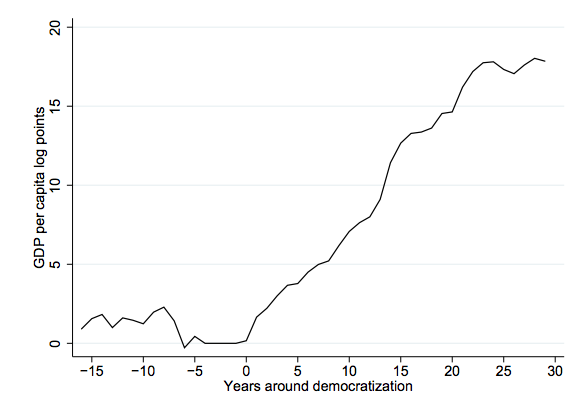
Well, Easterly’s book tour just got a boost thanks to Acemoglu et al. who have a new paper (see their blog post on it here) showing that democracy does indeed cause growth (boosting long run per capita income by as much as 20%):

Image

Reweighted relationship between GDP per capita and democracy (Source: Acemoglu et al., 2014)

Here is the paper’s abstract:

We provide evidence that democracy has a significant and robust positive effect on GDP. Our empirical strategy relies on a dichotomous measure of democracy coded from several sources to reduce measurement error and controls for country fixed effects and the rich dynamics of GDP, which otherwise confound the effect of democracy on economic growth. Our baseline results use a linear model for GDP dynamics estimated using either a standard within estimator or various different Generalized Method of Moments estimators, and show that democratizations increase GDP per capita by about 20% in the long run. These results are confirmed when we use a semi-parametric propensity score matching estimator to control for GDP dynamics. We also obtain similar results using regional waves of democratizations and reversals to instrument for country democracy. Our results suggest that democracy increases future GDP by encouraging investment, increasing schooling, inducing economic reforms, improving public good provision, and reducing social unrest. We find little support for the view that democracy is a constraint on economic growth for less developed economies [emphasis mine].

The full paper is available here.

Daron Acemoglu and James Robinson wrote the classic Economic Origins of Dictatorship and Democracy. The book is thin on empirics and analytical narratives, but is an amazing formal take on the subject of democratization. To balance Economic Origins you should probably also read Barrington Moore’s magnum opus Social Origins of Dictatorship and Democracy.

What’s African about unalloyed misogyny?

The just passed marriage bill is unambiguously the most offensive idea to come out of the 11th Parliament yet. According to the BBC:

MP Samuel Chepkong’a, who proposed the amendment, said that when a woman got married under customary law, she understood that the marriage was open to polygamy, so no consultation was necessary, Kenya’s Daily Nation newspaper reports.

Mohammed Junet, an MP representing a constituency from the western Nyanza province, agreed.

“When you marry an African woman, she must know the second one is on the way and a third wife… this is Africa,”

This is Grade A horse manure.

President Kenyatta should veto this bill. And the group of Kenyan MPs who think that disempowering women is a smart idea are advised to watch the video below of President Kibaki at a press conference ostensibly to confirm to Kenyans that he has ONLY ONE WIFE, following rumors to the contrary [More here].

Also, Mr. Kenyatta should require that before he assents to the bill it must expressly forbid dabbling in both civil and “customary” marriages because the resultant legal arbitrage only benefits men. SOMEONE TELL ME, WHY DO WE NEED A DUAL SYSTEM ANYWAY??? A woman entering a civil marriage should have the guarantee that it will always remain so, with stiff penalties for men who violate the contract. The provisions for Muslims have always been clear and should remain so.

[youtube.com/watch?v=wSlTW8mjirs&eurl=http://www.nation.co.ke/oped/Opinion/-/440808/541450/-/441cmq/-/index.html]

And just for good measure, they should also hear what Chimanda has to say about gender relations:

[youtube.com/watch?v=hg3umXU_qWc]

More on the unbelievably sophomoric debate on this matter in the National Assembly here.

The Simpsons’ Springfield just had a massive infrastructure upgrade

Research shows that the combination of urban sprawl and a lack of adequate public transportation is disastrous for low-income urbanites. Aware of this fact, the political leadership of Springfield resolved that they would do everything in their power to avoid becoming the next Atlanta. But to do so they have had to overcome challenges such poor demand (on account of a tiny car-loving population of just over 30,000), endemic corruption, and the lack of political will (The last time the town tried to build a subway system the contractor did a rather shoddy job, forcing the town to abandon the project altogether).

According to Architizer.com:

Image

The old “ring” subway system

This is not the first transportation overhaul that the STA (Springfield Transit Authority) has implemented, although the last drastic change was way back in a 1993 episode with the introduction of a failed monorail system. Since then, it’s been pretty much all cars and skateboards on the city’s streets, and viewers learned that the single sad loop of a subway system in the city was actually abandoned. Poor transportation construction seems to be endemic to Springfield, as the tunnels, although functional, were apparently ruining the underground foundations of buildings.

ImageThe system appears much more lively, covering spunky new districts like Jerk Circle, Boulevard of Broken Dreams, and Little Pwagmattasquarmsettport (last stop on the indigo line).

…….Bart probably won’t be putting his skateboard away any time soon, but it will be interesting to see how these fictional sites of comedy and intrigue return in the series. Will Springfield face a familiar future of urban disputes—perhaps sparked by the aesthetic retaliation from the residents of the Ugli district, or maybe the gentrification of Ethnictown?

However, there are still lingering questions about future commercial viability of the new expensive subway system, especially if the town fails to attract new residents. It doesn’t help that the town has a history of being hostile to immigrants. But given their apparent appreciation for evidence-based rigorous academic research in the process of public policy development, perhaps they could benefit from some of the fantastic work on immigration and migration coming out of the CGD.

In addition, it is unclear how the town financed the new subway system. As the Economist reports, banks have lately been wary of financing infrastructure investments. And with Yellen and co. scheduled to hit the brakes soon and a sooner-than-expected rates hike, Springfield’s public debt could become unsustainable. 

More on this here.

In which I talk development with Bill Easterly and others on Al Jazeera

This afternoon I joined NYU’s William Easterly, Ingrid Kvangraven of the New School and Daniel Kaufmann of Revenue Watch to talk about Easterly’s new book, The Tyranny of Experts. You will notice that I am a huge fan of STATE CAPACITY.

(Apparently, graduate school prepares you not for TV appearances…)

[youtube.com/watch?v=CmcL4R_PZRE]

Note: If you are in the US you have to VPN it since al jazeera doesn’t stream content in the US.

In preparation for the show I finally finished reading Easterly’s book. A review is coming soon (grad school permitting). 


Authoritarian Origins of Democratic Party Systems in Africa

That is the title of a new book by Rachel Riedl of Northwestern University on party system development in Africa following re-democratization in the early 1990s. Riedl writes:

To explain these country’s divergent development, I point to earlier authoritarian strategies to consolidate support and maintain power. The initial stages of democratic opening provide an opportunity for authoritarian incumbents to attempt to shape the rules of the new multiparty system in their own interests, but their power to do so depends on the extent of local support built up over time. Where authoritarian incumbents are strong, they tightly control the democratic transition process, which paradoxically leads to higher party system institutionalization in the new democratic system.  Conversely, where authoritarian incumbents are weak, they lose control of the transition agenda and new players contribute in uncoordinated ways to press for greater reform and more open participation, which results in lower party system institutionalization in the democratic era.  The particular form of the party system that emerges from the democratic transition is sustained over time through isomorphic competitive pressures embodied in the new rules of the game, the forms of party organization, and the competitive strategies that shape party and voter behavior alike.

The book is an excellent resource for understanding the evolution of party systems on the Continent.

Implied in the book’s argument is the centrality of state capacity to well-ordered development and consolidation of democracy. As the case of Mali shows, if there was ever a precondition for democracy it is certainly a reasonable level of state capacity. In other words, there has to be empowerment before limitation, or else you get collapse.

Peter Singer and the Utility Monster

This just made my morning:

ImageMore from existential comics here.

Who is Peter Singer?

H/T P. Gowder.

Resource Dependence in Africa (with some thoughts on Mozambique)

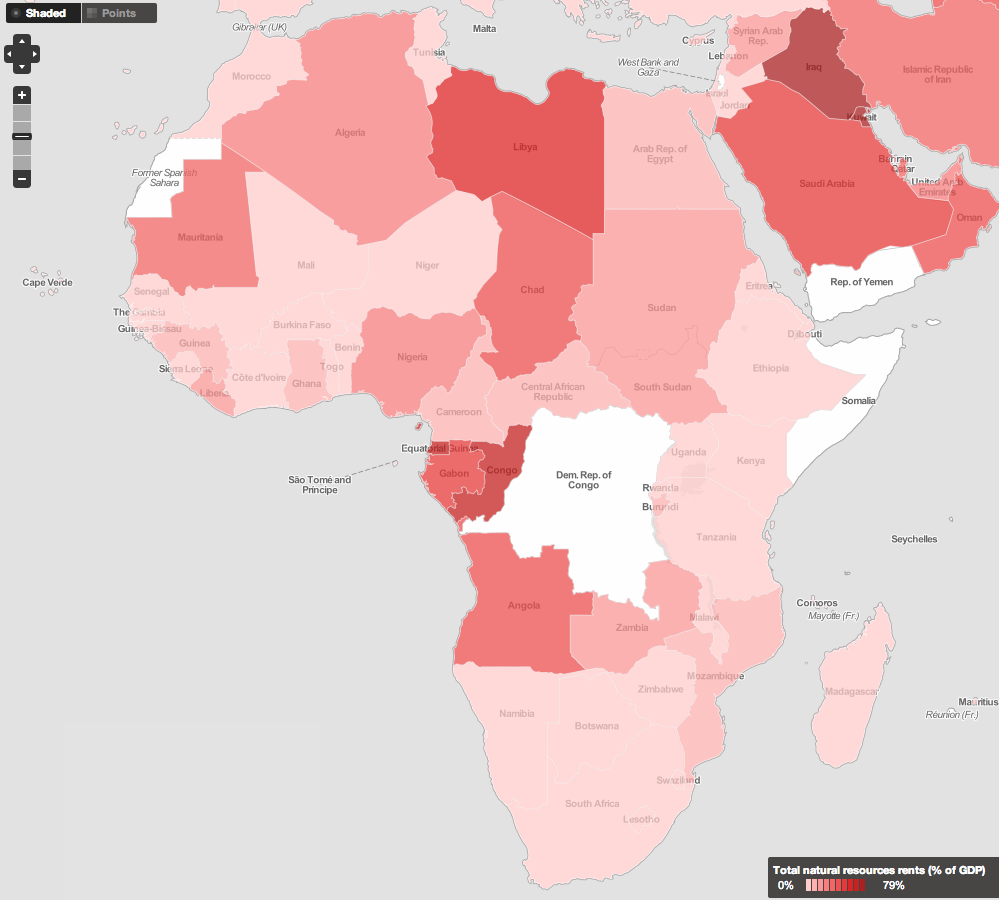
Source: The World Bank

Source: The World Bank. Click on image to enlarge  

This map shows resource rents as a share of GDP for the period 2009-2013. Note that the colouring on the map is about to change, with the Indian Ocean east coast getting some of the hydrocarbon action that has hitherto been a preserve of the Atlantic coast and a couple of landlocked states like Chad, Sudan and South Sudan (The biggest change in West Africa will most likely be in Guinea once the mining of its high grade iron ore in the Simandou Mountains gets going. A few contractual and logistical hurdles still stand in the way of the mega mining project).

The eastern African states of Kenya, Uganda, Tanzania and Mozambique are about to get a shade or more redder. Kenya and Uganda will start producing oil between 2016-17. Tanzania and Mozambique have massive amounts of natural gas, with Mozambique having recently climbed to top four in the world with a capacity to meet total global demand for more than two years.

As you may have guessed Mozambique is by far the country to watch out for as far as the ongoing eastern African resource bonanza is concerned. The country will continue to see a rapid rise in coal production, ultimately producing an estimated 42 million tons in 2017. Mozambique’s Gold production is also expected to more than triple by 2017 relative to its 2011 level. Estimates suggest that based on the full capacity exploitation of coal and gas alone the Mozambican economy could rise to become SSA’s third or fourth largest (after Nigeria, South Africa and (or ahead of) Angola). Going by the 2012 GDP figures from the Bank, that would be a change from US$14 billion to about $114 billion.

Have you enrolled in Portuguese classes yet?

As Mozambique gets wealthier in the next five years at a vertiginous pace, it will be interesting to see if it will go the Angola way. Both are former Portuguese colonies that had drawn out civil wars. Both tried to have democratic elections but then the ruling parties managed to completely vanquish the opposition. And both continue to be ruled by overwhelmingly dominant parties that appear to have consolidated power.

My hunch is that Mozambique is different, as FRELIMO is less of a one man show than is the MPLA. Indeed FRELIMO just selected a successor to Guebuza, the Defense Minister Filipe Nyusi (Nyusi’s background in engineering and the railway sector should prove useful for the development of the country’s coal industry).

The Tanzanian model of dominant/hegemonic party with term limits appears to have spread south. And that is a good thing. The other African country that appears to be embracing this model is Ethiopia (I think I can now say that the Zenawi succession was smooth and that Desalegn, also an engineer, is credibly term limtied).

Kampala, Kigali and Yaounde should borrow a leaf from these guys (that is, as a second best strategy given that their respective leaders do not seem to be into the idea of competitive politics).

For more on the politics and management of natural resources in Africa see here, here and here.

Happy Independence Day Ghana!

Ghana is 57 today, having gained independence from the UK on the 6th of March, 1957.

ghana


Back then the independence of Ghana (named after the historic empire that existed in parts of present day Mali and Mauritania) had a lot of symbolic value given that it was the first majority black African country to gain independence.

African Demographics

The Economist has a piece on the delayed demographic dividend on the Continent, citing research that argues that African states should do more to reduce fertility rates (through family planning) with a view of mitigating potential problems arising from an uncontrollable youth bulgeImage

“There were 411m African children in 2010, aged 14 years or below. By 2050 there will be 839m, according to the UN’s high variant. Educating all those young minds will be expensive. It is true that there will also be lots of new arrivals into the labour force, who should be able to earn the money to pay for their younger siblings to go to school. In 2010 there were roughly 200m Africans between 15 and 24 years of age and this number could rise to over 450m by 2050. But the African Development Bank pointed out in 2012 that only a quarter of young African men and just 10% of young African women manage to get jobs in the formal economy before they reach the age of 30. The vast majority of young Africans will continue to have precarious employment—a worrying prospect.”

This is yet another reason for African governments and development economists to start thinking seriously about industrial development and manufacturing.

ImageThat said, the alarmists over Africa’s impending demographic disaster should tone it down a little. Let’s not forget that one of the reasons the Continent has lagged behind in the economic growth and political development stakes in the last few centuries has been its historical sparse population density and abundance of cultivatable land (to get a clear idea on this read this great book on states and power in Africa).

Furthermore, as Max Fisher over at the Post pointed out last year (see above) Africa’s high fertility rates will come with benefits, with the region’s dependency ratio projected to decline even as it rises for the rest of the world. 


KENYAN PRIDE

[youtube.com/watch?v=r3XJQaMVzIo]

Kenyan politicians, you keep using that word [culture], I don’t think it means what you think it means

Here is the Standard reporting on the proposed amendments to the Marriage Bill:

The Bill passed through its second reading in the House Wednesday, even as controversy raged over how much say women should have on their husbands’ choice to get them co-wives [?!!!???!?!??!?!?!?!?].

Although the Bill has wide ranging provisions touching on marriage, the clause on polygamy has assumed a life of its own, with debate in the House and in the public zeroing in on the controversial clause. During debate last week, the chairman of the National Assembly’s Legal Affairs Committee Mr Samuel Chepkonga said they had considered an array of opinions before the decision to introduce the amendment that may see the controversial clause deleted when the Bill comes before the Committee of the Whole House.

Predictably, the reaction during debate was sharp and immediate, with mostly male MPs supporting the amendment, terming the consent clause “impractical and unrealistic” in the context of African culture [emphasis mine].

To which I say:

[youtube.com/watch?v=G2y8Sx4B2Sk]


Infrastructure Interconnections in Africa

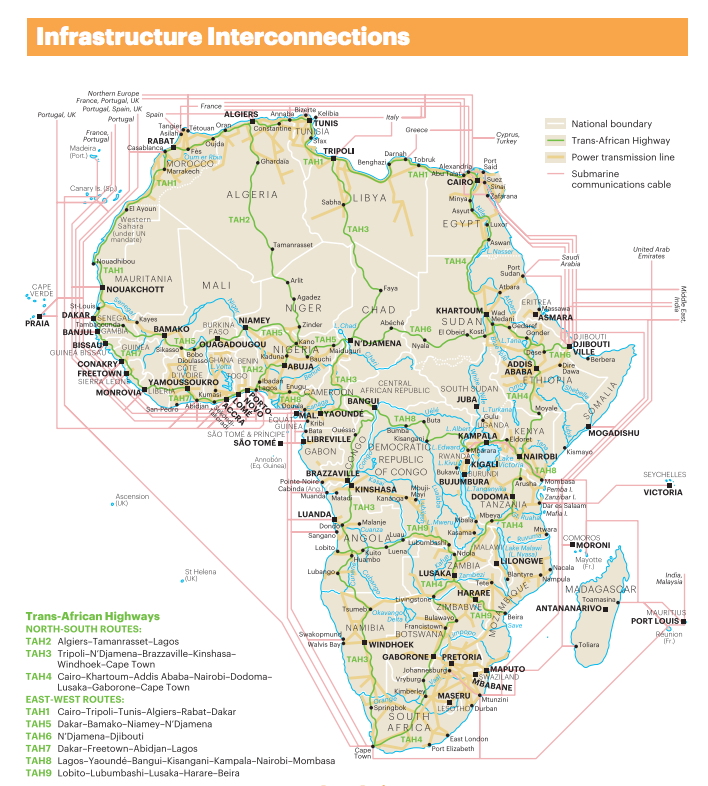
ImageHere is a crazy idea, why did we stop building canals? Look at all those potential waterways (which might prove cheaper in the long run than roads). And don’t tell me its all about rapids and waterfalls, those can be overcome.

Also, notice how “landlockedness” is not just about national boundaries but about access to the sea and transport infrastructure.

No shortcuts to sustained economic growth

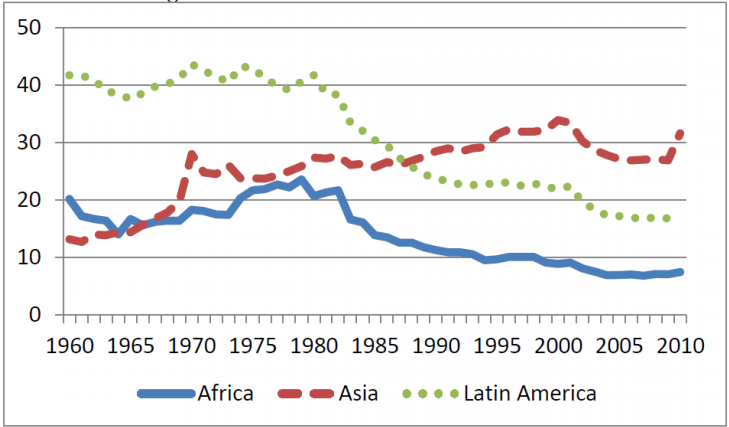
Dani Rodrik keeps reminding us that one of the factors slowing down the anti-poverty fight in Africa is the slow growth in manufacturing which comes with the risk of “premature” de-industrialization. Economic histories of several countries over the last two centuries tells us that rapid and sustained growth only occurred on the back of industrialization. In Africa on the other hand manufacturing is still a paltry 10.1% of annual output on average (and ranges between 10-14%, which is bad for a developing region). Compare this to 34% in Thailand, 31% in South Korea and 24% in Malaysia. Furthermore, productivity in the manufacturing sector in Africa has actually declined over the last 40 years (see figure below).

Image

Productivity in Manufacturing (USA=100)

Now, starry-eyed technophile African leaders can talk about leapfrogging the historical stages of economic growth until the cows come home but there is no hiding from the fact that sustained growth and reduction of poverty will only come once Africa’s poor (up to 70% of whom still depend on subsistence agriculture in SSA) have access to well paying jobs. Yes, the types of jobs and products will be different, from say steam powered 18-19th century northwestern Europe or even 20th century East Asia, but there will have to be jobs for the masses. M-apps won’t do, as they will only benefit those who are already well off (mainly the creators), once they are sufficiently monetized. Asking poor people to be “entrepreneurial” with high interest micro-loans and grow themselves out of poverty as a matter of national development policy will also not work.

To quote Chris Blattman:

The difference between a country with $1,500 and $15,000 of income a head is simple: industry. All the microfinance and microenterprise programs in the world are not going to build large firms and import technology and provide most people with what they really want: a stable job, regular wages, and a decent work environment.

The good thing is that in quite a few countries on the Continent structural conditions favorable to mass job creation are beginning to congeal. Hopefully sooner, rather than later, PRSPs will start focusing less on pro-poverty “pro-poor” initiatives and more on strategies for mass job creation. Remember, “making the lives of poor people better is not the same thing as fighting poverty.” Over to you Development Economists and African policymakers.

Kenya’s super rich are betting on future stability, and that is a good thing

One of the historical features of “Kenyan exceptionalism” in Africa – outlined by Bob Bates and others – has been its elites’ reliance on immovable assets, mostly agricultural land. This is in contrast to most other African countries where insecure property rights, lack of good investment opportunities, and outright kleptocracy have over the years bled national economies dry of capital. A study of 33 countries in Sub-Saharan Africa showed that between 1970-2010 about 0.814 trillion dollars left the region (in constant 2010 dollars). That was more than the total aid ($659 billion), and more than two and a half times the FDI ($306 billion) received over the same period.

The study shows Kenya to have lost $4.9 billion in capital, ranking it 21st on the list. This despite having been among the region’s top five economies and its largest non-mineral economy over the same period. Kenyan politicians and their associates were by no means less venal than their regional counterparts. They definitely stole, too. A lot. The difference is that they invested a good chunk of the stolen money in land (agriculture) and other assets within the country.

The same Kenyan trend appears to continue, even in an era of relatively liberalized financial flows. A recent report on Kenya’s top 8,300 wealthiest high net worth individuals – who also control wealth the equivalent of about two thirds ($31 billion) of the country’s annual output – shows that they have put more than a quarter (26%) of their wealth in real estate, a most immovable asset. 18% of this wealth is in equities, with only 12% in liquid cash [Just to be clear, $31.4b is 62% of Kenya’s GDP, not its total wealth. The latter figure includes the total accumulated net value of all wealth in Kenya, including both public and private household wealth].

The Business Daily reports that:

This level of wealth multiplication has caught the attention of Kenya’s super-rich making them invest 19.5 per cent of their total assets in residential property, 5.4 per cent in commercial property and 1.3 per cent in foreign property in 2013.

Obviously the wealth disparities outlined in the report should concern Kenyan politicians and the super-wealthy elite alike. 8,300 people make up 0.0002075% of Kenya’s 40 odd million people. This is total insanity. But the investment choices of the country’s wealthiest are an implicit endorsement of the country’s property rights laws and a sign that the super rich are betting on the continued stability of the country and its economy.

Now the challenge for chaps at State House, the Treasury and the Ministry of Industrialization and Enterprise Development (of course with some help from Parliament) should be how to incentivize investments in sectors that will generate mass employment. This is a drum that I have been beating for a while now (see also here). It is also the point that David Ndii neatly summarized in his recent critique of the government’s apparent blind belief in mega-projects as the panacea to Kenya’s endemic poverty problem. Dr. Ndii’s argument was that mega infrastructure projects only target the middle class and up, forgetting the rural poor who need investments in agricultural productivity. While I wouldn’t go as far as outrightly dismissing the utility of new major roads and railways, I think that the government should be a bit more proactive in ending rural poverty – a task that will necessarily require getting people off the land and providing alternative livelihoods in wage paying jobs.