An East African Geopolitical Dilemma: Which pipeline route makes most sense for Uganda?

Bloomberg reports:

Screen Shot 2016-03-25 at 9.34.21 AMKenya is competing with Tanzania to build the pipeline from oilfields in Hoima, western Uganda. It would either traverse northern Kenya’s desert to a proposed port at Lamu, near the border with Somalia, or south past Lake Victoria to Tanga on Tanzania’s coast. A third option would be through the southern Kenyan town of Nakuru.

Tanzanian President John Magufuli said earlier this month he’d agreed with Museveni to route the conduit via his country at a cost of about $4 billion, with funding from Total SA. The Kenyan option favored by Tullow, which has oil discoveries in Uganda and Kenya, may cost $5 billion, according to an estimate by Nagoya, Japan-based Toyota Tsusho Corp.

Uganda is in a rush to get its oil to market. It also wants to make sure that it does not tie its hands in an obsolescing bargain with Kenya. Being landlocked, the country already depends a great deal on Kenya as an overland route for its imports and exports. The pipeline would add to Nairobi’s bargaining power vis-a-vis Kampala.

In an open letter to President Yoweri Museveni, Angelo Izama, a Ugandan journalist (and a friend of yours truly) articulates these concerns and concludes that it is better for Uganda to build the pipeline through Tanzania in order to minimize its political risk exposure:

It is not rocket science that routing both commercial traffic and oil through Kenya would give Nairobi near total influence on economic matters and would, added to Kenya’s already considerable market penetration in Uganda, leave little wiggle-room for unforeseen and some predictable hazards. The Ugandan domestic commercial and industrial community as well as consumers remember well how helpless they were when disruptions followed the Kenyan election of 2007 (even when some of us had urged the government earlier to restock fuel in anticipation of political violence). Many also live with the challenges of a single port to our import-addicted economy and the cost to family fortunes whenever Nairobi pulls bureaucratic red tape. Obviously being landlocked is not a “non-issue” as you framed it in Kyankwanzi. It needs to be placed in a detailed context. I have some reservations over your optimistic take on political and market integration, and that said, clearly having one member, in this case Kenya, within this greater EAC community with more power and influence than the rest is not an advantage to the growth of the community and may in fact prove rather dangerous. This as I recall has been the common fear cited in our neighbourhood about Uganda’s aggressive military spending (to which the Kenyan government responded with its own expenditure in the decade ending 2018).

The official reason given by Uganda for considering the Tanzania option (see map) is that construction of the Kenyan pipeline would be delayed (due to corruption, expensive land [Kenyans and land!], security threats from al-Shabaab, and the fact that the Lamu Port is yet to be completed).

All these are reasonable concerns.

Plus, it would have been foolish for Uganda not to strengthen its bargaining position by CREDIBLY demonstrating that it is considering BOTH options.

But Uganda must also know that whatever the outcome, this is an obsolescing bargain. Once the pipeline is constructed, it will be at the mercy of the host country government.

It is for this reason that it should seriously consider the kinds of future governments that might be in office in Nairobi and Dodoma/Dar es Salaam.

To this end Ugandan policymakers need to ask themselves the question: Would you rather deal with a government that partially answers to private sector interests and operates in a context of weak parties; or do you want to be at the mercy of a party-state in which some politically-motivated party stalwarts can actually influence official policy?

Understood this way, Uganda’s concern should be about what happens after the deal has been sealed; rather than the operational concerns that have thus far been raised by Kampala.

Notice that Kenya has been able to protect its existing oil pipeline well enough. Rioters may have uprooted the railway in 2007, but that was because they felt that Museveni was supporting their political opponent (Museveni could be more discreet in the future). Also, it is a lot harder to uproot a pipeline buried in the ground. The construction delays due to land issues can also be solved (and in Kenyan fashion, at whatever cost) — notice how fast Kenya is building the new standard gauge (SGR) railway line from Mombasa to Nairobi despite the well documented shenanigans around land compensation (More on this in a World Bank report I co-authored in my grad school days here).

Perhaps more importantly, the Kenyan option is attractive because Kenya also has oil, and will have to protect the pipeline anyway. This scenario also guarantees a private sector overlap between the two countries — in the form of Tullow or whoever buys its stake — that will be in a position to iron out any future misunderstandings.

Tanzania is also an attractive option. The pipeline will be $1 billion cheaper. Because it passes through largely uninhabited land, construction will be speedy. And the port at Tanga is a lot further from the Somalia border than Lamu, and should be easier to protect.

All this to say that the operational concerns raised by Kampala are a mere bargaining tool. These issues can be ironed out regardless of the host country. The big question is what happens AFTER the pipeline is constructed.

And here, I don’t see why Tanzania is necessarily a slam dunk.

The history of the EAC (see here for example) tells us that Kenya tends to subject its foreign policy to concentrated private interests. Tanzania on the other hand has a record of having a principled an ideologically driven (and sometimes nationalist) foreign policy with significant input from well-placed party officials. Put differently, the calculation of political risk in Kenya involves fewer structural veto players than in Tanzania. Ceteris paribus, it seems that it would be cheaper to manage the long-run political risk in Kenya than in Tanzania.

That said, the Tanzania option makes a lot of sense in a zero sum game. As Angelo puts it:

I have some reservations over your [Museveni’s] optimistic take on political and market integration, and that said, clearly having one member, in this case Kenya, within this greater EAC community with more power and influence than the rest is not an advantage to the growth of the community and may in fact prove rather dangerous.

But even this consideration only makes sense in the short run. Assuming all goes well for Tanzania, in the long run the country’s economy is on course to catch up to Kenya’s. Dodoma will then have sufficient political and economic muscle to push around land-locked Uganda if it ever so wishes.

To reiterate, the simple question Museveni should ask himself is: who would you rather negotiate with once the pipeline is built?

I don’t envy the Ugandan negotiators. And they have not helped themselves by publicly stating their eagerness to get their oil to market ASAP.

Some Africanist inside baseball

Image

Screen Shot 2015-12-01 at 8.58.24 PM

Does Kenya have too many MPs?

An article in the Daily Nation asked this provocative question. In the article, the author examined the cost per capita of legislatures in several countries; and concluded that legislatures in OECD democracies tend to be relatively more representative (seats/million people) as well as cost effective (per capita cost per seat) than their counterparts in the developing world.

Of course, linking per capita income to the density of representation has its pitfalls. An assumption that countries with smaller economies should have smaller assemblies, regardless of population size, implicitly undervalues the political voice (and rights) of citizens of poor countries. At the same time, setting an arbitrary upper bound on the remuneration of legislators (and general resourcing of legislatures) has the potential to limit the continued professionalization of legislatures in emerging democracies. Under-resourced legislatures find themselves in a bad equilibrium of high turnovers, weak institutionalization (lack of experience), inability to check the executive or effectively legislate, and a whole lot of dissatisfied voters who invariably choose to go with erstwhile challengers.

How to break out of this bad equilibrium is one of the key questions I grappled with in my book, Legislative Development in Africa. But I digress…

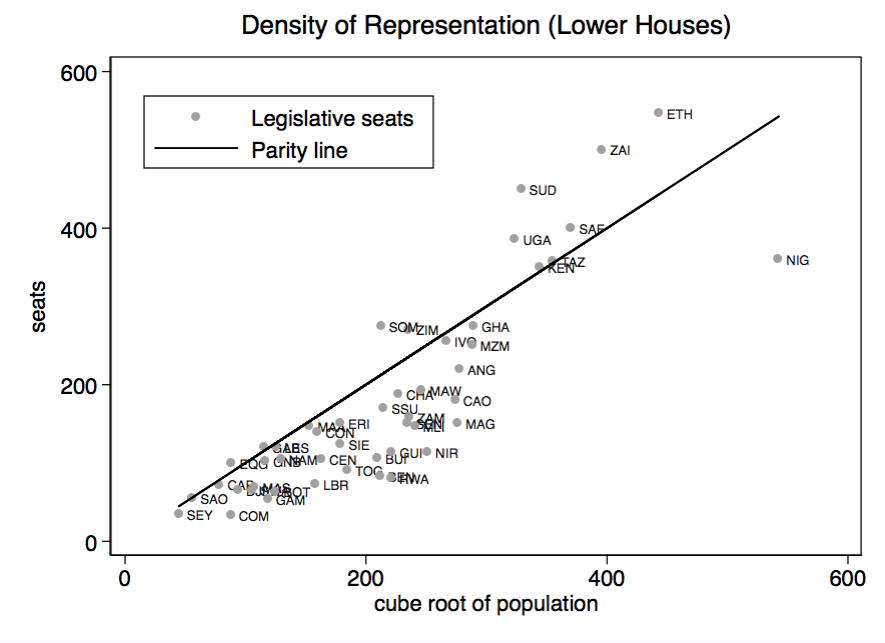
legseatsThe standard metric in Political Science for comparing the density of representation was developed by Rein Taagepera in the early 1970s. The Taagepera formula predicts that assembly sizes tend to approximate the cube root of the total population of states. In the dissertation I looked at how African states faired according to this metric (see figure) and found that the vast majority of countries on the Continent have relatively smaller assemblies than would be predicted by their population sizes (the figure only captures the sizes the lower houses). Somalia, Uganda, Sudan, the DRC, South Africa, and Ethiopia are the clear outliers. Incidentally, Kenya’s National Assembly is right on the parity line.

The usefulness of this metric (at the national level) diminishes beyond a certain population size. For countries with hundreds of millions of people or more, it makes more sense to apply the formula with respect to sub-national assemblies, if they exist. This is for the simple reason that beyond a certain number of seats the legislature would become too big to reasonably be able to conduct its business (see Nigeria).

Most read posts in 2014

Here are the top posts in 2014

1. Corruption under apartheid South Africa: This post was top partly because of the 2014 South African elections. More on the legacies of apartheid era corruption and rent-seeking in South Africa here.

2. Kenya Security Laws (Amendment) Bill 2014: This bill (now an Act of Parliament) is further evidence of Uhuru Kenyatta’s autocratic tendencies. I personally don’t think that he is an incarnation of Moi or other dictators of years gone. Rather, Mr. Kenyatta is a poor administrator who likes taking shortcuts to get quick results. As I argued in a related post, the Security Laws (Amendment) Act 2014 could potentially severely limit civil liberties in Kenya.

3. Did European Colonialism Benefit Africans? The popularity of this post is perhaps a reminder that more research is needed on the long-run effects of colonialism not just in Africa but in other formerly colonized places as well. So far all the literature tells us is that colonialism was bad, but that the Western institutions that Europeans spread around the globe are good. More recently we’ve seen evidence that pre-colonial institutions in the colonies were pretty resilient in the face of colonial intrusion; and have had lasting effects (also remember that the duration and intensity of colonialism varied widely across the globe). One avenue of research that I have been exploring is how pre-colonial institutions interacted with colonial administrations, and how this shaped the institutions that emerged out of the independence wave of the early 1960s. More on this in the new year.

4. Why Raila Odinga Lost: A sizable proportion of Kenyans still believe that Odinga was robbed in the March 2013 election in Kenya. I disagree. In my own projections on this blog – merging disaggregated opinion polls with historical district turnout rates (perks of having a case with tight ethnic voting) – I found Mr. Kenyatta to be ahead of Mr. Odinga by about 740,000 votes, or 7.2 percentage points (which was close to the final official figure of 6.7% difference between the two).

I don’t think that Kenyatta won in the first round, but do believe that we would have trounced Odinga in a runoff anyway. Which is why I have never come to terms with the unanimous Supreme Court decision granting Kenyatta victory on the basis of less than 9000 votes out of 12.3 million cast.

5. Understanding Uganda’s Military Adventurism Under Museveni: General President Museveni has managed to create an image of himself as the anti-terror hatchet man in the wider horn of Africa region. Ugandan troops are the backbone of the AU mission in Somalia (AMISOM). Since his triumphant entry into Kampala in 1986 Museveni has also been involved in conflicts in Rwanda, the DRC, Sudan, C.A.R, and more recently South Sudan. Because of the degree of militarization of the Ugandan state and recent public displays of intra-elite friction, I think Uganda will continue to inch up in the coup sweepstakes ahead of the 2016 election.

Meanwhile in the Central African Republic

According to Doctors Without Borders (MSF):

We are talking about up to one million IDPs and refugees, out of a population of 4.6 million. This accounts for 20% of the population, which is outrageous when we take into consideration these communities were already very fragile in a disrupted country, where health services outside Bangui would be practically non-existent if not for the presence of MSF in seven different regions. This past year has pushed the population to the edge of the abyss. The deployment of MSF has been huge, spectacular and swift in order to respond rapidly and provide emergency medical care. However the population is still in dire need of more assistance, including medical care. And above all, the population needs safety and security.

CAR is scheduled to hold elections either later this year or early next to speed up the transition to normalcy (France wants out ASAP). The hope, I presume, is that whoever wins the election will bring political order to the former Central African Empire. Fingers crossed?

On a related note, the US recently announced new military aid to Uganda, including four CV-22 Ospreys and an additional 150 Special Operation troops (to join the 100 deployed in 2011) in an effort to step up the hunt for Joseph Kony, leader of the Lord’s Resistance Army (LRA). Kony is suspected to be in hiding in the border regions CAR, the DRC, Sudan and South Sudan. Of course this rather bizarre decision (is Kony really that much of a priority right now in the Great Lakes Region?) is motivated by the need to keep the Ugandan military in top shape and ready to fight in places the US doesn’t want to set foot

What if the US and the EU also had a humanitarian equivalent of Uganda? You know, a country that could be just as well funded with cash and equipment to wade into troubled places like CAR and South Sudan and provide humanitarian assistance backed by credible firepower. What if? It might even help shore up some of the soft power the US (and the West in general) is haemorrhaging fast on account of the developmental interventions from the East in the wider region. 

Understanding Uganda’s Military Adventurism Under Museveni

On January 15th 2014 President Yoweri Museveni finally admitted that Uganda People’s Defence Force troops are engaging in combat operations within South Sudan. Right after the political fallout in Juba and escalation of hostilities between forces loyal to President Salva Kiir and those behind his former deputy Riek Machar, Mr. Museveni threatened Machar with military action if he did not come to the table to negotiate with Kiir. Museveni’s military involvement in the conflict has caused concern in Nairobi and other capitals in the region. For one, Uganda’s military intervention in the conflict may yet jeopardize the ceasefire agreement that was signed on January 23, 2014 in Addis Ababa. The regional body IGAD (Intergovernmental Authority on Development) is supposed to be a neutral arbiter and monitor in the conflict. Museveni’s clear leanings towards the government in Juba may bring to question IGAD’s neutrality in the mediation effort.

For historical reasons (see below) Khartoum fears Kampala’s military involvement in South Sudan. But this time the situation is slightly different, and a little more complex. Bashir has already shown his hand in support of Juba against Machar, possibly for two reasons: (i) Khartoum needs Juba’s help in weakening the rebellion by the rump SPLA (SPLA-North) that is still active in Blue Nile and South Kordofan, regions that border South Sudan; and (ii) Bashir needs to keep the oil flowing in order to ward off internal turmoil within Sudan due to rapidly deteriorating economic conditions (see here). Kiir’s willingness to throw SPLA-N under the bus comes as no surprise since it is an offshoot of the “Garang Boys” (mostly PhDs) who occupied a special place, unlike Kiir and others, in John Garang’s SPLA. SPLM-N’s leader Malik Aggar, shared Garang’s vision of one united reformed Sudan, as opposed to secession by the South. At the same time, however, Khartoum does not want a super strong South Sudan free of rebels. Total cessation of conflict in South Sudan would rob Khartoum of proxies to keep Juba in check. Uganda’s involvement could tip the balance in Juba’s favor vis-à-vis potential Bashir allies.

Meanwhile in Nairobi and Addis Ababa concern is growing over Uganda’s claim that the IGAD should foot the bill of UPDF’s adventures in South Sudan. Both Ethiopia and Kenya prefer settling the conflict at the negotiating table, partly because both have their security forces stretched by domestic armed groups and bandits and the war in Somalia. Kenya has said categorically that it will not send troops to South Sudan, even under IGAD. The wariness in Nairobi and Addis to send troops or cash for a military cause in South Sudan contrasts sharply with Kampala’s choice of military action from the moment the current flare up started in Juba. This despite the fact that Uganda also has troops serving in Somalia.

Which raises the question: What explains Uganda’s international military adventurism under Museveni? The answer lies in the confluence of history, international geopolitics, and Uganda’s internal politics.

Uganda is one of the more militarized states in Africa, with the military having direct representation in parliament (10 seats). It is also interventionist, with a history of combat engagement and support for rebel groups in six neighboring states – Burundi, the Central African Republic (CAR), the Democratic Republic of Congo (DRC), Rwanda, Somalia, and South Sudan. More recently, the nation has been a key advocate for greater integration within the East African Community (EAC). Indeed, Ugandan President Yoweri Museveni fancies himself as a possible head of an EAC political federation should it ever materialize. Uganda is also a key player in the African Capacity for Immediate Response to Crises (ACIRC), a proposed standby force with capacity to rapidly deploy troops to trouble spots in Africa (other key supporters include South Africa, Chad, and Tanzania).

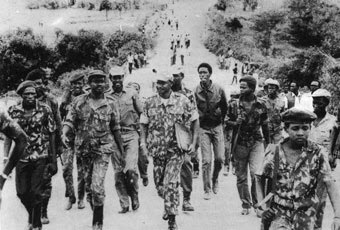
Museveni and his kagogo (little) soldiers

Museveni and his kadogo (little) soldiers

President Yoweri Museveni’s military adventurism and internationalist outlook have deep roots. As a young student in Tanzania, Museveni was involved in exile organizations opposed to Iddi Amin. Indeed, Museveni’s National Resistance Army (NRA), started off as the Popular Resistance Army (PRA) in Tanzania (As testament to its Tanzanian roots, NRA borrowed the idea of political commissars from the Tanzanian military to educate civilians in “liberated” Luweero Triangle). In Tanzania and even after returning to Uganda Museveni made regional connections that he maintained even after he ascended to power in 1986 – including Rwanda’s Paul Kagame, Sudan’s John Garang’, and leaders of Mozambique’s FRELIMO. Before rebelling against Kigali, Kagame was Museveni’s Chief of Military Intelligence. Museveni supported Garang’s Sudan People’s Liberation Army (SPLA).

Once in power, Museveni styled himself as the guarantor of peace and stability in Uganda. Many (both at home and abroad) evaluated his performance relative to the disastrous years under Amin and the ensuing civil war. The resulting peace dividend (albeit restricted to the south of the country) was marked by relative macro-economic stability, with growth averaging about 6% for much of the 1990s. This made Museveni a darling of Western donors and international financial institutions. However, Museveni’s record with regard to democracy and human rights remained dubious. This put him in awkward position vis-à-vis the West, especially since the 1990s was the zenith of Western promotion of liberal democracy.

To this Museveni reacted cleverly, and worked hard to position Uganda as a strategic player in the wider region’s geopolitics. In order to maintain his international stature and secure his position domestically, Museveni labored to bolster Uganda’s relevance to the West.

Museveni enters Kampala (Source)

Museveni enters Kampala (Source)

Beginning in the early 1990s, Uganda got militarily involved in a number of neighboring states. Support for Garang’s SPLA drew the ire of Khartoum, which in turn supported the Lord’s Resistance Army (LRA) in northern Uganda. Subsequently, the Ugandan military conducted raids against LRA bases in Sudan while also offering combat assistance to the SPLA. For instance, the 1997 battle at Yei featured Ugandan soldiers alongside the SPLA against the Sudan Armed Forces (SAF). It is around this time that the seed was planted for future military involvement abroad at the turn of the century (this time in Somalia under the Western-funded AU mission, AMISOM, to help stabilize the country). After US President Bill Clinton designated Sudan as a state sponsor of terror, Uganda positioned itself as an ally in the frontline of “Global War on Terror.” Kampala served as an intermediary for US aid to SPLA, thereby further strengthening US-Uganda military ties. It is telling that in 2003 Uganda was among only a handful of African states that supported the US-led Iraq War. About 20,000 Ugandans worked in US military bases in Iraq (this was also an excellent job creation tool; and a way of earning Forex).

So far Uganda’s most complex military adventure was in the Democratic Republic of Congo (DRC). A mix of strategic geopolitical positioning, the need to secure markets for Ugandan goods, private greed and domestic politics drove Uganda’s invasion of the DRC. The first Congo War (1996-97) was swift, aimed at helping Laurent Kabila oust Mobutu Seseseko (Rwanda and Angola also helped). Soon after Uganda and Rwanda fell out with Kabila, occasioning the Second Congo war (1998-2003), which involved four other African states. It is then that the façade of intervention for regional stability completely broke down. Ugandan and Rwandan commanders exploited existing and new cross-border smuggling and semi-legitimate trade networks to orchestrate massive pillaging of natural resources in eastern DRC (Competition between the two militaries later intensified, resulting in the “Kisangani Wars.”)

For instance, in the year 2000 despite only producing 0.00441 tonnes of gold, Uganda exported 11 tonnes. A UN report indicates that well-connected generals (including Museveni’s half-brother) created entities headquartered in Kampala to facilitate the illicit trade. It’s important to note that Museveni’s tolerance of the semi-autonomous activities by his generals was strategic (it generated revenue through Kampala-based entities and kept the generals happy) and did not lead to fracturing within the military. Indeed, many of those involved were later promoted.

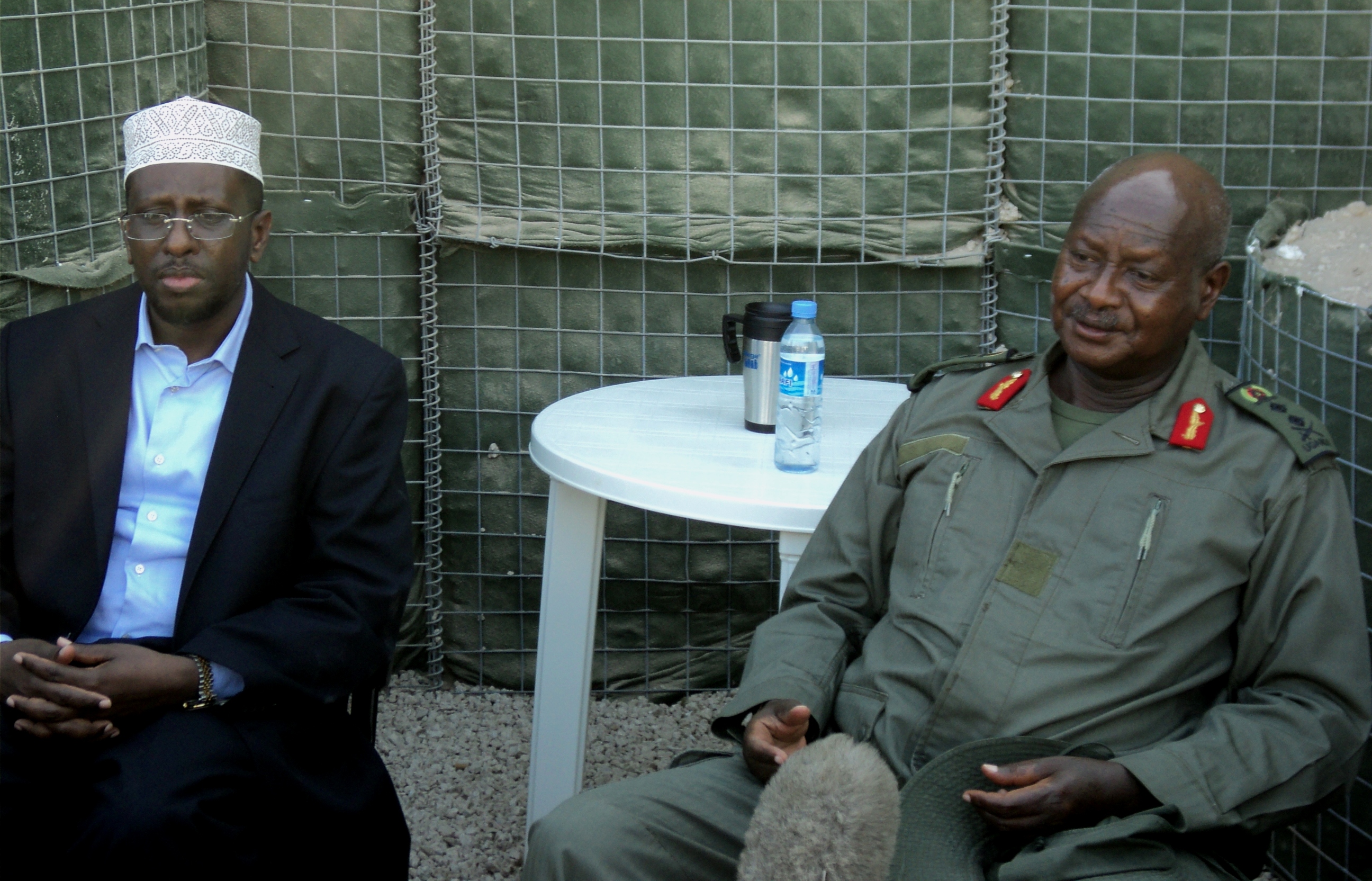
Museveni meets Somali President, Shayk Sharif Ahmed in Mogadishu in 2010


Incidentally, the present involvement in South Sudan also reflects the multifaceted logic of Ugandan international military adventurism. Historical alliances with the SPLA against the LRA and SAF make Kampala and Juba natural bedfellows. But the intervention is also about securing markets for Ugandan goods. According to figures from the Bank of Uganda, in 2012 the country’s exports to South Sudan totaled an estimated USD 1.3 billion. About 150,000 Ugandan traders operate across the border, not to mention countless more primary producers in agriculture who benefit from cross-border trade with their northern neighbor.

The above account explains Museveni’s efforts in the recent past to build an image as the regional powerbroker: heading peace talks between the DRC, Rwanda and eastern DRC rebels; intervening in Somalia to prop up the government in Mogadishu; and in the latest episode siding militarily with President Salva Kiir in South Sudan’s domestic political cum military conflict. Domestically, Museveni’s grip on power is as strong as ever. Recent reshuffles in the military removed powerful Historicals (the original “bush war heroes”) thereby leaving Museveni (and his son) firmly in control of Uganda’s armed forces. There is no end in sight for Uganda’s international military adventurism.

In many ways Uganda’s international adventurism has been a case of agency in tight corners. The country is a landlocked; has neighbors with sparsely governed borderlands that provide rear-bases for Ugandan armed groups; and Kampala needs Western aid to maintain the regime, a situation that necessitates acts of geopolitical positioning – especially with regard to the “Global War on Terror” and maintenance of regional peace and stability. Furthermore, oil discovery along the conflict-prone DRC border on Lake Albert and the need for pipelines to the sea to export Ugandan oil will necessitate even greater regional involvement. So while Uganda’s present outward adventurism is primarily because of Museveni’s peculiar personal history, it is correct to say that even after Museveni (still far into the future) the country will continue to be forced to look beyond its borders for economic opportunities, security, and regional stature.

No, the West should not have governed South Sudan

In light of the ongoing civil war in South Sudan, Chris Blattman posed the question of whether the West should have governed South Sudan. My simple answer is that neotrusteeship would not have helped much with regard to long-term institutional stability in South Sudan, for the following reasons:

  • Neotrusteeship would still entail the same logic of old-style colonialism, only with a shorter time horizon. Whichever entity was designated as the ruler of Sudan – be it the UN, the State Department or the Foreign Office – would be working on a fixed timeline, with an exit strategy in mind. As Fearon and Laitin (gated) aptly noted: “In sharp contrast to classical imperialists, neotrustees want to withdraw as fast as possible. References to “exit strategy” have led the policy discourse and debate surrounding international and U.S. operations in the Balkans, East Timor, Sierra Leone, Afghanistan, and now Iraq.” Assuming that South Sudanese elite are rational, they would play the game, if forced to, and bid their time until the overlords left and then they would get down to the business of settling their grievances. The building of institutions, unlike learning a language or programing, is not something that you are taught and then left on your own to practice. Institutions only work if they reflect the de facto balance of power, something that trusteeship would necessarily not provide. And what would be the time horizon? How long would it take to build good institutions? As Fearon and Laitin note, “….due to the sources of the civil wars that lead to collapsed states, successful exit from neotrusteeship will be extremely difficult in most cases. We have stressed the need to develop local tax-collecting capability as an incentive to move the country from international welfare toward self-governance and, in some cases, the notion of transfer not to full sovereignty but rather as a state embedded in and monitored by international institutions.” 
  • The proposed exit strategy would probably be elections. Such elections would most likely favor those that played the game well under neotrusteeship, possibly the favored choice of the Western administrators [to pay back Western tax dollars, time and connections, etc with contracts and influence in the post-trusteeship era]. But this is not the way to do it. Electoral democracy would then necessarily be used by disgruntled elites who were not given a seat at the table to correct the ills of the era of neotrusteeship. Depending on the outcomes, failure at the ballot would probably lead to armed conflict.
  • Also, the period 1952-1957 was not a benelovent neotrusteeship but the last mile of British Colonialism in Ghana. I would have liked to hear more discussion of post-1957 Ghana by Pascal Zachary and how it is a good lesson on the virtues of neotrusteeship. Are we to forget what Nkrumah did right after ascending to the Political Kingdom and all that happened in Ghana between 1957 and 1981 when Jerry Rawlings finally brought order to the political process with an iron fist?
  • Lastly, a Western-run neotrusteeship would fly in the face of current IR norms and the structural reality of the present international system. I think the myth of the benevolent disinterested Western institution-builder [known in an earlier time as a civilizer] should be put to rest. China and Russia [and probably the African Union] would oppose such a move and work to make it fail. So even if it were workable in theory, something that I highly doubt, reality would render the point moot.

In my view the talk about neotrusteeship as the solution to weak state institutions is an attempt to avoid the ugly face of the state-building process. No one likes paying taxes to another dude who uses it to buy a private jet. Throughout human history states have been imposed on people against their will, most of the time with force. The challenge in South Sudan is not that the leaders had not learned how to govern efficiently, and therefore all we need to do is train them for a few years, but rather that Kir did not have the capacity and full control over the army to credibly deter Machar and his allies from attempting to take power by force.

Put differently, state-building is not value-neutral because it requires the threat or actual use of force, which implies the taking of sides. The logics of local insatiability and time inconsistent preferences dictate that chaps will always want to reorganize existing institutional arrangements. The only thing that prevents them from doing so – from Denmark to CAR – is the difference in the costs of doing so. Even in democracies, people are restricted on how often they can throw out their elected leaders, with a credible threat of the use of force in place to make sure that people obey and accept the outcome of elections [PLEASE read Terry Moe on power and political institutions]. Democratic state-building (the means most preferred on account of our 21st century sensibilities) in the context of weak or severely truncated coercive capacity is very hard.

Seen this way, neotrusteeship can only be useful in the short-term to prevent mass atrocities, the creation of safe heavens for transnational terror networks, and provide an environment for a less violent process of institutional development. But it certainly cannot generate the state institutions required for long-term political stability.

I definitely appreciate the need for international assistance in the process of building institutions in young states. But with regard to strategies of long-term state-building I tend to lean more toward Jeremy Weinstein’s idea of “autonomous recovery” which stresses the need to identity and understand

 “internal processes of change that give rise to successful state-building, the conditions under which these internal mechanisms are likely to work, and the lessons international actors can draw from autonomous recovery for efforts to bring conflict to an end. Although it may be difficult to accept, one of the key lessons is that sometimes it makes sense not to intervene, or to intervene actively on behalf of one side.

To echo Weinstein:

……….. The durable resolution of the world’s civil wars will depend to a large degree on how  quickly international actors incorporate the lessons of history into current strategies. To reconstitute states with governments capable of projecting power, the international community must be prepared to identify and recognize legitimate and effective governance (in whatever form it takes). And if the political change that war produces is to survive the end of the fighting, international actors must develop new approaches to both support and constrain the winners as they consolidate power in the aftermath of conflict.

How Eastern Africa can avoid the resource curse

This post originally appeared on the African Development Bank’s Integrating Africa Blog, where yours truly is a regular contributor. 

Eastern Africa is the new fossil fuel frontier (for more check out this (pdf) Deloitte report). In the last few years Kenya, Uganda, Tanzania and Mozambique have discovered large quantities of commercially viable oil and gas deposits, with the potential for even more discoveries as more aggressive prospecting continues. There is reason to be upbeat about the region’s economic prospects over the next three decades, or at least before the oil runs out. But the optimism must be tempered by an acknowledgement of the dangers that come with the newfound resource wealth. Of particular concern are issues of governance and sound economic management.

We are all too aware of the dangers of the resource curse. This is when the discovery and exploitation of natural resources leads to a deterioration of governance, descent into autocracy and a fall in living standards. Associated with the resource curse is the problem of the Dutch disease, which occurs when natural resource exports (e.g. oil and gas) lead to an appreciation of the exchange rate, thereby hurting other export sectors and destroying the ability of a country to diversify its export basket. The new resource-rich Eastern African states face the risk of having both problems, and to avoid them they must cooperate.

In many ways Eastern African states are lucky to be late arrivals at the oil and gas game. Unlike their counterparts in Western and Central Africa, nearly all of them are now nominal electoral democracies with varying degrees of institutionalized systems to ensure transparency in the management of public resources. Across the region, the Big Man syndrome is on the decline. But challenges remain. Recent accusations of secrecy, corruption and bribery surrounding government deals with mining companies suggest that there is a lot of room for improvement as far as the strengthening of institutions that enforce transparency (such as parliaments) is concerned. It is on this front that there is opportunity for regional cooperation to improve transparency and resource management.

While it is easy for governments to ignore weak domestic oversight institutions and civil society organizations, it is much harder to renege on international agreements and treaties. A regional approach to setting standards of transparency and accountability could therefore help ensure that the ongoing oil and gas bonanza does not give way to sorrow and regret three decades down the road. In addition, such an approach would facilitate easier cross-border operations for the oil majors that are currently operational in multiple countries, not to mention drastically reduce the political risk of entering the region’s energy sector. It would also leave individual countries in a stronger bargaining position by limiting opportunities for multinational firms to engage in cross-border regulatory arbitrage.

The way to implement regional cooperation and oversight would be something akin to the African Peer Review Mechanism, but with a permanent regional body and secretariat (perhaps under the East African Community, EAC). Such a body would be mandated to ensure the harmonization of laws to meet global standards of transparency and protection of private property rights. The body would also be mandated to conduct audits of national governments’ use of revenue from resources. The aim of the effort would be to normalize best practices among states and to institute a global standard for states to aspire more – more like the way aspirations for membership in the European Union has been a catalyst for domestic reforms in the former Yugoslavia and Eastern Europe.

Regional cooperation would also provide political cover to politicians with regard to economically questionable fuel subsidies. The realities of democratic government are such that politicians often find themselves forced to concede to demands for fuel subsidies from voters. But history shows that more often that not subsidies come at an enormous cost to the economy and instead of benefitting the poor only benefit middlemen. In addition, as the case of Nigeria shows, once implemented such policies are never easy to roll back both due to politics and the power of entrenched interests. Regional agreements capping any fuel subsidies at reasonable levels would be an excellent way to tie politicians’ hands in a credible manner, while at the same time providing them with political cover against domestic criticism.

Beyond issues of governance, there is need for cooperation on regional infrastructure development in order to reap maximum value for investment and avoid unnecessary wastes and redundancies. Landlocked Uganda and South Sudan will require massive investments in infrastructure to be able to access global energy markets. The two countries’ oil fields are 1,300 km and 1,720 km from the sea through Kenya, respectively. One would hope that as these projects are being studied and implemented, there will be consideration for how to leverage the oil and gas inspired projects to cater to other exports sectors – such as agriculture, tourism and light manufacturing – as well. KPMG, the professional services firm, recently reported that transportation costs eat up as much as 20 per cent of Africa’s foreign exchange earnings.  There is clearly a need to ensure that the planned new roads and railways serve to reduce the cost of exports for all outward oriented sectors in the region. Embedding other exports sectors (such as agriculture, timber, domestic transport, etc.) in the process of developing new transportation infrastructure will minimize the likelihood of their being completely crowded out by the energy sector.

In isolation, each country’s resource sector policy is currently informed by domestic political economy considerations and regional geo-politics. There is an emerging sense of securitization of resources, with each country trying to ensure that the exploitation of its resources does not depend too much on its neighbours. Because of the relatively small size of the different countries’ economies, the risk of ending up with economically inefficient but expensive pipelines, roads and railways is real. South Sudan is currently deciding whether to build a pipeline through Kenya (most likely), through Ethiopia, or stick with the current export route for its oil through Sudan (least preferred due to testy relations). For national security and sovereignty reasons, Uganda is planning on a 30,000-barrel per day refinery in Hoima, despite warnings from industry players that the refinery may not be viable in the long run. Some have argued for the expansion of East Africa’s sole refinery in Mombasa to capture gains from economies of scale, an option that Uganda feels puts its energy security too much in Kenya’s hands.

In the meantime, Kenya and Tanzania are locked in competition over who will emerge as the “gateway to Eastern Africa,” with plans to construct mega-ports in Lamu and Tanga (Mwambani), respectively. While competition is healthy and therefore welcome, this is an area where there is more need for coordination than there is for competition among Eastern African governments. The costs involved are enormous, hence the need for cooperation to avoid any unnecessary redundancies and ensure that the ports realize sufficient returns to justify the investment. Kenya’s planned Lamu Port South Susan Ethiopia Transport Corridor (LAPSSET) project will cost US $24.7 billion. Tanzania’s Mwambani Port and Railway Corridor (Mwaporc) project will cost US $32 billion.

Chapter 15 of the EAC treaty has specific mandates for cooperation in infrastructure development. As far as transport infrastructure goes, so far cooperation has mostly been around Articles 90 (Roads), 91 (Railways) and 92 (Civil Aviation and Air Transport). There is a need to deepen cooperation in the implementation of Article 93 (Maritime Transport and Ports) that, among other things, mandates the establishment of a common regional maritime transport policy and a “harmonious traffic organization system for the optimal use of maritime transport services.”

The contribution of inefficient ports to transportation costs in the regional cannot be ignored. Presently, the EAC’s surface transportation costs, associated with logistics, are the highest of any region in the world. According to the African Development Bank’s State of Infrastructure in East Africa report, these costs are mainly due to administrative and customs delays at ports and delays at borders and on roads. Regional cooperation can help accelerate the process of reforming EAC’s ports, a process that so far has been stifled (at least in Kenya) by domestic political constituencies opposed to the liberalization of the management of ports. The move by the East African Legislative Assembly to pass bills establishing one-stop border posts (OSBPs) and harmonized maximum vehicle loads regulations is therefore a step in the right direction.

Going back to the issue of governance, more integrated regional cooperation in the planning and implementation of infrastructure development projects has the potential to insulate the projects from domestic politics and patronage networks that often limit transparency in the tendering process. Presently, Uganda is in the middle of a row with four different Chinese construction firms over confusion in the tendering process for a new rail link to South Sudan and port on Lake Victoria. The four firms signed different memoranda with different government departments in what appears to be at best a massive lapse in coordination of government activities or at worst a case of competition for rents by over-ambitious tenderpreneurs.  This does not inspire confidence in the future of the project. A possible remedy to these kinds of problems is to have a permanent and independent committee for regional infrastructure to oversee all projects that involve cross-border infrastructure development.

In conclusion, I would like to reiterate that Eastern Africa is lucky to have discovered oil and gas in the age of democracy, transparency and good governance. This will serve to ensure that the different states do not descend into the outright kleptocracy that defined Africa’s resource sector under the likes of Abacha and Mobutu in an earlier time. That said, a lot remains to be done to ensure that the region’s resources will be exploited to the benefit of its people. In this regard there is a lot to be gained from binding regional agreements and treaties to ensure transparency and sound economic management of public resources. Solely relying on weak domestic institutions and civil society organizations will not work.

Petro-Politics in East Africa

Is LAPSSET under threat? May be.

The Economist reports:

The Lamu pipeline makes the most economic sense for all involved. But failure to work together may doom it. National and personal interests trump regional co-operation and commercial logic. In Uganda Mr Museveni is keen to settle his legacy as the champion of a strong nation, building vast refineries and spiting the tiresome Kenyans. South Sudan is fixated on warding off the north at the expense—it seems—of almost everything else. Ethiopia sees a chance to steal Kenya’s thunder, too. “It’s every guy for himself,” says an oil executive wryly. “And I thought the private sector is rough.” Pipeline politics makes a mockery of the East African Community, a bloc dedicated to regional co-operation. All but one of the countries are members or aspire to join.

Of late, a new momentum behind the oil push is being felt. The Ugandan government is in final production talks with three oil companies. Executives from Tullow, Total and the China National Offshore Oil Corporation (better known as CNOOC), as well as local civil servants, conferred with Mr Museveni at his farm near the Rwandan border in late April. In June South Sudan will finish a feasibility study for the Ethiopian pipeline to Djibouti, after which it has said it will make a decision on export routes. “Everything is up in the air,” says a diplomat. Kenyan and Ethiopian officials, as well as oil-company representatives, have been scurrying to Juba to make their case. Pagan Amun, who leads South Sudan’s talks with the north, is said to be keen to ditch the Lamu pipeline.

My guess is that Nairobi, for historical reasons, will prevail in Juba. Plus Juba and Addis are not the best of buddies, despite recent warm relations. Mengistu was a key ally and supplier of SPLM before he was overthrown by Meles and his army. The departure of Meles may have made things a little better. Time will tell. Uganda will most likely construct a mini-refinery as it is not integral to the implementation of LAPSSET.

The 2013 Resource Governance Index

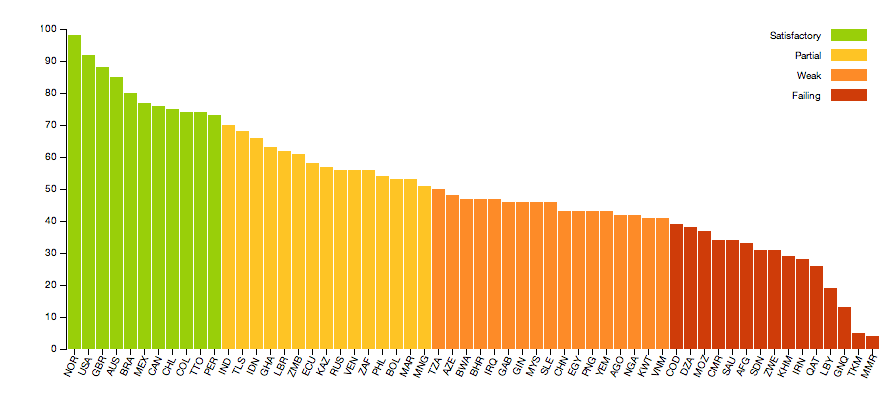
The 2013 Resource Governance Index (published by the Revenue Watch Institute) is out. The top performing African countries include Ghana, Liberia?, Zambia and South Africa, with partial fulfillment. The bottom performing countries are Equatorial Guinea, Zimbabwe, South Sudan, the Democratic Republic of Congo and Mozambique.

The 58 nations included in the report “produce 85 percent of the world’s petroleum, 90 percent of diamonds and 80 percent of copper.” Ghana, where we are doing some evaluation  work on extractive sector transparency initiatives, is the best performing African country on the list. Image

More here. 

And in related news, The Africa Progress Report was released last week. The report details the massive loss of revenue by African governments through mismanagement – either by commission and/or omission – of extractive resources. For instance:

The report details five deals between 2010 and 2012, which cost the Democratic Republic of the Congo over US$1.3 billion in revenues through the undervaluation of assets and sale to foreign investors. This sum represents twice the annual health and education budgets of a country with one of the worst child mortality rates in the world and seven million pupils out of school.

The DRC alone is estimated to have 24 trillion dollars worth of untapped mineral resources.

The most bizarre case of resource management in Africa is Equatorial Guinea, a coutnry that is ranked 43rd on the global per capital GNI index but ranks 136th on the Human Development Index (2011).

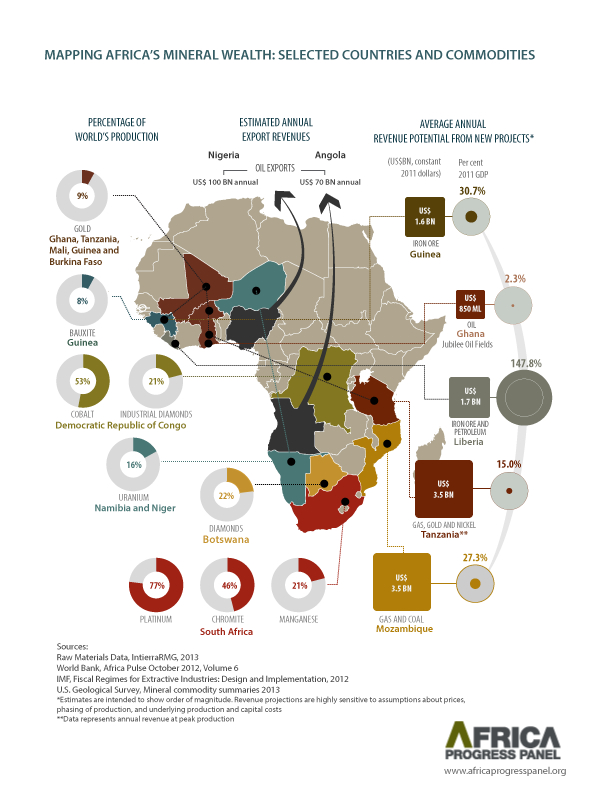
Below is a map showing flows related to Africa’s vast resources:

RESOURCE-MAP

US Africa Policy, A Response

This is a guest post by friend of the blog Matthew Kustenbauder responding to a previous post.

On the question of human rights guiding America’s foreign policy in Africa, I agree with you; it shouldn’t be the first priority. The US needs a more pragmatic development diplomacy strategy, which would help African countries develop just as it would help American businesses thrive.

But I disagree with your characterization of Hillary’s position in this respect. Here’s Secretary Clinton’s own words:
“Last year I laid out America’s economic statecraft agenda in a series of speeches in Washington, Hong Kong, San Francisco, and New York. Since then, we’ve accelerated the process of updating our foreign policy priorities to take economics more into account. And that includes emphasizing the Asia Pacific region and elevating economics in relations with other regions, like in Latin America, for example, the destination for 40 percent of U.S. exports. We have ratified free trade agreements with Colombia and Panama. We are welcoming more of our neighbours, including Canada and Mexico, into the Trans-Pacific Partnership process. And we think it’s imperative that we continue to build an economic relationship that covers the entire hemisphere for the future.” 
“Africa is home to seven of the world’s ten fastest-growing economies. People are often surprised when I say that, but it’s true. And we are approaching Africa as a continent of opportunity and a place for growth, not just a site of endless conflict and crisis. All over the world, we are turning to economic solutions for strategic challenges; for example, using new financial tools to squeeze Iran’s nuclear program. And we’re stepping up commercial diplomacy, what I like to call jobs diplomacy, to boost U.S. exports, open new markets, lower the playing field – level the playing field for our businesses. And we’re building the diplomatic capacity to execute this agenda so that our diplomats are out there every single day promoting our economic agenda.” 

One of the problems, however, is that the pragmatic approach articulated by the Secretary doesn’t trickle down through the bureaucracy. This is especially true, ironically, of the State Department’s primary development diplomacy arm, USAID, which has a deeply entrenched culture of being anti-business. It’s a huge problem, and part of the reason why American foreign policy in Africa has been so slow to adjust to new economic realities.

Security drives US Africa Policy

Security drives US Africa Policy

Academics schooled in all the latest development orthodoxies but lacking the most basic understanding of economic or business history have flocked to USAID, so that the suggestion that American economic interests should guide development policy – making it a win-win for Africa and America – is anathema. It’s also why the Chinese are running all over the US in Africa.

As a prominent economic historian recently remarked in the Telegraph, “While we [Western governments] indulge our Victorian urge to give alms to the Africans, Beijing is pumping black gold.” And this is just it. As long as the US approaches Africa as a beggar needing to be saved and not as a business partner worthy of attention, both sides will continue to lose out.

In this respect, what Africa does not need is another “old Africa hand” steeped in conventional development ideas and old dogmas about what’s wrong with Africa and why the US must atone for the West’s sins. For this reason alone, John Kerry – not Susan Rice – probably stands a better chance, as the next Secretary of State, at putting American foreign policy toward Africa on a more solid footing.

– Matthew Kustenbauder is a PhD candidate in history at Harvard University.

Meles Zenawi, Prime Minister of Ethiopia, is dead at 57

The BBC reports:

Ethiopian Prime Minister Meles Zenawi has died at the age of 57, state media say, after weeks of illness. A government spokesman said Mr Meles had died in a hospital abroad – but did not say exactly where or give details of his ailment. Speculation about his health mounted when he missed an African Union summit in Addis Ababa last month.

Mr. Zenawi is believed to have died in a Belgian hospital – the Saint-Luc University Hospital in Brussels (where he was allegedly receiving treatment for an acute case of hematologic cancer). The last time he was seen in public was on the 19th of June 2012 at the G20 summit in Mexico.

For now the leadership transition in Ethiopia, Sub-Saharan Africa’s second most populous country, appears to have gone smoothly. According to the BBC report, the deputy Premier – Hailemariam Desalegn – will take over.

Mr. Desalegn is from the south of Ethiopia, away from the political centre of gravity of the country, which for centuries has been to the north – in Tigray and Amhara dominated areas.  

It is not yet clear if the smooth transition will stick. As the Economist reported a couple of weeks ago:

“power [in Ethiopia] has still rested with a clutch of Mr Meles’s comrades from his home area of Tigray in northern Ethiopia, many of them once members of a Marxist-Leninist group that used to admire Albania’s long-serving Communist leader, the late Enver Hoxha. This hard core, including the army’s chief of staff, General Samora Younis, retains a “paranoid and secretive leadership style”, according to a former American ambassador to Ethiopia, David Shinn. Were Mr Meles to leave in a hurry, relations between the young modernisers and the powerful old guard might fray.”

Under Mr. Zenawi (May 1991- Aug. 2012) Ethiopia was a mixed bag. His rule was characterized by one of the worst human rights records in the world. But he also brought some semblance of stability following the misguided and murderous Marxist-Leninist dictatorship of the Derg under Mengistu Haile Mariam; and presided over an economy with one of the fastest growth rates on the Continent.

It is also under Meles Zenawi that Ethiopia invaded Somalia to rid it of the Islamic Courts Union (ICU) which was beginning to spread Somalia’s chaos into Ethiopia’s Ogaden region (it helped that the U.S. also wanted the ICU ousted from Mogadishu because of their alleged links of al-Qaeda).

A recent profile in the Atlantic summarizes it all:

“for every Muammar Qaddafi there’s a Meles Zenawi, the shrewd, technocratic Prime Minister of Ethiopia. Inside of the country, he’s known for imprisoning his political opponents, withholding development assistance from restive areas, stealing elections, and cracking down on civil society NGOs. In the rest of the world, he’s often praised for his impressive economic record, though not for his human rights. Zenawi has attracted Western support by being a responsible steward of aid money, a security partner in a rough region, and a G20 summit invitee.”

I remain cautiously optimistic that the Ethiopian ruling elite will pull through the rocky transition period. The next elections are due in 2015. In the current parliament the ruling party, the EPRDF, and its allies control nearly all of the 547 seats.

Beyond Ethiopia’s borders, the absence of Mr. Zenawi will certainly be felt in Somalia (which is presently struggling to get on its feet after decades of total anarchy and whose government partly depends on Ethiopian troops for security) and South Sudan (where Addis Ababa has been a broker in past conflicts between Khartoum and Juba). Ethiopia’s hostile relationship with Eritrea might also experience some change, most likely for the worse as whichever faction emerges victorious in Addis engages in sabre rattling in an attempt to prove their hold on power.

Energy in East Africa

Still on my ongoing project on commodities in Africa, I came across an interesting piece on prospecting for oil in East Africa in which an industry expert had this to say:

The success rate in this region is outstanding. To provide some context, oil and gas exploration typically has a success rate just 10-20%. That’s terrible when you think about. It can cost $50 million to sink an offshore well, and the chance of making a financial return could be as low as one in ten.

But East Coast African energy exploration stands out from the crowd because in all but a few cases they hit oil or gas. To be exact — the success rate has been 87%. A strike rate of close to 9 out of 10 is almost unheard of.

Kenya, South Sudan and Uganda have commercially viable oil reserves. Tanzania has gas and, together with Kenya, has stepped up offshore prospecting in the Indian ocean.

And it is not just foreign MNCs that are in on the game. Locals, in collaboration with foreign investors, are also getting a piece of the energy bonanza in East Africa. Business Daily, a Kenyan paper, recently profiled one George Kariithi, a businessman who started off as a marketing executive and has since built multiple companies in the wider region. His latest investment is in Kenya’s emerging coal sector.

Reason for African Petro-Rulers to be Worried

Africa’s petrorulers (heads of state of Angola, Cameroon, Chad, Congo-Brazzaville, Equatorial Guinea, Gabon, Ghana, Nigeria, South Sudan, and Sudan) may be headed for tough times later this year. According to a piece by (Steve Levine) over at FP, Saudi Arabia – the world’s leading oil producer – is considering flooding the global oil markets with the aim of sticking it to the Russians and Iranians. Saudi action of this nature could lower prices to as low as US $40 a barrel from the current $83.27.

With the exception of Ghana and Cameroon, such a drop in oil prices would almost certainly lead to political unrest in the rest of Africa’s oil producers. Sudan and South Sudan are already facing huge revenue shortfalls due to a dispute over the sharing of oil revenue.

More on “The Coming Oil Crash” here.

Is regionalism helping the East African Community

Evidence seems to suggest it is:

Trade between the EAC countries almost doubled from $2.2 billion in 2005 to $4.1 billion in 2010, although regional trade with the rest of the world expanded faster, meaning that the relative share of intra-EAC trade has stayed around 21 per cent since 2005 [The African Average is 11 %]. “Europe enjoys 64 per cent internal trade; our 21 per cent is better than we thought, but we have to make efforts to do better,” said Betty Maina, chairperson of the Kenya Association of Manufacturers.

Kenya still remains the biggest economy in the region, although some convergence is definitely likely to happen in the next decade or so given the large hydrocarbon discoveries in Uganda and off the Tanzanian coast.

The region’s oil consumption rose from 96,000 barrels per day in 2003 to 144,000 barrels per day in 2010, with Kenya consuming more than all the other EAC countries put together. East Africa now accounts for 10 per cent of all mobile subscribers in Africa, with the number of mobile subscribers surging from just three million in 2002 to a staggering 64 million in 2010.

More on this here.