Quick hits

UPDATE:

The Atlantic has a nice piece on the legacy of Meles Zenawi, the ailing Ethiopian Premier.

*************************

The African Union elected South African Nkosazana Dlamini-Zuma to head its executive arm, the AU Commission. Ms Dlamini-Zuma is a former wife of the polygamist South African President Jacob Zuma. I hope that with Pretoria’s success in having her elected to head the AU South Africa will take a more proactive role in leading the regional organization. As I have stated before, I think the organization needs “owners” in the form of diplomatically powerful custodians. Being the region’s biggest economy, South Africa is well placed to provide strong leadership to the African Union, if it wanted to.

Still on the AU Summit, Ethiopian Prime Minister Meles Zenawi has been conspicuously absent, fueling speculation that he is critically ill. Rumors abound that Mr. Zenawi has left the country for a Belgian hospital – the Saint-Luc University Hospital in Brussels (where he is believed to be receiving treatment for an acute case of hematologic cancer). Some opposition groups have suggested that Mr. Zenawi may have died in hospital. The last time he was seen in public was on the 19th of June. Mr. Zenawi has led Ethiopia since 1991. His record has been a mixed bag of aggressive and ambitious development projects (with results, growth has averaged over 8.4% over the last ten years) and militarism and authoritarian tendencies that have seen many opposition members detained, exiled or killed.

And in Somalia, BloombergBusinessweek reports on the massive corruption in the Transitional Federal Government.

The nearly 200-page report lists numerous examples of money intended for Somalia’s Transitional Federal Government (TFG) going missing, saying that for every $10 received, $7 never made it into state coffers.

The report, written by the U.N. Monitoring Group on Somalia and Eritrea and obtained by The Associated Press Monday, says government revenues aren’t even clear: The Ministry of Finance reported revenues of $72 million in fiscal year 2011, while the accountant general reported revenues of $55 million.

The Somali Government remains an unrepresentative shell, propped up by African Union forces and barely in control anywhere outside of Mogadishu. No elections are in sight (and rightly so. I have never been a fan of rushed post-conflict elections. See Liberia circa 1997 for details), instead the UN and the AU are presiding over a process in which Somali power brokers will put together a list of electors to appoint the next parliament. The current government’s mandate expires the 20th of August (next month).
South Africa and the AU [Rant and rave alert!!]

As you may already know South African candidate for the AU Commission Chair Nkosazana Dlamini-Zuma (ex-wife of president Zuma) failed to get elected. Instead the AU extended Mr. Jean Ping’s term till June. Ms Dlamini-Zuma intends to vie for the seat again in June.

South Africa and its backyard (SADC member states) had lobbied hard for Ms Dlamini-Zuma.

The South African Business Day reports:

Mzukisi Qobo of the University of Pretoria says: “It is clear that this is an intensely divisive campaign, and plays into the hands of those who view SA as harbouring intentions of running roughshod over other countries. Unity in the AU is a facade reinforced by a poorly conceived notion of pan-Africanism.

“Africa’s political elites still think very much in terms of regional groupings — east Africa, north Africa, southern Africa and west Africa — as well as along the colonial lines of Francophone, Lusophone and Anglophone. These are realities that are there.”

SA’s foreign policy stance has been back and forth, which may have caused more divisions with countries like Nigeria and Egypt.

 But political analyst Steven Friedman does not think policy “flip-flopping” was the reason Ms Dlamini-Zuma did not get the post. With its economic infrastructure strength, other countries feared that SA would dominate Africa politically if given a chance, he says.

To which I say, why not?

What would be so wrong with a reasonably stable and important regional player taking charge of the rudderless dictators’ club institution that is the AU? The organization’s failures in the recent past – including in Libya, Sudan, Cote d’Ivoire, Somalia, Zimbabwe, DRC, Central African Republic, etc – have been partly because no single country has managed to emerge as its de facto leader and ultimate guarantor (forget the delusional late King of Kings, he was a clown on steroids).

Instead of having a strong leadership – whether by a single country or by a group of regional representatives – the AU has opted to have weak leadership in the form of a Commission headed by nondescript individuals political lightweights unable to rally the member countries to any respectable cause. The only time the club’s dictators are ever united is when they dump on the ICC and all other manner of foreign infringement on their “sovereignty” (which to them means the right to starve, jail or murder their citizens). The existing post of a rotating presidency has also been a complete sham.

Obiang was the latest one to occupy the post. Yes, Teodoro Obiang Nguema Mbasogo of Equatorial Guinea. This guy.

May be this episode will end Pretoria’s navel-gazing and encourage it to focus on having a coherent Africa policy that will provide strong leadership for the AU.

A leaderless organization of 54 states, new $200m headquarters or not, is a useless organization.

For more on this see here and here.

Also, check out this thought-provoking piece on the symbolism of the new AU headquarters.

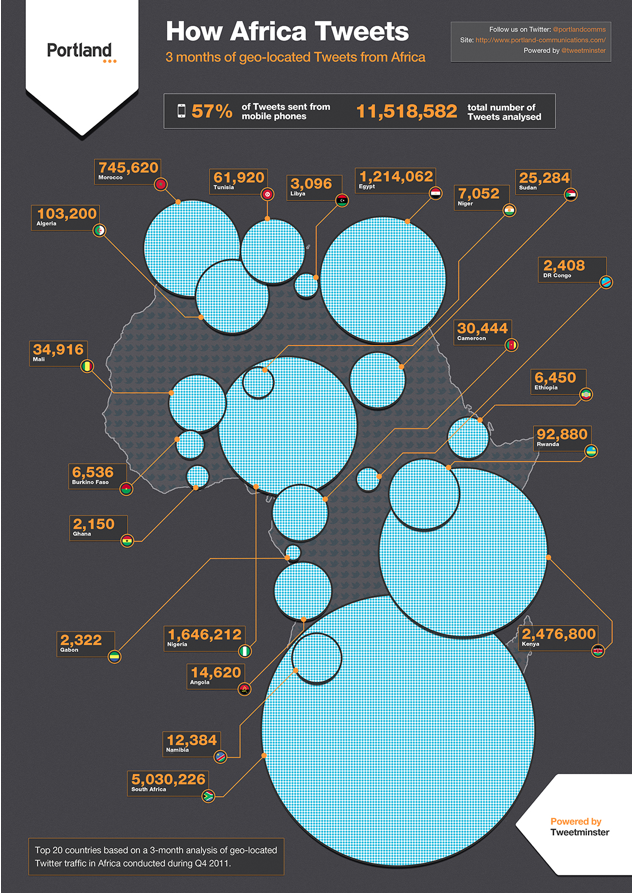
How Africa Tweets

Click on image to enlarge.

Just out of curiosity I did a quick calculation of per capita tweets based on the figures from Portland Communications. The biggest difference between the two rankings is Gabon. My guess is that the rather slight variation in the right and left columns (especially for the top ten) is a reflection of the fact that about 57% of tweets geolocated in the region are from the ever ubiquitous cell phones.

Ghana’s ranking on either column was rather surprising.

Top 20 (by volume) Top 20 (per capita)
South Africa
Kenya
Nigeria
Egypt
Morocco
Algeria
Rwanda
Tunisia
Mali
Cameroon
Sudan
Angola
Namibia
Niger
Burkina Faso
Ethiopia
Libya
DR Congo
Gabon
Ghana
South Africa
Kenya
Morocco
Egypt
Nigeria
Rwanda
Tunisia
Namibia
Algeria
Mali
Cameroon
Gabon
Sudan
Angola
Niger
Libya
Burkina Faso
Ghana
Ethiopia
DR Congo

More on this hear.

HT Jason Stearns.

Tackling Africa’s Image Problem

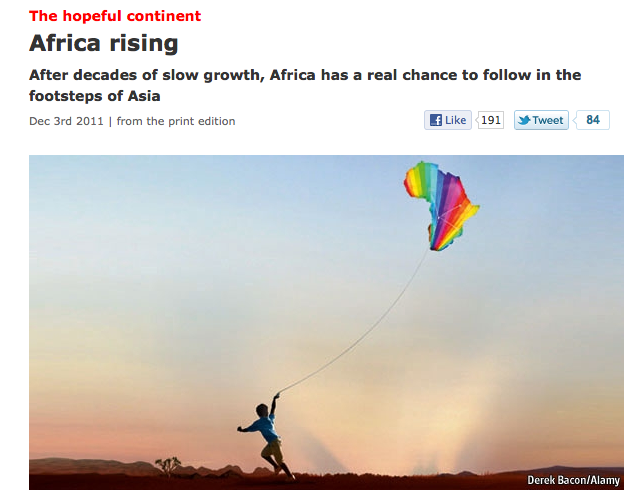
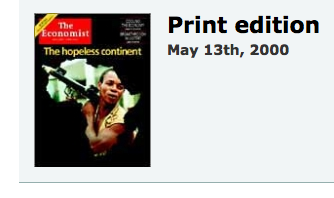
Back in 2000….


And now…

The latest issue of the Economist has “Africa” on the cover, with the pronouncement that the continent has, in the last ten years, moved from hopeless to hopeful.

Africa’s enthusiasm for technology is boosting growth. It has more than 600m mobile-phone users—more than America or Europe. Since roads are generally dreadful, advances in communications, with mobile banking and telephonic agro-info, have been a huge boon. Around a tenth of Africa’s land mass is covered by mobile-internet services—a higher proportion than in India. The health of many millions of Africans has also improved, thanks in part to the wider distribution of mosquito nets and the gradual easing of the ravages of HIV/AIDS. Skills are improving: productivity is growing by nearly 3% a year, compared with 2.3% in America.

All this is happening partly because Africa is at last getting a taste of peace and decent government. For three decades after African countries threw off their colonial shackles, not a single one (bar the Indian Ocean island of Mauritius) peacefully ousted a government or president at the ballot box. But since Benin set the mainland trend in 1991, it has happened more than 30 times—far more often than in the Arab world.

Population trends could enhance these promising developments. A bulge of better-educated young people of working age is entering the job market and birth rates are beginning to decline. As the proportion of working-age people to dependents rises, growth should get a boost. Asia enjoyed such a “demographic dividend”, which began three decades ago and is now tailing off. In Africa it is just starting.

More on this here.

Quick hits

Follow the goings on in the DRC (especially this election season) over at Alex Engwete’s blog.

Living under the shadow of Kony and his men in Eastern CAR.

On a related note, the Ugandan army’s dirty war in the Congo and CAR.

Shame on the ANC. But there is still hope for cleaner politics in South Africa. The ANC is an over-size coalition with a high chance of internal breakup in the not so distant future. It might even occur sooner, over the Zuma succession. And this time it might not be a rather benign COPE affair. You can read more on the controversial bill over at the Economist.

Trying God? Churches claim to have cured HIV positive congregants. This goes beyond faith, it is naked exploitation. And a call for government involvement.

And lastly, a very dictator Christmas (via Blattman)

[youtube.com/watch?feature=player_embedded&v=38YWB8iX7OY]

Zuma may be a one-term president

Back when he dislodged Thabo Mbeki South African President Jacob Zuma promised that he would only serve one term. But having tasted the power of the presidency, he now wants a second term. His bid, however, has not been well accepted within the ANC.

Although it is common knowledge that the much-married Zuma wants a second term he has remained equivocal on the issue, at one point saying “I never said I would serve one term and I have never said that I would want two terms”  (The New Age reported on Wednesday, June 8th).

The Africa Confidential reports:

Zuma’s main rivals, Tokyo Sexwale and Deputy President Kgalema Motlanthe, are trying to fix it so that Motlanthe would be a one-term president, Sexwale would be his deputy and Paul Mashatile, Gauteng’s provincial leader and Premier, would be ANC national chairman. They may offer a deputy presidency to Lindiwe Nonceba Sisulu, the Defence Minister and Zuma’s ally. Sisulu and Sexwale, however, do not get along.

An anti-Zuma tirade erupted from the General Secretary of the Congress of SA Trade Unions, Zwelinzima Vavi, who said there is leadership paralysis in the ANC and warned that the country is in danger of ‘imploding’. He criticised Zuma’s ‘doublespeak’ on economic issues.

More on this here.

Effects of Conditional Vs. Unconditional Cash Transfer

Baird, McIntosh and Ozler have an upcoming paper in the QJE investigating the differential impacts of conditional and unconditional cash transfer in Malawi:

Starting with schooling outcomes, we find that although dropout rates declined in both treatment arms, the effect in the UCT arm is 43% as large as that in the CCT arm. Evidence from school ledgers for students enrolled in school also suggests that the fraction of days attended in the CCT arm is higher than the UCT arm. Using independently administered tests of cognitive ability, mathematics, and English reading comprehension, we find that although achievement is significantly improved in all three tests in the CCT arm compared with the control group, no such gains are detectable in the UCT arm. The difference in program impacts between the two treatment arms is significant at the 90% confidence level for English reading comprehension. In summary, the CCT arm had a significant edge in terms of schooling outcomes over the UCT arm: a large gain in enrollment and a modest yet significant advantage in learning.

The paper then gets nuanced:

When we turn to examine marriage and pregnancy rates, however, unconditional transfers dominate. The likelihood of be- ing ever pregnant and ever married were 27% and 44% lower in the UCT arm than in the control group at the end of the 2-year intervention, respectively, whereas program impacts on these two outcomes were small and statistically insignificant in the CCT arm.

……….. Our findings show that UCTs can improve im- portant outcomes among such households even though they might be much less effective than CCTs in achieving the desired behav- ior change.

Check it out here.

Saturday afternoon procrastination

This is some scary stuff (don’t worry, no one gets hurt):

[youtube.com/watch?v=Wso13n4kHZ4]

What does a Sata Presidency Mean for Zambia?

UPDATE:

For a closer take on the Sino-Zambian connection check out Louise Redvers’ piece for the BBC.

************************************

So the Economist beat me to writing about what a Sata presidency means for the Zambian economy, especially with regard to foreign investment.

For the two of you out there who are not conversant with the campaign details in the Zambian election, Mr. Sata’s main campaign strategy involved characterizing incumbent President Banda as someone who was out to mortgage Zambia’s future to foreign investors, and especially China.

Here is what the Economist had to say:

“He is too savvy a politician not to realise how much this impoverished country of 13m people needs China’s cash. Over the past decade, the Chinese have invested over $2 billion in Zambia, the GDP of which is only $16 billion. More than half of that came in last year. And China is committed to pouring in billions more. There are now about 300 Chinese companies in Zambia, most of them privately owned, employing around 25,000 locals. Standards differ: some companies treat their workers badly, but most of the big state-owned companies genuinely seek to respect local labour laws.”

The long and short of it is that Sata will definitely kick out a few shady companies that were operating outside the law – and these are not just Chinese firms; the South Africans and Australians also have some shady businesses in Zambia. The former, especially, have a lot of money-laundering operations.

More on this here and here.

On the democracy and governance front, things won’t change much. President Sata’s camp is full of recycled UNIP veterans. UNIP was the independence party that ruled Zambia between 1964 and 1991. Mr. Sata, however, could surprise us by finally passing through a new constitution for Zambia. The last parliament killed the proposed constitution.

Quick hits

The world marathon record is back in Kenya, where it belongs.

Zambian Economist has nice maps showing the results of the just concluded general elections.

(Dada) Kim on Haba na Haba has a story on the continuing decline of Malawi into overt and brutal dictatorship. President Bingu wa Mutharika recently appointment his wife and brother to the cabinet. This reminded me of this paper on the inefficient extraction of rents by dictators.

President Zuma of South Africa still hasn’t established his dominance within the ANC (and probably never will).

The drought in the Horn has thus far claimed 10,000 lives. The Bank is increasing its aid package to the region.

Quick hits

Guide to arguing on the internet (HT Lauren).

Speaking of arguing on the internet, I like the drama that is spats between economists and other academics on their respective blogs.

The Economist presents the faces of famine in the Horn. It is beyond sad that so many people should be condemned to suffer this man-made tragedy.

Brett Keller has posts here and here on Sam Childers (a.k.a. machine gun preacher), a gun-runner into the habit of doing morally and ethnically dubious things in the name of God. Keller says that Childers is “stockpiling arms at his orphanage and has admitted to selling weapons to unnamed armed factions in Sudan, Uganda, and Rwanda.”

In Zambia (where I shall be for the elections in Sept.) the politics of citizenship and belonging are yet to be settled 50 years after independence. We recently witnessed the dangers of de-legitimizing whole sections of countries as outsiders in Cote d’Ivoire. I hope that if Sata ever wins he will not do what incumbent Ivorians did to ignite a rebellion in the northern reaches of their country. For more on this check out this great book on the Ivorian collapse. I have read it and absolutely loved it.

A muddy few months ahead for the South African government. Infighting with the ANC top brass might mean an early exit for President Zuma. With over 60% of the votes in the last election, the ANC is essentially an oversize coalition prone to internal wrangles. It will be interesting to see how Zuma weathers the storm in the midst of challenges from both COSATU and Malema.

Lastly, the current issue of the Journal of African Economies looks at the impact of higher education in Africa. The main takeaway is that the low quality of education at lower levels (primary and secondary) has meant that the biggest bang for the buck on the Continent, as far as education is concerned, only comes with higher education. Too bad that many of those that get higher education are underpaid or out of the Continent all together.

Happy Birthday Madiba

Happy Birthday Tata Madiba!

The Conscience of a Continent

Links I liked

I just discovered Chri’s Blog on Madagascar and other Africa-related issues.

For those with a flavor of finance and capital markets and the political economy of development be sure to read Frontier Markets.

Germany is on the hunt for the UN security council seat in Africa.

And lastly, Justice – Uganda style:

Vice president upsets the president during tenure, president fires vice after election. Former vice gets accused of corruption. President declares former vice innocent, but leaves the matter up to the “independent” Inspectorate of Government. Here’s a quote from the president:

“What I know is that there was a power struggle between Bukenya and some businessmen but I found no merit in the case. But since the Inspectorate of Government is an independent body, let them investigate thoroughly.”

Yeah right.

Rants and Raves / Thoughts on the African Union

The African Union (AU) has had a rough few months. The diplomatic failures in Zimbabwe, Cote d’Ivoire, and Madagascar exposed the organization’s incompetence. The misguided anti-ICC crusade continues to cement the image of the organization as nothing more than a club of out-of-date and tone deaf autocrats. To many observers, calls for “African  Solutions to African Problems” amid all this failure has been seen as a cover of impunity and mediocre leadership on the African continent.

It says a lot that the current chairman of AU is President Theodore Obiang’ of Equatorial Guinea; a man who leads an oil-rich country of under 0.7 million people, with a per capita income of more than 30,000; but with more than 70% of its population living on less than $2 a day.

The epitome of the organization’s woes was the total snub it got from NATO before the military campaign against Libya’s Gaddafi, one of the AU’s main patrons. The AU was created by the Sirte Declaration, in Libya. Mr. Gaddafi’s influence ranged from his “African Kings” caucus (in which he was the King of Kings) to investments from Libya’s Sovereign wealth fund. I bet Gaddafi had a hand in the organization’s green flag.

So what ails the African Union?

The AU’s problems are legion. In my view, the following are some of the key ones.

  1. Lack of a regional hegemon(s): The AU faces massive collective action problems. With no regional hegemon(s) to act as the rudder of the organization, most of the organization’s resolutions are not worth the paper they get written on. The rotating chairmanship is a distraction from the real leadership needed in the organization. For instance, I had to google it to find out who’s currently in charge of the presidency of the EU (Poland). Everybody knows that France and Germany run the EU. Their word has gravitas in the Union. In the AU on the other hand, there is no leader. Could it be Navel-gaving South Africa or serially under-performing Nigeria?
  2. Too much political control: Most successful international organizations, despite having political principals, tend to have technical agents that are to some extent shielded from the principals. The AU is political through and through. The key decision-making body is the assembly of heads of state. The council of ministers does nothing. And the commission is all bark and no bite. Cronies of dictators staff most of the key positions in the organization.
  3. Disconnect from the masses: Most Africans have no idea what exactly the AU does. What is the point of the organization? Is it to preserve Africa’s borders? Is it to defend the likes of Gaddafi when the ICC’s Mr. Ocampo comes calling? Giving the people a voice in the Union might force the organization to do the people’s bidding, instead of being a protector of impunity in the name of African sovereignty.

What would reforming the AU entail?

  1. Radical restructuring: Like all inter-state organizations, the AU’s leadership should reflect regional power differences. The current assembly – in which Chad has the same power as Nigeria – makes no sense. There should be a smaller assembly of sub-regional representatives (West – Nigeria; East-Ethiopia; North – Egypt; and South-South Africa) with veto power and the mandate to implement the organization’s resolutions.
  2. Competent staffing: The practice of presidents appointing their sisters-in-law as AU representatives should go. An injection of competent expertise into the organization would go a long way in making it appear to be a more politically independent, competent and respectable organization.
  3. Direct elections to the AU parliament or no parliament at all: Instead of having the members’ parliaments elect representatives to the AU parliament, there should be direct elections. If that cannot happen then the parliament should be scrapped all together. A toothless and unrepresentative parliament is a waste of resources.
  4. Constructive and focused engagement with the rest of the world: Who is the AU chief foreign policy person? Are there permanent representatives in Beijing, Brussels, Brasilia, New Delhi and Washington? Why aren’t they trying to initiate a collective bargaining approach when dealing with these global powers (even if it is at the sub-regional level)? And what with the siege mentality? Not every condemnation of African leaders’ incompetence and mediocrity is a neo-colonial conspiracy, you know. For instance, instead of whining against the ICC’s Africa bias, the AU should clean up its own house. It doesn’t matter that George Bush is not being tried for crimes against Iraqis. The last time I checked none of the leaders of Switzerland was being tried for crimes committed in the German cantons.
  5. A more consistent commitment to progressive ideals: The AU is the only organization in the world that includes in its charter the provision to intervene in its member countries under the principle of responsibility to protect. If the AU were slightly more serious, the disasters in Zimbabwe, Cote Ivoire and Madagascar could have been nipped in the bud. As things stand it is only tiny Botswana that keeps shouting about the organization’s commitment to proper governance and responsibility to protect.

I am not a fan of the idea of the United States of Africa. That said, I believe that a regional organization like the AU can be a force for good. But in order for it to fulfill its purpose, it has to change. The change must reflect the regional power balance; it must increase the competence quotient in the AU and it must increase the voice of the average African within the organization.

Quick hits

1. If you don’t have a summer reading list already, Blattman has one for you. The list is obviously not exhaustive, but two pressing titles I might add are Avner Greif’s Institutions and the Path to the Modern Economy and Gerschenkron’s Economic Backwardness in Historical Perspective.

2. In yet another not so nice chapter in the relationship between the Angolans and Congolese, Angola has deported thousands of Congolese. According to IRIN:

The expulsions are symptomatic of the tense relations between Luanda and Kinshasa, rooted in disputes over border demarcation and natural resources. Angola’s alleged loss of hundreds of millions of dollars in revenue due to the unauthorized artisanal exploitation of diamonds is a particular bone of contention.

3. Michelle Obama is in Africa on one of those first lady gigs. Many Africa watchers have complained that the visit does not have any real policy agenda beyond the usual talking points.

I agree.

But I would also like to point out that the failure of Africa to reap an Obama dividend is not just because of the State Dept.’s indifference to Africa but also because Africa lacks a coherent voice in Washington. Is there an Africa lobby? What does it do?

Instead of a calculated strategic response to the election of the first US president of African descent the Continent has swung from euphoria to disappointment over the fact that manna did not fall from heaven.

4. Lastly, the fortunes of the AU force in Somalia appear to be on an upswing. Now if only Somali politicians can get their act together and form a stable government.