We Must Free Our Imaginations — Binyavanga Wainaina

A great thinker. A great artist. A great Kenyan.

Part One (see also Parts Two, Three, Four, Five and Six)

[youtube.com/watch?v=8uMwppw5AgU]

Joyce Nyairo of the Daily Nation has written a stinging critique of Binyavanga’s short documentary. Nyairo takes umbrage at Binyavanga’s bashing of Pentecostals and giving a dumbed down, even simplistic, account of Kenyan history over the Moi years. 

The ultimate tragedy of Binyavanga’s documentary is the ease with which he slides into a diatribe against Pentecostals — as if homosexuality can only be popularised by bashing something or someone else’s conformity…..

Each one of the titles of this six part “documentary” is a quote from Binyavanga’s long and frighteningly convoluted tirade against the hypocrisies of Africa’s discourse on homosexuality.

The quotes are as clever as they are memorable. But they represent isolated flashes of brilliance in a text that is neither articulate nor lucid. Binyavanga struggles too hard to be profound, repetitively swinging from mimicry and lazy stereotyping to banal imagery that does nothing to enlighten. His style is unworthy, an injustice to his subject.

I think Nyairo has missed the point of this short “tirade” by miles. The style of delivery and everything about this documentary show that Binyavanga’s intended audience is not the class of Kenyans who go to Blankets & Wine. He is not trying to preach to the choir – most upper middle class Kenyans already have liberal views on homosexuality and those that don’t often have to hide them behind their middle class civility. Neither is he trying to engage in an enlightened rebuttal of the claim that homosexuality is “un-African.” No. What Binyavanga is trying to do is to take the conversation to the streets, and the homes of regular Kenyans. He is aiming at the middle middle class and lower. Binyavanga knows that this is the demographic that will matter the most in changing Kenya, whether it is economically or in the further expansion of human rights.

Yes, Binyavanga has hoisted up the Pentecostal movement as his ultimate straw man. But that’s just in reaction to the hijacking of the conversation on homosexuality in Africa by religious moralists. It is hard to see how one can have an open conversation about homosexuality in Kenya today without addressing the question of sin and hell and Sodom and Gomorrah. This precedes even the macho talk of “natural African” (read heterosexual male) and “un-African” sexual habits. The language of “rights” alone will simply not fly, and when attempted will most likely result in an ugly backlash. This is what Binyavanga is speaking to.
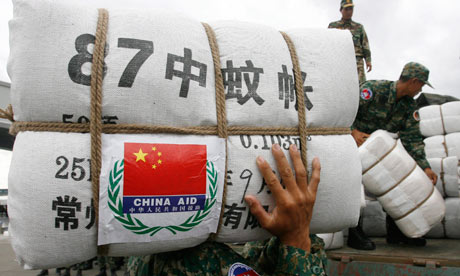
How does Chinese aid interact with level of democracy in poor countries?

It is a commonly accepted idea in IR theory that states have the habit of externalizing their domestic institutions [and accompanying economic and political systems] in their engagements within the international system (See Katzenstein, 1976 [pdf, gated]) – think democracy promotion, Reagan-Thatcherist free market evangelism, or Sino-Russian coziness with states that have an authoritarian bend. 

This phenomenon has non-trivial implications for development assistance. For instance, poor countries receiving capacity development assistance from say a Scandinavian liberal democracy often need to also adopt related practices beyond the narrow specific field (say tax reform) that is being addressed by the capacity development program. Many projects fail to produce the desired results because of this. Indeed past research has shown that “though aid [from wealthier, mostly Western democracies] does not affect quality of life in the aggregate, it is effective when combined with democracy, and ineffective (and possibly harmful) in autocracies.” [Kosack, 2003- pdf]

So does the effect of Chinese aid/finance to poorer countries follow this pattern? In other words, does the institutional incongruence effect also hold for autocratic donors? Image

The folks at Aid Data blog think it does: 

…… we estimate the relationship between Chinese development finance and human development in democratic and autocratic recipient countries. Our results show a negative relationship between Chinese development finance and human development in democratic countries. Interestingly, these results also suggest that Chinese development finance can successfully promote HDI growth for autocratic recipients. Kosack found the opposite pattern in his study of Western aid.

The findings are preliminary and may not withstand robustness checks, but all the same interesting.

More on this here.

Also, check out the Economist for a neat analysis of the potential impact of a Chinese economic slowdown on African economies.

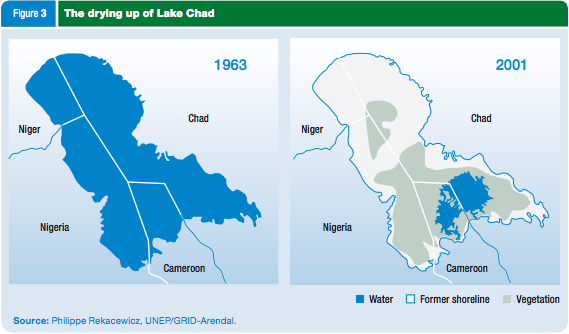
The disappearing Lake Chad, 1963-2001


I have been looking at the African Development Bank’s long term strategy (available here) and one of the figures that caught my eye was the extent to which Lake Chad has shrunk over the last 50 years. Wow.

Image

Africa’s newfound love with creditors: Bond bubble in the making?

I know it is increasingly becoming not kosher to put a damper on the Africa Rising narrative (these guys missed the memo, H/T Vanessa) but here is a much needed caution from Joe Stiglitz and Hamid Rashid, over at Project Syndicate, on SSA’s emerging appetite for private market debt (Africa needs US $90b for infrastructure; it can only raise $60 through taxes, FDI and concessional loans):

To the extent that this new lending is based on Africa’s strengthening economic fundamentals, the recent spate of sovereign-bond issues is a welcome sign. But here, as elsewhere, the record of private-sector credit assessments should leave one wary. So, are shortsighted financial markets, working with shortsighted governments, laying the groundwork for the world’s next debt crisis?

…….Evidence of either irrational exuberance or market expectations of a bailout is already mounting. How else can one explain Zambia’s ability to lock in a rate that was lower than the yield on a Spanish bond issue, even though Spain’s [which is not Uganda…] credit rating is four grades higher? Indeed, except for Namibia, all of these Sub-Saharan sovereign-bond issuers have “speculative” credit ratings, putting their issues in the “junk bond” category and signaling significant default risk.

The risks are real, especially when you consider the exposure to global commodity prices among the ten African countries that have floated bonds so far – Ghana, Gabon, the Democratic Republic of the Congo, Côte d’Ivoire, Senegal, Angola, Nigeria, Namibia, Zambia, and Tanzania.

In order to justify the exposure to the relatively higher risk and lending rates on the bond market (average debt period 11.2 years at 6.2% compared to 28.7 years at 1.6% for concessional loans) African governments must ensure prudent investment in sectors that will yield the biggest bang for the buck. And that also means having elaborate plans for specific projects with adequate consideration of the risks involved.

Here in Zambia (which is heavily dependent on Copper prices), the Finance Minister recently had to come out to defend how the country is using the $750 million it raised last year on the bond market (2013-14 budget here). Apparently there was no comprehensive plan for the cash so some of the money is still in the bank awaiting allocation to projects (It better be earning net positive real interest).

“They are fighting each other. By the time they have projects to finance, they will have earned quite a lot of interest from the Eurobond money they deposited. So, all the money is being used properly,” he [Finance Minister] said.

Following the initial success the country’s public sector plans to absorb another $4.5b in debt that will raise debt/GDP ratio from current ~25% to 30%. One hopes that there will be better (prior) planning this time round.

Indeed, last month FT had a story on growing fears over an Emerging (and Frontier) Markets bond bubble which had the following opening paragraph:

As far as financial follies go, tulip mania takes some beating. But future economic historians may look back at the time when investors financed a convention centre in Rwanda as the moment that the rush into emerging market bonds became frothy.

The piece also highlights the fact that the new rush to lend to African governments is not entirely driven by fundamentals – It is also a result of excess liquidity occasioned by ongoing quantitative easing in the wake of the Great Recession.

I remain optimistic about the incentive system that private borrowing will create for African governments (profit motive of creditors demands for sound macro management) and the potential for this to result in a nice virtuous cycle (if there is one thing I learned in Prof. Shiller’s class, it is the power of positive feedback in the markets).

But I also hope that when the big three “global” central banks start mopping up the cash they have been throwing around we won’t have a repeat of the 1980s, or worse, a cross between the 1980s (largely sovereign defaults) and the 1990s (largely private sector defaults) if the African private sector manages to get in on the action.

African governments, please proceed with caution.

The politics of reforming Nigeria’s oil sector

Nigerian legislators are attempting the impossible – to reform the management of their nation’s biggest cash cow – and failing. Decades of mismanagement and grand corruption have left Nigeria’s oil sector with entrenched and convoluted interests that are almost impossible to untangle and dislodge.

Africa Confidential reports:

Efforts towards comprehensive reform of Nigeria’s oil and gas industry are in tatters some five years after the first version of the Petroleum Industry Bill was presented to Parliament. After several redrafts, the PIB is still on the floor of the National Assembly and at the centre of partisan disputes, as parliamentarians pick over clauses which they claim favour one region of the country over another.Meanwhile, well connected companies and officials continue to benefit from an opaque system of management and operation that has allowed as much as US$100 billion to be siphoned off from state oil and gas revenue over the past decade, according to a report drawn up by the former anti-corruption czar, Nuhu Ribadu (AC Vol 53 No 9).

The failure to pass the reforms mooted in the PIB, which was intended to boost accountability and state revenue from exports, has developmental as well as financial costs. Nigeria has been unable to conduct a licensing round to award new blocks since 2007 because of uncertainties about new regulations and fiscal terms. This has limited new investment, raising the possibility that production capacity, which has been fixed at around 2.5 million barrels per day for a decade, could start to fall in the next few years.

More on this here.

Georgetown MSFS Launches New Africa Scholarship

The application deadline is January 15, 2014. Spread the word.

Starting in fall 2014, the Master of Science in Foreign Service (MSFS) at Georgetown University is offering a full- tuition scholarship for a talented graduate student from sub-Saharan Africa.

Image

MSFS is a two-year, full-time graduate degree program in international affairs. Students will take courses in international relations, international trade, international finance, statistics and analytical tools and history. In addition, students choose an area of concentration such as International Relations and Security, International Development or International Business.

More on State Building and the International System

This is a guest post in response to a previous blog post by friend of the blog Matthew Kustenbauder.

Your post highlights the contradictions between today’s human rights regime (which is based on universal concepts of humanity and has its origins in European anti-slavery campaigns and traditions of humanitarianism, and before that debates in Christian theology) and the post-imperial international order (based on the nation state as the fundamental political unit).

Since the rise of nationalism after WWII, new states that were historically part of empires (and thereby incorporated under their systems of law, governance, and trade) have had to make their own way. For most of these states, and especially for the people living within them, the new era of national self-determination has been no more kind than was the Age of Empire. The withdrawal of imperial powers left a vacuum that today’s international system struggles to address with any effect. There are many reasons for this, not the least of which is that it is a fragmented and cumbersome system that gives the impression all states are “equal” — clearly they are not. It also tends to be a forum in which smaller and poorer states invoke language of victimhood in an effort, ironically, to get larger or more wealthy states to step in and do the work that states are meant to do for themselves — namely, govern those residing within their boundaries.

What do I mean by this last point? An illustration by way of anecdote may help clarify. I was recently frustrated watching a BBC World Report special (an outlet for the Bleeding Hearts Industrial Complex that you mentioned in your post) about multinationals and poor working conditions in the developing world. Cotton and chocolate were featured. The reporter investigated big cotton operations in India and cocoa plantations in Cote D’Ivoire. What registered as surprise to the BBC reporter was no surprise to me — He found lots of young women and children working there. But instead of asking why the local government didn’t regulate the industry or why they didn’t enforce the regulations already on the books, he ran off to Switzerland and the UK and America to ask why Nestle and Tommy Hilfiger, etc. don’t monitor their supply chains. I was baffled. This is a classic example of how an international system based on the sovereignty of individual nation states is at odds with universal notions of human rights. In many ways, it is the modern-day replacement for the old global-local tensions that existed between the imperial metropole and its colonies. We might ask, however, whether the current framework in which human rights activism operates is really any better suited to address the ongoing problems that plague developing nations. To my mind’s eye, the focus is on the wrong place … or is at least too focused on the role of businesses and advanced economies and not focused enough on working with multinationals in order to help citizens in poor countries put pressure on their governments to be accountable, competent, and truly sovereign.

The emphasis on human rights by Western governments and development work by NGOs in African countries have, more often than not, undermined the sovereignty of national governments since decolonization. More recently, however, China has emerged as the largest trading partner with many African countries. This is a game changer, not only because the Dragon does not hold human rights sacrosanct, but also because, unlike its Western counterparts, China considers economic growth and trade essential to establishing national sovereignty and the nation-state (not the international community) as the principal guarantor of the well-being of its citizens. The degree to which China can be ‘socialised’ in the ways of the international system, which was after all created by the Great Powers to replace the disintegrating world that western empires had made, remains to be seen. In any event, the long-standing tensions between universal principals of human rights, on the one hand, and the limits placed on intervention into the affairs of one state by another in the name of national sovereignty, on the other, will endure.

=======
Matthew Kustenbauder is a PhD candidate in history at Harvard University.

In which I write about Africa’s emerging drug problem

The globalization of terrorism over the last decade has created a situation in which the number one threat to international security is no longer strong, conquering states, but failing ones that provide safe havens for terrorist organizations. Drug trafficking in Africa reflects the heart of this concern. The illicit trade is both contributing to the deterioration of state institutions – which could result in state collapse – and financing terrorist groups like AQIM and Al-Shabaab. So far the international community has not treated the matter with the urgency it deserves. The consequences of inaction will be dire, as has already been seen in Central America. The region’s misfortune of being an important transit route between South American cocaine production centers and North American consumers has resulted in the highest murder rates in the world, fueled by transnational organized crime and drug trafficking. The statistics are astonishing: Among 20-year old men in some Central American countries, 1 in 50 will be murdered before they are 32Africa, a region already replete with weak states, might be next if drug trafficking on the continent continues to grow.

More on this here.

Quick hits

HIV self-testing showing promising results in Malawi.

Kenyan legislators, who make upwards of $175,000 a year, now have $3000 chairs to snooze on.

Jina Moore on the white correspondent’s burden in “Africa.”

This sad event in Zambia adds significance to my planned fieldwork there in the coming year on Chinese-African relations.

And lastly, celebrating the informal economy on the Continent:

[youtube.com/watch?v=Yi0fNa1G4-4&sns=fb]

Reason for African Petro-Rulers to be Worried

Africa’s petrorulers (heads of state of Angola, Cameroon, Chad, Congo-Brazzaville, Equatorial Guinea, Gabon, Ghana, Nigeria, South Sudan, and Sudan) may be headed for tough times later this year. According to a piece by (Steve Levine) over at FP, Saudi Arabia – the world’s leading oil producer – is considering flooding the global oil markets with the aim of sticking it to the Russians and Iranians. Saudi action of this nature could lower prices to as low as US $40 a barrel from the current $83.27.

With the exception of Ghana and Cameroon, such a drop in oil prices would almost certainly lead to political unrest in the rest of Africa’s oil producers. Sudan and South Sudan are already facing huge revenue shortfalls due to a dispute over the sharing of oil revenue.

More on “The Coming Oil Crash” here.

Beating the drum for Ngozi

The Economist has joined a string of internet commentators in endorsing Nigerian Minister of Finance to become the next president of the World Bank. Contrasted against the resume of Obama’s choice for the Bank, Ngozi wins. By miles.

According to the Economist:

The World Bank is the world’s premier development institution. Its boss needs experience in government, in economics and in finance (it is a bank, after all). He or she should have a broad record in development, too. Ms Okonjo-Iweala has all these attributes, and Colombia’s José Antonio Ocampo has a couple. By contrast Jim Yong Kim, the American public-health professor whom Barack Obama wants to impose on the bank, has at most one.

However, it is interesting that in all the debate no one has talked about HOW Ngozi will change the Bank’s operations, besides insinuations that she has hands on experience in transforming Nigeria’s public finances, coupled with her previous experience at the Bank.

More importantly, what would be the cost to Nigeria if they lose Ngozi? Is this important at all?

Ngozi leading the bank will probably make a difference. However, I think that support for her candidacy has thus far been too one-sided. Nigeria, like much of the developing world, does not have much influence on the Bank’s board. Nigeria also stands to lose one of its ablest technocrats just when it is striving to reform its public finances. These considerations should matter too, I think.

Just for the record, I am one of those who think that it would be really cool to have Ngozi lead the Bank (despite the fact that she probably will not).

**********************************************

Update: I just came across some interesting thoughts on Ngozi’s nomination over at Africa is A Country (H/T Chad).

South Africa and the AU [Rant and rave alert!!]

As you may already know South African candidate for the AU Commission Chair Nkosazana Dlamini-Zuma (ex-wife of president Zuma) failed to get elected. Instead the AU extended Mr. Jean Ping’s term till June. Ms Dlamini-Zuma intends to vie for the seat again in June.

South Africa and its backyard (SADC member states) had lobbied hard for Ms Dlamini-Zuma.

The South African Business Day reports:

Mzukisi Qobo of the University of Pretoria says: “It is clear that this is an intensely divisive campaign, and plays into the hands of those who view SA as harbouring intentions of running roughshod over other countries. Unity in the AU is a facade reinforced by a poorly conceived notion of pan-Africanism.

“Africa’s political elites still think very much in terms of regional groupings — east Africa, north Africa, southern Africa and west Africa — as well as along the colonial lines of Francophone, Lusophone and Anglophone. These are realities that are there.”

SA’s foreign policy stance has been back and forth, which may have caused more divisions with countries like Nigeria and Egypt.

 But political analyst Steven Friedman does not think policy “flip-flopping” was the reason Ms Dlamini-Zuma did not get the post. With its economic infrastructure strength, other countries feared that SA would dominate Africa politically if given a chance, he says.

To which I say, why not?

What would be so wrong with a reasonably stable and important regional player taking charge of the rudderless dictators’ club institution that is the AU? The organization’s failures in the recent past – including in Libya, Sudan, Cote d’Ivoire, Somalia, Zimbabwe, DRC, Central African Republic, etc – have been partly because no single country has managed to emerge as its de facto leader and ultimate guarantor (forget the delusional late King of Kings, he was a clown on steroids).

Instead of having a strong leadership – whether by a single country or by a group of regional representatives – the AU has opted to have weak leadership in the form of a Commission headed by nondescript individuals political lightweights unable to rally the member countries to any respectable cause. The only time the club’s dictators are ever united is when they dump on the ICC and all other manner of foreign infringement on their “sovereignty” (which to them means the right to starve, jail or murder their citizens). The existing post of a rotating presidency has also been a complete sham.

Obiang was the latest one to occupy the post. Yes, Teodoro Obiang Nguema Mbasogo of Equatorial Guinea. This guy.

May be this episode will end Pretoria’s navel-gazing and encourage it to focus on having a coherent Africa policy that will provide strong leadership for the AU.

A leaderless organization of 54 states, new $200m headquarters or not, is a useless organization.

For more on this see here and here.

Also, check out this thought-provoking piece on the symbolism of the new AU headquarters.

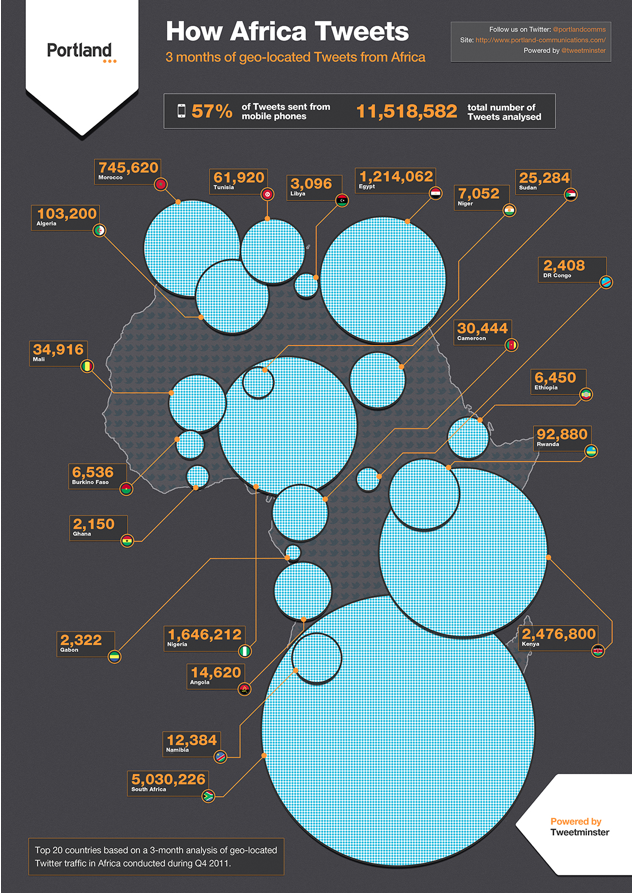
How Africa Tweets

Click on image to enlarge.

Just out of curiosity I did a quick calculation of per capita tweets based on the figures from Portland Communications. The biggest difference between the two rankings is Gabon. My guess is that the rather slight variation in the right and left columns (especially for the top ten) is a reflection of the fact that about 57% of tweets geolocated in the region are from the ever ubiquitous cell phones.

Ghana’s ranking on either column was rather surprising.

Top 20 (by volume) Top 20 (per capita)
South Africa
Kenya
Nigeria
Egypt
Morocco
Algeria
Rwanda
Tunisia
Mali
Cameroon
Sudan
Angola
Namibia
Niger
Burkina Faso
Ethiopia
Libya
DR Congo
Gabon
Ghana
South Africa
Kenya
Morocco
Egypt
Nigeria
Rwanda
Tunisia
Namibia
Algeria
Mali
Cameroon
Gabon
Sudan
Angola
Niger
Libya
Burkina Faso
Ghana
Ethiopia
DR Congo

More on this hear.

HT Jason Stearns.

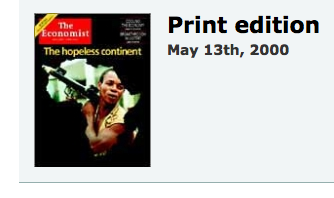
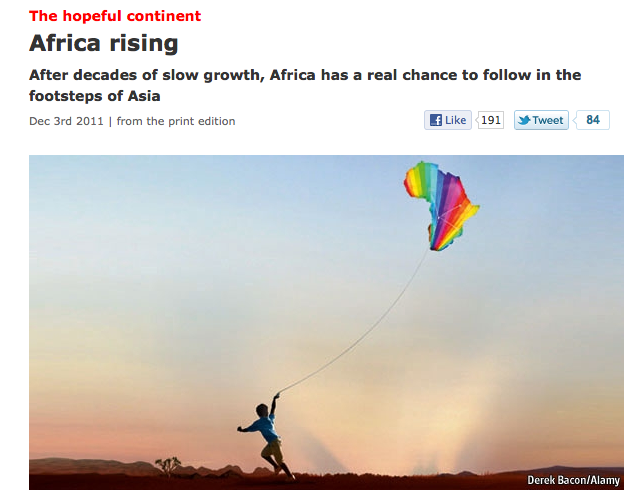
Tackling Africa’s Image Problem

Back in 2000….


And now…

The latest issue of the Economist has “Africa” on the cover, with the pronouncement that the continent has, in the last ten years, moved from hopeless to hopeful.

Africa’s enthusiasm for technology is boosting growth. It has more than 600m mobile-phone users—more than America or Europe. Since roads are generally dreadful, advances in communications, with mobile banking and telephonic agro-info, have been a huge boon. Around a tenth of Africa’s land mass is covered by mobile-internet services—a higher proportion than in India. The health of many millions of Africans has also improved, thanks in part to the wider distribution of mosquito nets and the gradual easing of the ravages of HIV/AIDS. Skills are improving: productivity is growing by nearly 3% a year, compared with 2.3% in America.

All this is happening partly because Africa is at last getting a taste of peace and decent government. For three decades after African countries threw off their colonial shackles, not a single one (bar the Indian Ocean island of Mauritius) peacefully ousted a government or president at the ballot box. But since Benin set the mainland trend in 1991, it has happened more than 30 times—far more often than in the Arab world.

Population trends could enhance these promising developments. A bulge of better-educated young people of working age is entering the job market and birth rates are beginning to decline. As the proportion of working-age people to dependents rises, growth should get a boost. Asia enjoyed such a “demographic dividend”, which began three decades ago and is now tailing off. In Africa it is just starting.

More on this here.

Quick hits

Jesus! Good intentions are not enough. (Properly regulated) Markets rule.

Kenya and Eritrea appear to be on a collision course. The Horn might get a little bit hotter in the next few months.

Some insights into politics and development in Nigeria. I hold the minority opinion that Nigeria might yet surprise those short selling it at the moment. The political situation is almost good enough. Remember, all you need (at least for the initial stages of growth) is predictability, not Sweden’s institutions.

AFRICOM has a blog. The posts are sporadic but it’s worth checking out once in a while.