Nigeria’s Africa Internet Group posts the Continent’s first “unicorn” startup

This is from the FT:

Africa Internet Group is set to become the continent’s first “unicorn” after securing an investment valuing the ecommerce group at more than $1bn.

… African Internet Group’s valuation could be matched by Interswitch, the Nigerian fintech group that processes payments for banks, if the company decides to float later this year.

Over the next couple of decades the mobile and tech market in Africa will only grow bigger — watch out for Nigeria, Kenya, Ghana, Cote d’Ivoire ….. and Ethiopia when they finally liberalize (which I hope will happen sooner rather than later). According to the same FT piece:

Smartphones have begun to transform the way Africans live and work. The continent is projected to have 360m smartphones by 2025, when internet penetration on the continent will hit 50 per cent, according to McKinsey Consultants.

H/T Tyler Cowen.

Median vs Per Capita Income in Africa

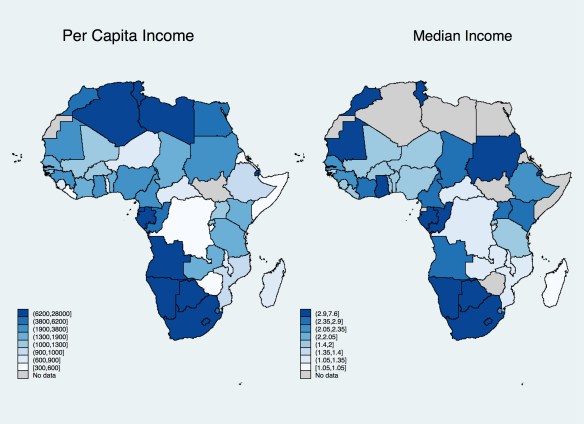
CGD’s Anna Diofasi and Nancy Birdsall compiled median income (2011 PPP) data for 144 countries. In the data they find interesting cases of a mismatch between median and per capita incomes:

the median reflects how much the person at the 50th percentile of the income distribution earns (or spends), giving us a better picture of the well-being of a “typical” individual in a given country. Take Nigeria and Tanzania: in 2010, Nigeria’s GDP per capita (at PPP) was $5,123; Tanzania’s stood at only $2,111. This suggests that Nigerians were more than twice as well off as Tanzanians. Yet, if we compare consumption medians, a different picture emerges: a Nigerian at the middle of the income distribution lived on $1.80 a day, while his or her Tanzanian counterpart had 20 cents more to spend, at $2 a day.

I got curious and made maps of median (2011 $$) and per capita (2010 $$) incomes on the Continent.

income differences

What is going on with median incomes in Central Africa from CAR through to Mozambique? Also, what’s up with Zambia?

On the high cost of corruption in Nigeria

This is from the Economist:

In 2014 a respected former central-bank governor lost his job after claiming that $20 billion had been stolen. But this captures only a small share of the damage done by corruption. The much bigger question is where Nigeria could be if its politicians and officials were a little more honest.

One answer comes from economists at PricewaterhouseCoopers (PwC). They compared Nigeria to three other resource-producing countries that are somewhat less corrupt than it, though by no means squeaky clean: Ghana, Malaysia and Colombia. PwC concluded that Nigeria’s’s economy, which was worth $513 billion in 2014, might have been 22% bigger if its level of corruption was closer to Ghana’s, a nearby west African country.

By 2030, the size of Africa’s biggest economy should triple in real terms come what may. Yet if Nigeria manages to reduce corruption to levels comparable to Malaysia (itself hardly above suspicion: its prime minister recently had to explain how almost $700 million had made it into his bank account), its economy could be some 37% bigger still. The additional gain would be worth some $534 billion (adjusted for inflation), or about as much as the economy is currently worth. If it does nothing to change then the cost of corruption in Nigeria would amount to almost $2,000 per person a year by 2030, PwC reckons.

Corruption in Nigeria has inspired interesting strategies of combating the vice:naijacorruption

The full PwC report is available here.

Also, a gentle reminder that not all government money gets stolen through corruption (most estimates I have seen from leading African economies cap the figure at around 30% of budgets being lost). That means that there is still upwards of 70% of government budgets that never get spent well, or in some cases, never get spent at all.

Improving state agencies’ capacity to absorb budgetary allocations and to effectively carry out their duties is therefore just as important as fighting corruption.

Btw, Nigeria only collects about 8% of its GDP in taxes. Which is absolutely nuts.

This graph doesn’t tell us what you think it does (Because stateness matters)

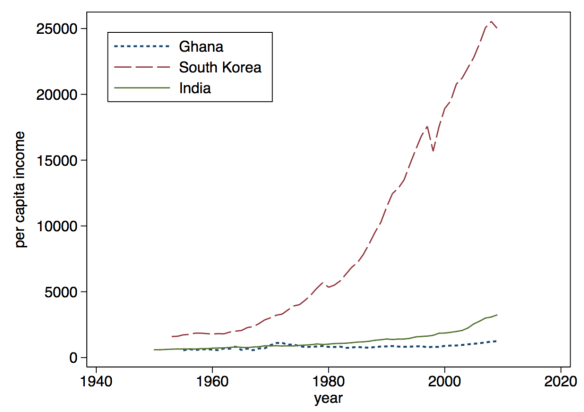
You probably saw this graph in your undergraduate development class — almost invariably as a demonstration of South Korea’s massive growth relative to countries that were allegedly at similar levels of “development” in the early 1960s.

Screen Shot 2016-01-28 at 3.39.29 AM

But were these countries really at the same level of development as South Korea?

The simple answer is no.

And to know why you need to read States and Markets: The Advantage of an Early Start:

A longer history of statehood might prove favorable to economic development under the circumstances of recent decades for several reasons. There may be learning by doing in the ways of public administration, in which case long-standing states, with larger pools of experienced personnel, may do what they do better than newly formed states. The operation of a state may support the development of attitudes consistent with bureaucratic discipline and hierarchical control, making for greater state (and perhaps more broadly, organizational) effectiveness. An experienced state like China seems to have been capable of fostering basic industrialization and the upgrading of its human capital stock even under institutions of government planning and state property in the 1960s and 1970s, whereas an inexperienced state like Mozambique sowed economic disaster when attempting to pursue similar policies a few years later. Such differences may carry over to a market setting — contrast, for instance, the late 20th century economic development of Japan and South Korea, modern countries with ancient national histories, with that of the Philippines, a nation that lacked a state before its 16th century colonization by Spain.

Development is not just about income. It also involves a lot of intangible socio-political variables. Going back to the graph, a key difference in 1960 between Ghana, India, and South Korea was the degree of coherent stateness. On this measure South Korea was way ahead of its developing country peers.

For more on this Dani Rodrik has a delightfully concise take on how South Korea and Taiwan grew rich.

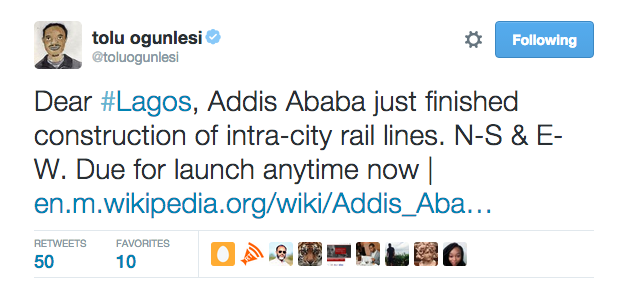
Even within Africa, historical stateness makes a difference in development outcomes. A neat recent example can be found in Ethiopia’s ability to build a light rail in Addis in record time as Nigeria floundered.

Powering Africa Into the Next Decade

The African Development Bank has made power generation its top priority (see list of power projects here). The US-led initiative, Power Africa, is focusing capital on some very big and interesting projects. I’m not sure if the AfDB was the instigator of the new trend (even before President Adesina), but several serious African governments have recently prioritized power generation (looking at you, Pretoria). Here’s a sample:

A 450MW gas-fired power plant near Nigeria’s Benin City. In 2014 Nigeria flared more than 290b standard cubic feet of gas.

Twenty international banks and equity funders have committed $900m to the Azura-Edo Independent Power Project, a 450MW gas-fired open-cycle power plant to be built in the country’s Edo State.

A joint venture of Siemens and Julius Berger Nigeria will start building the plant, which is expected to start generating in 2018.

Considered a model for future plants in terms of its private financing, the plant will also burn Nigeria’s natural gas, of which many billions of cubic feet are now routinely flared off as waste.

Zambia and Zimbabwe are in an advanced stage of making the 2400MW Batoka Gorge dam and power station a reality.

Construction of the Batoka Gorge hydroelectric power station to be located on the Zambezi River approximately 54km downstream of Victoria Falls is projected to commence early next year.

….That is why I am saying that we are closer to the fulfillment of the dream for the construction of the dam. Once construction starts it will take five years and we expect it to be completed by 2023.

Nambia set to build its biggest gas-fired power plant since independence.

The $450m plant to be located in Walvis Bay, is set to generate about 250 megawatts, 50 per cent of what the country currently generates internally (500 megawatts)

And lastly, Ethiopia’s mega dam and power plant will generate about 6,000MW:

When Ethiopia completes construction of the [Grand Renaissance] dam in 2017, it will stand 170 metres tall (550 feet) and 1.8km (1.1 miles) wide. Its reservoir will be able to hold more than the volume of the entire Blue Nile, the tributary on which it sits (see map). And it will produce 6,000 megawatts of electricity, more than double Ethiopia’s current measly output, which leaves three out of four people in the dark.


The OAU is dead, long live the AU

On Friday, the African Union approved draft plans to send troops to the conflict-ridden Burundi even without permission from Bujumbura in what could be a historic move to stop the country’s impending implosion.

The move by the AU Peace and Security Council reached on Friday despite initial opposition from the Burundi delegation invoked a rarely-used clause in AU Constitutive Act.

Article 4(h) of the AU Constitutive Act provides for sending of troops to a member country under circumstances of war crime, genocide or crimes against humanity without that country’s permission.

More on the African Union’s 5000 strong force for Burundi here. The actual AU resolution establishing the African Prevention and Protection Mission in Burundi (MAPROBU) is available here. Paul D. Williams, an associate professor of international affairs at George Washington University, parses the text of the AU communique here.

This semester I taught a class on intra-Africa IR, mostly looking at economic and security cooperation from 1963 to the present. One of the issues we wrestled with in the class was whether the AU was any different from the OAU, despite the language of Article 4(h). The OAU was notoriously ineffectual in dealing with conflict in Africa, on account of its many non-interference clauses.

Doubts about the AU and its ability to effectively originate an intervention in the face of intra-state conflicts were reinforced by:

(i) its continued commitment to the “equality” of member states (no regional hegemons — like Nigeria, Ethiopia, or South Africa — were given any formal status of first among equals);

(ii) the the deliberate weakening of the Peace and Security Council (PSC) — which has no permanent membership (5 elected for 3 years, 10 for 2 years);

(iv) the fact that the chairmanship of the PSC rotates monthly (by country name alphabetical order), giving any one chair hardly any time to develop the connections required for effective operations of such a sensitive post in a major IO;

(v) the structure of the regional distribution of seats on the PSC which incentivizes a sub-regional logic of seat allocation, as opposed to actual efficiency of the PSC.

It is therefore interesting that 4(h) was today invoked to justify intervention in Burundi, without the direct consent of Bujumbura (Nkurunziza may yet save face by inviting the AU mission under 4(j)).

Also interesting is the fact that the troops will be under the banner of the East African Standby Force (EASF) and not the AU. This will expose the actual operations of the mission to the same EAC politics that I outlined in an earlier post here (for the two of you out there who care to know, the different (sub)regional standby forces actually have formal relationships with the AU, so they are not totally run by the sub-regional RECs but can be seen as a practical first step in the aspirational goal of a continental standby force, someday).

Who said intra-African IR is boring (or does not exist)?

Also, watch out for a draft paper on the politics of intra-Africa IR soon…
Some Africanist inside baseball

Image

Screen Shot 2015-12-01 at 8.58.24 PM

Africa’s Demographic Destiny

Notice that these are estimates. The Journal reports:

The biggest human increase in modern history is under way in Africa. On every other continent, growth rates are slowing toward a standstill for the first time in centuries, and the day is in sight when the world’s human population levels out.

But not here — not yet.

Some 2.5 billion people will be African by 2050, the U.N. projects. That would be double the current number and 25% of the world’s total. There will be 399 million Nigerians then, more than Americans. When the century closes, if projections hold, four out of 10 people will be African.

Billions of them will be living in cities that are today small towns. The land of open spaces that was Africa will have blended into one big megalopolitan web.

More on this here.

Brazil is officially the 2nd biggest black country, after Nigeria

The Guardian reports:

For the first time since records began black and mixed race people form the majority of Brazil’s population, the country’s latest census has confirmed.

Screen Shot 2015-11-22 at 7.29.36 PM.png

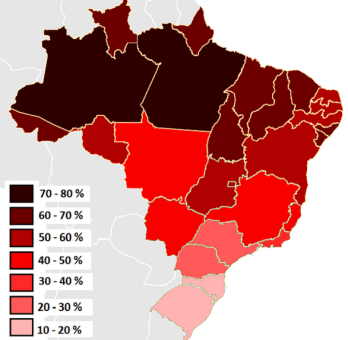
Distribution of Mixed-Race Brazilians

Preliminary results from the 2010 census, released on Wednesday, show that 97 million Brazilians, or 50.7% of the population, now define themselves as black or mixed race, compared with 91 million or 47.7% who label themselves white.

The proportion of Brazilians declaring themselves white was down from 53.7% in 2000, when Brazil’s last census was held.

But the proportion of people declaring themselves black or mixed race has risen from 44.7% to 50.7%, making African-Brazilians the official majority for the first time.

“Among the hypotheses to explain this trend, one could highlight the valorisation of identity among Afro-descendants,” Brazil’s census board, the IBGE, said in its report.

According to the census, 7.6% of Brazilians said they were black, compared with 6.2% in 2000, and 43.1% said they were mixed race, up from 38.5%.

Ethiopia is the third biggest. With about 94 million people.

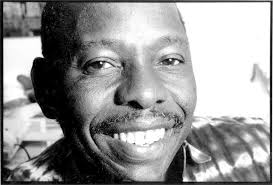
Remembering Ken Saro-Wiwa (and all of the Ogoni 9)

kensarowiwa

Fighting Corruption in Nigeria (Your Uncle is a Crook!)

naijacorruption

This approach to fighting corruption goes against the lessons in Peter Ekeh’s delineation between “primordial” and “civic” publics in Nigeria. According to Ekeh one’s uncle may be corrupt in the civic public, but as long as he provides benefits and adequately “shares” in the primordial public he can remain in good standing within his community.

That said, the strategy might work if every Nigerian credibly promises to expose their uncle who’s corrupt but pretends to be an international businessman. The Nigerian government could nudge Nigerians in the right direction by actually prosecuting and jailing the country’s corrupt uncles and aunts.

Energy to top the African Development Bank’s agenda

The FT reports:

Akinwumi Adesina, who took over as president of Africa’s lead development lender in September, has said that his flagship project aims to raise $55bn of investment to close the energy deficit in the next decade.

He says the bank will take a leadership role, coordinating with existing multinational initiatives and pushing member states to move faster to privatise and liberalise their energy sectors.

More on this here.

The paper also has a neat report on African economies’ adjustment to China’s slowdown, US pension funds’ move into the PE space in Africa, the grievances that fuel extremism in Africa, among others.

Full report is here (unfortunately, gated).

Africa’s looming debt crises

The 1980s are calling. According to Bloomberg:

Zambia’s kwacha fell the most on record after Moody’s Investors Service cut the credit rating of Africa’s second-biggest copper producer, a move the government rejected and told investors to ignore…..

Zambia’s economy faces “a perfect storm” of plunging prices for the copper it relies on for 70 percent of export earnings at the same time as its worst power shortage, Ronak Gopaldas, a credit risk analyst at Rand Merchant Bank in Johannesburg, said by phone. Growth will slow to 3.4 percent in 2015, missing the government’s revised target of 5 percent, Barclays Plc said in a note last week. That would be the most sluggish pace since 2001.

The looming debt crisis will hit Zambia and other commodity exporters hard. As I noted two years ago, the vast majority of the African countries that have floated dollar-denominated bonds are heavily dependent on commodity exports. Many of them are already experiencing fiscal blues on account of the global commodity slump (see for example Angola, Zambia and Ghana). This will probably get worse. And the double whammy of plummeting currencies and reduced commodity exports will increase the real cost of external debt (on top of fueling domestic inflation). I do not envy African central bankers.

Making sure that the looming debt crises do not result in a disastrous retrenchment of the state in Africa, like happened in the 1980s and 1990s, is perhaps the biggest development challenge of our time. Too bad all the attention within the development community is focused elsewhere.

What roughly $470m of borrowed money gets you in Nigeria vs Ethiopia

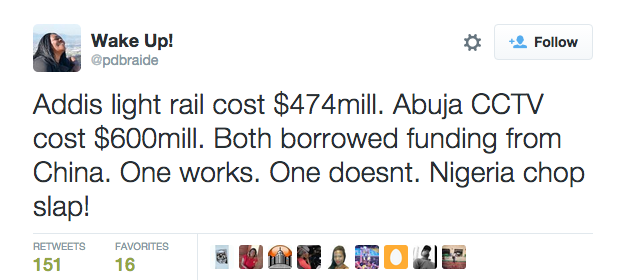
Ethiopia and Nigeria both borrowed roughly the same amounts of money from China’s EXIM Bank for massive infrastructure investments. The former sought to transform its capital’s transit system with a light rail ($475m); the latter tried to boost security in its capital by installing security (CCTV) cameras ($470m).

The outcomes of the two projects are an indication of what will be the impact of China’s ongoing infrastructure projects in much of SSA. Some countries because of the specificities in their domestic political economy are using borrowed money to deliver on actual tangibles — dams, power lines, stadia, housing projects, railway lines, roads, et cetera (corruption plays a role, but projects get completed). Yet others are accruing loans (albeit on concessionary terms) simply to treat the cash injections in the same manner that political elites have treated windfalls from mineral resources in decades past.

Ethiopia just opened its new light rail system in Addis. Nigeria’s CCTV project was a major flop. Of course this fact was not lost on a section of Nigerians on twitter:

Screen Shot 2015-09-21 at 3.04.19 PM

Screen Shot 2015-09-21 at 3.06.44 PM

How to increase mass employment in Nigeria (and other developing countries)

David Mckenzie of the Bank writes:

The modal firm size in most developing countries is one worker, consisting of only the owner of the firm. Amongst the firms that do hire additional workers, most hire fewer than ten. In Nigeria survey data indicate that 99.6 percent of firms have fewer than 10 workers. This is in sharp contrast to the United States, where the modal manufacturing firm has 45 workers. Are there constrained entrepreneurs in developing countries with the ability to grow a firm beyond this ten worker threshold? If so, this raises the questions of whether such individuals can be identified in advance, and of whether public policy can help them overcome these constraints to firm growth.

In an attempt to figure out if policy can help grow firms in developing countries, Mackenzie evaluated a program in Nigeria that awarded 1,200 winners about $50,000 each (out of an initial application pool of 24,000; the top 6000 applicants were in the study). See a summary here. And the paper is available here.

………. winning this competition has large positive impacts on both applicants looking to start new firms as well as those aiming to expand existing firms. Three years after applying, new firm applicant winners were 37 percentage points more likely than the control group to be operating a business and 23 percentage points more likely to have a firm with 10 or more workers, while existing firm winners were 20 percentage points more likely to have survived, and 21 percentage points more likely to have a firm with 10 or more workers. Together the 1,200 winners are estimated to have generated 7,000 more jobs than the control group, are innovating more, and are earning higher sales and profits.

Two quick thoughts. First, this is a really cool finding that should get African central bankers excited about how the financial sector can be put to use in boosting mass employment. Second, it is a caution against the odd idea prevalent in development programs of trying to turn poor people into entrepreneurs (see below). The best solution to poverty is jobs. Entrepreneurship is a risk that shouldn’t be imposed on people with already super slim margins of error in terms of income security. As Mckenzie rightly observes:

The results of this evaluation show that a business plan competition can be successful in identifying entrepreneurs with the potential to use the large amounts of capital offered as prizes, and that these individuals appear to be otherwise constrained from realizing this potential. The prize money generates employment and firm growth that would not have otherwise happened. However, the results also highlight the difficulties of picking winners. Conditional on reaching the semi-finalist stage, neither the scores for the business plans, nor individual and business characteristics have much predictive power for predicting which firms will grow faster or benefit most from the program. This remains an area for active research, but also highlights the inherent riskiness of entrepreneurial activity.