Tribe, Nation or Literacy?

Tanzania’s founding president Julius Nyerere famously described Kenya as a vulgar, capitalist “man eat man society” – to which Kenya’s then Attorney General Charles Njonjo retorted that, in contrast, Tanzania was a “man eat nothing society.” At the time Tanzania had embarked on a program of African Socialism – Ujamaa – backed by a language policy that put a lot of emphasis on Kiswahili as the national language. As Ted Miguel has argued inTribe or Nation?(pdf)this was a great strategy in nation building. But was it economically beneficial in the long run?

For now the answer is probably no.

The legacy of Tanzania’s language policy has been that English language instruction only begins to be done seriously in high school. Obviously, four years are simply not enough to master a language, let alone sit a major national examination in that language. The result has been an astonishingly high failure-rate in the national end of high school exams in Tanzania. Earlier this year 60% of high school (Form Four) students failed, prompting jokes like “I’m a rocket scientist in Tz” on this side of the border. In reality even fewer made the cutoff to get a place in institutions of higher learning. In addition, a recent survey done by Twaweza, an education Think Tank, found that 72% of sampled primary school kids and 66% of high school students could not do second grade maths. English reading and comprehension was equally bad.

It goes without mention that the state of Tanzania’s education system has serious implications for human resource development in the country. The impending commodities boom in many parts of the country will certainly not benefit locals if workers have to be imported. Tanzania cannot effectively transform itself into a 21st century economy without a drastic improvement in its education system. Oddly enough, despite its obvious shortage of human capital, Tanzania is the most restrictive state with regard to labor mobility in the East Africa Community (EAC). Dodoma is especially hostile to Kenyan workers that it sees as a threat to local workers (Kenyans and their alleged aggressiveness rudeness have jokes about Tanzanians’ work ethic….. I should add though that Tanzanians tend to be stereotyped unfairly, both at Mang’u and in New Haven I went to school with some very smart and hardworking Tanzanians).

In the final analysis, although Kenya’s post-independence education and language policy left us with a ‘tribe eat tribe’ legacy, it allowed the country’s education system to focus on English language instruction from early on, and a chance to develop a relatively more globally competitive human resource base. Nation building may have taken a hit in the process but I would argue that internal economic ties – the result of man eat man competition – have now made it such that the Kenyan nation-state will only get stronger. The challenge for Tanzania is to ensure that nation building does not limit the development of a globally competitive human resource capacity.

Since the announcement of the high school exam results earlier this year the country (Tanzania) has been debating possible avenues of reform. Better teacher training, more books and equipment and more teachers have been cited as possible remedies. Strategic review of the country’s language policy should also be put on the table.

In my opinion the EAC should adopt a language policy in which our history, social and religious studies and civics are taught in Swahili while everything else is taught in English. This would not be a selling out to a foreign language (with due respect to Ngugi) but an investment in global competitiveness. Many decades down the road, once we have universal literacy in both English and Kiswahili, we can have a full switch to universal Kiswahili language instruction in all subjects.

Georgetown MSFS Launches New Africa Scholarship

The application deadline is January 15, 2014. Spread the word.

Starting in fall 2014, the Master of Science in Foreign Service (MSFS) at Georgetown University is offering a full- tuition scholarship for a talented graduate student from sub-Saharan Africa.

Image

MSFS is a two-year, full-time graduate degree program in international affairs. Students will take courses in international relations, international trade, international finance, statistics and analytical tools and history. In addition, students choose an area of concentration such as International Relations and Security, International Development or International Business.

China in Kenya

Image

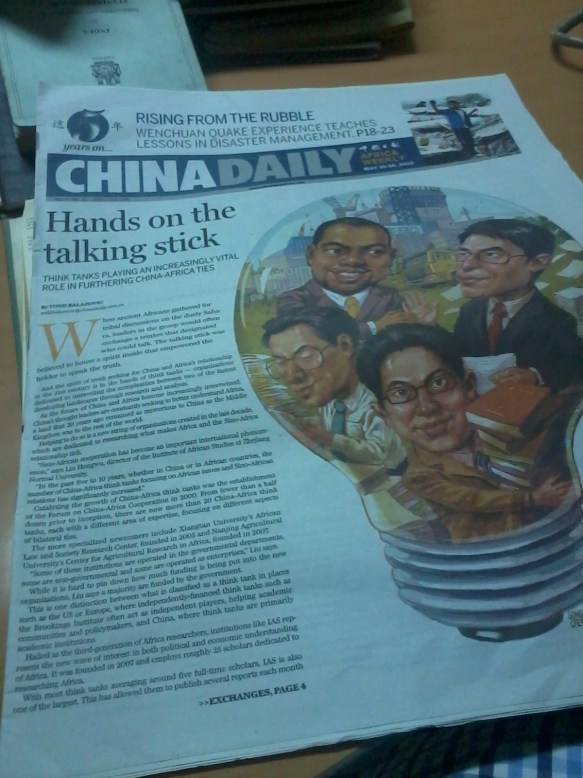
Increasing Chinese soft power in Africa is real.

China in Kenya

I have been spending a lot of time in government offices and libraries in Nairobi lately. One thing that struck me this morning is that China Daily now publishes an Africa Weekly magazine and that government offices in Nairobi actually subscribe to it. They do not subscribe to the IHT.

A look into Kenyatta’s new cabinet

President Kenyatta has announced 16 of 18 cabinet secretaries in his administration. The list of names has elicited mixed reactions. On the one hand the manner of the announcement – on the steps of State House – was different, and dignified. It was much less pedestrian than what Kenyans had become used to – presidential cabinet appointments via press releases to newsrooms. Six women made the list, including in the powerful Defense and Foreign Affairs dockets. With the exception of Balala and Ngilu, all the nominees so far are not politicians.

But on the other other hand grumblings emerged on the lack of regional (read ethnic) balance in the appointments. Kenya is an ethnically fragmented country, with 11 (out of 42) ethnic groups with populations over 1 million (Kikuyu/GEMA, Luhya, Kalenjin, Luo, Kamba, Somali, Kisii, Meru (part of GEMA), Mijikenda, Turkana, Maasai). For most of the country’s history ethnicity has been a key organizing principle of politics, with people largely voting along ethnic lines for various instrumental reasons.

So what is the ethnic breakdown of Kenyatta’s cabinet so far? Here is my guestimation based on their last names: Kikuyu (3), Kalenjin (4), Somali (3), Luo (1), Meru (1), Kisii (1), Kamba (1), Luhya (1), Arab (1). Two slots remain unoccupied.

Only two groups (Kalenjins and Somalis) are clearly overrepresented in the cabinet appointments in proportion to their relative ethnic group size in the country (Kalenjin 25% vs 13.2%; Somalis 18.75 vs 6.3%). Those groups in the top ten that are underrepresented missed their “objective proportion” of the cabinet by about one slot, on average.

On an aside, historically African presidents have actually been pretty good at ethnic balancing in the appointment of cabinet ministers – as Francois, Rainer and Trebbi show in this paper. They claim to “show that African ruling coalitions are large and that political power is allocated proportionally to population shares across ethnic groups. This holds true even restricting the analysis to the subsample of the most powerful ministerial posts. We argue that the likelihood of revolutions from outsiders and the threat of coups from insiders are major forces explaining such allocations.

If the ethnic composition of the cabinet is anything to go by, it shows the extent to which deputy president William Ruto is more of an equal than deputy to President Kenyatta. His part of the Jubilee coalition dominates the list of cabinet nominees. Or it might just be a case of Mr. Kenyatta, being president, having opted to have his half of the cabinet “represent the face of Kenya” (Kenyatta and Ruto had a 50-50 pre-election appointments sharing agreement at the formation of the Jubilee coalition).

Despite Kenyans’ relief at the end of Odinga and Kibaki’s coalition government, the era of nusu mkate might still be among us.

In related news, president Kenyatta broke one of his campaign promises by not appointing an ethnic Turkana as secretary in charge of Energy and Petroleum. Kenya’s oil discoveries have been mostly in Turkana County. The Standard reports:

Uhuru [President Kenyatta] repeated he will appoint a Turkana to head the Ministry of Energy portfolio should he take over the next Government.

Kenyatta said his Government would give first priority to locals to manage the oil resources that were discovered in the area.

“Our mandate is to ensure that every Kenyan gets equal share of national cake. But locals where such resources are found should benefit more as a right stipulated in the Constitution,” he said.

Deputy President William Ruto also broke a promise he made yesterday. He said at a presser that the cabinet will not have any politicians, yet Charity Ngilu and Najib Balala have been nominated.

Kenyatta’s Cabinet Nominees:

  1. Fred Matiang’i (Information, Communication and Technology) – Kisii
  2. Henry K. Rotich (The National Treasury) – Kalenjin
  3. James Wainaina Macharia (Health) – Kikuyu
  4. Amb Amina Mohamed (Foreign Affairs) – Somali
  5. Adan Mohammed (Industrialisation) – Somali
  6. Ann Waiguru (Devolution and Planning) – Kikuyu
  7. Davis Chirchir (Energy and Petroleum) – Kalenjin
  8. Amb Raychelle Omamo (Defence) – Luo
  9. Eng Michael Kamau (Transport and Infrastructure) – Kikuyu
  10. Phyllis Chepkosgey (East African affairs, Commerce and Tourism) – Kalenjin
  11. Prof Jacob Kaimenyi (Education) – Meru
  12. Felix Kosgey (Agriculture, Livestock and Fisheries) – Kalenjin
  13. Prof Judy Wakhungu (Environment Water and Natural Resources) – Luhya
  14. Dr Hassan Wario (Sports, Culture and Arts) – Somali
  15. Najib Balala (Mining) – Arab
  16. Charity Ngilu (Lands, Housing and Urban Development) – Kamba
  17. Ministry of Labour, Social Security and Services (Vacant)
  18. Ministry of Interior and Coordination of National Government (Vacant)

Supreme Court Judgment on the Presidential Election Petition 2013

The Kenyan Supreme Court released the full judgment (PDF) following the justices’ unanimous dismissal of Raila Odinga’s petition challenging the election of President Uhuru Kenyatta.

Below are some sections of the ruling.

This Judgment, therefore, may be viewed as a baseline for the Supreme Court’s perception of matters political, as these interplay with the progressive terms of the new Constitution. It is clear that this Judgment, just as it is important to all Kenyans in political terms, is no less important to the Court itself, in terms of the evolution of jurisprudence in the domain of public affairs. It is particularly so, in the light of Section 3(c) of the Supreme Court Act, which vests in this Court the obligation to “develop rich jurisprudence that respects Kenya’s history and traditions and facilitates its social, economic and political growth.”

…the respondents are invited to bear the evidential burden. The threshold of proof should, in principle, be above the balance of probability, though not as high as beyond-reasonable-doubt…

…the failure mainly arose from the misunderstandings and squabbles among IEBC members during the procurement process – squabbles which occasioned the failure to assess the integrity of the technologies in good time. It is, indeed, likely that the acquisition process was marked by competing interests involving impropriety, or even criminality: and we recommend that this matter be entrusted to the relevant State agency, for further investigation and possible prosecution of suspects.

In summary, the evidence, in our opinion, does not disclose any profound irregularity in the management of the electoral process, nor does it gravely impeach the mode of participation in the electoral process by any of the candidates who offered himself or herself before the voting public. It is not evident, on the facts of this case, that the candidate declared as the President-elect had not obtained the basic vote-threshold justifying his being declared as such.

As I have said before on this blog, the justices had to make both legal and political considerations with regard to this case. I am not a lawyer and cannot comment on the legal aspects of the case/ruling. With regard to the political considerations, I think the court showed its conservative hand – opting for a strategy of letting Kenya’s new institutions grow on their own without strict supervision from the courts; notice the many references to public opinion and perception in the ruling. That is how the court interprets its mandate to “develop rich jurisprudence that respects Kenya’s history and traditions and facilitates its social, economic and political growth,” I think.

Kenyan pollster Ipsos explains why they missed the mark

Today Ipsos Synovate provided their own internal analysis (see here, pdf) of the election results vis-a-vis their poll numbers right before the March 4th election.

According to the final IEBC tally (Which Mr. Odinga is challenging in court) all the eight candidates except Mr. Kenyatta performed within the margin of error of Ipsos’ last poll before the election.

Mr. Kenyatta outperformed the last poll by 5.25%, well outside the margin of error.

How did Ipsos miss this?

Their answer on page 23 basically agrees with my observation that differential turnout, especially in the candidates’ respective strongholds, made the difference.

According to the final IEBC numbers, Mr. Kenyatta’s 20 biggest vote-basket counties averaged a turnout rate of 88%, compared to Mr. Odinga’s 84%.

In related news, tomorrow Mr. Odinga will officially file the petition that seeks to nullify Mr. Kenyatta’s election as president.

CORD may seek the nullification of the whole election or narrow their challenge to just whether Mr. Kenyatta actually crossed the 50% threshold.

Crucial figures to think about as we await to see the content of the petition tomorrow are (1) 10.6m votes were cast in the 47 governor races compared to 12.3m in the presidential race, a difference of 1.7m votes; and (2) Mr. Kenyatta crossed the 50% threshold by less than 10,000 votes.

More on this next week.

Day 3 after the Kenyan election

Counting is still going on following Monday’s general election in Kenya. Following the close of polls the electronic tallying system for the presidential election crashed, forcing the IEBC to resort to a manual tallying system.

Just under half of the 290 constituencies have so far reported. Mr. Kenyatta still holds the lead, by about 350,000. The projected national turnout stands at 82%.

The IEBC has promised to release the final results tomorrow (Friday).

A couple inexplicable things have happened since my last post.

Firstly, the 300,000+ “rejected votes” that consistently made up 6% of votes in the initial tally have dwindled down to 40,000 – less than 1% of the total votes counted so far.

The IEBC’s explanation was that there was a software malfunction in the electronic tallying that increased the rejected votes by a factor of eight.

Secondly, both CORD and Jubilee coalitions have issued statements regarding the tallying process. CORD claimed that some results were “doctored.” Jubilee claimed that the UK government had sent troops to Kenya and that the high commissioner was trying to influence the tallying process.

None of these claims have been substantiated. Kenyan media houses have agreed to deny live coverage to such political pronouncements.

Life is slowly getting back to normal – I was glad to see traffic on Nairobi roads today!

With regard to the final result, it is clear that Mr. Uhuru Kenyatta has an unassailable lead over Mr. Raila Odinga. What is not clear is whether or not he will win by a wide enough margin to avoid a runoff.

The wait continues…

Who will win the Kenyan presidential election? A look at the numbers

With elections less than a month away many in Kenya are reading the tea leaves and making predictions as to who they think will win the March 4th presidential election. Unfortunately, many of these self-styled political analysts – including the most celebrated one Mutahi Ngunyi – are merely using the raw IEBC voter registration numbers and assumptions about ethnic bloc voting.

The reality, however, is that there will be differential voter turnout in the many ethnic zones regions of the country in a manner that will have a non-trivial impact on the outcome of the election. As I highlighted in a previous post, this will be a turnout election. Everyone knows who their voters are. The swing voters will be few. And the two major contenders don’t appear to have any intention or strategy to eat into each other’s perceived strongholds.uhuru

And so just as I did last time, I ran the numbers from the latest opinion poll from Ipsos Synovate with regional breakdowns to estimate the winner of the presidential election. This time round my turnout model also includes variables on income, voter registration, and whether a region has a top presidential contender or not.

So what do the numbers say?

Well, if the polls are right Uhuru Kenyatta still leads Raila Odinga by about 740,000 votes.  I estimate that Mr. Kenyatta will get 48.87% of the votes cast to Mr. Odinga’s 41.72%, which means that a run-off is almost inevitable. I don’t expect Mr. Kenyatta to hit the 50% mark since my model is slightly biased in his favor (especially coming from the Rift Valley turnout figures from 2007 that I use as a basis of estimating turnout in 2013).  Below I show the regional tallies according to my turnout model.

A few caveats to go with my estimates: 

  • Of course the polls could be all wrong, in which case none of what I say here matters. 
  • The result of the election will hinge on the turnout in the respective candidates’ strongholds. As it is my model estimates a turnout rate in Mr. Kenyatta’s strongholds at 77.33 to Mr. Odinga’s 66.68. Mr. Odinga can easily erase Mr. Kenyatta’s lead by matching his stronghold turnout rate and having a respectable showing in Western region (by eating into Mr. Mudavadi’s vote share) on March 4th.
  • In the event of a run-off, all bets are off. Most likely the election will then centre on Mr. Kenyatta’s ethnicity (which is the same as that of the outgoing president) and his tribulations at the ICC thereby handing Mr. Odinga a lead straight off the gates.
REGION Uhuru Kenyatta Raila Odinga
Coast 64,064 410,012
North Eastern 103,978 115,531
Eastern 865,432 732,612
Central 1,623,483 113,266
Rift Valley 1,655,262 695,972
Western 58,040 444,974
Nyanza 282,626 1,299,053
Nairobi 406,099 507,624
TOTAL 5,058,984 4,319,044

For those interested in looking under the hood of Ipsos Synovate’s polls go here.

Odinga cracks 50% rating in opinion poll

The Odinga/Musyoka ticket leads the Kenyatta/Ruto ticket in an opinion poll on the electorate’s preferred president and running mate ahead of the March 4th 2013 general election. Odinga’s lead (51-39) is well outside the margin of error of the poll.

The chart below shows the Infotrak Harris tracking poll since early 2010.

kenpollsJanThe most interesting data points in the poll are (1) the level of support (at 36%) for the Odinga/Musyoka ticket in the backyard of William Ruto, Mr. Kenyatta’s running mate; (2) the fact that the former Western Province is not really a swing region after all, with Musalia Mudavadi being preferred by a meager 23% of registered voters; and (3) The geographical limits, albeit in relatively higher population density areas, of the Kenyatta/Ruto ticket – the Odinga/Musyoka ticket leads in 6 of Kenya’s 8 provinces.

According to my own estimations (more rigorous analyses coming after 17th of this month) Odinga/Musyoka have the lead in 23 counties perceived to be CORD’s strongholds. Kenyatta/Ruto and their Jubilee Alliance lead in 20 counties. 4 counties are truly swing.

The Kenyatta/Ruto alliance however have a vote lead of about 292,000. 2.5 million votes are still up for grabs, enough to swing the election in CORD’s favor. .

The latest polls continue to confirm that Mr. Odinga remains a slight favorite to become Kenya’s 4th president. But as I have said before, this will be a close election.

Mitigating violence in Kenya’s 2013 elections

Joel Barkan has a CFR contingency planning memorandum on the Kenyan elections in which he notes that:

The United States and others may have limited leverage over Kenya’s domestic politics, but they are not without options that would significantly improve the prospects for acceptable elections and help avert a major crisis. However, with little more than two months before the elections, Washington must intensify its engagement or forsake its opportunity to make a difference.

But the window might be closing fast on the international community to help Kenya avoid a repeat of 2007-08, when 1300 died and 300,000 were displaced after a bungled election. According to a report by the Global Commission on Elections, Democracy and Security (yours truly was a research assistant for the commission), evidence suggests that international interventions to encourage reasonably free and fair and peaceful elections are most effective when done well in advance to the polling day. In the Kenyan case, the structural causes of previous rounds of electoral violence were never addressed, and may yet lead to the loss of life this election cycle.

What can now be done to avoid large scale organized violence is to credibly convince the politicians and those who finance youth militia (chinkororo, taliban, mungiki, jeshi la mzee, baghdad boys, etc) that they will be held accountable. So far, as is evident in Tana River and the informal settlements within Nairobi, the lords of violence appear to be operating like it is business as usual.

Kenyan Elections 2013 Polling Trends (Presidential Race)

It is less than two months to the Kenyan general election on March 4th 2013. In the next ten days political parties will nominate candidates (either directly or through primaries) for various elective posts – Governor (for the 47 counties), MP (290 of them), Senator (one per county), Woman MP (representing each county), and several County Representatives per county. I suspect the next round of polls will come out after the nomination exercises, which will undoubtedly result in further realignment of the political landscape.

Kenyan political parties are not known for their democratic credentials and I expect quite a few candidates (and their supporters) to shift their support if they feel that they’ve lost unfairly in the party primaries.

As I noted in my last post on the Kenyan elections, the institutional incentives have made it such that the presidential race is one between two main contenders – Uhuru Kenyatta and Raila Odinga. (Mr. Musalia Mudavadi has since fallen out with Mr. Kenyatta and is also running for president, although his candidature is mainly a strategy designed to maintain his political relevance in Western Kenya moving forward.)

Mr. Odinga’s biggest strength is his national appeal and name recognition – having been co-president of some sort (at least on paper) over the last 5 years he is running like an incumbent. He is also widely viewed as a reformer who can be trusted to implement the new constitution. His weaknesses include his proclivity to radicalism, a tendency to surround himself with yes-men from his ethnic group, and the failure to foster democratic competition within his own party – the Orange Democratic Movement.

Mr. Kenyatta’s strengths include his youth, name recognition (he is the son of Kenya’s first president), and his massive wealth (he is perhaps the richest Kenyan). His base (central Kenya and surrounding areas) is the most populous in the country and registered the highest rates of turnout in the voter registration exercise. Added to all of this is the fact that in his running mate, William Ruto, he has one the best, if not the best, political campaigner this election cycle. Mr. Ruto knows how to get the masses excited with memorable talking points. His phrase “kusema na kutenda” (saying and doing) is the main rallying call of this election.

The duo’s biggest weakness is their impending case at the ICC. Mr. Kenyatta is also of the same ethnicity as the outgoing President Kibaki. Many in Kenya feel that the presidency should go to a different region this time round, central Kenya having had it twice. Mr. Ruto is from the same ethnic group as Kenya second president Daniel Moi. Both Ruto and Kenyatta are suspected to be lukewarm with regard to the new constitution. Mr. Kenyatta only reluctantly backed the document while Mr. Ruto campaigned against it.

As we await the next round of polls and the final picture of regional alignments, below is a snapshot of the polling trends over the last 18 months. Mr. Odinga (in my view the slight favorite to be Kenya’s 4th president) has consistently led in the polls since March of 2010. No one has so far cracked the 50% mark. The Kenyan constitution mandates that the winning presidential candidate garner 50%+1 of the votes cast.

Does this mean that there will be a runoff after March 4? The answer to this question depends on how well Mudavadi performs in his Western Province backyard. Having registered the second highest number of voters this cycle (behind Mr. Kenyatta’s Central Province (and its “diaspora”) base), Western Province (and its “diaspora”) is the biggest swing region. Mr. Odinga is banking on the Western vote and may win in the first round if Mudavadi doesn’t have a good showing on March 4th.

click on image to enlarge.

polls

Poll numbers from Infotrak Research.

Where do robbers choose to locate?

Rob thy neighbor appears to be the decision rule for robbers, at least in Chicago. Bernasco, Block and Ruiter, writing in the January 2013 issue of the Journal of Economic Geography, present research on robbers’ choice of crime sites:

“This article analyzes how street robbers decide on where to attack their victims. Using data on nearly 13,000 robberies, on the approximately 18,000 offenders involved in these robberies, and on the nearly 25,000 census blocks in the city of Chicago, we utilize the discrete choice framework to assess which criteria motivate the location decisions of street robbers. We demonstrate that they attack near their own homes, on easily accessible blocks, where legal and illegal cash economies are present, and that these effects spill over to adjacent blocks.”

The graph below (on p. 129 in the paper) illustrates robbers’ tendency to carry out their activities closest to where they live (for reasons why see the paper).

crime location

crime frequency and distance from robber residence

The findings are at once obvious and insightful. The insightful bit is that because of the geographic concentration of crimes and criminals, sometimes it might make more sense from the point of view of authorities to just focus on containing criminal activity within specific neighborhoods, leading to further entrenchment of a culture of crime in those neighborhoods.

If you notice,  in most places – including Nairobi – certain types of crime only get reported when they cross these implicit barriers. Otherwise, crime in bad neighborhoods becomes a case of if a tree falls in the forest.

Kerry or Rice? The View From Africa

The window is closing fast on the chances of having an Africanist as US Secretary of State (Minister of Foreign Affairs). Republicans in the US Congress, human rights activists and a section of Africanists have come out in opposition to Ambassador Susan Rice. Republicans insist that she lied to Americans about the real masterminds of the attack on the US embassy in Libya that resulted in the deaths of four Americans, including the ambassador. The Africanists and human rights activists are not enthused by Ms Rice’s cozy relationship with the regimes of Paul Kagame of Rwanda and the late Meles Zenawi of Ethiopia. A section of African elites (the elitist sovereignty crowd) may also be wary of her support for interventionism on humanitarian grounds.

Source: Wikipedia

Source: Wikipedia

As things stand Pres. Obama might be forced to choose Sen. John Kerry over Ms Rice in order to avoid an unnecessary war with a section of Congress at a time when everyone and their dogs and cats should be worrying about the fiscal cliff.

John Kerry would not be a terrible choice. His past focus on drug trafficking in Latin America, free trade agreements and climate change would make him useful to Africa.

As I have written before, Africa is increasingly becoming a transit point for drugs from Asia and Latin America destined for the European market. Africa also needs more trade with the US beyond AGOA. And climate change will probably affect Africans the most since the vast majority of them depend on rain-fed agriculture and live under conditions that can least withstand natural disasters. But Kerry is not an Africa expert and has done little on the region beyond his support for the South Sudanese cause. This makes it hard to see how he will connect his global focus on these important issues to the African context.

Susan Rice on the other hand has studied Africa and has in the past shown a pragmatism that you want in the top US diplomat. Plus it helps that Ms Rice would have Obama’s ear as she is reported to be very close to the president. She has had successes at the UNSC, the highlight of which was the intervention in Libya to stop Gaddafi from butchering civilians in Benghazi. Rice is a smart straight-talker whose undiplomatic streaks can be a plus in a region full of under-achieving strongmen.

For a very long time Foggy Bottom has seen Africa through a humanitarian lens. Even Hillary Clinton, with all her awesomeness, has done little in new initiatives for Africa beyond human rights issues and a campaign that involved providing cameras for rape victims in eastern DRC. These are not unimportant issues. I am not saying that human rights catastrophes in Africa should be ignored. Just that this should not be a secretary of state’s pet project for the entire the region.

In my opinion Ms Rice’s biggest plus is that she gets one of Africa’s biggest challenges: state incapacity.

It would be nice to have a US secretary of state who takes state capacity development in the region as her pet project (and has the guts to at times subordinate democracy promotion to this project). Her praise of Kagame and Zenawi (no doubt both rabid and at times murderous autocrats) was centred around this very same idea (and to be honest, the ghosts of Rwanda circa 1994). Democracy promotion is a noble cause. But it must be done with a sober mind. The last thing you want is a procrustean approach to the promotion of rights, freedoms and liberties like we have seen in the past.

(Just for the record, I am pro-democracy and have criticized the likes of Kagame here and here, among other forums).

Anyone who reads the development reports side by side with the human rights reports from Rwanda and Ethiopia must be conflicted. I have talked to a senior opposition figure from Ethiopia who told me that she thinks the biggest challenge to fighting Meles Zenawi (at the time) is that “people see the dams and the roads.” It is hard to ignore revealed competence. I would hazard to guess that most people would rather live in autocratic Singapore than democratic Malawi. Yes, it is not an either/or argument with these regimes. All I am saying is that interventionism has to be constructive and not lead to the rolling back of hard fought gains against disease, illiteracy and poverty in these states.

As I opined following Obama’s reelection, I think that security will be at the top of the US Africa policy, of course dressed up in rhetoric about democracy and human rights. John Kerry will handle that on auto pilot. His focus will be on the Middle East and South Asia. It would have been better to have an Africanist at the helm who understands more about the continent and could sneak in a few policy agendas here and there that could make a difference on the ground. An aggressive focus on state capacity development could have been one of those policies.

This is a missed opportunity for Africa. For the first time in history Africa had a chance to have the number one American diplomat be a person who is an expert on a section of the region (Ms Rice wrote a thesis on Zimbabwe). Her defense of a couple of African autocrats aside, I think Ms Rice would have been better for Africa than John Kerry – who in all likelihood will focus on the Middle East and South Asia and continue Sub-Saharan Africa’s designation to the “humanitarianism column.”

Africa for Norway

Some light humour, because it is a nice and sunny Wednesday morning here in Nairobi and winter is about to get real for millions of hapless Norwegians.

[youtube.com/watch?gl=US&feature=player_embedded&v=oJLqyuxm96k]

More on this here.

H/T VKW

Life expectancy in Kenya jumps to 64

The Daily Nation reports:

The life expectancy of a Kenyan has increased to 64 years up from 55 two years ago, a report released on Sunday shows.

The data compiled by the University of Nairobi in partnership with 12 other universities worldwide notes that the life of Kenyans has improved substantially and they can expect to live longer.

The report, State Of The Tropics, further says that Zimbabwe is the only nation in the world that recorded a decline in life expectancy at 47 years.

Madagascar reported the largest improvement in life expectancy to 65.8 years, with large reductions in infant and adult mortality rates.

…. In regional terms, Zimbabwe has a low infant mortality rate, but a very high adult mortality rate (the highest in the world)

Overall, there has been massive improvement in life expectancy in the tropics since the fifties:

…. life expectancy in the tropics has increased by 22.8 years to 64.4 years between 1950 and 2010 and the gap between the life expectancy of women and men has widened in favour of women over the same period.

I guess this calls for an investigation of the real causes of the drop (if the data hold up) in mortality rates (especially infant mortality). Is it better healthcare, diet or just a natural secular trend? Or could it be better economic prospects (since the mid-1990s) that inspire greater investment in healthcare? Also, has the AIDS epidemic peaked in the tropics? Over to you, epidemiologists.

It is a bit odd that a country like Zimbabwe has a low infant mortality rate but a high adult mortality rate – why has the total collapse of state institutions disproportionately affected health provision to adults?