Workshop Fatigue: Residents of Kibera Demand Sitting Allowances to Attend NGO Meetings

The residents of Kibera, in Nairobi,  have a message for foreign aid groups in their community: if you want us to come hear what you have to say, you need to pay us.

So many non-governmental organizations (NGOs) have flooded this poor area that many locals have become disillusioned by the foreigners who say they want to help.

Inundated by invitations to go to meetings and trainings put on by NGOs, the  residents now seek compensation for their time. The handouts, known as “sitting allowances,” generally range from about $1 – $3 per hour, which can buy a fair amount here.

“Trust me, no one will go without the sitting allowance,” said Sharon Ogolla, 20, as she stands outside the hair salon she runs with her mother.

Asked whether most locals go to hear what the NGOs have to say, or just to collect the payment, Ogolla said, “Well, both, but mostly, honestly, to get the fee.”

For more see here. You should also read it for commentary on misguided foreign interventions.

H/T Laura Seay.

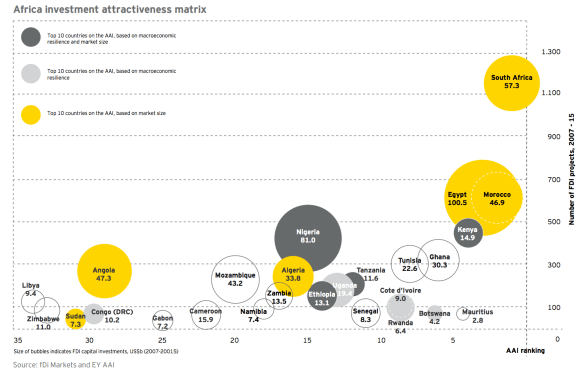
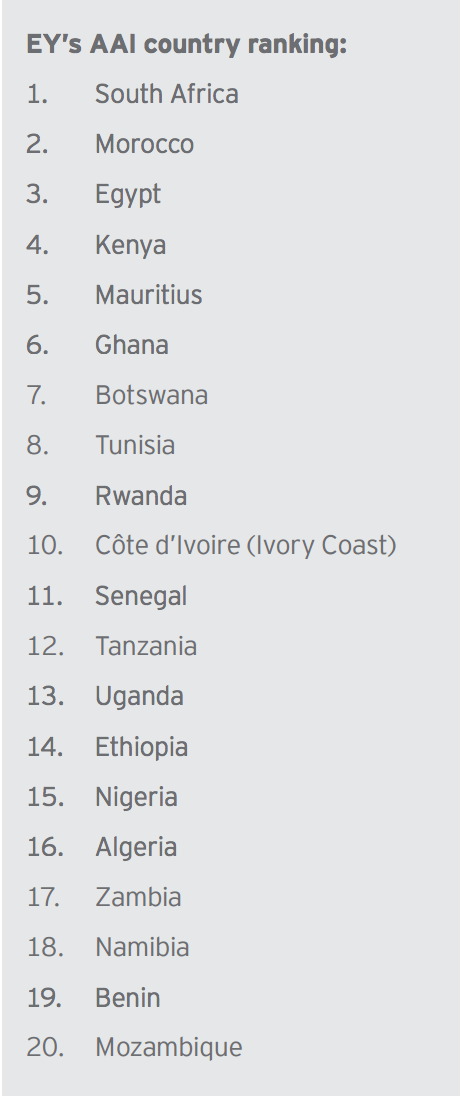
The top 20 best countries to invest your money in Africa

This is according to the latest Ernst & Young’s Africa Attractiveness Report (2016). Kenya is ranked 4th. Ahead of Tunisia, Mauritius, and Botswana. You just need to spend a few hours in Nairobi, or the other 46 county headquarters, to understand why. While economic inequality remains to be a huge (political) challenge, it’s hard to argue against the structural transformations underway in the Kenyan economy.

Screen Shot 2016-07-26 at 11.41.28 AM.png

Screen Shot 2016-07-26 at 11.36.26 AM

More on this year.

Is Brexit good or bad for Africa?

Writing in Foreign Policy, Alex de Waal is certain that Brexit is terrible for African countries, and that “[e]verything from the economy to peacekeeping missions will suffer.”

The damage to British interests is significant, but the losses for [African countries] could be greater still. In campaigning to leave the European Union, Minister for Africa James Duddridge argued that Britain would be able to forge stronger ties with the continent if it were unencumbered by EU inefficiencies in aid and trade. Perhaps if Duddridge had a blank slate on which to construct a new Africa policy, he could do better than Britain’s existing one, which is part bilateral and part multilateral through the EU.farage But no policy is ever built on a blank slate, and surveying the post-Brexit political wreckage, he is now faced with a salvage job that will involve decoupling Britain from numerous EU-led peace and development initiatives and renegotiating dozens of trade deals. Even deftly managed by Duddridge or his successor, the Brexit will leave Britain with a fraction of the influence it currently wields in Africa.

And over at Africa is a Country Grive Chelwa notes that:

The one obvious channel through which Brexit could affect economies in Africa is if it triggers a recession in the UK. A recession might affect trade and investment between the two regions. The Bank of England thinks a recession might very well be on the cards. A study reviewing all studies that have estimated the likely economic impact of Brexit found: “GDP losses for the UK in the range of 10% or more [could not] be ruled out in the long run.”

How much trade takes place between the UK and Africa? Not much, it turns out. Combining data from the UK’s Office for National Statistics (ONS) and the United Nations Conference on Trade and Development (UNCTAD) for 2014, the latest year for which we have comparable data, we calculated that exports from Africa to the UK represent about 5% of Africa’s total exports. Africa is more worried about a slowdown in China, its biggest trading partner by far.

…. The UK doesn’t have the same influence on the continent that it did decades ago. And Brexit will be further proof of that. If the UK sneezes Africa will … well Africa will say “bless you” and move on.

On balance, I agree with Chelwa. It appears that with regard to the UK-Africa relationship, the Brits stand to lose more than Africa as a unit following Brexit. This is for the following reasons:

  1. Lacking the amplifying effects of the EU, UK influence in Africa will be diminished. This is bad for the UK, but not necessarily so for African states. Notice that the UK’s security objectives in Somalia or elsewhere on the Continent have not suddenly changed following the Brexit vote. We should disabuse ourselves of the notion that the UK involvement in these theatres of conflict is out of pure benevolence. It is largely to protect British interests (tourists, MNCs, aid workers, other tied aid, etc). Those interests have not suddenly changed with Brexit. Is a post-Brexit UK better off with a stable Somalia? I think so. Viewed this way, what Brexit has done is not to change British interests in Africa but to increase the UK’s transaction costs in catering to those interests. The Brits may invest less in specific peacekeeping operations, but their self-interest dictates that they will not suddenly close the taps on these investments.
  2. A diminished UK diminishes Europe, which may reduce Europe’s leverage vis-a-vis African countries. This outcome could cut both ways. On the one hand, it may exacerbate the moral hazard problem faced by African leaders by allowing them to play different European powers off each other (why invest in good governance if Europe is always at the ready to help if things go south?) But on the other hand, a weaker Europe may be less willing to bail out African leaders all the time. This might force these leaders to take their jobs seriously, thereby improving the welfare of their citizens. 
  3. It is not clear that decoupling UK aid from the rest of Europe will necessarily lead to the UK cutting its aid budget. In fact, the opposite might prove true. Going its own way may force the UK to put more aid pounds into projects in the region than it currently does under a joint EU aid budget. Again, increased transaction costs may mean the UK spending more money than it currently does in Africa, which is good for African economies. Plus the UK is likely to find itself needing to make up for the lost amplifying effects of the EU with more aid pounds.
  4. A recession in the UK may prove contagious. This would be bad for the world economy, and Africa would not be an exception. That said, I don’t think economic turbulence in Africa would necessarily lead to the conflicts of the early 1990s. With a few glaring exceptions, most African countries would be able to withstand a global recession without collapsing. We saw this during the Great Recession.
  5. The world is learning a lot about democracy by observing the challenges it currently faces in the West. Suddenly, corrosive ethnic politics is not exclusive to poor countries. “Leaders” like Donald J. Trump and Boris Johnson are not things that only happen in Zimbabwe or Nicaragua. These data points will serve to demystify democracy as a system of governance, and refocus global attention on what really makes democracy work — a stable intra-elite consensus coupled with reasonably sufficient responsiveness to the electorate (down with the fetishization of elections!!!) This will be a valuable lesson for Africa and other developing regions of the world. The ongoing sociopolitical troubles in the West are bound to liberate the worldview of leaders and other elites in the Global South, and will empower them to mold their own societies in their own image, instead of trying to turn them into Denmarks. The often-misrepresented “European mystique” has lost its shine. And this is a good thing for the world.

This is not to say that Africa’s economies will be able to weather Brexit without any non-trivial hiccups. South Africa, Nigeria, and Kenya are probably the most exposed (in that order). Other African economies will be exposed to the extent that economic troubles in the UK lead to a global recession (the gold exporters might even benefit…)

And Western security policies and support for missions in Somalia and across the Sahel may face short-term uncertainties. But these experiences will not necessarily be catastrophic (on the security front, America will most likely steady the ship).

In fact, I tend to think that the long-run impact of these experiences will be positive. English speaking African economies will have incentives to diversify their export destinations away from the UK. African countries will have more leverage vis-a-vis the UK and (a fractured) Europe (and the US). And the lessons from the political upheavals in the West will serve to liberate Global South elites to mold their own societies in their own image and in a manner that respects sociopolitical realities in their specific contexts.

Five Things You Should Know About the Ongoing Monday Protests in Kenya

Over the last couple of weeks opposition parties in Kenya have staged public protests across the country demanding for personnel changes at the Independent Electoral and Boundaries Commission (IEBC) — Kenya’s electoral management body (EMB). This week’s Monday demonstrations turned violent in some towns and cities, with at least four people reported dead at the hands of anti-riot police.

The organizers of the protests have vowed to keep at it every Monday until the current IEBC commissioners resign. Here are the five things you need to know about the protests:

  1. A plurality of Kenyans have lost faith in the IEBC (see here). Screen Shot 2016-06-07 at 8.07.41 PMIn the run up to the 2013 election, several members of the commission (then known as IIEC) and its secretariat were implicated in graft (known as the chickengate scandal) involving a number of British companies. These individuals’ accomplices were found guilty by UK courts; and court documents explicitly mentioned the Kenyans that were bribed by their UK counterparts. Yet a number of those adversely mentioned in the UK court documents continue to remain in office — including the chairman of the commission, Issack Hassan. It is partially for this reason that a plurality of Kenyans (including politicians on both sides of the political divide) have lost faith in the IEBC.
  2. Opposition politicians, including those in CORD and KANU, want the IEBC reconstituted over suspicions that its current leadership favors incumbent Uhuru Kenyatta and the governing Jubilee Alliance. CORD (in my view, erroneously) maintains that the IEBC was used to rig the 2013 election in favor of President Kenyatta. KANU has most recently accused the same EMB of rigging the Kericho senatorial by-election in favor of the Jubilee candidate. CORD has also argued that its failure to meet the threshold for a popular referendum (dubbed Okoa Kenya) —  whose main thrust was a change in Kenya’s electoral laws — was a result of bias within the IEBC. CORD wants the IEBC reconstituted and the new commission to have proportional representation of parliamentary political parties. Although the constitution lays out the procedure for removing commissioners of an independent entity like IEBC (through Parliament), CORD is wary of this option due to its minority status in the legislature. Initially it pinned its hopes on a popular referendum. But when that failed it resorted to mass action in a bid to strategically influence any eventual institutional reform of the IEBC (in my view this eventuality can partially be blamed on the singular failure of the(Jubilee) leadership of the National Assembly).
  3. The Uhuru Kenyatta Administration is caught between a rock and a hard place. On the one hand, it is hard for the administration to defend an obviously tainted EMB. This would also go against its continued claim that the IEBC is an independent body. But at the same time, the administration needs a reform path that will not embolden the opposition. The thinking within the Jubilee Alliance appears to be that if they give in to CORD on IEBC, what will CORD demand next? The contention that any and all reforms touching on the IEBC should follow constitutionally stipulated channels is partly motivated by this fear. In this regard, if CORD is genuine about surgical reforms specifically targeting the IEBC, it’s leadership should perhaps think of a way to credibly signal to the Kenyatta Administration that their reform agenda is limited in scope. From a purely political standpoint, President Kenyatta has reason to be cautious about the potential to open a whole pandoras box of constitutional reforms.
  4. Police brutality is (still) common in Kenya. Screen Shot 2016-06-07 at 7.27.32 PMOne of the goals of Kenya’s new political dispensation following the adoption of a new constitution in 2010 was police reform (majority of the 1,300 killed in the post-election violence of 2007-8 were shot by police). The institution even changed its name from Police Force to Police Service; and an independent police oversight authority was created (to democratize the institution through civilian oversight). But experience since 2013 has shown that these attempts at reform have not yielded any tangible results. The Police Service is still as corrupt as ever. And has little consideration for constitutional limits to its use of force (see image). Which means that more Kenyans will be killed in the hands of the police if the Monday protests continue.
  5. The 2017 presidential contest will likely be more competitive than most people think. Six months ago I would have predicted a landslide reelection victory for President Uhuru Kenyatta in 2017. Not anymore. President Kenyatta is still the favorite to win (because of incumbency advantage). But the jostling over control of the IEBC and the Supreme Court are telltale signs that the political class is expecting a close contest that will likely be disputed. It says a lot that despite being the incumbent, President Kenyatta’s poll numbers have stubbornly stuck in the low 40s (he can thank mind-blowing corruption and general Public Sector incompetence for that). This means that unless we see a drastic shift in regional alliances, next year’s election will most likely go to a runoff contest between Kenyatta and Odinga — which will be close. The more reason to have credible institutions in the form of a trusted IEBC and a Supreme Court beyond reproach. 

What does this say about overall political stability in Kenya? At this point in time I am a lot  more worried about county-level electoral violence than a 2007-08 style national disaster. That said, there is reason to fear that continued police brutality, especially targeting opposition supporters, may trigger wider civilian violence against presumed Jubilee supporters.

It is a little too early to talk specifics about next year’s presidential election. But what is clear is that Kenyatta’s reelection battle will no longer be a walk in the park.

A Tentative (Mixed) Public Health Victory: The Slow Retrenchment of HIV-AIDS

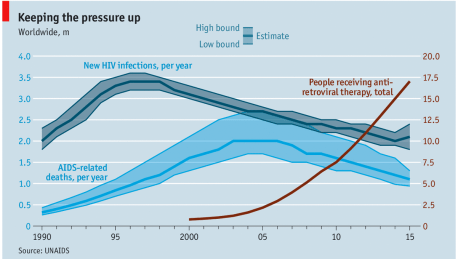
This is from the Economist, on the state of the fight against HIV-AIDS.

The next UN target is that, by 2020, 90% of those infected should have been diagnosed and know their status, 90% of those so diagnosed should be on ARVs, and 90% of those on ARVs should have suppressed viral loads. That is ambitious, but history suggests those in the field will rise to the challenge.

Screen Shot 2016-06-06 at 9.07.02 AM

The blue line is testament to George W. Bush’s No. 1 foreign policy success: PEPFAR.

But we should count our chickens just yet. The trends in the graph above are not uniform across the globe. As I noted in a previous post, there is quite a bit of heterogeneity both across and within countries. For example, in East Africa, Uganda is lagging Kenya and Tanzania in the quest to tame the virus (see below).

On a different note, this is yet another data point to suggest that Yoweri Museveni has hit the inflection point, and from now on all his machinations to stay in power will wipe out the achievements of his first 20 years in power.

The Kenyan National Assembly since 2002

From a dictatorship of one, to a dictatorship of 349. I say this is progress. Admittedly, change has been slow. But the dispersal of power is almost always a good thing.

kenyaMoi

H/T Boniface Mwangi.

Uganda chooses Tanzania over Kenya in pipeline deal

The Business Daily reports:

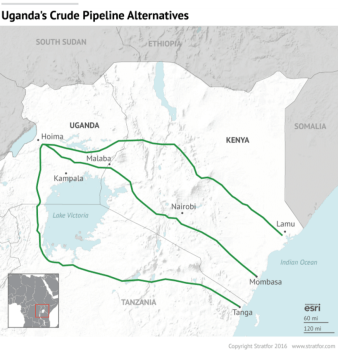
Uganda will take its oil to the market through Tanzania’s Tanga port, leaving Kenya to build its own pipeline to Lamu, if the positions taken at the just-ended talks in Kampala are maintained.

It turns out that Kenyan negotiators showed up without having done their homework. For example:

….. it has also emerged that the Kenyan officials participating in the Kampala talks may not have had all their facts right as they tried to address the concerns raised by Uganda over the northern route for the pipeline.

This is odd, given Amb. Amina Mohamed’s chops. Or should we be asking questions of the energy ministry?

Screen Shot 2016-04-16 at 5.04.17 PMUganda’s decision should be treated as new information on the capacity of the Kenyan state to execute large scale infrastructure projects. Kenya really wanted this deal, and the fact that the negotiators could not seal the deal with Uganda suggests that there is no there there as far as Nairobi’s capacity to execute on LAPSSET is concerned. This will undoubtedly impact the Kenyatta administration’s ability to originate new projects related to the $25b LAPSSET development plan.

The economics of the choice of pipeline appeared to not have mattered:

A joint pipeline between Kenya and Uganda would have had an initial throughput of 300,000 barrels per day (200,000 barrels for Uganda and 100,000 barrels for Kenya). This could have earned the pipeline companies $1.66 billion a year, which would be shared between the countries according to throughput.

…… If the two countries go for a standalone pipeline, Uganda will lose $300 million every year due to an increase of $4.07 in tariff per barrel, and Kenya will lose $250 million per year due to the increased tariff of $6.96 per barrel.

All else equal, this is probably a net positive development for the future of the East African Community (EAC). It is obviously a big financial and political loss for Kenya (and for that matter, Uganda) but it will dampen the idea of a two-speed EAC — with Kenya, Uganda, and Rwanda in the fast lane and Tanzania and Burundi in the slow lane.


President Uhuru Kenyatta’s State of the National Address to Parliament

On Thursday President Uhuru Kenyatta presented his annual report to the joint session of Parliament. You can find the text of the speech here and the youtube clip here.

Key achievements of his administration over the last three years include (i) rural electrification (nearly all primary schools have been connected to the grid — THIS IS PRETTY BIG DEAL); (ii) the construction of a new railway line (the project is a corruption boondoggle, but the speed with which it is being carried out is stunning); and (iii) power generation.

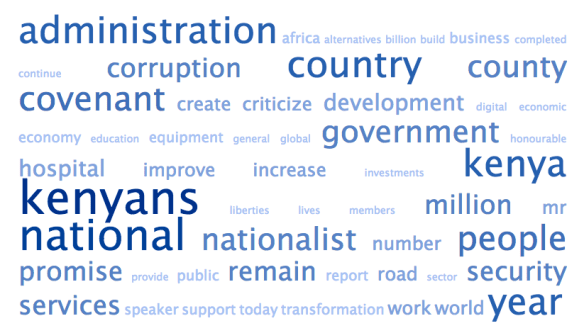
Below is a word cloud showing some of the issues the president focused on. Corruption, health (hospital), security, and general service provision were the main policy areas that the president chose to focus on.

I was surprised by the failure of “agriculture”, “land”, “education”, and “infrastructure” to make the top twenty. “Road” had a respectable show. There was also a lot of politics — mainly directed at the opposition and civil society.

Screen Shot 2016-04-01 at 4.46.04 PM

Perhaps in reaction to David Ndii’s provocative article on the failure of the Kenya Project, the president’s speech was particularly nationalist. The words “Covenant” and “Nationalist” appeared 27 and 22 times, respectively, well ahead of key policy-related terms.

I am personally worried that the word “development” outperformed “economic/economy.” I hope this is not a signal that the government views the running of the economy as a massive “development project.” We all know how those usually turn out.


Hard truths about the Kenyan economy

The World Bank has just released a must-read report on the state of the Kenyan economy. Here is just one of many excellent observations about the structural impediments to accelerated growth in Kenya:

Screen Shot 2016-03-09 at 11.00.50 PMCompared with other fast-growing economies, Kenya invests less and the share of investment financed by foreign savings is higher. The economic literature and post-World War II history illustrate that investment determines how fast an economy can grow. Kenya’s investment, at around 20 percent of GDP, is lower than the 25 percent of GDP benchmark identified by the Commission on Growth and Development (2008). Kenya’s investment rate, as a share of GDP, has also been several percentage points lower than the rate in its peer countries. At the same time, the economy has largely relied on foreign savings as a source for new investment since 2007, while national savings have been declining. National savings—measured as a share of gross national disposable income (GNDI)—has not surpassed the 15 percent mark over the past decade. In contrast, Pakistan’s savings is above 20 percent of GNDI, and Vietnam’s is more than 25 percent. Cambodia had a low savings rate in the 1990s, but it more than doubled the rate in the 2000s.

You can find the whole report here.


Do host governments necessarily “do development” better than foreign donors?

A common complaint you hear against donor-driven development projects is that they are typically at variance with local priorities; and make no attempts to work along the grain, or build upon existing systems. It turns out that governments in developing countries aren’t any different.

Take the example of the slum upgrading project in the infamous Kibera slum in Nairobi:

A keen look at the Open Street Map for Kibera and Mathare Valley before the NYS initiative started reveals the existence of services such as education, health, water and sanitation points. In Korogocho, Mukuru, Mathare and Kibera self help groups had emerged even before NYS Initiative start to earn daily income from activities such as urban farming, garbage collection and water delivery services. It is a fact that most toilets are not connected to the main sewer and private clinics are either not registered or managed by quacks, while illegal power connections abound.

The NYS Initiative would have scored big by establishing connections with already existing services providers in poor neighbourhoods by either improving their capacity to offer quality and affordable services to the urban poor or by trying to create an enabling environment for slum entrepreneurs to be part of formal and legal business entities. It is a mistake to assume that  there are no service providers within poor neighborhoods. Poverty and lack of basic services is an urban reality which has motivated the establishment of civil society groups to initiate health, education and income generating activities for women and youths as a supplement to government efforts in meeting its obligations. No government in the world can be able to solve the complex community problems of the poor by itself.

And there is an interesting twist to this story…

Experience from Dar es Salaam in Tanzania and the Urban Poverty and Slum Upgrading Project funded by the World Bank might be instructive. The project has some similarities with the NYS project in terms of targeting poor neighborhoods but was able to achieve more success because it worked more closely with local communities and partnered with Dar es Salaam Municipal Council officials from conception to implementation and monitoring stages, a situation which is totally lacking with the National Youth Service projects. The NYS Initiative seems to be a duplication and competition with the mandate of mandate of Nairobi City County.

I do not know about the veracity of the claims about the Dar slum (and I think the NYS budget is fully domestic — after the initial Chinese boost) but right now it’s hard not to feel like Tanzanians are doing everything right; while Kenyans are perennially running around in circles. The Mara Derby is on.

Read the whole thing here.

Thoughts on the Uhuru Kenyatta Administration in 2016

This is from Kenya’s leading newspaper, the Daily Nation, addressing the president:

We acknowledge the fact that it has been a tough year for leaders across the world — what with global economic upheavals and terrorists wreaking havoc everywhere.

However, we reject the almost criminal resignation and negligence with which your government has responded to our national crises this past year. We need not recount the number of lives lost, the losses incurred by businesses and opportunities wasted for millions of Kenyans due to the incompetence of the Executive.

With the exception of a few family businesses and tenderpreneurs who raked in billions of shillings — thanks largely to political patronage — everyone is losing money in this country.

More on this here. Read the whole thing.

This is pretty direct, and articulates a narrative of the middle class’ general dissatisfaction with President Uhuru Kenyatta’s administration.

It will also have very little political impact.

First, the Kenyan middle class (the primary audience of the Nation) is tiny. Second, the same middle class is as much a hostage of identity politics as is the rest of the country (this is true of even for the Nation‘s editorial team) — and on this score Kenya’s demographic profile favors Mr. Kenyatta in the next election scheduled for August next year (All indications suggest that a breakup of the Jubilee Alliance ahead of 2017 is a low probability event). Third, there still exists a wide chasm between the middle and upper middle classes and the vast majority of working class and rural Kenyans (with the former group perpetually wondering why the latter group doesn’t vote for its interests). This is why identity politics continue to dominate even cosmopolitan counties like Nairobi, Kisumu, Nakuru, and Mombasa.

That said, here are some quick thoughts on the Jubilee Administration as it enters its fourth year:

  1. President Uhuru Kenyatta is a politician: That means that he will invariably only take action that is consistent with his perceived political interests — getting reelected in 2017; keeping his political lieutenants and the wider Jubilee coalition happy; taking care of his core base; et cetera. Reformists who imagine that the president can operate outside of Kenya’s political system are bound to be disappointed. And those who equate Uhuru Kenyatta to Daniel arap Moi are missing the point by miles. Moi micro-managed. Kenyatta II delegates (Kibaki and Kenyatta I delegated, but with relatively better monitoring).
  2. The Kenyatta Administration’s biggest problem is too much delegation without sufficient monitoring: Much of the criticism of the Administration tends to be packaged in the language of “political will” — if only Kenyatta REALLY wanted to change things. The truth, however, is that the president faces both political and organizational obstacles to reform. Administrators continue to stonewall reform at will; and the administration remains too top heavy for its own good. What needs to happen is a radical restructuring to empower the equivalent of “mid-level managers” in the Civil Service. This should be accompanied by a shift from an internal police patrol system of monitoring (characterized by an extreme form of siege mentality) to a fire alarm system — Civil Servants should be judged by what the public thinks of their work. And those found wanting should be fired. Incentives matter. Focusing on these administrative and organizational reform agendas, rather than the politics of “political will” might be more amenable to the president (see 1 above) and could yield good results — especially if they come with sufficient political cover for the president.
  3. State House is not focused on any key signature policies: Most governments tend to be judged by a few signature achievements. President Kibaki will forever be remembered as Mr Infrastructure. Thus far Mr. Kenyatta has not staked his legacy on any pet projects or policies — most of the big investments he has made (in rail, roads, and power) are on Kibaki legacy projects. This makes it very hard for him to sell any “successes.” Back in 2013 I proposed housing, agriculture, and education as possible areas in which the president could make significant improvements while building on Kibaki’s legacy. The lack of focus at State House creates the impression of an administration that dabbles in everything but closes on nothing. It also allows Civil Servants to shirk a lot. They are doing everything, but have nothing to show for it. The president would be better served if he told his staff that he will no longer show up at the launching of anything, and instead will only be available for commissioning of fished projects. Incentives matter.
  4. Perception is everything in politics: Narratives matter in politics. They also tend to be sticky and self-fulfilling. It is going to be hard for the president to sell his successes — including in energy and electricity access and continued investment in Kibaki legacy projects — if the public is convinced that his administration is failing on every front.
  5. What is William Ruto’s strategy? President Kenyatta has had a rough three years. By his own admission the war on corruption and malaise in the public service has proven to be a lot harder than he imagined it to be. But he is a Kenyatta, and will most likely be reelected next August. Ruto, the Deputy President, hopes to succeed Kenyatta in 2022. However, Ruto’s electoral success will hinge on the Administration’s performance over the next seven years. Also, Vice Presidents typically take the fall for the boss if things go wrong. It is not clear to me how Ruto would be a successful candidate in 2022 if the Kenyatta II era is judged to have been a failure (especially since it will be judged against the Kibaki era). Given this reality one would expect Ruto to do his all to make the administration work for Kenyans, instead of relying solely on patronage. Kenya has changed a lot since 2010; and will have changed even more by 2022. Performance will matter a lot more then that it does now, even for rural Kenyans. I am constantly surprised that this fact does not seem to bother the man from Eldoret.
  6. What to look for in 2016: The management of Kenya’s public debt (which will impact movements in domestic interest rates, with knock on effects on growth); continued investment in key infrastructure, including transportation and power generation (by year end nearly all primary schools in the country will be on the grid, a pretty big deal); a rebound in tourism (he has his faults, but CS Najib Balala is probably the best man for the job at tourism); and continued growth in construction (which grew by 14.1% in Q3 of 2015). I remain cautiously optimistic about the handling of monetary policy. The Governor of the Central Bank, Dr. Patrick Njoroge, is probably the most respected technocrat in the country.

Historically, growth in the Kenyan economy tends to slow down by about 0.5 percentage points during election years. This time is probably not going to be different. That said, I expect the economy to remain on a positive growth trajectory (above 5% growth p.a.) going into 2017.

On the political front, the role of the Governors of Kenya’s 47 counties will the biggest wildcard. Many of these mini-presidents have amassed financial war chests and created networks that will prove consequential in 2017. True to Kenyan form, a number of them are already founding their own parties (the true District Parties are back, with cash). The balancing effects of governors (vis-a-vis established national politicians) creates a reality in which no one is fully “in charge” in the Jamuhuri, a fact that comes with all sorts of frustrations and fears. But sometimes that is a good thing. Especially when Kenyans and their indefatigable biashara habits are involved.

Lastly, expect to see more hard-hitting criticism of Mr. Kenyatta in the Kenyan press in 2016, much of it inspired by Kenya’s deep-seated Tanzania envy. If Tanzanian president John Magufuli maintains his reformist zeal there will be a lot of pressure on Mr. Kenyatta (#WhatWouldMagufuliDo?). Very few Kenyans will care to remember that the two presidents serve under two completely different constitutional and party regimes.

Happy New Year!

Kenya is at peak Tanzania envy

There’s a veritable reason President John Pombe Magufuli is a Tanzanian, and not a Kenyan. It’s the same reason Chief Justice Willy Mutunga is a product of the University of Dar es Salaam, and not the University of Nairobi. President Magufuli embodies the immutable character forged into the Tanzanian identity by President Julius Kambarage Nyerere, the philosopher-king. It’s a national character of service and selflessness that made Tanzania the anchor of the African liberation movement — the Mecca of all black freedom fighters.

It’s a mchicha [sukumawiki] culture of simplicity that eschews public gluttony, impunity, and vileness. That’s why #WhatWouldMagufuliDo has become a household hashtag. Not since President Nyerere have we seen the likes of Mr Magufuli in Africa. There’s a famous quote, attributed variously to Alexis de Tocqueville or Joseph de Maistre, which speaks of the character of a nation, a people. It says that “In a democracy, people elect the government they deserve.” The keys to the nugget are “democracy” and “elect.” In other words, it speaks of the free expression of the will of the people through an open plebiscite. In Tanzania, the people decided to “elect” Mr Magufuli over the opposition candidate, former PM Edward Lowassa. Even before the election, Mr Magufuli had distinguished himself as the hardest working member of the Kikwete government. Mr Lowassa was wildly popular, but Mr Magufuli beat him hands down. The people spoke.

…… In contrast, faced with a stark choice in Kenya in 2013, my compatriots were said to prefer Jubilee’s Uhuru Kenyatta and William Ruto over CORD’s Raila Odinga and Kalonzo Musyoka. The former faced charges for crimes against humanity at the International Criminal Court. I was one among many who placed obstacles in Mr Kenyatta’s election. I argued that electing an ICC indictee wasn’t in the national interest. But voters were polarised along ethnic blocks and failed to see my logic. Today — three years after the election — Kenyans are more depressed than ever, and every new scandal sinks the country into a deeper funk. Most Kenyans today wish Mr Magufuli was a Kenyan. I hate to say I’ve no sympathy.

That’s SUNY Buffalo law professor Makau Mutua writing in the Standard.

This is among a long line of Kenya-Tanzania comparisons that often serve to highlight the relative moral/ethical deficiencies of the former. Kenyans are corrupt and boorish; Tanzanians are polite and virtuous. Kenyans are rabid tribalists; Tanzanians have a strong national identity crafted around Kiswahili as a national language and the great Mwalimu Julius Nyerere’s vision for the Muungano (full disclosure, like Mutua, I am also intellectually enamored by the Dar es Salaam School).

Like all sweeping narratives there is some truth to these comparisons. And bucket loads of unsubstantiated hype. For example, under both Mkapa and Kikwete Tanzania had its share of mega corruption scandals, not unlike what happens north of the Kilimanjaro. Kenya ranks 145/175 in Transparency International’s perception of corruption rankings. Tanzania is at 119/175, still experiencing widespread corruption. The same slight differences are depicted in Afrobarometer survey results (See above. Tanzania is on the left. Question asks for respondents’ perceived share of government officials involved in corruption).

Also, the income of the average Kenyan is almost 1.5 times that of her Tanzanian counterpart. The infant mortality rates (per 1,000 live births) are 37 and 51 in Kenya and Tanzania, respectively.

Mwalimu once quipped that Kenya is a dog-eat-dog society. To which Kenya’s then Attorney General Charles Njonjo replied that Tanzania is a man-eat-nothing society.

Tanzania’s economy may yet outpace Kenya’s in the near future on account of the former’s solid foundation of nationhood. But for now I think it is fair to say that Kenya’s faux “African Socialism” beat Tanzania’s Ujamaa in delivering the goods, the morality of it all notwithstanding.tanzania

Oh, and what about the tired stereotyping of Kenyans as being more hardworking than Tanzanians? Well, according to Pew survey findings a bigger proportion of Tanzanians (than Kenyans) believe that the best way to get ahead is through hard work.

So there is that.


Why isn’t the East African Community doing more on Burundi?

The situation in Burundi is deteriorating, fast.
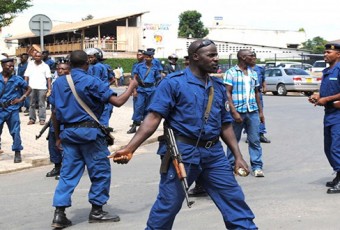
Armed-forces-in-Burundi-340x230There are strong signs of ethnic violence. More than 300 people have been killed since President Pierre Nkurunziza successfully violated term limits to stay in office for a third term early this year. The ensuing violence has forced over 220,000 to flee the country, while scores remain displaced internally. Over the last week alone more than 80 people have been murdered in what is increasingly looking like a civil war rather than mere civil unrest met with heavy-handed repression. The African union has used the word “genocide” in reference to the Burundian situation.

For a background on the current Burundian crisis see here, here, here and here.

So given the clear evidence that things are falling apart in Burundi, why isn’t the East African Community (EAC) doing more to de-escalate the situation?

The simple answer is intra-EAC politics (which serve to accentuate the body’s resource constraints).

The EAC is a five-member (Burundi, Kenya, Tanzania, Rwanda and Uganda) regional economic community (REC) that is arguably the most differentiated REC in Africa. Based in Arusha, Tanzania, it is a relatively robust institution replete with executive, legislative and judicial arms.

Like is the case for most African RECs, the EAC member states conceded precious little sovereignty to Arusha. For example, the  EAC treaty does not directly empower the REC to intervene in a member country even in cases of gross violations of human rights (like is currently happening in Burundi). So far regional cooperation within the EAC has mainly focused on economic issues that do not pose substantial threats to sovereignty. It is for this reason that the EAC has avoided any kind of direct intervention in Burundi to end what is a singularly political crisis — both within Burundi and at the regional level.

That said, Article 123 of the EAC treaty provides a loophole for intervention.

The Article stipulates that the purpose of political cooperation among EAC member states is to, among other things: (i) strengthen the security of the Community and its Partner States in all ways; and (ii) preserve peace and strengthen international security among the Partner States and within the Community. In my view these clauses mandate the EAC to protect both the internal security of Burundi as well as intra-EAC security.

It is important to note that so far the norm has been to treat vagueness in African REC treaties as a call to inaction. But vagueness also provides willing interveners with a fair amount of latitude over interpretation. Furthermore, since 2000 the trend within African RECs has been to dilute the infamous OAU non-intervention clauses (see the AU treaty, for example) especially with regard to security matters.

It is not hard to see how the conflict in Burundi poses a clear and present danger to both Burundi’s internal security as well as peace and security within the EAC.

We know from history that an all out civil war in Burundi would threaten the security of the region. Burundi’s ethnic make up roughly mirrors that of Rwanda. Ethnic conflict in Burundi would inevitably elicit an intervention from Rwanda, thereby regionalizing the conflict (with an almost guaranteed knock on effect in eastern DRC). In addition, even though Kagame may not be a fan of Nkurunziza, he lacks the moral authority to criticize him given recent moves to scrap term limits in Rwanda.

If Rwanda (overtly) intervenes in Burundi, it is not clear which side Tanzania — a critical player — would take (especially because of the implications for the stability of eastern DRC). Kigali and Dodoma do not always see eye to eye. In addition, the new Tanzanian president, John Magufuli, is not particularly close to his Kenyan counterpart on account of his closeness to Kenyan opposition leader Raila Odinga. This may limit the possibility of collective action on Burundi by the EAC’s two leading powers.

And then there is Uganda. President Yoweri Museveni is currently the designated mediator in the Burundian negotiation process. But he is currently preoccupied in his bid to win an nth term in office (who’s counting?) His legitimacy as a mediator is seriously in question on account of his political record back home. Recall that the proximate cause of the current crisis in Burundi was Nkurunziza’s decision to violate term limits. Museveni scrapped term limits in 2005 and has systematically squeezed the Ugandan opposition into submission through heavy handed tactics that are direct violations of human rights.

Sadly for Burundians, the current state of inter-state relations within the EAC is strongly biased against any robust intervention to stop the violence that is increasingly becoming routine. Nkurunziza knows this, and will likely try to make an end run on his perceived political opponents before the wider international community begins to pay closer attention.

Lastly, the other possible interveners — the  UN and the EU — are also not likely to intervene in Burundi any time soon, despite the country’s heavy dependence on foreign aid. Europe is hobbled by the ongoing refugee crisis and the war on ISIS. As for the UN, it increasingly launders its interventions through region or sub-regional IOs (see for example AMISOM in Somalia, under the AU). This kind of strategy requires a willing regional partner, something that is lacking in the case of the EAC (or the AU for that matter).

In the next few weeks there will probably be attempts at mediation and calls for a ceasefire. But my hunch is that things are likely to get much worse in Burundi in the short term.
Stanford Biz School Seed Transformation Program is seeking applicants from East Africa

Do you run an SME? Are you interested in training and mentorship? Then apply for Stanford’s STP.

The Stanford Seed Transformation Program addresses the needs of founders/senior leaders in developing economies who lead growing, small to medium sized enterprises.

The STP curriculum is customized to address the needs of founders and senior leaders of small and medium sized companies who are committed to growing their businesses.

Over a period of six months, you will attend four highly interactive sessions—each lasting one week. Sessions cover tools and methodologies that you will use to grow and transform your business.

For example, you will learn about Design Thinking—an innovative problem-solving approach refined by Stanford faculty and its alumni—that is invaluable for identifying new products and services for your customers.

STP topics include leadership training, strategy, organizational design, business model development, operations, accounting, marketing, finance/investing, value chain innovations, governance, business ethics, and product and service innovations. 

You can apply here.

The Kenyan Army’s Criminal Racket in Somalia

Quoting from a new report from the Journalists for Justice project:

With the death toll from al-Shabaab attacks inside Kenya rising to over 400, Journalists for Justice felt that the task of examining whether Operation Linda Nchi is actually delivering was overdue. This study looks at the conduct of KDF forces in two areas: 1) sugar smuggling and financial enabling of al-Shabaab and, 2) human rights violations.

This report presents the findings of several months of research in Somalia in Kismayo and Dhobley and inside Kenya in Liboi, Dadaab, Garissa and Nairobi. A desktop review, encompassing UN monitoring reports, academic studies, African Mission in Somalia (AMISOM) communication and media reports was followed by one-on-one interviews with over 50 people with intimate knowledge of KDF activities, including serving senior KDF officers, UN officials, western intelligence officials, members of parliament, victims of KDF human rights violations inside Somalia, journalists, doctors, porters at the charcoal stockpiles, drivers on the sugar routes and middlemen in the Dadaab camp.

…. JFJ research suggests that both KDF, the Jubaland administration of Ahmed Madobe and al-Shabaab are all benefitting from shares in a trade that is worth, collectively, between $200 million and $400 million.

More on this here.

For more on the challenges facing Kenya’s security operation in Somalia see here.