Life expectancy in Kenya jumps to 64

The Daily Nation reports:

The life expectancy of a Kenyan has increased to 64 years up from 55 two years ago, a report released on Sunday shows.

The data compiled by the University of Nairobi in partnership with 12 other universities worldwide notes that the life of Kenyans has improved substantially and they can expect to live longer.

The report, State Of The Tropics, further says that Zimbabwe is the only nation in the world that recorded a decline in life expectancy at 47 years.

Madagascar reported the largest improvement in life expectancy to 65.8 years, with large reductions in infant and adult mortality rates.

…. In regional terms, Zimbabwe has a low infant mortality rate, but a very high adult mortality rate (the highest in the world)

Overall, there has been massive improvement in life expectancy in the tropics since the fifties:

…. life expectancy in the tropics has increased by 22.8 years to 64.4 years between 1950 and 2010 and the gap between the life expectancy of women and men has widened in favour of women over the same period.

I guess this calls for an investigation of the real causes of the drop (if the data hold up) in mortality rates (especially infant mortality). Is it better healthcare, diet or just a natural secular trend? Or could it be better economic prospects (since the mid-1990s) that inspire greater investment in healthcare? Also, has the AIDS epidemic peaked in the tropics? Over to you, epidemiologists.

It is a bit odd that a country like Zimbabwe has a low infant mortality rate but a high adult mortality rate – why has the total collapse of state institutions disproportionately affected health provision to adults?

Insecurity in Kenya and the upcoming March 2013 elections

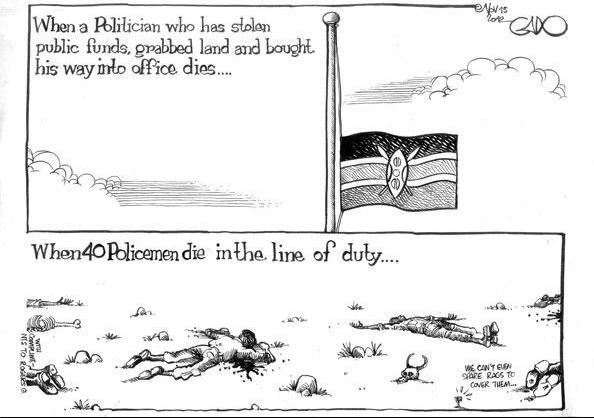
It is a mere three and a half months before the March 4th elections in Kenya and compounding the problems facing the electoral commission (which is riddled with corruption allegations and is yet to register voters) is the fact that insecurity in the country appears to be on the rise. The recent killing of at least 40 police officers in Baragoi (in northwestern Kenya) says it all. This comes just a couple of months after the Tana River massacre that left over 100 villagers and police officers dead in mid-September.

(credit: Gado)

The Tana Delta and Baragoi massacres exposed the failures of the intelligence and policing operations in the less-governed parts of Kenya (roughly the northern half and most of the east and southeast of the country). In both cases the government was caught flat-footed and unable to respond rapidly to emergent security threats.

A lot of finger pointing followed both incidents, with the police claiming that their hands were tied by strict laws on the use of force (thanks in part to the justifiably hyperactive human rights crowd in Nairobi) and the politicians blaming one another for incitement of the perpetrators of the crimes.

The latest incident in Baragoi has forced the president to order the deployment of the Kenya Defense Forces to assist in bringing to book the bandits behind the murder of dozens of policemen.

But the deployment of the security forces alone will not bring an end to the cycle of killings that have plagued Kenya in the last several months. In order to clean up the toxic mix of archaic cultural practices, local politics and economic interests, the government will have to be a little bit more broad and nuanced in its approach. What ought to be done about the cultural practices behind cattle rustling? How, if at all, are local leaders ever involved in these operations? What is the local political impact of these raids?

Which brings me back to the 2013 elections. The electoral commission has only one month beginning on Monday Nov 19 to register 18 million voters. Serious lapses in security that seem to be commonplace in large parts of the country do not inspire confidence in the agents of the commission who are supposed to traverse the whole country to build a new voter roll.

A failure to register enough voters for the election due to insecurity will de-legitimize the whole process, with dire consequences.

I hope that the electoral commission is following the investigations of these incidents of violence closely (especially since it has the power to punish those in contravention of election laws). Many Kenyans trust that the commission will be fair on election day. It is therefore not inconceivable that knowing that they won’t change the results after people have voted, crooked politicians have resorted to gerrymandering by other means – by dislocating certain pockets of voters or instigating violence to suppress voter registration and eventual turnout.

Who runs the world?

May be it is just because my adviser at some point studied the politics of language and identity (see here and here), but this morning over breakfast as I was watching the newly elected appointed successor of Hu Jintao as president of China give his inaugural speech to the press I was reminded of the continued soft (and hard) power of the English speaking North Atlantic world – or just simply the US.

In my opinion, it says a lot that the Chinese authorities felt the need to have a translator in the room, and for Mr. Xi Jinping to wait after every paragraph or so for the English translation to go through (they may have had translations to other languages as well, I was watching it live on the BBC).

Imagine the day when a newly elected US president, standing on the steps of the Capitol, gives a speech in English but has to wait every now and then for a Mandarin Chinese translation to go through.

I may be making too much of this. It all might have been a deliberate attempt to engage the rest of the world. As Time reports, Mr. Xi urged the press to facilitate more exchanges between China and the rest of the world:

But most of all, Xi was in a celebratory mood, advising the gathered press to do their part in furthering cross-cultural awareness. “Friends from the press, just as China needs to learn more about the world, so does the world need to learn more about China,” he said in a jocular tone. “I hope you will continue your efforts to deepen mutual understanding between China and the world.”

Language is very central to human interactions, and whoever has power over language usually has a lot of sway (as is argued in the books above). This morning someone won the politics of language. And it was not Beijing.

What if we killed all the mosquitoes?

It appears that a malaria vaccine will not be available for some time. According to Reuters,

“The world’s first potential malaria vaccine proved only 30 percent effective in African babies in a crucial trial, calling into question whether it can be a useful weapon in the fight against the deadly disease.”

Reading this reminded me of my own illness with malaria at the end of summer.

Back in September I contracted malaria while on a short trip back home in Kenya. Due to malaria’s incubation period I only started feeling sick after I was back in Palo Alto. My illness set off a total freakout at the Stanford Hospital. No less than four medical students, besides the crowd from the infectious disease unit at the hospital, passed by my hospital bed to ask the EXACT same questions. And of course they wanted to keep me overnight. They had an IV drip already installed in my arm. I tried my best to tell the doctor that I didn’t think I needed to be hospitalized to no avail.

The nurse who took my vitals put a mask on her face the moment I told her that I had malaria. I had to restrain myself from reminding her that malaria is not airborne.

A week later the Santa Clara County infectious disease office called me to get my details and ask me if I was feeling better. The government wanted to know where and how I got malaria. The grad student in me was fascinated by the level of state capacity in Santa Clara.

A few weeks before my Kenya visit I was in Fort Worth, TX. This was at the height of the West Nile virus outbreak that killed dozens of people. At the time health authorities in the Dallas-Fort Worth area were in the middle of spraying the area to kill all the vectors (mosquitoes). My girlfriend reminded me of the fact that as recent as when her parents were growing up in Grand Prairie, TX much of the American South still had to be sprayed regularly (with DDT) to get rid of disease-bearing mosquitoes.

The reason I recounted these stories is to illustrate the fact that there is an alternative to pouring tons on money on vaccine research or bed nets. Yes, these may result in cool scientific discoveries or provide excellent opportunities for social scientists to get published on their RCT findings. But the reality is that millions of people are still dying.

Instead of asking those living in high disease burden environments to change their behaviors and sleep under mosquito nets, how about we get rid of the mosquitoes??

If it worked in the American South, and many other places, why can’t it work in Africa?

I would very much love to live in a place free of malaria. Because of my age and health, my malaria infection at the end of summer was a mere nuisance – mild aches and fatigue. But for millions of children and post-natal mothers across much of tropical Africa malaria is a fatal disease.

But is DDT the answer? Haven’t we been made to internalize the evils of DDT?

It turns out that what we know about DDT might not be the whole truth. As Gourevitch argues, the environmental impact of DDT might have been overblown by the environmentalists.

Writes Gourevitch:

“Around the same time, the U.S. government launched an ambitious DDT-centered malaria eradication project which by the early ’60s had virtually eliminated malaria from Southern Europe, the Caribbean, and parts of East and South Asia. (In India, for example, annual deaths went from 800,000 to zero.) At the time, DDT was thought to be such an effective and useful substance that in 1948, Muller received a Nobel Prize in medicine. “To only a few chemicals does man owe as great a debt as to DDT,” declared the National Academy of Sciences in a report in 1970. “In little more than two decades, DDT has prevented 500 million human deaths, due to malaria.””

Adding that:

“But over the years, mainstream scientific opinion has absolved DDT of many of its supposed sins. Indeed, the Stockholm Convention partially backfired because it brought to light a slew of studies and literature reviews which contradicted the conventional wisdom on DDT. Like nearly any chemical, DDT is harmful in high enough doses. But when it comes to the kinds of uses once permitted in the United States and abroad, there’s simply no solid scientific evidence that exposure to DDT causes cancer or is otherwise harmful to human beings……

Not a single study linking DDT exposure to human toxicity has ever been replicated.”

But even assuming that the effects were as bad as they were claimed to be, shouldn’t we as humans be able to decide on the relative importance of human lives versus bald eagles?

How many children should be allowed to die so that bird watchers can better enjoy their Sunday afternoons?
Kenyan Elections 2013 and The High Potential for Violence

In an excellent piece over at African Arguments Sheekh and Mosley give a comprehensive discussion of the recent outbreak of violence in the Tana Delta region of Coast Province, Kenya. According to the authors:

Long-standing competition and conflict over access to pasture and water resources were important factors, but did not alone provide the trigger for violence.  A range of political and economic factors have fed into the local dynamics in Tana Delta. These include longer-term trends related to alienation of local people from land due to large-scale government and private sector purchases, and shorter-term impacts related to the process of delineating electoral constituency boundaries and county districts in line with Kenya’s new constitution. The ready availability of small arms has also seen such conflicts intensify in recent decades. Lack of livelihood opportunities for the youth is also a major factor.

As such, the recent clashes are emblematic of wider trends.  Although the Tana Delta (along with the rest of Coast Province) has tended to be politically marginalised, tensions in other areas – such as Mt Elgon and parts of the Rift Valley including Eldoret, Nakaru and Naivasha, and counties in northern Kenya – could also be exacerbated by the same political factors.  Some of these areas were flash-points in the post-poll violence of late 2007 and early 2008, with major national and regional ramifications.”

Spot on.

The Tana Delta conflict is symptomatic of a larger dynamic that will play out in anticipation of the March 4th 2013 elections in Kenya. The new constitution has created 47 county governments, many of them multiethnic or otherwise diverse, that will each have three county-wide elected officials (a governor, deputy governor, and a senator). Ethnic and communal rivalries will inevitably surface in these county contests, with potentially disastrous outcomes such as what we’ve seen so far in Tana River County.

The potential for decentralized violence in Kenya’s 47 counties is a real cause for concern.

In order to limit the potential for violence, the national commission charged with policing ethnic harmony has initiated talks in potential flash-points to broker inter-ethnic power-sharing deals with the hope of avoiding a situation in which certain communities are totally excluded from county-wide elected offices. Sadly, so far there is no sign that these initiatives will work (Not to mention how un-democratic such back room arrangements will be). Plus the violence will not necessarily be exclusively of the inter-ethnic variety (which is what the commission is fixated on at the moment). Even ethnically homogenous counties might experience inter-clan violence.

While most of the attention in the next few months will be on how to avoid a repeat of the aftermath 2007-08 election, Kenya watchers should be warned that the problem will be much more complicated. If nothing is done, many counties will experience inter-communal violence. The new county governments will have real resources (about a third of national revenue) that will generate real patronage networks worth fighting for.

Given the nature of Kenyan politics, the race for the presidency (more blog posts on this soon) will inevitably hog all the attention in the next five months. I hope the contest for State House and its own risks for violence will not overshadow the county-level contests which will also be just as intense and likely to result in violence.

What Obama’s re-election means for US Africa Policy

On the 14th of June this year President Obama outlined his policy for Sub-Saharan Africa. Included in the policy statement were four key strategic objectives: (1) strengthen democratic institutions; (2) spur economic growth, trade, and investment; (3) advance peace and security; and (4) promote opportunity and development.

In my view, of the four aspirational goals the one that will receive the most attention in the near future will be the third (especially security).

US strategic security interests in Africa mainly involve two key concerns: (1) China’s growing economic presence in the region and (2) the spread of Al-Qaeda linked groups in the region, stretching from Somalia to Mauritania (This is why Mali featured more prominently than the EU in the Presidential foreign policy debate). Before talking about China, here are my thoughts on the US campaign against  al-Qaeda in Africa.

While I don’t foresee any success in the creation of an African base for AFRICOM, the US will continue to cooperate with AU member states in fighting Islamist extremism in the region. The “successful” AU mission in Somalia could provide a blueprint for future operations against potential terror groups. The biggest lesson from Somalia is that the US cannot just pick one nation (in this case Ethiopia) to fight its wars in the region, and that a collaborative effort with the blessing of the regional umbrella organization (the AU) and others such as IGAD can deliver results.

Having helped (both directly and indirectly) in the ouster of Al-Shabaab from strategic locations in Somalia, the next big task will be dealing with the mushrooming Islamist extremism in the Sahel (especially in northern Mali but also in Niger and Nigeria).

The problem of extremism in the Sahel is further compounded by the link of some of the groups to the drug trade flowing from Latin America and into Europe. There is significant evidence that drug money has financed the activities of separatist groups in northern Mali. The fight against these groups will necessarily involve dealing with this crucial source of finance. This means that for the operation to succeed the US will have to engage in capacity building and the strengthening (and clean-up) of security institutions (especially the armies) in states like Guinea, Guinea-Bissau, South Africa, Kenya, among others, in which officials in the security sector have been implicated in the drug trade.

The Sahelian challenge might yet prove more formidable than Somalia. The latter case had relatively stable neighbors that served to contain the anarchy. The Sahel (Sahelistan, if you will) is much larger and includes some of the least governed spaces on the planet.

On China, the US (and for that matter, the rest of the West) has to change its present approach of total freak-out overt suspicion over Chinese involvement in Africa. Africans need protection from China only as much as they need protection from the West. China is not out to “exploit” Africa any more than the West has. Nobody should expect China to engage Africa more benevolently than the West did for the better part of the last 60 years (Mobutu and Bokassa were not that different from Bashir and Mugabe).

A constructive approach ought to include policies designed to strengthen African states so that they can engage China on their own terms. It is ultimately African leaders who mortgage their resources and sovereignty to China (or the West). Instead of focusing too much on China, a better approach might be one that creates strong regional organizations (like the SADC or the EAC) that can improve the bargaining power of African states.

The other policy objectives outlined by Obama appear to fall in the business-as-usual category. Democracy promotion will not yield much in the face of other more pressing priorities (notice how security has triumphed over democracy in Mali). And unless the US is willing to get involved in massive infrastructure projects like China has (last time I checked they were in 35 African states), I don’t see how it can help spur economic growth in the region (AGOA was great, but Africa needs something better). Plus the US continues to be hampered in its development-promotion efforts by its aversion to state industrial policy. It’s about time Foggy Bottom realized that it is really hard to have a thriving private sector and American-style free enterprise in places with bad roads, very few (and bad) schools, and governments that are run by personalist dictators. In these instances some corruption-laden developmental state policies may be the best way to go.

There is no way around the basics: Development will take time

I just read Chris Blattman’s response to the UK Prime Minister’s op-ed in the Journal. It reminded me of a lot of the things that I have been reading lately in preparation for my fieldwork (My dissertation will tackle the subject of legislative (under)development in Africa, with a focus on the Kenyan and Zambian legislatures).

Cameron’s sentiments in the op-ed are emblematic of the problems of development assistance. Like in all kinds of foreign intervention, developed states often try to externalize their institutions (and more generally, ways of doing things). These attempts often ignore the lived realities of the countries being assisted.

Forgetting the history of his own country (think autocratic monarchs, monopolies, limited suffrage), Cameron thinks that democracy, human rights and free markets (all great things) will magically create jobs in the developing states of the world. They don’t. In fact, they often lag the job creation process. For development assistance to be effective it must eschew these feel-good approaches to the problem of underdevelopment.

Blattman is spot on on a number of points:

  1. Unchecked leaders are bad for economic development (this is why I am so much into PARLIAMENTS!!!): Also, democracy is NOT synonymous with limited government. Heads of state like Queen Victoria or Hu Jintao or Bismarck or even Seretse Khama were in no measure democrats. However, they ruled under systems with strong (sometimes extra-constitutional) checks to their power. That made a difference.
  2. Institutions rule, yes, but the right kinds of institutions: 1688 moments do not drop out of the sky. They are often preceded by decades if not centuries of civil strife, economic change and plain old learning. Institutional development takes time. Plus each society requires its own unique and appropriate mix of institutional arrangements to meet unique economic and social needs. A procrustean approach to institutional development (embodied in global capacity building) will inevitably fail. Institutional development must never be allowed to be captured by those who think that we can transform Chad simply by having them adopt Swedish institutions.
  3. Growth will require creation of jobs, i.e. industrial development: The poor countries of the world need real jobs for high school-leavers and other less educated people. The present focus on the “sexy” entrepreneurial sectors – whether they are small businesses for the poor or tech hubs for the very highly educated – as the engines for growth in the developing world is misguided. I reiterate, starting a business is a very risky venture that should be left to the wealthy and the occasional dare devil. The poor in the global south need stable 9-5 jobs. Lots of them.

And lastly, where do strong institutions come from? There is no easy answer to this question. What we know is:

  1. History matters: Present countries with a long history of stateness have a better track record of building strong institutions for development. Yes, they may not always be democratic, but countries with a long history of centralized rule have strong states (and institutions) that deliver for their people (for more on this see Englebert and Gennaioli and Rainer).
  2. Democracy does not always create strong institutions: Since 1945 many have chosen to forget the fact that universal suffrage is a pretty recent phenomenon in the political history of the world. For the longest time world polities were ruled by power barons who held de facto power (as opposed to the procedural de jure power in democracies). When democracy came along after the Enlightenment the resulting structures of rule often reflected these de facto configurations of power. Over time institutions in these countries were cemented enough to allow for complete outsiders like say the current president of the United States to be elected without upsetting the balance of power (in another era he would have had to have mounted a coup). This is the challenge of the democratization in the new post-WWII states. How do you make democracy serve the interests of the people, rather that purely that of the elite? How do you use democracy to create strong institutions? Is this even possible? And if not, what other options do we have?

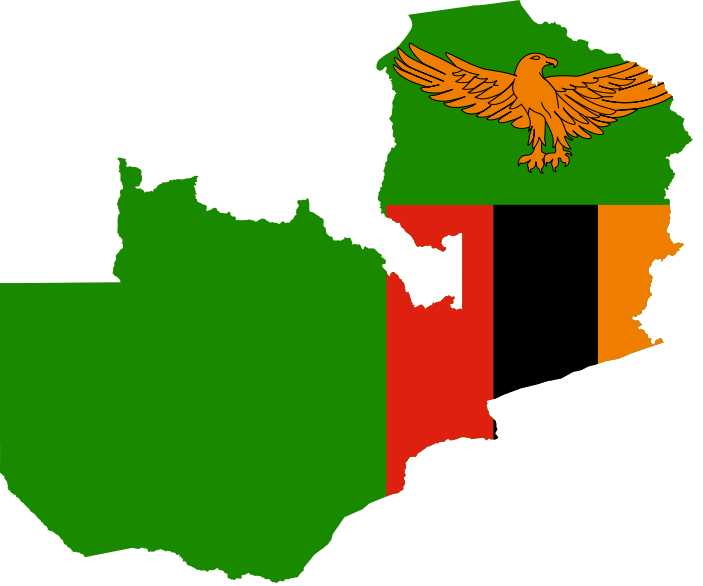
Happy Independence Day to all the Zambians out there!

Image source: Wikipedia

Who’s interested in democracy?

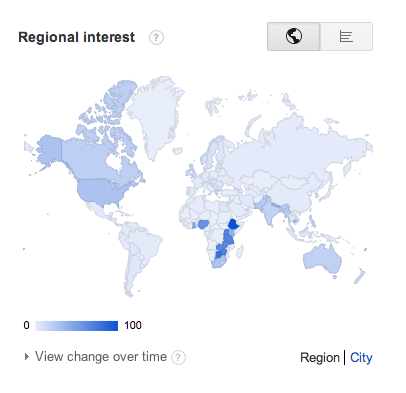
According to Google Trends the answer is Ethiopians. Between 2004 and now they score the highest in the search index for the word “democracy,” at least among the English speaking countries of the world. Ethiopians have lived under successive military and quasi-military dictatorships since the overthrow of Emperor Haile Selassie in 1974.

It is also interesting to see the relative concentration of searches for the word in eastern and southern Africa compared not only to other regions in Africa but also to the rest of the world. Besides Ethiopia, the other countries in Africa with a high search index have recently had somewhat high levels of political contestation through reasonably competitive elections.

Quick Hits

Haiti wants to join the African Union 

Partisan stats: Of red-state moochers and blue state makers 

Romney’s elusive tax plan (funny)

Zuma’s failed presidency and South Africa’s labor unrest

Mo Ibrahim Prize goes unclaimed, again

Kenya might be seeing the origins of insurgency (More details on this soon)

Rational Impatience and marshmallows (and development)

Back in 1972 Stanford psychologist Walter Mischel conducted experiments in which he claimed to show a correlation between patience and later success in life – in the experiment kids who could wait for 15 minutes before getting two marshmallows, instead of eating one immediately, were likely to be more successful and self-controlled later in life. Michel attributed patience and self-control to some of the kids’ innate capacities.

It turns out that that might not be the case after all. Researchers in Rochester revisited the experiment and show that kids’ choices over whether to wait or not are “moderated by beliefs about environmental reliability,” in other words, kids react rationally to the proposed deal based on prior experience.

According to Celeste Kidd (more on this here), a University of Rochester grad student and lead author on the study:

“Being able to delay gratification — in this case to wait 15 difficult minutes to earn a second marshmallow — not only reflects a child’s capacity for self-control, it also reflects their belief about the practicality of waiting,”

Adding that:

“Delaying gratification is only the rational choice if the child believes a second marshmallow is likely to be delivered after a reasonably short delay.”

This reminded me of the interesting works in economic history (gated, sorry) that try to tackle issues of culture and socialization and their role in economic development. The punchline from these works is that group-specific socio-cultural values have long-lasting effects on attitudes towards investment, saving, entrepreneurship and ultimately economic development (Think of the fabled frugality and self-discipline of Weber’s protestants). Putting some of the critiques of these works aside for a moment, they are a reminder of just how COMPLEX development is.

Because material conditions both shape and are a result of prevailing cultural norms and practices (both Marx and Weber were right!) it becomes difficult to change one thing while ignoring the other (And this is even before you open the pandora’s box, viz: POLITICS). To put it simply, you cannot increase the investment rate in a society simply by throwing money at people. They will spend it on a new shrine for their god or marry a third wife.

This is not to say that it is impossible to transform entire societies in a short while, just that it is not easy, and that we should be humble enough to accept this fact when thinking about how to promote economic development in the bottom billion societies of the world.

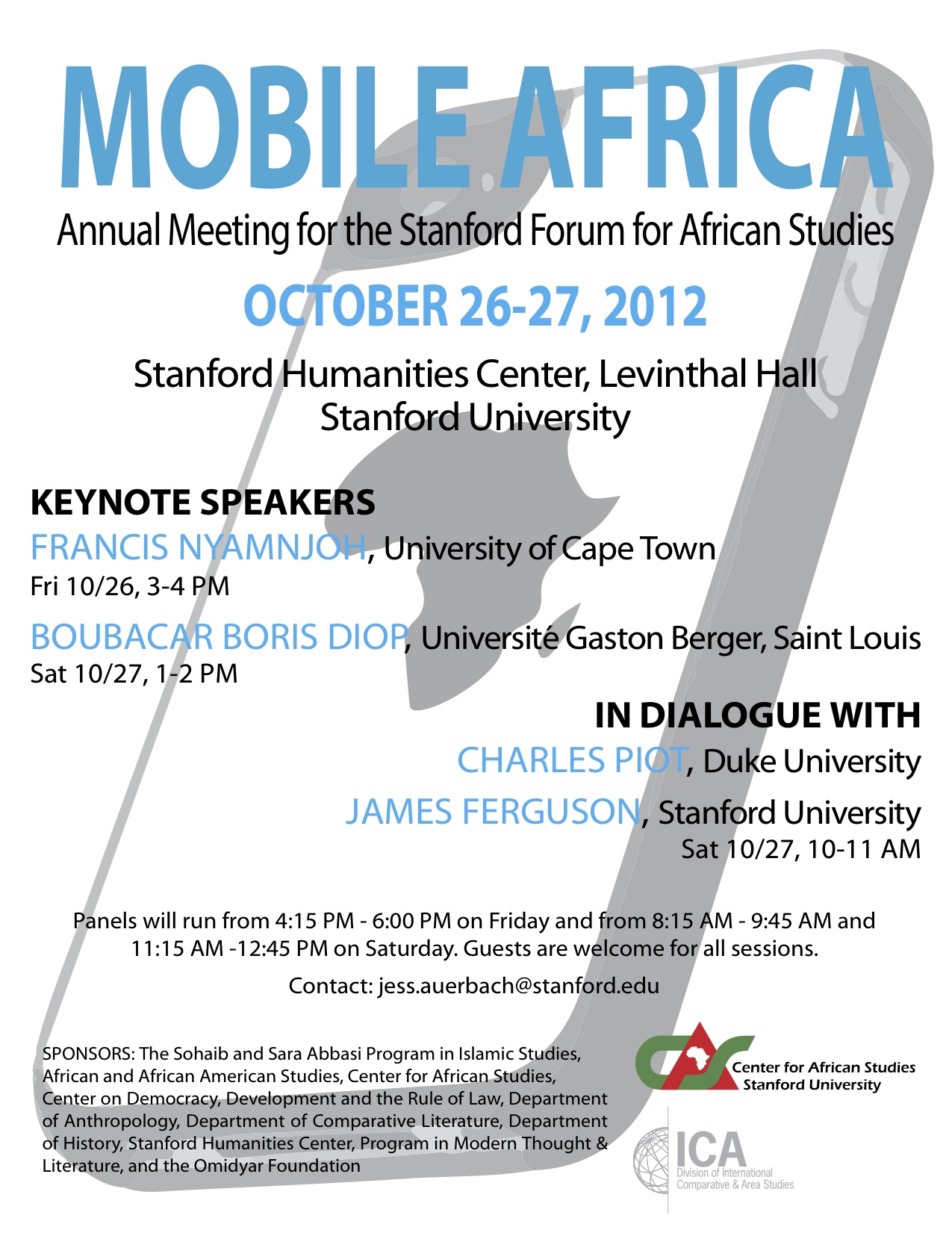
2012 SFAS conference, “Mobile Africa”

The Stanford Forum for African Studies is an interdisciplinary organization of Africanist grad students at Stanford. SFAS, in collaboration with the Center for African Studies at Stanford, holds an annual conference in late October every year.

This year’s annual conference of the Stanford Forum for African Studies will be held October 26-27, 2012 at the Stanford Humanities Center. All are invited to attend. Guest speakers include Francis Nyamnjoh (University of Cape Town) and Senegalese writerBoubacar Boris Diop, best known for his book, Murambi.

The full conference program can be found on the SFAS website.

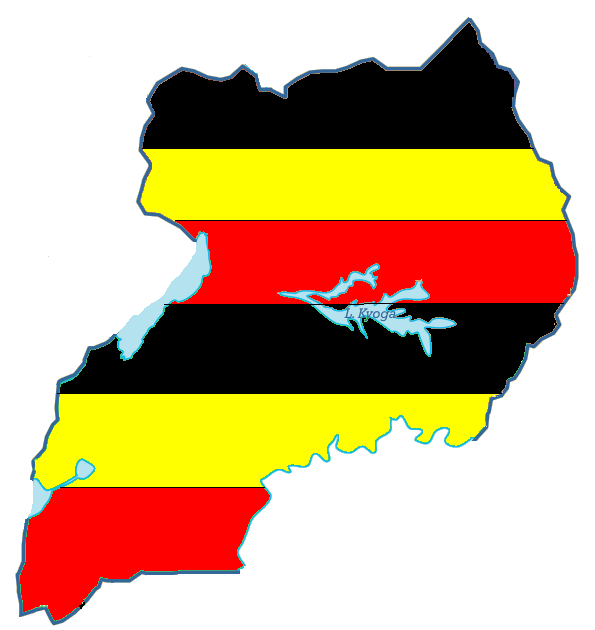
UGANDA AT 52

This blog wishes all Ugandans around the world a happy independence day!

The Revolt of the Pitied

Development assistance and general engagement between the West and the developing world is often laden with a lot of both intentional and non-intentional objectification of those being “assisted” (and we academics are no exception). This is something that I have since come to accept as inevitable in cross-cultural interactions.

Others are less tolerant, and rightly so. Here is Magatte Wade writing over at The Guardian:

“Her question assumed that those of us in developing nations are to be pitied. I know as a Senegalese that her attitude is precisely what disgusts us about many who work at NGOs.

For many of those who “care” about Africans, we are objects through which they express their own “caring”.

I replied to the young woman, “If you see us as human beings, there is nothing to deal with. We like to eat good food, we love to talk and laugh with our family and friends. We wonder about the world, and why so often bad is rewarded rather than good.”

H/T: NYU Development Research Institute

Introducing the Marginal Revolution University

Alex Tabarrok and Tyler Cowen, of Marginal Revolution, have teamed up to produce MRUniversity, an online university that will be offering courses to the general public.

[youtube.com/watch?feature=player_embedded&v=qlBnXNAfWUE]


Their first course on development economics is already live. You can access it here.