On the quality of higher education (and human capital development) in Africa

This post first appeared on the African Development Bank’s Integrating Africa Blog where I am a regular contributor. 

UPDATE: I got an email from readers working with the Regional Initiative in Science and Education (RISE), exactly the kind of collaboration that I am saying is much needed in Africa. Check them out here.

According to The Times Higher Education World University Rankings 2012-2013, the highest ranked university in Africa, the University of Cape Town, is 113th in the world. The ranking system employs 13 performance indicators that take into account universities’ core functions, including “research, knowledge transfer and international outlook.” Among the leading 400 world academic institutions, there are only four from Africa, all in South Africa. As a region, Africa only has 35 scientists and engineers per million inhabitants, compared with 168 in Brazil, 2,457 in Europe and 4,103 in the United States. The region is clearly behind as far as knowledge production and dissemination is concerned, producing only 1.1 percent of the world’s scientific knowledge, despite comprising more than 13 percent of the global population.

At barely over 8 percent, Africa’s gross enrollment in tertiary institutions of learning is the lowest of any region in the world (UNESCO, 2011). The average enrollment rate for developing countries is 23 percent, and that for advanced countries is 74 percent. Africa’s poor showing in the higher education sweepstakes is both a cause and effect of the region’s poor economic environment. The massive cuts in higher education funding in the wake of the structural adjustment programs of the 1980s and 1990s, even as enrollment more than tripled between 1991 and 2005, have had an adverse impact on quality. And in turn, the lack of high quality tertiary level education has starved the region of high skills needed for efficient allocation of factors of production thereby stunting improvement in productivity, high value addition and research and development. Africa devotes less than 1 percent of its GDP to research and development.

Data from 33 countries for which it is available show that tertiary education financing in the region has declined from a high of US $6,800 per student per year in 1980 to just about $981 in 2005. Over the same period the World Bank decreased its education lending from 17 percent in 1985-89 to just 7.5 percent currently (this is despite the fact that the World Bank nearly doubled its education lending between 2008 and 2009). The decline in public funding in the face of increasing demand for higher education has led to the proliferation of private universities of dubious standards and a bias towards perceived “soft” fields. In 2004 a meager 28 percent of students were enrolled in perceived “hard” disciplines in the sciences and engineering.

A 2008 study of 12 countries showed an increase in public universities from 113 to 188 between 1995 and 2008. Over the same period private universities ballooned from 14 to 107. This rapid increase in the number of universities in the region has not been matched by an increase in the number of trained teaching staff or facilities such as laboratories, libraries, and the like. Indeed, most of the new universities have tended to specialize in vocational subjects that require very little capital and human resource investment. To put it mildly, there is a great mismatch between the region’s development needs and the type of graduates it produces each year.

Image

An impression of the proposed Konza City in Kenya

The shortage of skills permeates nearly all skill levels, and could get worse as the region’s economy continues to grow over the next two decades. The case of Kenya is illustrative. The country has an ambitious plan to be the information and communication technology (ICT) hub of Eastern Africa (dubbed the “Silicon Savannah”) complete with a proposed $10 billion techno-city (Konza City) situated about 60 kilometres southeast of Nairobi. Already ICT multinationals, including IBM, Microsoft, Google and Intel, have their regional headquarters in Kenya. All this sounds good, except the lack of local skills. IBM’s research lab in Kenya has had to source for top talent among graduates in computer science, electrical engineering, mathematics, and data scientists from American universities. There is still a shortage of required skills among graduates of Kenyan universities. Quality assurance is also lacking, as recent news reports of “theses for hire” have demonstrated.

As the Kenyan case suggests, the lack of sufficient investment in high quality tertiary education has adversely impacted Africa’s ability to realize its economic potential. A 2005 study showed that a one-year increase in the higher education stock of the region could boost growth rate by about 0.63 percentage points. This adds up to an overall increase in income by about 12 percent over five years. For the region to take off economically there is need for greater investment in quality higher education that will train workers for the 21st century economy. But improving the quality of higher education in the region will be a very costly affair. On their own, the region’s countries lack both the resources (on account of their small economies) and demand (on account of their population sizes) to justify the types of investments required. This is where regional cooperation comes in.

Cross-border educational exchanges are not new in Africa, and go back to the pre-independence era. For generations non-Senegalese francophone students have studied in Senegal, seen as a cheap way of getting quality education at par with diplomas from France. Uganda, with East Africa’s top university, Makerere, hosts legions of Kenyan students, eager to avoid congestion and high costs back home. South Africa, with its many quality institutions is also a preferred destination for students from across the continent. These historical cross-border exchanges have led to the formation of regional associations of higher education – the francophone Conseil Africain et Malgache pour l’Enseignement Superieur (CAMES); Inter-University Council of East Africa (IUCEA); Southern African Regional Universities Association (SARUA); and inter-university cooperation under the Arab Maghreb Union (AMU). Continent-wide, the 208-member Association of African Universities (representing 45 countries) is the umbrella organization of the region’s institutions of higher learning.

These associations need to be strengthened and empowered as drivers of regional harmonization of higher education both to facilitate cross-border inter-university mobility of both teachers and students and guarantee quality assurance. As a 2007 World Bank report aptly noted, “regional quality assurance networks are particularly relevant to Africa because of human resource constraints.” On this score the European Higher Education Area provides a possible model. The just over 10 years old Bologna process is working towards ensuring inter-university mobility (in terms of courses, qualifications, and periods of study) as well as a uniform quality assurance standard. In the African context, a continent-wide area of higher education is infeasible because of language and logistical constraints. However, sub-regional areas of higher education, based on the existing associations, provide a possible avenue to invest in a few good institutions of higher learning that can have a demonstrative effect on national institutions as well set high standards of learning. The associations themselves can also serve as certification bodies to ensure a uniform quality assurance standard (see here).

The announcement in late July 2013 of the creation of a new US $154.2 million multinational science, innovation and technology Pan African University (PAU) in the next five years is therefore welcome. (The African Development Bank (AfDB) has pledged a $45 million grant towards the effort.) PAU will be structured around existing institutions of higher learning across Africa’s five sub-regions. Basic sciences, technology and innovation will be based in East Africa; earth and life sciences including health and agriculture in West Africa; governance, humanities and social sciences in Central Africa; water and energy sciences including climate change in North Africa; and space sciences in Southern Africa.

Thus far, discussions over regional integration of systems of higher education have tended to view tertiary institutions as tools for regional economic and political integration – be it in East Africa, Europe or East Asia. However, the creation of stronger regional areas of higher education – especially in a region like Africa – can also be an economically efficient way of facilitating greater investment in higher education to match the demands of a 21st century economy. It is encouraging that current trends signal a move in this direction. University systems in Africa’s sub-regions would be a good place to start.

I conclude with a caution. The rapid increase in the number of public and private universities in Africa over the last two decades has come at the expense of other post-secondary institutions of learning such as polytechnics (this shift has occurred to a lesser extent in francophone Africa than anglophone Africa). In many countries governments have simply converted polytechnics and other constituent colleges into fully-fledged universities. This trend is worrying, especially given the fact that the vast majority of high school leavers on the continent do not make it to university. The low quality of high school education in the region (as demonstrated by the recent mass student failures in Liberia and Tanzania) is yet another reason why these “bridge” tertiary institutions are needed, both to prepare students for university and to impart valuable skills for those that do not eventually make it to university.

The rush to invest in university education should not distract from the fact that vocational post-secondary institutions, such as polytechnics, are an important component of human capital development, even in advanced countries as is the case in Germany (with its impressive “dual system” of training codified in the Vocational Training Act of 1969). As African economies move from dependence on primary commodities to manufacturing and technology, there will be need for skilled workers at all occupational levels. Doing away with vocational post-secondary institutions will only serve to further inhibit the development of adequate and relevant human capital to match the increased demand for skilled workers.
And now onwards with life after fieldwork…

Image

With findings and humility.

And now onwards with life after fieldwork...

Looks like succession planning in private companies is just as bad as in non-democracies

I was fascinated by this piece in the Times about the impending retirement of Steven Ballmer as the chief executive of Microsoft. The piece notes that:

Succession planning is a delicate issue for many companies, particularly one like Microsoft, where Mr. Ballmer has been a senior employee since 1980 and chief executive since 2000, and his longtime friend, Bill Gates, Microsoft’s co-founder, remains chairman.

“Particularly for a person like Ballmer, who really is one of the founders, leaving is almost like death, so it’s extremely difficult to have an orderly process,” said Joseph L. Bower, a professor at the Harvard Business School. “It requires a very grown-up relationship between the chief executive and his board.”

Microsoft is certainly no dictatorship but does this remind you of the delicate question of when a certain founding president in southern Africa will retire?

The most interesting paragraph notes that: 

Developing a succession plan is one of a board’s chief responsibilities, but only half of companies actively groom executives, according to a 2010 study by Stanford University’s Rock Center for Corporate Governance and Heidrick & Struggles, the executive search firm that is leading Microsoft’s search. Boards spend only an average two hours a year on succession planning, the study found.

One of the lessons here is that absent term limits, no one really wants to openly plan for succession (It’s obviously destabilizing, and worse, might result in internal splits and conflict). And the longer the incumbent stays, the harder it becomes to remove her; for those around them actually become invested in maintaining the status quo.

So in the end, the timing of a transition becomes not just the prerogative of the incumbent, but also of those around her – which results in the boards of private companies behaving more or less in the same way as Zimbabwean president Robert Mugabe’s praise-singers in the military and ZANU-PF establishment. 

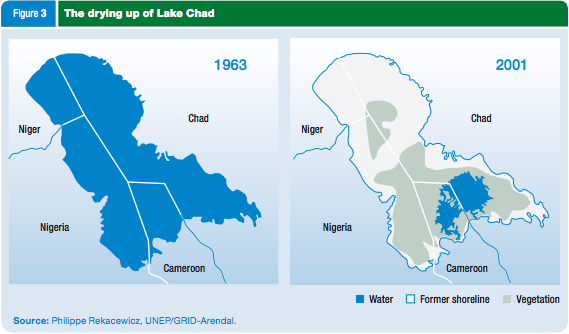
The disappearing Lake Chad, 1963-2001


I have been looking at the African Development Bank’s long term strategy (available here) and one of the figures that caught my eye was the extent to which Lake Chad has shrunk over the last 50 years. Wow.

Image

How to achieve energy security for growth in Africa

This post originally appeared on the AfDB’s Integrating Africa Blog where yours truly is a regular contributor.

According to a recent survey by Ernst & Young, 44% of businesspeople in Africa identified inadequate infrastructure as one of the key constraints to doing business in the region.  This means that as Africa continues to grow in the next two decades, infrastructure development must top the investment agenda. General infrastructure development will be especially crucial as African economies undergo structural transformation from being primarily resource-driven to having bigger manufacturing and service sectors. Indeed Ernst & Young estimates that in 2012 43.1% of investments in capital in Africa went to manufacturing as opposed to 12% that went to the extractive sector. 

A key area that will require greater and smarter investment to fuel the region’s economic growth will be the energy sector. 

Everyone knows about the energy woes of many an African country – from Nigeria’s infamous generators to the total lack of functional national grids in some African states. A few countries have initiated plans to boost their energy sectors through investment in power generation (Ethiopia’s 6000MW Great Renaissance Dam on the Blue Nile), oil refining (Angola’s planned 200,000 bbl/day refinery in Lobito), and aggressive prospecting for fossil fuels (especially in eastern and southern Africa). Despite these national efforts, for African states to ensure energy security for their growing economies, they must also think regional (and to some extent continental) when developing their respective energy sectors. As intra-Africa trade grows in the next two decades, there will be pressure to integrate energy markets as well. 

The reasons for a regional/continental approach to energy sector development are twofold. Firstly, investment outlays in energy infrastructure development are often prohibitively expensive (because their viability relies on economies of scale), thus necessitating the pooling of resources. Ethiopia’s newest dam, for instance, will cost $4.7 billion. Not many African countries can afford such massive investments on one project. 

Secondly, there is the issue of markets. With 12% of the world’s population, Africa consumes a meager 3% of the world’s electricity. Of this 75% takes place in North Africa (33%) and South Africa (45%). The remainder is shared out among the rest of Sub-Saharan African states. Furthermore, electricity connectivity on the continent remains relatively low, with rates averaging 43% (North Africa stands at 99%, with the other sub-regions between 12-44%).

This means that for projects like Ethiopia’s to make sense, access to international markets must be guaranteed. A key part of the Ethiopian project is the planned interconnector line linking the power station to the Kenyan grid. Joint investment and taking advantage of economies of scale will also help lower the cost of power in Africa. At present the average tariff per kilowatt-hour in the region is US $0.14, compared to US $0.04 in Southeast Asia. It is estimated that investing in regional grids and hydropower will save the region up to $2 billion annually. This is music to the ears of sugar millers, cement manufacturers and many small factory owners across the continent. 

Existing and Planned Power Pool Connections in Africa

Source: Niyimbona, P, UN Economic Commission for Africa; Note: There are additional planned lines connecting Ethiopia to Sudan and Kenya, respectively, not shown on the map.

With this in mind, African states have begun the process of integrating their power sector infrastructure, via regional power pools (see map above of existing and planned power interconnector links). The South African Power Pool (SAPP, established in 1995); North African power pool (COMELEC , 1998); West African Power Pool (WAPP, 2000); the Central African Power Pool (CEAPP, 2003); and the East Africa Power Pool (EAPP, 2005) are all initiatives to establish regional power markets and help harmonize energy policy. 

The COMELEC sub-region (27.4 GW, largely thermal, in 2009) has the highest connectivity and the best infrastructure. The region is also linked to the Middle East via the Egypt-Jordan interconnector line and Europe via the Morocco-Spain line (part of the future Mediterranean Electricity Ring, MEDRING). SAPP, with a capacity of 50GW (78.4% coal; 20.1% hydro; 4% nuclear and 1.6% diesel), is next in terms of infrastructure development.  The remaining pools have 13 GW in the WAPP; 29 GW in the EAPP. There is a plan to link the EAPP to states outside of East Africa as part of COMESA. The 19-state COMESA bloc has an installed capacity of 52MW (69% thermal and 30% hydro) and has since 2009 initiated a process to harmonize regulation and energy policy.   In terms of regional (intra-power pool) trade in power, SAPP is ahead with 7.5%, WAPP 6.9%, NAPP 6.2%, EAPP 0.4% and CAPP 0.2%.  Clearly, there is a lot of room for improvement in levels intra-pool trade in power. 

All these developments are encouraging. But a lot more needs to be done. For starters African states must work harder to harmonize their energy policies. This will necessarily involve greater liberalization of their power sectors, especially with regard to power generation and distribution. There is also an urgent need to invest in interconnector infrastructure to ensure that power can be transmitted efficiently to market. In the Day Ahead Market (DAM) of SAPP, for instance, trading is limited by between 40-50% of the potential level due to lack of efficient transmission capacity. Lastly, there will be a need to connect the regional power pools. This will reduce their overreliance on regional “anchor” economies (the best example of this is SAPP’s overreliance on ESKOM of South Africa, which has its own integrated resource plan). It will also create even bigger markets, including potentially the Middle East and Europe.  

Ultimately, whether or not the dream of regional and continental power interconnectivity is achieved will depend on politics. Unfortunately, so far things do not look good. Almost a decade after the idea of regional power pools set in, governments are yet to harmonize their power sector regulatory policies. In many countries state monopolies dominate, with attendant inefficiencies. And across the continent power supply master plans are still very nation-centric and under the tight control of local vested interests. Moving forward, the challenge will be to convince governments and stakeholders (private sector and consumers alike) of the benefits of having an Africa-wide power market – which will necessarily require the liberalization of national power sectors. The alternative will be more roundtable discussions and promises of policy harmonization that never get fulfilled. 

Corruption under apartheid South Africa, 1976-1994 (and its present institutional legacy)

Since the ANC took over in 1994 several top government officials in South Africa, including the current president Jacob Zuma, have been implicated in grand corruption. This has led some commentators to make the controversial claim that governance in South Africa has actually deteriorated since 1994.

apartheidLet’s just say that this is a rather odd claim to make. Of course, from a governance standpoint, it doesn’t take a rocket scientist to appear uber efficient if all you have to do is milk over 90% of the population of its surplus and resources to make less than 10% happy (for more see history of South Africa).

Don’t get me wrong, South Africa under the ANC has been a massive disappointment (both for South Africans and for Africa in general). But when analyzing the ANC’s failures over the last 20 years, the comparison should never be to the “good old pre-1994 days.” Anyone who does this either has a minimal understanding of history, or is (inadvertently) letting known their stand on the morality of apartheid.

But I digress….

Like any good student of institutions will tell you, institutional habits die hard and outlive even the most sharp of discontinuities – like decolonization or the end of apartheid. And as we’d expect, many institutional habits of the apartheid era survived the 1994 transition. Indeed a 2006 report on grand corruption under apartheid appears to show that post-1994 corruption in South Africa is not a new phenomenon, and to a large extent is actually a mere continuation of the bad old habits inherited by state institutions from the apartheid era.

The report indicates that between 1976-1994, the equivalent of US $54bn (in 2005 ZAR) went through secret “government” accounts controlled by a small clique within government. It is not clear exactly what proportion of this wound up in the pockets of those with access to the lootable cash.

On the question of the quality of governance under apartheid South Africa, the report rightly notes that:

Racist nationalism is as vulnerable to corruption as most systems of authoritarian rule. In closed societies, which are highly militarised under dictatorial rule, the truth is hidden from public view by design. Access to power (and a monopoly over it) provides the elite in the public and private sectors with a unique opportunity to line their pockets. In so doing, the defenders of an illegitimate and corrupt system start to defy their own rules and laws that criminalise such behaviour. In terms of common law crime they are simply crooks dressed in the guise of patriots representing the interests of their volk, their race or their narrow class. They have effectively corrupted themselves.

Such a system can also only survive for as long as a monopoly over power is maintained. Its survival is therefore tenuous—common knowledge to all functionaries of the system, who are the first to ensure that they are taken care of should there be a break with the past. This leads to a reliance on ‘insurance’, usually in the form of cash or other easily moveable assets that can be moved abroad in the event of regime change. It is in the period before regime change that the elite, in particular, are likely to accumulate as many resources as possible for fear that they may soon be out of a job or, at worst, have to flee the country.

Adding that:

A key tenet of the apartheid state was secrecy. This manifested itself in the creation of secret organisations such as the Broederbond, a group of white male Afrikaner Nationalists that numbered 12,000 by the late 1970s (almost all loyal members of the NP), who were the invisible hand directing NP policy and who held enormous influence over government policy and its implementation

In other words, implementing the total domination of a minority or a majority population by the state necessarily requires the curtailment of everyone’s rights, EVEN the rights of those in whose name the state is supposedly carrying out the domination. Also, the authoritarian nature of such domination necessarily leads to the emergence of a select few who must be above the law in order to maintain the system. And like we’d expect, those above the law habitually abuse their power for their personal benefit. This was true in pre-1964 America (to a greater extent in the deep South than elsewhere), was true under Nazi Germany and apartheid South Africa, and is true in the modern states that continue to institutionally discriminate against sections of their populations.

Check out the full report (pdf) here (H/T Kenyan Pundit).

For those into the study of the rule of law and governance check out these two new papers – Paul Gowder on the egalitarian underpinnings of the rule of law (Law and Philosophy) and Marcus Agnafors on the meaning of good governance (APSR).

How Eastern Africa can avoid the resource curse

This post originally appeared on the African Development Bank’s Integrating Africa Blog, where yours truly is a regular contributor. 

Eastern Africa is the new fossil fuel frontier (for more check out this (pdf) Deloitte report). In the last few years Kenya, Uganda, Tanzania and Mozambique have discovered large quantities of commercially viable oil and gas deposits, with the potential for even more discoveries as more aggressive prospecting continues. There is reason to be upbeat about the region’s economic prospects over the next three decades, or at least before the oil runs out. But the optimism must be tempered by an acknowledgement of the dangers that come with the newfound resource wealth. Of particular concern are issues of governance and sound economic management.

We are all too aware of the dangers of the resource curse. This is when the discovery and exploitation of natural resources leads to a deterioration of governance, descent into autocracy and a fall in living standards. Associated with the resource curse is the problem of the Dutch disease, which occurs when natural resource exports (e.g. oil and gas) lead to an appreciation of the exchange rate, thereby hurting other export sectors and destroying the ability of a country to diversify its export basket. The new resource-rich Eastern African states face the risk of having both problems, and to avoid them they must cooperate.

In many ways Eastern African states are lucky to be late arrivals at the oil and gas game. Unlike their counterparts in Western and Central Africa, nearly all of them are now nominal electoral democracies with varying degrees of institutionalized systems to ensure transparency in the management of public resources. Across the region, the Big Man syndrome is on the decline. But challenges remain. Recent accusations of secrecy, corruption and bribery surrounding government deals with mining companies suggest that there is a lot of room for improvement as far as the strengthening of institutions that enforce transparency (such as parliaments) is concerned. It is on this front that there is opportunity for regional cooperation to improve transparency and resource management.

While it is easy for governments to ignore weak domestic oversight institutions and civil society organizations, it is much harder to renege on international agreements and treaties. A regional approach to setting standards of transparency and accountability could therefore help ensure that the ongoing oil and gas bonanza does not give way to sorrow and regret three decades down the road. In addition, such an approach would facilitate easier cross-border operations for the oil majors that are currently operational in multiple countries, not to mention drastically reduce the political risk of entering the region’s energy sector. It would also leave individual countries in a stronger bargaining position by limiting opportunities for multinational firms to engage in cross-border regulatory arbitrage.

The way to implement regional cooperation and oversight would be something akin to the African Peer Review Mechanism, but with a permanent regional body and secretariat (perhaps under the East African Community, EAC). Such a body would be mandated to ensure the harmonization of laws to meet global standards of transparency and protection of private property rights. The body would also be mandated to conduct audits of national governments’ use of revenue from resources. The aim of the effort would be to normalize best practices among states and to institute a global standard for states to aspire more – more like the way aspirations for membership in the European Union has been a catalyst for domestic reforms in the former Yugoslavia and Eastern Europe.

Regional cooperation would also provide political cover to politicians with regard to economically questionable fuel subsidies. The realities of democratic government are such that politicians often find themselves forced to concede to demands for fuel subsidies from voters. But history shows that more often that not subsidies come at an enormous cost to the economy and instead of benefitting the poor only benefit middlemen. In addition, as the case of Nigeria shows, once implemented such policies are never easy to roll back both due to politics and the power of entrenched interests. Regional agreements capping any fuel subsidies at reasonable levels would be an excellent way to tie politicians’ hands in a credible manner, while at the same time providing them with political cover against domestic criticism.

Beyond issues of governance, there is need for cooperation on regional infrastructure development in order to reap maximum value for investment and avoid unnecessary wastes and redundancies. Landlocked Uganda and South Sudan will require massive investments in infrastructure to be able to access global energy markets. The two countries’ oil fields are 1,300 km and 1,720 km from the sea through Kenya, respectively. One would hope that as these projects are being studied and implemented, there will be consideration for how to leverage the oil and gas inspired projects to cater to other exports sectors – such as agriculture, tourism and light manufacturing – as well. KPMG, the professional services firm, recently reported that transportation costs eat up as much as 20 per cent of Africa’s foreign exchange earnings.  There is clearly a need to ensure that the planned new roads and railways serve to reduce the cost of exports for all outward oriented sectors in the region. Embedding other exports sectors (such as agriculture, timber, domestic transport, etc.) in the process of developing new transportation infrastructure will minimize the likelihood of their being completely crowded out by the energy sector.

In isolation, each country’s resource sector policy is currently informed by domestic political economy considerations and regional geo-politics. There is an emerging sense of securitization of resources, with each country trying to ensure that the exploitation of its resources does not depend too much on its neighbours. Because of the relatively small size of the different countries’ economies, the risk of ending up with economically inefficient but expensive pipelines, roads and railways is real. South Sudan is currently deciding whether to build a pipeline through Kenya (most likely), through Ethiopia, or stick with the current export route for its oil through Sudan (least preferred due to testy relations). For national security and sovereignty reasons, Uganda is planning on a 30,000-barrel per day refinery in Hoima, despite warnings from industry players that the refinery may not be viable in the long run. Some have argued for the expansion of East Africa’s sole refinery in Mombasa to capture gains from economies of scale, an option that Uganda feels puts its energy security too much in Kenya’s hands.

In the meantime, Kenya and Tanzania are locked in competition over who will emerge as the “gateway to Eastern Africa,” with plans to construct mega-ports in Lamu and Tanga (Mwambani), respectively. While competition is healthy and therefore welcome, this is an area where there is more need for coordination than there is for competition among Eastern African governments. The costs involved are enormous, hence the need for cooperation to avoid any unnecessary redundancies and ensure that the ports realize sufficient returns to justify the investment. Kenya’s planned Lamu Port South Susan Ethiopia Transport Corridor (LAPSSET) project will cost US $24.7 billion. Tanzania’s Mwambani Port and Railway Corridor (Mwaporc) project will cost US $32 billion.

Chapter 15 of the EAC treaty has specific mandates for cooperation in infrastructure development. As far as transport infrastructure goes, so far cooperation has mostly been around Articles 90 (Roads), 91 (Railways) and 92 (Civil Aviation and Air Transport). There is a need to deepen cooperation in the implementation of Article 93 (Maritime Transport and Ports) that, among other things, mandates the establishment of a common regional maritime transport policy and a “harmonious traffic organization system for the optimal use of maritime transport services.”

The contribution of inefficient ports to transportation costs in the regional cannot be ignored. Presently, the EAC’s surface transportation costs, associated with logistics, are the highest of any region in the world. According to the African Development Bank’s State of Infrastructure in East Africa report, these costs are mainly due to administrative and customs delays at ports and delays at borders and on roads. Regional cooperation can help accelerate the process of reforming EAC’s ports, a process that so far has been stifled (at least in Kenya) by domestic political constituencies opposed to the liberalization of the management of ports. The move by the East African Legislative Assembly to pass bills establishing one-stop border posts (OSBPs) and harmonized maximum vehicle loads regulations is therefore a step in the right direction.

Going back to the issue of governance, more integrated regional cooperation in the planning and implementation of infrastructure development projects has the potential to insulate the projects from domestic politics and patronage networks that often limit transparency in the tendering process. Presently, Uganda is in the middle of a row with four different Chinese construction firms over confusion in the tendering process for a new rail link to South Sudan and port on Lake Victoria. The four firms signed different memoranda with different government departments in what appears to be at best a massive lapse in coordination of government activities or at worst a case of competition for rents by over-ambitious tenderpreneurs.  This does not inspire confidence in the future of the project. A possible remedy to these kinds of problems is to have a permanent and independent committee for regional infrastructure to oversee all projects that involve cross-border infrastructure development.

In conclusion, I would like to reiterate that Eastern Africa is lucky to have discovered oil and gas in the age of democracy, transparency and good governance. This will serve to ensure that the different states do not descend into the outright kleptocracy that defined Africa’s resource sector under the likes of Abacha and Mobutu in an earlier time. That said, a lot remains to be done to ensure that the region’s resources will be exploited to the benefit of its people. In this regard there is a lot to be gained from binding regional agreements and treaties to ensure transparency and sound economic management of public resources. Solely relying on weak domestic institutions and civil society organizations will not work.

So you want to be an independent researcher or consultant?

In am must read post, Jay Ulfelder says do not quit your day job

….. I occasionally wonder how and why it’s worked for me so far. My answer always starts with the point Phil Schrodt made about the value of already being a known quantity with professional ties to people with money to spend. I started this spell of my career after a ten-year stint with a big consulting firm that connected me to lots of great scholars and sharp people in several U.S. government agencies. If I had tried to do something like this right out of grad school, I’m virtually certain I would have failed fast. I like to think that my careerist turn to social media and blogging have made a big difference, but that’s probably not true. Sure, I’ve landed some paid freelance jobs through those channels, but the vast majority of my income in the past two years has come from work that came to me through the connections I made and the reputation I developed in my old salaried job.

The post is an important caution to those in academia who are interested in bridging the gap between scholarly work and the policy realm through independent research and/or consulting. 


On the upcoming elections in Zimbabwe

The latest ICG report says this about the General Elections in Zimbabwe tomorrow: 

A return to protracted political crisis, and possibly extensive violence, is likely, as Zimbabwe holds inadequately prepared presidential, parliamentary and local elections on 31 July. Conditions for a free and fair vote do not exist. Confidence in the process and institutions is low. The voters roll is a shambles, security forces unreformed and the media grossly imbalanced. The electoral commission is under-funded and lacked time to prepare. Concerns about rigging are pervasive, strongly disputed results highly likely. 

More on this here.

On a lighter note, check out this prank from 5 years ago:

[youtube.com/watch?v=ARZgzXv0pY0]

The cost of decentralization in Uganda

This quote from The Independent says it all:

……. In 2010 Bushenyi district was split into five districts. In the 2009/10 financial year, the old Bushenyi had a budget of Shs 1.64 billion for UPE and Primary healthcare (non-wage) of which Shs214 million was for administrative costs.

When it was split, the mother Bushenyi got Shs482 million. Of this, administrative costs were Shs241 million (due to wage increases). Mitooma district got Shs365 million of which administrative costs were Shs201 million; then Rubirizi got Shs198 million of which administrative costs were Shs136 million; Sheema got Shs403 million with administrative costs of  Shs160 million; and Buhweju got Shs175 million of which Shs 126 million went to administrative expenses.

The total central government grant to the “region” of the old Bushenyi remained the same. But the administrative costs now grew from Shs241 million to Shs865 million – that is money diverted from providing public goods and services to citizens to paying the salaries of elites – civil servants and politicians – in these areas.

Theoretically, in an electoral democracy like ours, voters should reject this arrangement in favour of services. Yet a study by the London School of Economics found that whenever a district is created, Museveni’s support increases by 3% in the mother district and 5% in the new.

More on this here.

It’s clear that Museveni’s preferred method of keeping Ugandans (and especially the political elite) happy is not sustainable in the long run. Mr. Museveni does not operate outside the laws of economics, and soon enough he will hit the glass wall of finite resources. Uganda’s rising patronage inflation might soon explode into patronage hyper-inflation (I think most reasonable people would find it insane to have over 70 ministers).

In addition, a crazy number of MPs are broke (the president recently had to step in to stop them from selling their debt to a Chinese firm), and might demand for even thicker brown envelopes or sacks of cash in order to continue playing ball with State House.

The oil in Bunyoro will definitely buy President Museveni time. But for how long, and at what cost?

Going back to pre-2001 “no party” authoritarianism would be a very costly option. The horrors of pre-Museveni Uganda are slowly being archived by time; and can no longer sell among Uganda’s younger generation who might prefer to think of Uganda’s future potential rather than what Museveni saved them from.

All this makes for interesting politics in Uganda ahead of the 2016 elections.

H/T Andrew Mwenda

Are humans hard-wired warriors or just petty murderers?

It is anthropologist Napoleon Chagnon that controversially argued back in 1988 that the supposed extreme violence among the Yanomamo people of Amazonia was an evolutionary trait, and evidence of a primordial human nature that is predisposed to violence. In Chagnon’s study, men who had killed had more wives and offspring than men who had not killed.   

But do humans really have an evolved tendency to form coalitions to kill out-group political communities? And does chronic raiding and feuding characterize life in a state of nature

Writing in Science, Fry and Soderberg answer in the negative:

The findings suggest that MFBS [mobile forager band societies] are not particularly warlike if the actual circumstances of lethal aggression are examined. Fifty-five percent of the lethal events involved a sole perpetrator killing only one individual (64% if the atypical Tiwi are removed). One-person-killing-one-person reflects homicide or manslaughter, not coalitional killings or war. Additionally, 36% of all lethal events occurred within the same local group (62% if the atypical Tiwi are removed), and violence within a local group is not coalitional war. Only 15% of the lethal events occurred across societal lines. Some such events might fall within a definition of war, whereas others might not (such as when shipwreck survivors were killed). Finally, very few lethal disputes were over resources. Overall, a consideration of reasons for lethal aggression reveals that most cases stemmed from personal motives consistent with homicide and, in some cases, family feuds, but much less often with lethal aggression between political communities, or warfare.

Notice that this finding does not rule out a Hobbesian war of all against all in the state of nature. It just means that inter-communal warfare is not an inherently human thing.

H/T The Economist

Did we count the chickens too soon in Somalia?

May be.

First, the foreign purveyors of peace and stability involved appear to be working at cross-purposes. The US, and presumably the AU, are working for a stable Somalia. Kenya appears to be more concerned with establishing a buffer autonomous state in Jubaland with a capital in Kismayo, even at the expense of souring relations with Mogadishu (I wrote on this more than two years ago here, although my views on Jubaland have since changed). Second, the al-Shabab is regrouping, in part thanks to the activities of the same chaps that were supposed to have wiped them out. 

In August, 2011, a U.S.-backed African peacekeeping mission wrested control of the capital of Mogadishu, helping to deliver a rare respite of calm. It set the stage for the September 2012, election of a new, Western-backed President Hassan Sheikh Mohamud. Another key American ally, Kenya, last year joined forces with a Somali clan and seized control of al-Shabab’s principle stronghold, Kismayo.

But those gains are being threatened by rampant corruption within the U.S. backed government’s weak institutions, al-Shabab’s infiltration in the “highest levels” of the Somali government, and continued attacks against targets inside Somali, including a recent deadly strike on a U.N. humanitarian aid compound in Mogadishu.

Even worse, Kenyan forces in Kismayo have clashed with clans loyal to the U.S.-backed federal government while colluding with financial backers of al-Shabab in the lucrative and illicit charcoal trade, enabling the Islamist movement to refill its war chest. “The revenue that al-Shabaab currently derives from its Kismayo shareholding, its … exports and the taxation of ground transportation likely exceeds the estimated U.S. $25 million it generated in charcoal revenue when it controlled Kismayo,” the report stated.

That is Lynch over at FP in an excellent piece on the apparent increase in US involvement in the war in Somalia. 

Also, now you get the charcoal reference in my previous blog post…. Shame on the KDF, if this is true [I need a cure for denial].

Why are Kenyan politicians politicizing the military?

Botswana, Gabon, Kenya, Malawi, Namibia, South Africa, Swaziland, Tanzania, Zambia and Zimbabwe are the only continental sub-Saharan African states to have never experienced military rule. Each country has managed to do so via well orchestrated coup-proofing strategies of ethnic balancing and material payoffs to the men and women with the guns and tanks. 

Kenya, in particular, has perfected this art. Because of its fractious ethnic politics, ethnic balancing within the officer corps has been key to Kenya’s coup-proofing. Kenyatta (who spoke Kikuyu) had a bit of a hard time in the beginning with a Kamba and Kalenjin speakers dominated military but eventually succeeded in having his co-ethnics in key positions. But before he did so he ensured Kikuyu dominance over the paramilitary force, the General Service Unit (GSU) to balance the military. Through the 60s and 70s, Kenyatta ensured that the GSU and police could handle their own against the military in case stuff hit the fan. Moi continued along this path, so much so that for a while in the media the typical accent of a security officer – whether police or military – became an accent from the North Rift. Under Moi the Kenyan army became “Kalenjin at the bottom, Kalenjin at the middle, and Kalenjin at the top.”

Beyond the ethnic balancing, Kenya has also coup-proofed by keeping the generals wealthy and OUT OF POLITICS – at least not overtly. The generals in Kenya are probably some of the wealthiest on the Continent. I went to high school with the son of an Air Force Major General whose family was always taking foreign trips to exotic places and always made a big splash on visiting days. The only estimates I could find are from the 1960s when nearly “two thirds of the military budget went to pay and allowances, most of it to officers.” A lot of them also got free land for cash crop farming and lucrative business deals (some illegal) from the Kenyatta and Moi governments. Keenly aware of West Africa’s junior officer problem following 1981 Moi extended land grants to junior officers as well. 

But despite their importance as leaders of a key national institution, most Kenyans, yours truly included, do not know much about the top generals in the army. The one chief of staff that I remember hearing a lot about in my childhood days was Gen. Mahmood Mohamed, the man who played a big role in quelling the 1982 coup attempt. For the most part I only saw these guys in the media on national holidays when they rode on the president’s Land Rover. 

In other words, I think it is fair to say that, contrary to arguments made by N’Diaye, for the most part the Kenyan military has historically been fairly professionalized and depoliticized relative to other countries in the neighborhood. There is no evidence to suggest that ethnic balancing has severely interfered with the process of professionalization. Kenyan presidents’ preferred agents for dirty political work have always been the intelligence service, the police and paramilitary units, but never (to the best of my knowledge) the military. Indeed the US and British militaries have had very close technical cooperation with the Kenyan military through training, material assistance and more recently joint operations, resulting in a relatively highly trained force that has for the most part stayed clear of politics.  

But this consensus appears to be slowly eroding. Before the 2013 General Elections the former Prime Minister Raila Odinga accused the military and the intelligence service of colluding with his opponent, Uhuru Kenyatta, to rig the presidential election. And now the heads of the military and intelligence service are reportedly contemplating suing a former aide to Mr. Odinga for defamation. Increasingly, the military is being dragged down to the level of the marionette-esque GSU and Police, perennial hatchet men for whoever occupies State House.

This cannot end well. 

Coup proofing is hard. And the thing with coups is that once the genie is out of the box you can’t take it back. Coups just breed more coups.

This is why the generals must be left fat and happy and in the barracks, or busy keeping the peace (and hopefully not facilitating charcoal exports) in Somalia’s Jubaland State. Do your ethnic balancing and all, but by all means KEEP THEM OUT OF POLITICS (I am glad the current Defense Minister has no political constituency).

The last thing Kenya needs is a Zimbabwe situation in which there is open bad blood between the military and the opposition. 

Plus Kenya, based on its per capita income, ethnic politics, and minimal experience with genuine democratic government, is still not beyond the coup trap to be able to safely play politics with the military. If you doubt me, go find out the last time Brazil, Thailand and Turkey had generals in charge. 

Can ethnic quotas mitigate against negative legacies of ethnic exclusion and conflict?

I examine the consequences of quota-based integration in Burundi’s military after a brutal and ethnically charged civil war. The evidence shows that at the macro level, the new Burundian military operates as a deeply integrated and cohesive institution. This is indicative of the possibility of quota-based integration in difficult settings such as postwar Burundi. At the micro level, evidence from a natural experiment suggests that this cohesion may be undergirded by the fact that integration itself reduced prejudice and caused no apparent increase in ethnic salience among soldiers. This is indicative of the promise of quota-based integration as a strategy for addressing ethnic conflict in this difficult setting.

That is Cyrus Samii in an excellent paper in the August issue of the APSR. Definitely worth a read if you are interested in ethnic politics/conflict and institutions.