Naming Diseases After One’s Enemies

This is an interesting graphic showing the initial names giving to syphilis in various jurisdictions.
Screen Shot 2017-03-08 at 1.57.28 PM.png

The WHO recently came out against naming diseases after people, foods, animals, occupations, or places. However, this decision has raised some new concerns. According to Science:

Many scientists agree that disease names can be problematic, but they aren’t sure the new rulebook is necessarily an improvement. “It will certainly lead to boring names and a lot of confusion,” predicts Linfa Wang, an expert on emerging infectious diseases at the Australian Animal Health Laboratory in Geelong. “You should not take political correctness so far that in the end no one is able to distinguish these diseases,” says Christian Drosten, a virologist at the University of Bonn, Germany.

Naming diseases has long been a fraught process. Badly chosen names can stigmatize people, as did gay-related immune deficiency, an early name for AIDS. They can also lead to confusion and hurt tourism and trade. The so-called swine flu, for instance, is not transmitted by pigs, but some countries still banned pork imports or slaughtered pigs after a 2009 outbreak. More recently, some Arab countries were unhappy that a new disease caused by a coronavirus was dubbed Middle East respiratory syndrome.


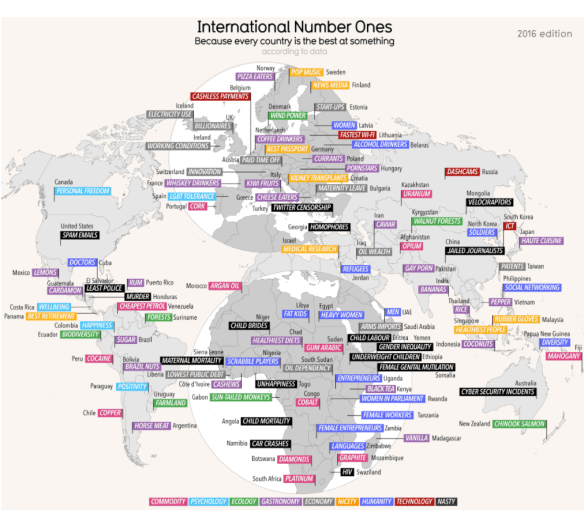
Every Country Gets a Trophy

Screen Shot 2017-02-26 at 4.18.05 PM.png

Source: see here.

H/T Laura Seay

Thoughts of a Warrior-Scholar

I’ve started reading H. R. McMaster’s Dereliction of Duty.

As some of you may know, McMaster is the new national security advisor to U.S. President Donald Trump. I chose the title of this post because, besides sounding great, the term “warrior-scholar” pretty much describes the professors and cadets that I met on my one visit to West Point. The American system of government (including its national security apparatus) has its faults, but a good chunk of Americans certainly do try to engage in everyday performative expressions of the (admittedly still aspirational) ideals of their republic.

Here are two paragraphs in Dereliction of Duty that caught my eye:

McNamara’s Whiz Kids were like-minded men who shared their leader’s penchant for quantitative analysis and suspicion of proposals based solely on “military experience.” Many of them had worked in think tanks and research corporations, such as RAND, and they were eager to apply their techniques to the problems of the Defense Department. Taylor recalled that “cost-effectiveness charts appeared on all the walls, and a whole host of requests for information and advice flooded the JCS.” The two most important offices were Paul Nitze’s International Security Affairs (ISA) and Alain Enthoven’s Systems Analysis divisions.

Enthoven quickly became McNamara’s point man in establishing firm civilian control over the Defense Department. His flair for quantitative analysis was exceeded only by his arrogance.70 Enthoven held military experience in low regard and considered military men intellectually inferior. He likened leaving military decision making to the professional military to allowing welfare workers to develop national welfare programs. Enthoven suggested that military experience “can be a disadvantage because it discourages seeing the larger picture.” He and many of his colleagues believed that most people in the Department of Defense simply tried to “advance their particular project or their service or their department.” He was convinced that “there was little in the typical officer’s early career that qualifies him to be a better strategic planner than… a graduate of the Harvard Business School.” He used statistics to analyze defense programs and issues and then gave the secretary of defense and the president information needed to make decisions. Enthoven saw no limits to the applicability of his methods.

It’s almost as if McMaster had read William Easterly’s Tyranny of Experts. These two paragraphs highlight the dangers of privileging narrowly defined ways of “knowing”; especially when dealing with complex social systems as typically the case with policymaking. McNamara, for some reason, imagined that he could tame Vietnam solely by faithfully following the numbers.


Scottish Land Ownership Fact of the Day

As far as land ownership goes, Scotland is still in the 16th century (I am not making any normative judgment here).

This is from a briefing paper for the House of Commons:

Scotland has the most concentrated pattern of private land ownership in the developed world. The degree of concentration is evident from the fact that a mere 432 landowners account for half of all Scotland’s privately owned land – such land (since not much more than 10 per cent of Scotland is in public ownership) accounting, in turn, for the bulk of the country.


Economics in Low-Income Countries

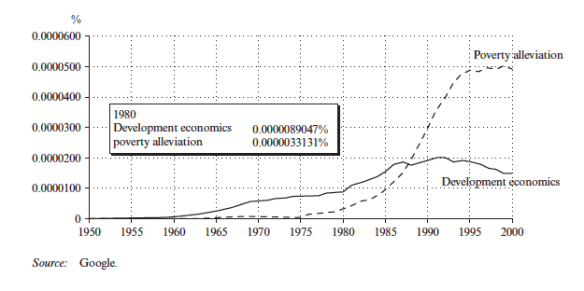
I came across Ingrid Kvangraven‘s very thoughtful review of Alternative Theories of Economic Development over at Developing Economics. The book sounds like a rehashing of the standard critiques of contemporary research in the field of development economics, some which tend to fall squarely in the caricature column. That said, caricatures can sometimes be useful in forcing us to reconsider core assumptions. In particular, I think the field of development economics has yet to deal with the problem of being “a tool-driven profession, where the tools determine the types of questions that are possible to ask as well as the type of analysis possible to carry out.”

For instance, I love most of the exciting micro work in development economics, but would certainly be interested in reading more books or papers covering big picture macro topics in developing countries. I also realize that economists from developing countries are the best-placed (in terms of incentives and access to information) to try and answer some of the big picture questions that do not always lend themselves to empirical analyses.

Here are some excerpts:

The editors also emphasize the increasing focus on methods in the field of development economics, rather than theory and history (in line with my own observation). The editors argue that the field has developed into a tool-driven profession, where the tools determine the types of questions that are possible to ask as well as the type of analysis possible to carry out. For example, as pointed out by Viner (1937), increasing returns was removed from international trade theory because it was not compatible with equilibrium. As Paul Krugman (1991) puts it: Economics came to “follow the line of least mathematical resistance”.

screen-shot-2017-02-14-at-3-49-26-pmThe editors also find that the basic fact of uneven development tends to be reduced to models of “dualism,” which implies less attention to the differentiation internal to sectors, and patterns of interaction of different groups of classes within and across sectors. Furthermore, when it is discovered that certain institutions are different from “the norm” in developing countries, they are highlighted and explained using the same basic analytical tools developed for the norm. This type of Economics is what the editors call a National Geographic view of the broader process of development, as only snapshots of particular institutions or economic activities are separated for the analysis.

You can read the whole thing here.

Why is Mugabe Still in Power?

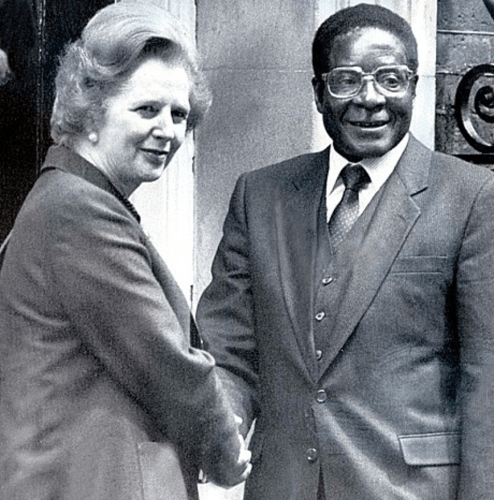
Zoe Samudzi provides some excellent answers to the question of why President Robert Mugabe has had such staying power despite the many political and economic upheavals that have beset Zimbawe since the late 1990s.

Here is an excerpt:

Throughout the course of his thirty-six years in office, President Robert Mugabe has used coercion and violence to clear the Zimbabwean political arena of opposition and dissent and consolidate his political power. He has singularly blamed the deteriorating economy on western sanctions rather than responsibly attributing it also to his own inadequate planning, mismanagement of both capital and resources, his allowance of economic liberalisation and structural adjustment, and political corruption. Yet, contrary to the singularly critical narratives that tend to dominate, he enjoys some earnest support beyond what western reports about stolen elections indicate.

Also:

Most critically, the land issue – an issue of indigenous sovereignty, and perhaps the most unifying politic of Black resistance to colonial rule – went unaddressed. President Mugabe’s refusal to resign or allow regime change is justified, in part, by an idea that the revolution was stalled, and there must be consistent leadership in its continuity. It is no mistake that the ongoing process of land repossession and reform is characterised as the Third Chimurenga, and it is no accident that such vehement western critique has been levelled at state policy (genuine or otherwise) seeking to regain land sovereignty.

Remember that around independence in 1980 some 6,000 European immigrants, nearly all of whom defended the apartheid-lite (Southern) Rhodesian regime, owned 42% of Zimbabwe. Given the importance of land in an agrarian economy such as Zimbabwe’s, this was always going to be a politically untenable situation — regardless of the race of the landowners. Zimbabwe was on a path to significant land redistribution, one way or another.

So why didn’t Zimbabwe deal with the land question before independence in 1980?

Screen Shot 2017-02-10 at 7.45.33 AM.pngThe answer has to do with the the relative political power of the European settler community, especially after UDI. Since 1923 the group had enjoyed effective self-government with significant autonomy from London. And it is precisely because of their political power that Zimbabwe never had a “Swynnerton Plan” akin to what happened in Kenya in response to the Mau Mau anti-colonial insurgency.

Zimbabwe’s landowners failed to appreciate the need to make deals when they had the (political) upper hand. And by so doing set themselves up for very costly reforms/expropriations thirty years hence.

Why they made this choice is an interesting and open question.

Perhaps they trusted that Zimbabwe would continue to rely on Western aid in a manner that would have incentivized property rights protection by the government (under the threat of aid cuts and sanctions). They may have also thought that the government would not be crazy enough to jeopardize its commercial farming sector and risk total economic collapse. Another reason might have been the comfort of knowing that any land reform efforts in Zimbabwe would elicit reaction from South Africa (then under apartheid) in defense of property rights.

Apartheid, of course, ended in 1994. And the first two considerations did not stop President Robert Mugabe, at great cost to Zimbabweans of all stripes.

Given the complicated history of Zimbabwe and the wider anti-colonial struggle in eastern and southern Africa, I expect Mugabe’s legacy to be sanitized as soon as he passes on, especially outside of Zimbabwe.


Image of the Month

africa


Unprincipled Principals

vjbsjmj

H/T Jeff Anderson.

Malawi: University of Chicago Post-Doc Position (2 years)

Post-Doctoral Position (2 years with a possible additional year)

The Tsogolo La Thanzi (TLT) project http://tsogololathanzi.uchicago.edu/ is seeking a post-doctoral scholar with interest in fertility, reproductive health, and the life-course and experience with data collection in developing countries. The candidate will have PhD degree in sociology, demography, or a related social science in hand for a start date of August 1, 2017. The position is located within the Division of Social Sciences at the University of Chicago and funded by NICHD R01-HD077873.  Candidates will have the opportunity to forge intellectual ties with the African Studies Workshop, the Population Research Center, and the Center for International Social Science Research but should be prepared to advance an independent research agenda and draw upon TLT data resources.

Salary is commensurate with NIH post-doc levels, and some additional support for conference travel and fieldwork is available. Applicants must be Citizens or Permanent Residents of the United States at the time of application.

Application materials should include: 1) a cover letter outlining the applicant’s research agenda and plans to engage TLT data and resources; 2) curriculum vitae; 3) 2 writing samples; 4) names and contact information for three references. Please send all materials to Jenny Trinitapoli (jennytrini@uchicago.edu)

A review of applications will begin by January 31, 2017 and will continue until the position is filled.

H/T R. Riedl.

Travel back in time with Jeffrey Gettleman of the New York Times

screen-shot-2017-01-24-at-3-57-37-pm

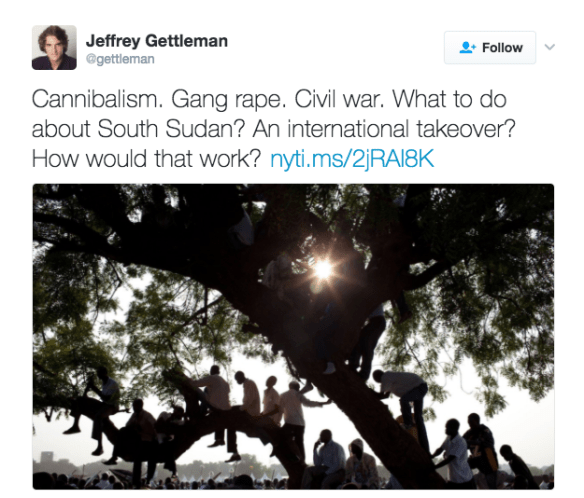
South Sudan is in the middle of a political crisis that has a high risk of degenerating into genocide. Millions of lives are at stake. And the world needs to know (and do something) about it.

But this is not an excuse to use dehumanizing language in describing South Sudanese. Why did Jeffrey Gettleman choose, in this tweet, to lead with the trifecta of cannibalism, gang rape, and civil war? It is important to note that this is not what the piece was about. In the piece, actual acts of cannibalism and gang rape only get a single line each in this short paragraph.

Women were raped. Children were burned to death. Some people were even forced at gunpoint to eat the flesh of their dead relatives. The horror has been meticulously documented. Still, it goes on.

Gettleman’s gratuitous tweet may have been meant as clickbait. But seen in the context of his other pieces from the region, it fits a pattern. It was a dog whistle, meant to take us back to a time when callous dehumanization of Africans was commonplace, including in the most highbrow of outlets. From the DRC, to Kenya, to Uganda, Gettleman’s writings read like the works of a careless journalist who, for whatever reason, does not think that dehumanizing the subjects of his pieces is wrong.

It’s almost as if he intentionally wants to beat Joseph Conrad in producing piles and piles of horse manure on his imagined idea of what Africa and Africans are about.

It is a shame that, in 2017, the Times continues to feed this stuff to its readers.


Interested in Education Research? Come Work With Us in Tanzania!

Application details here. The deadline is January 22, 2017.

Twaweza is hiring immediately for a Dar es Salaam-based Program Associate on the RISE Tanzania Research Project.

RISE (Research on Improving Systems of Education) is an ambitious multi-country research program that seeks to answer the question, “What works to improve education systems to deliver better learning at scale in developing countries?” RISE aims to broaden the evidence base on education systems, with the ultimate goal of improving learning outcomes.

The Programme is funded by the UK’s Department for International Development (DFID) and Australia’s Department of Foreign Affairs and Trade (DFAT).

RISE’s work is Tanzania is led by the Tanzania Country Research Team (CRT), a group of 12 expert researchers from Georgetown University, the University of Dar es Salaam, Twaweza, Amsterdam Institute for International Development, The University of Virginia, and the World Bank.

In Tanzania, the CRT will conduct research to document the process and impact of recent and emerging education reforms.

Application details here.

Answers to Some of Team Trump’s Questions on Foreign Aid to Africa

A piece in the New York Times highlights some of the Africa-related queries posed by Team Trump to the State Department. Sub-Saharan Africa’s 48 countries get $8b in U.S. aid each year. The average country receives far less than critical U.S. allies like Afghanistan ($5.5 billion), Israel ($3.1 billion), Iraq ($1.8 billion) and Egypt ($1.4 billion).

Here are some answers to Team Trump’s questions.

With so much corruption in Africa, how much of our funding is stolen? Why should we spend these funds on Africa when we are suffering here in the U.S.?

 First of all, corruption is not the biggest impediment to success in the aid business. Often, it is poor planning and execution. And most of the time this tends to be the fault of the donors themselves. Research shows that aid works best when complemented with strong local capacities. This requires knowing what those capacities are, or investing in their long term development.

I would suggest that the administration worries more about planning and execution. How can you make your aid agencies better at identifying and executing on projects? How can you help African countries improve their absorption capacity of aid dollars without too much distortion of their local political economies? How can you move away from projects predicated on good will, and into ones that are anchored on self-interest and value creation?

Africans want jobs. Not handouts. And the 0.2% of the U.S. budget that goes to this region each year can be a powerful tool for shifting incentives in the right direction as a far as job creation is concerned. Want to export more GM cars or carrier air conditioning units to Lagos? Then help create the demand by creating jobs in Lagos.

The new administration should also end the double talk of financing corruption and condemning it at the same time.

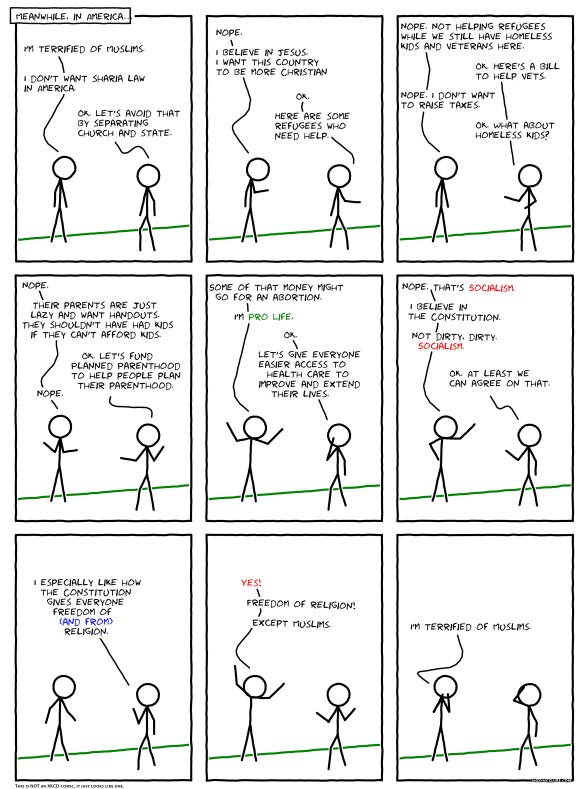
screen-shot-2017-01-14-at-2-17-58-pmTake the example of security assistance. If you want to reduce corruption in military procurement, I would suggest that you channel all assistance through the normal appropriation processes in African legislatures. More people will know how much money is going where, thereby increasing the likelihood of greater accountability. The same applies for budget support. Strengthen existing constitutional appropriation processes so that bigger constituencies get to own the aid dollars.

Leaders do terrible things all the time for political reasons, and not because of an inherent failure in moral judgment. Learn to respect and trust your African counterparts. Know their interests. Don’t think and act like it is 1601.

We’ve been fighting al-Shabaab for a decade, why haven’t we won?

Well, for a number of reasons. Kenya, Ethiopia, the U.S., and the other TTCs are working at cross-purposes. The first best option would be to strengthen Mogadishu as the center of a strong unitary state. But no one wants that. Not the Somalian elites running the state-lets that make up the federal state. Not Kenya — whose goal seems to be no more than creating a buffer stable region in Jubaland. Not Ethiopia — whose elites are more concerned about Pan-Somalia irredentism and their own domestic politics. And certainly not the TTCs — who are largely in it for the money and other favors from Washington and Brussels. The second best option would probably be to localize the Al-Shabaab problem and then strengthen the Somali state-lets so that they can be able to fight the group. However, by globalizing the “war on terror” the U.S. has largely foreclosed this option. Also, Mogadishu would not want to cede too much military power to the states.

All to say that the U.S. cannot win the fight against al-Shabaab, certainly not by raining fire from the air.

Somalians, with some help from their neighbors, are the best-placed entity to win the war. But for this to happen, all actors involved — and especially Ethiopia and Kenya — must have an honest discussion about both short-term and long-term objectives of their involvement, and the real end game.

Most of AGOA imports are petroleum products, with the benefits going to national oil companies, why do we support that massive benefit to corrupt regimes?

Again, you should not approach this problem from the perspective of a saintly anti-corruption crusader. Moralizing from the high mountains is boring, and does not solve anything. I thought the Trump Team would be into dealing with the world as it is. Appeal to the specific interests involved. Think creatively.

It turns out that public finance management is a lot harder than most people think. Don’t expect people to be honest and patriotic. Help design PFM systems that are robust to the worst of thieves.

Here, too, I would suggest a move towards mainstreaming resource sector transactions into the normal appropriation processes. For instance, the administration can introduce greater transparency in the oil business, and create stronger links between oversight authorities in the host countries and the American firms involved. This will not end corruption, but it will serve to disperse power within the oil producing countries. And that would be a good thing.

Also, a quick reminder that AGOA involves more than just oil. Africa’s tiny textiles sector benefits too. Doing more to develop this sector would create tens of thousands of jobs, thereby reducing aid dependence.

We’ve been hunting Kony for years, is it worth the effort?

Nope.

The LRA has never attacked U.S. interests, why do we care? Is it worth the huge cash outlays? I hear that even the Ugandans are looking to stop searching for him, since they no longer view him as a threat, so why do we?

I have no idea.

May be this has been used as a way of maintaining ties with the Ugandan military in exchange for continued cooperation in central Africa and in Somalia? May be it is a secret training mission for the U.S. military in central Africa?

I honestly have no idea.

Is PEPFAR worth the massive investment when there are so many security concerns in Africa? Is PEPFAR becoming a massive, international entitlement program?

PEPFAR has saved millions of lives. And I would argue that it is probably America’s most important investment in soft power across Africa.

I would suggest a few modifications, though. The new administration should think creatively about how to use PEPFAR dollars to strengthen African public health *systems* in a manner that will allow them to provide effective care beyond HIV/AIDS. Malaria and GI diseases kill way more people. These need attention, too.

How do we prevent the next Ebola outbreak from hitting the U.S.?

By strengthening public health systems in countries that are likely to experience Ebola outbreaks.

The Elusive Quest to Fix (Political) Governance Problems Using Technology

File this under “the perils of treating political problems as technical problems”:

The government’s main financial management system is marred by technology loopholes, making it prone to abuse and possible loss of public funds, an official audit has revealed. An inquiry report by the Auditor- General reveals that the Integrated Financial Management Information System (Ifmis) has numerous control weaknesses that badly expose it to fraud and misuse, with unidentified users capable of logging in remotely while others have multiple identities in the government’s main financial nerve centre.

So exposed is the system that one can create more than one User ID. This can lead to misuse of such additional User ID freely in committing fraud. The audit reveals that almost 50 users had more than one User ID leaving little accountability on the users. The system also lacks a trackable approval process in the creation of new User IDs, meaning it is possible to create ghost IDs and carry out transactions including remotely without being noticed.

In fact, a list of authorised personnel provided with remote access was not available for audit review meaning their identities remained anonymous. There was no practice of approving the remote login requests; which means even those not authorised would log in remotely. Remote transactions were largely blamed for the theft at the Ministry of Devolution which saw the loss of more than Sh1.6 billion in the infamous National Youth Service (NYS) scandal.

Vendors were also duplicated in the system with a review of the supplier master data showing the existence of almost 50 cases of duplication of the same vendor, meaning the vendor may as well have been paid 50 times.

Elections 2017: David Ndii makes a rather weak case for new wine in old wineskins

This is from the Daily Nation:

The idea that political alternative necessarily means different or new people is a fallacy.

One of the most bizarre moments in my political life was walking into the Serena Hotel’s ballroom for a cocktail to celebrate the formation of Narc, and scanning the room to see Kanu stalwarts George Saitoti, Joseph Kamotho and William Ntimama mingling and laughing heartily with their erstwhile mortal political enemies.

It was the strangest and most confusing feeling.

I stayed only a few minutes and went home quite depressed.

I had the privilege of working with Saitoti thereafter and I have to say he turned out to be one of the most committed and progressive ministers in the Narc government.

“If the opposition is not an alternative” had obtained in 2002, Narc could not have been an alternative to Kanu because even its presidential candidate was a long time Kanu stalwart who once compared felling Kanu with trying to cut down a mugumo tree with a razor blade.

Yet it is undeniable that Narc’s election was a watershed in our political history.

More fundamentally, the narrative glosses over the fact that we have a very clearly defined ideological cleavage in this country that goes back to the Kanu-KPU fallout shortly after independence.

Opposition in Kenya means opposing the Kanu establishment. It means standing up for political equality and social justice.

I am not convinced. For two reasons.

First, I have always found issue with depictions of Uhuru Kenyatta as a latter day Moi (or wannabe dictator). He is not. In my view Kenyatta is simply a poor administrator with a thin skin and lots of sycophantic lieutenants (not to mention a very ambitious deputy). Combine these together and you get lots of failures at different nodes of the administration; and lots and lots of stealing (the definition of a common-pool problem). Is Kenyatta himself corrupt? Perhaps. Does he have a masterplan for taking us back to the baba na mama era? I doubt it.

This doesn’t absolve Kenyatta of any of his failings highlighted by Ndii. It certainly sucks to live in a poor country on autopilot and with an “absentee-landlord” president. Rather, it’s a call for a proper diagnosis of the real causes of the failures of the Jubilee administration.

Second, the ideological commitments of members of the opposition are sketchy. When its leading lights were in government (briefly after 2003 and then after 2008) they did not behave any differently than the alleged Kanu Establishment (with the possible exception of Charity Ngilu). Just because Raila Odinga claims to be a social democrat doesn’t mean that we should believe him. His actual track record suggests that as president he would probably be somewhere between Jomo Kenyatta and Kibaki in style — able to delegate, primarily pro-business, big on elite-level ethnic regional balance, but also keen to use coercion when necessary (which is why I am always amused by Railaphobia scaremongering that depicts the man from Bondo as a rabid anti-wealth, pro-poor socialist. Look at the man’s record. He is no more pro-poor than is Kenyatta).

Musalia Mudavadi, who stands the best chance of beating Kenyatta this August atop a united opposition ticket, is essentially a scion of the Kanu Establishment.

Change for the sake of change is not always a good thing.

The case that an opposition government would be less corrupt, more competent in managing the economy, and more inclusive than Jubilee is fairly weak. After nearly fours years under the system of devolved government, the opposition’s record on actual policy performance is paper-thin. Their governance record is nothing to sing about. For instance, CORD controls the big urban counties of Nairobi, Mombasa, and Kisumu. Wouldn’t it be nice if they had something to point to as evidence of their administrative and policy competence? Where does the opposition stand on agricultural policy? Health policy (do they even know that there is an ongoing doctors’ strike)? Education policy? Housing and land policy?

Can we really say with a straight face that the leadership of opposition counties have sought to channel Oginga Odinga, Kaggia, JM, Pinto, Murumbi, or Seroney in their policies? Does the Kenyan left even exist anymore among the political class?

The Jubilee government has failed on many fronts, and ought to face a strong challenge come August. But the Kenyan public shouldn’t be expected to hand the opposition the keys to State House simply because they are in the opposition. They must first show wananchi what is in it for them. They must demonstrate that they get the issues that affect the proverbial number of sufurias in Kenyan homes.

PS: This is not some starry-eyed case for a third force. Rather it is a call for more rigorous arguments for either reelecting Jubilee or voting for the opposition from their respective intellectual backers. I am a big believer in making do with the politicians we have.

PSS: It is sad that 2017 will not be about the counties. It ought to have been about the counties. And bringing government closer to wananchi.

Tyler Cowen Goes to Lagos

MR’s Tyler Cowen (also Professor of Economics at George Mason) recently spent six days in Lagos. Here is what he has to say about Africa’s biggest and most economically dynamic city:

A trip is often defined by its surprises, so here are my biggest revelations from six days in Lagos, Nigeria.

Most of all, I found Lagos to be much safer than advertised. It is frequently described as one of the most dangerous cities on earth. Many people told me I was crazy to go there, and some Nigerian expats warned me I might not get out of the airport alive.

The reality is that I walked around freely and in many parts of town. I didn’t try to go everywhere or at all hours, and I may have been lucky. Yet not once did I feel threatened, and I strongly suspect that a trip to Lagos is safer than a trip to Rio de Janeiro, a major tourist destination. (In my first trip to Rio I was attacked by children with pointed sticks. In my second I found myself caught in a gunfight between drug lords). Many Lagos residents credit the advent of closed-circuit television cameras for their safety improvements.

So if you’re an experienced traveler, and tempted to visit Africa’s largest and arguably most dynamic city, don’t let safety concerns be a deal killer.

Read the whole thing here.

I have never been to Lagos, and look forward to fixing this in 2017. So far my experience of West African (commercial) capitals is limited to Dakar, Accra, Lome, Conakry, Nouakchott and Monrovia (I like them in that order). Dakar edges Accra only by a whisker, mostly on account of the seascape. I have spent way more time in Accra, and therefore my ranking might also be a function of my knowledge of Accra a little too well.

Accra beats all other cities on food. It has the most variety, and nearly all of the offerings beat the bland stuff that we East Africans consume. The grilled tilapia and banku is unbeatable.

Oh, and I must admit that I have a slight preference for Senegalese jollof. My wife insists that Ghanaian jollof is the best jollof (ahead of both the Nigerian and Senegalese variations). I look forward to sampling Naija jollof so we can finally settle this disagreement.