This is from Sisonke Msimang over at Africa is a Country:
Today, many younger South Africans suggest that Mandela made too many compromises. Twenty-six years into the new era, there is a lively, angry, often chaotic debate about the role and place of the father of our nation.
When the student protests began a few years ago on South Africa’s university campuses some of the young activists accused Nelson Mandela of betraying the revolution. They called him a sell-out. The elders were alarmed and hurt, but the young ones were convinced. I am of the generation that lies between the two: I was not old enough to fight for freedom but I am old enough to remember Mandela. I know that he was no sell-out.
I agree with one point the youth made however: the revolution was betrayed. I do not place the blame at Madiba’s feet though. The blame for that lies squarely with the generation of leaders who followed him—my parent’s generation. The freedom fighters whom I respected and loved in Lusaka and Nairobi, returned home. They put down their guns and they picked up their spoons and they began to eat. Many of them have not stopped eating since. I can think of only a handful of them who I would trust with my future.
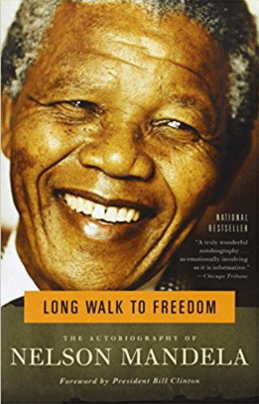
Mandela’s successors have all been lacking in one key respect or another. Thabo Mbeki’s cerebral approach to government did little to inspire the ANC’s rank and file. Jacob Zuma was a corrupt and ineffectual huckster masquerading as a populist. Cyril Ramaphosa is a multimillionaire who, while inspiring confidence among the business and middle classes, will struggle to earn the confidence of millions of South Africans who are either unemployed or underemployed.
The best hope for protecting Madiba’s legacy would be an honest and good faith attempt at solving South Africa’s structural problems — historical legacies of apartheid, lack of dependable (manufacturing) jobs, quality of education, and a fraying social sector (with crime topping the list).
Unfortunately for everyone involved, so far the country has oscillated between boardroom politicians scared stiff of the (forex) markets, and a cast of “populists” eager to exploit their control of the state for personal enrichment.
My view is that Mandela’s legacy will survive the ongoing process of undoing the legacies of colonialism/apartheid. As Msimang points out, Mandela was not a pacifist saint but a strategic politician driven by his quest for the total liberation of South Africans. To that end he was willing to play politics or resort to armed resistance, as needed.
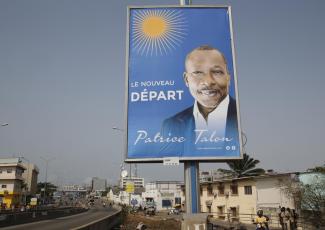 Benin was among a handful of African countries that voted out incumbent presidents in the “founding” multiparty elections of the early 1990s. Mathieu Kérékou, president since 1972, lost to Nicéphore Soglo in 1991, and agreed to step down.
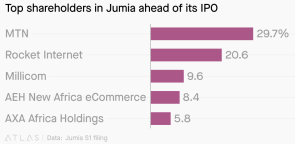 Jumia, the largest e-commerce operator in Africa, has today (April 12th) launched its landmark initial public offering (IPO) on the New York Stock Exchange.
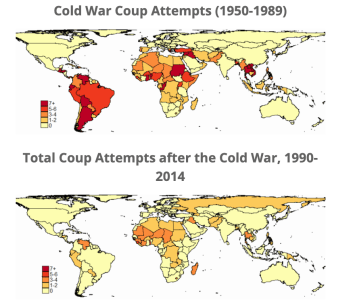 For these reasons, there is fair amount of clustering within countries when it comes to coup incidence. In Africa, Sudan leads the charts when it comes to coup incidence.
  Building on
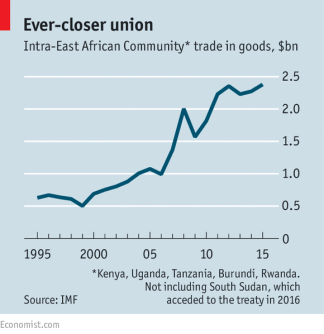 In the year 2000, Ugandan exports to Rwanda were worth $9 million. By the 2017/2018 financial year, this figure had shot up to $197 million, against imports of $20 million, giving it a surplus of $177 million, despite the icy relations currently prevailing.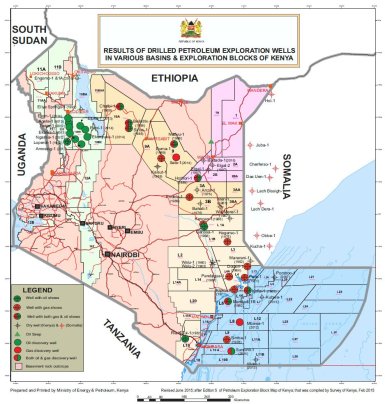
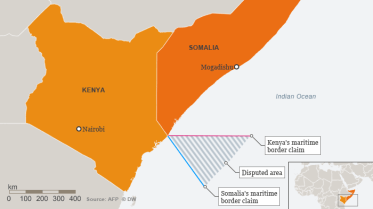 Kenya and Somalia hold rival claims on a triangular maritime territory in the Somali Sea (see image).
 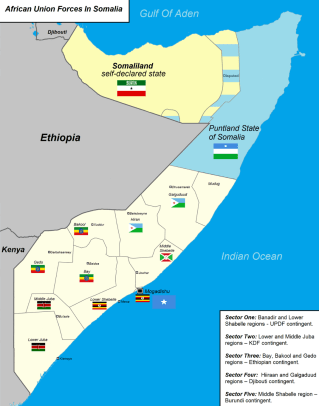 Kenya may have suffered these attacks since it is considered a key ally of the West. But why is Al-Shabaab (an Al-Qaeda affiliate) targeting Kenya more than it is other countries in the region, such as Ethiopia and Uganda, which also have close ties with the West and have fought Al-Shabaab in Somalia? To what extent does Al-Shabaab attack Kenya for the reasons it publicly gives? Will Al-Shabaab, for example, stop targeting Kenya if the Kenya Defence Forces pulled out of Somalia?
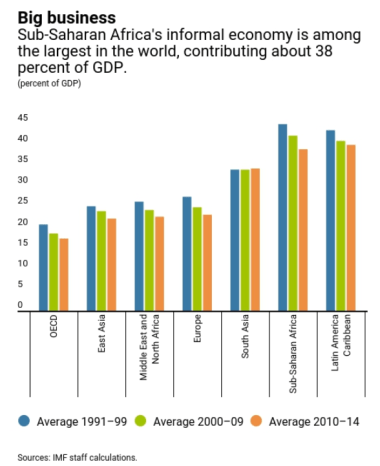 Inspired by Yuen Yuen Ang’s
 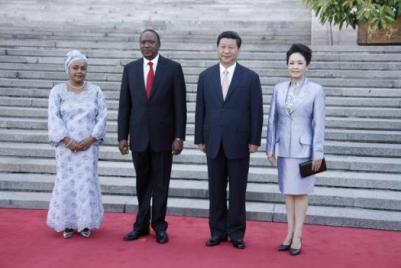 A key weakness that I see in the “Let China Fail in Africa” strategy is that it vastly underestimates the extent to which Africans will be willing to work hand in hand with China to make the Sino-African relationship work.
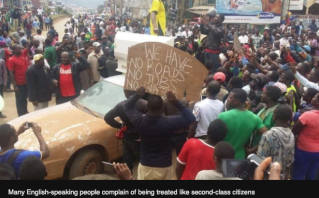 At some point it will become impossible to piece the Cameroons back together. Human rights abuses by the Cameroonian military,
 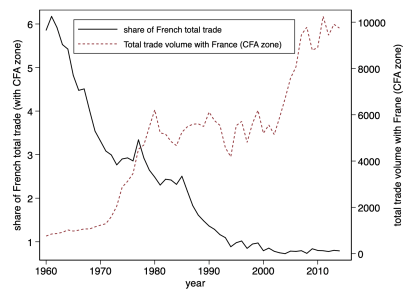 It is worth noting that, from the French perspective, the economic case for françafrique is not as strong as it used to be (see image). Trade with the CFA zone as a share of total French trade volume has been on a steady decline since the 1960s.
  kenopalo.com