Why are Kenyan politicians politicizing the military?

Botswana, Gabon, Kenya, Malawi, Namibia, South Africa, Swaziland, Tanzania, Zambia and Zimbabwe are the only continental sub-Saharan African states to have never experienced military rule. Each country has managed to do so via well orchestrated coup-proofing strategies of ethnic balancing and material payoffs to the men and women with the guns and tanks. 

Kenya, in particular, has perfected this art. Because of its fractious ethnic politics, ethnic balancing within the officer corps has been key to Kenya’s coup-proofing. Kenyatta (who spoke Kikuyu) had a bit of a hard time in the beginning with a Kamba and Kalenjin speakers dominated military but eventually succeeded in having his co-ethnics in key positions. But before he did so he ensured Kikuyu dominance over the paramilitary force, the General Service Unit (GSU) to balance the military. Through the 60s and 70s, Kenyatta ensured that the GSU and police could handle their own against the military in case stuff hit the fan. Moi continued along this path, so much so that for a while in the media the typical accent of a security officer – whether police or military – became an accent from the North Rift. Under Moi the Kenyan army became “Kalenjin at the bottom, Kalenjin at the middle, and Kalenjin at the top.”

Beyond the ethnic balancing, Kenya has also coup-proofed by keeping the generals wealthy and OUT OF POLITICS – at least not overtly. The generals in Kenya are probably some of the wealthiest on the Continent. I went to high school with the son of an Air Force Major General whose family was always taking foreign trips to exotic places and always made a big splash on visiting days. The only estimates I could find are from the 1960s when nearly “two thirds of the military budget went to pay and allowances, most of it to officers.” A lot of them also got free land for cash crop farming and lucrative business deals (some illegal) from the Kenyatta and Moi governments. Keenly aware of West Africa’s junior officer problem following 1981 Moi extended land grants to junior officers as well. 

But despite their importance as leaders of a key national institution, most Kenyans, yours truly included, do not know much about the top generals in the army. The one chief of staff that I remember hearing a lot about in my childhood days was Gen. Mahmood Mohamed, the man who played a big role in quelling the 1982 coup attempt. For the most part I only saw these guys in the media on national holidays when they rode on the president’s Land Rover. 

In other words, I think it is fair to say that, contrary to arguments made by N’Diaye, for the most part the Kenyan military has historically been fairly professionalized and depoliticized relative to other countries in the neighborhood. There is no evidence to suggest that ethnic balancing has severely interfered with the process of professionalization. Kenyan presidents’ preferred agents for dirty political work have always been the intelligence service, the police and paramilitary units, but never (to the best of my knowledge) the military. Indeed the US and British militaries have had very close technical cooperation with the Kenyan military through training, material assistance and more recently joint operations, resulting in a relatively highly trained force that has for the most part stayed clear of politics.  

But this consensus appears to be slowly eroding. Before the 2013 General Elections the former Prime Minister Raila Odinga accused the military and the intelligence service of colluding with his opponent, Uhuru Kenyatta, to rig the presidential election. And now the heads of the military and intelligence service are reportedly contemplating suing a former aide to Mr. Odinga for defamation. Increasingly, the military is being dragged down to the level of the marionette-esque GSU and Police, perennial hatchet men for whoever occupies State House.

This cannot end well. 

Coup proofing is hard. And the thing with coups is that once the genie is out of the box you can’t take it back. Coups just breed more coups.

This is why the generals must be left fat and happy and in the barracks, or busy keeping the peace (and hopefully not facilitating charcoal exports) in Somalia’s Jubaland State. Do your ethnic balancing and all, but by all means KEEP THEM OUT OF POLITICS (I am glad the current Defense Minister has no political constituency).

The last thing Kenya needs is a Zimbabwe situation in which there is open bad blood between the military and the opposition. 

Plus Kenya, based on its per capita income, ethnic politics, and minimal experience with genuine democratic government, is still not beyond the coup trap to be able to safely play politics with the military. If you doubt me, go find out the last time Brazil, Thailand and Turkey had generals in charge. 
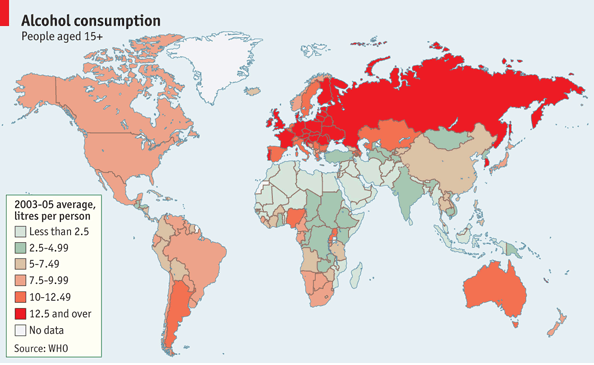
So Tanzanians drink more than Kenyans?

Kenyans pride themselves in their ability to consume machozi ya simba (lion’s tears) and have a good time, more so than their regional neighbors, especially the polite Tanzanians to the south. But the data, at least between 2003-05, says something different. Kenyans drink the least in the EAC (which is a testament to the strong conservative undercurrents in Kenyan society despite the outward liberalism that we (almost exclusively Nairobians) all like to wear on our sleeves).

Image
Source: The Economist
It is also in Kenya that there is an anti-drinking law forbidding the sale of alcohol before 5 PM on weekdays and 2 PM on weekends and after 11 PM. Of course the law is almost never enforced and seems to only benefit the police whenever they need extra cash from bar operators. That said, sections of Kenyan society have a serious drinking problem that the government continues to ignore at enormous social and economic cost. Incidentally, like all good Commanders in Chief, ours is no stranger to booze, although he must’ve ditched the habit now that he is lives in the House on the Hill.

Africa’s newfound love with creditors: Bond bubble in the making?

I know it is increasingly becoming not kosher to put a damper on the Africa Rising narrative (these guys missed the memo, H/T Vanessa) but here is a much needed caution from Joe Stiglitz and Hamid Rashid, over at Project Syndicate, on SSA’s emerging appetite for private market debt (Africa needs US $90b for infrastructure; it can only raise $60 through taxes, FDI and concessional loans):

To the extent that this new lending is based on Africa’s strengthening economic fundamentals, the recent spate of sovereign-bond issues is a welcome sign. But here, as elsewhere, the record of private-sector credit assessments should leave one wary. So, are shortsighted financial markets, working with shortsighted governments, laying the groundwork for the world’s next debt crisis?

…….Evidence of either irrational exuberance or market expectations of a bailout is already mounting. How else can one explain Zambia’s ability to lock in a rate that was lower than the yield on a Spanish bond issue, even though Spain’s [which is not Uganda…] credit rating is four grades higher? Indeed, except for Namibia, all of these Sub-Saharan sovereign-bond issuers have “speculative” credit ratings, putting their issues in the “junk bond” category and signaling significant default risk.

The risks are real, especially when you consider the exposure to global commodity prices among the ten African countries that have floated bonds so far – Ghana, Gabon, the Democratic Republic of the Congo, Côte d’Ivoire, Senegal, Angola, Nigeria, Namibia, Zambia, and Tanzania.

In order to justify the exposure to the relatively higher risk and lending rates on the bond market (average debt period 11.2 years at 6.2% compared to 28.7 years at 1.6% for concessional loans) African governments must ensure prudent investment in sectors that will yield the biggest bang for the buck. And that also means having elaborate plans for specific projects with adequate consideration of the risks involved.

Here in Zambia (which is heavily dependent on Copper prices), the Finance Minister recently had to come out to defend how the country is using the $750 million it raised last year on the bond market (2013-14 budget here). Apparently there was no comprehensive plan for the cash so some of the money is still in the bank awaiting allocation to projects (It better be earning net positive real interest).

“They are fighting each other. By the time they have projects to finance, they will have earned quite a lot of interest from the Eurobond money they deposited. So, all the money is being used properly,” he [Finance Minister] said.

Following the initial success the country’s public sector plans to absorb another $4.5b in debt that will raise debt/GDP ratio from current ~25% to 30%. One hopes that there will be better (prior) planning this time round.

Indeed, last month FT had a story on growing fears over an Emerging (and Frontier) Markets bond bubble which had the following opening paragraph:

As far as financial follies go, tulip mania takes some beating. But future economic historians may look back at the time when investors financed a convention centre in Rwanda as the moment that the rush into emerging market bonds became frothy.

The piece also highlights the fact that the new rush to lend to African governments is not entirely driven by fundamentals – It is also a result of excess liquidity occasioned by ongoing quantitative easing in the wake of the Great Recession.

I remain optimistic about the incentive system that private borrowing will create for African governments (profit motive of creditors demands for sound macro management) and the potential for this to result in a nice virtuous cycle (if there is one thing I learned in Prof. Shiller’s class, it is the power of positive feedback in the markets).

But I also hope that when the big three “global” central banks start mopping up the cash they have been throwing around we won’t have a repeat of the 1980s, or worse, a cross between the 1980s (largely sovereign defaults) and the 1990s (largely private sector defaults) if the African private sector manages to get in on the action.

African governments, please proceed with caution.

Happy Madaraka Day!

Happy Madaraka Day to all fellow Kenyans here at home and around the world. Hongera for all we have achieved over the last 50 years!

Najivunia kuwa mkenya.

flag

Kenyatta and Odinga argue in public

This is an audio clip of Jomo and Oginga at a public function. President Kenyatta launches into former Vice President Odinga and his party, the Kenya People’s Union (KPU), accusing them of being useless rubble rousers that are unconcerned with development (especially in Luo Nyanza). Odinga answers back, telling Kenyatta that he is the one with the authority to develop Luo-Nyanza and other marginalized parts of the country. 

As someone who grew up in the Moi and Kibaki eras, it is unimaginable that anyone would speak back to the president, at a public function no less. The clip serves to show the special relationship that existed between Kenyatta and Odinga, even after they fell out politically. Odinga was the most vocal campaigner for Kenyatta’s release before independence, with the slogan “Kenyatta na Uhuru.” 

[youtube.com/watch?v=WmWx3eB4oqg]

Which way forward for Kenya’s Civil Society?

It is no secret that the candidature of Raila Odinga had the backing of the largely progressive Civil Society Organizations (CSOs) in Kenya. Odinga’s loss to Uhuru Kenyatta, someone they considered an unelectable ICC suspect, was their loss too. In addition, both during the campaigns and after the election, CSOs in the country found themselves on the defensive against charges of being stooges of Western donors and institutions (including the ICC) out to subvert Kenyas sovereignty. An ill-advised move by Western embassies to show their hand in the contest backfired spectacularly and provided more ammo for the anti-CSO brigade. An even bigger problem for Kenyan CSOs was that at some point in the election cycle they lost the support of a sizable chunk of the middle class. The feeling of betrayal was hard to miss. The very people they had fought for had rejected their cause.

Kenya’s upwardly mobile middle class was desperate to get past the election, peacefully. Many took to heart the Peace Brigade’s PSAs that blanketed the airwaves in the run-up to and after the election. This lay the groundwork for everyone to “accept [the results] and move on,” no uncomfortable questions asked. The media too played ball, glossing over even the most glaring of irregularities in the IEBC’s tallying process. Indeed up to date none of the major media houses has seriously reported on the delayed release of constituency-level vote tallies for the National Assembly races. Reports in a section of the print press suggest the IEBC is “reconciling the presidential results and those of other positions. Over a million votes must be reconciled with others….” The silence from the major media houses on this issue is all part of accepting the official outcome of the election and moving on.

Recent discussions on the opinion pages here suggest that the chasm between the middle class and CSOs might be widening. Kenyan CSOs have been tagged as gratuitous rubble rousers intent on scaring away investors. Mention of their Western “puppet masters” has now become a must in the media when covering CSO activities. Even the recent protest against demands by Kenyan parliamentarians to increase their pay has not escaped the question of whether it is yet another plot by neocolonial schemers. The attacks have now extended to the social sphere as well. Exploiting Kenyas social conservatism, some have accused progressive CSOs of colluding with foreigners to destroy the country’s moral fabric with liberal and anti-African, atheist values. In their minds Civil Society has become “Evil Society.”

The resulting situation raises important questions regarding the future of CSOs in Kenya. Can they remain relevant without the support of the middle class? What tactics must they adopt to survive in the current political landscape? When did the rain start beating Kenyan CSOs and how can they regain the allegiance of a wide section of the middle class?

The Civil Society movement in Kenya was born out of the clamor for political space and greater civil rights during the height of Moi’s single party rule. As such, most Kenyan CSOs have always had an anti-government streak, with an inherent predisposition “to speak truth to power.” This was a strategy that worked well in fighting a widely unpopular government. And then Kenya changed. The Kibaki administration robbed Civil Society of quite a few luminaries that earned their badges of honor in the fight for the Second Liberation. Once in power these individuals faced different incentives. Many felt that it had now become their turn to eat.

The 2007-08 post-election violence weakened CSOs further by bringing to the fore ethnic divisions that existed among them. Come 2012-13 the ethnic chasm became even wider. And the ranks of CSOs thinned even more. The middle class also got alienated by a movement that seemed (fairly or not) more concerned about the past and intangible rights at time when the Kibaki boom years had given the middle class a glimpse of new economic possibilities. The mood had changed. Some suggested that Kenya had “too much democracy” that would stand in the way of development.

In a twist of irony Kenyan CSOs and the political left are a victim of their own success. Much of the Kenyan middle class, for better or worse, have since become convinced that the fight for political rights and space had been won. After all Kenya now has a new constitution; the devolved system of government is being implemented; and we no longer have an imperial presidency. For many middle class Kenyans, it is now time to focus on winning the economic fight and achieving the Kenyan dream. Many Kenyans are persuaded to believe that their own economic success is hinged on general investor confidence, and that the country needs to project an image of peace and stability.

Throughout the election cycle, no one wanted to let the ghosts of 2007 forestall Kenya’s quest to regain its place as the oasis of peace and stability in the region. The allure of 10% annual growth rates and the promise of Vision 2030 have proven very hard to resist. Many cling to the hope that mega infrastructure projects – including LAPSSET, the Thika Super Highway, and new cities and gated communities –  are about to catapult Kenya into middle-income status. Under these conditions, the ideology of peace, stability and public order was an easy sell.

In light of these developments, in order for progressive CSOs to remain relevant to the middle class they must adopt tactics that are in line with middle class aspirations. The confrontational tactics that were successful in the past will probably no longer work. I have no doubt that the government will opportunistically continue to react to public demonstrations in a manner to provoke riots that will then be labeled as anarchic and a threat to public order. Shop owners, small business operators and much of the middle class, all averse to public disorder, will no doubt nod in agreement. Despite the challenges, it should not be lost on those involved that in order to guarantee their continued survival and ability to check the government Kenyan CSOs must reengage their middle class allies. The moderating effect of the middle class will also serve to make CSOs more attractive to the wider public. As a first step CSOs must formulate a strategy that is less confrontational and more in tune with the emergent focus on the economy.

This is not to say that public demonstrations should cease to be a tactic used by CSOs in Kenya. Far from it. Public demonstrations are the best way to get the publics attention. The recent anti-parliamentarians protest, complete with a sow and its litter, was very successful in catching public attention. But such public stunts must be backed by deliberate formal engagement with the relevant authorities. This is because for a section of the public Kenya is now supposedly a nation of laws and institutions in which public protests are not allowed. All aggrieved parties should go to court where decision-making is sanitized, with minimal risk of scaring away the all-important investors. On this score both the government, wary of the unpredictable nature of unchecked public demonstrations, and the development-hungry middle class seem to be reading from the same script.

The imperative to play within the institutional framework will necessarily require CSOs to become even more institutionalized. Many Kenyan CSOs will soon be forced to morph into full fledged professional Think Tanks that can credibly address the middle class desire for economic progress, while at the same time continuing to hold those in power politically accountable. This is a lesson that I hope CSOs got from the last election.

Their skeletal operations and poor strategic judgment – which also extended to Odinga’s party – might have cost them an election that was theirs to lose. They appeared to not have done their homework when confronted with the media savvy and incredibly moneyed Kenyatta campaign. It is now well known that Odinga did not have agents in key polling stations. When the IEBC’s tallies became suspect they did not have their own numbers to report, even as they were disputing the IEBC’s tallies. Such sloppiness betrayed both a party and its CSO allies that lacked organizational competence and took too much for granted. This has to change. In this new game only those that have institutional and organizational depth will effective compete. The era of “capacity building” seminars and workshops is gone.

In addition, those in the middle class that support the incumbent government should be persuaded to form their own CSOs. The idea of CSOs being a preserve of the progressive movement in Kenya should be a thing of the past. Vigorous debate ought to be encouraged among CSOs representing both sides of the political divide. That is the mark of a true democracy. Such an eventuality would make incumbent governments and their supporters less hostile to CSOs in general. It would also force a situation in which “incumbent” CSOs, as part of a wider community of activists, felt the need to provide well argued justifications for government action and policies.

These are interesting times in Kenyan politics. Pocketbook issues are rising faster and faster up the list of Kenyans’ concerns. For now this shift in public mood appears to have been at the expense of concern over political rights. This means that in order to remain relevant, especially in the eyes of the middle class, Kenyan CSOs must change tactics and address Kenyans’ economic needs as much as their political needs. Activism, as we know it, must be backed by more institutionalized Think Tanks that can competently play the new institutional game. There is also a need for greater democracy among CSOs by encouraging the growth organizations that support the incumbent government. This will serve to further institutionalize and professionalize both the development of public policy and the conduct of politics in Kenya. It will also guarantee much-needed cooperation between Civil Society and the middle class. Merely accepting the present estrangement and moving on is not an option.

Fraud and vote patterns in Kenya’s 2013 election

Update: The video link now works. Many thanks to SAIS for fixing it and letting me know.

**********************

The video below has been making the rounds in the Kenyan online community. The Daily Nation even reported on the claims by UCSD Professor Clark Gibson and James Long, Asst. Prof. and University of Washington, that President Uhuru Kenyatta may not have crossed the 50% threshold in the March 4th election. The duo conducted an exit poll (N = 6000) on election day that showed both candidates in a statistical tie at 40.9% for Odinga and 40.6% for Kenyatta. In the presentation Clark and James make the case that exit polling is superior to PVT because it is immune to things like ballot stuffing and tallying fraud. NDI sponsored ELOG conducted a PVT that confirmed the results announced by the Kenyan EMB, the IEBC.

[youtube.com/watch?v=68a3cUrq1gI&feature=youtu.be]

I do not really know what to make of this poll finding by James and Clark at the moment. I am waiting for the actual MP and Governor elections results to be published by the IEBC so I can try and see if the results in these local races were in line with the presidential results.

A look into Kenyatta’s new cabinet

President Kenyatta has announced 16 of 18 cabinet secretaries in his administration. The list of names has elicited mixed reactions. On the one hand the manner of the announcement – on the steps of State House – was different, and dignified. It was much less pedestrian than what Kenyans had become used to – presidential cabinet appointments via press releases to newsrooms. Six women made the list, including in the powerful Defense and Foreign Affairs dockets. With the exception of Balala and Ngilu, all the nominees so far are not politicians.

But on the other other hand grumblings emerged on the lack of regional (read ethnic) balance in the appointments. Kenya is an ethnically fragmented country, with 11 (out of 42) ethnic groups with populations over 1 million (Kikuyu/GEMA, Luhya, Kalenjin, Luo, Kamba, Somali, Kisii, Meru (part of GEMA), Mijikenda, Turkana, Maasai). For most of the country’s history ethnicity has been a key organizing principle of politics, with people largely voting along ethnic lines for various instrumental reasons.

So what is the ethnic breakdown of Kenyatta’s cabinet so far? Here is my guestimation based on their last names: Kikuyu (3), Kalenjin (4), Somali (3), Luo (1), Meru (1), Kisii (1), Kamba (1), Luhya (1), Arab (1). Two slots remain unoccupied.

Only two groups (Kalenjins and Somalis) are clearly overrepresented in the cabinet appointments in proportion to their relative ethnic group size in the country (Kalenjin 25% vs 13.2%; Somalis 18.75 vs 6.3%). Those groups in the top ten that are underrepresented missed their “objective proportion” of the cabinet by about one slot, on average.

On an aside, historically African presidents have actually been pretty good at ethnic balancing in the appointment of cabinet ministers – as Francois, Rainer and Trebbi show in this paper. They claim to “show that African ruling coalitions are large and that political power is allocated proportionally to population shares across ethnic groups. This holds true even restricting the analysis to the subsample of the most powerful ministerial posts. We argue that the likelihood of revolutions from outsiders and the threat of coups from insiders are major forces explaining such allocations.

If the ethnic composition of the cabinet is anything to go by, it shows the extent to which deputy president William Ruto is more of an equal than deputy to President Kenyatta. His part of the Jubilee coalition dominates the list of cabinet nominees. Or it might just be a case of Mr. Kenyatta, being president, having opted to have his half of the cabinet “represent the face of Kenya” (Kenyatta and Ruto had a 50-50 pre-election appointments sharing agreement at the formation of the Jubilee coalition).

Despite Kenyans’ relief at the end of Odinga and Kibaki’s coalition government, the era of nusu mkate might still be among us.

In related news, president Kenyatta broke one of his campaign promises by not appointing an ethnic Turkana as secretary in charge of Energy and Petroleum. Kenya’s oil discoveries have been mostly in Turkana County. The Standard reports:

Uhuru [President Kenyatta] repeated he will appoint a Turkana to head the Ministry of Energy portfolio should he take over the next Government.

Kenyatta said his Government would give first priority to locals to manage the oil resources that were discovered in the area.

“Our mandate is to ensure that every Kenyan gets equal share of national cake. But locals where such resources are found should benefit more as a right stipulated in the Constitution,” he said.

Deputy President William Ruto also broke a promise he made yesterday. He said at a presser that the cabinet will not have any politicians, yet Charity Ngilu and Najib Balala have been nominated.

Kenyatta’s Cabinet Nominees:

  1. Fred Matiang’i (Information, Communication and Technology) – Kisii
  2. Henry K. Rotich (The National Treasury) – Kalenjin
  3. James Wainaina Macharia (Health) – Kikuyu
  4. Amb Amina Mohamed (Foreign Affairs) – Somali
  5. Adan Mohammed (Industrialisation) – Somali
  6. Ann Waiguru (Devolution and Planning) – Kikuyu
  7. Davis Chirchir (Energy and Petroleum) – Kalenjin
  8. Amb Raychelle Omamo (Defence) – Luo
  9. Eng Michael Kamau (Transport and Infrastructure) – Kikuyu
  10. Phyllis Chepkosgey (East African affairs, Commerce and Tourism) – Kalenjin
  11. Prof Jacob Kaimenyi (Education) – Meru
  12. Felix Kosgey (Agriculture, Livestock and Fisheries) – Kalenjin
  13. Prof Judy Wakhungu (Environment Water and Natural Resources) – Luhya
  14. Dr Hassan Wario (Sports, Culture and Arts) – Somali
  15. Najib Balala (Mining) – Arab
  16. Charity Ngilu (Lands, Housing and Urban Development) – Kamba
  17. Ministry of Labour, Social Security and Services (Vacant)
  18. Ministry of Interior and Coordination of National Government (Vacant)

Will Kenya’s civil society survive Kenyatta’s presidency?

This is the question – what’s civil society to do if it feels so strongly about the Kenyatta regime? There’s no doubt Mr Kenyatta and his government have the support of a lot of Kenyans. That’s unarguable. But there are many Kenyans who are apathetic.

Take it from me – apathy is strongest in civil society. It’s an “existential moment” for some of the leading lights of civil society.

They feel betrayed by a population they’ve always fought for. In fact, most of the freedoms Kenyans enjoy today were made possible by civil society, including the 2010 Constitution.

Many are questioning the ability of the human rights movement to uproot embedded tribalism and the money corruption of the wealthy.

No one knows whether civil society will survive the Kenyatta regime and, if so, in what shape. We are in uncharted territory. But I can point to some possible routes. I believe Mr Kenyatta understands that his regime suffers from a “legitimacy deficit”.

That’s because of the charges against him at The Hague and the contested nature of the election. He may try to co-opt some civil society leaders into his regime to shore up his credibility.

That is the Chair of the Kenyan Human Rights Commission, Dr. Makau Mutua writing in his Sunday Column on the challenge ahead of civil society under the Kenyatta administration. He goes on to add that:

….others may accept the outcome of the election and “move on,” as has been urged. This cohort would simply go back to the trenches and continue their fight for human rights – much in the same way they did under former President Kibaki.

….there is a group that’s likely to disengage, and “divorce” the human rights movement. This chunk may “resign” from civil society. A number may even “divorce” Kenya. Some may go for further studies, or join the private sector. This group took Mr Kenyatta’s election the hardest, and cannot reconcile itself to the choice of a supposed plurality of Kenyans.

Mr. Mutua is one of the few civil society members who have come out strongly against the election of President Kenyatta. His views represent those of a significant proportion of Kenyans who feel that much of the democratic gains of the last 20 years have been lost with the election of Kenyatta and Ruto, scions of former President Moi.

The progressive forces in Kenya are presently in a state of shock. This was their election to lose. Having managed to get a favorable constitution in 2010, many had banked their hopes in Raila Odinga to implement it. Instead, Mr. Kenyatta captured the State House and control of both houses of Parliament.

Mr. Odinga’s loss has left many disillusioned with the Kenyan political system. Once again, despite valiant attempts to even the playing field, money and entrenched interests triumphed over progressive ideals. 

Why Raila Odinga Lost

Why did Raila Odinga, the man to beat in the 2013 Kenyan presidential election, end up losing by up to 7 percentage points? Here are some quick answers:

I. Bad campaign management:

Back in 2009 James Orengo, one of Raila’s closest operatives said this about Mr. Odinga:

“Odinga has done nothing to reorganise his office to make it more effective. Odinga is a poor manager who does not follow up, and he is primarily focused on preparing for his presidential run in 2012, Orengo said. Odinga has avoided bold moves because he is hostage to his difficult political constituency”

The constituency mentioned must comprise of politicians and not the residents of Kibera because Mr. Odinga’s ODM/CORD secretariat was run by old/disconnected politicians. Yes he may have had administrators running the back office but the face of the ODM operation was one Franklin Bett, a veteran politician that elicited a lot of distrust from voters and presided over a sham of a nomination process. President Kenyatta’s Jubilee coalition was the polar opposite. Youthful Johnson Sakaja and Onyango Oloo presented a face of professionalism in the management of TNA affairs.

TNA also had a rather chaotic nomination process, but Sakaja and Oloo seemed to be in charge and gave the impression of being fair arbiters. For instance, they allowed Ferdinand Waititu, a stone thrower, to run against Evans Kidero for the governorship of Nairobi when they could have rigged in Jimnah Mbaru, a much better candidate. Over at ODM Raila Odinga’s brother and sister were fighting nasty nominations in Siaya and Kisumu respectively, which gave people the impression that the party wanted to rig in Raila’s relatives.  

Mr. Odinga’s lack of managerial abilities was also displayed in the choice of his son (Fidel) as controller of the purse for some campaign operations. An ODM operative in the Kidero campaign intimated to me that some of the money was never used and that t-shirts intended for campaigns were kept in storage in readiness for Raila’s swearing in! Mr. Odinga’s wife also ruffled a few feathers during the campaign period. The heavy visibility of his family made it much harder to avoid seeing Mr. Odinga’s campaign as a family affair. 

II. Strategic blunders: 

Raila Odinga’s campaign had several strategic blunders, going back a few years. 

  1. The Mau Forest Issue: 

    If Raila Odinga had garnered at least 20% of the vote in Kalenjin land in the Rift Valley province we may be having a different discussion today. His dismal showing in the Kalenjin heartland was partly because of his strategic myopia with regard to the eviction of squatters in the Mau forest. The cabinet, which at the time included William Ruto, Uhuru Kenyatta and Mwai Kibaki, approved the plans to preserve the Mau forest water tower by evicting those who were squatting in the protected areas. Yet, Raila Odinga managed to allow himself be left holding the political bag for the evictions (Many of those who lost land in the process were actually wealthy land owners with thousands of acres). 

    Come election time four years later, one of the issues that arose was why the poor who were evicted had not been resettled. At the time Mr. Odinga, through James Orengo, was in charge of the lands ministry. Instead of addressing the issue head on politically, the Odinga camp kept saying that treasury (run by Kenyatta then later by his allies) was witholding funds to resettle the evictees, thereby walking right into the political trap. What stopped Orengo, the lands minister, from allocating land to the evictees, thereby forcing treasury to rescind this offer or worse to evict the people from their newly allocated land? 

  2. Voter registration:

    TNA completely outmaneuvered ODM in registering voters in their strongholds. Local political analyst Mutahi Ngunyi (of the tyranny of numbers fame) was partly right when he said Kenyatta won the election on December 18, the day voter registration closed. Again here Odinga could have done better. Many youth in his strongholds did not register for lack of national identification cards. Yet Mr. Odinga controlled the ministry in charge of issuance of IDs through Otieno Kajwang’. Why didn’t Odinga mobilize his base to register?

    My theory is that his lieutenants’ incentives were misaligned with his. While Mr. Odinga needed massive grassroots mobilization, his old and disconnected close associates dreaded this. Many of them were very good at playing politics at the national stage but did very little for their constituents upcountry. Massive voter registration would have undoubtedly meant defeat for this lot (quite a few of them won nominations under dubious circumstances). Mr. Kenyatta on the other hand was less encumbered by old established politicians since he had a brand new popular party (TNA) in which everyone who wanted to be elected in central Kenya had to join.  

    The same Odinga lieutenants also appeared to be ever too eager to pursue their own interests at the expense of the former Prime Minister. Prof. Anyang’ Nyong’o threatened to fire 3,000 nurses close to the election, and called them zombies. One Jakoyo Midiwo, a vocal MP from Nyanza province and Odinga’s nephew, said that ODM had its owners and that Mr. Odinga’s brother (Oburu Odinga) was the designated nominee for governor of Siaya. He advised those who did not like this idea to look for other parties

  3. Giving up the ICC fight:

    Many analysts concluded following the election that Kenyatta and Ruto won partly because of their strategic use of the cases they face at the ICC. I hold the position that the ICC only made it more likely that Uhuru would team up with Ruto. The advantage here could have gone either way. Late last year opinion polls were still showing at least 50% of Kenyans wanting perpetrators of the 2007-08 violence to be prosecuted at the ICC. 

    Mr. Odinga could have used this to his advantage by going directly to the voters most likely to be sensitive to international trade restrictions – many of whom were in Kenyatta and Ruto’s strongholds (mostly commodity exporters) – and making the case to them that electing the duo would negatively impact their businesses. Instead he completely gave up on this and allowed Kenyatta to own the issue and set the tone on how the ICC would be talked about in the campaigns. As a result in the first debate Mr. Kenyatta masterfully neutralized the ICC cases as an issue by forcing all serious contenders on stage to denounce the trials and pledge to try the suspects of the 2007-08 violence domestically. 

III. Money:

Uhuru Kenyatta is one of the wealthiest people in Africa (probably worth hundreds of millions of dollars). He was therefore able to pour money into his campaign without reserve. Red t-shirts, caps, reflector jackets, lesos, etc were everywhere. ODM on the other hand had the reputation of being stingy throughout the campaign. They had less money to work with and even then managed to mismanage the little they had. Mr. Odinga’s dependence on wealthy party financiers may have also hampered his independence leading to the many strategic blunders he made throughout the campaign. 

IV. Demographics: 

In the final analysis democratic elections are about numbers. And sometimes a candidate just doesn’t have the numbers. Kenyans vote along ethnic lines. And on this score Mr. Kenyatta had a head start. The two core communities of the Jubilee Alliance (Kikuyu and Kalenjin) make up 36.5% of Kenyans. The two core communities in the CORD Alliance (Luo and Kamba) are only 21.1%. Add this to the fact that Mr. Kenyatta completely out-registered Mr. Odinga and also had a better turnout on voting day (I hinted at this here before the election) and it becomes clear why Mr. Kenyatta’s margin of victory was so big.  

Mr. Odinga’s party needs to do a lot of soul searching and be honest in its assessment of the conduct of the last election. They were caught flatfooted, playing the politics of yesteryears – mass rallies and whipping up emotions – instead of meticulously planning and targeting voters for registration, turnout, and with specific messages. Mr. Kenyatta, perhaps because he had a lot more to lose if he lost, or because he had a newer party with immense resources, or both, was able to do these things very well. 

Elections in Kenya will forever be different. And a lot more expensive. 


Supreme Court Judgment on the Presidential Election Petition 2013

The Kenyan Supreme Court released the full judgment (PDF) following the justices’ unanimous dismissal of Raila Odinga’s petition challenging the election of President Uhuru Kenyatta.

Below are some sections of the ruling.

This Judgment, therefore, may be viewed as a baseline for the Supreme Court’s perception of matters political, as these interplay with the progressive terms of the new Constitution. It is clear that this Judgment, just as it is important to all Kenyans in political terms, is no less important to the Court itself, in terms of the evolution of jurisprudence in the domain of public affairs. It is particularly so, in the light of Section 3(c) of the Supreme Court Act, which vests in this Court the obligation to “develop rich jurisprudence that respects Kenya’s history and traditions and facilitates its social, economic and political growth.”

…the respondents are invited to bear the evidential burden. The threshold of proof should, in principle, be above the balance of probability, though not as high as beyond-reasonable-doubt…

…the failure mainly arose from the misunderstandings and squabbles among IEBC members during the procurement process – squabbles which occasioned the failure to assess the integrity of the technologies in good time. It is, indeed, likely that the acquisition process was marked by competing interests involving impropriety, or even criminality: and we recommend that this matter be entrusted to the relevant State agency, for further investigation and possible prosecution of suspects.

In summary, the evidence, in our opinion, does not disclose any profound irregularity in the management of the electoral process, nor does it gravely impeach the mode of participation in the electoral process by any of the candidates who offered himself or herself before the voting public. It is not evident, on the facts of this case, that the candidate declared as the President-elect had not obtained the basic vote-threshold justifying his being declared as such.

As I have said before on this blog, the justices had to make both legal and political considerations with regard to this case. I am not a lawyer and cannot comment on the legal aspects of the case/ruling. With regard to the political considerations, I think the court showed its conservative hand – opting for a strategy of letting Kenya’s new institutions grow on their own without strict supervision from the courts; notice the many references to public opinion and perception in the ruling. That is how the court interprets its mandate to “develop rich jurisprudence that respects Kenya’s history and traditions and facilitates its social, economic and political growth,” I think.

Supreme Court confirms election of Uhuru Kenyatta

Uhuru Muigai Kenyatta has just been confirmed validly elected as president by the Supreme Court.

Earlier this month runner-up Raila Odinga had filed a petition challenging the declaration of Mr. Kenyatta as winner of the presidential election.

image

Mr. Kenyatta will be sworn in on April 9th.

The unanimous court decision was delivered in under twelve minutes shortly after 5 PM. The Chief Justice promised a detailed ruling within two weeks.

Following the court decision Mr. Odinga held a press conference and accepted the ruling, after which he wished Mr. Kenyatta well.

Most Kenyans breathed a sigh of relief after the orderly conclusion of this year’s presidential election contest.

A post mortem of the election and why exactly Odinga lost coming soon….

Kenya awaits Supreme Court verdict

Kenya’s prime minister Raila Odinga last Saturday filed a petition challenging the declaration of Uhuru Kenyatta as president-elect (with 50.07% to 43.28%) after the presidential elections earlier this month.

In the petition Mr. Odinga cites a host of factors that, in his view, significantly compromised the integrity of the election – including an unstable voter register; inconsistencies and errors in final vote counts; and failures in the electronic tallying system.

In a rally in Mombasa this week Odinga claimed to have won the election with 5.7m votes to Kenyatta’s 4.5m.

With the filing of the petition, the country’s attention has shifted to the Supreme Court. The court is constitutionally mandated to issue its ruling within a fortnight from last Saturday (latest March 30).

Should the court find in favor of Odinga’s petition Kenyans will have a re-run election in late May, with a possible runoff a month after that. The law says that in case of irregularities the court has to nullify the entire (presidential) election. It is unclear if the judges can rule on limiting the re-run to a runoff between Kenyatta and Odinga. If the judges dismiss the case Kenyatta will be sworn in on April 9th.

It is obvious that the ruling will be as political as it will be legal. Six judges (see here) will hear the case as the nominated deputy Chief Justice is yet to be confirmed by the National Assembly. Under normal circumstances five judges would have heard the case to avoid a tie but since the selection of the five would have tilted the case one way or the other all six will be present.

Should there be a tie the status quo will hold and Kenyatta will be sworn in early next month.

So how might the judges vote?

Based on my conversations with people in the know, it appears that the swing justices will be Chief Justice Mutunga and Justice Mohamed Ibrahim. The two are largely expexted to adhere the most to the legal merits and implications of the petition. The eventual ruling will therefore partly depend on the ability of the two to persuade their colleagues. As President of the court, CJ Mutunga will be under pressure to be on the winning side of the ruling.

A tie would be the worst of possible outcomes as it would suggest that the court, by far the most trusted Kenyan institution, is just as divided as the rest of the country.

The court’s only other ruling before this was on affirmative action to increase the proportion of women in the Kenyan parliament to a third. They voted against (arguing for a gradualist achievement of the same), with CJ Mutunga being the sole dissenter.

On the left-right spectrum CJ Mutunga is the most progressive member of the court (and the highest rated public official, despite Kenya’s socially conservative bend). Justices Wanjala, Ibrahim and Ndungu are centrists, while Ojwang and Tunoi are conservative.

Kenyan pollster Ipsos explains why they missed the mark

Today Ipsos Synovate provided their own internal analysis (see here, pdf) of the election results vis-a-vis their poll numbers right before the March 4th election.

According to the final IEBC tally (Which Mr. Odinga is challenging in court) all the eight candidates except Mr. Kenyatta performed within the margin of error of Ipsos’ last poll before the election.

Mr. Kenyatta outperformed the last poll by 5.25%, well outside the margin of error.

How did Ipsos miss this?

Their answer on page 23 basically agrees with my observation that differential turnout, especially in the candidates’ respective strongholds, made the difference.

According to the final IEBC numbers, Mr. Kenyatta’s 20 biggest vote-basket counties averaged a turnout rate of 88%, compared to Mr. Odinga’s 84%.

In related news, tomorrow Mr. Odinga will officially file the petition that seeks to nullify Mr. Kenyatta’s election as president.

CORD may seek the nullification of the whole election or narrow their challenge to just whether Mr. Kenyatta actually crossed the 50% threshold.

Crucial figures to think about as we await to see the content of the petition tomorrow are (1) 10.6m votes were cast in the 47 governor races compared to 12.3m in the presidential race, a difference of 1.7m votes; and (2) Mr. Kenyatta crossed the 50% threshold by less than 10,000 votes.

More on this next week.

Kenyan pollsters eat humble pie

No one in the mainstream Kenyan media, at least not yet, wants to talk about the failure of opinion polls to predict the outcome of last Monday’s election (For some thoughts on the election check out my post on the monkey cage blog here).

A week to the election the three main polls showed the race to be neck and neck between Messrs Raila Odinga and Uhuru Kenyatta, with a slight advantage to Mr. Odinga, on average.

But in the end it was not even close. Mr. Kenyatta handily beat Mr. Odinga by almost 7 percentage points (50.07% – 43.28%).

So what went wrong?

In my view, the pollsters missed the mark both by not taking turnout into account (despite my unwarranted advice!) and perhaps poorly weighting the results from the different regions of the country (Kenyans largely vote along ethnic lines for various instrumental reasons; ethnic groups are geographically concentrated, with variance in size and population density).

The polling firms ought to have done a better job of basing their results on likely voters as opposed to self-declared registered voters. Kenyatta’s strongholds registered voters at higher rates, and based on past elsctions, were likely to register higher turnout rates than  Odinga’s strongholds- and they did (88.6% to 84%).

My own pre-election predictions a month before the election highlighted this fact. In my estimation the polls consistently overestimated Mr. Odinga’s support.

I eagerly await the polling firms’ own rationalization of what happened. Hopefully the misses this time won’t permanently damage the public’s perception of opinion polls.

Despite the difficulties in forecasting political outcomes, it is better to have polls than fly blind into an election.