the million-shilling goat question

What is the Ugandan government doing trading in goats?

At least 30,230 goats belonging to government are unaccounted for, according to an investigation by the Auditor General’s Office, which expressed concerns about the possibility of a major scam involving officials in the Ministry of Agriculture.

The missing goats were meant for the implementation of a Shs6.7 billion pilot breeding project for strategic export under President Museveni’s poverty reduction programme in Sembabule District. The Support for Export Breeding and Production Project was to benefit more than 100 farmers.

Records show that the Project received Shs800 million from government in the financial year 2004/2005 for infrastructure development and purchase of the first lot of goats. However, only 3,023 Mubende goats were procured and were not distributed to farmers at the time due to lack of sufficient funds.

At a cost of about Shs 1 million per goat, it’s estimated that taxpayers could have lost more than 302.3 million for the missing goats. Parliament’s Public Accounts Committee (PAC) Vice Chairperson Oduman Okello (Bukedea) said the committee will open fresh investigations into the circumstances under which the goats disappeared from the farm and who were the officials responsible for the loss.

More on this here.

african presidents and the “elites” around them

This is the first of many installments on African presidents. I am currently researching the nature of presidential power in Africa.

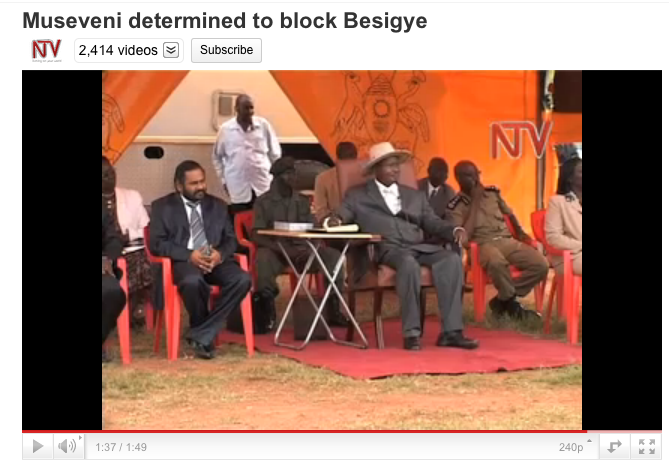
First on the list is Yoweri Museveni of Uganda. Mr. Museveni has been in power since 1986 and is pretty much convinced that he is God’s gift to Uganda has just won another 5-year term in office. The picture below is a screen shot from a recent tour of an area of Kampala to launch a cooperative society.

More Village Chief than President

Notice the state and size of the presidential “red carpet.” Also, everyone but the president has to make do with plastic chairs. This picture, in many ways, is a metaphor for most African societies. In many countries only the “Big Man” gets to sit on the “carpet” while everyone else has to languish in the dust, including elites around the president.

This state of affairs creates perverse incentives that are inimical to economic growth. If I am an elite – even one who is close to the president – why should I invest in creating a carpet of my own if I know that the president will take it away? The result is poverty and material want that extends to the heart of power and elite-dom.

In a way EVEN the political elite in Uganda are poor. They may have some wealth stashed abroad but their realized standard of living within Uganda is not elite. If they get sick they have to fly to Kenya, South Africa [who’s elites have done slightly better at local accumulation] or further afield for treatment. Oftentimes even their 4X4 vehicles get stuck on the non-existent roads that they have refused to build and maintain. A mastery of the art of surviving [living day by day] is not restricted to the hoi polloi. Even the elite lack the requisite stability to escape the surviving mentality, even though they may not necessarily be surviving materially.

This is the reality for most of the Continent.

Next time, something on the false largesse of the likes of the late Omar Bongo Ondimba (the very short guy in the middle of the crowd in this video)

quick hits

Ugandan walk to work protests continue, despite the arrest of key opposition leaders.

Mutiny spreads in Burkina Faso. Compraore has been in power since 1987 after he ousted Thomas Sankara.

Benin’s Yayi Boni might have stole his way into a second term. I hope he is not planning on extending the presidential term limit in Benin.

economic hardship in uganda

Strongman Yoweri Museveni might be nearing the end of the road. For 25 years he has ruled Uganda as the country recovered from Idi Amin’s disastrous rule and a brutal civil war. To add to the stability brought about by his regime, Uganda has also been one of the fastest growing in Africa since the mid 1990s.

But recent inflationary pressures on the prices of fuel and other essential commodities are increasing pressure on the strongman. The last two days have seen running battles in Kampala and Gulu, with at least two reported dead. Opposition leader Kizza Besigye was reportedly shot in the hand by a rubber bullet on Thursday.

Museveni’s game plan in reaction to all this still remains unclear. Whatever the eventual strategy, it is gonna be hard to keep the rallies against his regime bloodless if the people keep coming out to protest. Most people tend to forget that Museveni has never really stopped being a military ruler.

History shows that the most frequent way through which military rulers are ousted, at least on the continent, is through coups.

Those who enter power by the gun also tend to exit by the gun.

Overall, African autocrats with the longest tenures include: Obiang’ of Equatorial Guinea (32 years); Edwardo dos Santos of Angola (32); Biya of Cameroon (29); Compraore of Burkina Faso (25); Mswati of Lesotho (25); Museveni of Uganda (25).

Other autocrats fast approaching the league of lifetime rulers include Omar al-Bashir of (Northern) Sudan, Meles Zenawi of Ethiopia, Yahya Jammeh of The Gambia (who is planning on crowning himself King), Idris Deby of Chad, and Paul Kagame of Rwanda.

Africa needs zuma (to have a coherent foreign policy)

This week the Economist rightly called out South African president Jacob Zuma on his country’s lack of a coherent foreign policy. South Africa was reborn in 1994 with the moral authority and international goodwill to be Africa’s shining light in the world. Instead, under Mbeki and now Zuma, the country has squandered all that away.

Mbeki did it with his intransigence against reason on the issue of HIV/AIDS and support of Robert Mugabe in Zimbabwe. Mr. Zuma is doing the same with his support for Mugabe and equivocal pronouncements against other murderous tyrants on the Continent. Since his election he has not spoken strongly against any injustices or electoral fraud on the Continent; this task has been left to Ian Khama, president of tiny but relatively prosperous Botswana.

Sub-Saharan Africa is desperately in need of a regional hegemon to help it chart a coherent path in global politics. Latin America has Brazil. South Asia has India. East Asia has China. Even Europe has Germany. In Africa, Nigeria (pop. 150+m), South Africa (~40m, biggest economy), Ethiopia (85m) and the Democratic Republic of Congo (~70m) – all potential regional leaders – have woefully underperformed.

Nigeria is Nigeria. Ethiopia is dirt poor and needs to clean its own mess, Somalia’s and Eritrea’s, before it can venture further afield. The DRC is struggling to keep itself afloat. South Africa, by far, has the capacity and the requisite soft power to take up the job of regional guiding light. The country is slated to become a BRIC country soon, making the BRICS (Brazil, Russia, India, China and South Africa).

It is a shame that Mr. Zuma has chosen to abdicate his role as the Continental leader. He alone, among the members of the Continent’s club of kleptocratic autocrats (a.k.a AU), has the clout to stand up to the evils we continue to see in Cote d’Ivoire, Darfur, Zimbabwe and elsewhere.

conflating inept autocracy with independent mindedness

Col. Gaddafi has been having an independent foreign policy and, of course, also independent internal policies. I am not able to understand the position of Western countries, which appear to resent independent-minded leaders and seem to prefer puppets. Puppets are not good for any country. Most of the countries that have transitioned from Third World to First World status since 1945 have had independent-minded leaders: South Korea (Park Chung-hee), Singapore (Lee Kuan Yew), China People’s Republic (Mao Tse Tung, Chou Enlai, Deng Xiaoping, Marshal Yang Shangkun, Li Peng, Jiang Zemin, Hu Jing Tao, etc), Malaysia (Dr. Mahthir Mohamad), Brazil (Lula Da Silva), Iran (the Ayatollahs), etc.

Between the First World War and the Second World War, the Soviet Union transitioned into an Industrial country propelled by the dictatorial, but independent-minded Joseph Stalin. In Africa, we have benefited from a number of independent-minded leaders: Col. Nasser of Egypt, Mwalimu Nyerere of Tanzania, Samora Machel of Mozambique, etc.  That is how Southern Africa was liberated. That is how we got rid of Idi Amin. The stopping of genocide in Rwanda and the overthrow of Mobutu, etc., were as a result of efforts of independent-minded African leaders. Gaddafi, whatever his faults, is a true nationalist.  I prefer nationalists to puppets of foreign interests. Where have the puppets caused the transformation of countries? I need some assistance with information on this from those who are familiar with puppetry. Therefore, the independent-minded Gaddafi had some positive contribution to Libya, I believe, as well as Africa and the Third World. I will take one little example. At the time we were fighting the criminal dictatorships here in Uganda, we had a problem arising of a complication caused by our failure to capture enough guns at Kabamba on the February 6, 1981. Gaddafi gave us a small consignment of 96 rifles, 100 anti-tank mines, etc., that was very useful. He did not consult Washington or Moscow before he did this. This was good for Libya, for Africa and for the Middle East. We should also remember as part of that independent-mindedness he expelled British and American military bases from Libya, etc.

That is Yoweri Museveni, President of Uganda, talking about Col. Gaddafi. More on this here.

My thoughts on this: Dictators have no internal affairs (HT Han Han). I will forever be skeptical of autocrats screaming “sovereignty.” Oftentimes it is when they are jailing, exiling, killing and dispossessing dissidents left, right and centre that they will shout loudest about the principle of non-interference.

How different would Uganda be today minus economic aid and any form of interference from the West? Let’s not pretend that it is Western interference that has stunted African economic, social and political development. Achebe was right. The trouble with Africa is simply and squarely a problem of leadership. For every Lula, Lee Kwan Yew or even Stalin, Africa has had Mobutu, Museveni and Mugabe. Where the former had controversial (and sometimes despicably murderous) but well thought out and ideologically driven plans for transforming their societies, African leaders have more often than not willingly mortgaged away their country’s futures while engaging in ideologically bankrupt and crass tribal politics.

African resources have created billionaires elsewhere while African masses  starved. African leaders signed off on most of these deals in exchange for kickbacks. The African tragedy over the last 50 years is just that. An African tragedy. Foreigners only played a supporting role.

At a meta-level I sympathize with Museveni. It is the nature of the international system that the strong prey on the weak. But where I disagree with him is how to deal with this fact. He wants the strong to benevolently keep off and condone his mediocrity. I prefer the continued pressure from the strong so that even states like Uganda can develop capacities to stand up to the strong, both economically and militarily.

It is a pipe dream to continue nurturing and protecting mediocre leadership all over Africa while expecting the strong nations of the world to benevolently keep off. China, India, Brazil, Russia and the usual suspects from the West will continue preying on Africa as long as clowns like Kabila, Mugabe, Gbagbo and the thieves in Abuja are in charge. Let’s not kid ourselves. What would stop Europe from re-colonizing Africa if Brussels and Washington signed off on the idea? And if Russia and China joined in, would they defend Africans or access to African resources?

I am glad that the threat of regime change is alive and well. Perhaps it will wake up the inept kleptocrats all over Africa from their 50-year stupor.

sovereign hypocrisy and the icc: exposing african impunity

UPDATE:

Keating at FP reacts to the UN resolution against Gaddafi.

In 2000 Stephen Krasner, a renowned academic and member of my department, published a book that outed the “organized hypocrisy” that is state sovereignty. The book noted that leaders of states want to stay in power and have violated or allowed their own sovereignty to be violated numerous times as long it suited them. We should therefore be wary of any leaders that go nationalistic and invoke sovereignty. The Chinese and Russians have done it to protect domestic human rights abuses. The US has done it to protect its leadership and generals from prosecutions for crimes committed during foreign military campaigns. The genocidal president of Sudan, Omar al-Bashir, has done it. The mullahs of Iran keep crowing about it.

Presently, the Kenyan government is doing the same to protect members of the political class that are suspected of having organized the murder of over 1300 and displacement of hundreds of thousands in 2007-08. Six prominent Kenyans, including two of the president’s closest allies, are expected to stand trial for crimes against humanity at the ICC. The African Union, a bastion of kleptocracy, impunity and ineptitude, has come out in strong support of Kenya’s efforts to have the trial of the six deferred, or even dismissed by the UN Security Council.

A section of the African media, including prominent academics and people of repute, have also come out against the ICC. They contend that it has mainly concentrated on trying African strongmen. Some say it is a racist and neo-colonial institution. Many have demanded that the ICC stay out of Africa’s business.

I say this is all horse manure.

The ICC is not perfect. Some of the drudge that has been thrown at it sticks. But that said, it represents a voice for the hundreds of millions of voiceless Africans who for half a century have been virtual serfs to their political elite. Charles Taylor, Idris Deby, Daniel Moi, Mobutu Sese Seko, Emperor Bokassa, Robert Mugabe, Francois Bozize, among many others, have for far too long used “sovereignty” to loot, rape and pillage. They have used their own people as pawns in a dangerous game of sovereign rent extraction. They have over-taxed farmers through marketing boards. They have siphoned away foreign aid intended to build schools and hospitals into Swiss banks. Worst of all, whenever it suited them, they have started wars that killed millions.

Robert Mugabe is starving, jailing, exiling and killing Zimbabweans. Kenya’s Moi engineered “ethnic clashes” in 1992 and 1997 that killed thousands. Charles Taylor fanned the flames of a brutal war in Sierra Leone. Omar al-Bashir continues to kill Sudanese, in the north, in Darfur and in border areas with the south. Mobutu destabilized the east and south east of his country, leading to the 1997 Congo civil war, the deadliest conflict since WWII. Over 5 million died.

If this is what it means for African states to be sovereign, then count me out. To be frank, 50 years of African independence has left Africans with not much to be proud of. Disease, abject poverty, conflict, and all sorts of maladies continue to define the region. This while most of Latin America, Asia and the Middle East, other regions that have been comparably poor, have sped off toward economic development and political stability.

Before 1945 war made states. States fought to best each other in classical Darwinian fashion. The UN has since taken that off the table. In most parts of the world peaceful competition has replaced war. Brazil competes for jobs, markets and resources with other BRICs. But in Africa, competition is still lacking. What you have instead is collusion among inept dictators. The African Union exists to protect the likes of Robert Mugabe and Omar al-Bashir.

In my view, the ICC represents a much needed international threat to an inept and murderous African leadership.

I reiterate. The ICC is not perfect. But I am perfectly willing to hold my nose and support it in its attempts to end impunity on the African continent. Idris Deby, Theodore Obiang’, Paul Biya, and their ilk should know that it is no longer acceptable that they live like gods while deliberately confining millions of their own citizens to 16th century levels of poverty and incessant conflict.
museveni is on the ropes

With 72 cabinet ministers Uganda reeks of instability. Leonardo Arriola, a Political Scientist at Berkeley, has made argued that African presidents create bloated cabinets to buy off opponents when they feel insecure in power. Uganda’s Museveni might be doing just that. In office since 1986, Mr. Museveni just won another 5-year term in office with 68% of the vote, or so the Ugandan electoral commission would like us to believe.

The opposition parallel vote tallying system was sabotaged by security forces in cahoots with cell phone companies (these companies should be fined in other countries in which they operate…). The main challenger, Mr. Kizza Besigye, claims that the last count he got showed Museveni at 50.8% with him second at 42.5%. The final official tally gave Mr. Museveni a landslide win of more than 40 points.

It is now quite possible that a majority of Ugandans do not want Museveni in power. Given his long tenure and the recent terror events that could have boosted him with a “rally around the flag” effect, his poor performance at the polls should be cause for concern for stability in Uganda. Too bad he will soon have oil money to create even bigger cabinets and buy more tanks and anti-riot gear, if he so wishes.

Ugandans may have to wait for quite a while before they experience their first ever peaceful transfer of power.

museveni wins another term, Gaddafi using African mercenaries

Long-term Ugandan President, Yoweri Museveni, in on course to a comfortable win in the country’s general election. With over 70% of the votes counted Mr. Museveni leads his closest rival, Besigye, with over 40%. President Museveni, ruler of Uganda since 1986, started off as a different kind of African president, presiding over a decade of sustained growth, drastic reduction in HIV infection rates and general peace and stability. But he stayed for too long. Beginning in the mid-1990s Uganda transitioned – under intense domestic and international pressure – from a “no-party democracy” [whatever that means] to a multiparty electoral system in which Museveni allowed for opposition at the margins.

The new dispensation created pressures for greater levels of patronage in order for Museveni to stay in power. He scrapped constitutionally mandated term limits, created a cabinet of over 70 ministers and went crazy with what Ugandans call “districtization” – the act of creating new local government jurisdictions purely for patronage purposes. Uganda’s new found oil reserves will certainly continue to fund the long-term autocrat’s stranglehold on Ugandan politics. Rumors abound that he intends to install his son and head of the presidential guard as his successor.

In other news, Col. Gaddafi is reported to be using African mercenaries to quell rebellion in the east of Libya. For decades Gaddafi has been a Guevara wanna-be, funding armed rebellions all over the Continent (Including the infamous Charles Taylor of Liberia). He seems to have done all that in the hope that the rebels he funded would come to his aid, like is happening now. But the presidents/rebel leaders who have sent soldiers to kill Libyans demanding for their natural rights should be aware that it is precisely such acts that have landed Jean-Pierre Bemba at the Hague.

Afro-American relations and Justice

FP Magazine reports:

In short, all the carrots that U.S. diplomats are offering the Sudanese president seem to be working. Among the prizes for Khartoum are a U.S. promise to remove Sudan from its list of terrorism-supporting states and a possible visit by U.S. Secretary of State Hillary Clinton, according to the Sudan Tribune. Earlier this month, U.S. State Department officials also signaled that they would be ready to begin normalization following Sudan’s acceptance of the vote.

While the US approach has yielded good results in securing the secession referendum in the South, American policy in the wider region leaves a lot to be desired. Washington appears to be ready to cut a deal with any dictator, as long as they serve a short-term US need.

America needs to do more on Darfur. America needs to do more in Ethiopia, where Meles Zenawi continues to reign with an iron fist without any pretense of respecting human rights. America needs to do more in Uganda, where Museveni has emerged as an anti-terror crusader who does not care for any liberal (in the classical sense) ideals.

The choice between protecting American interests abroad and respecting the rights of other peoples of the world is a false choice. Liberty (the world over) is not incompatible with American security. The ideals embodied in the federalist papers, the American declaration of independence, and the first amendment of the US constitution should not be confined within the US borders as far as American policy goes.

ushering in the new year

Happy new year to all readers.

2011 will be a crucial year for a few countries on the Continent. On January 9th Southern Sudan will vote for secession, creating the newest state in the world. The aftermath of that might be all out war with North Sudan (over borders and oil) and/or civil war in the south (ethnically motivated warfare over control of the new state). That is what most analysts predict. I think there is a glimmer of hope for peace due to heavy Kenyan investment in the south and the desire to build, link and orient the new nation towards the East African Community. Watch this space as it all unfolds.

Uganda will hold elections on February 18th. Yoweri Museveni will win big and dig in even more now that Uganda has oil in the west of the country. Also bolstering Mr. Museveni’s hold on power will be the LRA’s delusional insurgency in the north of the country and the continuing war on terror in the horn of Africa – Uganda’s troops form the core of the African Union (AU) forces in Somalia. Mr. Museveni has been in power since 1986.

The other major election will be in Nigeria, the continental behemoth in the west. President Goodluck Jonathan is favored to win, but his victory will most certainly be tainted with chaos and irregularities.

Other countries holding elections in the new year are Central African Republic, Benin, Madagascar, Cape Verde, Chad, Djibouti, Niger and Liberia.

Electoralism remains largely dysfunctional and inconsequential in Africa because of a myriad of structural impediments (poverty, weak institutions, monarchical presidentialism, etc). In the recent past events in Kenya, Zimbabwe and Cote d’Ivoire have shown how far the Continent is from being a liberal democratic paradise (may be democracy is not for everyone at all times?). 2011’s elections will no doubt fail to buck the trend.

grenade attack on uganda-bound bus in nairobi

The Nation reports that unknown people threw grenades into a Kampala Coach bus in Nairobi’s River Road district. At least three people have been confirmed dead killed. More on this here.

more from wikileaks

The Guardian reports:

The oil giant Shell claimed it had inserted staff into all the main ministries of the Nigerian government, giving it access to politicians’ every move in the oil-rich Niger Delta, according to a leaked US diplomatic cable.

Nice. Friedman was right. Firm’s only social responsibility should be to make profits. Forget about the population and the destroyed lives.

Also,

US diplomats fear that Kenya could erupt in violence worse than that experienced after the election in 2008 unless rampant government corruption is tackled.

America asked Uganda to let it know if its army intended to commit war crimes based on US intelligence – but did not try to prevent war crimes taking place.

Washington’s ambassador to the troubled African state of Eritrea described its president, Isaias Afwerki, as a cruel “unhinged dictator” whose regime was “one bullet away from implosion”.

Still (im)patiently waiting for the stuff on the Kenyan elections in 2007.

And lastly,

Apparently based on a conversation with Johnnie Carson, the US assistant secretary of state for African affairs, it said: “China is a very aggressive and pernicious economic competitor with no morals. China is not in Africa for altruistic reasons. China is in Africa for China primarily.”

Yeah right. Because the US involvement in Africa since the 1960s has been any different. At least the Chinese do not bother to be janus-faced about it [ok, that is a little too harsh, but you get my point].

africa in the news

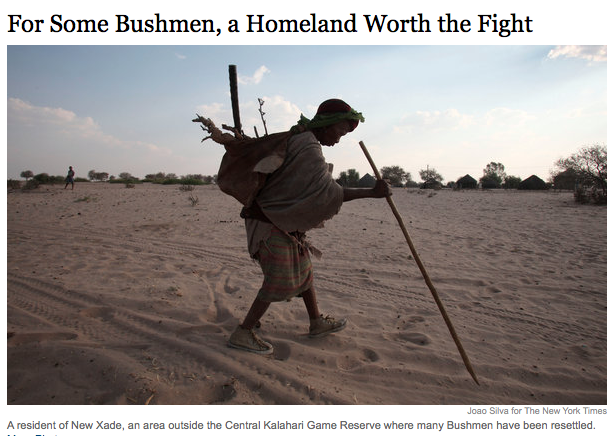
Forget about the elections in Tanzania or the Ivory Coast. What matters for the American audience as far as news from Africa go are human interest stories such as this one which made it to the front page of the New York Times.

I echo the point of the Times piece. It really sucks being a hunter-gatherer in Botswana. And by extension, it really sucks being a citizen of Chad, Niger, Uganda or any one of the 40 other countries that make up sub-Saharan Africa. Despite the “good news” (see earlier post below) things are really bad on the Continent.

Africa deserves all the bad press it gets. Period. The only problem is that Africans have not been able to participate effectively in the discourse on their continent or attempted to contextualize the bad press. The continent long lost the game of framing the narrative.

catch me if you can: of presidents and genocide

Those who conceive of justice as an end in itself must be livid. The last several days have seen one appeasement after another of heads of state who may have or have committed heinous crimes against their people. First there was the Kenyan invitation and failure to arrest suspected genocidaire Omar al-Bashir of Sudan. Then came the leaked UN report accusing Kagame’s men of committing crimes against humanity, and possibly genocide, in eastern Congo that did not stop regional presidents from attending the increasingly autocratic Kagame’s inauguration after his sham reelection. The damning report even forced the UN Secretary General to fly to Kigali in order to reassure Mr. Kagame and express his regret over the leaking of the report (I wonder if Mr. Kagame reminded Mr. Ki-moon about his peacekeepers’ abysmal failure to protect civilians from sexual violence in eastern Congo).

While appreciating the complexity of the respective cases (which have serious implications for regional security and stability), the recent events related to Messrs Bashir and Kagame may serve to  create a dangerous precedent. The whole point of the ICC was to make heads of state and other people in power think twice before going Pol Pot on their people. This objective will not be served if leaders realize that not even genocide can get in the way of regional and global geopolitical considerations.

In other news, as usual, Texas in Africa has interesting posts on the Congo. Check them out.