Petro-Politics in East Africa

Is LAPSSET under threat? May be.

The Economist reports:

The Lamu pipeline makes the most economic sense for all involved. But failure to work together may doom it. National and personal interests trump regional co-operation and commercial logic. In Uganda Mr Museveni is keen to settle his legacy as the champion of a strong nation, building vast refineries and spiting the tiresome Kenyans. South Sudan is fixated on warding off the north at the expense—it seems—of almost everything else. Ethiopia sees a chance to steal Kenya’s thunder, too. “It’s every guy for himself,” says an oil executive wryly. “And I thought the private sector is rough.” Pipeline politics makes a mockery of the East African Community, a bloc dedicated to regional co-operation. All but one of the countries are members or aspire to join.

Of late, a new momentum behind the oil push is being felt. The Ugandan government is in final production talks with three oil companies. Executives from Tullow, Total and the China National Offshore Oil Corporation (better known as CNOOC), as well as local civil servants, conferred with Mr Museveni at his farm near the Rwandan border in late April. In June South Sudan will finish a feasibility study for the Ethiopian pipeline to Djibouti, after which it has said it will make a decision on export routes. “Everything is up in the air,” says a diplomat. Kenyan and Ethiopian officials, as well as oil-company representatives, have been scurrying to Juba to make their case. Pagan Amun, who leads South Sudan’s talks with the north, is said to be keen to ditch the Lamu pipeline.

My guess is that Nairobi, for historical reasons, will prevail in Juba. Plus Juba and Addis are not the best of buddies, despite recent warm relations. Mengistu was a key ally and supplier of SPLM before he was overthrown by Meles and his army. The departure of Meles may have made things a little better. Time will tell. Uganda will most likely construct a mini-refinery as it is not integral to the implementation of LAPSSET.

US Africa Policy, A Response

This is a guest post by friend of the blog Matthew Kustenbauder responding to a previous post.

On the question of human rights guiding America’s foreign policy in Africa, I agree with you; it shouldn’t be the first priority. The US needs a more pragmatic development diplomacy strategy, which would help African countries develop just as it would help American businesses thrive.

But I disagree with your characterization of Hillary’s position in this respect. Here’s Secretary Clinton’s own words:
“Last year I laid out America’s economic statecraft agenda in a series of speeches in Washington, Hong Kong, San Francisco, and New York. Since then, we’ve accelerated the process of updating our foreign policy priorities to take economics more into account. And that includes emphasizing the Asia Pacific region and elevating economics in relations with other regions, like in Latin America, for example, the destination for 40 percent of U.S. exports. We have ratified free trade agreements with Colombia and Panama. We are welcoming more of our neighbours, including Canada and Mexico, into the Trans-Pacific Partnership process. And we think it’s imperative that we continue to build an economic relationship that covers the entire hemisphere for the future.” 
“Africa is home to seven of the world’s ten fastest-growing economies. People are often surprised when I say that, but it’s true. And we are approaching Africa as a continent of opportunity and a place for growth, not just a site of endless conflict and crisis. All over the world, we are turning to economic solutions for strategic challenges; for example, using new financial tools to squeeze Iran’s nuclear program. And we’re stepping up commercial diplomacy, what I like to call jobs diplomacy, to boost U.S. exports, open new markets, lower the playing field – level the playing field for our businesses. And we’re building the diplomatic capacity to execute this agenda so that our diplomats are out there every single day promoting our economic agenda.” 

One of the problems, however, is that the pragmatic approach articulated by the Secretary doesn’t trickle down through the bureaucracy. This is especially true, ironically, of the State Department’s primary development diplomacy arm, USAID, which has a deeply entrenched culture of being anti-business. It’s a huge problem, and part of the reason why American foreign policy in Africa has been so slow to adjust to new economic realities.

Security drives US Africa Policy

Security drives US Africa Policy

Academics schooled in all the latest development orthodoxies but lacking the most basic understanding of economic or business history have flocked to USAID, so that the suggestion that American economic interests should guide development policy – making it a win-win for Africa and America – is anathema. It’s also why the Chinese are running all over the US in Africa.

As a prominent economic historian recently remarked in the Telegraph, “While we [Western governments] indulge our Victorian urge to give alms to the Africans, Beijing is pumping black gold.” And this is just it. As long as the US approaches Africa as a beggar needing to be saved and not as a business partner worthy of attention, both sides will continue to lose out.

In this respect, what Africa does not need is another “old Africa hand” steeped in conventional development ideas and old dogmas about what’s wrong with Africa and why the US must atone for the West’s sins. For this reason alone, John Kerry – not Susan Rice – probably stands a better chance, as the next Secretary of State, at putting American foreign policy toward Africa on a more solid footing.

– Matthew Kustenbauder is a PhD candidate in history at Harvard University.

What Obama’s re-election means for US Africa Policy

On the 14th of June this year President Obama outlined his policy for Sub-Saharan Africa. Included in the policy statement were four key strategic objectives: (1) strengthen democratic institutions; (2) spur economic growth, trade, and investment; (3) advance peace and security; and (4) promote opportunity and development.

In my view, of the four aspirational goals the one that will receive the most attention in the near future will be the third (especially security).

US strategic security interests in Africa mainly involve two key concerns: (1) China’s growing economic presence in the region and (2) the spread of Al-Qaeda linked groups in the region, stretching from Somalia to Mauritania (This is why Mali featured more prominently than the EU in the Presidential foreign policy debate). Before talking about China, here are my thoughts on the US campaign against  al-Qaeda in Africa.

While I don’t foresee any success in the creation of an African base for AFRICOM, the US will continue to cooperate with AU member states in fighting Islamist extremism in the region. The “successful” AU mission in Somalia could provide a blueprint for future operations against potential terror groups. The biggest lesson from Somalia is that the US cannot just pick one nation (in this case Ethiopia) to fight its wars in the region, and that a collaborative effort with the blessing of the regional umbrella organization (the AU) and others such as IGAD can deliver results.

Having helped (both directly and indirectly) in the ouster of Al-Shabaab from strategic locations in Somalia, the next big task will be dealing with the mushrooming Islamist extremism in the Sahel (especially in northern Mali but also in Niger and Nigeria).

The problem of extremism in the Sahel is further compounded by the link of some of the groups to the drug trade flowing from Latin America and into Europe. There is significant evidence that drug money has financed the activities of separatist groups in northern Mali. The fight against these groups will necessarily involve dealing with this crucial source of finance. This means that for the operation to succeed the US will have to engage in capacity building and the strengthening (and clean-up) of security institutions (especially the armies) in states like Guinea, Guinea-Bissau, South Africa, Kenya, among others, in which officials in the security sector have been implicated in the drug trade.

The Sahelian challenge might yet prove more formidable than Somalia. The latter case had relatively stable neighbors that served to contain the anarchy. The Sahel (Sahelistan, if you will) is much larger and includes some of the least governed spaces on the planet.

On China, the US (and for that matter, the rest of the West) has to change its present approach of total freak-out overt suspicion over Chinese involvement in Africa. Africans need protection from China only as much as they need protection from the West. China is not out to “exploit” Africa any more than the West has. Nobody should expect China to engage Africa more benevolently than the West did for the better part of the last 60 years (Mobutu and Bokassa were not that different from Bashir and Mugabe).

A constructive approach ought to include policies designed to strengthen African states so that they can engage China on their own terms. It is ultimately African leaders who mortgage their resources and sovereignty to China (or the West). Instead of focusing too much on China, a better approach might be one that creates strong regional organizations (like the SADC or the EAC) that can improve the bargaining power of African states.

The other policy objectives outlined by Obama appear to fall in the business-as-usual category. Democracy promotion will not yield much in the face of other more pressing priorities (notice how security has triumphed over democracy in Mali). And unless the US is willing to get involved in massive infrastructure projects like China has (last time I checked they were in 35 African states), I don’t see how it can help spur economic growth in the region (AGOA was great, but Africa needs something better). Plus the US continues to be hampered in its development-promotion efforts by its aversion to state industrial policy. It’s about time Foggy Bottom realized that it is really hard to have a thriving private sector and American-style free enterprise in places with bad roads, very few (and bad) schools, and governments that are run by personalist dictators. In these instances some corruption-laden developmental state policies may be the best way to go.

Meles Zenawi, Prime Minister of Ethiopia, is dead at 57

The BBC reports:

Ethiopian Prime Minister Meles Zenawi has died at the age of 57, state media say, after weeks of illness. A government spokesman said Mr Meles had died in a hospital abroad – but did not say exactly where or give details of his ailment. Speculation about his health mounted when he missed an African Union summit in Addis Ababa last month.

Mr. Zenawi is believed to have died in a Belgian hospital – the Saint-Luc University Hospital in Brussels (where he was allegedly receiving treatment for an acute case of hematologic cancer). The last time he was seen in public was on the 19th of June 2012 at the G20 summit in Mexico.

For now the leadership transition in Ethiopia, Sub-Saharan Africa’s second most populous country, appears to have gone smoothly. According to the BBC report, the deputy Premier – Hailemariam Desalegn – will take over.

Mr. Desalegn is from the south of Ethiopia, away from the political centre of gravity of the country, which for centuries has been to the north – in Tigray and Amhara dominated areas.  

It is not yet clear if the smooth transition will stick. As the Economist reported a couple of weeks ago:

“power [in Ethiopia] has still rested with a clutch of Mr Meles’s comrades from his home area of Tigray in northern Ethiopia, many of them once members of a Marxist-Leninist group that used to admire Albania’s long-serving Communist leader, the late Enver Hoxha. This hard core, including the army’s chief of staff, General Samora Younis, retains a “paranoid and secretive leadership style”, according to a former American ambassador to Ethiopia, David Shinn. Were Mr Meles to leave in a hurry, relations between the young modernisers and the powerful old guard might fray.”

Under Mr. Zenawi (May 1991- Aug. 2012) Ethiopia was a mixed bag. His rule was characterized by one of the worst human rights records in the world. But he also brought some semblance of stability following the misguided and murderous Marxist-Leninist dictatorship of the Derg under Mengistu Haile Mariam; and presided over an economy with one of the fastest growth rates on the Continent.

It is also under Meles Zenawi that Ethiopia invaded Somalia to rid it of the Islamic Courts Union (ICU) which was beginning to spread Somalia’s chaos into Ethiopia’s Ogaden region (it helped that the U.S. also wanted the ICU ousted from Mogadishu because of their alleged links of al-Qaeda).

A recent profile in the Atlantic summarizes it all:

“for every Muammar Qaddafi there’s a Meles Zenawi, the shrewd, technocratic Prime Minister of Ethiopia. Inside of the country, he’s known for imprisoning his political opponents, withholding development assistance from restive areas, stealing elections, and cracking down on civil society NGOs. In the rest of the world, he’s often praised for his impressive economic record, though not for his human rights. Zenawi has attracted Western support by being a responsible steward of aid money, a security partner in a rough region, and a G20 summit invitee.”

I remain cautiously optimistic that the Ethiopian ruling elite will pull through the rocky transition period. The next elections are due in 2015. In the current parliament the ruling party, the EPRDF, and its allies control nearly all of the 547 seats.

Beyond Ethiopia’s borders, the absence of Mr. Zenawi will certainly be felt in Somalia (which is presently struggling to get on its feet after decades of total anarchy and whose government partly depends on Ethiopian troops for security) and South Sudan (where Addis Ababa has been a broker in past conflicts between Khartoum and Juba). Ethiopia’s hostile relationship with Eritrea might also experience some change, most likely for the worse as whichever faction emerges victorious in Addis engages in sabre rattling in an attempt to prove their hold on power.

Energy in East Africa

Still on my ongoing project on commodities in Africa, I came across an interesting piece on prospecting for oil in East Africa in which an industry expert had this to say:

The success rate in this region is outstanding. To provide some context, oil and gas exploration typically has a success rate just 10-20%. That’s terrible when you think about. It can cost $50 million to sink an offshore well, and the chance of making a financial return could be as low as one in ten.

But East Coast African energy exploration stands out from the crowd because in all but a few cases they hit oil or gas. To be exact — the success rate has been 87%. A strike rate of close to 9 out of 10 is almost unheard of.

Kenya, South Sudan and Uganda have commercially viable oil reserves. Tanzania has gas and, together with Kenya, has stepped up offshore prospecting in the Indian ocean.

And it is not just foreign MNCs that are in on the game. Locals, in collaboration with foreign investors, are also getting a piece of the energy bonanza in East Africa. Business Daily, a Kenyan paper, recently profiled one George Kariithi, a businessman who started off as a marketing executive and has since built multiple companies in the wider region. His latest investment is in Kenya’s emerging coal sector.

Reason for African Petro-Rulers to be Worried

Africa’s petrorulers (heads of state of Angola, Cameroon, Chad, Congo-Brazzaville, Equatorial Guinea, Gabon, Ghana, Nigeria, South Sudan, and Sudan) may be headed for tough times later this year. According to a piece by (Steve Levine) over at FP, Saudi Arabia – the world’s leading oil producer – is considering flooding the global oil markets with the aim of sticking it to the Russians and Iranians. Saudi action of this nature could lower prices to as low as US $40 a barrel from the current $83.27.

With the exception of Ghana and Cameroon, such a drop in oil prices would almost certainly lead to political unrest in the rest of Africa’s oil producers. Sudan and South Sudan are already facing huge revenue shortfalls due to a dispute over the sharing of oil revenue.

More on “The Coming Oil Crash” here.

On the unintended consequences of the Sachs-Kristoff syndrome

Badvocacy alert!

[youtube.com/watch?feature=player_embedded&v=Y4MnpzG5Sqc]

With due apologies to the eminent economist and journalist.

Invisible Children’s Kony 2012 publicity push is generating some backlash. Here is quoting Under the Banyan:

Critics of the Invisible Children campaign say that while it is well-intentioned and while Kony deserves international condemnation, there are questions about the organisation’s methods, money and support for military action that need to be answered. Others are revulsed (sic) by the idea of foreigners thinking they can solve an entrenched and complex problem with goodwill alone.

More on this here. And for those interested in the complexity of the issue click here.

I am still learning to block out all the misguided interventions by the members do-gooder industrial complex of our time. Sometimes I wish I could wave a magic wand and make the tenants of State Houses across the Continent to also ignore the prophets of this axis of distraction-from-the-real-problems.

Also, I only discovered Invisible Children after the latest brouhaha but it turns out that Blattman was already in their case three years ago.

H/T A View from the Cave.

Tough trying to be good in a bad neighborhood

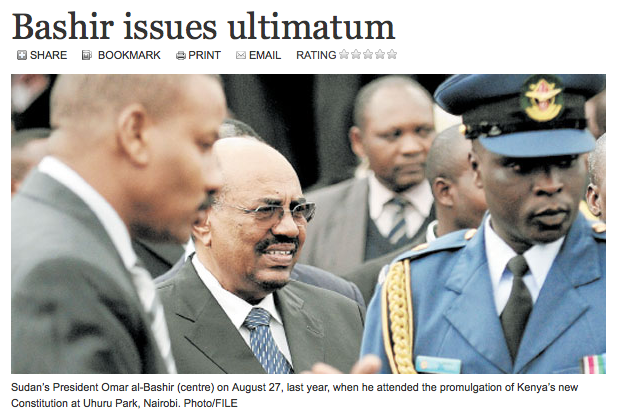
A few days ago a Kenyan judge ordered the government to arrest Sudanese President Omar al-Bashir if he ever sets foot in Kenya. Mr. Bashir has an outstanding arrest warrant against him from the ICC for crimes against humanity committed since 2003 in Darfur.

The ruling has since metastasized into a full blown diplomatic row; Khartoum expelled the Kenyan ambassador before rescinding the expulsion, and is now threatening to cut all trade ties with Kenya, expel Kenyans living in Sudan and deny any planes leaving or going to Kenya from flying in its airspace – if the government does not take back the ruling in two weeks.

The diplomatic row aside, the case has implications for the reform process in Kenya. The case is a test of the depth of the Kenyan judiciary’s new found independence from the executive.

According to Khartoum:

“al-Bashir expects Nairobi to scrap the arrest warrant within the next two weeks and not simply file an appeal.”

That is not how the judicial process works in a democracy. The executive cannot just scrap a judicial ruling. Within Kenya, for the sake of precedence the government must be seen to be complying with court rulings. The Chief Justice has already warned the executive against ignoring the court ruling saying that

“If a country chooses to live by anarchy, it must be ready to face the consequences of disregarding the law.”

It remains unclear what the executive will do given Khartoum’s two week ultimatum. Disregarding the court ruling will come with consequences for the individuals involved – in particular the Foreign Minister and the Commissioner of Police.

Kenyan Court Orders Bashir Arrest, Sudan Expels Kenyan Ambassador

UPDATE:

The BBC reports:

Sudan ordered the expulsion of the Kenyan ambassador after a Kenyan judge issued an arrest warrant for Sudan’s President Omar al-Bashir, Sudan’s foreign ministry has said.

Mr Bashir is wanted by the International Criminal Court (ICC) for alleged war crimes in Darfur.

Sudan has ordered the Kenyan ambassador to leave the country within 72 hours.

It has also ordered the Sudanese ambassador in Kenya to return to Khartoum.

*************************************************************

A Kenyan court has issued an arrest warrant for Sudan’s President Omar al-Bashir over alleged war crimes in Darfur.

The ruling came after Kenya allowed Mr Bashir to visit in August in defiance of an International Criminal Court (ICC) warrant for his arrest.

The judge said he should be arrested if he “ever set foot in Kenya” again, the AFP news agency reports.

Kenya is a signatory to the treaty which established the ICC in 2002.

The new Kenyan constitution requires that the government implements its international treaty obligations. The ruling, though without much bite – I doubt Bashir will need to be in Kenya any time soon, has immense symbolism in the region.

It also matters for Kenyan domestic politics. Presently, a few high ranking Kenyan politicians – including the Finance minister, two former ministers and former police boss – are on trial at the ICC for crimes against humanity. The accused await judgment on the admissibility of their cases later this year or early next. The Bashir ruling means that if the charges against the “Ocampo Six” are confirmed but the government drags its feet in implementing an arrest warrant then the courts will step in.

More on the Bashir case here and here.

In other news, Uganda and Tanzania have rejected Khartoum’s petition to join the East African Community, citing “several issues like their democracy, the way they treat women and their religious politics.” Yeah right.

We finally have a winner for the Mo Ibrahim Prize

UPDATE: Check out the Mo Ibrahim Index of Governance here. The usually suspects – Botswana, Cape Verde and Mauritius –  lead the pack.

*************************************************

The BBC reports:

Former Cape Verde President Pedro Verona Pires has been awarded this year’s $5m (£3.2m) Mo Ibrahim prize for good governance in Africa.

The prize committee said Mr Pires, who stepped down in August, had helped make the archipelago off the West African coast a “model of democracy, stability and increased prosperity”.

The prize is supposed to be awarded each year to a democratically elected leader who has voluntarily left office.

There has been no winner for two years. The committee said there had been no suitable candidate.

The $5m award, given over 10 years followed by $200,000 a year for life, is the world’s most valuable individual prize. The previous winners are Botswana’s President Festus Mogae and Mozambique’s Joaquim Chissano.

In case you are wondering why African incumbents – including Cameroon’s Paul Biya and Senegal’s Wade – do not find the world’s most valuable individual prize worth their time check out an earlier post in which I attempted to calculate the opportunity cost of accepting the award. Notice that my calculation did not factor in the probability of not winning the prize even after stepping down or that of winding up at the Hague or dead.

The prize is a nice carrot and is part of a larger and highly commendable, I should add, attempt at an ideational change on what it means to be a good president. But it almost naively assumes that the only reason autocrats stay in power beyond their “use by” date is for the money.

If that were the case Gbagbo and Gaddafi would surely have done the right thing.

If I were on the committee I would ask Mo to consider channeling some of the money from years without winners to countries with promise – to help facilitate institutional reforms – all in an attempt to make the environment safe for the incumbent and his cronies in case he chooses to step down.

More on Eritrea and armed groups in eastern Africa

While Eritrea has in the past been repeatedly accused of supporting Somalia’s Islamist militia Al Shabaab, a charge it strenuously denies, the current report catalogues Afewerki’s growing notoriety in the world of terrorism finance, and in particular the global web through which these funds are routed, with Kenya serving as a global transaction distribution hub.

The report details the country’s activities in funding the terror group, following the money trail from its citizens in the diaspora in Europe and North America, through Dubai and the Eritrean embassy in Nairobi, and into the hands of Al Shabaab, all the while concealed in convoluted and opaque informal financial networks.

That is The East African reporting on Eritrea’s support for armed groups in the wider eastern African region. Mr. Afewerki’s actions are a threat to regional security for the following reasons:

1. Eritrea’s (opportunistic and cynically instrumental) use of Islam as a galvanizing force (against “Christian” Ethiopia) threatens to ignite a wider regional conflict that would probably include North Sudan and Egypt. The reason this is likely is because:

       (a) Remember that the use of the waters of the Nile continues to be a source of friction between Egypt and the riparian states of eastern Africa. Egypt itself has in the past been linked to armed groups in Somalia opposed to Ethiopian rule of the Ogaden region. Both countries have a history of funding rival clan militias in Somalia. In all of this the principle of my enemies’ enemies’ are my friends will most likely apply.

        (b) Because of its own problems with South Sudan, North Sudan might have an interest in using Eritrea’s networks to destabilize its southern neighbor. Recently the government of South Sudan banned all people of Somali origin from entering the country by land for security reasons. Juba clearly suspects either direct or indirect links between Khartoum and the myriad armed groups in war-torn Somalia

2. Given that the groups it supports (e.g. al-Shabaab) have other enemies besides Ethiopia, President Afewerki has effectively declared war on countries like Uganda, Burundi, South Sudan and Kenya that have also either been attacked or threatened by al-Shabaab. I wouldn’t be surprised if one or two of these EAC states decided to materially support the Ethiopian side the next time Addis and Asmara fight over their barren disputed border lands.

The EAC needs a defense pact

UPDATE: The Government of South Sudan has barred people of Somali origin from entering the country by road for “security reasons.” This wrongheaded move has created an awkward situation since not all people of Somali origin are from Somalia. In Kenya, for instance, a good chunk of the long haul transport sector is run by Kenyans of Somali origin.

********************************************************

The Ugandan government recently went on a $1 billion shopping spree for six fighter jets. The deal, which almost broke the bank, made a significant dent on Uganda’s forex reserves. Many, while acknowledging the risks that might have motivated the purchase, have questioned the wisdom of spending that much money on six jets.

For those not in the know, the key motivation for Museveni’s purchase was a desire to project military power in the region for two key reasons:

Firstly, in order to create a market for Ugandan light industries – cooking oil, soap, etc – Kampala has had to project military power to help in the pacification of pockets of eastern DRC and northern Uganda/South Sudan. These markets are crucial because they create jobs in Uganda, allowing Museveni some room as he continues to preside over Uganda’s decline into a dysfunctional police state.

The second reason was Museveni’s desire for military grandeur in the region. Kigali and Khartoum are not in the best of terms with Kampala. Museveni is probably suspicious of a potential Odinga presidency in Kenya. For these reasons, the Ugandan military establishment – the real rulers of Uganda – might have wanted to ensure that non of their neighbors are in a position to bully them in the near future.

While most of Museveni’s militarism is inspired by a mentality from a bygone era, I find Kampala’s fears against Khartoum as legitimate grounds for a regional defense pact. It is an open secret that Khartoum will try as much as it can to destabilize the new government of South Sudan (and by extension the wider region). And they have a few options:

  • They can foment civil war within South Sudan – there are a lot of disgruntled armed bands within South Sudan who might decide to take their chances with Khartoum; Remember that even Riek Machar, the current vice president of South Sudan, formed a Khartoum-backed splinter group (SPLA-Nasir) that fought Garang’ back in the early 1990s.
  • They can use armed groups in the wider central African region – including Kony’s LRA and the plethora of roving bandits in eastern DRC to engineer insecurity in South Sudan. Khartoum has used the LRA against SPLM in the past.
  • They can invade in an all out war. This option is the riskiest because of its potential to generate international opprobrium. But remember that Ethiopia and its secessionist former province Eritrea fought a bloody war that generated nothing but “stern” warnings from the UN and the wider international community. The US even armed Ethiopia because it needed Addis Ababa to fight its war in Somalia.
  • Lastly, they can use non-conventional tactics. Terrorism is slowly growing in the wider east African region. So far Eritrea has been the biggest state sponsor of terror in the region – mostly aimed at Ethiopia in the Ogaden, Oromo land and Somalia. The involvement of Ugandan and Burundian troops in Somalia has created even more enemies for these groups. There is no reason to believe that Khartoum would not use these same groups to destabilize South Sudan, if for nothing then as a survival tactic for a beleaguered Bashir administration that will forever be blamed for having lost the South’s oil.

Needless to say, an unstable South Sudan is bad for the region. Period.

The proliferation of small arms is already a major problem in the areas bordering the Ilemi triangle and eastern Uganda. That instead of sticks pastoralists have to roam around with AK-47’s says it all. More conflict in South Sudan will only make a really bad situation even worse. The potential for proxy wars within the region would also be an unnecessary drain on limited resources. Because of various interests in Juba, an aggression by Khartoum against South Sudan will definitely be met with reaction in one form or another from Kenya, Ethiopia and Uganda.The conflict will definitely be regionalized. Lastly, Eritrea’s bad habit of supporting terrorists should not be permitted to catch on. Khartoum must know that if it tries this dirty tactic it will be met by more than just resolutions from the AU, IGAD or the UN.

Which is why I think that the EAC should have a robust defense pact. War should have to be a last resort. But that does not mean that the East African Community should not prepare for such an eventuality, if it arise.

That way, no single country will be burdened with the task of buying all the necessary hardware needed to keep Khartoum deterred.

Such a plan would face significant challenges, of course – key among them the fact that the region’s armies are non-professionalized. A functional defense pact would require near total civilian control of the army. Only Kenya and Tanzania come close to this in the EAC. Rwanda, South Sudan and Uganda are dominated by their respective armies. Burundi can’t even win against rebels within its territory and remains a militarized tin pot dictatorship. And Ethiopia, if it were to join, is still dominated by the remnants of the rebellion that ousted Mengistu.

These challenges aside, it might be worth a try. Such a pact might even help professionalize and de-politicize the officer corp in the region’s armed forces.

And the biggest winner if this were to happen is MORE regional trade.

Briefing from Malabo

The club of African autocrats African Union has its biannual summit in Malabo, Equatorial Guinea this week (This guy is the current AU Chairman, no joke).

The struggling AU has a lot on its plate at the moment (subject of an upcoming blog post). It is in the middle of trying to put out new fires in Sudan and Libya, while ignoring/recovering from the humiliation of its failures in Somalia, Cote d’Ivoire, and Zimbabwe – not to mention the region’s other problems.

All this while insisting on “African Solutions to African Problems,” despite the organization’s infamous reputation for incompetence.

Top on the agenda at the summit has been the ongoing hostilities (Obama might disagree) in Libya. According to the Oman Daily Observer, the AU has come up with a plan that

“envisages a ceasefire, humanitarian aid, a transition period, reforms towards democracy and elections, but the position on the future of Gaddafi has not been made clear.”

In other words the heads of state in Malabo, led by their Chairman Obiang, are hoping to do a Zimbabwe: Have Gaddafi in charge of the same reform process that is supposed to phase out his 42-year rule. I need not elaborate how this story ends.

No ICC hearings in Kenya

The ICC Pre-Trial Chamber Judge Ekaterina Trendafilova on Wednesday decided that the trial of suspects of the 2007-08 election violence in Kenya will not be held in the country.

Great move.

I am of the view that holding the hearings in Kenya would have created an unnecessary distraction from the important task of implementing Kenya’s new constitution. Already, the bigwigs accused of masterminding the violence that killed 1300 and displaced over 300,000 Kenyans have ethnicized their predicament. Holding the hearings in Kenya would have handed them an opportunity for a circus of ethnicity-charged rallies and demonstrations in Nairobi.

The ICC continues to be a source of debate in Kenya and across Africa. Many have faulted the court’s apparent bias against African leaders. Some have even called it a form of neocolonialism. While admitting that the court could use a little bit more tact [principally by acknowledging that it cannot be apolitical BECAUSE it is an international court SANS a world government] I still think that it is the best hope of ending impunity on the African continent – at least until African leaders internalize the fact that it is not cool to kill your own people.

Among the cases that should have been handled with a sensitivity to political realities include Sudan and Libya [and may be the LRA in Uganda]. Kenya’s Ocampo Six, the DRC’s Jean-Pierre Bemba and Cote d’Ivoire’s Laurent Gbagbo, on the other hand, should not raise questions of national sovereignty. Murderous dictators and their henchmen do not have internal affairs. In any case sovereignty for many an African country means nothing more than sovereignty for the president and his cronies.

Related posts here and here.

Graphical Illustration of China’s global reach

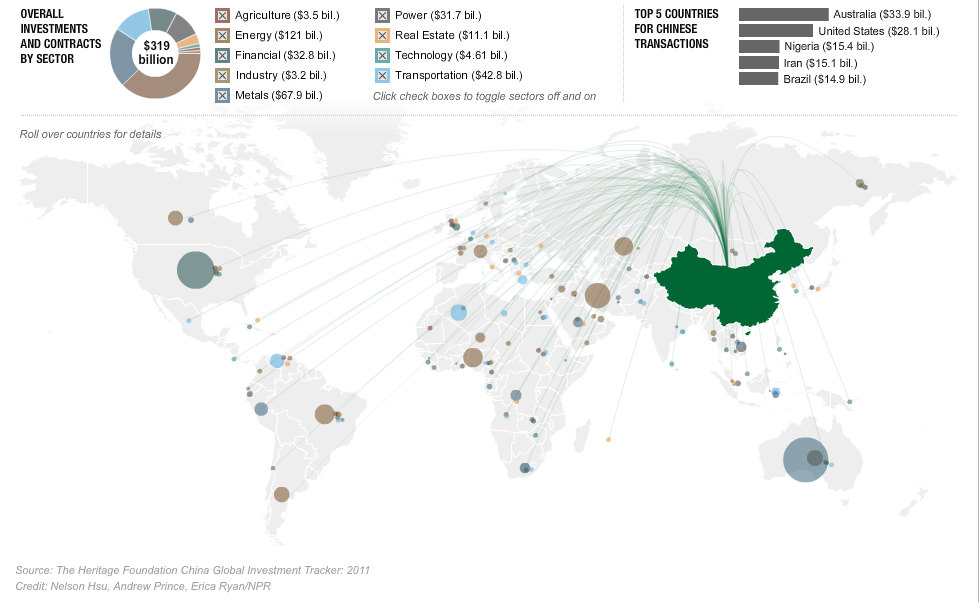
NPR has this cool graphic on China’s global investments [click on image to enlarge].

Notice that Nigeria is among the top destinations of Chinese investments.

In my alternate universe Abuja (the undisputed regional hegemon) is stable and uses this, and the fact that it is also among the most important sources of US-bound crude oil, as leverage to nudge the two biggest global powers in the direction of a more stable and coherent Africa policy.

More on this here.