Thoughts on Devolution in Kenya

As Grossman and Lewis show in this paper, a lot of decentralization efforts in the developing world have not resulted in greater capacity or control of policy by the devolved units. But there are exceptions, like in Kenya where since early last year 47 subnational units (Counties) have come into existence with a constitutionally mandated (at least 15%) sharing of ordinary revenue between Nairobi and the counties. In the 2014/5 financial year about 32.4% of the most recently audited ordinary revenues (2011/12) will go to the Counties. The revenue sharing is governed by a strict formula (with population, geographic size, and poverty rate weights) in order to limit the discretionary powers of officials at Treasury.  More crucially, the County heads – a governor and a County Assembly – are directly elected, not appointed as is the case in most of the instances of “fake decentralization” noted by Grossman and Lewis.

ImageThe quote above from the governor of Mandera County in the northeast of Kenya sums the potential impact of Kenya’s brand of devolution.

Yes, in the interim there will be massive corruption, insufficient absorption, weak capacity for implementation and the like.

ImageBut the important point is that Kenya’s new government structure has 47 capitals handling billions of shillings each year. If all else fails, the system will at least create strong politically autonomous regional elites with sufficient power to check Nairobi. And that is a fantastic thing. Already a few governors (including Nairobi, Machakos and Bomet) have broken ranks with their sponsoring parties, evidence that the interests of the national parties and County governments will not always be aligned. And if the last two fiscal years are any indication, the political pressure on the national government to overshoot the 15% minimum requirement will continue to hold. Those perceived to be enemies of devolution will be punished at the polls.

The new system also has another plus: Kenya now has 47 training centres for the job of chief executive. Governors who do well – like the Governor of Machakos – will become very strong contenders for State House in the not so distant future (Also more work for me to study inter-governmental political careers!!)

My biggest concern about the new devolved system of government is its potential impact on the coercive capacity of the Kenyan state (recently the state has been at sixes and sevens in response to rising insecurity and sporadic terror attacks). If there was ever Kenyan exceptionalism in Africa it was on account of its post-colonial inheritance of a strong state. Since for political reasons security cannot be devolved (latent centrifugal tendencies still exist at the periphery), the centre must still guarantee security of life and property. My hope is that the ongoing restructuring of the Provincial Administration will not be as large a swing as to completely gut a system (reviled or not) that helped hold the country together over the last 50 years.

What’s African about unalloyed misogyny?

The just passed marriage bill is unambiguously the most offensive idea to come out of the 11th Parliament yet. According to the BBC:

MP Samuel Chepkong’a, who proposed the amendment, said that when a woman got married under customary law, she understood that the marriage was open to polygamy, so no consultation was necessary, Kenya’s Daily Nation newspaper reports.

Mohammed Junet, an MP representing a constituency from the western Nyanza province, agreed.

“When you marry an African woman, she must know the second one is on the way and a third wife… this is Africa,”

This is Grade A horse manure.

President Kenyatta should veto this bill. And the group of Kenyan MPs who think that disempowering women is a smart idea are advised to watch the video below of President Kibaki at a press conference ostensibly to confirm to Kenyans that he has ONLY ONE WIFE, following rumors to the contrary [More here].

Also, Mr. Kenyatta should require that before he assents to the bill it must expressly forbid dabbling in both civil and “customary” marriages because the resultant legal arbitrage only benefits men. SOMEONE TELL ME, WHY DO WE NEED A DUAL SYSTEM ANYWAY??? A woman entering a civil marriage should have the guarantee that it will always remain so, with stiff penalties for men who violate the contract. The provisions for Muslims have always been clear and should remain so.

[youtube.com/watch?v=wSlTW8mjirs&eurl=http://www.nation.co.ke/oped/Opinion/-/440808/541450/-/441cmq/-/index.html]

And just for good measure, they should also hear what Chimanda has to say about gender relations:

[youtube.com/watch?v=hg3umXU_qWc]

More on the unbelievably sophomoric debate on this matter in the National Assembly here.

Mapping Nairobi’s Informal Transit System

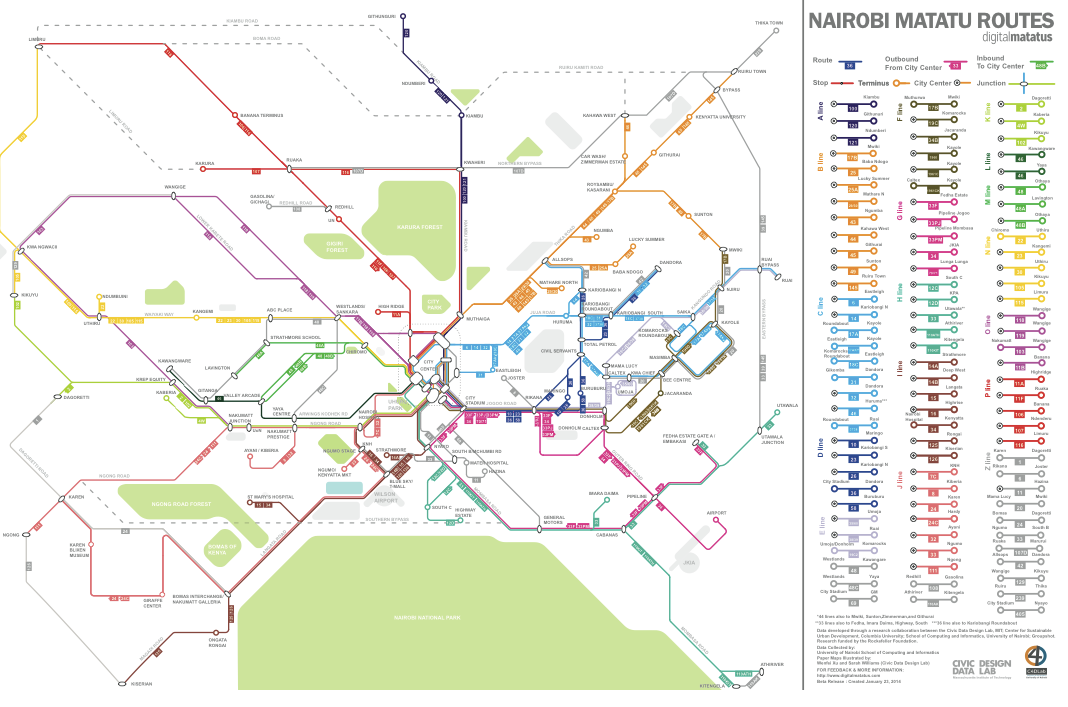
Researchers and students at the University of Nairobi, the Center for Sustainable Urban Development at Columbia University, and the Civic Data Design Lab at MIT produced the map below – and the underlying data behind it – after carrying cell phones and GPS devices along every route in the network. Result? There is order to Nairobi’s seemingly chaotic matatu industry.

Pretty cool stuff. 

Image

 More here.

H/T Amanda R.

Understanding Uganda’s Military Adventurism Under Museveni

On January 15th 2014 President Yoweri Museveni finally admitted that Uganda People’s Defence Force troops are engaging in combat operations within South Sudan. Right after the political fallout in Juba and escalation of hostilities between forces loyal to President Salva Kiir and those behind his former deputy Riek Machar, Mr. Museveni threatened Machar with military action if he did not come to the table to negotiate with Kiir. Museveni’s military involvement in the conflict has caused concern in Nairobi and other capitals in the region. For one, Uganda’s military intervention in the conflict may yet jeopardize the ceasefire agreement that was signed on January 23, 2014 in Addis Ababa. The regional body IGAD (Intergovernmental Authority on Development) is supposed to be a neutral arbiter and monitor in the conflict. Museveni’s clear leanings towards the government in Juba may bring to question IGAD’s neutrality in the mediation effort.

For historical reasons (see below) Khartoum fears Kampala’s military involvement in South Sudan. But this time the situation is slightly different, and a little more complex. Bashir has already shown his hand in support of Juba against Machar, possibly for two reasons: (i) Khartoum needs Juba’s help in weakening the rebellion by the rump SPLA (SPLA-North) that is still active in Blue Nile and South Kordofan, regions that border South Sudan; and (ii) Bashir needs to keep the oil flowing in order to ward off internal turmoil within Sudan due to rapidly deteriorating economic conditions (see here). Kiir’s willingness to throw SPLA-N under the bus comes as no surprise since it is an offshoot of the “Garang Boys” (mostly PhDs) who occupied a special place, unlike Kiir and others, in John Garang’s SPLA. SPLM-N’s leader Malik Aggar, shared Garang’s vision of one united reformed Sudan, as opposed to secession by the South. At the same time, however, Khartoum does not want a super strong South Sudan free of rebels. Total cessation of conflict in South Sudan would rob Khartoum of proxies to keep Juba in check. Uganda’s involvement could tip the balance in Juba’s favor vis-à-vis potential Bashir allies.

Meanwhile in Nairobi and Addis Ababa concern is growing over Uganda’s claim that the IGAD should foot the bill of UPDF’s adventures in South Sudan. Both Ethiopia and Kenya prefer settling the conflict at the negotiating table, partly because both have their security forces stretched by domestic armed groups and bandits and the war in Somalia. Kenya has said categorically that it will not send troops to South Sudan, even under IGAD. The wariness in Nairobi and Addis to send troops or cash for a military cause in South Sudan contrasts sharply with Kampala’s choice of military action from the moment the current flare up started in Juba. This despite the fact that Uganda also has troops serving in Somalia.

Which raises the question: What explains Uganda’s international military adventurism under Museveni? The answer lies in the confluence of history, international geopolitics, and Uganda’s internal politics.

Uganda is one of the more militarized states in Africa, with the military having direct representation in parliament (10 seats). It is also interventionist, with a history of combat engagement and support for rebel groups in six neighboring states – Burundi, the Central African Republic (CAR), the Democratic Republic of Congo (DRC), Rwanda, Somalia, and South Sudan. More recently, the nation has been a key advocate for greater integration within the East African Community (EAC). Indeed, Ugandan President Yoweri Museveni fancies himself as a possible head of an EAC political federation should it ever materialize. Uganda is also a key player in the African Capacity for Immediate Response to Crises (ACIRC), a proposed standby force with capacity to rapidly deploy troops to trouble spots in Africa (other key supporters include South Africa, Chad, and Tanzania).

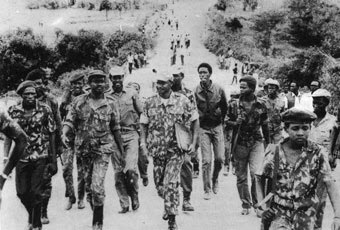
Museveni and his kagogo (little) soldiers

Museveni and his kadogo (little) soldiers

President Yoweri Museveni’s military adventurism and internationalist outlook have deep roots. As a young student in Tanzania, Museveni was involved in exile organizations opposed to Iddi Amin. Indeed, Museveni’s National Resistance Army (NRA), started off as the Popular Resistance Army (PRA) in Tanzania (As testament to its Tanzanian roots, NRA borrowed the idea of political commissars from the Tanzanian military to educate civilians in “liberated” Luweero Triangle). In Tanzania and even after returning to Uganda Museveni made regional connections that he maintained even after he ascended to power in 1986 – including Rwanda’s Paul Kagame, Sudan’s John Garang’, and leaders of Mozambique’s FRELIMO. Before rebelling against Kigali, Kagame was Museveni’s Chief of Military Intelligence. Museveni supported Garang’s Sudan People’s Liberation Army (SPLA).

Once in power, Museveni styled himself as the guarantor of peace and stability in Uganda. Many (both at home and abroad) evaluated his performance relative to the disastrous years under Amin and the ensuing civil war. The resulting peace dividend (albeit restricted to the south of the country) was marked by relative macro-economic stability, with growth averaging about 6% for much of the 1990s. This made Museveni a darling of Western donors and international financial institutions. However, Museveni’s record with regard to democracy and human rights remained dubious. This put him in awkward position vis-à-vis the West, especially since the 1990s was the zenith of Western promotion of liberal democracy.

To this Museveni reacted cleverly, and worked hard to position Uganda as a strategic player in the wider region’s geopolitics. In order to maintain his international stature and secure his position domestically, Museveni labored to bolster Uganda’s relevance to the West.

Museveni enters Kampala (Source)

Museveni enters Kampala (Source)

Beginning in the early 1990s, Uganda got militarily involved in a number of neighboring states. Support for Garang’s SPLA drew the ire of Khartoum, which in turn supported the Lord’s Resistance Army (LRA) in northern Uganda. Subsequently, the Ugandan military conducted raids against LRA bases in Sudan while also offering combat assistance to the SPLA. For instance, the 1997 battle at Yei featured Ugandan soldiers alongside the SPLA against the Sudan Armed Forces (SAF). It is around this time that the seed was planted for future military involvement abroad at the turn of the century (this time in Somalia under the Western-funded AU mission, AMISOM, to help stabilize the country). After US President Bill Clinton designated Sudan as a state sponsor of terror, Uganda positioned itself as an ally in the frontline of “Global War on Terror.” Kampala served as an intermediary for US aid to SPLA, thereby further strengthening US-Uganda military ties. It is telling that in 2003 Uganda was among only a handful of African states that supported the US-led Iraq War. About 20,000 Ugandans worked in US military bases in Iraq (this was also an excellent job creation tool; and a way of earning Forex).

So far Uganda’s most complex military adventure was in the Democratic Republic of Congo (DRC). A mix of strategic geopolitical positioning, the need to secure markets for Ugandan goods, private greed and domestic politics drove Uganda’s invasion of the DRC. The first Congo War (1996-97) was swift, aimed at helping Laurent Kabila oust Mobutu Seseseko (Rwanda and Angola also helped). Soon after Uganda and Rwanda fell out with Kabila, occasioning the Second Congo war (1998-2003), which involved four other African states. It is then that the façade of intervention for regional stability completely broke down. Ugandan and Rwandan commanders exploited existing and new cross-border smuggling and semi-legitimate trade networks to orchestrate massive pillaging of natural resources in eastern DRC (Competition between the two militaries later intensified, resulting in the “Kisangani Wars.”)

For instance, in the year 2000 despite only producing 0.00441 tonnes of gold, Uganda exported 11 tonnes. A UN report indicates that well-connected generals (including Museveni’s half-brother) created entities headquartered in Kampala to facilitate the illicit trade. It’s important to note that Museveni’s tolerance of the semi-autonomous activities by his generals was strategic (it generated revenue through Kampala-based entities and kept the generals happy) and did not lead to fracturing within the military. Indeed, many of those involved were later promoted.

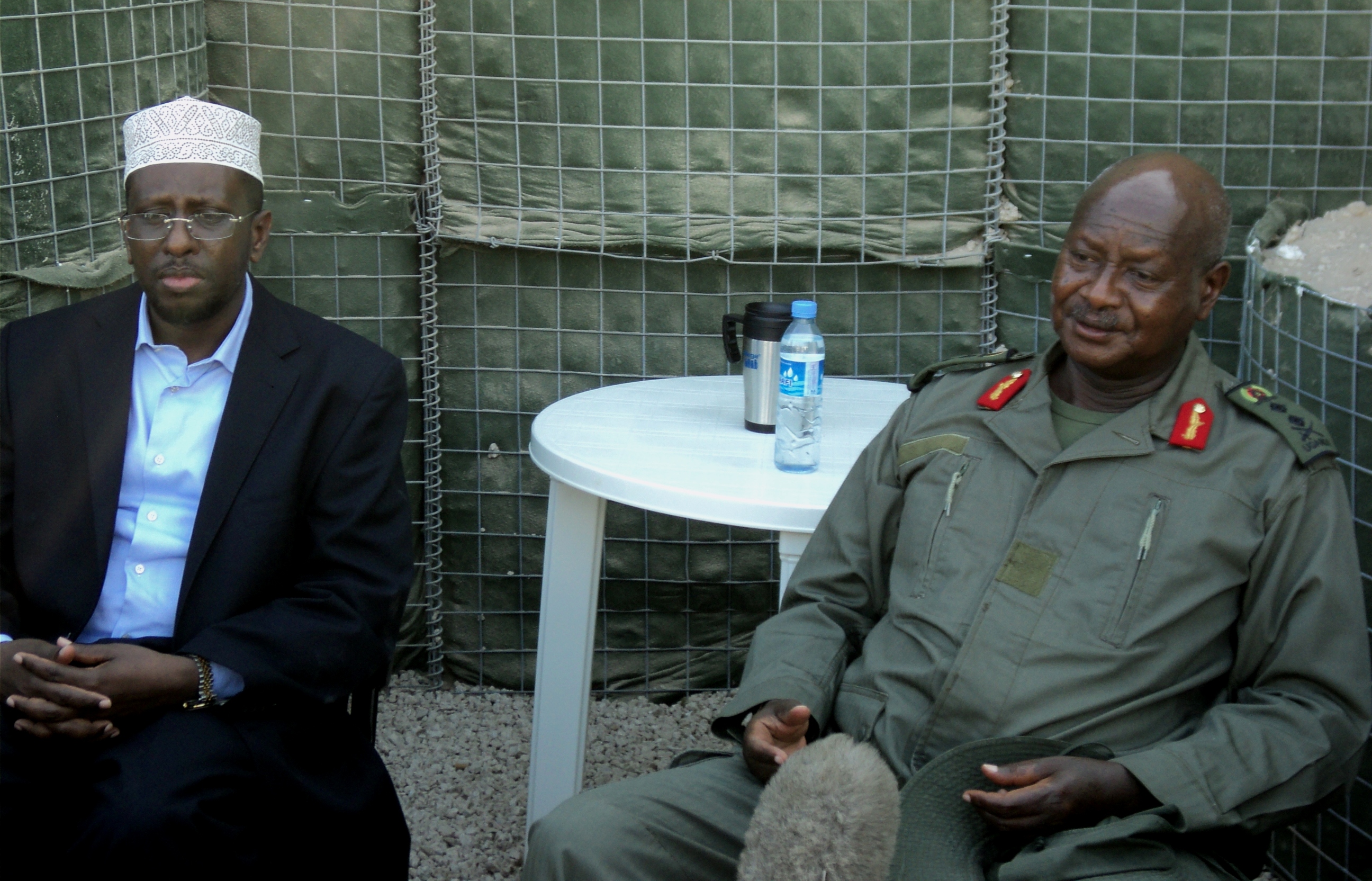
Museveni meets Somali President, Shayk Sharif Ahmed in Mogadishu in 2010


Incidentally, the present involvement in South Sudan also reflects the multifaceted logic of Ugandan international military adventurism. Historical alliances with the SPLA against the LRA and SAF make Kampala and Juba natural bedfellows. But the intervention is also about securing markets for Ugandan goods. According to figures from the Bank of Uganda, in 2012 the country’s exports to South Sudan totaled an estimated USD 1.3 billion. About 150,000 Ugandan traders operate across the border, not to mention countless more primary producers in agriculture who benefit from cross-border trade with their northern neighbor.

The above account explains Museveni’s efforts in the recent past to build an image as the regional powerbroker: heading peace talks between the DRC, Rwanda and eastern DRC rebels; intervening in Somalia to prop up the government in Mogadishu; and in the latest episode siding militarily with President Salva Kiir in South Sudan’s domestic political cum military conflict. Domestically, Museveni’s grip on power is as strong as ever. Recent reshuffles in the military removed powerful Historicals (the original “bush war heroes”) thereby leaving Museveni (and his son) firmly in control of Uganda’s armed forces. There is no end in sight for Uganda’s international military adventurism.

In many ways Uganda’s international adventurism has been a case of agency in tight corners. The country is a landlocked; has neighbors with sparsely governed borderlands that provide rear-bases for Ugandan armed groups; and Kampala needs Western aid to maintain the regime, a situation that necessitates acts of geopolitical positioning – especially with regard to the “Global War on Terror” and maintenance of regional peace and stability. Furthermore, oil discovery along the conflict-prone DRC border on Lake Albert and the need for pipelines to the sea to export Ugandan oil will necessitate even greater regional involvement. So while Uganda’s present outward adventurism is primarily because of Museveni’s peculiar personal history, it is correct to say that even after Museveni (still far into the future) the country will continue to be forced to look beyond its borders for economic opportunities, security, and regional stature.

“Only four shooters at Kenya mall (Westgate) and they may have escaped alive, says NYPD”

On Tuesday morning the NYPD issued a damning statement [full report here] that pointed fingers at the Kenyan government for its handling of the terrorist attack at the Westgate Mall in September. Dozens of people were killed in the attack.

According to the statement:

  • Despite conflicting reports from the Kenyan government, “evidence suggests that there were only four attackers, who may have escaped alive.”
  • The commander of the police tactical team that went to quell the siege was most likely killed by the KDF. “The police department tactical team entered the mall at 3 p.m., without police markings or identifications, and were fired on by Kenyan soldiers, killing the commander of the unit.”
  • The security team “had no idea what the mall looked like internally, and didn’t know they could access the closed circuit television system.”
  • The NYDP “didn’t know what had caused the mall to collapse,” but it is likely that “the Kenyan military may have used rocket-propelled grenades and anti-tank missiles on the building, and that heat from fires caused by the explosions may have weakened the poorly built structure.”
  • And lastly, “the Kenyan military may not have killed any of the attackers, there was “significant” physical and video evidence that they had looted the mall.”

[UPDATE: A reader, @ZiadFazel, just reminded me of the KTN documentary in October that questioned the official line about the attack. Back then the government dismissed the documentary as inaccurate and alarmist and even threatened to arrest KTN journalists. This new statement from the NYPD adds credibility to the evidence previously dismissed by the government]

Westgate is not just an indictment of the KDF (a force that has and continues to sacrifice a lot for regular Kenyans in the north east and in Somalia) but of the entire security apparatus in Kenya. For the longest time Kenyan civilian administrations have obsessed with issues of coup-proofing, maintenance of public order and the suppression of dissent over actual provision of security.* Urban crime, banditry in the north and pockets of rural areas even in the more governed south and latterly the threat of terrorism have exposed the underbelly of the Kenyan security system.

President Uhuru Kenyatta praised the KDF and the police following the botched operation at Westgate. Was this an attempt to boost the morale of the boys or was he simply continuing the tradition of appeasement with the aim of keeping the army in the barracks and the paramilitary GSU and police ever ready to “restore order” whenever necessary?

Whatever the case, it may be that President Kenyatta and his administration have found themselves in an unfamiliar territory. Kenya’s much touted bureaucratic-executive state may have worked well against internal dissent, but can it effectively deal with current security threats? Civilian control over the security apparatus demands for accountability and performance; and whenever there is failure, an attempt at correction. Is the Kenyan system capable of sustaining a civilian-military relationship that is responsive to the public and based on performance and accountability?

Kenyans were told many tales following that tragic Saturday afternoon in September and the ensuing four day siege. But the more Secretary Ole Lenku spoke of “exploding mattresses” the more questions emerged. The NYPD report is yet another reminder that the security system failed Kenyans, and that the civilian administration was unable to stand up to those responsible and demand for accountability.

*Read E. S. Atieno-Odhiambo’s chapter on “Democracy and the Ideology of Order in Kenya” and Tamarkin’s “The Roots of Political Stability in Kenya.”

Ethiopia’s Gibe Dam Threatens Kenya’s Lake Turkana, and Why the Kenyan Government Doesn’t Care

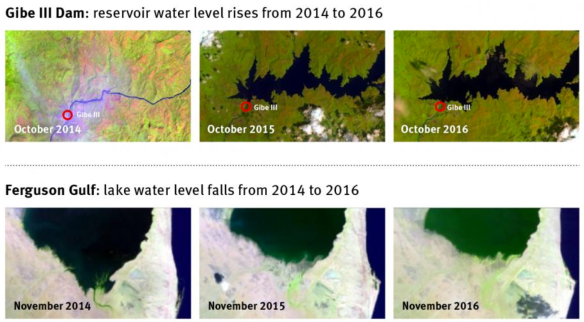
Six hundred miles upstream from the northern tip of Lake Turkana in Kenya, the Ethiopian Gibe III dam is nearing completion. According to Africa Confidential the dam will produce 1860 MW, making it the biggest hydro-electric power plant in Africa.

No doubt the developmental impact of the Gibe projects will be huge. Despite doubling Ethiopia’s 2007 installed power generation capacity, the project will bring more than 150,000 hectares (about 580 sq. miles) of land under irrigation (this will be more than the total acreage under irrigation in the whole of Kenya as of 2011). In addition, the boost in power generation capacity will feed into the East African Power Pool, thus helping alleviate power problems in Kenya and beyond.

But will the benefits of the Gibe projects outweigh the potential human cost, especially considering externalities that will spread beyond Ethiopia’s borders?

screen-shot-2017-02-14-at-11-04-21-pmAccording to Sean Avery, the Omo-Gibe project intends to divert as much as 32% of the Omo River’s waters for irrigation and other uses upstream. But the Omo River is the main inlet of Lake Turkana, Kenya’s largest by area (Kenya owns the smallest bit of Lake Victoria) and Africa’s fourth largest lake.

Lake Turkana gets as much as 90% of its inflow from the Omo River.

In a new Oxford study, Avery notes that one of the planned Ethiopian irrigations schemes alone, the Kuraz Sugar Scheme, will gobble as much as 28% of Omo inflows into Lake Turkana at 70% efficiency and a whopping 40% if the project inefficiently uses water! The same study notes that construction of Gibe III may lower the water volume in Lake Turkana by as much as 41-58% (or an average drop in lake level of 22 metres) over a period of time. This will have a significant impact on the Lake’s salinity (being the biggest desert lake in the world) and suitability of its water for human consumption and agriculture. To put this in perspective, the average depth in the lake is 30 metres. Without proper water management upstream Lake Turkana faces hydrological collapse akin to what happened to the Aral sea or what is happening to Lake Chad.

These findings have been echoed in this Human Rights Watch report.

Screen Shot 2017-02-14 at 11.06.32 PM.pngAt this juncture you may ask, why isn’t the Kenyan government up in arms over the Gibe projects?

Well, the simple answer is that a confluence of factors have made it such that Nairobi does not have an incentive to care about the 170,000 odd people that will be adversely affected by a decline in water volume and economic viability of Lake Turkana. Three of these factors stand out.

  1. Turkana, being largely rural, sparsely populated, poor, and with a low literacy rate, does not make a fertile ground for pressure groups to form. Complaints over the potential impact of Gibe III have mostly come from academics and international NGOs that, lacking political salience, are very easy to ignore. Historical low voter turnout in the region also does not help matters. This has made it easy for the government to pretty much ignore the region over the years. Residents of Turkana often talk of “going to Kenya” whenever they venture into the southern regions of the country.
  2. A more important reason than the one above is perhaps that Gibe III will provide power to the Kenyan grid. Kenya’s Vision 2030 development plan includes a raft of projects that will require increased generation capacity in the next couple of decades that the country will surely not meet. Gibe III will be a much needed plug in the expected energy capacity gap. Notice that most of the projects will benefit the more politically powerful pockets of the Kenyan electorate to the south of the country, most of whom have never and will probably never hear of the human impact of Gibe III in Turkana unless it leads to something catastrophic enough to attract national media attention.

    Image

    Source: Gado, Daily Nation

  3. Oil. Oil. Oil! As if things could not get worse for residents to the north of Turkana county, commercially viable deposits of oil have been discovered to the south of the county. It goes without saying that moving forward most of the economic focus will be in that part of the county, at the expense of most other economic activities (and Turkana residents’ most pressing needs, see image) – including fisheries on Lake Turkana.

Admittedly, the fault here lies not with Addis Ababa. Ethiopia had to do what it had to do to meet its development needs. The fault is Nairobi’s for not having the foresight to strike a workable “Coasian bargain” with Addis on an arrangement that would be less harmful to residents of Turkana. This post has attempted to sketch some of the reasons why this is the case.

In an ideal world Nairobi would have negotiated with Addis Ababa for a discount rate for power from Gibe III and pledged to invest the difference in compensating residents of the Lake Turkana basin who will be adversely affected by the planned projects on the other side of the border. Unfortunately, for the three reasons stated above and others, I doubt that this happened or will happen in the near future.

To paraphrase a famous quote from a couple of millennia ago, in the world we live in those with political power get what they want and those without suffer what they must.

Statement from the Supreme Council of Kenya Muslims following Westgate attack

We Muslim leaders gathered here today condemn in the strongest terms the attack on peace loving Kenyans and our international guests who have chosen to live and work in Kenya.

We send our deepest condolences to the families of the bereaved and those wounded in the ongoing siege at the Westgate Mall.

We reiterate that wanton and indiscriminate killing of innocent men, women and children is against Islamic teachings and tenets.

We re-affirm our support to the government of Kenya and its security organs in the ongoing operations to secure the mall from the attackers.

We call upon our Muslim brethren and all Kenyans of goodwill to heed the appeal and come out in large numbers to donate blood to relieve our healthcare institutions provided care and treatment to the wounded.

We call upon all Kenyans to remain calm and refrain from being divided on sectarian grounds by this unfortunate incident.

Read by Adan Wachu, Secretary-General, Supreme Council of Kenya Muslims (SUPKEM)on behalf of the leaders gathered at Jamia Mosque Nairobi on Sunday  22.9.2013

What next for Kenyan Policy on Somalia?

For two years it almost seemed too good to be true. Kenya had invaded Somalia and occupied Kismayo, a key Al-Shaabab-held city in southern Somalia without carnage visiting the capital Nairobi. The group instead opted for sporadic attacks against churches and police installations in the border regions of North Eastern and Coast. A few explosions rocked the capital, but these were never spectacular. Indeed, some of them appeared to have been motivated by local business rivalries and not some revenge mission by the Somali Islamist group Al-Shaabab. Within Somalia, the African Union Mission in Somalia (AMISOM) mission made quick gains that left Al-Shaabab backpedaling. With a few exceptions, the Al-Shaabab was reported to have been severely weakened and on the run. Before the recent uptick in bombings, Mogadishu was slowly becoming a reasonably peaceful boomtown.
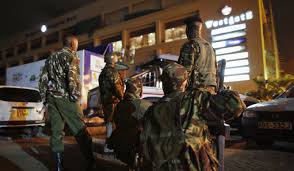
scenes from the Westgate Mall

A scene from the Westgate Mall siege

And then Westgate happened. At around noon on September 21st three groups of armed men (and allegedly at least one woman) stormed the upscale mall in Nairobi and started shooting indiscriminately. Several hours after the attack started Al-Shaabab claimed responsibility via twitter. A day later, the Islamist group gave an alleged list of the gunmen, all men between the ages of 20-27. Six were from the US, two from Somalia, and one each from Kenya, the UK, Finland and Syria. More than 36 hours after the attack began at least 69 people had been confirmed dead, including one gunman and two Kenyan officers. A visibly incensed President Uhuru Kenyatta condemned the attacks, and reassured Kenyans of a swift response to punish the perpetrators. Just a few minutes earlier Al-Shaabab had claimed responsibility for the attacks, terming them a retribution for Kenya’s invasion of Somalia in 2011. The Kenyan Defence Forces, under Operation Linda Nchi, invaded Somalia following sporadic kidnappings and attacks along the Kenya Somalia border. The forces still remain in Somalia under the command of AMISOM.

So how will Kenya respond? There will be both short-term and long-term responses to the daring terrorist attack. The likely short-term response holds more risk, and may even jeopardize the strategic objectives of the long-term response.

Understandably, in the short-term there is going to be considerable public pressure for a swift military response from the government. In the coming weeks the government’s response will likely involve both domestic crackdowns in suspected Al-Shaabab havens in Kenya (most likely in Nairobi, the Coast and North Eastern regions) and military operations against Al-Shabab targets within Somalia.
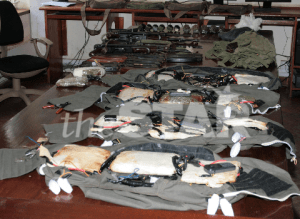
eastleigh

police recover suicide bombs in a past operation in Eastleigh (Courtesy of the Star Newspaper)

Crackdowns within Kenya will come with a lot of risk. Depending on how they are carried out, the government could end up walking right into Al-Shaabab’s trap by alienating Kenyan Muslims and ethnic Somalis who make up the majority of residents in Coast and North Eastern regions of the country that border Somalia.

Ethnic Somalis (both Kenyan and Somali nationals) also make up the majority of residents in Eastleigh, a district of Nairobi that has in the past witnessed government crackdowns targeting cells linked to the Al-Shaabab militant group.

Kenyan security forces must therefore proceed with extreme caution to ensure that as few innocent civilians as possible are arrested or roughed up by security forces in any operations within the country. A repeat of reported cases of police brutality in North Eastern following the murder of army officers by gunmen would be a terrible mistake. It is also vital that the government stresses the unity of all Kenyans of all ethnic extractions against terror attacks. Any victimization of ethnic Somalis must be met with swift punishment.

Military operations within Somalia will likely involve significant cooperation with Mogadishu, pro-AMISOM militia in Jubaland, AMISOM and the US and may not be completely under the control of Nairobi. I suspect that Nairobi might push for a more aggressive hunt for the leaders of Al-Shaabab, including Samantha Lewthwaite a.k.a. the “white widow,” a British national that is rumored to have been the mastermind of the Westgate Mall attack. Lewthwaite, the widow of London 7/7/2005 suicide bomber Jermaine Lindsay, is suspected to be on the run in Mombasa, Kenya with her four children. Crucially, any military operations in Somalia must be informed by analysts’ observation that it might be the case that Al-Shabaab is a group on the decline that is just lashing out to maintain relevance.
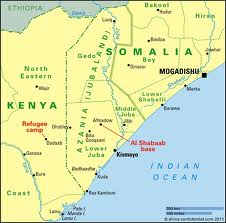
jubaland

An outline of the Jubaland region of Somalia

In the long-run, Nairobi will most likely push for a more robust Somali solution to the security crisis posed by the lack of a functional state in its backyard. Top on the agenda will be the strengthening of the security apparatus in the administration of Jubaland, the Somali state that is on the border with Kenya (For a detailed analysis of the situation in Jubaland see here). The creation of Jubaland has long been a goal of the Kenyan government as a buffer against the chaos that has been Somalia for the last two decades. Despite obvious objections from Mogadishu, Nairobi has never publicly denounced this policy goal. The brazen attack in the capital creates even more need for a strong buffer region that can help the Kenyan security forces to deal effectively with a terrorist group that appears desperate and willing to do just about anything to remain relevant. The success of this policy will depend on Mogadishu’s ability to veto it, and support from Ethiopia and AMISOM.

Ethiopia, Djibouti, Somaliland, Puntland and Kenya all have reasons to support the creation of Jubaland, or in general, a more decentralized state in Somalia. Kenya, Djibouti and Ethiopia remain wary of a potential rise in Somali nationalism and any irredentist attempts that might follow to unite all lands that make up the so called Greater Somalia – which would include the Ogaden in Ethiopia, North Eastern region of Kenya, and Djibouti. This is not a crazy fear. Mogadishu once attempted this in the late 1960s in a botched operation (in the Shifta and Ogaden wars) that ultimately led to a military coup and the rise of Siad Barre to power (See Laitin, 1976 [gated]). Ethiopia has the most to worry about regarding this potential risk. The Ogaden remains at the periphery of the Ethiopian state, giving the Somali population lots of reasons to rebel against Addis Ababa.

In the recent past Kenya has experienced an increasing level of integration of the Somali elite into the Kenyan state. Prominent Kenyans of Somali extraction include the leader of Majority in the National Assembly, the Foreign Minister, the Industrialization Minister, the head of the electoral management body (IEBC), among others.

Furthermore, many Somalis both Kenyan and from Somalia have in the recent past made significant investments in Kenya, most notably in the real estate sector. A lot of the investments have been means of laundering money got from illicit activities (some say including piracy). Indeed the governor of the Central Bank of Kenya is on record to have said that he could not account for billions of shillings in the economy. With an estimated total of only 20,000 mortgage accounts, most of the Kenya’s real estate boom has so far been financed by cash.

Yes, a lot more needs to be done for the average Kenyan of Somali extraction in North Eastern region, but the Somali elite in Kenya have every reason to not rock the boat and remain wedded to Nairobi. This same elite has so far tacitly supported Nairobi’s policy regarding the creation of an autonomous region in Jubaland.

The powerful imagery of a picture that went viral showing a Kenyan police officer, who also happens to be an ethnic Somali, carrying a baby while shielding three adults as they ran for safety at Westgate is hard to miss.

A domestic outcome of the Westgate attack will likely be greater scrutiny of the police and intelligence forces. The Kenyan police have been exposed in the past for having looked the other way in exchange for bribes to allow gun-runners to do their thing along the country’s highways. President Kenyatta will likely call for a cleaning of house both at Vigilance House and at the NSIS headquarters. All security agencies will likely see closer scrutiny from the political class and calls to pull up their socks. The minister in charge of internal security, Joseph Ole Lenku, probably has his days numbered on the job.

The quest for greater security will be completed by the proliferation of small arms and light weapons in the country on account of civil wars and general insecurity in the border regions with Uganda, South Sudan, Ethiopia and Somalia. According to a 2012 a study by the Small Arms Survey and the Kenya National Focus Point on Small Arms and Light Weapons, there are between  530,000 and 680,000 firearms in civilian arms across the country. The government must tighten its disarmament operations. Westgate has shown that AK-47s are not just the weapons of cattle rustlers, bank robbers and carjackers.

Will the reforms succeed? Very likely. The Kenya Revenue Authority is a testament to the fact that when it matters, the Kenyan government can reform key state institutions. The security sector is need of just such a reform drive. Insecurity is on the rise across the country, both from common criminals and organized gangs and terrorists. The Kenyan leadership appreciates that insecurity is not just bad in terms of risk to human lives. It is also bad for business.

If Mr. Kenyatta’s first term is to achieve even a modicum of success, the security sector must be reformed.

In all likelihood the president’s quest for a successful first term will outrank a few officers’ venal machinations within the administration. Police ineptitude in dealing with common petty and not-so petty crime creates loopholes for spectacular attacks like Westgate. Reform will therefore need to go beyond capacity building within the Special Forces and dedicated anti-terror units.

For regular Kenyans, life in Nairobi will never be the same again. It is almost impossible to imagine that things that most only read in the news could happen right at home; that a Saturday afternoon at the mall could turn into a ghastly massacre. It will take time before the capital, and the nation, finds its new normal, if at all it does.
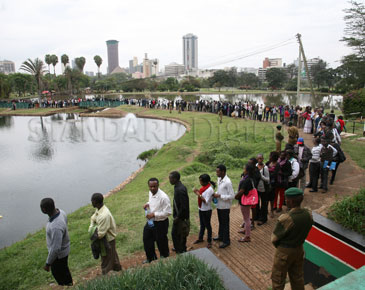
blooddrive

Kenyans queue to donate blood at Uhuru Park on Monday Sept. 23rd (Source: The Standard)

So far Kenyans’ resiliency has been outstanding. People showed up in their thousands to donate blood. Buses in Nairobi lowered their fares to take people to blood donation points. More than 40 million Shillings has so far been raised through MPesa for affected victims. Never before in my life have I felt or seen this level of patriotism from fellow Kenyans.

I hope it sticks. Especially because the country will need it in the next few weeks and months as the government formulates and effects a response to the Westgate Mall attack.

President Uhuru Kenyatta’s statement following Westgate terror attack

Fellow Kenyans,

This morning, a group of armed terrorists forcefully entered the Westgate Mall in Nairobi’s Parklands area and unleashed senseless violence upon customers and workers. They have killed at least 39 innocent people and injured more than 150 others. With the entire nation, I stand with the families of those who have lost their lives and extend every Kenyan’s deepest condolences. (I know what you feel having personally lost very close family members)

I ask God to give all of you comfort as you confront this tragedy. My Government will provide the support you will need in the days to come. To those who were injured, I wish you a quick recovery from the physical and other shocks you underwent today. The Government will be at hand to ensure that your lives return to normal as quickly as possible. The people of Kenya have been wonderful, as always. With your support we safely evacuated hundreds of people from the Mall. I salute your conscientious and selfless acts of solidarity in response to the terrorist attack. 

Your courage and sympathy saved lives and reassured countless people.

I commend those who volunteered by giving first-aid, transporting the injured to hospital, donating blood, locating and contacting loved ones and making it easy for rescue, medical and security personnel to do their work. I appreciate those who have used media to rally help of all kinds, condole with and comfort the affected and thank all those responsible citizens who have desisted from spreading panic and despondency. Please continue helping, and continue praying.

The despicable perpetrators of this cowardly act hoped to intimidate, divide and cause despondency among Kenyans. They would like us to retreat into a closed, fearful and fractured society where trust, unity and enterprise are difficult to muster. An open and united country is a threat to evil doers everywhere. With our values of solidarity and love for our homeland, we fought proudly and bravely to secure the freedom to lead our lives as we choose. Our choice is codified in our Constitution. 

We have overcome terrorist attacks before. In fact, we have fought courageously and defeated them within and outside our borders. We will defeat them again. Terrorism in and of itself, is the philosophy of cowards. The way we lead our lives; in freedom, openness, unity and consideration for each other represents our victory over all those who wish us ill. We are as brave and invincible as the lions on our Coat of Arms.

My Government stands ready to defend the nation from internal as well as external aggression. I urge all Kenyans to stand together and see this dark moment through. Donate blood. Provide information to the authorities. Comfort and reassure the affected families. Let us ashame the Devil and his works by demonstrating our timeless values of love, compassion and solidarity. Our security forces are conducting a multi-agency response to this attack as we speak and are in the process of neutralizing the attackers and securing the Mall. 

It is a very delicate operation as our top priority remains to safe guard the lives of innocent people held up in this unfortunate incident. But let me make it clear. We shall hunt down the perpetrators wherever they run to. We shall get them. We shall punish them for this heinous crime. 

I have directed security agencies to be decisive in their response to this or any other threat. They must and will do this to demonstrate our constitution’s categorical guarantee of Kenyans’ indefeasible rights to life and property.

Across the country, we have tightened security but I urge all of you to remain calm and vigilant.

God bless you. God bless Kenya.

How Eastern Africa can avoid the resource curse

This post originally appeared on the African Development Bank’s Integrating Africa Blog, where yours truly is a regular contributor. 

Eastern Africa is the new fossil fuel frontier (for more check out this (pdf) Deloitte report). In the last few years Kenya, Uganda, Tanzania and Mozambique have discovered large quantities of commercially viable oil and gas deposits, with the potential for even more discoveries as more aggressive prospecting continues. There is reason to be upbeat about the region’s economic prospects over the next three decades, or at least before the oil runs out. But the optimism must be tempered by an acknowledgement of the dangers that come with the newfound resource wealth. Of particular concern are issues of governance and sound economic management.

We are all too aware of the dangers of the resource curse. This is when the discovery and exploitation of natural resources leads to a deterioration of governance, descent into autocracy and a fall in living standards. Associated with the resource curse is the problem of the Dutch disease, which occurs when natural resource exports (e.g. oil and gas) lead to an appreciation of the exchange rate, thereby hurting other export sectors and destroying the ability of a country to diversify its export basket. The new resource-rich Eastern African states face the risk of having both problems, and to avoid them they must cooperate.

In many ways Eastern African states are lucky to be late arrivals at the oil and gas game. Unlike their counterparts in Western and Central Africa, nearly all of them are now nominal electoral democracies with varying degrees of institutionalized systems to ensure transparency in the management of public resources. Across the region, the Big Man syndrome is on the decline. But challenges remain. Recent accusations of secrecy, corruption and bribery surrounding government deals with mining companies suggest that there is a lot of room for improvement as far as the strengthening of institutions that enforce transparency (such as parliaments) is concerned. It is on this front that there is opportunity for regional cooperation to improve transparency and resource management.

While it is easy for governments to ignore weak domestic oversight institutions and civil society organizations, it is much harder to renege on international agreements and treaties. A regional approach to setting standards of transparency and accountability could therefore help ensure that the ongoing oil and gas bonanza does not give way to sorrow and regret three decades down the road. In addition, such an approach would facilitate easier cross-border operations for the oil majors that are currently operational in multiple countries, not to mention drastically reduce the political risk of entering the region’s energy sector. It would also leave individual countries in a stronger bargaining position by limiting opportunities for multinational firms to engage in cross-border regulatory arbitrage.

The way to implement regional cooperation and oversight would be something akin to the African Peer Review Mechanism, but with a permanent regional body and secretariat (perhaps under the East African Community, EAC). Such a body would be mandated to ensure the harmonization of laws to meet global standards of transparency and protection of private property rights. The body would also be mandated to conduct audits of national governments’ use of revenue from resources. The aim of the effort would be to normalize best practices among states and to institute a global standard for states to aspire more – more like the way aspirations for membership in the European Union has been a catalyst for domestic reforms in the former Yugoslavia and Eastern Europe.

Regional cooperation would also provide political cover to politicians with regard to economically questionable fuel subsidies. The realities of democratic government are such that politicians often find themselves forced to concede to demands for fuel subsidies from voters. But history shows that more often that not subsidies come at an enormous cost to the economy and instead of benefitting the poor only benefit middlemen. In addition, as the case of Nigeria shows, once implemented such policies are never easy to roll back both due to politics and the power of entrenched interests. Regional agreements capping any fuel subsidies at reasonable levels would be an excellent way to tie politicians’ hands in a credible manner, while at the same time providing them with political cover against domestic criticism.

Beyond issues of governance, there is need for cooperation on regional infrastructure development in order to reap maximum value for investment and avoid unnecessary wastes and redundancies. Landlocked Uganda and South Sudan will require massive investments in infrastructure to be able to access global energy markets. The two countries’ oil fields are 1,300 km and 1,720 km from the sea through Kenya, respectively. One would hope that as these projects are being studied and implemented, there will be consideration for how to leverage the oil and gas inspired projects to cater to other exports sectors – such as agriculture, tourism and light manufacturing – as well. KPMG, the professional services firm, recently reported that transportation costs eat up as much as 20 per cent of Africa’s foreign exchange earnings.  There is clearly a need to ensure that the planned new roads and railways serve to reduce the cost of exports for all outward oriented sectors in the region. Embedding other exports sectors (such as agriculture, timber, domestic transport, etc.) in the process of developing new transportation infrastructure will minimize the likelihood of their being completely crowded out by the energy sector.

In isolation, each country’s resource sector policy is currently informed by domestic political economy considerations and regional geo-politics. There is an emerging sense of securitization of resources, with each country trying to ensure that the exploitation of its resources does not depend too much on its neighbours. Because of the relatively small size of the different countries’ economies, the risk of ending up with economically inefficient but expensive pipelines, roads and railways is real. South Sudan is currently deciding whether to build a pipeline through Kenya (most likely), through Ethiopia, or stick with the current export route for its oil through Sudan (least preferred due to testy relations). For national security and sovereignty reasons, Uganda is planning on a 30,000-barrel per day refinery in Hoima, despite warnings from industry players that the refinery may not be viable in the long run. Some have argued for the expansion of East Africa’s sole refinery in Mombasa to capture gains from economies of scale, an option that Uganda feels puts its energy security too much in Kenya’s hands.

In the meantime, Kenya and Tanzania are locked in competition over who will emerge as the “gateway to Eastern Africa,” with plans to construct mega-ports in Lamu and Tanga (Mwambani), respectively. While competition is healthy and therefore welcome, this is an area where there is more need for coordination than there is for competition among Eastern African governments. The costs involved are enormous, hence the need for cooperation to avoid any unnecessary redundancies and ensure that the ports realize sufficient returns to justify the investment. Kenya’s planned Lamu Port South Susan Ethiopia Transport Corridor (LAPSSET) project will cost US $24.7 billion. Tanzania’s Mwambani Port and Railway Corridor (Mwaporc) project will cost US $32 billion.

Chapter 15 of the EAC treaty has specific mandates for cooperation in infrastructure development. As far as transport infrastructure goes, so far cooperation has mostly been around Articles 90 (Roads), 91 (Railways) and 92 (Civil Aviation and Air Transport). There is a need to deepen cooperation in the implementation of Article 93 (Maritime Transport and Ports) that, among other things, mandates the establishment of a common regional maritime transport policy and a “harmonious traffic organization system for the optimal use of maritime transport services.”

The contribution of inefficient ports to transportation costs in the regional cannot be ignored. Presently, the EAC’s surface transportation costs, associated with logistics, are the highest of any region in the world. According to the African Development Bank’s State of Infrastructure in East Africa report, these costs are mainly due to administrative and customs delays at ports and delays at borders and on roads. Regional cooperation can help accelerate the process of reforming EAC’s ports, a process that so far has been stifled (at least in Kenya) by domestic political constituencies opposed to the liberalization of the management of ports. The move by the East African Legislative Assembly to pass bills establishing one-stop border posts (OSBPs) and harmonized maximum vehicle loads regulations is therefore a step in the right direction.

Going back to the issue of governance, more integrated regional cooperation in the planning and implementation of infrastructure development projects has the potential to insulate the projects from domestic politics and patronage networks that often limit transparency in the tendering process. Presently, Uganda is in the middle of a row with four different Chinese construction firms over confusion in the tendering process for a new rail link to South Sudan and port on Lake Victoria. The four firms signed different memoranda with different government departments in what appears to be at best a massive lapse in coordination of government activities or at worst a case of competition for rents by over-ambitious tenderpreneurs.  This does not inspire confidence in the future of the project. A possible remedy to these kinds of problems is to have a permanent and independent committee for regional infrastructure to oversee all projects that involve cross-border infrastructure development.

In conclusion, I would like to reiterate that Eastern Africa is lucky to have discovered oil and gas in the age of democracy, transparency and good governance. This will serve to ensure that the different states do not descend into the outright kleptocracy that defined Africa’s resource sector under the likes of Abacha and Mobutu in an earlier time. That said, a lot remains to be done to ensure that the region’s resources will be exploited to the benefit of its people. In this regard there is a lot to be gained from binding regional agreements and treaties to ensure transparency and sound economic management of public resources. Solely relying on weak domestic institutions and civil society organizations will not work.

Nairobi to Lusaka, Part II

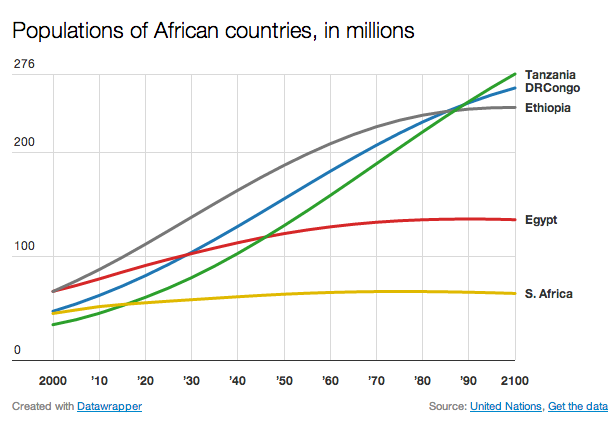
Dar es Salaam is a pleasant town in late June. I had only been there once before, back in 2011 when I stayed for a day and a half to catch the Tazara. I didn’t like it then because of the heat and humidity (humidity is up there with cats – I am allergic – on the list of things I cannot stand). But this time round it was nice, I managed to walk around town marveling at the pillars of concrete and glass that are rising up in every corner of the city. The construction boom puts even Nairobi to shame, enough to make me think that the suggestions that Tanzania may soon eclipse Kenya as the place where all the action is in East Africa are not that far fetched after all (see image and this piece).  Image

My only complaint was that a prime section of the beach front still remains under-utilized, although this might be because of the presidential palace nearby. I hear you can’t drive there at certain times of the day (Stop channeling Mugabe, Bwana Kikwete. Also, let Chadema be). Oh, and I did manage to drive on the Kibaki road. I thought it was a new road, but it is not. Sections of it are actually pretty bad. Apparently, the Tanzanian government is planning an upgrade soon. I also drove past Mwalimu Nyerere’s home. It made me respect the man even more.

I arrived in Dar late on Tuesday night after many hours of travel by bus. On Thursday morning I was scheduled to continue with the second leg of the journey to Lusaka. I was at the bus stop by 5:45 AM, still sleepy. I had stayed up late the previous night, watching the Confederation Cup matches of the day, reading and writing my Saturday column. I fell asleep as soon as I got to my seat.

Image

Dar’s public housing units. For a moment I thought that the choice of color was meant to discourage applicants. Until I saw the pink public housing headquarters. Some of the units are in really nice parts of town.

The bus left the station promptly at 6:15 AM. Tanzania is huge. From Dar es Salaam to the Tunduma border is about 931 kilometres. The drive to the Zambian border took a total of 16 hours.

As I said in the previous post on this trip, I regretted taking the bus. If you want to travel overland between Dar and Lusaka, take the train. It is a million times more pleasant. There is a restaurant and a bar (that serves Tusker) on the train. There are bathrooms. And you have a bed. Plus the train is just slow enough that you can read and truly appreciate the empty Tanzanian countryside.

But the trip wasn’t all gloomy. The scenery was still enjoyable. Sections of Tanzania are quite hilly, with amazing views of cliffs and rivers and rock formations. At some point past Iringa I saw what seemed to be the biggest tree plantation in the world. For miles and miles all I could see were rows and rows of trees. And when there were no trees there were rows and rows of sisal. Someone is making bank off the land in that part of the country.

Also, western Tanzania is a lesson on how hard it is to achieve economic development in the context of a sparsely populated country. Such situations make it impossible to reach everyone with the grid and water pipes. Either the government has to wait for demographics to work its magic (again, see figure above – and be sure to check out this story on the Africa-driven demographic future of the world) or provide smart incentives to accelerate the process of urbanization.

For those who went to high school in Kenya, journeying by land through Tanzania reminded me of Ken Walibora’s Siku Njema. I felt like I was retracing the steps of Kongowea Mswahili. Some day I would like to go back and spend some time in Morogoro and Iringa. By the way, Siku Njema is by far the best Swahili novel I have ever read (which reminds me that it has been eight years since I read a Swahili novel. Suggestions are welcome, preferably by Tanzanian authors). It is about time someone translated it into English for a wider audience.

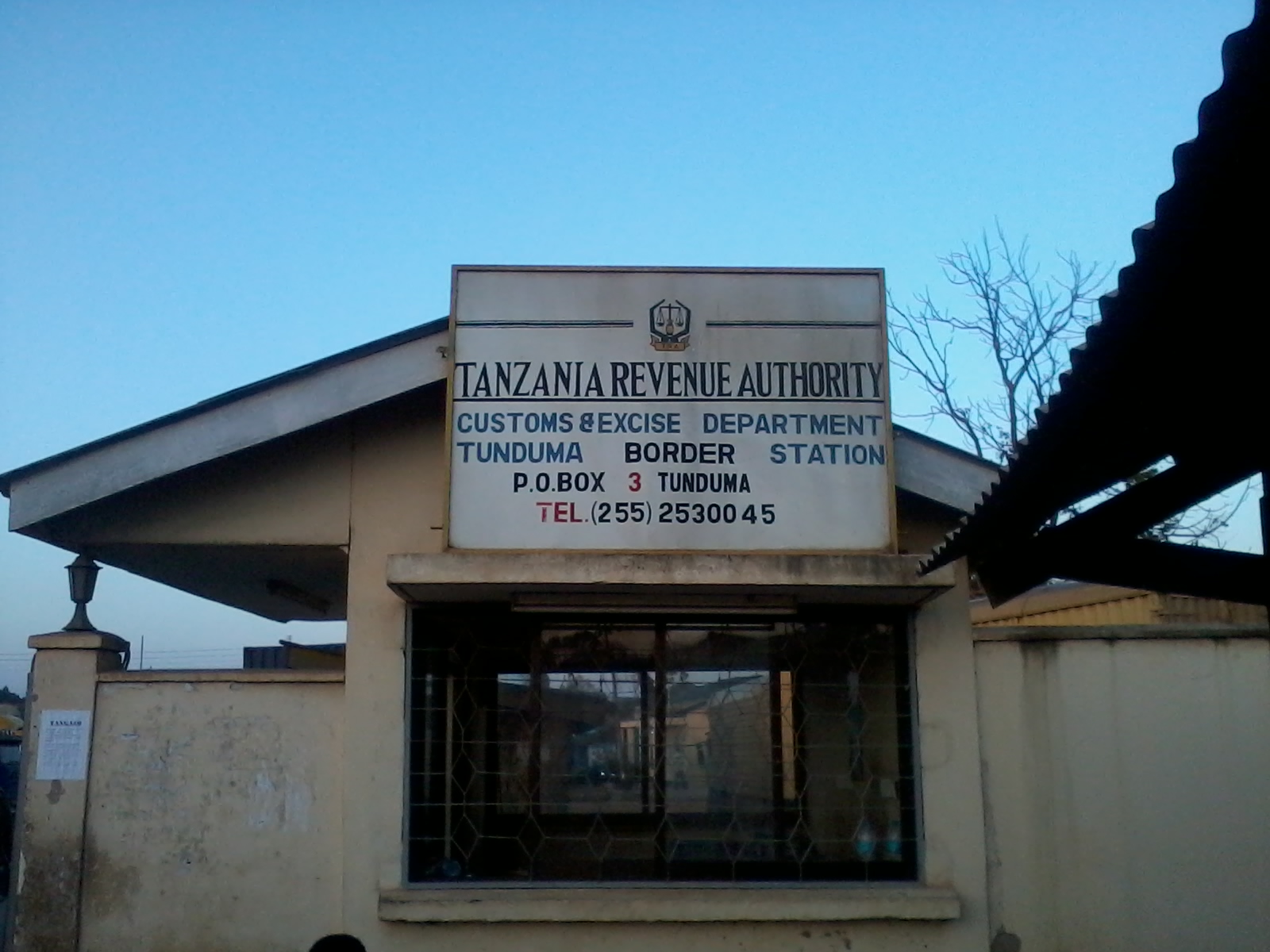
We reached Tunduma some minutes past 10 PM. The border crossing to Nakonde on the Zambian side was closed. Some passengers on the bus left to rent out rooms for the night. I decided to tough it out on the bus with the crew and a few other guys. Desperate for something warm to eat, I had chicken soup and plain rice for dinner. The “restaurant” reminded me of the place in Tamale, Ghana where Vanessa and I got food poisoning two months earlier. But I was desperate. I quickly ate my hot soup and rice and hoped for the best.

ImageI crossed the border early in the morning on foot. The bus had to wait in line for inspection and to pay duty for its cargo (It is at this point that I learned that the bus was actually going all the way to Harare in Zimbabwe). I am usually very careful with money changers, but perhaps because of my tiredness and lack of sleep the chaps in Nakonde got me.

If you ever cross to Nakonde on foot wait until you are on the Zambian side to exchange cash at the several legit forex stores that line the streets.

The bus finally got past customs at noon (on Friday). In Nakonde we waited for another two hours for more passengers and cargo.

I took the time to get some food supplies. Lusaka was another 1019 kilometres away. 

By this time I was dying to have a hot shower and be able to sleep in a warm bed. It was cold. Like serious cold. And Lusaka was still another 14 hours away.

I slept lightly through most of the 14 odd hours. In between I chatted with two Kenyan guys that were apparently immigrating to South Africa, with little more than their two bags. They said that this was their second attempt. The previous time they found work in Lusaka and decided to stay for a bit before going back to Nairobi. They were part of the bulk of passengers from Nakonde who were going all the way to Harare. Apparently, this is the route of choice for those who immigrate from eastern and central Africa into South Africa in search of greener pastures.

Before it got dark we saw several overturned trucks on the road. I slept very lightly, always waking up in a panic every time the driver braked or swerved while overtaking a truck just in time to avoid oncoming traffic. My only source of comfort was the fact that the driver was a middle aged man, most likely with a family to take care of and therefore with a modicum of risk aversion.

I arrived in Lusaka at around 4 AM, more than three days and 2871 kilometres since leaving Nairobi.

I said goodbye to my two Kenyan countrymen and rushed out of the bus as soon as I could. On the way to my hotel I couldn’t stop thinking how much I would like to read an ethnography of the crew of the bus companies (and their passengers and cargo) that do the Dar to Harare route.

At Lusaka Hotel that morning I had the best shower I had had in a very long time. And slept well past check out time. I had two months of fieldwork and travel in Zambia to look forward to.

Africa’s newfound love with creditors: Bond bubble in the making?

I know it is increasingly becoming not kosher to put a damper on the Africa Rising narrative (these guys missed the memo, H/T Vanessa) but here is a much needed caution from Joe Stiglitz and Hamid Rashid, over at Project Syndicate, on SSA’s emerging appetite for private market debt (Africa needs US $90b for infrastructure; it can only raise $60 through taxes, FDI and concessional loans):

To the extent that this new lending is based on Africa’s strengthening economic fundamentals, the recent spate of sovereign-bond issues is a welcome sign. But here, as elsewhere, the record of private-sector credit assessments should leave one wary. So, are shortsighted financial markets, working with shortsighted governments, laying the groundwork for the world’s next debt crisis?

…….Evidence of either irrational exuberance or market expectations of a bailout is already mounting. How else can one explain Zambia’s ability to lock in a rate that was lower than the yield on a Spanish bond issue, even though Spain’s [which is not Uganda…] credit rating is four grades higher? Indeed, except for Namibia, all of these Sub-Saharan sovereign-bond issuers have “speculative” credit ratings, putting their issues in the “junk bond” category and signaling significant default risk.

The risks are real, especially when you consider the exposure to global commodity prices among the ten African countries that have floated bonds so far – Ghana, Gabon, the Democratic Republic of the Congo, Côte d’Ivoire, Senegal, Angola, Nigeria, Namibia, Zambia, and Tanzania.

In order to justify the exposure to the relatively higher risk and lending rates on the bond market (average debt period 11.2 years at 6.2% compared to 28.7 years at 1.6% for concessional loans) African governments must ensure prudent investment in sectors that will yield the biggest bang for the buck. And that also means having elaborate plans for specific projects with adequate consideration of the risks involved.

Here in Zambia (which is heavily dependent on Copper prices), the Finance Minister recently had to come out to defend how the country is using the $750 million it raised last year on the bond market (2013-14 budget here). Apparently there was no comprehensive plan for the cash so some of the money is still in the bank awaiting allocation to projects (It better be earning net positive real interest).

“They are fighting each other. By the time they have projects to finance, they will have earned quite a lot of interest from the Eurobond money they deposited. So, all the money is being used properly,” he [Finance Minister] said.

Following the initial success the country’s public sector plans to absorb another $4.5b in debt that will raise debt/GDP ratio from current ~25% to 30%. One hopes that there will be better (prior) planning this time round.

Indeed, last month FT had a story on growing fears over an Emerging (and Frontier) Markets bond bubble which had the following opening paragraph:

As far as financial follies go, tulip mania takes some beating. But future economic historians may look back at the time when investors financed a convention centre in Rwanda as the moment that the rush into emerging market bonds became frothy.

The piece also highlights the fact that the new rush to lend to African governments is not entirely driven by fundamentals – It is also a result of excess liquidity occasioned by ongoing quantitative easing in the wake of the Great Recession.

I remain optimistic about the incentive system that private borrowing will create for African governments (profit motive of creditors demands for sound macro management) and the potential for this to result in a nice virtuous cycle (if there is one thing I learned in Prof. Shiller’s class, it is the power of positive feedback in the markets).

But I also hope that when the big three “global” central banks start mopping up the cash they have been throwing around we won’t have a repeat of the 1980s, or worse, a cross between the 1980s (largely sovereign defaults) and the 1990s (largely private sector defaults) if the African private sector manages to get in on the action.

African governments, please proceed with caution.

Nairobi-Lusaka by road, Part I

Image

The towering Uhuru Heights under construction in Dar es Salaam combines office space with residential apartments

Lusaka must be the only African capital (or major city) that is not a frenzied construction site. No new major roads are being constructed downtown. My quick look only found two new constructions of tall-ish buildings downtown. Lusaka feels really sleepy compared to the three other African capitals/major cities that I have been to in the last three months  – Dar es Salaam, Nairobi, Accra. Dar es Salaam, in particular, is impressive. The city is constructing a rapid bus transportation system with a dedicated lane. Citywide construction of “office space cum residential apartments” mark the landscape promising a rich experience of downtown living for city residents in the near future (I wish Nairobi did more of this….)

The guy who runs the place I am staying at in Lusaka tells me that the only construction going on in town is of shopping malls and expensive residential houses that no one will afford. President Michael Sata, he argues, is bent on turning Zambia into Zimbabwe.

Michael Sata (a.k.a King Cobra) may not go the way of uncle Bob in Zim but he is definitely not the hope for change that Zambians voted for back in 2011. The growth in the economy (6% on average in the last decade, 7.3% last year) is barely trickling down and the ruling PF seems too preoccupied with killing the opposition to care. The old duo of  Scott and Sata seem out of ideas on how to translate the country’s economic growth into wider socio-economic transformation.

Indeed the African Development Bank in its latest report on the Zambian economy noted that “Zambia has yet to achieve significant gains in social and human development. The poverty headcount remains high, with about 60% of the population still living below the poverty line.” The economy is imbalanced, heavily dependent of capital-intensive copper mining that it barely taxes (80% of exports, but paltry a 6% of revenue).

I was first here two years ago for reconnaissance research and have come back for more work. The pace is a nice change from Nairobi. It is also warmer than Nairobi at this time of the year (well at least before nightfall) – just after three years in California and seven months in Nairobi and I have become a little soft on cold weather (Moving to Chicago this fall will be fun!!)

This time round instead of doing air (Nairobi-Dar), rail (Dar-Kapiri) and road (Kapiri-Lusaka), I decided to do it all by road. This turned out to be a terrible idea.

Image

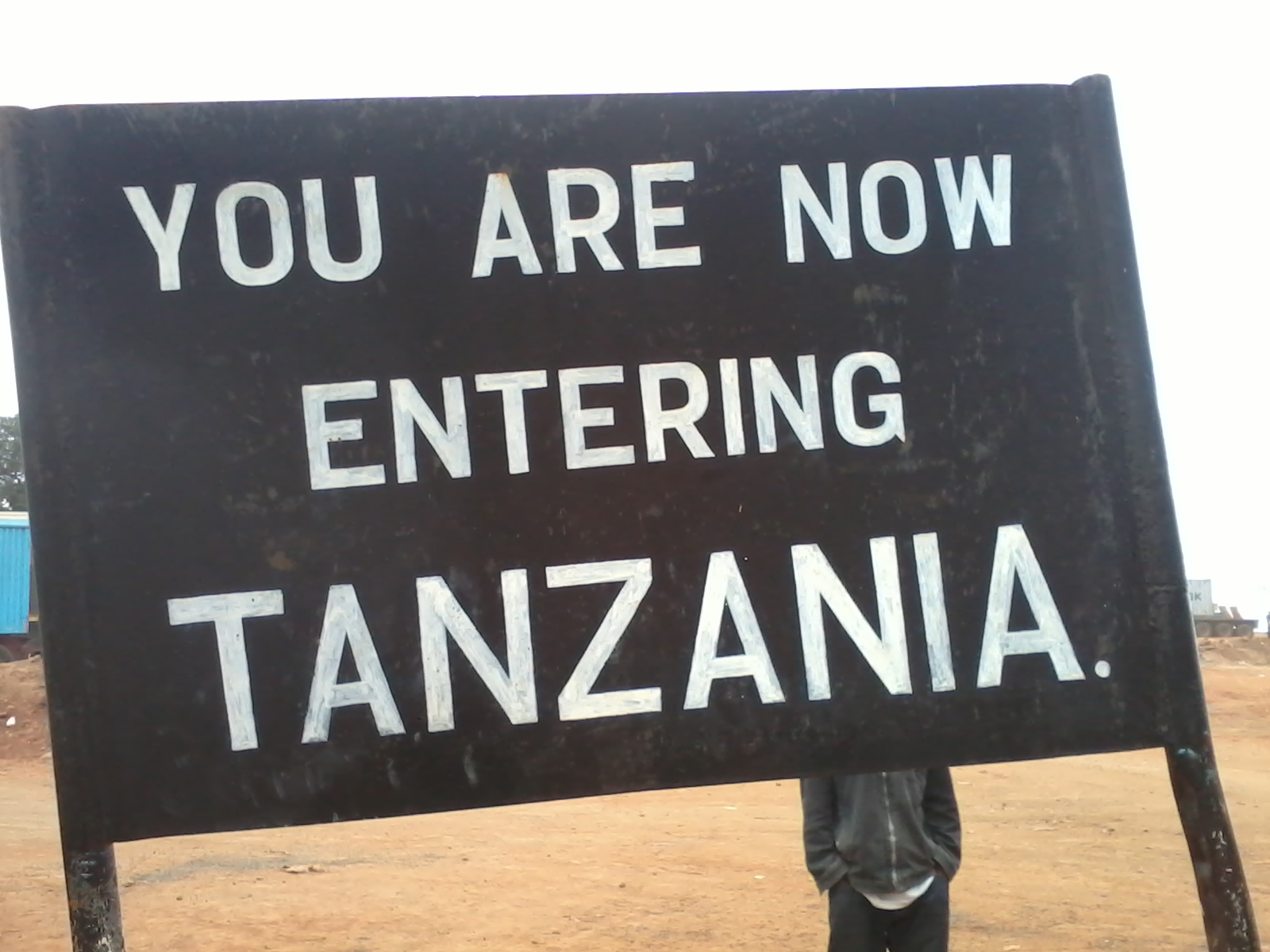
Sign post on the Tanzanian side of Namanga

Leaving Nairobi was itself an adventure. Despite Vanessa’s well-intentioned “alarm clock” calls to make sure I was up and ready by 5 AM, I missed my bus (I also missed my bus the first time, which is why I flew to Dar es Salaam). However, this time round it was my dad who was dropping me off and because he is a lot more daring that me and my brother, he decided to chase the bus (we were barely five minutes late, thank you very much Nairobi traffic at 5:45 AM). We did not catch my bus (Dar Express), but caught up with its competitor (name withheld for legal reasons, see below) after it had been stopped by the traffic police on Mombasa road for lack of a passenger license (it had a cargo license). Let’s just say that I was mightily impressed by my dad’s driving skills. I wish I were as daring.

So after the police got their cut (which I later found out was Kshs 5000, about US $60) we set off on the journey to Dar. The conductor on the new bus was kind enough to give me a free ride to Namanga (only Tanzanians can do this!!!) with hopes of catching up with Dar Express – in the end we did not, and I had to pay Kshs 2000 for the rest of the journey. The last time I was on the Nairobi-Arusha road was in 2009 when it was all no more than a dirt track that left you caked in thick red-brown dust. Now it is all paved. Nairobi-Namanga took a dizzying three hours. Just over an hour and a half after that we were in Arusha. After Arusha we sped to Moshi where we were caught up in the Prime Minister’s motorcade as he went to the city referral hospital to visit victims of the recent bombing at an opposition rally in Arusha (Arusha is the Chadema (Tanzania’s main opposition party) stronghold; but even in Dar the few people I spoke to about politics did not have nice things to say about the CCM government, especially with regard to rising inequality and corruption – yeah, I just totally Tom-Friedmanned that one).

Image

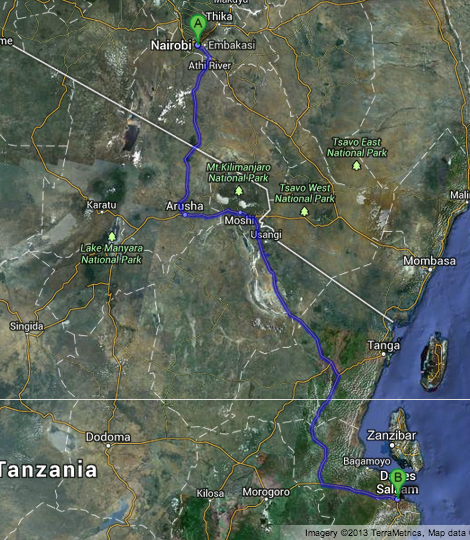
The 922 kilometer (573 miles) Nairobi-Dar road

I must say that the Nairobi-Dar road is impressive. Save for about one hour total of patches that were still being done about two hours outside of Moshi, most of the road is paved. Sometimes I forget how massive (and hence empty) Tanzania is. Namanga-Arusha is marked by flat plains, rolling hills and mountains. In the plains cattle rearing appeared to be the economic mainstay (unfortunately, with school age kids herding tens of cattle and sheep – wake up, Tanzania ministry of education). The hilly and mountainous areas mostly have maize and coffee. After the hills there are vast sisal plantations that stretch from horizon to horizon. Arusha and Moshi are the only big towns on the Namanga-Dar route. I particularly like Moshi (or may be I just don’t like touristy, expensive Arusha). It is a town with character, combining a provincial feeling with urban comforts. It also has some nice public monuments.

I rarely see weigh bridges on Kenyan roads (besides the infamous two in Gilgil and on Mombasa road) but in Tanzania they are plenty. And they are not just for the trucks, but also cater for passenger buses. Most of the trucks on the route were connecting Uganda, Rwanda, Burundi and the eastern DRC to the port in Dar. The passengers on the bus consisted of businesspeople (mostly Kenyans and Congolese), random travelers like myself, and tourists (most of who alighted at Arusha). On the Kenyan side, between Nairobi and Namanga we had a total of 5 police stops. On the Tanzanian side between Namanga and Dar there were 6 police stops and about 4-5 weigh bridge stops – the Tanzanians definitely police their roads more keenly. The police on the Tanzanian side were on the lookout for khat/miraa (illegal in Tanzania, and a beloved commodity of truckers) from Kenya and other contraband. True to EAC hospitality, I did not have any problems with immigration at Namanga (unlike in Nakonde, Zambia) or at any of the police check points (officers came on board to check passports). Talking to Tanzanians reminded me of just how bad Kenyan Swahili is – we must sound to Tanzanians like the Congolese sound to us whenever they speak whatever it is they call Swahili (*ducks and runs*).

The bus arrived in Dar es Salaam about 20 hours after leaving Nairobi (Not bad for a US $42 ticket), despite having been made to believe that the trip would take 13 hours. It didn’t help that I ignored Vanessa’s advice to pack food, hoping to buy stuff on the road – the first food stop was six hours into the trip, I had not had breakfast. Exhausted, hungry and mad at myself for taking the hard way to Dar I decided to get a room at the Peacock Hotel. It is not fancy (probably a 4 star?) but it has hot water, the rooms are spacious, and there’s fast internet. They also have a nice restaurant downstairs (Tausi) and are within walking distance to the port and other sites of interest in Dar – a Subway, Indian restaurant, the national library, banks, etc.

I had a day to burn in Dar reading, writing and walking around in readiness for the second leg of my trip to Lusaka, again by road.

Some thoughts on Kenyan MPs and their salaries

Update: Sarah Serem and the SRC appear to be backtracking and are now “open to dialogue” with MPs over their pay.

******************************************

“False standards are set with salary scales for MPs, Ministers and top civil servants that the country cannot possibly afford in a time when examples not of extravagance but of austerity and sacrifice should be set. In 1963 MPs earned K£ 620 a year [in present terms about Ksh 89,704.34 a month].

This was increased to K£ 840 then to K£ 1200 a year [about Ksh 173,619.53 a month in present terms], making three increases and a doubling of salary in less than three years (And the K£ 100 a month is augmented by a daily sitting allowance, plus mileage and other allowances). Junior Ministers earn K£ 2260 a year. The President’s salary has been fixed at K£ 15,000 a year tax free and including other emoluments……. In six months an MP receives more money than the average peasant earns in half a life-time.”

That is Oginga Odinga writing in his autobiography Not Yet Uhuru.

As Kenyan MPs prepare to adopt a report this afternoon that will allegedly give the Parliamentary Service Commission legal cover to grant them a 59% pay rise, we should remember that this is not a new phenomenon. Top public officers in Kenya, and in particular MPs, have always been remunerated well relative to the country’s per capita income.

Activists block the entrance to the National Assembly in protest at MPigs' greed

Activists block the entrance Parliament in Nairobi with a sow and piglets in protest at the greed of “MPigs”

I must admit that as a researcher on legislatures in Africa, and Kenya and Zambia in particular, the issue of how to look at MPs’ salaries is not a straightforward one. On the one hand it is absolutely obscene that in a poor country like Kenya MPs make more than their counterparts in far much wealthier countries in Western Europe. But on the other hand I also realize the importance of shielding the House from the influence of money bags from State House. Poorer paid parliamentarians across the Continent (including in “shining star” Ghana) live and work at the mercy of the executive. It is no coincidence that Barkan and colleagues concluded in Legislative Power in Emerging African Democracies that Kenya has the strongest legislature in the region.

The ratio of the president’s pay to MPs’ is instructive. Back in the sixties, the president made 12.5 times what the MPs made. That ratio has since shrunk to less than 2.5.

As Oloo Aringo passionately argued in the late 1990s and early 2000s, the high pay of Kenyan MPs is partly responsible for the rise in legislative power in Kenya (Part of my work in the dissertation, among other things, will be to convince you that this is true – that relative pay of MPs matters. Stay tuned). In the present Kenyan case there is an argument to be made for the Salaries and Remuneration Commission (SRC) to review the salaries of all State Officers; and to bump MPs higher up the totem pole (by cutting the pay of other state officers) than where they are right now as far as their pay is concerned. Ms Serem’s first stop should be the numerous seminars,workshops & capacity building obsessed talking shops independent constitutional commissions that continue to drain the exchequer with nothing to show for their work (OK, I’ll admit that some of the commissions are useful).

Kenyan MPs should definitely not get a pay hike. But the fight against greed in the august House should not be overdone, lest we end up with a weak parliament at the mercy of State House. This is the balancing act that I hope will inform the SRC commissioners’ actions as they try to tame our MPigs’ Honorable Members’ appetite.

Petro-Politics in East Africa

Is LAPSSET under threat? May be.

The Economist reports:

The Lamu pipeline makes the most economic sense for all involved. But failure to work together may doom it. National and personal interests trump regional co-operation and commercial logic. In Uganda Mr Museveni is keen to settle his legacy as the champion of a strong nation, building vast refineries and spiting the tiresome Kenyans. South Sudan is fixated on warding off the north at the expense—it seems—of almost everything else. Ethiopia sees a chance to steal Kenya’s thunder, too. “It’s every guy for himself,” says an oil executive wryly. “And I thought the private sector is rough.” Pipeline politics makes a mockery of the East African Community, a bloc dedicated to regional co-operation. All but one of the countries are members or aspire to join.

Of late, a new momentum behind the oil push is being felt. The Ugandan government is in final production talks with three oil companies. Executives from Tullow, Total and the China National Offshore Oil Corporation (better known as CNOOC), as well as local civil servants, conferred with Mr Museveni at his farm near the Rwandan border in late April. In June South Sudan will finish a feasibility study for the Ethiopian pipeline to Djibouti, after which it has said it will make a decision on export routes. “Everything is up in the air,” says a diplomat. Kenyan and Ethiopian officials, as well as oil-company representatives, have been scurrying to Juba to make their case. Pagan Amun, who leads South Sudan’s talks with the north, is said to be keen to ditch the Lamu pipeline.

My guess is that Nairobi, for historical reasons, will prevail in Juba. Plus Juba and Addis are not the best of buddies, despite recent warm relations. Mengistu was a key ally and supplier of SPLM before he was overthrown by Meles and his army. The departure of Meles may have made things a little better. Time will tell. Uganda will most likely construct a mini-refinery as it is not integral to the implementation of LAPSSET.