Why does Al Shabaab target Kenya?

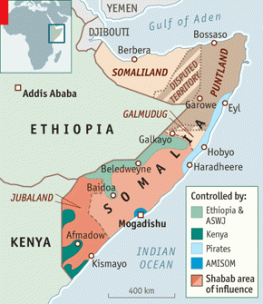
Ngala Chome, PhD candidate at Durham University, has a great review of Al Shabaab recruitment and attacks in Kenya since 2011, and why the group has been able to stage a lot more attacks in Kenya (96.4% of recorded attacks between 2008-16) relative to other troop contributing countries engaged in Somalia (see map):

Screen Shot 2019-02-03 at 10.50.23 AM.pngKenya may have suffered these attacks since it is considered a key ally of the West. But why is Al-Shabaab (an Al-Qaeda affiliate) targeting Kenya more than it is other countries in the region, such as Ethiopia and Uganda, which also have close ties with the West and have fought Al-Shabaab in Somalia? To what extent does Al-Shabaab attack Kenya for the reasons it publicly gives? Will Al-Shabaab, for example, stop targeting Kenya if the Kenya Defence Forces pulled out of Somalia?

…. The Global Terrorism Database (GTD) recorded 14 more attacks before September 2011, and then 49 in 2012, 35, in 2013, 80 in 2014, 42 in 2015, and 45 in 2016. While the GTD is yet to provide figures from 2017, existing evidence shows that of the 302 trans-border attacks perpetrated by Al-Shabaab from 2008-2016, 3 occurred in Ethiopia, 5 in Uganda, 2 in Djibouti and 291 in Kenya. Brendon Cannon and Dominic Pkalya, in a recent article, have argued that beyond sharing a border with Somalia, Al-Shabaab targets Kenya more than other frontline states because of the opportunity spaces linked to Kenya’s international status and visibility, its relative free and independent media that widely publicizes terrorist attacks, a highly developed and lucrative tourism sector that provides soft targets, expanding democratic space and high levels of corruption. In sum, these variables play into Al-Shabaab’s motivations and aid planning and execution of acts that aim to fulfil the group’s quest to survive – as it losses more ground in Somalia – by maintaining its relevance on the global stage.

Read the whole thing here. For more on the African Union Mission in Somalia (AMISON), Paul D. William’s new book looks fascinating (I haven’t read it yet).

For a broader understanding of the dynamics driving insurgency in the Horn, check out Michael Woldemariam’s Insurgent Fragmentation in the Horn of Africa: Rebellion and its Discontents and Inside Al-Shabaab by Harun Maruf, Dan Joseph and Christopher Anzalone.


Is China Doomed to Fail in Africa?

This is from Wilson VornDick, a commander in the U.S. Navy Reserve, writing in the National Interest: 

It is unclear whether China could handle the financial repercussions of a larger, more systemic default or debt-forgiveness program across the African continent. Seeking relief, debtors to China would likely overwhelm existing mechanisms, like international arbitration, or China-backed forums such as the Export-Import Bank of China , China Development Bank , and Asian Infrastructure Investment Bank . More importantly, debt restructuring, recoupment, and, in the more extreme case, seizure may not be viable, reasonable, or sustainable for Chinese interests or presence continent-wide. Just such a dire economic scenario might push China to use its nascent military force to protect or even seize its interests. Looking back at the previous period of Great Power Competition more than a century ago, leveraging military might to force repayment was commonplace. The U.S. military made multiple incursions into Caribbean and South American nations as did the Western powers in Africa and Asia.

It is reasonable to assume that China would have little or no experience in any dire economic contagion across Africa. The one primary example, the take-over of Hambantota Port, was an isolated incident during calmer times, before the financial uncertainty stoked by a slowing global economy or the current U.S.-China trade war. Moreover, the port takeover has now become a watershed moment in Chinese behavior that has attracted significant international scrutiny and ire.

More broadly, VornDick articulates the potential merits (from a U.S. standpoint) of a “Let China Fail in Africa” strategy as part of Washington’s Great Power global competition with Beijing. The whole argument is worth a read.

A glaring omission in VornDick’s analysis, however, is the interests and roles of Africans in this whole game (note that this is a gap in the “China-in-Africa” genre more generally).

chinafricaA key weakness that I see in the “Let China Fail in Africa” strategy is that it vastly underestimates the extent to which Africans will be willing to work hand in hand with China to make the Sino-African relationship work.

China’s forays in Africa is creating complex tapestries of personal and institutional relationships that will become ever harder to undo. For example, in both electoral democracies and autocracies in the region, citizens have come to expect political elites to provide public goods — many of them financed and built by China. Demands for more of the same will likely only get stronger. The desire to secure funding for more public goods will likely push African elites even closer to Beijing. Furthermore, at a time when the U.S. is working hard to signal that Africans are not welcome on its shores, tens of thousands of African students are earning degrees in Chinese universities. Many of these students will probably go back to their respective countries and maintain ties with Chinese business and academic contacts. These kinds of investments in soft power will matter in the long run.

Global diplomacy is not just about crass material interests. It is also about values and shared commitments to respectful mutual cooperation. If African elites become convinced that they are better off bandwagoning with China, they will do so.

And most importantly, having made that choice, they will make specific investments (whether deliberately or not) to make their nations ever more closely allied with China. They will adopt specific technologies. Establish specific market relationships. Acquire specific weapons systems. And yes, more of their students will learn Chinese and go on to earn degrees in China. The closer the military, economic and “soft” ties, the more African elites will be willing to make costly investments in order to ensure that their respective states’ relationships with China work.

A good lesson in this regard is francafrique. The relationship between France and its former colonies in Africa is not winning any awards soon. But for almost six decades African elites have remained committed to the relationship and worked to give the French military free rein in the region and French firms access to vast natural resources. The French state, in turn, has worked to prop up the same elites despite massive economic and political failings.

The point is: China’s failure in Africa (if it comes to pass) is not what will determine the future of Sino-African relations. What happens before any such failure will likely matter more.

Ethics of publishing images of the dead

Yesterday at 3 PM four suspected Al Shabaab gunmen attacked the Dusit complex (14 Riverside) in Nairobi. Initial reports indicate that at least 21 people were killed in the attack. More than 700 people were at the complex at the time and were evacuated.

It is worth noting that yesterday was the third anniversary (15/01/2016) of the El Adde attack (also by Al Shabaab) on a Kenyan military base in Somalia. El Adde was the deadliest attack in Kenyan military history — with at least 141 soldiers reportedly killed.

As the Dusit attack was unfolding, media houses began publishing images from the complex. One image — in a New York Times story — drew the ire of Kenyans for showing two dead men slumped over their seats at a cafe. The Times claimed that this was standard policy.

Kenyans did not buy their explanation. And for good reason. At the very least, the image was insensitive. The two men were easily identifiable by their clothing.

First, it’s one thing to show the image of the dead covered in the streets (the ethics of which are also questionable), and another to show two easily-identifiable dead men slumped over their seats at a cafe. It takes a significant amount of empathy gap to not notice this difference. Second, and more importantly, Kenyans’ demands for respect for victims and their families are valid in their own right. They do not need further validation by what the Times does elsewhere. It is not ordained that what passes for Nice or New York ought to naturally pass for Nairobi. As an institution, the Times ought to have shown that it takes the complaints about the image seriously.

Here is a great explainer on why a lot of Kenyans took particular offense to the Times’ response:

… In the New York Times’ initial story about the event, penned by recently appointed East Africa bureau chief Kimiko de Freytas-Tamura, the photo editors decided to include an image (from the wire Associated Press) that has since spurred not one but two trending hashtags in Nairobi.

Taken at the popular Secret Garden Café tucked away in the compound, the grainy photograph depicts a scene of utter carnage. Two unidentified men’s lifeless bodies are slumped over on their tables, their laptops still next to them. It is a horrific reminder of the indiscriminate nature of terrorist attacks.

… What particularly angered Kaigwa — and many others — is how de Freytas-Tamura responded to the controversy: she reminded her critics that as the reporter, she did not choose the photo, and that people could take their concerns up directly with the photo department. She was factually correct, but to many Kenyans, she displayed an unnerving callousness.

“I think what that tweet showed to people is that they didn’t have someone who listen[ed] to them and empathize[ed] with them,” says Kaigwa. The reporter later deleted the tweet and instead shared the New York Times’ official policy on showing casualties during terrorist attacks.

Underlying the current discussion (and no doubt fueling the expressions of outrage) is, of course, a long history of the Western press being callous about publishing images of dead Africans. And it is in that context that the reaction from Kenyans should be understood. My hope is that this present discussion will force the Times and other media houses to review their guidelines on publishing images of the dead — regardless of their nationality.

Finally, and to echo Nanjala Nyabola, it goes without saying that the Times’ reprehensible editorial choice in this instance should not be used to attack individual journalists or the freedom of the press more generally.

Are Metros Overrated?

This is from a story in The Guardian:

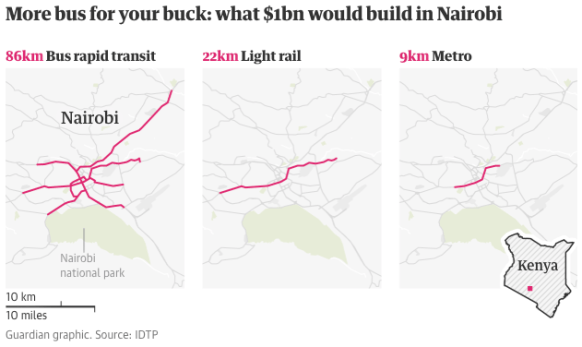
The ITDP bemoans Africa’s obsession with metros. Lagos in Nigeria – the largest city in the world without a functioning mass transit system – has been trying to build a metro since the 1980s. In the latest of many incarnations, the project was supposed to begin operations in 2012 at a cost of $2.4bn (£1.9bn). Six years after the supposed start date, construction is “nowhere near complete”, says Kost.

Abidjan, the economic capital of Ivory Coast, began construction of a metro last year. The French-financed and -built line is projected to carry 500,000 passengers a day at a cost of $1.7bn. Dar es Salaam’s bus system, by contrast, has capacity for 400,000 people and cost less than a 10th of that – about $150m.

Addis Ababa in Ethiopia opened a Chinese-built and -operated light rail line last year at a cost of $475m. Shenzhen Metro Group has a deal to run it for the first five years.screen shot 2019-01-09 at 4.03.54 pm“With a metro, an international firm will often just parachute in its own system,” says Kost. “Bus rapid transit allows existing stakeholders to get involved. That’s what we did in Dar es Salaam and what we’re planning in Nairobi, where the bus bodies will be built in the city and local operators will look after tickets, fare collection and IT. It’s good for the development of the local economy.”

Regular readers know that I have a bias for Kost’s argument. Read the whole thing here.

H/T Dina Pomeranz.

Mobile connectivity in Kenya is at 97.8%

Penetration of mobile phones reached 98 per cent at the end of June, up from 89 per cent during the same month last year, according to the Communications Authority of Kenya (CA) statistics.

“As at June 30, 2018, the number of mobile service subscriptions in the country stood at 45.5 million up from 44.1 million reported in March 2018. This also marked an increase of 13.2 per cent when compared to the 40.2 million subscriptions recorded as at June 330, 2017,” said the CA in its latest update. “This has resulted to increased mobile penetration of 97.8 per cent during the subject quarter from 95.1 per cent reported in the preceding quarter.”
The actual number of households with at least one mobile phone is probably 10 percentage points lower than the headline figure. Which is still a very high rate of mobile penetration. For comparison, the gross rate of connectivity in India stood at 65-75% last year.
The challenge for Kenyan entrepreneurs is to think of ways to exploit this potentially lucrative platform (beyond the exciting innovations in financial inclusion).

David Ndii on the Kenyatta-Odinga “Handshake” and what it means for Kenyan politics going forward

Ndii contends that “whatever comes out this [Kenyatta-Odinga handshake] … will not be transformational.” It is merely a “containment.”

Ndii also concedes that it’s impossible to work around ethnicity as the primary basis of organizing Kenyan politics.

The whole thing is worth watching:

The Scramble for Somalia

UPDATE:

The Journal has a great piece on the new scramble for Somalia among regional and global powers:

The maneuvering for territory has drawn a motley crew of actors, including U.A.E. state-owned shipping giant DP World; a Turkish conglomerate owned by the family of President Recep Tayyip Erdogan’s son-in-law; and Navy-SEAL-turned-businessman Erik Prince, who wants to develop a port south of the capital Mogadishu. France and Japan have military bases, and Russian entities are scouting for deals.

Since 2011, a number of regional powers have been in a scramble for political and economic influence in (Southern) Somalia. Many of these foreign engagements have come with serious threats to Somalia’s territorial integrity and the capacity of the Federal Government to effectively influence regional governments.

Kenya has strong relations with Jubaland, and prefers a weak federated Somalia. Ethiopia and the United Arab Emirates (UAE) are keen on working with the breakaway region of Somaliland. Somaliland, of course, is thriving as a free electoral democracy with functional institutions.

Turkey and Qatar are focused on supporting the Federal Government and investing in Mogadishu and its environs. And Qatar’s Gulf rival, the UAE, is interested in working with the semi-autonomous region of Puntland, against the wishes of the Federal Government.

It is fair to say that the conflicting interests and goals of Somalia’s friends are not helping the wider stabilization effort under AMISOM.

So far Turkey is miles ahead of every other regional powers in terms of economic influence in Mogadishu. This reality is causing a lot of angst among Gulf states eager to cut Qatar, an ally of Turkey, to size.

Turkey and Qatar will likely win this race.

Turkey invested in Somalia early (since 2011) and in a diversified fashion:

Turkish money and aid – delivered directly to key stakeholders in the Somali Federal Government – ingratiated Turkey with local power brokers and provided Ankara with access and power in Mogadishu. What soon followed is Turkish control and management of Somalia’s most lucrative assets, the airport and seaport.

Parallel to these were unilateral rebuilding efforts, offers of scholarships, renovations of hospitals, and the hosting of international conferences about Somalia. These have largely contributed positively to Somalia’s development and yielded the international acclaim and diplomatic clout craved by President Recep Tayyip Erdoğan and his coterie.


The Political Legacy of Kenneth Matiba

In 1988 President Daniel arap Moi overplayed his hand, and set in motion the beginning of the end of KANU’s dominance in Kenyan politics. Ever since the attempted coup of August 1982, Moi had increasingly concentrated power in KANU and in his own hands. First he made Kenya a de jure single party state under KANU and called the 1983 snap election to rid Parliament of critical voices. He then went about strengthening the KANU national office to serve as an enforcer of strict party discipline within and outside of Parliament. KANU became baba na mama, and Kenya a nascent Party State (albeit nothing near what CCM in Tanzania or UNIP in Zambia had accomplished). By the mid-1980s Moi had abandoned all pretenses to the supremacy of parliament, and in 1986 declared KANU to be supreme over bunge. In the same year he removed security of tenure for the Attorney General and Auditor General; and in 1988 leaned on Parliament to remove security of tenure for judges.

1988 was also the year of the infamous Mlolongo elections. Ahead of the KANU primaries, Moi (through KANU) abolished the secret ballot and decreed that voters should queue behind their preferred candidates. This was an attempt to intimidate voters into selecting pro-Moi legislators. But in a sign of KANU’s weakness at the grassroots level, District Commissioners still had to rig out popular candidates whose lines were visibly the longest. The backlash against the Mlolongo election caused irreparable damage to the elite consensus that had (very tenuously) underpinned single party rule in Kenya since the death of President Jomo Kenyatta in 1978.

Screen Shot 2018-04-15 at 3.39.42 PM.pngAmong those targeted by Moi in 1988 was Kenneth Matiba, a wealthy former Civil Servant, executive at East African Breweries, and M.P. for Mbiri (later renamed Kiharu) Constituency in Murang’a District since 1979. In order to defend his seat, Matiba went as far as hiring a helicopter and cameramen to take pictures and video evidence of the length of this queues, just in case the District Commissioner declared his opponent the winner. Matiba saved his seat, against his perennial opponent Julius Gikonyo Kiano, but would be out of government and then parliament in less than a year.

In September 1988 KANU held its branch elections. Matiba was vying for the position of Chairman of the Murang’a branch against Joseph Kamotho, MP for Kangema. Following brazen rigging, in which Matiba lost his own home area, the District Commissioner declared Kamotho the winner. Matiba disputed the result, forcing Moi to order a repeat of the poll. But Matiba and his supporters boycotted the repeat election, citing a lack of faith in the local Provincial Administration officials who doubled as KANU election officials.

Then on December 9, 1988 Matiba did the unthinkable: He resigned from the Cabinet as Minister of Transport and Communications. This was the first time since 1966 that a Kenyan Cabinet Minister had resigned. It was also a direct insult targeted at Moi, who was scheduled to receive international guests the next day to celebrate his first decade in power (“Moi Day” was created on the same day).

The move made Matiba a marked man. He was promptly expelled from KANU which resulted in the loss of his parliamentary seat. But these moves only served to strengthen Matiba’s cause for freer electoral politics in Kenya. In the words of Gibson Kamau Kuria:

Matiba was a kind of reluctant reformer… he did not have issues with the system until the excesses of mlolongo in 1988. Up until then, he was part of the authoritarian government. The important thing about him, however, is that he had a sense of decency. He got converted to the cause of pluralism. Kenya had reached a stage where it was contravening Article 21 of the Universal Declaration of Human Rights, which states that “everyone has a right to take part in the government of his country, directly or through freely chosen representatives.” Mlolongo was a negation of all that.

Screen Shot 2018-04-15 at 7.57.23 PM.pngMatiba then joined forces with intellectuals, church leaders, and politicians who were calling for a return to multiparty politics. For his efforts he was detained on July 4 1990 as he and other opposition leaders prepared for the first Saba Saba (July 7th) rally at Kamukunji grounds in Nairobi. While in detention he was tortured, suffered a stroke on May 26th 1991, and was only allowed treatment a week later. He spent the next 11 months receiving treatment in London before his triumphant return to Nairobi on May 2, 1992 (see image). Matiba never fully recovered from the stroke, and in 2017 was awarded $9.5m in damages after a successful suit against the Kenyan state.

Moi would later acquiesce to both domestic and international pressure and allow for constitutional amendments to reintroduce multiparty politics in December 1991.

Was the end of  KANU’s single party rule inevitable even without Matiba’s efforts?

Perhaps. Besides Matiba, there were several other leading lights in Kenya’s opposition movement capable of bringing down the proverbial Mugumo tree — men and women like Oginga Odinga, Bishops Alexander Muge and Henry Okullu, Paul Muite, Gitobu Imanyara, Martin Shikuku, Gibson Kamau Kuria, James Orengo, Kijana Wamalwa, Kiraitu Murungi, Raila Odinga, Charity Ngilu, Martha Karua, and Wangari Maathai, among others. As single party regimes fell all over the Continent between 1990 and 1994 like dominos, so would have KANU’s single party dominance.

However, Matiba’s important legacy is that he was the first prominent insider to publicly ditch KANU and Moi. Because of his actions Moi went from appearing to be completely in charge in 1988 to fighting for his political life in 1992.

Scholars of democratization processes have long emphasized the importance of intra-elite splits in autocratic regimes as catalysts of transition. Seen in this light, Matiba’s resignation from Cabinet was important in that it forced Moi to react in ways that only accelerated further defections from his government and KANU. In quick succession he lost his Vice President Josephat Karanja, former Vice President Mwai Kibaki, KANU Chairman Peter Oloo Aringo, and Minister Njoroge Mungai. These defections, inspired in part by the considerable wealth and economic independence of those involved, were as clear a sign as any of open elite rebellion against Moi’s rule, and forced him into accepting term limits and multiparty electoral politics. Moi would later survive the 1992 (with 36.4% of the vote) and 1997 (40.6%) elections amid opposition division, but was forced to step down in 2002 in observance of term limits.

As Kenya mourns Kenneth Stanley Njindo Matiba (1932-2018), his legacy will endure forever as the ultimate insider who nonetheless took significant risks against Moi’s autocracy. His personal sacrifices created space for many of the freedoms that Kenyans enjoy today.

Lala salama Bwana “Let the People Decide!”, a true hero of Kenya’s Second Liberation.


Interesting paper on the privatization of the “Rule of Law” in autocratic China

This is from Stanford’s Lizhi Liu and Barry R. Weingast:

We argue in this paper that, China has begun to fashion an alternative approach to establishing legal market infrastructure, which we call, “law, Chinese style.” Facing the authoritarian’s legal dilemma that constrains formal legal development, the central government has effectively off-loaded a substantial part of the development and enforcement of commercial law to private actors, namely, various online trading platforms. This approach allows the central government to cabin the domain of the legal system to private law.

To elucidate this private development of law, we focus on Taobao, China’s largest online trading platform, owned by Alibaba. We demonstrate that, with over 430 million users and more than 10 million vendors, Taobao is not simply an exchange platform, but a complete market that is in the process of developing a modern legal system. The system includes a very complex reputation mechanism, a credit score, a fraud detection program, and even a jury-like system in which ordinary users can vote to adjudicate cases or to change platform rules. With respect to exchange on the platform, this legal system helps creates law, enforce contracts, protect certain property rights, resolve disputes, and prevent fraud. By doing so, Taobao has begun to supply many aspects of market-supporting infrastructure normally associated with the state.

This the kind of paper that might interest folks in Kigali and Addis Ababa. Or Nairobi, these days.

How to overthrow the Kenyan government in twelve steps

  1. Form a hopelessly fractious political coalition on the back of four years of doing nothing with county governments to demonstrate your chops at transformative governance.
  2. Successfully push for electoral reforms, and then sit on your hands trusting that the system will work.
  3. Engage in all manner of self-sabotage during the campaign period, including failing to push for grassroots voter registration, having a unity message, reaching out to wavering voters, and credibly committing to reform the public sector.
  4. Fail to agree on a common slate of candidates ahead of the election, thereby granting the incumbent party a significant sweep of legislative and county seats.
  5. Fail to prepare for the logistical nightmare of coordinating poll agents across the country, thereby making it possible for the incumbent party to pad results where needed.
  6. Get lucky at the Supreme Court, but without a plan on how to prepare for a fresh election 60 days after the ruling.
  7. Try to push for more electoral reforms and a postponement of the election. When that fails, boycott the re-run presidential election.
  8. Half-heartedly boycott Parliament and other state institutions.
  9. Promise to swear in your presidential candidate as a bargaining tactic, but without a way out of the plan in case the incumbent government calls your bluff.
  10. Meanwhile, stay hopelessly off-message at every turn, and play into the narrative of being a disruptive alliance of sore-loser crybabies that would be no different than the incumbent party at governing.
  11. Sow distrust among your core leadership by failing to share important legislative committee seats in good faith.
  12. Swear in your presidential candidate as “The People’s President” (an office not provided for in the Constitution) as an act of defiance, but with no real public agenda or explanation of the act’s real impact on Kenyans’ lives.

If you do these things, you will cause a COMPLETE FREAKOUT in the Kenyan government. They will shut TV stations. They will scream treason. They will withdraw the security detail of opposition politicians. They will declare you members of a criminal gang. They will risk unnecessarily plunging the country into a security crisis.

They will drop the focus on the president’s potentially transformative Big Four agenda. They will behave like they will be in office for life. They won’t care about the negative precedences they are setting. They will forget that in five years they will be out of office, and might face a less benevolent, but way more competent tyrant that will eat their lunch and dinner.


Some quick thoughts on President Uhuru Kenyatta’s new cabinet nominations

Two months after being sworn in for his second and final term, President Uhuru Kenyatta has nominated members of his new cabinet (see list below). Kenyatta also created a new position in government, the office of Chief Administrative Secretary (CAS), which is different than the Principal Secretary (PS) position. Essentially, CASs will be the new assistant ministers as was the case under the old constitution.

The cabinet appointments are underwhelming.

In his second inaugural address, Kenyatta promised to focus on four key areas (the “Big Four”) in his second term. I had therefore expected that appointments would mirror a shift in approach, at least in the key ministries that touch on the “Big Four” areas (manufacturing, agriculture, health, and infrastructure). But Adan Mohamed was retained at Industrialization (he hasn’t been particularly bad. But he hasn’t been bold either). The new CS of health is untested in the docket. Nominations for the agriculture, water, lands, and devolution portfolios are explicit political appointees that will likely be distracted by patronage politics.

James Macharia at transport is probably the only “Big Four” appointment/retention that makes sense considering the president’s stated policy goals.

It would appear that the only recipe for success in the next five years would be for Kenyatta to shield the actual operations of these ministries from most of the Cabinet Secretaries. In principle, it should be possible to create islands of success separate from the messy political economy considerations that informed the structure of the overall cabinet.

The creation of the position of CAS and appointment of politicians to this position will further complicate matters by injecting even more patronage politics into the functions of ministries.

From a purely administrative standpoint, this looks like a really bad idea.

If all Kenyatta is doing is rewarding politicians for their political support, there are other economically cheaper but more impactful ways of doing so. I wish State House took the science of the industrial organization of public administration more seriously.

Now that this is done, the onus is on the president and his team to make it work. That will not be an easy task. There is bound to be conflict over contracts, bribes, and jobs between CSs and CASs. In addition, by essentially creating multiple principals at the top, the president has saddled state agencies with principal-agent problems that will be hard to solve without a strict allocation of tasks. And this is before we even consider the potentially messy interaction between parliamentary committees and the CSs and CASs. Smart chairs of departmental committees in the National Assembly will play these two against each other and extract bribes like never before.

MPs are not fighting to head these committees out of a sense of public duty.

I wish Nzioka Waita and his team all the best of luck.

Finally, the cabinet has (broadly speaking) good regional balance. The two biggest surprises are the total exclusion of big name politicos from Lower Eastern and the Gideon Moi faction of the Rift Valley from the CS list. At first glance, it appears that Deputy President William Ruto got a good deal with these appointments (see here for background). There are only 6/22 (27%) women on the list, in violation of the constitutional requirement of at least 33%.

Kobia and Juma look well-matched to their portfolios. Mohammed’s move to education looks like a demotion, but her new docket has a bigger budget than Foreign Affairs. Education is a tough docket, but a part of me thinks that she is likely to emerge as the best-performing minister on account of her management skills and incredible work ethic (if, and only if, she can handle the politics of education well).

Here is the list:

1. Margaret Kobia – CS Youth and Public Service.
2. John Munyes – CS Petroleum and Mining.
3. Eugene Wamalwa – CS Devolution.
4. Racheal Omamo – CS Defense. 
5. Monica Juma -CS Foreign affairs.
6. Simon Chergui – CS Water.
7. Keriako Tobiko – CS environment
8. Adan Mohammed – CS Industrialization
9. James Macharia – CS transport
10. Joseph Mucheru – CS ICT
11. Henry Rotich – CS Treasury
12. Fred Matiangi – CS Interior
13. Mwangi Kiunjuri – CS Agriculture
14. Sicily Kariuki – CS Health
15. Rashid Achesa – CS Sports
16. Najib Balala – CS Tourism
17. Amina Mohammed – CS Education
18. Farida Karoney – CS Lands
19. Ukur Yattany – CS Labour
20. Peter Munya – CS EAC
21. Charles Keter – CS Energy
22. Raphel Tuju – CS (without portfolio)

How robust is William Ruto’s plan to succeed Uhuru Kenyatta in 2022?

rutoPresident Uhuru Kenyatta is yet to name his full second term cabinet, 52 days since being sworn in for his second term. According to news reports, the delay might be due to internal wrangles within the Jubilee Party over specific cabinet appointments. While Kenyatta is keen on putting together a cabinet that will help him implement his ambitious legacy projects, Deputy President William Ruto wants a cabinet that keeps the path clear for his stab at the presidency in 2022 when Kenyatta will be term limited.

It seems, at least for now, that the two goals are in conflict.

Formed ahead of the 2017 election, the Jubilee Party was supposed to be a commitment device binding Kenyatta and his supporters to Ruto’s planned bid for the presidency in 2022. The idea was to make the party strong enough at the grassroots to make it impossible for anyone to run and win without pledging loyalty to the party leaders — Kenyatta and Ruto.

Not all of Kenyatta’s elite supporters are on board with this plan.

This raises the question, how robust is Ruto’s plan to succeed Kenyatta? In my view, four factors make the plan almost ironclad:

  1. Kenyatta needs Ruto for the rest of his presidency: Ruto cannot be fired (see the Kenyan constitution). His legislative point man, Aden Duale, is the Majority Leader in the National Assembly. And he has enough votes in the legislature to control the agenda (mainly through veto threats), and to frustrate Kenyatta should the two fall out. That means that even if Ruto loses the fight over specific cabinet appointments, he would likely get a substantial side payment that leaves him financially potent ahead of 2022. Furthermore, while he may not be able to sway every single voter in his core base, there is no reason to believe that Kenyatta would renege on the promise to back Ruto in 2022. No former president wants a successor with an axe to grind.
  2. Ruto has amassed an insurmountable financial lead relative to potential competitors: Besides Raila Odinga, there is no other Kenyan politician with the same level of national appeal and grassroots loyalty to rival Ruto. Mombasa Governor Hassan Joho comes close, but there are structural constraints to his candidacy (he would be a great running mate to Ruto, though). And on top of all this, Ruto has amassed an incredible amount of wealth (or access to it) that will make him the runaway frontrunner in the competition for elite endorsements ahead of 2022. What this means is that Ruto can run in 2022 even without Kenyatta’s support and still win.
  3. Running in 2022 as a victim of Central Kenyan perfidy would likely win Ruto sympathy votes: A constant (and potentially powerful) narrative in Kenyan politics is that voters in Central Kenya (Kenyatta’s backyard) never vote for anyone but their own. If Central Kenyan elites were to spurn Ruto, he could go to the wider Kenyan electorate and make the case that he entered into an agreement in 2013 in good faith but got burned — just like Raila Odinga was burned by Mwai Kibaki, and his father before him by Matiba and Kibaki. With such a strategy, Ruto could engineer a coalition similar to Odinga’s 41 vs 1 coalition of 2007 and easily win the presidency.
  4. If all else fails, Ruto can blackmail Central Kenyan elites by threatening to destabilize the Rift Valley: This is not a far-fetched idea. It is not a surprise that recent pronouncements challenging Ruto’s 2022 candidacy were met with disquiet in Uasin Gishu and Nakuru counties along the same cleavages that defined the post-election violence in 2007-08. It is common knowledge that the alliance between Kenyatta and Ruto in 2013 was one of political expedience, and did not address the economic and social root causes of the violence that erupted in the Rift Valley following the disputed 2007 election. It would only take a few careless statements from people like Gov. Jackson Mandago of Uasin Gishu to cause significant instability in the Rift Valley.

Overall, despite the current impasse over cabinet appointments, Ruto’s political position remains very strong. To weaken him, Kenyatta would have to take overt steps — such as allowing his elite allies to form a different party than Jubilee — which would come with immense political costs (especially in parliament). Kenyatta’s hands are tied on this matter. Furthermore, why would he spend the next five years building a legacy that would be jeopardized by his failure to honor the 2013 deal with Ruto?

People often compare Ruto to former President Daniel arap Moi who remained loyal to Jomo Kenyatta and quietly waited in line until Kenyatta died in 1978. I disagree. On the specific matter of succession politics, I like to think of Ruto as a latter day Tom Mboya, the overtly ambitious KANU Secretary General who was murdered ahead of the 1969 General Election after which he would have been in pole position to succeed Kenyatta. Like Mboya, Ruto has, from the beginning, been very clear about what he wants and what he is willing to do to achieve it. And all indications are that this time will be different.

Rwanda’s Kagame on the Social Construction of Ethnicity

This is from an interesting interview with the FT:

During the interview, Mr Kagame says it matters little whether there are real physical differences between Hutus and Tutsis or whether these were arbitrary distinctions codified by race-obsessed imperialists. “We are trying to reconcile our society and talk people out of this nonsense of division,” he says. “Some are short, others are tall, others are thin, others are stocky. But we are all human beings. Can we not live together and happily within one border?” Mr Kagame has taken a DNA test that, he says, reveals him to be of particularly complex genetic mix. The implication, he says, is that he, the ultimate symbol of Tutsi authority, has some Hutu in his genetic make-up.

The transcript is available here. Read the whole thing.

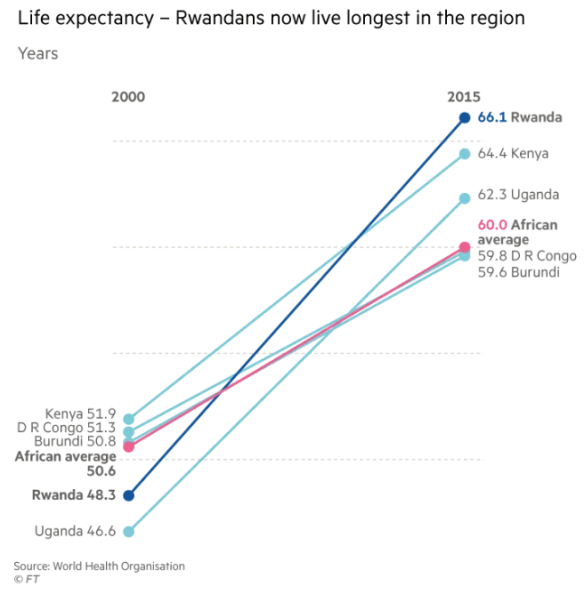
Also, the average Rwandese lives a full six years longer than the average African.

Screen Shot 2017-08-28 at 11.13.48 AM.png

Ultimately, the sustainability of Kagame’s achievements will depend on his ability to solve an important optimal stopping problem:

The problem, he says of who might succeed him, is preventing someone from “bringing down what we have built”. Above all, he says, he wants to “avoid leaving behind a mess”.

The president insists it was never his intention to stay on, but the party and population insisted. “We are not saying, ‘We want you forever until you drop dead,’” he says, imitating the voice of the people. “We’re only saying, ‘Give us more time.’”

Initial Thoughts on the Reelection of President Uhuru Kenyatta

Congratulations to President Uhuru Kenyatta on reelection. In the end, he outperformed the polls by having a well-oiled national campaign that paid close attention to down ballot races. Jubilee MPs, Governors, Senators, and MCAs were elected in Bungoma, Kakamega, and other key swing areas. Where the party won it won big; and in the places it lost, it stayed competitive. The same cannot be said for NASA-affiliates.kenyatta

The polls were not that off. Kenyatta led in all but one poll conducted by Infotrak. In the end it appears that the undecideds stayed home. Turnout was relatively lower in Western and Coast regions (to regions with the biggest share of undecideds) relative to the national average. Odinga needed to at least match Kenyatta’s stronghold turnout in these regions to stay competitive.

Of the two models that I ran, the one incorporation registration rate as a measure of voter enthusiasm did better that the one that only considered historical turnout rates by region. Kenyatta supporters registered at high rates and followed through on Tuesday. Undecided Odinga supporters stayed home on Tuesday.

In a model that gives less weight to registration rates (as proxies for voter enthusiasm and likely turnout), the estimated vote share is Kenyatta 52.8% vs Odinga 47.2%. 

A more involved model that tries to estimate differential voter enthusiasm yields an even bigger advantage for Kenyatta (54% vs 46%). 

Turnout in 2013 was most certainly inflated by both CORD and the Jubilee Alliance.

Whatever one thinks of him, William Ruto is a political genius. After Tuesday has emerged as arguably the most powerful politician in Kenya. Initially I had thought that Jubilee Party was a bad idea that would end up depressing turnout by forcing everyone to vote for the same candidates. In the end it did not matter. Instead, Jubilee won big in the presidential election and, perhaps more importantly, swept key down ballot races. The party will command at least 49% of the seats in the 12 Parliament and will most certainly hit more than 50% with the support of friendly independents. Ruto has successfully vanquished the Moi family in Rift Valley politics. And more importantly, he is slowly emerging to be a national politician with a strong direct following outside of his core base. Only Odinga has managed to achieve this feat in the recent past.

Chances are very high that William Ruto will be the 5th President of Kenya. I must admit to have been wrong in assuming that his political stock would plummet as soon as Kenyatta won reelection. Instead, I think because of his hold on Jubilee his stock will only rise with time. Kenyatta’s elite base cannot push him aside. He has the numbers in Parliament and the very credible threat of inflicting maximum pain by raising political temperatures in the Rift Valley.

This will be a tough loss for Odinga supporters. At 72, this was surely his last stab at the presidency. There will be a lot to be said about the organization and strategy of his campaign — including the apparent lack of polling agents, failure to try and raid Jubilee strongholds, and own goal regarding the prospects of violence following a rigged election (the latter may have cost Evans Kidero the Nairobi governorship). There is also the issue of IEBC’s inability to relay results with the confidence of all parties concerned. However, despite the possibility of hacking of the results transmission system, the down ballot results point to a credible Kenyatta win. Unless more evidence becomes public, I am inclined to believe that this election was credible. The KIEMS system worked. IEBC should build on this success to strengthen the transmission system. It was messy, yes. But it was also most certainly better than last time.

This is a step forward in Kenya’s political development. The opposition is in disarray, but the real institutional fights are about to start within the Jubilee coalition. Ruto’s 2022 ambitions will likely force him to expand the size of the Jubilee coalition. He will likely reach out to Odinga’s base — including in Coast, Nyanza, Eastern, and Western regions. Kenyatta will also want to give himself some credible check on Ruto’s power and influence, which will force him to reach outside of Jubilee’s core constituency for institutional support. Recall that Jubilee is now pretty much Ruto’s party. It will be interesting to see how Joho, Nyong’o, Ngilu, and Oparanya react to all this.

I expect Kenyatta to be constrained by intra-Jubilee politics in his second term. I will say more on the likely political and policy direction of the second term after Kenyatta announces his new cabinet.

In the next fortnight I’ll probably put together a piece on the historical and political significance of Odinga’s likely exit from the political stage.

Hon. Raila Amolo Odinga is perhaps the one individual who has contributed  the most to democratic consolidation in Kenya since the early 1990s. He is also a tragic figure who has had to deal with personal shortcomings, family tragedy, and systemic rejection by Kenya’s powers that be — all played out in full view of the Kenyan public. In addition, it is impossible to talk about Odinga without mentioning the ethnic factor. I think that the biggest impact of this loss will be the Kenyanization of the Luo elite. Since Odinga Senior, the Luo elite have invested a lot in trying to change Kenya (at great expense for the Luo masses) — a fact that made Luo Nyanza the perennial epicenter of oppositionist politics. But with Odinga’s exit, this collective commitment to oppositionist politics will likely diminish. I expect Luo Nyanza politics to become more fragmented and transactional (i.e. less purist). All else considered, the Kenyanization of the Luo elite will probably be a good thing for the masses in Luo Nyanza.


What the poll numbers tell us about Kenya’s presidential election next Tuesday

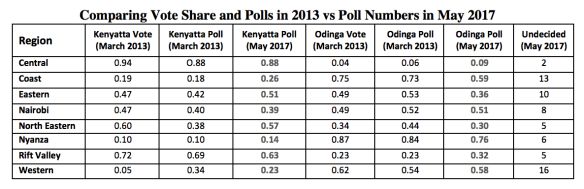
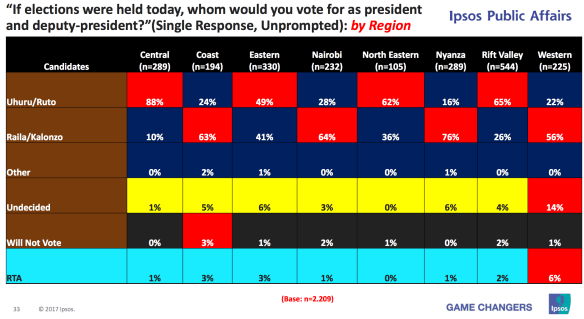
Below is a table from a previous post comparing the poll numbers and actual votes ahead of the 2013 presidential election, as well as May 2017 poll numbers for the two leading candidates (Messrs. Uhuru Kenyatta and Raila Odinga). You can read the background post here. See also here.Screen Shot 2017-05-31 at 9.30.40 PMAlso below is the July 23rd poll released by Ipsos Synovate that reveals some interesting changes over the last two months. As of now the race stands at 47% vs 43%, advantage Kenyatta. But with a margin of error of 2.09%, this is a statistical dead heat.
On President Kenyatta: 

Kenyatta has seen his support decline in Nairobi (by 11 percentage points), Coast, Eastern, and Western regions. His support has increased in North Eastern (by 5 percentage points), Nyanza and Rift Valley regions. In addition, his support is stable in Central region at 88%.

On Prime Minister Odinga:

Odinga’s support has declined in Rift Valley (by 6 percentage points) and Western. His support has increased in Nairobi (by 13 percentage points), Eastern, Central, Coast, and North Eastern regions. In addition, his support is stable in Nyanza region at 76%.
Screen Shot 2017-08-02 at 8.08.46 AM.png

Looking at Trends:

A bigger share of undecideds will likely break for Odinga: The above trends confirm my previous observation that undecideds in Coast, Eastern, and Western regions are likely to be reluctant Odinga supporters. Odinga has seen his poll numbers go up in Coast and Eastern as the number of undecideds has shrunk in both regions. At 14% in the latest poll, the number of undecideds in Western region remain virtually the same from the May figure (16% of respondents). Both Kenyatta and Odinga saw declines in their support in Western region between May and July, but most of the undecideds in the region will likely break for Odinga. Virtually all the leading political elites in the region support Odinga’s bid for the presidency.

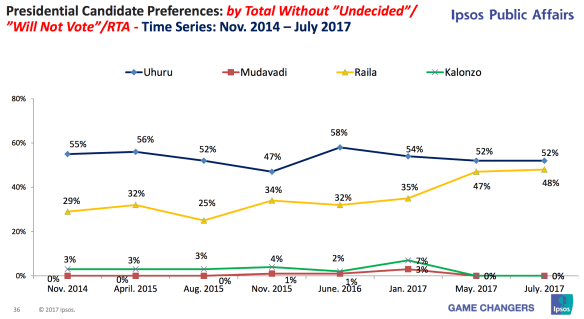
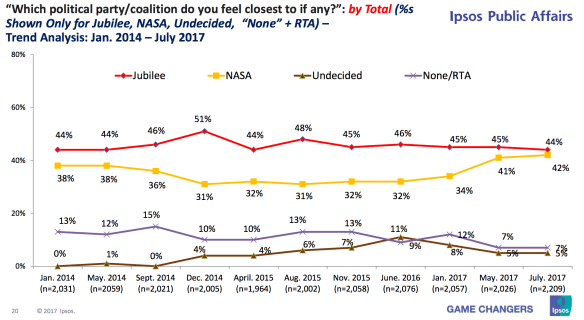
The race has tightened over the last two months: It is also clear that the race has tightened over the last two months as more voters have internalized the fact that this is a two-horse race between Kenyatta and Odinga. In particular, much of the tightening appears to have come from shifts in Western and lower Eastern, the two regions comprising the “Big Five” voting blocs where a clear majority of elites are behind the Odinga ticket.
Screen Shot 2017-08-02 at 8.03.45 AMScreen Shot 2017-08-02 at 7.59.37 AM

What do the numbers say?

First a couple of caveats.

In the last cycle the polling by Ipsos was off by a few percentage points in either direction. The final polls before the election underestimated Kenyatta’s support in all regions except Western. The final poll also underestimated Odinga’s support in Coast, Nyanza, and Western regions, was spot on in the Rift Valley, and overestimated his support in the remaining four regions. This is largely because polling in Kenya is often structured by region, on account of the fact that vote choice often maps neatly on regional/ethnic cleavages. No polling firm has figured out a likely voter model (I honestly don’t know why). Much of the underestimation of Kenyatta’s support came from the erroneous assumption of evenly spread turnout across the country.

And speaking of turnout, it is important to note that the Uhuru/Ruto ticket has a structural advantage. On average, Kenyatta’s core support comes from wealthier regions of the country that are relatively easier to reach and mobilize. In addition, with nearly 40% of the electorate coming from just two of the “Big Five” voting blocs, the combined ticket also offers a classic minimum winning coalition which adds to efficiency of messaging and turnout mobilization. This is in contrast to the Odinga/Kalonzo ticket’s turnout challenge. Its core is three of the “Big Five” that combined add up to just over 30% of the electorate. Therefore, Odinga has to make the difference by appealing to smaller voting blocs, particularly in the Coast, North Eastern, and Rift Valley regions (especially among pastoralist subregions of the Rift). The pro-Odinga non-Big Five regions have historically had relatively lower turnout rates, in no small part because of lower rates of access to education and economic opportunities. Dispersed support also means dispersed messaging. It is not clear that Odinga has successfully been able to overcome his turnout challenge ahead of Tuesday’s election.

The numbers, taking into account likely turnout: 

Based on 2013 turnout, I have created a model that takes into account county-level turnout (averaged at the constituency level to generate more data points). I have then clustered individual counties into regions. A more granular model that looks at individual voting blocs (e.g. that separates Nyamira and Kisii from the rest of Nyanza, Kitui, Makueni, and Machakos from the rest of Eastern, or Narok from the rest of the Rift Valley yields more or less similar results). Lastly, I weighted the estimated turnout in each county by the registration rates ahead of the 2017 elections. Turnout in 2013 varied from a low of 58% in Kilifi to a high of 95% in Makueni. Similarly, registration rates (as a share of eligible adults) ahead of 2017 varied from a low of 50.6% in Vihiga to a high of 86% in Kajiado. Presumably, these differences in registration rates reveal information on voter enthusiasm, and therefore likelihood of turning out next Tuesday.

All this is like attempting to perform open heart surgery with a blunt panga. So bear with me.

After the weighting, I then estimated turnout rates at the county level after which I used the raw vote numbers to estimate turnout rates at regional levels (polling is sparse at the county level). With the regional turnout figures, I then estimated the likely vote totals for Kenyatta and Odinga by region. Throughout this process I ignored the proportion of voters that are undecided.

In a model that gives less weight to registration rates (as proxies for voter enthusiasm and likely turnout), the estimated vote share is Kenyatta 52.8% vs Odinga 47.2%. 

A more involved model that tries to estimate differential voter enthusiasm yields an even bigger advantage for Kenyatta (54% vs 46%). 

In short, going by historical turnout rates, Kenyatta is still a strong favorite to win reelection next Tuesday.

Now, there are several ways in which I could be totally off the mark.

First, there is the issue of undecideds. The bulk of these voters are in Coast and Western regions, both Odinga strongholds. So far the trends indicate that undecideds appear to be breaking for Odinga in larger proportions. Should this trend continue, Odinga may eat enough into Kenyatta’s leads to force a runoff, or even an outright squeaker of a first round win.

Second, there is the issue of turnout. If Odinga were to average a turnout rate of 85 in Nairobi, Coast, and Western regions, my model estimates a vote distribution of 50.9% vs 49.1% in favor of Odinga. If Western and Coast regions alone got to 87% turnout, Odinga’s lead would increase to 51.1% vs Kenyatta’s 48.9%. Structurally, Kenyatta pretty much maxed out on turnout in 2013, while Odinga has a lot of head room.

As I keep saying, this is going to be very much a turnout election in which historical voting patterns strongly favor Kenyatta. For Odinga to have a fighting chance he has to convince undecideds to turn up and vote for him next Tuesday.

Other Interesting Polls to Consider:

There are two other polls that came out yesterday, one commissioned by Radio Africa and another done by Infotrak.

The Radio Africa poll puts the race at 47% for Kenyatta vs 46% for Odinga, a virtual tie. With this poll, too, the trends show a tightening race. Earlier in the month Kenyatta led Odinga by 49% vs 44%. The Infotrak poll puts the race at 49% for Odinga vs 48% for Kenyatta. Infotrak is the only polling company that has shown Odinga leading Kenyatta throughout this cycle.

Finally, Ipsos also released a poll yesterday that puts the race at 47% (Kenyatta) vs 44% (Odinga), but the details of which are not yet available. More on this soon.