South Sudan to relocate capital to Ramciel

The Sudan Tribute reports:

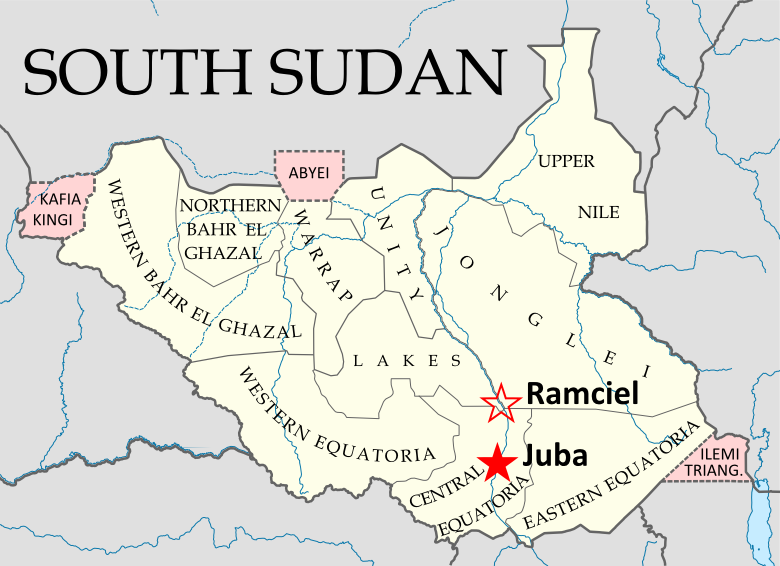
“The survey for the proposed new capital of South Sudan, Ramciel, is expected to be completed within the next six months, reports the official in charge of the project.

resolved to suspend any construction of new public buildings for the national government in Juba.

Juba was disqualified for a number of reasons including administrative stalemate over which level of government its jurisdiction should fall under.”

That is the official reason.

Source: Political Geography Now

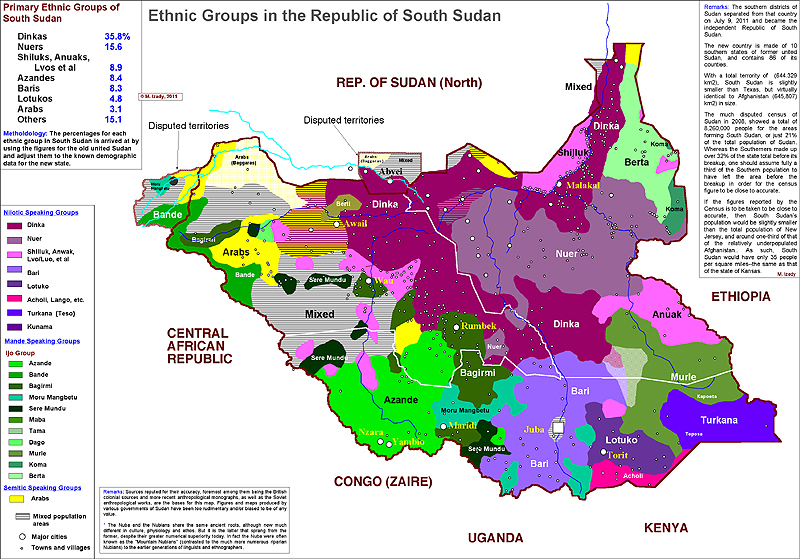
I know very little about the deliberations that resulted in the move but another reason could be that Juba was too far from the new nation’s centre of (ethno) political gravity (see maps; click on image to enlarge). Relocations of capitals almost invariably have political considerations. One only hopes that the Bari community whose ancestral homeland is around Juba will not suddenly find themselves completely abandoned by the central government.

The government should ensure that Ramciel does not suddenly suck in all the money. It could prove beneficial to decouple the political and economic capitals of the country.

Source: Gulf 2000 Project

On the plus side this is a sign that the new government in Juba is willing to try out new things. A fresh start in Ramciel might not be such a bad idea.

A Ugandan journalist and a politician respond to Kony 2012

Angelo Izama, Ugandan journalist (and a good friend of yours truly) has a thoughtful op-ed piece in the Times. He makes the case that:

Campaigns like “Kony 2012” aspire to frame the debate about these criminals and inspire action to stop them. Instead, they simply conscript our outrage to advance a specific political agenda — in this case, increased military action.

African leaders, after all, are adept at pursuing their own agendas by using the resources that foreign players inject and the narratives that they prefer — whether the post-9/11 war on terror or the anti-Kony crusade. And these campaigns succeed by abducting our anger and holding it hostage. Often they replace the fanaticism of evil men with our own arrogance, and, worse, ignorance. Moreover, they blind us by focusing on the agents of evil and not their principals.

At the same time over at FP Nobert Mao, politician from northern Uganda and former presidential candidate, has the following to say:

It’s clear that the aim of the video [Kony 2012] was never intellectual stimulation. I don’t think the founders of Invisible Children are the foremost analysts of the complicated political, historical and security dynamics in our troubled part of Africa. They certainly wouldn’t earn high marks in African Studies. But I will go to my grave convinced that they have the most beautiful trait on earth — compassion.

Such sentiments matter, even today.  There are those who say the war is over in Northern Uganda. I say the guns are silent but the war is not over. The sky is overcast with an explosive mix of dubious oil deals, land grabs, arms proliferation, neglected ex-combatants, and a volatile neighborhood full of regimes determined to fish in troubled waters. What we have is a tentative peace. Our region is pregnant with the seeds of conflict. The military action in the jungles of Congo may capture Kony, but we need to do more to plant the seeds of peace founded on democracy, equitable development, and justice. Like peace, war too has its mothers, fathers, midwives, babysitters, and patrons. Perhaps Kony 2012 will help sort out the actors. The video has certainly shaken the fence, making fence-sitting very uncomfortable, indeed.

The two may disagree on the usefulness of tactics such as those that made the now famous video, but they certainly agree on the need to acknowledge agency of local actors in all these problems that require outside intervention.

My two cents on this is that there is definitely room for Africans to shape the narrative and tactics of advocacy in Western capitals (or elsewhere). Emotionally charged  mobilization tactics, like Kony 2012, are definitely a distraction from the real issues. But they also present an opportunity for African actors to leverage international attention and support against their own leaders who refuse to deal with problems that affect their daily lives. I am glad that in the case of Kony 2012 Ugandans have stepped in to provide perspective on the narrative and, hopefully, influence the eventual response by the relevant policymakers in DC.

Tough trying to be good in a bad neighborhood

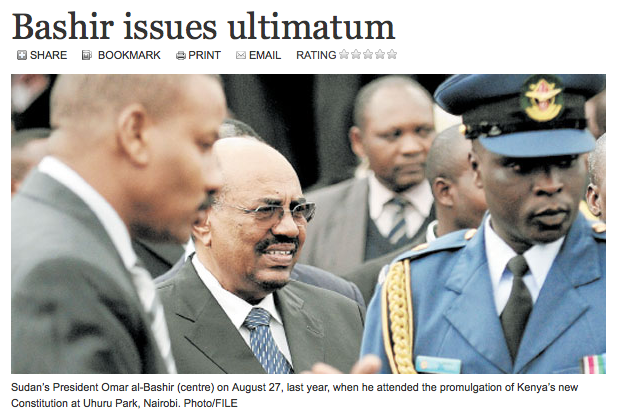
A few days ago a Kenyan judge ordered the government to arrest Sudanese President Omar al-Bashir if he ever sets foot in Kenya. Mr. Bashir has an outstanding arrest warrant against him from the ICC for crimes against humanity committed since 2003 in Darfur.

The ruling has since metastasized into a full blown diplomatic row; Khartoum expelled the Kenyan ambassador before rescinding the expulsion, and is now threatening to cut all trade ties with Kenya, expel Kenyans living in Sudan and deny any planes leaving or going to Kenya from flying in its airspace – if the government does not take back the ruling in two weeks.

The diplomatic row aside, the case has implications for the reform process in Kenya. The case is a test of the depth of the Kenyan judiciary’s new found independence from the executive.

According to Khartoum:

“al-Bashir expects Nairobi to scrap the arrest warrant within the next two weeks and not simply file an appeal.”

That is not how the judicial process works in a democracy. The executive cannot just scrap a judicial ruling. Within Kenya, for the sake of precedence the government must be seen to be complying with court rulings. The Chief Justice has already warned the executive against ignoring the court ruling saying that

“If a country chooses to live by anarchy, it must be ready to face the consequences of disregarding the law.”

It remains unclear what the executive will do given Khartoum’s two week ultimatum. Disregarding the court ruling will come with consequences for the individuals involved – in particular the Foreign Minister and the Commissioner of Police.

Kenyan Court Orders Bashir Arrest, Sudan Expels Kenyan Ambassador

UPDATE:

The BBC reports:

Sudan ordered the expulsion of the Kenyan ambassador after a Kenyan judge issued an arrest warrant for Sudan’s President Omar al-Bashir, Sudan’s foreign ministry has said.

Mr Bashir is wanted by the International Criminal Court (ICC) for alleged war crimes in Darfur.

Sudan has ordered the Kenyan ambassador to leave the country within 72 hours.

It has also ordered the Sudanese ambassador in Kenya to return to Khartoum.

*************************************************************

A Kenyan court has issued an arrest warrant for Sudan’s President Omar al-Bashir over alleged war crimes in Darfur.

The ruling came after Kenya allowed Mr Bashir to visit in August in defiance of an International Criminal Court (ICC) warrant for his arrest.

The judge said he should be arrested if he “ever set foot in Kenya” again, the AFP news agency reports.

Kenya is a signatory to the treaty which established the ICC in 2002.

The new Kenyan constitution requires that the government implements its international treaty obligations. The ruling, though without much bite – I doubt Bashir will need to be in Kenya any time soon, has immense symbolism in the region.

It also matters for Kenyan domestic politics. Presently, a few high ranking Kenyan politicians – including the Finance minister, two former ministers and former police boss – are on trial at the ICC for crimes against humanity. The accused await judgment on the admissibility of their cases later this year or early next. The Bashir ruling means that if the charges against the “Ocampo Six” are confirmed but the government drags its feet in implementing an arrest warrant then the courts will step in.

More on the Bashir case here and here.

In other news, Uganda and Tanzania have rejected Khartoum’s petition to join the East African Community, citing “several issues like their democracy, the way they treat women and their religious politics.” Yeah right.

More on Eritrea and armed groups in eastern Africa

While Eritrea has in the past been repeatedly accused of supporting Somalia’s Islamist militia Al Shabaab, a charge it strenuously denies, the current report catalogues Afewerki’s growing notoriety in the world of terrorism finance, and in particular the global web through which these funds are routed, with Kenya serving as a global transaction distribution hub.

The report details the country’s activities in funding the terror group, following the money trail from its citizens in the diaspora in Europe and North America, through Dubai and the Eritrean embassy in Nairobi, and into the hands of Al Shabaab, all the while concealed in convoluted and opaque informal financial networks.

That is The East African reporting on Eritrea’s support for armed groups in the wider eastern African region. Mr. Afewerki’s actions are a threat to regional security for the following reasons:

1. Eritrea’s (opportunistic and cynically instrumental) use of Islam as a galvanizing force (against “Christian” Ethiopia) threatens to ignite a wider regional conflict that would probably include North Sudan and Egypt. The reason this is likely is because:

       (a) Remember that the use of the waters of the Nile continues to be a source of friction between Egypt and the riparian states of eastern Africa. Egypt itself has in the past been linked to armed groups in Somalia opposed to Ethiopian rule of the Ogaden region. Both countries have a history of funding rival clan militias in Somalia. In all of this the principle of my enemies’ enemies’ are my friends will most likely apply.

        (b) Because of its own problems with South Sudan, North Sudan might have an interest in using Eritrea’s networks to destabilize its southern neighbor. Recently the government of South Sudan banned all people of Somali origin from entering the country by land for security reasons. Juba clearly suspects either direct or indirect links between Khartoum and the myriad armed groups in war-torn Somalia

2. Given that the groups it supports (e.g. al-Shabaab) have other enemies besides Ethiopia, President Afewerki has effectively declared war on countries like Uganda, Burundi, South Sudan and Kenya that have also either been attacked or threatened by al-Shabaab. I wouldn’t be surprised if one or two of these EAC states decided to materially support the Ethiopian side the next time Addis and Asmara fight over their barren disputed border lands.

Quick hits

Guide to arguing on the internet (HT Lauren).

Speaking of arguing on the internet, I like the drama that is spats between economists and other academics on their respective blogs.

The Economist presents the faces of famine in the Horn. It is beyond sad that so many people should be condemned to suffer this man-made tragedy.

Brett Keller has posts here and here on Sam Childers (a.k.a. machine gun preacher), a gun-runner into the habit of doing morally and ethnically dubious things in the name of God. Keller says that Childers is “stockpiling arms at his orphanage and has admitted to selling weapons to unnamed armed factions in Sudan, Uganda, and Rwanda.”

In Zambia (where I shall be for the elections in Sept.) the politics of citizenship and belonging are yet to be settled 50 years after independence. We recently witnessed the dangers of de-legitimizing whole sections of countries as outsiders in Cote d’Ivoire. I hope that if Sata ever wins he will not do what incumbent Ivorians did to ignite a rebellion in the northern reaches of their country. For more on this check out this great book on the Ivorian collapse. I have read it and absolutely loved it.

A muddy few months ahead for the South African government. Infighting with the ANC top brass might mean an early exit for President Zuma. With over 60% of the votes in the last election, the ANC is essentially an oversize coalition prone to internal wrangles. It will be interesting to see how Zuma weathers the storm in the midst of challenges from both COSATU and Malema.

Lastly, the current issue of the Journal of African Economies looks at the impact of higher education in Africa. The main takeaway is that the low quality of education at lower levels (primary and secondary) has meant that the biggest bang for the buck on the Continent, as far as education is concerned, only comes with higher education. Too bad that many of those that get higher education are underpaid or out of the Continent all together.

Securing Peace in South Sudan

UPDATE:

The ICG has a good report on the simmering conflicts in Sudan and South Sudan:

The loss of South Sudan has had a profound effect on the NCP, and senior generals led a soft-coup within the party. They have outflanked more pragmatic elements in the NCP who seek a negotiated strategy. Encouraging progress in the post-separation arrangements between North and South was blocked. More importantly, hardliners in Khartoum — including SAF generals — immediately rejected a 28 June framework agreement, which includes a political and a security agreement for Southern Kordofan and Blue Nile, facilitated by former South African President Thabo Mbeki and Prime Minister Meles Zenawi of Ethiopia, and signed by Dr. Nafie Ali Nafie, Co-deputy NCP chairman and a presidential adviser. A few days later, President Omar al-Bashir publicly disavowed the agreement.

Check out the rest of the report here.

******************************************

Texas in Africa makes a compelling argument against arming South Sudan (against potential aggression from Khartoum). She basically outlines three reasons against arming Juba:

  1. Such a move would implicitly side with the SPLM against other domestic armed/opposition groups. The point of concern here is that having just won independence South Susan needs to have a negotiated settlement among all interested groups. The Dinka-dominated SPLM, in particular, ought to credibly share power and resources with the other ethnic/interest groups.
  2. Arming South Sudan would spark an arms race against Khartoum and might lead to a war sooner rather than later.
  3. The West can’t be sure of Juba’s future geopolitical leanings. The same weapons might be used in the future against say America and its allies – AfPak style.

For the most part I agree with Laura. And like her, I am on record as having concerns over the alarmist celebrity diplomacy/mediation effort that has been orchestrated in South Sudan, Darfur and eastern DRC by Prendergast and his buddy Clooney.

In addition, I think that the debate over whether or not to arm Juba forecloses on other options that might also help secure South Sudan. Make no mistake, South Sudan has real domestic and international security challenges that occasionally will require the use of military force. Addressing these security challenges will necessarily require some form of military aid to South Sudan.

Here’s my take:

  1. If South Sudan is to avoid the fate of Zaire/DRC, the pacification of the whole country must happen ASAP. While negotiating with rebel leaders is the best approach, the truth is that in some cases military force might be needed. To that end providing SPLM with the necessary capacity to win the fight against fringe groups that do not want to sit at the negotiating table may be a necessary evil. Yes, we should be cognizant of the fact that there are legitimate internal differences within South Sudan. But we should not legitimize any groups that might want to air those differences using the force of arms. Real democratic competition can only take place in a peaceful environment. Armed challengers to SPLA (the legitimate army of South Sudan) must bear the burden of proving the legitimacy of their grievances. South Sudan’s Savimbis must be deterred. Also, the international community must not be under any illusion that democracy will come soon to South Sudan. It will take a long time.
  2. The arms race between Khartoum and Juba is already underway. The question is not if it will happen but what it will lead to. Furthermore, after “losing” the South and its oil Bashir will be hard pressed for distractions from his domestic woes, especially if the economy of Sudan experiences a sharp decline. Starting a border war with South Sudan would be a welcome distraction. Although arming the SPLA is not the best way to deal with this possibility, an alternative would be to bring in the EAC through a regional defense pact. Uganda, in particular, would be interested in such a deal since it would help reduce its own defense budget. The involvement of Eritrea in South Sudan’s internal conflicts makes the need for a regional security arrangement even more urgent. Most recently the UN accused Eritrea of plotting to bomb an AU meeting in Addis Ababa Ethiopia.
  3. Concerns over Juba’s future geopolitical leanings can be allayed through continued military aid and professionalization. This can be achieved by getting the generals out of politics following the Kenyan model – a combination of awesome perks and professional training – and through greater political and economic integration of South Sudan into the East African Community.

War is nasty and should be the last option. That said, there is a need for genuine debate over how to achieve the twin goals of state monopoly of violence within South Sudan and the deterrence of a trigger-happy Khartoum.

If it were left to me I would quickly move to decouple the SPLM and SPLA as a condition for any military assistance. The last thing the region needs is yet another regime with a fused political and military leadership as is the case in Rwanda and Uganda.

The EAC needs a defense pact

UPDATE: The Government of South Sudan has barred people of Somali origin from entering the country by road for “security reasons.” This wrongheaded move has created an awkward situation since not all people of Somali origin are from Somalia. In Kenya, for instance, a good chunk of the long haul transport sector is run by Kenyans of Somali origin.

********************************************************

The Ugandan government recently went on a $1 billion shopping spree for six fighter jets. The deal, which almost broke the bank, made a significant dent on Uganda’s forex reserves. Many, while acknowledging the risks that might have motivated the purchase, have questioned the wisdom of spending that much money on six jets.

For those not in the know, the key motivation for Museveni’s purchase was a desire to project military power in the region for two key reasons:

Firstly, in order to create a market for Ugandan light industries – cooking oil, soap, etc – Kampala has had to project military power to help in the pacification of pockets of eastern DRC and northern Uganda/South Sudan. These markets are crucial because they create jobs in Uganda, allowing Museveni some room as he continues to preside over Uganda’s decline into a dysfunctional police state.

The second reason was Museveni’s desire for military grandeur in the region. Kigali and Khartoum are not in the best of terms with Kampala. Museveni is probably suspicious of a potential Odinga presidency in Kenya. For these reasons, the Ugandan military establishment – the real rulers of Uganda – might have wanted to ensure that non of their neighbors are in a position to bully them in the near future.

While most of Museveni’s militarism is inspired by a mentality from a bygone era, I find Kampala’s fears against Khartoum as legitimate grounds for a regional defense pact. It is an open secret that Khartoum will try as much as it can to destabilize the new government of South Sudan (and by extension the wider region). And they have a few options:

  • They can foment civil war within South Sudan – there are a lot of disgruntled armed bands within South Sudan who might decide to take their chances with Khartoum; Remember that even Riek Machar, the current vice president of South Sudan, formed a Khartoum-backed splinter group (SPLA-Nasir) that fought Garang’ back in the early 1990s.
  • They can use armed groups in the wider central African region – including Kony’s LRA and the plethora of roving bandits in eastern DRC to engineer insecurity in South Sudan. Khartoum has used the LRA against SPLM in the past.
  • They can invade in an all out war. This option is the riskiest because of its potential to generate international opprobrium. But remember that Ethiopia and its secessionist former province Eritrea fought a bloody war that generated nothing but “stern” warnings from the UN and the wider international community. The US even armed Ethiopia because it needed Addis Ababa to fight its war in Somalia.
  • Lastly, they can use non-conventional tactics. Terrorism is slowly growing in the wider east African region. So far Eritrea has been the biggest state sponsor of terror in the region – mostly aimed at Ethiopia in the Ogaden, Oromo land and Somalia. The involvement of Ugandan and Burundian troops in Somalia has created even more enemies for these groups. There is no reason to believe that Khartoum would not use these same groups to destabilize South Sudan, if for nothing then as a survival tactic for a beleaguered Bashir administration that will forever be blamed for having lost the South’s oil.

Needless to say, an unstable South Sudan is bad for the region. Period.

The proliferation of small arms is already a major problem in the areas bordering the Ilemi triangle and eastern Uganda. That instead of sticks pastoralists have to roam around with AK-47’s says it all. More conflict in South Sudan will only make a really bad situation even worse. The potential for proxy wars within the region would also be an unnecessary drain on limited resources. Because of various interests in Juba, an aggression by Khartoum against South Sudan will definitely be met with reaction in one form or another from Kenya, Ethiopia and Uganda.The conflict will definitely be regionalized. Lastly, Eritrea’s bad habit of supporting terrorists should not be permitted to catch on. Khartoum must know that if it tries this dirty tactic it will be met by more than just resolutions from the AU, IGAD or the UN.

Which is why I think that the EAC should have a robust defense pact. War should have to be a last resort. But that does not mean that the East African Community should not prepare for such an eventuality, if it arise.

That way, no single country will be burdened with the task of buying all the necessary hardware needed to keep Khartoum deterred.

Such a plan would face significant challenges, of course – key among them the fact that the region’s armies are non-professionalized. A functional defense pact would require near total civilian control of the army. Only Kenya and Tanzania come close to this in the EAC. Rwanda, South Sudan and Uganda are dominated by their respective armies. Burundi can’t even win against rebels within its territory and remains a militarized tin pot dictatorship. And Ethiopia, if it were to join, is still dominated by the remnants of the rebellion that ousted Mengistu.

These challenges aside, it might be worth a try. Such a pact might even help professionalize and de-politicize the officer corp in the region’s armed forces.

And the biggest winner if this were to happen is MORE regional trade.
Welcoming Southern Sudan to the EAC

UPDATE: A related article on Uganda’s influence in the soon to be independent South Sudan can be found in the New York Times.

In three days the East African Community will celebrate the independence of its next newest member. Because of SPLM connections in Kenya, among other East African nations, the Southern Sudanese economy will most likely orient itself southwards.

Kenya’s Vision 2030 development plan, for instance, will link Southern Sudan to the Indian Ocean coast via a pipeline and railway line. Oil from South Sudan is currently exported through Port Sudan, 3,000 kilometres away. The planned link to Lamu would reduce that distance to 1,700 kilometres.

For Southern Sudan, economic ties with its southern neighbors will not only grant it access to much needed capital and skilled labor but also implicitly guarantee it security against its menacing neighbor to the north.

I doubt that Kenya, Ethiopia and Uganda will sit on their hands if the north decides to bomb local offices of Equity Bank, Ethiopian Airlines or Ugandan retail outlets in Juba (Remember the “Kenyan” tanks fiasco?). It also helps that IGAD has suddenly woken up to the security challenges posed by proxy wars among its member states. Kenya’s president, and current head of IGAD, recently chastised Eritrea for its ties with militant groups in the region.

IGAD will provide yet another forum for the region to put pressure on Khartoum to honor the CPA and not resort to war.

Several Kenyan companies have already set up shop in Juba. About 70,000 Kenyans live and work in Southern Sudan. According to the Business Daily:

Although several major Kenyan companies like Equity Bank, KCB, UAP Insurance and many small enterprises operate in South Sudan, the independence declaration on July 9 is expected to trigger another wave of corporate movement there.

Bidco Refineries that has a dealership in South Sudan, for example, is expected to consider having a physical presence there, said the company’s CEO Vimal Shah in an earlier interview. Kenyan manufacturers are, however, discouraged by low consumption levels and shortage of power, water and sewerage systems.

Co-operative Bank of Kenya is also expected to start setting up its banking infrastructure with a new venture that will be 30 per cent owned by the Government of South Sudan.

The new bank is expected to benefit from government business as it will process salaries of government employees and enjoy business arising from the government’s shareholding in the venture. The peaceful aftermath of the January 9 referendum that voted for secession from the North has helped to improve the country’s risk profile.

Graphical Illustration of China’s global reach

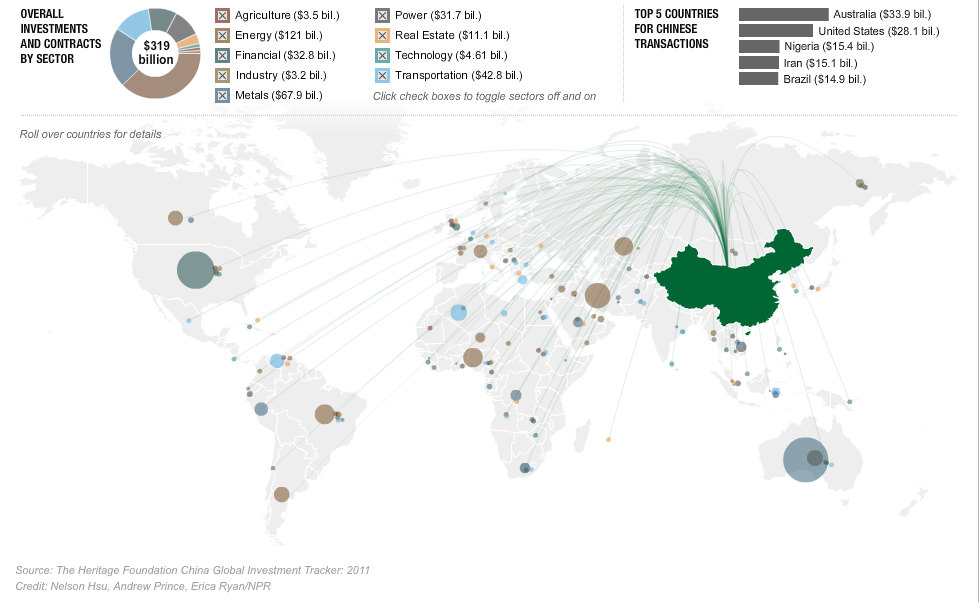
NPR has this cool graphic on China’s global investments [click on image to enlarge].

Notice that Nigeria is among the top destinations of Chinese investments.

In my alternate universe Abuja (the undisputed regional hegemon) is stable and uses this, and the fact that it is also among the most important sources of US-bound crude oil, as leverage to nudge the two biggest global powers in the direction of a more stable and coherent Africa policy.

More on this here.

Quick hits

Texas in Africa’s review of Fighting for Darfur.

Blattman on economic growth and development.

The long arms of the Rwandan state?

The Zambian elections will be close. Last time round the opposition leader lost by a mere 3% (I will be there for the campaigns this summer).

And lastly, Kenya’s trillion-shilling proposed budget. High on development expenditure but could it crowd out the private sector?


Who will stop khartoum?

It appears that the war between north and south Sudan is inevitable. The north overran the disputed town of Abyei last week and now is angling to take over two border states. The Times reports:

Now, according to a letter from the Sudanese military’s high command, the northern army, in the next few days, plans to take over Blue Nile and Southern Kordofan states, two disputed areas with a long history of conflict that are still bristling with arms.

Analysts, local leaders and Western diplomats fear that if the northern army carries through on its threat to push out or forcibly disarm the thousands of fighters allied to the south in these two areas, it could set off a much bigger clash between the northern and southern armies, who have been building up their arsenals for years in anticipation of war.

Malik Agar, Blue Nile’s governor, said Sunday night that northern forces had recently moved “dangerously close” to the bases of southern-allied fighters and that he didn’t think the southern-allied forces would surrender.

A part of me still thinks that Bashir’s sabre-rattling is designed for the northern public. After all he will go down in history as the president who lost the south. In order to avoid immediate ouster he must, at least, pretend to put up a fight. My other side, however, thinks that Bashir (and his generals) might actually want war. Oil and water are on the line.

So how can a war be avoided?

Right now everyone appears to be looking in the direction of the UN for help. But the UN is busy putting out fires elsewhere, not least in Darfur where Khartoum’s forces keep firing at UN helicopters.

That Khartoum would let the south go peacefully was always a long shot. Many analysts had predicted that the north would either finance mini-rebellions in the south or go for a full blown war. It appears that Khartoum is going for both.

South Sudan does not need this war. The whole country has less than 200 Kilometres of paved road, among other mind-boggling underdevelopment records. Its human capital development is lagging behind the regional average by decades. A sustained war would take away vital resources from much needed development work.

Which brings me back to the title of this post. Many a time I have lamented at Africa’s lack of a regional hegemon. A hegemon that would take the mantle of regional conscience and policeman. A regional power that would put out fires even when the UN and the global powers that be were too busy (like they are now) or just plain indifferent (remember the mid-1990s?).

If it occurs the north-south war will be bloody and dirty (read land mines, more child soldiers, crimes-against-humanity tactics). As many as hundreds of thousands of people could die. Millions will be affected. It will also mean more light arms in an already volatile region, not to mention potential for spillovers into ongoing insurgencies in The DRC, Chad, Uganda and Ethiopia. Who will stop Omar al-Bashir and his generals?


talks between north and south sudan break down

The US Foreign Ministry (State Dept.) has announced on its blog that talks between the NCP and the SPLM have broken down. The blog post partly said:

In this sensitive period, it is critical that the NCP and SPLM maintain their dialogue and make further progress toward the creation of sustainable economic, political, and security arrangements between the two parties. To that end, we urge President Bashir and First Vice President Kiir to take steps against alleged actions that destabilize each other’s governments and territories, and to lay the ground for mutual cooperation with the goal of the creation of two viable states in July.

The communique also made note of the rapidly escalating war by proxies (Omar al-Bashir is the king of such tactics in the Great Lakes region):

We also condemn the violence in Malakal, Southern Sudan, on March 12. The Comprehensive Peace Agreement (CPA) rules out the existence of armed groups outside the two established forces of the parties. Allegations of support to proxies are serious, and should be investigated through established CPA mechanisms and the good offices of UNMIS. The members of the Troika stand ready to assist.

The war between north and south Sudan is almost inevitable. Unresolved border issues in Abyei, Jonglei, Nuba Mountains and Blue Nile, renegotiation of oil revenues and the south’s internal problems will most certainly result in war in the very near future.

North Sudan must be thinking that given how fast the south is arming (through Kenya) it might be prudent to strike while Juba is still weak (right after independence in July) than wait until the south is strong and has a pipeline through Kenya thus no longer needing the north’s pipelines and refineries. Plus having “lost the south” and facing continued pressure following events in the Middle East and North Africa, Omar al-Bashir could use a little of the tried and tested war of distraction tactic.

south sudan and the challenges of self-rule

The BBC reports that at least 100 people have been killed in clashes between the South Sudan government and soldiers loyal to a renegade rebel, George Athor, in Jonglei State.

This latest clash does not come as a surprise. Most analysts predict a high likelihood of civil war in post-independence South Sudan. Conflict will most likely come from two sources: Khartoum funding local dissident groups in order to check Juba and internal ethnic rivalry over government positions and the sharing of oil wealth.

Civil war in South Sudan may prove to be deadlier than the 2 decade war against Khartoum. Civilianization of the two decade war placed guns in the hands of most able bodied young men (In the South cattle herders tend to their animals with AK’s in hand). The prospect of Khartoum supporting secessionist movements along its border with the South is not pure fantasy.

The spotlight is on the political elite in the South. Will they hammer out a power and resource sharing deal or will despotism yet again kill the independence dreams of an African nation? I can’t stop thinking that John Garang’ de Mabior died too soon.

Afro-American relations and Justice

FP Magazine reports:

In short, all the carrots that U.S. diplomats are offering the Sudanese president seem to be working. Among the prizes for Khartoum are a U.S. promise to remove Sudan from its list of terrorism-supporting states and a possible visit by U.S. Secretary of State Hillary Clinton, according to the Sudan Tribune. Earlier this month, U.S. State Department officials also signaled that they would be ready to begin normalization following Sudan’s acceptance of the vote.

While the US approach has yielded good results in securing the secession referendum in the South, American policy in the wider region leaves a lot to be desired. Washington appears to be ready to cut a deal with any dictator, as long as they serve a short-term US need.

America needs to do more on Darfur. America needs to do more in Ethiopia, where Meles Zenawi continues to reign with an iron fist without any pretense of respecting human rights. America needs to do more in Uganda, where Museveni has emerged as an anti-terror crusader who does not care for any liberal (in the classical sense) ideals.

The choice between protecting American interests abroad and respecting the rights of other peoples of the world is a false choice. Liberty (the world over) is not incompatible with American security. The ideals embodied in the federalist papers, the American declaration of independence, and the first amendment of the US constitution should not be confined within the US borders as far as American policy goes.