More good news on the fight against AIDS

AIDS researchers, many of whom have been meeting this week in Rome under the auspices of the International AIDS Society, are rightly pleased with the progress they have made. In particular, the use of antiretroviral drugs has not only revolutionised treatment of HIV infection, but also offers the prospect of stopping the spread of the virus. In a matter of weeks, these drugs reduce the number of viruses per millilitre of infected blood from millions to less than 50. That deals with both symptoms and infectivity. Unless a patient stops taking the drugs, or goes on to develop resistance to them, he can expect to live almost as long as an uninfected individual.

……. there is a glimmer of hope on the horizon. To deal with dormant viruses several researchers are taking what sounds like a counterintuitive approach. They are trying to wake the viruses up and so boost, rather than reduce, the amount of active HIV in a patient’s body. Their reasoning is that the now-active viruses will either kill the cells they are in (and thus themselves) or encourage the immune system to attack those cells.

That is the Economist in its latest issue. For more on the details of the state of AIDS research go here.

The Economist’s optimism is supported by empirical data. According to the Vancouver Sun:

HIV patients in Uganda who are receiving regular treatment can expect to live a near-normal lifespan, Canadian researchers have suggested in the world’s first large-scale study to examine HIV patients’ life expectancy in Africa.

After studying 22,315 patients who were using combined antiretroviral therapy (cART), scientists from the B.C. Centre for Excellence in HIV/AIDS along with experts at the Universities of British Columbia and Ottawa found that with early initiation and access to regular treatment, those infected with HIV were living about two-thirds of a normal lifespan.

More on this here.


The EAC needs a defense pact

UPDATE: The Government of South Sudan has barred people of Somali origin from entering the country by road for “security reasons.” This wrongheaded move has created an awkward situation since not all people of Somali origin are from Somalia. In Kenya, for instance, a good chunk of the long haul transport sector is run by Kenyans of Somali origin.

********************************************************

The Ugandan government recently went on a $1 billion shopping spree for six fighter jets. The deal, which almost broke the bank, made a significant dent on Uganda’s forex reserves. Many, while acknowledging the risks that might have motivated the purchase, have questioned the wisdom of spending that much money on six jets.

For those not in the know, the key motivation for Museveni’s purchase was a desire to project military power in the region for two key reasons:

Firstly, in order to create a market for Ugandan light industries – cooking oil, soap, etc – Kampala has had to project military power to help in the pacification of pockets of eastern DRC and northern Uganda/South Sudan. These markets are crucial because they create jobs in Uganda, allowing Museveni some room as he continues to preside over Uganda’s decline into a dysfunctional police state.

The second reason was Museveni’s desire for military grandeur in the region. Kigali and Khartoum are not in the best of terms with Kampala. Museveni is probably suspicious of a potential Odinga presidency in Kenya. For these reasons, the Ugandan military establishment – the real rulers of Uganda – might have wanted to ensure that non of their neighbors are in a position to bully them in the near future.

While most of Museveni’s militarism is inspired by a mentality from a bygone era, I find Kampala’s fears against Khartoum as legitimate grounds for a regional defense pact. It is an open secret that Khartoum will try as much as it can to destabilize the new government of South Sudan (and by extension the wider region). And they have a few options:

  • They can foment civil war within South Sudan – there are a lot of disgruntled armed bands within South Sudan who might decide to take their chances with Khartoum; Remember that even Riek Machar, the current vice president of South Sudan, formed a Khartoum-backed splinter group (SPLA-Nasir) that fought Garang’ back in the early 1990s.
  • They can use armed groups in the wider central African region – including Kony’s LRA and the plethora of roving bandits in eastern DRC to engineer insecurity in South Sudan. Khartoum has used the LRA against SPLM in the past.
  • They can invade in an all out war. This option is the riskiest because of its potential to generate international opprobrium. But remember that Ethiopia and its secessionist former province Eritrea fought a bloody war that generated nothing but “stern” warnings from the UN and the wider international community. The US even armed Ethiopia because it needed Addis Ababa to fight its war in Somalia.
  • Lastly, they can use non-conventional tactics. Terrorism is slowly growing in the wider east African region. So far Eritrea has been the biggest state sponsor of terror in the region – mostly aimed at Ethiopia in the Ogaden, Oromo land and Somalia. The involvement of Ugandan and Burundian troops in Somalia has created even more enemies for these groups. There is no reason to believe that Khartoum would not use these same groups to destabilize South Sudan, if for nothing then as a survival tactic for a beleaguered Bashir administration that will forever be blamed for having lost the South’s oil.

Needless to say, an unstable South Sudan is bad for the region. Period.

The proliferation of small arms is already a major problem in the areas bordering the Ilemi triangle and eastern Uganda. That instead of sticks pastoralists have to roam around with AK-47’s says it all. More conflict in South Sudan will only make a really bad situation even worse. The potential for proxy wars within the region would also be an unnecessary drain on limited resources. Because of various interests in Juba, an aggression by Khartoum against South Sudan will definitely be met with reaction in one form or another from Kenya, Ethiopia and Uganda.The conflict will definitely be regionalized. Lastly, Eritrea’s bad habit of supporting terrorists should not be permitted to catch on. Khartoum must know that if it tries this dirty tactic it will be met by more than just resolutions from the AU, IGAD or the UN.

Which is why I think that the EAC should have a robust defense pact. War should have to be a last resort. But that does not mean that the East African Community should not prepare for such an eventuality, if it arise.

That way, no single country will be burdened with the task of buying all the necessary hardware needed to keep Khartoum deterred.

Such a plan would face significant challenges, of course – key among them the fact that the region’s armies are non-professionalized. A functional defense pact would require near total civilian control of the army. Only Kenya and Tanzania come close to this in the EAC. Rwanda, South Sudan and Uganda are dominated by their respective armies. Burundi can’t even win against rebels within its territory and remains a militarized tin pot dictatorship. And Ethiopia, if it were to join, is still dominated by the remnants of the rebellion that ousted Mengistu.

These challenges aside, it might be worth a try. Such a pact might even help professionalize and de-politicize the officer corp in the region’s armed forces.

And the biggest winner if this were to happen is MORE regional trade.

Links I liked

I just discovered Chri’s Blog on Madagascar and other Africa-related issues.

For those with a flavor of finance and capital markets and the political economy of development be sure to read Frontier Markets.

Germany is on the hunt for the UN security council seat in Africa.

And lastly, Justice – Uganda style:

Vice president upsets the president during tenure, president fires vice after election. Former vice gets accused of corruption. President declares former vice innocent, but leaves the matter up to the “independent” Inspectorate of Government. Here’s a quote from the president:

“What I know is that there was a power struggle between Bukenya and some businessmen but I found no merit in the case. But since the Inspectorate of Government is an independent body, let them investigate thoroughly.”

Yeah right.

Another African country strikes black gold, in massive amounts

UPDATE: The office of the president in Uganda is saying that the oil around Lake Albert may be double what was initially thought. According to Bloomberg:

” Uganda may hold deposits of as many as 6 billion barrels of oil, more than double the current estimate, according to the office of the nation’s presidency.

“Some analysts estimate that Uganda’s Albertine Graben may hold more than 6 billion barrels of oil,” the presidential office said in an e-mail statement yesterday. The estimate is well above the discovered deposits with a potential of 2.5 billion barrels, it said.”

*************************************

Namibia has joined Ghana and Uganda as the latest winners of the oil lottery in Africa.

According to the Independent Online:

An estimated 11 billion barrels in oil reserves have been found off Namibia’s coast, with the first production planned within four years, mines and energy minister Isak Katali announced Wednesday.

The finding could put Namibia on par with neighbouring Angola, whose reserves are estimated at around 13 billion barrels and whose production rivals Africa’s top producer Nigeria.

With just over 2.1 million people and already rich in Uranium, Namibia stands to gain immensely from the new discovery – if it is managed sanely, that is.

Between the other new African petro-states, Ghana (with its fledgling democracy) hopes to rival Botswana as the poster child of exemplary mineral management on the continent. Uganda, however, appears poised to be yet another data point in support of the oil curse theory (see earlier post below).

Is Uganda experiencing its 1991 moment?

UPDATE II: Angelo over at TIA offers an analysis of the ongoing situation in the development of Uganda’s oil sector. After months of under-the-table maneuvers by the executive it appears that the Ugandan legislature has finally found its voice. Angelo credits this both on the rise of independents and internal divisions within the ruling party, NRM.

Perhaps in an attempt to deflect from its recent woes the government has also been trying to prosecute those involved in the mega-corruption surrounding procurement for construction projects in the run-up to the commonwealth summit in 2007. Senior officials, including a cabinet minister, have since resigned over this saga.

Many of us thought that the oil money would buy Museveni more time in State House, Entebbe. But the other thing the discovery of oil has done is increase the stakes. It remains to be seen how far Ugandan politicians and their coalitions within and without NRM are willing to go in order to get their fair share of the cake. I would not want to be M7 right now.

*******************************************************

UPDATE: Joel D. Barkan has a nice piece outlining Uganda’s and Museveni’s many challenges are potential scenarios of the continuing struggle for accountable government in Uganda.

********************************************************

The early 1990s were a heady time on the African continent. Student riots, mass strikes, opposition rallies and international pressure were causing many a one party African dictator sleepless nights.

By dint of history, Yoweri Museveni of Uganda escaped the winds of change that were sweeping through the continent. Having brought stability to Kampala and most of southern Uganda following the 1981-86 bush war, he had gone ahead to preside over the longest stretch of sustained economic growth in Uganda’s history. Many loved him. He was able to sell his weird idea of no party democracy to the masses. As a result Uganda’s first multiparty elections took place in 2006, a full 20 years after Museveni came to power.

But the long honeymoon for Museveni – the champion of Ugandan security and growth since 1986 – appears to be in its twilight. Since the last elections early this year, protests have rocked Kampala and other major urban centres across the country. Earlier today on twitter Ugandan journalist Andrew Mwenda argued that Museveni’s success will be the source of his downfall. Economic growth has created a lot of powerful forces with a lot to lose as Museveni continues to restrict political space in his bid to cling to power.

In a new article in the Journal of Democracy, Angelo Izama, another Ugandan journalist, echoes the same claims. The Ugandan masses can no longer tolerate the regime’s sins of misgovernance. High level sleaze in government, economic mismanagement (recent walk to work riots were in reaction to high inflation, partly related to runaway campaign spending by Museveni) and general fatigue with the overbearing Ugandan securocracy have ignited protests by the masses, beyond those called for by the main opposition party.

By all accounts Museveni is in a tight corner, despite his 68% win in the February 2011 polls.

But as many Uganda experts would quickly add, do not count M7 out just yet. The recent discovery of oil in the Lake Albert region is expected to provide a steady supply of cash to prop up the regime into the immediate future. Furthermore, the Ugandan opposition remains divided and unable to come up with a singular message against the regime’s many failures in the recent past.

That said, the cat appears to have been let out of the bag. Like many of his regional counterparts back in 1991, Museveni will have to make significant concessions if he is to survive the latest street protests.

But just how much time does Museveni have?

In my view, a lot of time. This is partly because Museveni has successfully convinced Ugandans – including many in the opposition and media that are opposed to his rule – that he is indispensable. Many, in the same breath, decry the sleaze and economic mismanagement in his administration but admire his regional military adventurism and opportunistic “independent mindedness.”

There is simply no compelling (and credible) replacement for Museveni in the public psyche (yet). The opposition leader Kizza Besigye, Museveni’s personal physician turned foe, is a pale shadow of his former self.

The other reason is Uganda’s weak civil society – a direct product of the country’s tumultuous history since the mid-1960s. Not enough indigenous independent wealth has been created to support a nascent opposition and civil society movement as was the case in Kenya, among other early experimenters with electoral pluralism, in the early 1990s.

Being the adroit politician that he is, Museveni will definitely play this reality to his advantage into the foreseeable future.

For the sake of Ugandans and the hope of a freer East African Community, I hope I am wrong.

Welcoming Southern Sudan to the EAC

UPDATE: A related article on Uganda’s influence in the soon to be independent South Sudan can be found in the New York Times.

In three days the East African Community will celebrate the independence of its next newest member. Because of SPLM connections in Kenya, among other East African nations, the Southern Sudanese economy will most likely orient itself southwards.

Kenya’s Vision 2030 development plan, for instance, will link Southern Sudan to the Indian Ocean coast via a pipeline and railway line. Oil from South Sudan is currently exported through Port Sudan, 3,000 kilometres away. The planned link to Lamu would reduce that distance to 1,700 kilometres.

For Southern Sudan, economic ties with its southern neighbors will not only grant it access to much needed capital and skilled labor but also implicitly guarantee it security against its menacing neighbor to the north.

I doubt that Kenya, Ethiopia and Uganda will sit on their hands if the north decides to bomb local offices of Equity Bank, Ethiopian Airlines or Ugandan retail outlets in Juba (Remember the “Kenyan” tanks fiasco?). It also helps that IGAD has suddenly woken up to the security challenges posed by proxy wars among its member states. Kenya’s president, and current head of IGAD, recently chastised Eritrea for its ties with militant groups in the region.

IGAD will provide yet another forum for the region to put pressure on Khartoum to honor the CPA and not resort to war.

Several Kenyan companies have already set up shop in Juba. About 70,000 Kenyans live and work in Southern Sudan. According to the Business Daily:

Although several major Kenyan companies like Equity Bank, KCB, UAP Insurance and many small enterprises operate in South Sudan, the independence declaration on July 9 is expected to trigger another wave of corporate movement there.

Bidco Refineries that has a dealership in South Sudan, for example, is expected to consider having a physical presence there, said the company’s CEO Vimal Shah in an earlier interview. Kenyan manufacturers are, however, discouraged by low consumption levels and shortage of power, water and sewerage systems.

Co-operative Bank of Kenya is also expected to start setting up its banking infrastructure with a new venture that will be 30 per cent owned by the Government of South Sudan.

The new bank is expected to benefit from government business as it will process salaries of government employees and enjoy business arising from the government’s shareholding in the venture. The peaceful aftermath of the January 9 referendum that voted for secession from the North has helped to improve the country’s risk profile.

Birthday politics in Uganda

President Museveni’s plans to succeed himself in 2016 have come under fresh attack. Activists in Uganda staged a mock birthday party, complete with gifts, to celebrate Museveni’s 73rd birthday. Police dispersed participants at the mock party and even seized the birthday cake.

The politics behind Museveni’s date of birth stem from the fact that the Ugandan constitution bars those over 75 to run for president. Museveni insists that he is 68, which means that he will be 73 in 2016 and still eligible to run for president. The opposition maintains that based on its own research the president is 73.

It appears that the latest strategy of the Ugandan opposition is to de-legitimize Museveni using his own rules.

So why should Museveni care if a bunch of activists stage a mock birthday party for him?

The beginning of the downfall of authoritarian systems is when the opposition goes legal on the regime. By highlighting the inconsistencies in the legal structure and challenging the regime using its own rules, the opposition forces the regime to continue tinkering with the very same rules.

But tinkering with the rules creates winners and losers within the regime. Ultimately it is those that find themselves with the short end of the stick that jump ship and join the opposition in an effort to oust the ancien regime.

President Museveni should consult with Kenya’s former President Moi on how events unfolded after the fiasco that was the 1988 mlolongo (queuing) election. It will take time, but kila mwizi ako na siku arubaini (every thief has forty days).

You can find the BBC story on the Uganda protests here.

No ICC hearings in Kenya

The ICC Pre-Trial Chamber Judge Ekaterina Trendafilova on Wednesday decided that the trial of suspects of the 2007-08 election violence in Kenya will not be held in the country.

Great move.

I am of the view that holding the hearings in Kenya would have created an unnecessary distraction from the important task of implementing Kenya’s new constitution. Already, the bigwigs accused of masterminding the violence that killed 1300 and displaced over 300,000 Kenyans have ethnicized their predicament. Holding the hearings in Kenya would have handed them an opportunity for a circus of ethnicity-charged rallies and demonstrations in Nairobi.

The ICC continues to be a source of debate in Kenya and across Africa. Many have faulted the court’s apparent bias against African leaders. Some have even called it a form of neocolonialism. While admitting that the court could use a little bit more tact [principally by acknowledging that it cannot be apolitical BECAUSE it is an international court SANS a world government] I still think that it is the best hope of ending impunity on the African continent – at least until African leaders internalize the fact that it is not cool to kill your own people.

Among the cases that should have been handled with a sensitivity to political realities include Sudan and Libya [and may be the LRA in Uganda]. Kenya’s Ocampo Six, the DRC’s Jean-Pierre Bemba and Cote d’Ivoire’s Laurent Gbagbo, on the other hand, should not raise questions of national sovereignty. Murderous dictators and their henchmen do not have internal affairs. In any case sovereignty for many an African country means nothing more than sovereignty for the president and his cronies.

Related posts here and here.

Who will stop khartoum?

It appears that the war between north and south Sudan is inevitable. The north overran the disputed town of Abyei last week and now is angling to take over two border states. The Times reports:

Now, according to a letter from the Sudanese military’s high command, the northern army, in the next few days, plans to take over Blue Nile and Southern Kordofan states, two disputed areas with a long history of conflict that are still bristling with arms.

Analysts, local leaders and Western diplomats fear that if the northern army carries through on its threat to push out or forcibly disarm the thousands of fighters allied to the south in these two areas, it could set off a much bigger clash between the northern and southern armies, who have been building up their arsenals for years in anticipation of war.

Malik Agar, Blue Nile’s governor, said Sunday night that northern forces had recently moved “dangerously close” to the bases of southern-allied fighters and that he didn’t think the southern-allied forces would surrender.

A part of me still thinks that Bashir’s sabre-rattling is designed for the northern public. After all he will go down in history as the president who lost the south. In order to avoid immediate ouster he must, at least, pretend to put up a fight. My other side, however, thinks that Bashir (and his generals) might actually want war. Oil and water are on the line.

So how can a war be avoided?

Right now everyone appears to be looking in the direction of the UN for help. But the UN is busy putting out fires elsewhere, not least in Darfur where Khartoum’s forces keep firing at UN helicopters.

That Khartoum would let the south go peacefully was always a long shot. Many analysts had predicted that the north would either finance mini-rebellions in the south or go for a full blown war. It appears that Khartoum is going for both.

South Sudan does not need this war. The whole country has less than 200 Kilometres of paved road, among other mind-boggling underdevelopment records. Its human capital development is lagging behind the regional average by decades. A sustained war would take away vital resources from much needed development work.

Which brings me back to the title of this post. Many a time I have lamented at Africa’s lack of a regional hegemon. A hegemon that would take the mantle of regional conscience and policeman. A regional power that would put out fires even when the UN and the global powers that be were too busy (like they are now) or just plain indifferent (remember the mid-1990s?).

If it occurs the north-south war will be bloody and dirty (read land mines, more child soldiers, crimes-against-humanity tactics). As many as hundreds of thousands of people could die. Millions will be affected. It will also mean more light arms in an already volatile region, not to mention potential for spillovers into ongoing insurgencies in The DRC, Chad, Uganda and Ethiopia. Who will stop Omar al-Bashir and his generals?


electoral democracy and inflation in africa

UPDATE: A related paper is here. [HT Julie]

Central bank independence is still the exception rather than the rule in most of Africa. This then raises the question of what effects elections – with the high associated costs of buying votes – have on the inflation rate.

For instance, Uganda has been experiencing inflation (a.k.a walk to work) riots following Museveni’s reelection. Many in Uganda and beyond have attributed the hike in the cost of living not just to global trends (food and oil prices) but also to Museveni’s massive reelection budget. Just before the Ugandan elections in February the president doled out cash like he was “printing his own money.”

Next door in Kenya rumors abound that the recent hike in oil prices, the failure to resettle IDPs and other forms of grand corruption are related to politicians amassing a war chest for next year’s general election.

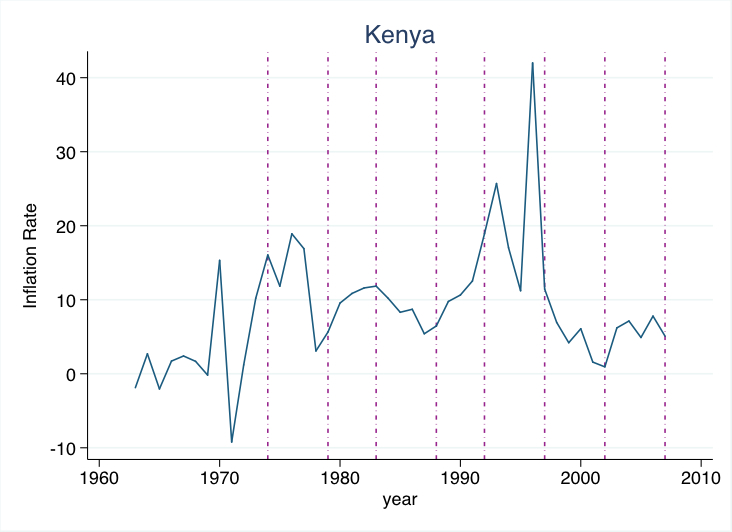
This raises the question: Is there a correlation between election years and inflation in Africa?

My first stab at this reveals rather weak correlations between election years and trends in inflation rates in a number of African states. (Shown below are Kenya, Uganda and Tanzania, Senegal). The vertical dotted lines indicate election years.

In the regressions different lags produce different results.

That said, it appears that competitive elections are significantly correlated with hikes in the inflation rates for up to three years (elections are “competitive” if the incumbent gets less than 2/3 of the vote).

Given the fact that Museveni’s vote share was trending downward in 1995, 2001 and 2006 (75%, 69% and 59% respectively), the NRM leader must have panicked and opened the floodgates for this past election.

Election monitoring and international sanctions against cheating have made the stealing of elections a very costly endeavor. But politicians are smart. If you can’t stuff the ballot boxes you can certainly intimidate voters or buy them off.

My hope is that with time the buying off of voters option will become institutionalized and made impartial to party ID.

this is how museveni treats the opposition in uganda

Uganda is experiencing hike in food and fuel prices – partly because of the rise in global oil prices but also because of “election money.” The Ugandan opposition has been organizing “walk to work” protests against the government’s inability to tackle inflation. In this video, the main opposition leader in Uganda gets to experience the full force of Museveni’s thugs security forces.

Museveni’s rule in Uganda will only get stronger because of the recent discovery of oil in the country. So much for someone who 25 years ago when he first assumed power was seen to represent a new crop of African leaders who were poised to usher in the era of African prosperity. Increasingly in Museveni I see a bungling but eloquent Paul Biya with a touch of faux egalitarianism.

the million-shilling goat question

What is the Ugandan government doing trading in goats?

At least 30,230 goats belonging to government are unaccounted for, according to an investigation by the Auditor General’s Office, which expressed concerns about the possibility of a major scam involving officials in the Ministry of Agriculture.

The missing goats were meant for the implementation of a Shs6.7 billion pilot breeding project for strategic export under President Museveni’s poverty reduction programme in Sembabule District. The Support for Export Breeding and Production Project was to benefit more than 100 farmers.

Records show that the Project received Shs800 million from government in the financial year 2004/2005 for infrastructure development and purchase of the first lot of goats. However, only 3,023 Mubende goats were procured and were not distributed to farmers at the time due to lack of sufficient funds.

At a cost of about Shs 1 million per goat, it’s estimated that taxpayers could have lost more than 302.3 million for the missing goats. Parliament’s Public Accounts Committee (PAC) Vice Chairperson Oduman Okello (Bukedea) said the committee will open fresh investigations into the circumstances under which the goats disappeared from the farm and who were the officials responsible for the loss.

More on this here.

african presidents and the “elites” around them

This is the first of many installments on African presidents. I am currently researching the nature of presidential power in Africa.

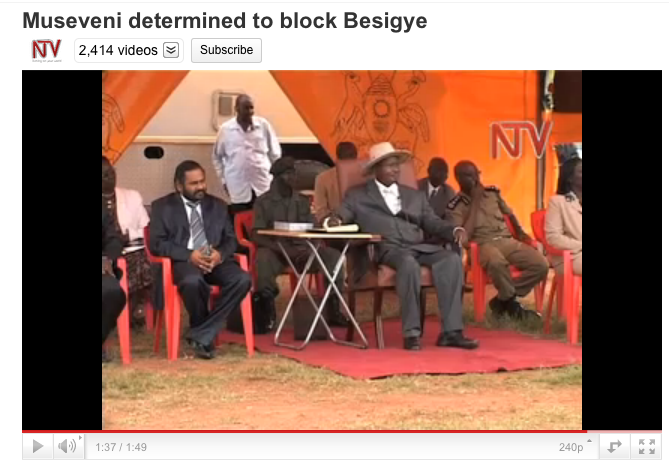
First on the list is Yoweri Museveni of Uganda. Mr. Museveni has been in power since 1986 and is pretty much convinced that he is God’s gift to Uganda has just won another 5-year term in office. The picture below is a screen shot from a recent tour of an area of Kampala to launch a cooperative society.

More Village Chief than President

Notice the state and size of the presidential “red carpet.” Also, everyone but the president has to make do with plastic chairs. This picture, in many ways, is a metaphor for most African societies. In many countries only the “Big Man” gets to sit on the “carpet” while everyone else has to languish in the dust, including elites around the president.

This state of affairs creates perverse incentives that are inimical to economic growth. If I am an elite – even one who is close to the president – why should I invest in creating a carpet of my own if I know that the president will take it away? The result is poverty and material want that extends to the heart of power and elite-dom.

In a way EVEN the political elite in Uganda are poor. They may have some wealth stashed abroad but their realized standard of living within Uganda is not elite. If they get sick they have to fly to Kenya, South Africa [who’s elites have done slightly better at local accumulation] or further afield for treatment. Oftentimes even their 4X4 vehicles get stuck on the non-existent roads that they have refused to build and maintain. A mastery of the art of surviving [living day by day] is not restricted to the hoi polloi. Even the elite lack the requisite stability to escape the surviving mentality, even though they may not necessarily be surviving materially.

This is the reality for most of the Continent.

Next time, something on the false largesse of the likes of the late Omar Bongo Ondimba (the very short guy in the middle of the crowd in this video)

quick hits

Ugandan walk to work protests continue, despite the arrest of key opposition leaders.

Mutiny spreads in Burkina Faso. Compraore has been in power since 1987 after he ousted Thomas Sankara.

Benin’s Yayi Boni might have stole his way into a second term. I hope he is not planning on extending the presidential term limit in Benin.

museveni is on the ropes

With 72 cabinet ministers Uganda reeks of instability. Leonardo Arriola, a Political Scientist at Berkeley, has made argued that African presidents create bloated cabinets to buy off opponents when they feel insecure in power. Uganda’s Museveni might be doing just that. In office since 1986, Mr. Museveni just won another 5-year term in office with 68% of the vote, or so the Ugandan electoral commission would like us to believe.

The opposition parallel vote tallying system was sabotaged by security forces in cahoots with cell phone companies (these companies should be fined in other countries in which they operate…). The main challenger, Mr. Kizza Besigye, claims that the last count he got showed Museveni at 50.8% with him second at 42.5%. The final official tally gave Mr. Museveni a landslide win of more than 40 points.

It is now quite possible that a majority of Ugandans do not want Museveni in power. Given his long tenure and the recent terror events that could have boosted him with a “rally around the flag” effect, his poor performance at the polls should be cause for concern for stability in Uganda. Too bad he will soon have oil money to create even bigger cabinets and buy more tanks and anti-riot gear, if he so wishes.

Ugandans may have to wait for quite a while before they experience their first ever peaceful transfer of power.