Africa’s newfound love with creditors: Bond bubble in the making?

I know it is increasingly becoming not kosher to put a damper on the Africa Rising narrative (these guys missed the memo, H/T Vanessa) but here is a much needed caution from Joe Stiglitz and Hamid Rashid, over at Project Syndicate, on SSA’s emerging appetite for private market debt (Africa needs US $90b for infrastructure; it can only raise $60 through taxes, FDI and concessional loans):

To the extent that this new lending is based on Africa’s strengthening economic fundamentals, the recent spate of sovereign-bond issues is a welcome sign. But here, as elsewhere, the record of private-sector credit assessments should leave one wary. So, are shortsighted financial markets, working with shortsighted governments, laying the groundwork for the world’s next debt crisis?

…….Evidence of either irrational exuberance or market expectations of a bailout is already mounting. How else can one explain Zambia’s ability to lock in a rate that was lower than the yield on a Spanish bond issue, even though Spain’s [which is not Uganda…] credit rating is four grades higher? Indeed, except for Namibia, all of these Sub-Saharan sovereign-bond issuers have “speculative” credit ratings, putting their issues in the “junk bond” category and signaling significant default risk.

The risks are real, especially when you consider the exposure to global commodity prices among the ten African countries that have floated bonds so far – Ghana, Gabon, the Democratic Republic of the Congo, Côte d’Ivoire, Senegal, Angola, Nigeria, Namibia, Zambia, and Tanzania.

In order to justify the exposure to the relatively higher risk and lending rates on the bond market (average debt period 11.2 years at 6.2% compared to 28.7 years at 1.6% for concessional loans) African governments must ensure prudent investment in sectors that will yield the biggest bang for the buck. And that also means having elaborate plans for specific projects with adequate consideration of the risks involved.

Here in Zambia (which is heavily dependent on Copper prices), the Finance Minister recently had to come out to defend how the country is using the $750 million it raised last year on the bond market (2013-14 budget here). Apparently there was no comprehensive plan for the cash so some of the money is still in the bank awaiting allocation to projects (It better be earning net positive real interest).

“They are fighting each other. By the time they have projects to finance, they will have earned quite a lot of interest from the Eurobond money they deposited. So, all the money is being used properly,” he [Finance Minister] said.

Following the initial success the country’s public sector plans to absorb another $4.5b in debt that will raise debt/GDP ratio from current ~25% to 30%. One hopes that there will be better (prior) planning this time round.

Indeed, last month FT had a story on growing fears over an Emerging (and Frontier) Markets bond bubble which had the following opening paragraph:

As far as financial follies go, tulip mania takes some beating. But future economic historians may look back at the time when investors financed a convention centre in Rwanda as the moment that the rush into emerging market bonds became frothy.

The piece also highlights the fact that the new rush to lend to African governments is not entirely driven by fundamentals – It is also a result of excess liquidity occasioned by ongoing quantitative easing in the wake of the Great Recession.

I remain optimistic about the incentive system that private borrowing will create for African governments (profit motive of creditors demands for sound macro management) and the potential for this to result in a nice virtuous cycle (if there is one thing I learned in Prof. Shiller’s class, it is the power of positive feedback in the markets).

But I also hope that when the big three “global” central banks start mopping up the cash they have been throwing around we won’t have a repeat of the 1980s, or worse, a cross between the 1980s (largely sovereign defaults) and the 1990s (largely private sector defaults) if the African private sector manages to get in on the action.

African governments, please proceed with caution.

Why are some African governments so bad at managing their countries’ resources?

UPDATE: According to Reuters,  Israeli billionaire businessman Dan Gertler sold one of his Congo-based oil companies to the government last year for $150 million – 300 times the amount paid for the oil rights – in a deal criticised by transparency campaigners.

*************************************************************

Resource mismanagement in Africa is not just a story of rampant corruption and the complete lack of political will for reform. It is also a story of governments that remain completely out-staffed by multinationals with far superior technical capacities. Improving resource management on the continent will therefore have to be as much about government technical capacity development as it will be about political reform.

Vale, for example, employs nearly 200,000 people around the world and has annual profits equivalent to nearly four times Mozambique’s state budget. It can recruit, train, and compensate employees to represent its interests on a scale far beyond what the government can do. Without Vale’s capacity for number crunching, Mozambique’s regulators lean on the companies they oversee for all manner of important data.

In 2011, the Mozambican government published an independent study of the country’s mining, oil, and gas industries. Conducted by a Ghanaian consulting company, Boas and Associates, the report was part of Mozambique’s application to the Extractive Industries Transparency Initiative, a World Bank-funded program designed to encourage an honest accounting of mining revenue and payments by participating countries and corporations alike. Mozambique’s candidacy was ultimately denied on the basis of its failure to publish what it earned from the companies involved, [but the report also noted a lack of qualified personnel in the agencies governing almost every aspect of the extraction of Mozambique’s natural resources]: licenses, prospecting, mining and drilling, sales, export.

According to the report, the [Mozambican government has no way of verifying the quality and quantity of minerals in the concessions it leases to private companies, and it depends on those companies for data on what is ultimately mined and exported]. Worse, the government has no system for monitoring global commodity prices or of tracking companies’ investment costs, which means it cannot independently verify a company’s profits.

Lesson? It’s not all corruption. It is also about the incentive structure that has resulted from government’s reliance on the word of profit-maximizing mining companies.

Improving government capacity to regulate resource sector operations is a key pillar of accountability and transparency that is currently missing from the discussion on how to manage Africa’s resources. It is easier to blame it all on thieving politicians and mining executives.

Not all governments might find it useful to improve their technical capacity (it is easier for them to steal if the valuation of state assets remain uncertain) but I bet many African states, especially those with moderately democratic regimes, can be persuaded to boost their technical capacity, if not for anything then just to improve their bargaining position vis-a-vis mining companies. At a minimum, this would mean more money for their pockets, and perhaps also more money for roads, schools and hospitals.

Some thoughts on Kenyan MPs and their salaries

Update: Sarah Serem and the SRC appear to be backtracking and are now “open to dialogue” with MPs over their pay.

******************************************

“False standards are set with salary scales for MPs, Ministers and top civil servants that the country cannot possibly afford in a time when examples not of extravagance but of austerity and sacrifice should be set. In 1963 MPs earned K£ 620 a year [in present terms about Ksh 89,704.34 a month].

This was increased to K£ 840 then to K£ 1200 a year [about Ksh 173,619.53 a month in present terms], making three increases and a doubling of salary in less than three years (And the K£ 100 a month is augmented by a daily sitting allowance, plus mileage and other allowances). Junior Ministers earn K£ 2260 a year. The President’s salary has been fixed at K£ 15,000 a year tax free and including other emoluments……. In six months an MP receives more money than the average peasant earns in half a life-time.”

That is Oginga Odinga writing in his autobiography Not Yet Uhuru.

As Kenyan MPs prepare to adopt a report this afternoon that will allegedly give the Parliamentary Service Commission legal cover to grant them a 59% pay rise, we should remember that this is not a new phenomenon. Top public officers in Kenya, and in particular MPs, have always been remunerated well relative to the country’s per capita income.

Activists block the entrance to the National Assembly in protest at MPigs' greed

Activists block the entrance Parliament in Nairobi with a sow and piglets in protest at the greed of “MPigs”

I must admit that as a researcher on legislatures in Africa, and Kenya and Zambia in particular, the issue of how to look at MPs’ salaries is not a straightforward one. On the one hand it is absolutely obscene that in a poor country like Kenya MPs make more than their counterparts in far much wealthier countries in Western Europe. But on the other hand I also realize the importance of shielding the House from the influence of money bags from State House. Poorer paid parliamentarians across the Continent (including in “shining star” Ghana) live and work at the mercy of the executive. It is no coincidence that Barkan and colleagues concluded in Legislative Power in Emerging African Democracies that Kenya has the strongest legislature in the region.

The ratio of the president’s pay to MPs’ is instructive. Back in the sixties, the president made 12.5 times what the MPs made. That ratio has since shrunk to less than 2.5.

As Oloo Aringo passionately argued in the late 1990s and early 2000s, the high pay of Kenyan MPs is partly responsible for the rise in legislative power in Kenya (Part of my work in the dissertation, among other things, will be to convince you that this is true – that relative pay of MPs matters. Stay tuned). In the present Kenyan case there is an argument to be made for the Salaries and Remuneration Commission (SRC) to review the salaries of all State Officers; and to bump MPs higher up the totem pole (by cutting the pay of other state officers) than where they are right now as far as their pay is concerned. Ms Serem’s first stop should be the numerous seminars,workshops & capacity building obsessed talking shops independent constitutional commissions that continue to drain the exchequer with nothing to show for their work (OK, I’ll admit that some of the commissions are useful).

Kenyan MPs should definitely not get a pay hike. But the fight against greed in the august House should not be overdone, lest we end up with a weak parliament at the mercy of State House. This is the balancing act that I hope will inform the SRC commissioners’ actions as they try to tame our MPigs’ Honorable Members’ appetite.

The 2013 Resource Governance Index

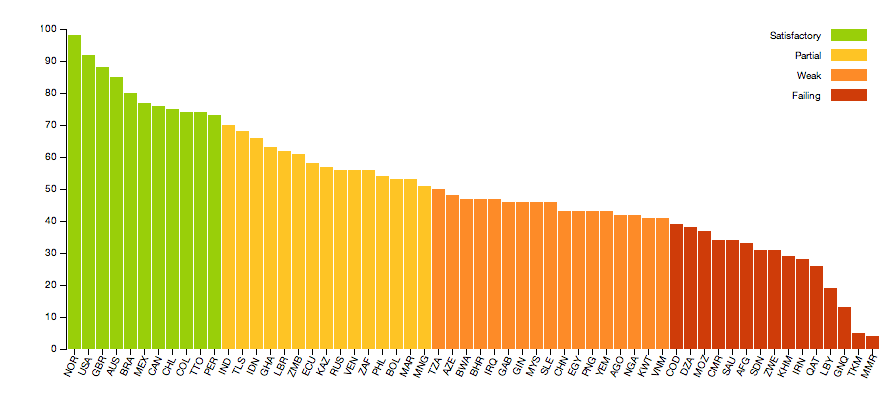
The 2013 Resource Governance Index (published by the Revenue Watch Institute) is out. The top performing African countries include Ghana, Liberia?, Zambia and South Africa, with partial fulfillment. The bottom performing countries are Equatorial Guinea, Zimbabwe, South Sudan, the Democratic Republic of Congo and Mozambique.

The 58 nations included in the report “produce 85 percent of the world’s petroleum, 90 percent of diamonds and 80 percent of copper.” Ghana, where we are doing some evaluation  work on extractive sector transparency initiatives, is the best performing African country on the list. Image

More here. 

And in related news, The Africa Progress Report was released last week. The report details the massive loss of revenue by African governments through mismanagement – either by commission and/or omission – of extractive resources. For instance:

The report details five deals between 2010 and 2012, which cost the Democratic Republic of the Congo over US$1.3 billion in revenues through the undervaluation of assets and sale to foreign investors. This sum represents twice the annual health and education budgets of a country with one of the worst child mortality rates in the world and seven million pupils out of school.

The DRC alone is estimated to have 24 trillion dollars worth of untapped mineral resources.

The most bizarre case of resource management in Africa is Equatorial Guinea, a coutnry that is ranked 43rd on the global per capital GNI index but ranks 136th on the Human Development Index (2011).

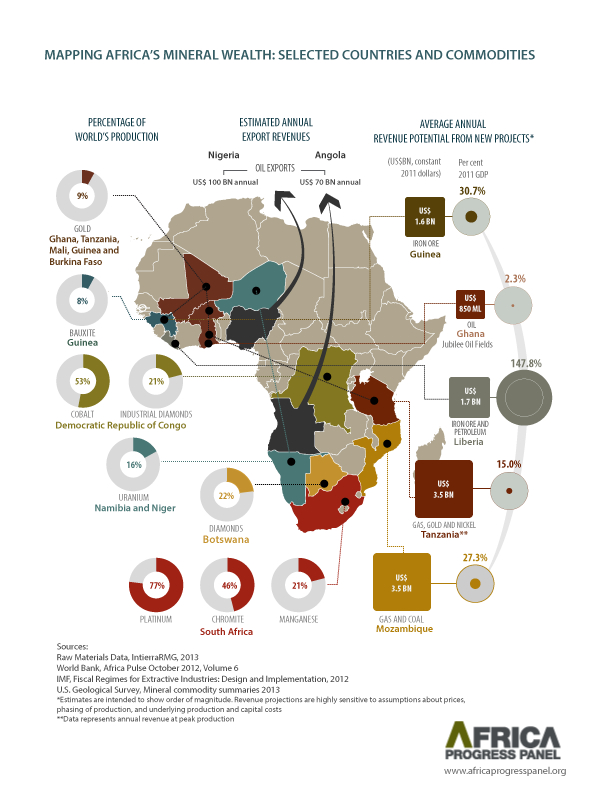
Below is a map showing flows related to Africa’s vast resources:

RESOURCE-MAP

Georgetown MSFS Launches New Africa Scholarship

The application deadline is January 15, 2014. Spread the word.

Starting in fall 2014, the Master of Science in Foreign Service (MSFS) at Georgetown University is offering a full- tuition scholarship for a talented graduate student from sub-Saharan Africa.

Image

MSFS is a two-year, full-time graduate degree program in international affairs. Students will take courses in international relations, international trade, international finance, statistics and analytical tools and history. In addition, students choose an area of concentration such as International Relations and Security, International Development or International Business.

Resource sector accountability in Africa: The supply side story

I was recently in Ghana for some preliminary work on an evaluation project that a few colleagues at IPRE Group and I will be working on later this year. On my trip I talked to people engaged in transparency initiatives targeting Ghana’s extractive sector. Most of you probably know that Ghana is the second biggest exporter of gold in the region, after South Africa. It also recently joined the club of African oil exporters. In the recent past Ghana has been touted as a model for transparency and accountability in the resource sector (I wrote about it here). EITI commended the country for going beyond the recommended minimum reporting threshold. That said, the country still has a long way to go, especially with regard to the gold sector (most of the publicized initiatives concentrate on the oil sector, forgetting the much older gold mining sector.)

My conversations with some of the CSOs working on various kinds of transparency initiatives revealed to me that the problem of government opaqueness in reference to resource sectors is not just because of lack of political will. It is also about governments’ lack of capacity to supply accountability. Take the example of oil drilling. In order to provide transparency to its citizens the government has to have a proper revenue management system (complete with accurate models of predicted production, prices, etc); well trained technical staff that can hold their own against the savvy experts (engineers, geologists, etc) of the oil companies; and the technical means of delivering information in a digestible form to the masses. As it is in most governments, Ghana included, ministries in charge of resources are often staffed by loyal political appointees, some whom lack the technical expertise to effectively carry out their jobs.

This is not to downplay the political economy aspects of resource sector accountability. Just to say that there is a difference between Obiang’ and Mahama. For the former, technical fixes may do little to increase transparency in Equatorial Guinea’s oil sector. But for the latter, the political situation necessitates the provision of set minimum levels of accountability. So to the extent that there is a failure to do so in the case of Ghana we should not be quick to scream politics but instead also consider ways of improving the state’s capacity to supply transparency and accountability.

Penpals: Karl Marx and Abraham Lincoln

I just came across this fascinating letter that Karl Marx wrote to Abraham Lincoln, following the latter’s re-election in 1864.

We congratulate the American people upon your re-election by a large majority. If resistance to the Slave Power was the reserved watchword of your first election, the triumphant war cry of your re-election is Death to Slavery. From the commencement of the titanic American strife the workingmen of Europe felt instinctively that the star-spangled banner carried the destiny of their class. The contest for the territories which opened the dire epopee, was it not to decide whether the virgin soil of immense tracts should be wedded to the labor of the emigrant or prostituted by the tramp of the slave driver?

… The workingmen of Europe feel sure that, as the American War of Independence initiated a new era of ascendancy for the middle class, so the American Antislavery War will do for the working classes. They consider it an earnest of the epoch to come that it fell to the lot of Abraham Lincoln, the single-minded son of the working class, to lead his country through the matchless struggle for the rescue of an enchained race and the reconstruction of a social world.

On a related note, my girlfriend and I recently watched Lincoln while on a short work/fun trip to Ghana (posts on Ghana coming soon). The controversies over the historical accuracy of parts of the film aside, Lincoln is a must-watch. The movie does a brilliant job of portraying the complexities that inhabit all humans – good or bad, or somewhere in-between.

The abolitionists in 19th century America were no altar boys. Their triumph against slavery was also a triumph against parts of themselves.

Another interesting thing about the movie is how Obama-esque the Lincoln in the movie is, or it might be that Obama has read so much Lincoln that he emulates the man from Illinois. The truth is probably a mix of both. It is almost impossible to imagine that the first black president would have no influence on the production of a movie about the president who signed into law an act abolishing slavery.

Go watch Lincoln.

And Django Unchained which is also awesome – but which I had to finish watching alone at the hotel because of a skype appointment with my adviser (and the Tarantino violence which in the end was too much for my girlfriend).

An infinitely more sophisticated review of the two films (Django Unchained and Lincoln) by a scholar of their subject matter can be found here.

The state of the web

Internet access still relatively costliest in Africa.

source: This is Africa

I would argue, though, that in the case of Africa even as costs come down relative to per capita income, the latter has to go up as well from its present low point.

In which I write about Africa’s emerging drug problem

The globalization of terrorism over the last decade has created a situation in which the number one threat to international security is no longer strong, conquering states, but failing ones that provide safe havens for terrorist organizations. Drug trafficking in Africa reflects the heart of this concern. The illicit trade is both contributing to the deterioration of state institutions – which could result in state collapse – and financing terrorist groups like AQIM and Al-Shabaab. So far the international community has not treated the matter with the urgency it deserves. The consequences of inaction will be dire, as has already been seen in Central America. The region’s misfortune of being an important transit route between South American cocaine production centers and North American consumers has resulted in the highest murder rates in the world, fueled by transnational organized crime and drug trafficking. The statistics are astonishing: Among 20-year old men in some Central American countries, 1 in 50 will be murdered before they are 32Africa, a region already replete with weak states, might be next if drug trafficking on the continent continues to grow.

More on this here.

Atta Mills, President of Ghana, is dead

The BBC reports:

Ghana’s President [John Atta Mills], who was suffering from throat cancer, has died in the capital, Accra.

A statement from his office said the 68-year-old died a few hours after being taken ill, but did not give details.

Vice President Dramani Mahama is due to be sworn in as the new president.

Ghana is scheduled to hold general elections later this year. With the passing of Mr. Mills it is unclear who will become the ruling party’s presidential candidate (more on this soon).

More on this here, here and here.

Reason for African Petro-Rulers to be Worried

Africa’s petrorulers (heads of state of Angola, Cameroon, Chad, Congo-Brazzaville, Equatorial Guinea, Gabon, Ghana, Nigeria, South Sudan, and Sudan) may be headed for tough times later this year. According to a piece by (Steve Levine) over at FP, Saudi Arabia – the world’s leading oil producer – is considering flooding the global oil markets with the aim of sticking it to the Russians and Iranians. Saudi action of this nature could lower prices to as low as US $40 a barrel from the current $83.27.

With the exception of Ghana and Cameroon, such a drop in oil prices would almost certainly lead to political unrest in the rest of Africa’s oil producers. Sudan and South Sudan are already facing huge revenue shortfalls due to a dispute over the sharing of oil revenue.

More on “The Coming Oil Crash” here.

Another African country strikes black gold, in massive amounts

UPDATE: The office of the president in Uganda is saying that the oil around Lake Albert may be double what was initially thought. According to Bloomberg:

” Uganda may hold deposits of as many as 6 billion barrels of oil, more than double the current estimate, according to the office of the nation’s presidency.

“Some analysts estimate that Uganda’s Albertine Graben may hold more than 6 billion barrels of oil,” the presidential office said in an e-mail statement yesterday. The estimate is well above the discovered deposits with a potential of 2.5 billion barrels, it said.”

*************************************

Namibia has joined Ghana and Uganda as the latest winners of the oil lottery in Africa.

According to the Independent Online:

An estimated 11 billion barrels in oil reserves have been found off Namibia’s coast, with the first production planned within four years, mines and energy minister Isak Katali announced Wednesday.

The finding could put Namibia on par with neighbouring Angola, whose reserves are estimated at around 13 billion barrels and whose production rivals Africa’s top producer Nigeria.

With just over 2.1 million people and already rich in Uranium, Namibia stands to gain immensely from the new discovery – if it is managed sanely, that is.

Between the other new African petro-states, Ghana (with its fledgling democracy) hopes to rival Botswana as the poster child of exemplary mineral management on the continent. Uganda, however, appears poised to be yet another data point in support of the oil curse theory (see earlier post below).

Africa’s budding narco-states?

UPDATE:

The Kenyan Prime Minister just admitted to the presence of drug money in Kenyan politics. Huge. Also, check the UNODC’s drug trafficking patterns for East Africa.

Also, does anyone out there have a copy of the report on drug trafficking in Kenya? Care to share?

****************************************

I have written before about the growing problem of drug-trafficking that is creating new problems for already fragile African states.

Of note is the fact that the problem is not just limited to the usual suspects – weak or failing states – but also extends to countries that most would consider to have it together, like Ghana, South Africa and Kenya.

According to Reuters, “cocaine moves through West Africa” while “heroin transits through the eastern part of the continent.”

The most alarming thing about this new trend is that in most of these African countries drug-trafficking happens with the consent of those in government.

For instance, in Guinea the son of former president Conte was for a long time a leading drug kingpin. In Guinea-Bissau President Vieira’s and Gen. Na Waie’s deaths in March of last year were a result of drug-related feuds. In Ghana President Atta Mills has lamented that the drug lords are too powerful to rein in. In Kenya, a woman (rumored to be) close to the president and other elites have been linked to the drug trade. Indeed on June 1st President Obama listed a sitting Kenyan Member of Parliament (Harun Mwau) as a global drug kingpin.

In South Africa former Chief of Police, Jackie Selebi, was jailed for 10 years in 2010 on drug charges. More recently the wife of the South African Intelligence Minister (Sheryl Cwele) was found guilty of having connections to the illicit trade. In 2009 a Boeing 727 crashed and was later set ablaze by suspected drug traffickers in Mali. The plane is believed to have been a drug cargo plane from Latin America destined for Europe. Other African states whose drug connections have also come to light include The Gambia (where rumors abound that President Jammeh is himself involved in the trade in drugs and arms in collusion with the Bissauian army) and Mozambique (H/T kmmonroe). You can find related news stories here and here.

Clearly, this is a real problem that if not nipped in the bud has the potential of growing to Mexican proportions, especially considering the already low levels of state capacity in most of Africa.

The Global Commission on Drug Policy also addresses this issue in their newly released report:

In just a few years, West Africa has become a major transit and re-packaging hub for cocaine following a strategic shift of Latin American drug syndicates toward the European market. Profiting from weak governance, endemic poverty, instability and ill-equipped police and judicial institutions, and bolstered by the enormous value of the drug trade, criminal networks have infiltrated governments, state institutions and the military. Corruption and money laundering, driven by the drug trade, pervert local politics and skew local economies.

A dangerous scenario is emerging as narco-traffic threatens to metastasize into broader political and security challenges. Initial international responses to support regional and national action have not been able to reverse this trend. New evidence suggests that criminal networks are expanding operations and strengthening their positions through new alliances, notably with armed groups. Current responses need to be urgently scaled up and coordinated under West African leadership, with international financial and technical support. Responses should integrate
law enforcement and judicial approaches with social, development and conflict prevention policies – and they should involve governments and civil society alike.

second hand clothes

Thanks to a view from the cave I just found out that there is an Oxfam study out there on the effects of second hand clothes (SHC) in the African markets. The findings are largely predictable: the poor benefit from the trade, the trade has created opportunity for fraud and most importantly, it has contributed to the death of local textile industries. The big question then is how to transition from the over-reliance on SHC.

In my view textiles is a sector in which countries would be justified in going nationalist and financing or facilitating the financing of local firms and industries. It is unacceptable that up to 90% of Ghanaians buy second hand clothing despite high unemployment and abundant cotton in the West African region.

Here are some snippets from the Oxfam paper:

The trade has clear consumer benefits. This is especially in countries with low purchasing power, and for poorer consumers, though in many sub-Saharan African countries it seems that almost ALL socio-economic groups are choosing to buy SHC. …. over 90% of Ghanaians purchase SHC.

The trade supports thousands of livelihoods…. These include jobs in trading, distributing, repairing, restyling and washing clothes. Oxfam’s research in Senegal estimates that 24,000 people are active in the sector in that country…. 1,355 people work in formal sector textile/clothing in Senegal.

SHC trade in recipient countries is mainly informal and is poorly regulated. In some instances it has facilitated considerable customs fraud, as new clothing imports have been passed off as used clothing.

sunday roundup

Easterly goes to church in Ghana.

This post has pictures on some interesting way to use bed nets…. It seems like the only way we shall ever eliminate malaria on the Continent is by getting rid of all the mosquitoes. Other tropical places have done it. Why can’t it be done on the Continent, at least in the urban areas??

And lastly, I found this video clip totally cool.

Happy Sunday!

JAMBO!