Graphical Illustration of China’s global reach

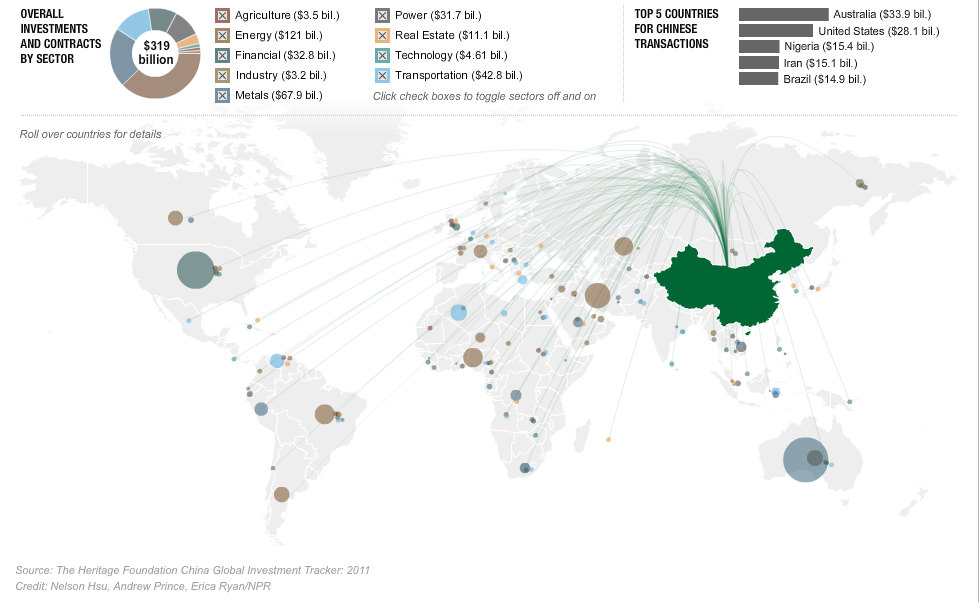
NPR has this cool graphic on China’s global investments [click on image to enlarge].

Notice that Nigeria is among the top destinations of Chinese investments.

In my alternate universe Abuja (the undisputed regional hegemon) is stable and uses this, and the fact that it is also among the most important sources of US-bound crude oil, as leverage to nudge the two biggest global powers in the direction of a more stable and coherent Africa policy.

More on this here.

The new constitution and patronage politics in Kenya

Former president Moi infamously liked warning voters that siasa mbaya maisha mbaya (bad politics leads to a bad life). This was code for vote for the opposition and no roads, no schools and no hospitals for you.

The framers of the new Kenyan constitution must have particularly disliked the power of the presidency in doling out development money and other patronage largesse. According to the Daily Monitor (Ugandan Daily):

“From 2012, it is likely to have the most limited presidency in Africa. The president has only about 10 per cent of the budget to dole out his patronage and fund his pet projects. The bulk of the rest are fixed; both by a constitutional cap, and a negotiation process.”

It will be interesting to see how the Kenyan presidency evolves following this revolutionary clipping of its powers. Already the executive has seen its powers watered down by an increasingly powerful parliament. To reinforce this trend, the judiciary has just seen the appointment of a card carrying reformer as Chief Justice. A powerful judiciary will provide a check not only on the presidency but on the wider executive branch as well – especially the now independent and obscenely corrupt Kenyan ministries.

Credit for the relatively more limited presidency also goes to President Kibaki.

Many forget that for a long period of time Kibaki governed with Moi’s constitutional powers. It is a relief that the limited presidency will now be both de facto and de jure, especially because there are way more Mois than Kibakis vying for the presidency in 2012.

A word of caution, though. Institutions are not automatic fixes to problems of governance. They are like incomplete contracts that have to be reinforced by numerous conventions and “gentleman agreements.” The Kenyan political elite may yet find ways to circumvent the spirit of the new constitution.


When not worrying about jobs, terrorists and reelection, Obama calms babies

This is on the fluffy side of things…

Remember when Obama could do just about anything [including touching MC Hammer]? Well, he still has some of that magic touch – at least when it comes to babies.

HT Huffington Post

Quick hits

1. If you don’t have a summer reading list already, Blattman has one for you. The list is obviously not exhaustive, but two pressing titles I might add are Avner Greif’s Institutions and the Path to the Modern Economy and Gerschenkron’s Economic Backwardness in Historical Perspective.

2. In yet another not so nice chapter in the relationship between the Angolans and Congolese, Angola has deported thousands of Congolese. According to IRIN:

The expulsions are symptomatic of the tense relations between Luanda and Kinshasa, rooted in disputes over border demarcation and natural resources. Angola’s alleged loss of hundreds of millions of dollars in revenue due to the unauthorized artisanal exploitation of diamonds is a particular bone of contention.

3. Michelle Obama is in Africa on one of those first lady gigs. Many Africa watchers have complained that the visit does not have any real policy agenda beyond the usual talking points.

I agree.

But I would also like to point out that the failure of Africa to reap an Obama dividend is not just because of the State Dept.’s indifference to Africa but also because Africa lacks a coherent voice in Washington. Is there an Africa lobby? What does it do?

Instead of a calculated strategic response to the election of the first US president of African descent the Continent has swung from euphoria to disappointment over the fact that manna did not fall from heaven.

4. Lastly, the fortunes of the AU force in Somalia appear to be on an upswing. Now if only Somali politicians can get their act together and form a stable government.

Failed states index out, the usual suspects top the list

FP has the annual list of failed states. The Continent has a heavy presence on the list, with the usual suspects like Somalia, Sudan, Chad, Niger and Central African Republic, among the top failures. Also on the list are otherwise stable places like Uganda, Nigeria, Kenya, Ethiopia, among others.

The list is, in some sense, a reminder that several states out there are in dire straits. Insecurity and poverty continue to be a daily experience of far too many people. But it also raises methodological questions regarding the rankings. Some of the rankings certainly do not make any substantive sense and merely feed into alarmist stereotypes we already have of certain countries or regions of the world.

Methodological issues aside, the list is yet another reminder that despite the recent surge in Afro-optimism, a lot still needs to be done in order to improve the human condition in Africa, among other regions of the world.

chiluba dies

The firebrand Zambian trade unionist-cum president, Frederick Chiluba, has died. The Daily Nation reports that the former president of Zambia died in the early hours of Saturday.

Mr. Chiluba came into power in 1991 following the defeat of Kenneth Kaunda in Zambia’s first multiparty elections. Although tainted by allegations of corruption – he has been accused of having embezzled US $46 million – Mr. Chiluba will be remembered as one of the fearless civil society leaders on the continent who championed the democratic cause at a time when it was dangerous to do so.

conflict minerals in the congo

As is now common knowledge, the mineral glut in the DRC has been more a source of pain rather than gain. Minerals have financed both corrupt governments and their cronies in Kinshasa and marauding rebel groups in the ungoverned corners of the vast country.

To over-simply the issue, reforms will have to tackle both angles of the problem, i.e. both Kinshasa and the plethora of armed groups will have to come clean with regard to the extraction and sale of mineral resources. Kinshasa’s hoarding of all the benefits from the trade provides a perverse legitimacy for armed groups to continue their illicit activities.

Jason Stearns, the author of Dancing In the Glory of Monsters [I highly recommend the book], has a post on the complexities surrounding conflict minerals in the DRC.

First, “cautious” is the operative word. The Congolese export ban (September 2010 – March 2011) and the US electronic industry’s embargo of untraced minerals (April 2011 – present) have caused major job losses in the Kivus, as well as played into the hands of a select elite of military commanders, including ICC-indictee Bosco Ntaganda. It is, however, important to point out that neither initiative was caused directly by the Dodd-Frank legislation in the US. Rather, the export ban was decreed by the Congolese presidency, while the industry embargo was an aggressive interpretation of the US legislation. Dodd-Frank call for companies to carry out due diligence and to report their findings; the OECD guidelines call on companies to minimize the risk of financing armed groups.

Secondly, the Malaysia Smelting Corporation (MSC), which I had reported as having signed a deal for the largest tin mines in the Kivus, has not yet officially concluded a deal. A large Congolese delegation visited Malaysia earlier this year, and MSC and their Belgian partners Traxys then came to meet with President Kabila. A “confidentiality agreement” was signed with MSC regarding the Sakima concessions in Maniema, a good place to start as most of the mines there are removed from the main areas of conflict. In addition, MSC has not yet given $10 million for certification an tracing schemes, although the mining minister says they have agreed to fund these initiatives.

More on this on Jason’s blog here.

The private sector is betting that Kenya will survive 2012

As I occasionally care to point out, Kenya is making meaningful progress towards institutionalization of government. According to Joel D. Barkan, the Kenyan parliament is the strongest in Africa. Its judiciary has just undergone radical reforms which saw outsiders from civil society appointed to the country’s newly created Supreme Court. The country’s provincial administration (with pith helmets and all), in the past the key tool of executive repression and control, is in its twilight and will be replaced by a devolved system of counties. The counties will elect their own assemblies, governors and will be funded directly from the consolidated fund.

But many fear that all these reforms could go up in flames in next year’s general election. President Kibaki is term limited and will be stepping down. The frontrunner is Raila Odinga. But new electoral rules – requiring a majority of 50% +1 – complicates matters a bit. Ethnic arithmetic point to an inevitable second round which will be closely fought between pro and anti-Raila factions. Raila is perhaps the most divisive figure in Kenyan politics. Most people tend to either love him or hate him, with a passion.

The prospect of another closely fought election has got many observers worried. 2007-08 is still fresh on many people’s minds.

That is why it is encouraging that the private sector is sending signals that they have confidence in the political system. Multibillion Shilling projects in construction, manufacturing and retail such as this and this are signs that businesspeople do not see that much political risk moving into next year.

These investments are also a vote of confidence in the nation’s property rights regime. The outcome of next year’s general election being unclear, it is significant that businesspeople have faith that their investments will be protected regardless of the outcome.

Kenyan supreme court takes shape

Judicial reform in Kenya made another big leap with the appointment of five individuals to the Supreme Court, the highest court in the land. Njoki Ndungu, Jackton Ojwang, Smokin Wanjala, Mohammed Ibrahim and Phillip Tunoi will join the Chief Justice, William Mutunga, and his assistant Nancy Baraza [Ms Baraza has since been replaced with Justice Kalpana Rawal] on the court.

Mutunga and Baraza will champion liberal views on the court – the Church and other conservative elements in Kenyan society unsuccessfully fought against their nomination to lead the Supreme Court. Messrs Tunoi and Ojuang will represent conservative views. Ndungu, Wanjala and Ibrahim are believed to be centrists.

The Supreme Court will provide the final word on constitutional matters as well as petitions involving presidential elections.

Although one can’t dismiss the possibility of political jockeying behind the scenes, the nomination of all seven justices was a coup for Kenya’s civil society. The Judicial Service Commission sought a clean break with Kenya’s muddy judicial history. None of the high-flying judges from the Moi and Kibaki eras got a nod to join the court.

Because this is Kenya, the JSC also made sure that the seven nominees reflected ethnic and regional balance. The ethnic balance in the nominations will ensure that parliament approves them.

Overall the court appears to have a progressive make up, albeit with a rightward tilt. This is good for Kenya.

In related news, the Kenyan parliament also approved the nomination of Keriako Tobiko to be the director of public prosecutions. Mr. Tobiko’s nomination was not without controversy, with civil society groups and a section of MPs accusing him of corruption and incompetence. In the end his nomination passed through.

The next big battle over judicial reforms will be over the appointment of the Attorney General.

Ignoring the log in one’s own eye (forgive the hackneyed biblical metaphor)

Hilary Clinton is on a tour of three African states. She is visiting Zambia, Tanzania and Ethiopia. This is what she had to say in Lusaka:

U.S. Secretary of State Hillary Rodham Clinton on Saturday warned Africa of a creeping “new colonialism” from foreign investors and governments interested only in extracting the continent’s natural resources to enrich themselves and not the African people. 

The point was directed at China.

But Mrs Clinton’s statement conveniently left out Equatorial Guinea, Gabon, Nigeria, Ethiopia, Uganda, among others. In these states the US government and American multinationals continue to cooperate with regimes that are obscenely corrupt and/or repressive for “constructive reasons.”

Chinese involvement in Africa is not clean, no doubt about that. Beijing’s support of the murderous regime in Khartoum is despicable. But this is nothing new. The US, Western Europe and Russia have done worse. The worst of all is the French who were in bed with the Rwandan army even as elements within it (Rwandan army) orchestrated the 1994 genocide.

Many people that I have spoken to about Chinese involvement in Africa seem to have lots to complain about, but they also like Chinese pragmatism. They get the roads built, the fibre cables laid out, etc.

I must say that Africans who are suffering under oppressive regimes still need western pressure on their governments to allow for more political space (however janus-faced this pressure might be). That said, Africa needs more options. A globally conscious China with lots of money to throw around will – in the long run – do more good than harm in Africa.

Their resources-for-(white elephant)-projects approach might yet prove to be better than the previous resources-for-Swiss-bank-accounts approach of Western multinationals.

And as has been the case with shady Western involvement in Africa, whenever the Chinese make deals that are bad for the locals the blame should be directed at the African governments who take side payments and look the other way.

Mastermind of 1998 bombings in Nairobi and Dar killed in Mogadishu

The man behind the US embassy bombings in Nairobi and Dar es Salaam has been killed by Somali government forces at a roadblock in Mogadishu.

The Saturday Nation reports:

The mastermind of the 1998 twin bombings in Nairobi and Dar es Salaam Fazul Abdullah has been killed by Somalia government forces in Mogadishu.

Mr Abdullah, who holds a Kenyan passport, was wanted for the fatal bombing of US Embassies in Kenya and Tanzania that left at least 250 people dead and many injured.

He was reportedly killed by the Transitional Federal Government (TFG) forces on Wednesday at a roadblock.

The run-away terrorist, who was on the Federal Bureau of Investigations (FBI) watchlist of most wanted terrorists, is believed to have taken over the leadership of al Qaeda’s branch in Somalia, al-Shabaab from where he directed world attacks and African terror operations.

Confirming the reports, Kenya’s Police Commissioner Mathew Iteere said he was working with security officers in Somalia to get a comprehensive report.

PhD comics movie

Isn’t it time we had a real show about graduate student life? (The big bang theory does not count, although it gets close. And I love it).

Here is the PhD Movie trailer:

I hope this will get hollywood writers and producers going (or not).

If you haven’t yet, check out PhD Comics.

More on economic development

Brookings has two pieces worth reading on the state of Africa’s economies.

The main takeaways are that: 1) there are many Africa’s; some states are doing well while others continue to run around in circles 2) Governance, Governance, Governance. You cannot have a thriving business sector amidst high levels of unpredictability and 3) Trade, both intra-continental and to other regions of the world, is the key to African development.

You can find the reports here and here.

selective unconditional convergence and growth

Rodrik has a finding that reinforces the importance of politics and other macro conditions for economic development. He points out the existence of the paradox of unconditional convergence at the industry level but not at the national level. Rodrik stresses the importance of structural change that channels labor into the right industries. To this we should add political change that provides certainty and the requisite legal and physical infrastructure for economic growth.

Industries that thrive in poorly run places – like telecoms, banks and construction firms in Nigeria or Kenya’s retail giants – do so despite their governments. Non-existent roads, underdeveloped railway systems, sporadic and expensive electricity, bad schools, legal uncertainty and massive amounts of political risk all serve to limit the extent to which within-industry gains can be extended to other sectors.

The massive uptake of mobile telephones across Africa suggests that consumerism in SSA is alive and well, just under-exploited. Sectors like textiles, agriculture and construction remain largely untouched because of cheap imports and bad regulation.

Development is a complex enterprise that requires massive amounts of (implicit) coordination. There has to be a link between California’s Silicon Valley, Massachusets’ Route 128 and New York’s Wall Street, in addition to other growth clusters. In this game synergy is King. The provision of the legal, human capital and physical infrastructure to facilitate coordination of this scale is largely dependent on well-functioning governance structures.

Here’s Rodrik.

Poor countries have access to new technologies already developed elsewhere so should grow more rapidly than richer economies. This is one of the implications of standard growth models, as well as of common sense.

But in reality, there is no automatic tendency for economic “convergence” among countries at different levels of income. Convergence depends instead on a number of additional determinants. It is only those developing nations with the “appropriate” preconditions – for example, adequate schooling or physical investment – that manage to absorb new technologies sufficiently rapidly and therefore to catch up. In the language of growth economics, there is conditional convergence, but not unconditional convergence.

When we look at the same question at the level of individual industries rather than countries a surprising finding emerges. Suppose we focus on, say, plastics, furniture, or the auto industry in developing countries. Does productivity in these (and other) industries experience automatic convergence with the technological frontier? Or is convergence once again conditional, depending on a host of country-level variables?

The interesting (and I think new) finding is that productivity convergence appears to be unconditional at the industry level – at least for manufacturing industries and for the period since the 1980s.

Quick hits

Texas in Africa’s review of Fighting for Darfur.

Blattman on economic growth and development.

The long arms of the Rwandan state?

The Zambian elections will be close. Last time round the opposition leader lost by a mere 3% (I will be there for the campaigns this summer).

And lastly, Kenya’s trillion-shilling proposed budget. High on development expenditure but could it crowd out the private sector?