Happy Jamuhuri Day to all the Wananchi out there!

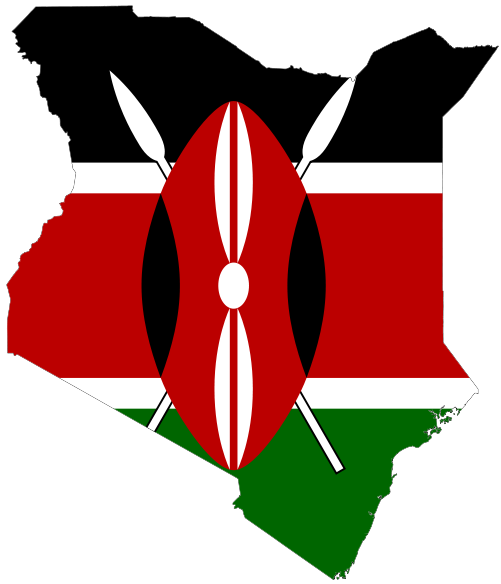
Kenya is 48, with a lot to celebrate. Happy Jamuhuri Day!


Live blogging the Kenya National Dialogue and Reconciliation Conference

Here is a link to the live stream.

I will post my own comments on the day’s proceedings later tonight.

The missing big thinkers

In order to think big your country/region must have some geopolitical significance… or so it seems.

Here is a quote from the comment section on Dan Drezner’s post on the big thinkers that were overlooked in the FP 100 top thinkers list.

What’s the criteria for big thinkers? do they precede big issues or are they considered big thinkers bc their issues are perceived as important? or because they’re closer to those who get to decide what ‘big thinking’ is?

it’s nice to know that no one in Africa or Latin America is thinking – five or so out of the list of 100 is hardly inclusive.

Tough trying to be good in a bad neighborhood

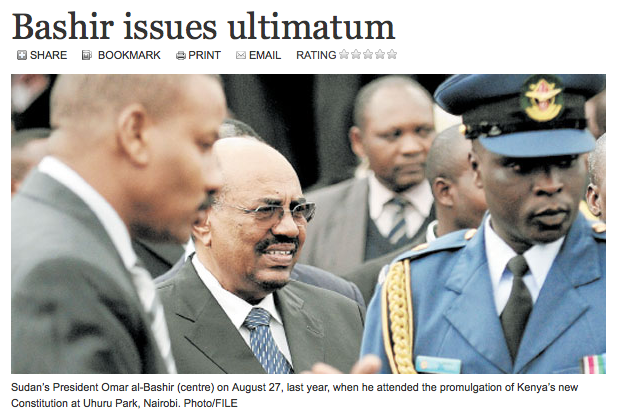
A few days ago a Kenyan judge ordered the government to arrest Sudanese President Omar al-Bashir if he ever sets foot in Kenya. Mr. Bashir has an outstanding arrest warrant against him from the ICC for crimes against humanity committed since 2003 in Darfur.

The ruling has since metastasized into a full blown diplomatic row; Khartoum expelled the Kenyan ambassador before rescinding the expulsion, and is now threatening to cut all trade ties with Kenya, expel Kenyans living in Sudan and deny any planes leaving or going to Kenya from flying in its airspace – if the government does not take back the ruling in two weeks.

The diplomatic row aside, the case has implications for the reform process in Kenya. The case is a test of the depth of the Kenyan judiciary’s new found independence from the executive.

According to Khartoum:

“al-Bashir expects Nairobi to scrap the arrest warrant within the next two weeks and not simply file an appeal.”

That is not how the judicial process works in a democracy. The executive cannot just scrap a judicial ruling. Within Kenya, for the sake of precedence the government must be seen to be complying with court rulings. The Chief Justice has already warned the executive against ignoring the court ruling saying that

“If a country chooses to live by anarchy, it must be ready to face the consequences of disregarding the law.”

It remains unclear what the executive will do given Khartoum’s two week ultimatum. Disregarding the court ruling will come with consequences for the individuals involved – in particular the Foreign Minister and the Commissioner of Police.

Tackling Africa’s Image Problem

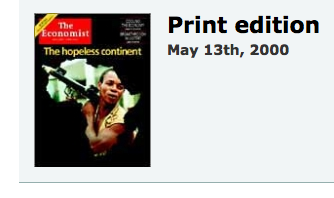
Back in 2000….


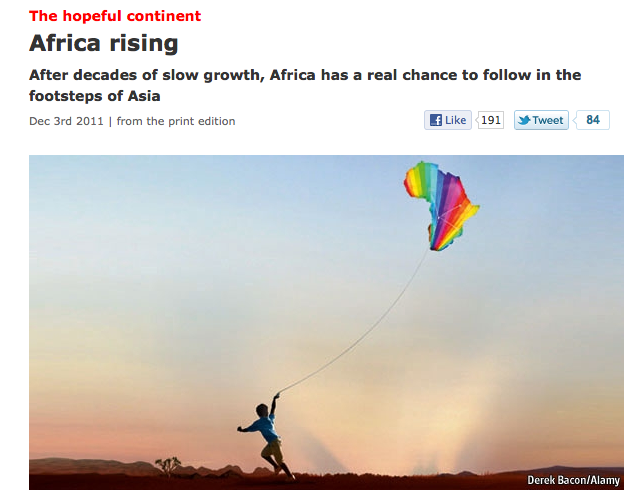
And now…

The latest issue of the Economist has “Africa” on the cover, with the pronouncement that the continent has, in the last ten years, moved from hopeless to hopeful.

Africa’s enthusiasm for technology is boosting growth. It has more than 600m mobile-phone users—more than America or Europe. Since roads are generally dreadful, advances in communications, with mobile banking and telephonic agro-info, have been a huge boon. Around a tenth of Africa’s land mass is covered by mobile-internet services—a higher proportion than in India. The health of many millions of Africans has also improved, thanks in part to the wider distribution of mosquito nets and the gradual easing of the ravages of HIV/AIDS. Skills are improving: productivity is growing by nearly 3% a year, compared with 2.3% in America.

All this is happening partly because Africa is at last getting a taste of peace and decent government. For three decades after African countries threw off their colonial shackles, not a single one (bar the Indian Ocean island of Mauritius) peacefully ousted a government or president at the ballot box. But since Benin set the mainland trend in 1991, it has happened more than 30 times—far more often than in the Arab world.

Population trends could enhance these promising developments. A bulge of better-educated young people of working age is entering the job market and birth rates are beginning to decline. As the proportion of working-age people to dependents rises, growth should get a boost. Asia enjoyed such a “demographic dividend”, which began three decades ago and is now tailing off. In Africa it is just starting.

More on this here.

More than 30 million dead, and counting…

But it can be stopped.

Be aware.

Ocampo’s successor to be named

Current Deputy Prosecutor of the ICC, Fatou Bensouda, will become the next top Prosecutor at the International Criminal Court. What does this mean for the future of the ICC, especially with regard to African cases?

JiC poses the following question:

….. Bensouda becomes the first African Prosecutor at the ICC. This fact will almost surely garner the most media attention. The African Union has been adamant that an African candidate would be selected, and they got their wish. It will now be very interesting to see how the AU deals with an African Prosecutor. The AU has often expressed frustration and, at times, outright hostility towards the Court for what it, and many of its member states, see as undue bias towards African nations and leaders. Now that the AU has its chosen candidate, will its attitude and rhetoric change?

I doubt it. The African Union’s opposition to the ICC was never predicated on the region of origin of the prosecutor but on the fact that, being largely a club of dictators and pseudo-democrats, it wanted to protect its own. That will not change with the retirement of Ocampo.

In my view the ICC remains to be a powerful source of leverage for African civil society groups against their rulers who oftentimes are inclined to use violence in an attempt to hold on to power.

Without the ICC, all these groups would have are a bunch of great powers and former colonizers full of bark and no bite and who will turn a blind eye to murderous dictatorship in the name of cheap oil and other commodities.

I hope that the court will continue in its task of being a voice to the voiceless, albeit with a little bit more tact (by which I mean the acknowledgement that justice is, ultimately, political).

I have previously commented on the court here, here and here.
Kenyan Court Orders Bashir Arrest, Sudan Expels Kenyan Ambassador

UPDATE:

The BBC reports:

Sudan ordered the expulsion of the Kenyan ambassador after a Kenyan judge issued an arrest warrant for Sudan’s President Omar al-Bashir, Sudan’s foreign ministry has said.

Mr Bashir is wanted by the International Criminal Court (ICC) for alleged war crimes in Darfur.

Sudan has ordered the Kenyan ambassador to leave the country within 72 hours.

It has also ordered the Sudanese ambassador in Kenya to return to Khartoum.

*************************************************************

A Kenyan court has issued an arrest warrant for Sudan’s President Omar al-Bashir over alleged war crimes in Darfur.

The ruling came after Kenya allowed Mr Bashir to visit in August in defiance of an International Criminal Court (ICC) warrant for his arrest.

The judge said he should be arrested if he “ever set foot in Kenya” again, the AFP news agency reports.

Kenya is a signatory to the treaty which established the ICC in 2002.

The new Kenyan constitution requires that the government implements its international treaty obligations. The ruling, though without much bite – I doubt Bashir will need to be in Kenya any time soon, has immense symbolism in the region.

It also matters for Kenyan domestic politics. Presently, a few high ranking Kenyan politicians – including the Finance minister, two former ministers and former police boss – are on trial at the ICC for crimes against humanity. The accused await judgment on the admissibility of their cases later this year or early next. The Bashir ruling means that if the charges against the “Ocampo Six” are confirmed but the government drags its feet in implementing an arrest warrant then the courts will step in.

More on the Bashir case here and here.

In other news, Uganda and Tanzania have rejected Khartoum’s petition to join the East African Community, citing “several issues like their democracy, the way they treat women and their religious politics.” Yeah right.

Quick hits

Follow the goings on in the DRC (especially this election season) over at Alex Engwete’s blog.

Living under the shadow of Kony and his men in Eastern CAR.

On a related note, the Ugandan army’s dirty war in the Congo and CAR.

Shame on the ANC. But there is still hope for cleaner politics in South Africa. The ANC is an over-size coalition with a high chance of internal breakup in the not so distant future. It might even occur sooner, over the Zuma succession. And this time it might not be a rather benign COPE affair. You can read more on the controversial bill over at the Economist.

Trying God? Churches claim to have cured HIV positive congregants. This goes beyond faith, it is naked exploitation. And a call for government involvement.

And lastly, a very dictator Christmas (via Blattman)

[youtube.com/watch?feature=player_embedded&v=38YWB8iX7OY]

$500 million, and for what?

Congolese go to the polls on Monday, the 28th of November. The result of the election is almost a foregone conclusion. Incumbent president Joseph Kabila looks set to win another term in office – another 5 years to continue the mismanagement of the DRC’s resources through shady mining deals.

According to the Economist:

Whatever the result, doubts about the election’s fairness will persist, not least because of a perception that the electoral commission’s head is a friend of the president. Logistical problems are also ubiquitous, despite an election budget of $500m or so. As well as 11 presidential candidates, 18,000 hopefuls, including several pop stars and a rebel leader accused of ordering the rape of more than 300 women in eastern Congo last year, are contesting 500 seats in parliament. Some of the ballots will exceed 50 pages, which will surely daunt even the minority of voters who can read.

(Read the whole piece here)

If I were in charge of the promotion of democracy in the DRC I would push for a system of staggered elections, both nationally and at the provincial level. I would also try and broker a deal to create a government of national unity in Kinshasa (representing the provinces) and competitive elections at the provincial level. In my view, the longer that everyone keeps pretending that the Congo – with its 70m+ and landmass the size of Western Europe – can be run by a single central government in Kinshasa – the longer it will take to put the country on the path of institutional development that will be conducive to long run economic growth.

Centralized state development definitely makes sense for smaller African states (think of the infamous trio of the Mano River basin). But if you are the DRC, capacity development in the capital must necessarily be accompanied by the strengthening of institutions at the provincial level – with more emphasis, in my view, on the latter than the former.

The number one problem facing the DRC right now is woeful state incapacity. It is doubtful that elections alone will force politicians’ hand in the right direction.

For more on the elections follow Congo Siasa.

Mining and Voting in the Congo

Elections in the DRC have come to be marked by a fire sale of state assets. A recent report by the UK parliament estimates that the government may have lost up to $5.5 b due to undervaluation of these state assets before sale.

No prizes for guessing where part of the difference in these sales go.

The whole situation is pretty stinky:

The IMF has asked the government to clarify several obscure contracts signed by Gécamines, which suggests that state assets have been sold for absurdly low prices…….. This would put the loss to the state at $870 mn.

The Chief Executive of Gécamines, Albert Yuma Mulimbi, has refused all requests, from the Mines Ministry to the IMF and others, to publish the controversial contracts, claiming that as a private company it is not obliged to, even though the state owns all its shares. The government has instructed Yuma, we understand, not to provide the information.

More on this here and here.

The Catholic Church and AIDS: A Sorry Case of Denial

The Church’s continued ostrich approach to the catastrophe that is HIV/AIDS on the continent:

Pope Benedict XVI on Saturday signed off on an African roadmap for the Roman Catholic Church that calls for good governance and denounces abuses, while labelling AIDS a mainly ethical problem. Benedict signed the apostolic exhortation called “The Pledge for Africa” during a visit to the West African nation of Benin, his second trip to the continent as pontiff.

The document says AIDS requires a medical response, but is mainly an ethical problem.

Changes in behaviour are required to combat the disease, including sexual abstinence and rejection of promiscuity, it adds. “The problem of AIDS in particular clearly calls for a medical and a pharmaceutical response,” it says. “This is not enough however. The problem goes deeper. Above all, it is an ethical problem.”

More on this from the Daily Nation.

I have written against the Church’s policy on birth control here, here and here.

Portugal Seeks Angolan Investment

The Portuguese once ruled an empire that included Brazil, Angola and Mozambique, among other smaller possessions. But since the loss of empire Lisbon has fared rather poorly. First it was the Brazilians who managed to economically dominate their former colonizers. The Angolans are beginning to also get in the game. Angola is one of the top three oil producers in Africa, and has the third largest economy in Sub-Saharan Africa.

The BBC reports:

Portugal’s prime minister is travelling to oil-rich Angola, which is boosting its investment in its former colonial power caught up in the eurozone debt crisis.

Angolan presidential aide Carlos Maria Feijo said Portugal’s privatisation scheme would be discussed. The International Monetary Fund has ordered Portugal to sell state companies to qualify for a bailout.

Angola’s investments in Portugal have risen sharply in recent years.

The figure in 2009 stood at $156m (£99m), compared to $2.1m in 2002, according to the Portuguese Institute of International Relations and Security (IPRIS), a Lisbon-based think-tank.

Angolan companies own the equivalent of 3.8% of companies listed on Portugal’s stock exchange, from banks to telecoms and energy, it says.

More on this here.

HT Louise Redvers

donkey markets and the al-shabab

Kenya’s invasion of al-Shabab held parts of Somalia has inadvertently elevated the demand for donkeys. Because of the rains (making the use of vehicles a nightmare) and a desire to disguise their transportation of arms, the al-Shabab have resorted to the use of donkeys.

The BBC reports:

In his latest series of tweets, the Kenyan military spokesman said that the price of donkeys had risen from $150 (£100) to $200 following the increased al-Shabab demand for the animals.

“Any large concentration and movement of loaded donkeys will be considered as al-Shabab activity,” he wrote, suggesting they would be targeted by Kenyan firepower.

“Selling Donkeys to al-Shabab will undermine our efforts in Somalia,” he continued.

Somalis’ improvisation in warfare is well known. The technical (which has been ubiquitous in Libya in recent months) is their key contribution to military technology, and has been the go to battle wagon in many civil wars since the early 1990s.

More on donkey markets  here.

Zuma may be a one-term president

Back when he dislodged Thabo Mbeki South African President Jacob Zuma promised that he would only serve one term. But having tasted the power of the presidency, he now wants a second term. His bid, however, has not been well accepted within the ANC.

Although it is common knowledge that the much-married Zuma wants a second term he has remained equivocal on the issue, at one point saying “I never said I would serve one term and I have never said that I would want two terms”  (The New Age reported on Wednesday, June 8th).

The Africa Confidential reports:

Zuma’s main rivals, Tokyo Sexwale and Deputy President Kgalema Motlanthe, are trying to fix it so that Motlanthe would be a one-term president, Sexwale would be his deputy and Paul Mashatile, Gauteng’s provincial leader and Premier, would be ANC national chairman. They may offer a deputy presidency to Lindiwe Nonceba Sisulu, the Defence Minister and Zuma’s ally. Sisulu and Sexwale, however, do not get along.

An anti-Zuma tirade erupted from the General Secretary of the Congress of SA Trade Unions, Zwelinzima Vavi, who said there is leadership paralysis in the ANC and warned that the country is in danger of ‘imploding’. He criticised Zuma’s ‘doublespeak’ on economic issues.

More on this here.