The State of Sub-National Government in Nigeria (Public Finance is Hard)

This is from the March Africa Research Institute (ARI) report on the state of sub-national government in Nigeria:

Screen Shot 2016-03-30 at 6.33.32 PMA federal structure, whose prime objective was to maintain security by curbing regional and ethnic influence, does not foster development. Despite receiving about half the national revenue – a sum of N2.7 trillion in 2014 (US$13.5 billion at current official exchange rate) – state governments fail to provide the services that could materially improve the lives of tens of millions of Nigerians. The 2015 United Nations Human Development Index ranked Nigeria 152nd out of 187 countries. State authorities are not accountable to citizens, state institutions are weak and corruption is endemic. The 774 LGAs – the most proximate form of government for most Nigerians – have all but ceased to function. Furthermore, groups armed by or linked to state governors have been responsible for the most deadly outbreaks of violence of the past decade: ethnic clashes in Plateau state, conflict in the Niger Delta and the Boko Haram insurgency.
… If oil were at US$20 a barrel, at 2014 budget levels only three states would be able to cover their recurrent costs with recurrent revenues: Lagos, because it generates substantial revenues internally and depends less on federal transfers; Kano, because of the amount the state receives in federal transfers due to the large number of local government areas; and Katsina, because the overhead and personnel costs are very low compared to other states.

And on Lagosian exceptionalism:

…. to raise tax revenues from various sources, including property, required a promise of benefits; and to make it sustainable those benefits had to be delivered to taxpayers. Federal funding resumed in 2007, but taxes still produce 60% of Lagos’s revenue. Its IGR, about N300 billion (US$1.5 billion) in 2014, is equivalent to the combined IGR of 32 of Nigeria’s 35 other states.4

Reliance on IGR made the Lagos state government more accountable to its electorate, who in turn became more aware of their right to judge its performance. Under Tinubu’s protégé and successor, Babatunde Fashola, crime was reduced, the environment improved, roads were built and the transport system expanded. Prompt action to contain a possible outbreak of Ebola in 2014 demonstrated governmental competence. Now that Fashola is a federal minister, many expect Nasir el-Rufai in Kaduna state, in the north-west, to earn the reputation as Nigeria’s most praiseworthy state governor. Elected in 2015, el-Rufai moved quickly to close the state’s commercial bank accounts; eliminate “ghost workers” from the payroll by introducing digital ID for the civil service; concentrate resources on infrastructure, transport and public services; and ensure that LGAs receive their correct share of funding.

The report is definitely worth a look. You can find it here.

Incentivizing Workshops as Substitutes for Actual Governing: The Case of Nigeria

This is from the FT:

According to figures released by the ministry, travel was the single biggest government line item from 2012 to 2014, at N248bn ($1.25bn) for the three years combined (the ministry did not provide annual figures). This is equivalent to an extraordinary 18 per cent of total government spending [Emphasis added].

……. A 2012 investigation by Nigerian newspaper Punch found that wealthy Nigerians spent $6.5bn on private planes between 2007 and 2012, making the country the biggest market for them in Africa.

Not all of them were bought with private funds. Under former president Goodluck Jonathan, Nigeria’s Presidential Air Fleet (PAF) acquired several new private jets, bringing its total to 11.

And you know a non-trivial proportion of these “study tours,” conferences, and meetings were either expensive shopping trips on the government’s tab or ploys to earn inflated per diems.

This is an instance where I’d endorse a move to “leapfrog” meetings, workshops, and conferences.

An East African Geopolitical Dilemma: Which pipeline route makes most sense for Uganda?

Bloomberg reports:

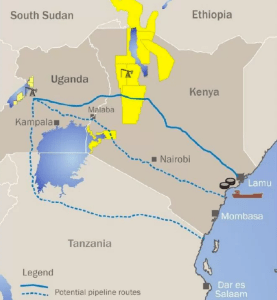
Screen Shot 2016-03-25 at 9.34.21 AMKenya is competing with Tanzania to build the pipeline from oilfields in Hoima, western Uganda. It would either traverse northern Kenya’s desert to a proposed port at Lamu, near the border with Somalia, or south past Lake Victoria to Tanga on Tanzania’s coast. A third option would be through the southern Kenyan town of Nakuru.

Tanzanian President John Magufuli said earlier this month he’d agreed with Museveni to route the conduit via his country at a cost of about $4 billion, with funding from Total SA. The Kenyan option favored by Tullow, which has oil discoveries in Uganda and Kenya, may cost $5 billion, according to an estimate by Nagoya, Japan-based Toyota Tsusho Corp.

Uganda is in a rush to get its oil to market. It also wants to make sure that it does not tie its hands in an obsolescing bargain with Kenya. Being landlocked, the country already depends a great deal on Kenya as an overland route for its imports and exports. The pipeline would add to Nairobi’s bargaining power vis-a-vis Kampala.

In an open letter to President Yoweri Museveni, Angelo Izama, a Ugandan journalist (and a friend of yours truly) articulates these concerns and concludes that it is better for Uganda to build the pipeline through Tanzania in order to minimize its political risk exposure:

It is not rocket science that routing both commercial traffic and oil through Kenya would give Nairobi near total influence on economic matters and would, added to Kenya’s already considerable market penetration in Uganda, leave little wiggle-room for unforeseen and some predictable hazards. The Ugandan domestic commercial and industrial community as well as consumers remember well how helpless they were when disruptions followed the Kenyan election of 2007 (even when some of us had urged the government earlier to restock fuel in anticipation of political violence). Many also live with the challenges of a single port to our import-addicted economy and the cost to family fortunes whenever Nairobi pulls bureaucratic red tape. Obviously being landlocked is not a “non-issue” as you framed it in Kyankwanzi. It needs to be placed in a detailed context. I have some reservations over your optimistic take on political and market integration, and that said, clearly having one member, in this case Kenya, within this greater EAC community with more power and influence than the rest is not an advantage to the growth of the community and may in fact prove rather dangerous. This as I recall has been the common fear cited in our neighbourhood about Uganda’s aggressive military spending (to which the Kenyan government responded with its own expenditure in the decade ending 2018).

The official reason given by Uganda for considering the Tanzania option (see map) is that construction of the Kenyan pipeline would be delayed (due to corruption, expensive land [Kenyans and land!], security threats from al-Shabaab, and the fact that the Lamu Port is yet to be completed).

All these are reasonable concerns.

Plus, it would have been foolish for Uganda not to strengthen its bargaining position by CREDIBLY demonstrating that it is considering BOTH options.

But Uganda must also know that whatever the outcome, this is an obsolescing bargain. Once the pipeline is constructed, it will be at the mercy of the host country government.

It is for this reason that it should seriously consider the kinds of future governments that might be in office in Nairobi and Dodoma/Dar es Salaam.

To this end Ugandan policymakers need to ask themselves the question: Would you rather deal with a government that partially answers to private sector interests and operates in a context of weak parties; or do you want to be at the mercy of a party-state in which some politically-motivated party stalwarts can actually influence official policy?

Understood this way, Uganda’s concern should be about what happens after the deal has been sealed; rather than the operational concerns that have thus far been raised by Kampala.

Notice that Kenya has been able to protect its existing oil pipeline well enough. Rioters may have uprooted the railway in 2007, but that was because they felt that Museveni was supporting their political opponent (Museveni could be more discreet in the future). Also, it is a lot harder to uproot a pipeline buried in the ground. The construction delays due to land issues can also be solved (and in Kenyan fashion, at whatever cost) — notice how fast Kenya is building the new standard gauge (SGR) railway line from Mombasa to Nairobi despite the well documented shenanigans around land compensation (More on this in a World Bank report I co-authored in my grad school days here).

Perhaps more importantly, the Kenyan option is attractive because Kenya also has oil, and will have to protect the pipeline anyway. This scenario also guarantees a private sector overlap between the two countries — in the form of Tullow or whoever buys its stake — that will be in a position to iron out any future misunderstandings.

Tanzania is also an attractive option. The pipeline will be $1 billion cheaper. Because it passes through largely uninhabited land, construction will be speedy. And the port at Tanga is a lot further from the Somalia border than Lamu, and should be easier to protect.

All this to say that the operational concerns raised by Kampala are a mere bargaining tool. These issues can be ironed out regardless of the host country. The big question is what happens AFTER the pipeline is constructed.

And here, I don’t see why Tanzania is necessarily a slam dunk.

The history of the EAC (see here for example) tells us that Kenya tends to subject its foreign policy to concentrated private interests. Tanzania on the other hand has a record of having a principled an ideologically driven (and sometimes nationalist) foreign policy with significant input from well-placed party officials. Put differently, the calculation of political risk in Kenya involves fewer structural veto players than in Tanzania. Ceteris paribus, it seems that it would be cheaper to manage the long-run political risk in Kenya than in Tanzania.

That said, the Tanzania option makes a lot of sense in a zero sum game. As Angelo puts it:

I have some reservations over your [Museveni’s] optimistic take on political and market integration, and that said, clearly having one member, in this case Kenya, within this greater EAC community with more power and influence than the rest is not an advantage to the growth of the community and may in fact prove rather dangerous.

But even this consideration only makes sense in the short run. Assuming all goes well for Tanzania, in the long run the country’s economy is on course to catch up to Kenya’s. Dodoma will then have sufficient political and economic muscle to push around land-locked Uganda if it ever so wishes.

To reiterate, the simple question Museveni should ask himself is: who would you rather negotiate with once the pipeline is built?

I don’t envy the Ugandan negotiators. And they have not helped themselves by publicly stating their eagerness to get their oil to market ASAP.

Karl Marx, 5th Year Graduate Student

This reportedly from a Prussian spy who visited the Marxes in the 1850s:

In private life he is an extremely disorderly, cynical human being, and a bad host. He leads the existence of a real bohemian intellectual. Washing, grooming and changing his linen are things he does rarely, and he likes to get drunk. Though he is often idle for days on end, he will work day and night with tireless endurance when he has a great deal of work to do. He has no fixed times for going to sleep and waking up. He often stays up all night, and then lies down fully clothed on the sofa at midday and sleeps till evening, untroubled by the comings and goings of the whole world.

In a world without Friedrich Engels that last sentence might have ended with, “except when he dreams has nightmares about the job market (or Reviewer Number 2).”

Barack Obama on Uhuru Kenyatta

This is from Jeffrey Goldberg in the Atlantic:

Obama’s relationship with Kenyatta is complicated. A careful reading of Obama’s memoir, Dreams From My Father, suggests that he holds Kenyatta’s father, Jomo Kenyatta, the liberator of Kenya, indirectly responsible for his own father’s premature demise. (The elder Kenyatta, a member of the Kikuyu tribe, froze out Obama’s father, a Luo, from government service after the elder Obama complained too insistently about corruption.) And the younger Kenyatta’s association with human-rights violators has placed a question mark over his head. But Obama also believes that Kenyatta is at least intermittently committed to battling tribalism and corruption, and aides tell me that Obama will devote a part of his post-presidential years to the issue of African governance.

Instead of focusing on “African Governance,” I’d suggest President Obama spends part of his post-presidential years as Africa’s economic ambassador to the United States and beyond.

“Good governance” and “good institutions” are great. But the notion that African states have to reach zero corruption and zero rigged elections before any factories can be built is a misguided fantasy. Institutions and positive economic performance co-evolve. Good politics is not always good economics; and good economics is not always good politics. Africa, despite everyone’s apparent belief in the region’s exceptionalism, is not unique in this regard.

Who’s responsible for South Africa’s woes? Zuma or the ANC?

I raised this question in a post last year.

Friend of the blog and Harvard-trained historian Matthew Kustenbauder has this thoughtful response (posted with his permission. Emphases mine).

Hi Ken,

Interesting post on South Africa’s recent rollercoaster and explanations for the economic downturn under Zuma’s presidency.  A few quick comments:

I agree South Africa’s current woes may be attributed to ANC policies, not President Jacob Zuma alone.  Take the issue of land, for example, about which Mr. Mngxitama is as passionate as he is wrong.  As I pointed out previously on this blog, the politics of land redistribution in South Africa are tied to the ANC’s historic decision to support and strengthen traditional authority in the former bantustans.  In short, the ANC forged an alliance with traditional leaders to bolster its negotiating power with the apartheid government in the 1990s and, afterwards, to win elections.  Mozambique served as a cautionary tale: civil war broke out after the socialist liberation government FRELIMO abolished chiefs and traditional forms of authority outright.  The ANC’s entrenchment of traditional chiefs and kings has had a ripple effect across South Africa, creating a drag on the rural economy, locking up productive agricultural land and capital assets, not to mention denying rural people equal justice under the law.

I also appreciate the argument, and agree to a degree, that both Mr. Zuma and Mr. Mbeki are ANC cadres.  When the opposition Democratic Alliance argue that somehow the country was in good hands until Mr. Zuma came along, it is more a political manouver to appeal to the black middle classes, many of whom are embarrased by Mr. Zuma and favoured Mr. Mbeki, than it is a faithful rendering of the historical record.  Thabo Mbeki was, despite his polished veneer, a disaster on many fronts, including but not limited to: unrepentant AIDS denialism, cadre deployment as an ANC policy, racial politics, silencing of internal opposition within the ANC, and a narrative that counterrevolutionary forces lurked within the media. These ideas and practices either began or were ramped up to become de facto party policy under Mr. Mbeki’s presidency.

I disagree, however, that Zuma and Mbeki represent nothing more than two cadres of the same party.  For one thing, the challenges facing South Africa today are different than those during the Mbeki years.  At that time, South Africa still luxuriated in the glow of 1994’s transition to democracy and the Madiba magic of Nelson Mandela had not yet worn off.  Mbeki was a skilled orator with global leadership aspirations, the likes of which have not been seen in South Africa since Jan Smuts was Prime Minister during WWII.  But it is not simply Zuma’s halting English, or his multiple wives, countless offspring, traditionalism, patriarchy, and coziness with Russia, China, and Sudan that make South Africans uneasy.

What is so disturbing – and what Mbeki assiduously avoided – is Zuma’s overt corruption. The most public evidence includes: Nkandla, the Gupta family’s illegal landings at Waterkloof Airforce Base, a prolonged legal battle over spy tapes that implicate him in fraud dating all the way back to his time as Deputy President (for which Mbeki sacked him and Schabir Shaik was found guilty and went to jail), and the most recent dismissal of Nhlanhla Nene for standing in the way of sweetheart SAA and nuclear deals that would have yielded tenders for Zuma’s friends and family.  If Mbeki was a loyal cadre who represented the ANC’s failed policies, Zuma is a loyal cadre who represents the ANC’s descent into patronage, corruption, and jobs for pals hidden behind a façade of election-time slogans, “our glorious struggle history” and “A Better South Africa for All.”  

Andile Mngxitama, booted out of the EFF, and firebrands like him who drone on about the ANC’s errant support of neoliberal policies and the tragedy of Mandela’s compromise during the political settlement period have little appreciation for just how far South Africa has come since 1994. Nor do they grasp the direction in which South Africa must go – and must go soon – to avoid a[n] even more tragic tailspin.

To give just one example, a major problem in South Africa has not been, contra Mr. Mngxitama, that capitalism has been prioritised. Rather, grassroots capitalism has been far too constrained – not just by government overregulation but by monopoly capitalism sheltered by the state.  This is a historical dynamic inherited from the apartheid-era National Party, one that the ANC never addressed, mainly because such arrangements benefitted the ANC so long as they controlled the levers of the state.

The number of state owned enterprises in South Africa – over 700 by the last count – is staggering for a country so small.  Just one, South African Airways, has drained well over $2 billion in bail-outs from state coffers in two decades. The energy sector is even more dire: Eskom, another state owned enterprise, has a near complete monopoly over energy generation and a complete monopoly over its transmission.  Due to a lack of capitalist competition, the country’s electricity supply is not just overly expensive, it is also tightly constrained. Last year South Africans plunged into darkness, and for some time now manufacturers and other industrial electricity consumers have actually been paid by the state to reduce their operations.

The result is that South Africa’s manufacturing sector is less competitive globally and unable to expand to create the jobs so desperately needed at home, where there is a 30% unemployment rate.  There are countless similar examples, where state owned enterprises should have been privatised, or at the very least private companies should have been permitted to enter the market and compete.  What must be remembered, however, is that the country’s economic system, designed by the old National Party, is now controlled by and benefits the African National Congress.

Similarly, in the private sector, too many large companies have a monopoly, making the cost of entry for small companies far too expensive. Government labor regulations and aggressive trade union action ensures that only the largest companies with the deepest pockets can comply and survive. Large private companies – like the mining groups, agro-processing operations, banks, telecommunications companies, and industrial manufacturers – operate with few competitors. Relatively small players in sectors like the textile industry have closed their doors and relocated to countries where labour is more productive, regulations more lax, and costs are cheaper. Too few South African companies can compete globally.

There may be a kernel of truth in Mngxitama’s claims, but his diagnosis is overly simplistic, ideological, and ahistorical.


Hard truths about the Kenyan economy

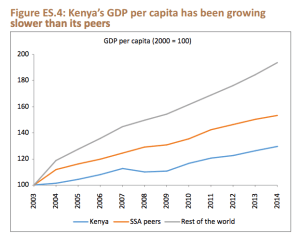
The World Bank has just released a must-read report on the state of the Kenyan economy. Here is just one of many excellent observations about the structural impediments to accelerated growth in Kenya:

Screen Shot 2016-03-09 at 11.00.50 PMCompared with other fast-growing economies, Kenya invests less and the share of investment financed by foreign savings is higher. The economic literature and post-World War II history illustrate that investment determines how fast an economy can grow. Kenya’s investment, at around 20 percent of GDP, is lower than the 25 percent of GDP benchmark identified by the Commission on Growth and Development (2008). Kenya’s investment rate, as a share of GDP, has also been several percentage points lower than the rate in its peer countries. At the same time, the economy has largely relied on foreign savings as a source for new investment since 2007, while national savings have been declining. National savings—measured as a share of gross national disposable income (GNDI)—has not surpassed the 15 percent mark over the past decade. In contrast, Pakistan’s savings is above 20 percent of GNDI, and Vietnam’s is more than 25 percent. Cambodia had a low savings rate in the 1990s, but it more than doubled the rate in the 2000s.

You can find the whole report here.


The Continuing Deterioration of Uganda Under Museveni: The Case of HIV & AIDS

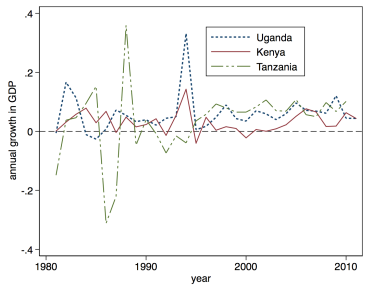
In the 1990s Uganda was typically considered to be one of the success stories in the management of the AIDS epidemic in SSA. However, as is shown below, since the early 2000s Uganda has significantly lagged its regional peers (Kenya and Tanzania) in the fight against HIV/AIDS. New infections are declining in Kenya and Tanzania but increasing in Uganda. HIV prevalence also appears to be increasing in Uganda, while either declining or keeping steady in Tanzania and Kenya. Lastly, of the three countries, the rate of decline in AIDS-related deaths has been slowest in Uganda.

It’s not clear to me why the HIV/AIDS situation has deteriorated in Uganda since the late 1990s relative to its neighbors. After all, the three countries have been receiving cash from PEPFAR since 2004 (which explains the decline in AIDS related mortality in the mid-2000s after the use of ARTs became widespread).

My hunch is that this is a reflection of Yoweri Museveni’s gradual loss of control of the state institutions that he has worked hard to build since 1986. It is also probably related to the manner in which Museveni chose to deal with the advent of competitive politics in Uganda after the end of the no-party “movement” era. His strategy has come to be defined by a willingness to basically buy off anyone and everyone — at the expense of state institutions and specific government agencies.

Consider this:

The OIG auditors identified stock-outs of key medicines, particularly those to treat HIV, in 70% of 50 health facilities visited which could result in treatment disruption for patients. Furthermore, 54% of the health facilities visited had accumulated expired medicines. 68% of facilities reported stock-outs of anti-malaria medicines and test kits and 64% of the facilities reported stock-outs of tuberculosis medicines of between one week and three months.

The OIG concluded that the supply chain system does not effectively distribute and account for medicines financed by the Global Fund. There were reported cases of theft, including 40 cartons of artemisinin-based combination therapies; an unexplained difference of US$21.4 million between recorded and actual stocks at the central warehouse; and a difference of US$1.9 million between commodities received and actually dispensed to patients from January 2014 to June 2015 in eight high-volume facilities visited by the auditors.

Screen Shot 2016-03-05 at 9.20.11 AMUganda’s post civil war economic recovery may have been impressive (see graph), but it should no longer be something for Museveni to hang his hat on. It is clear that the longer Museveni stays in office, the more he is going to undo his very own achievements in the earlier years of his three-decade rule.
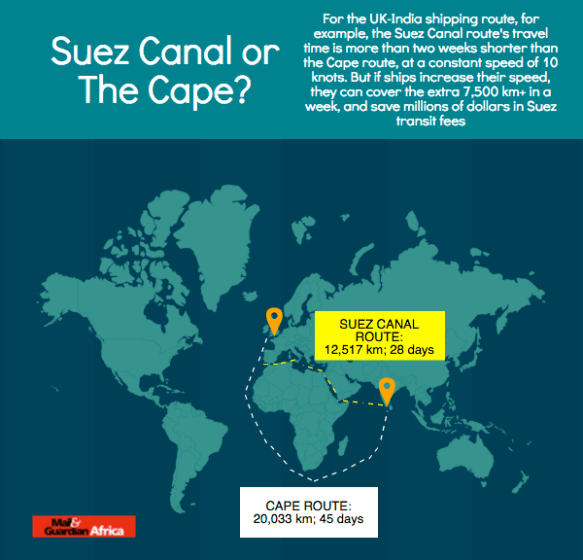


Turns out oil prices are so low it’s cheaper to sail 9,000km around Africa than cross the newly expanded Suez Canal

Screen Shot 2016-03-03 at 9.50.15 AM

This from the Mail & Guardian:

Essentially, it makes more business sense to sail the longer distance – even though the Suez Canal shortens the Europe Asia trade route by at least 9,000 km – and burn more fuel by increasing speeds.

With oil touching $30 a barrel, a recent analysis by SeaIntel, a maritime monitoring group suggests that if shippers can accept an extra week of transit time by sailing south of Africa, it would save them an average of $17.7 million a year per vessel, in transit fees.

According to the analysts the Suez Canal would need to reduce fees by around 50% – and the Panama Canal which similarly affected by 30% – for crossing to be commercially viable for long-haul ships.

Also:

That’s bad news for Egypt, which spent $8 billion on expanding the Suez Canal, opened with much fanfare last year. The expansion, accomplished in a record one year, was intended to reduce waiting times from 18 hours to 11 hours. Authorities said they expected canal revenues to more than double from the annual $5.5 billion in 2014 to $13 billion by 2023.

On a related note, if you are interested in shipping and global trade be sure to read Marc Levinson’s The Box: How the Shipping Container Made the World Smaller and the World Economy Bigger. I recently picked it up and really like it so far.

H/T Charles Onyango-Obbo


Why is Barclays exiting its Africa business?

The FT reports:

Firstly, he said it would create “a very simple, clear vision for Barclays” as a bank focused on its two core markets of the UK and US.

Secondly, he explained that Barclays was “structurally challenged” as the majority owner of the African operation. It has all the downsides of owning 100 per cent of the business, but benefits from less than two-thirds of its profits.

……. The African operation produced an attractive 17 per cent return on equity last year in local currency, but this fell to 8.7 per cent at group level, below its 10 per cent target.

In addition, the Wall Street Journal reports that the bank is selling its Asian wealth management fund in order to focus exclusively on the US and UK markets.

According to the Journal:

Cutting the African division “was a very difficult decision,” Mr. Staley said. A U.K. tax on bank balance sheets and the regulatory costs that come with holding the unit outweighed the benefits of keeping it, he added. It is unclear when Barclays will start to sell out of the business.

In short, this data point does not reveal any new information on the state of the African economies in which Barclays is a major player.

Tyler Cowen on the Contours of Partisanship in American Politics

Tyler Cowen has an interesting post on the contours of partisan politics in America. In the post he argues that at the state-level Republican politics and governance is superior to the Democratic variety:

This superior performance stems from at least two factors.  First, Republican delusions often matter less at the state and local level, and furthermore what the core Republican status groups want from state and local government is actually pretty conducive to decent outcomes.  The Democrats in contrast keep on doling out favors and goodies to their multitude of interest groups, and that often harms outcomes.  The Democrats find it harder to “get tough,” even when that is what is called for, and they have less of a values program to cohere around, for better or worse.

Second, the states with a lot of Democrats are probably on average harder to govern well (with some notable Southern exceptions).  That may excuse the quality of Democratic leadership to some degree, but it is not an entirely favorable truth for the broader Democratic ethos. Republicans, of course, recognize this reality.  Even a lot of independent voters realize they might prefer local Republican governance, and so in the current equilibrium a strong majority of governors, state legislatures, and the like are Republican.

Thomas Pepinsky looked under the hood of this argument and found this:

Those high functioning states (he cites this report) are North Dakota, Wyoming, Nebraska, Utah, and Iowa.

It is not obvious to me why Republicans would not look to the entire map of places that the GOP controls state government.

Maybe one clue is that those five states are among the whitest states in the country.

As an exercise, let’s ponder what “They think the rest of America should be much more like those places” means.

Cowen also has an interesting theory of why expats foreigners tend to lean Democratic:

It is easier for intelligent foreigners to buy more heavily into the Democratic stories. They feel more comfortable with the associated status relations, and furthermore foreigners are less likely to be connected to American state and local government, so they don’t have much sense of how the Republicans actually are more sensible in many circumstances.any circumstances.

I don’t know what to make of this. I’ve never lived in a fully Republican controlled state. All I know is that Republican governors and legislatures have a knack for cutting taxes at the expense of essential public goods — like schools in Kansas or drinkable water in Michigan; or refusing to accept federal dollars to finance healthcare for their poor voters in the name of ideological purity. I also know that for all their talk of ideological purity when it comes to social spending, Republicans’ preference for the size of the social safety net is conditional on the proportion of the population that is of European descent.

This is not to say that Republican elites are evil or anything. They are simply self-interested. Instead, it speaks to the awkwardness of the Republican coalition.

In Cowen’s language, in the current historical moment I see Democrats as a coalition that peddles status and some goodies to boot. Republican elites, on the other hand, traffic almost exclusively in status, while opting for lower taxes and fewer regulations for elites. This may work during boom times. But in tough economic times a shared status (codified by say, race) might not be enough to convince the working poor that they are natural political allies with either anti-tax business owners or the editors of the National Review.

And if we are honest, it doesn’t help that we’ve just had 7+ years under a president from a historically low status group in the American context.

Enter Donald John Trump.

Evidence of Ballot Box Stuffing in Uganda’s Presidential Election

As is the case in many electoral autocracies, Yoweri Museveni probably did not need to rig the just-concluded Ugandan presidential election. By most accounts it appears that he still has significant support in much of Uganda’s countryside, where most voters reside. And despite a late surge the leading opposition bloc lacked the organizational muscle to deal with an entrenched incumbent. For example, it failed to field candidates for legislative elections at the same rate as the ruling party. The opposition’s late surge also meant that not enough pro-Besigye supporters had registered to vote since it wasn’t clear that he was going to mount a serious challenge this time round after the experience of 2011.

But we also know that dictators never want to simply win. They like to win with overwhelming landslides in order to demonstrate their super-popularity and to deter any future challengers (agents of the regime, like those running electoral management bodies, also have an incentive to inflate the dictator’s numbers as a show of loyalty — see here, for example).

So it is not surprising that Museveni stuffed ballot boxes (or had them stuffed in his name) in certain areas — some of which registered 100% turnout!

Of the 28,010 voting stations, 130 of them had 100% voter turnout, 113 of which voted 90% or more for the eventual winner and incumbent, Yoweri Museveni (42,768 votes for him in these stations). 105 of these highly suspicious stations occurred in just 4 districts:

Ugandan districts

More on this here.


What Donald Trump teaches us about the stability of electoral democracies

Intra-elite checks and balances within America’s Republican Party are in shambles. It is increasingly clear that Donald Trump might be the exception that proves the rule that The Party Decides. Over the last 8 years the Republican Party has spawned and ceded power to all manner of groups and organizations aimed at delegitimizing and obstructing the Obama Administration. But by empowering fringe groups and ideas, the Republican party also ceded its power as a gatekeeper to key institutions like the U.S. Congress, state legislatures and governorships, and the U.S. presidency.

The result of this has been the Donald J. Trump presidential campaign. Trump is sort of self-financing (with loads of free publicity from an insatiable media), a fact that has left him untethered from the control of party elites who typically bankroll election campaigns in America. Electoral freedom from party elites has afforded Trump the luxury of dabbling in heterodox policy positions that are at variance with the positions of party elders. He is a populist who is promising a neglected segment of the Republican base a lot of goodies whose logical implication is an even bigger government — something the anti-tax establishment wing of the party doesn’t like. Trump also has a knack for plainly saying out loud what mainstream Republicans only ever communicate through dog whistles. This all makes for excellent political theater. It’ll be interesting to see if the party actually manages to stop the Trump juggernaut from getting the nomination.

The Trump phenomenon offers important lessons on political development in general and democratic consolidation in particular.

A key source of democratic stability in America has been the existence of robust intra-elite checks and balances within the leading parties. For much of American history the choice set presented to voters has been, for better or worse, significantly regulated by elites. This system has served to protect America from delegative democracy — whereby elected officials do whatever they want in-between elections. In other words, intra-elite checks — in an attempt to protect party brand names or sectional interests — have served to limit the variance between what politicians promise and what they do while in office. It has also protected the American political system from wildcards like Donald Trump.

The danger of posed by politicians like Trump is that because they are independent from fellow elites they are hard to keep in check in-between elections. This is a crucial point. Most voters do not have the time or interest to follow the everyday actions of their preferred politicians. Only a few activist citizens do. So the bulk of the monitoring of elected officials in-between elections tends to be carried out by other elected officials (like Members of Congress) or civilian elites (like lobbyists). A candidate that is untethered from these kinds of checks poses a real danger to political stability. Because they derive their power from opposing institutions, they are very likely to destroy the same institutions once elected. Trump has so far proven that he can win electoral contests without any support (and implied constraints) from America’s rightwing political and economic elites. Reasonable Americans have good reason to be very afraid.

Now imagine that Trump wins the nomination and the November 2016 election. What stops him from cobbling together a coalition that would win him reelection? All he has to do is give everyone what they want — crazy nativist talk for some, a nice dose of social services for others, and side payments to specific segments of the middle class to keep them comfortable. In this scenario the only thing that would stop Trump is America’s consolidated constitutional term limits. And even then the damage will already have been done.

Everyday politics in most young democracies have a lot of similarities to Trumpism. In these contexts the richest person in the country (or the one with the most power to determine who becomes rich) also tends to be the leading politician. Such politicians typically have the power to raise all the money they need to win elections. And because of their superior access to resources they also tend to have the power to determine who gets elected to legislatures and other important elective positions. The lack of independently wealthy elites that can finance rival factions, and because all elected officials typically depend on the one who controls the money spigot, means that very little intra-elite balancing happens in-between elections. In addition, political parties typically operate as personal enterprises of the president.

Notice that in these contexts, elections alone do not provide the panacea to the lack of intra-elite checks and balances. Anti-institutionalists can and do win free and fair elections.

Also notice that the failure of elections to correct the behavior of elites in-between elections is not because voters in these contexts are particularly dumb. It is just that most voters do not consider the institutional consequences of their personal electoral choices. It is elites who operate within institutions. And it is elites who care about institutional strength. When structural conditions dis-incentivize elite investments in institutional strength, personalist politics under a delegative democracy obtains.

In America, pro-Trump voters are probably not thinking about what a Trump victory will mean for democratic stability. They are simply responding to the bundle of solutions to their specific problems that Trump is selling them. And there are elites like Chris Christie who might join the Trump bandwagon, again for personal reasons or a resignation to the fact that Trump has voters on his side and the only way to stay relevant is to join Trump.

American institutions are old and strong enough to withstand the Trump candidacy (I think). They are also buttressed by strong informal (extra-institutional) intra-elite checks on presidential power. Chances are high that American democracy will survive Donald J. Trump.

But imagine this happening in a young democracy with a non-existent upper class and therefore almost zero informal checks on presidential power in-between elections. Such democracies almost always fail on their first contact with some variant of Trumpism. Trumpists violate term limits. Trumpists are erratic with policy. Trumpists know how to run populist campaigns and win elections. Trumpists undercut fellow elites and destroy institutional checks on presidential power.

The biggest lesson from the American 2016 election cycle is that elections, on their own, cannot protect political institutions in young democracies from characters like Donald J. Trump.

The long-run firm level effects of apartheid cronyism in South Africa

The FT has this fascinating piece on the troubles facing South African mining giant Anglo-American:

Anglo was not apartheid’s victim but its beneficiary, not only allowed to exploit black workers but shielded from competition. That encouraged it to behave like the old nickname for the Oppenheimer family empire, “the octopus”. It spread tentacles throughout the South African economy, extending into Botswana through De Beers, the Oppenheimer diamond group.

Anglo was not a state-owned enterprise but an enterprise that became a state — a skilled bureaucracy expert at controlling resources and wielding hegemony. Its elite cadre of Anglophile managers were not as astute as they thought they were, or were clever in a way that lost relevance. Some expected, as one former rival executive puts it, “to be rewarded for showing up”.

…. A structure and culture that was highly experienced at navigating the closed, politicised world of apartheid South Africa was outmatched by global capital markets. “It felt like we were being compelled to do things it was not in our nature to do,” says one Anglo executive.

On a related note, read this on corruption in apartheid South Africa.

All things for older people to remember before reminiscing over the good old days under apartheid as South Africa continues to struggle under the singularly inept leadership of Jacob Zuma.

Women Also Know Stuff: An excellent list of women political scientists

Manels suck. Don’t do manels. Do not do manels, I tell you.

Women Also Know Stuff is a website dedicated to making it easier for journalists, policymakers, and the wider public to easily access experts in different issue areas. You no longer have an excuse to organize an all-male panel of experts.

Here is a brief description of the website.

So often while planning a conference, brainstorming a list of speakers, or searching for experts to cite or interview, it can be difficult to think of any scholars who aren’t male. We’ve all been there… you just know that a woman has got to be studying that topic… but who?

This site is intended to provide an easily accessible database of female experts in a variety of areas.

This site was created and is maintained by political scientists and, as such, focuses on politics, policy, and government, but also on methods in the social sciences. (We’re certain that women know stuff in other fields too, though!)

And here is the Monkey Cage blog post on the same.