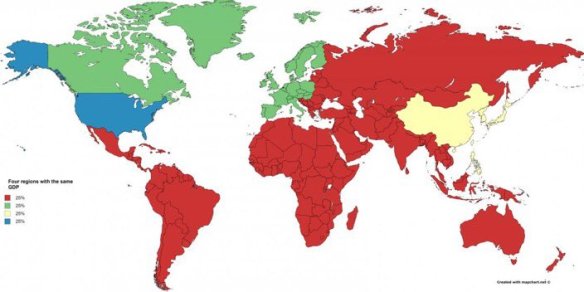
Distribution of Global Incomes: Four Regions With the Same GDP

Image

world-gdp

H/T 

Variagated Africa: Trends in Economic Performance in Two Charts

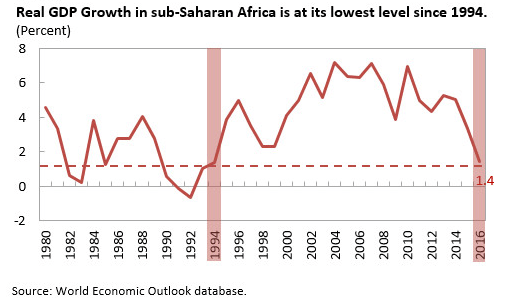
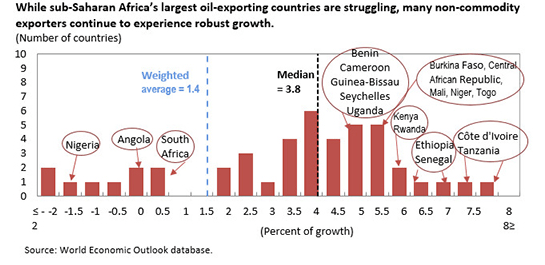
This is from the IMF’s Monique Newiak:

screen-shot-2016-10-28-at-1-12-28-pm

screen-shot-2016-10-28-at-1-12-42-pm

In summary:

Non-commodity exporters, around half of the countries in the region, continue to perform well with growth levels at 4 percent or more. Those countries benefit from lower oil import prices, improvements in their business environments, and strong infrastructure investment. Countries such as Côte d’Ivoire, Ethiopia, Senegal, and Tanzania are expected to continue to grow at more than 6 percent for the next couple of years.

Most commodity exporters, however, are under severe economic strain. This is particularly the case for oil exporters like Angola, Nigeria, and five of the six countries from the Central African Economic and Monetary Union, whose near-term prospects have worsened significantly in recent months despite the modest uptick in oil prices. In these countries, repercussions from the initial shock are now spreading beyond the oil-related sectors to the entire economy, and the slowdown risks becoming deeply entrenched.

It should be obvious, but it bears repeating that there is quite a bit of variation in economic performance across the 55 states on this vast continent.

My personal Africa growth index consists of Senegal, Cote d’Ivoire, Nigeria, Ghana, Gabon, Cameroon, Ethiopia, Kenya, Zambia, Angola, and South Africa. And despite ongoing turbulence in a number of the key economies in this basket, I am confident that the turbulence will not completely erase the gains of the last two decades.


What do you do when the government refuses to pave the local road?

Residents of Webuye West in the southwest of Kenya did this:

webuyeroad

The Place of Race and Racism in International Relations

In case you have not read Susan Pedersen’s review of Robert Vitalis’ White World Order, Black Power Politics: The Birth of American International Relations, you should.

Here is an excerpt:

The Journal of Race Development, established in 1910, was one of a spate of academic journals, associations and institutes founded as American social scientists came to grips with their country’s expanding global and imperial role. The journal’s title, jarring today, reflects perfectly the centrality of the category of ‘race’ to political science at the time. During the ‘Wilsonian moment’ of 1919, the journal was rechristened the Journal of International Relations without much disturbing its contributors or character. A few years after that, it was bought and renamed again by a New York-based association of internationalist businessmen, officials and academics, the Council on Foreign Relations. Yes, that’s right: it becameForeign Affairs, the pre-eminent journal of the foreign policy establishment.

This is just one of the startling and illuminating genealogies Vitalis pieced together during the ten years or more he spent researching this book. White World Order, Black Power Politics does two things. First, it provides a critical history of the institutional development of the field of international relations in the United States, from its founding at the turn of the century through to the Cold War. This history is radically unfamiliar: the ‘origin story’ taught on undergraduate courses, which traces the field’s core concepts (realism, liberal internationalism) back to Thucydides or Machiavelli or Wilson is, Vitalis insists, a post-1945 invention. Instead, at the moment of its American birth, ‘international relations meant race relations.’ Races, not states or nations, were considered humanity’s foundational political units; ‘race war’ – not class conflict or interstate conflict – was the spectre preying on scholars’ minds. The field of international relations was born to avert that disaster.

A blunter way to put this, and Vitalis is blunter, is that international relations was supposed to figure out how to preserve white supremacy in a multiracial and increasingly interdependent world. Segregation and Jim Crow had done the trick at home, where non-white populations were in the minority, but how could white America govern its newly annexed and overwhelmingly non-white territories without losing its republican soul? A few white scholars thought the task impossible. Indeed, one of the most famous – John Burgess, founder of Columbia’s School of Political Science and of the Political Science Quarterly – opposed President McKinley’s imperial adventuring precisely because it threatened the democratic institutions he thought suited to ‘Teutonic’ peoples alone. ‘American Indians, Asiatics and Africans cannot properly form any active, directive part of the political population which shall be able to produce modern political institutions,’ he warned. Unless it wanted to go the way of Rome, America should leave empire alone.

Something to think about for students of development and liberal international institutions, both big and small.

The book is available for purchase here. I can’t wait for my copy to arrive.

Is Africa Rising or Reeling?

This is from Amadou Sy, director of the Africa Growth Initiative at Brookings.

Whether described as “Hopeless,” “Rising,” or “Reeling,” no one can deny that African countries have made substantial gains.  In a recent piece, I argue that “missed in the binary of a hopeless versus a rosy narrative are large disparities among countries in terms of political and economic governance.” So many countries are quickly rising to the top. Countries such as Côte d’Ivoire, Ethiopia (in spite of the regrettable recent internal violence), Kenya (it is ironic that his article is a “Memo from Nairobi”), and Senegal are expected to grow at more than 5 percent this year (IMF, 2016). Yes, not surprisingly, oil exporters will continue to suffer from the lack of diversification of their sources of revenues, and South Africa—a middle-income country—is struggling from self-inflicted wounds.  But even within these countries, some regions and sectors will fare better than others.

Africans are past the debate of whether their countries are hopeless, rising, or reeling. What they want to see is resilient, sustainable, and inclusive growth, and the debate they are interested in is about the actual policies that will generate such outcomes. That is why young Burkinabe, following the example of youth in Senegal, took to the street in Ouagadougou two years ago to stop and reverse attacks against democracy. That is what many Congolese in the Democratic Republic of the Congo are fighting for right now.

Change is inherently destabilizing. So it is kind of amazing that in light of recent hiccups in political and economic development across Africa most analysts have opted to completely ignore the gains that African states have made over the last 25 years. Instead, many have run back to the old tried and tested narrative of a reeling continent plagued by political instability and economic catastrophes.
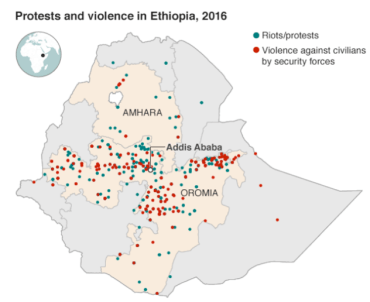
screen-shot-2016-10-21-at-10-50-20-amTake the example of Ethiopia. You essentially have a country that for a couple of decades has tried a formula of faux ethnic federalism under the domination of the TPLF, the formateur of the EPRDF constellation (see works by my colleague Lahra Smith here and here). For a long time this institutional innovation allowed for a reasonable amount of political stability (remember that Ethiopia was an empire of different peoples for centuries); on the back of which the country has registered pretty impressive economic gains (see here for another perspective). But now those gains have made the initial institutional innovation untenable. Ethiopians are demanding for greater voice for non-TPLF factions. Remember that the key trigger of the recent Oromo Protests was the encroachment on Oromo lands by a rapidly expanding Addis Ababa. Economic development (and the inequalities it has produced) is partially responsible for lowering the perceived costs of political organization in an attempt to revise the rules governing the initial post-Derg political settlement.

The state has pushed back violently against these revisionist political movements, particularly in the Oromo region (see image). A recent state of emergency takes away any pretense of proportionality, meaning Ethiopia is headed for greater shrinkage of political space.

Writing in 2003 Alem Habtu presciently observed that:

Ethnic federalism institutionalized ethnic groups as fundamental constituents of the state. It established them as social categories sharply distinct from the overarching category of citizenship. Many citizens are worried that it might lead to the demise of the state altogether. Thus far, there is no evidence that new ethnic nationalisms have emerged in Ethiopia as a consequence of ethnic federalism, as they did in the former USSR. But it is too early to entirely dismiss their emergence.

…… EPRDF has been undergoing an organizational-cum-ideological crisis since 2001. In a series of party meetings in June 2001, OPDO and SEDPF as well as the five allied regional parties, complained publicly of TPLF/EPRDF “tutelage.” Its crisis was manifested in its employment of Leninist organizational practices while adopting pluralist principles. It may face a great challenge in sustaining the ethnic federal project unless it undergoes ideological and organizational changes. Only time will tell whether it can do so without severely undermining the integrity and political management of the federal structure. If the federal state were to be in grave danger or collapse, the military may once again seize power. But if the latter fractures along ethnic lines, we could witness a Yugoslavia-like scenario. Inasmuch as EPRDF is a coalition, it is different from the Communist party of the USSR or Yugoslavia. The viability and stability of the infant political system is dependent on its flexibility and adaptability [emphasis mine]. Contingent events will shape the outcome of the ethnic federal experiment. In any case, the experiment is politically fragile.

On balance, it would be inaccurate to claim that Ethiopia is in decline. There are countless stories documenting very concrete gains in the country over the last two decades. Several state-owned enterprises are getting things done, with some — like Ethiopian Airlines — outcompeting their private competitors in the region. The narrative of general decline therefore betrays a singular misconception of how political development works. Did anyone really expect the process of reckoning with the failures of the institutions of ethnic federalism in Ethiopia to be smooth?

Serious students of Ethiopia (and of political development in general) certainly did not.

My own assessment is that this episode will be more of a Tiananmen Square moment for the Ethiopian state, as opposed to what happened in the USSR or Yugoslavia. I hope I am not wrong.

screen-shot-2016-10-21-at-5-17-29-pm

Ethiopian rules Africa’s skies

What can the international community do? Well, now is the time to make it clear to the Ethiopian government that basic respect for human rights will not always be sacrificed on the altar of economic growth. The TPLF leadership must be made to understand that for stability to obtain they must allow for some dispersal of power. They must be reminded of the fact that China’s rise was actually accompanied by significant openings on both the political and economic fronts. Nobody wants to go back to the suffocating and rudderless tin top dictatorship of the Derg.

I’ve always considered binary analyses of a continent of 55 countries as evidence of intellectual laziness. These analyses are nothing but a repackaging of 18th century views of the Continent as a place full of simple peoples, who live simple lives, that can be packaged into simple narratives. As I have tried to show with the Ethiopian case, what is happening in the country is complicated. And it is silly to try and project this onto the rest of the Continent.

All this to say that I agree with Sy. Read the whole thing here.
The World’s Other Multiethnic Democracies Need the American Experiment With Self Government to Keep Working

screen-shot-2016-10-11-at-3-20-21-pm


Happy Mashujaa Day!


flag

Make America Great Again

A Kansas City High Schooler’s Development Questions

I regularly receive emails from readers with all sorts of questions and requests. This one caught my eye:

Hello Dr. Opalo,

My name is [redacted] and I am a senior in high school in Kansas City, MO. I am currently working on an exhibition regarding poverty in sub Saharan Africa. My essential question is: What are the factors that contribute to ongoing poverty in sub Saharan Africa. I was wondering if you would be willing to answer a few questions to assist me in my research.

1. How would you describe the current state of poverty in sub-Saharan Africa?

2. What can be done to solve the feminization of poverty?

3. Is Time Poverty a large factor in ongoing poverty and how can time poverty be solved?

4. How can safety be maintained in sub-Saharan Africa through policy?

5. What can an average American do to help end poverty?

Thank you for your time!

If you have answers to any of these questions, let me know in the comments section. I plan to write back before the student’s exhibition is due…

Urban Bias on Steroids: The Case of Thailand

This is from the Economist:

The National Village Community Fund, which has allocated 500,000 baht each to almost 80,000 villages for rural projects, is now administered by the ministry of interior. The state’s Special Financial Institutions, which provide rural credit, are now regulated by the central bank, having previously been the playthings of provincial politicians. These days, if you wait for money from Bangkok, “you’ll wait forever,” says Mr Suradech.

His complaint is confirmed by a startling calculation. The World Bank reckons that over 70% of Thailand’s public expenditure in 2010 benefited Greater Bangkok, home to 17% of the country’s population. In no other economy with a comparable level of income is government spending as skewed, say the bank’s economists.

Rather than lift the shopping power of the rural masses, the junta has aimed to boost spending by tourists and urbanites. It has cut taxes markedly for the relatively few businesses and people that pay them. It has also succeeded in doubling the number of visitors from China to 10m a year.

Remember the red shirts and yellow shirts and how they managed to cripple Bangkok?

H/T Tyler Cowen.

On Valentine Strasser, former president of Sierra Leone

Buzzfeed has a really neat profile of Valentine Strasser, the army captain who became president of Sierra Leone at 25:

On April 29, 1992, Valentine Esegragbo Melvin Strasser accidentally seized power in Sierra Leone, a small, diamond-rich country tucked into Africa’s western coast. Until that day, Strasser had been an unknown army captain whose closest brush with fame came when he won a couple of dance-offs in a nightclub in Allen Town, a Freetown slum. At the age of 25, he found himself newly installed as the leader of a nation of 4 million people, and the commander-in-chief of a fractious, impoverished army.

strasser.jpg

The Strasser family home (Monica Mark)

After more than two decades of corrupt governments, most Sierra Leoneans welcomed the coup-makers, and Strasser was catapulted to messiah status. Print shops churned out calendars embossed with his childlike face. Graffiti artists splashed Freetown with his portrait and those of his fellow junta members, who called themselves the National Provisional Ruling Council.

The party’s inner circle was made up of equally young men, including a vice chairman who was barely 22 years old. From the outset, their rule was marked with the kind of eccentricities you’d expect if you walked into a college bar and handed over a country to a bunch of students.

Read the whole thing here.

H/T S. Mitter.


Mineral Assets and Corruption in the DRC: Israeli “businessman” Dan Gertler linked to Och-Ziff bribery convinction

What does Dan Gertler and his business associates think of term limits in the DRC?

This piece from The Globe and Mail has some answers:

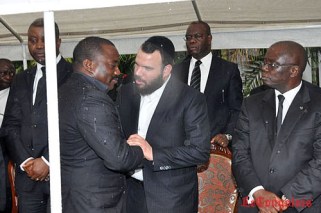
The cellphone message from the Israeli businessman was blunt and vulgar: The Canadian mining company must be “screwed and finished totally,” he told an associate as they negotiated a massive bribe to Congolese court officials to guarantee that the Canadian company would lose control of its copper mine.

dan-gertler-3

President Joseph Kabila and Dan Gertler 

Within hours of that 2008 message, the businessman and his associate had arranged a bribe of $500,000 (U.S.) to judges and other officials in the Democratic Republic of the Congo, according to court documents released in a U.S. corruption case.

A day later, the Israeli businessman obtained assurances that Congolese officials would ensure the Canadian company would lose its court fight against a local takeover of the copper mine, the U.S. documents say. Then, a week later, the Israeli won majority control of the company and the valuable asset.

The documents were released on Thursday in the settlement of a corruption case against Och-Ziff Capital Management, a U.S. hedge fund that manages $39-billion.

Och-Ziff agreed to pay $412-million in criminal and civil penalties, one of the biggest payments ever approved under the U.S. Foreign Corrupt Practices Act.

The U.S. documents show the hedge fund paid more than $100-million in bribes to officials in Congo, Libya, Chad, Niger and Guinea – including Congolese president Joseph Kabila – to gain corrupt influence and mining assets.

……. The hedge fund, Och-Ziff, went into partnership with the Israeli businessman and was involved in using intermediaries and business partners to funnel large bribe payments to officials in Congo and other African countries, according to the U.S. Securities and Exchange Commission. Och-Ziff was directly involved in financing the businessman’s acquisition of Africo, including his “legal expenses” in the case, the U.S. documents say.

As I have noted here and here, the DRC is a cherished playground for thieves foreign investors who do not give a rats behind about the political, institutional, and economic consequences of their actions.

That said, Gertler would be advised to talk to Benny Steinmetz. There is a precedent of a change in leadership leading to repossession of a fraudulently obtained concession.

Kabila will not be in power in Kinshasa forever.

More on the Och-Ziff story here.

Georgetown University Summer 2017 Hoyas in Tanzania Program

Deadline is February 7th, 2017. And Non-Georgetown students can apply. More information here.

You know you’ve lucked out when your school’s most exciting summer program is in the same country/region as your main research projects.

That was me this summer. Students took Kiswahili classes at the University of Dar es Salaam in the mornings and did research/internships in the afternoon. We also visited Bagamoyo and Zanzibar. And in the last week we topped it all with a visit to Arusha and safari in the Serengeti. While in Dar students stayed with host families (all faculty members) on the UDSM campus.

Here is my students’ summary of their experience:

You’re barreling down a dirt road through the middle of Serengeti in the late afternoon. Wildebeest are flashing by your windows but you’re in a race against the setting sun to get to the lodge before dark, so you keep driving. You feel tired, and also a little bit like you’re in The Lion King; you find yourself humming “The Circle of Life” as you try not to fall asleep. You’re jerked awake by a sudden slam on the breaks; the zebras are crossing the road. You try to wake yourself up. Professor Opalo tells you that, while everyone was sleeping, the car passed by a baby lion. . You find his opportune lack of witnesses suspicious. You resolve to stay awake, but find your mind drifting….

What have you done in the last six weeks? Well, most recently, you went on safari and you came within arms reach of a lioness and a hyena, a warthog and a zebra, an elephant and a wildebeest. Before that, you went climbing on mangrove trees in Zanzibar and visited Oldupai Gorge. You saw thirteenth-century ruins at Bagamoyo, Tanzania’s first capital. But in between all the big days were the equally memorable ordinary ones. And those are the days you’re thinking about right now (note: by now you’re probably at “Hakuna Matata” on your mental soundtrack).

A Day in the Life of a Hoya in Tanzania

6:00AM: It’s still dark outside but you’re already awake with toothbrush in hand so as not to lose your spot in the family line-up for the bathroom. You run downstairs to drink your chai and eat your banana and chapati before you have to leave for school. Then you run back upstairs because you forgot your malarone and back down again and out the door as you shout, “Have a good day!” back to the house girl.

7:00AM: You start your trek to school and pick up your friends at their various host families along the way. If you’re lucky, Baba will pity you as he drives by on his way to work and give you a ride. Otherwise, you continue on the sometimes quiet, sometimes chatty walk and stop every so often to take a picture of the local monkeys. You usually arrive 15 minutes before class starts and sit on the bench in the hallway to wait for Mwalimu to unlock the classroom door. All the professors strike up conversations in Swahili with you as they walk by and you get a little overwhelmed and immediately forget all the Swahili words you’ve learned.

8:00AM: Class starts. You start to remember some of the Swahili words you forgot in the hallway as you try to correctly recall your home address, the directions to your host house, and the name of your SFS major. Professor Opalo shows up and takes your passport but you’re not sure why. You just roll with it.

You can read the whole thing here. 

Non-Georgetown students interested in learning Kiswahili (at all levels) can apply to the program. Application details can be found here.

Also, my students are the very best.

J. D. Vance’s Hillbilly Elegy and Economic Development

Hillbilly Elegy has been touted as a the guide to understanding Donald J. Trump’s overwhelming support among working class European-Americans.

It also has important lessons for students of development. Take this excerpt, for example:

Despite its reputation, Appalachia – especially northern Alabama and Georgia to South Ohio – has far lower church attendance than the Midwest, parts of the Mountain West, and much of the space between Michigan and Montana. Oddly enough, we think we attend church more than we actually do. In a recent Gallup poll, Southerners and Midwesterners reported the highest rates of church attendance in the country. Yet actual church attendance is much lower in the South.

This pattern of deception has to do with cultural pressure. In southwestern Ohio, where I was born, both the Cincinnati and Dayton metropolitan regions have very low rates of church attendance, about the same as ultra-liberal San Francisco. No one I know in San Francisco would feel ashamed to admit that they don’t go to church (In fact, some of them might feel ashamed to admit that they do.) Ohio is the polar opposite. Even as a kid, I’d lie when people asked if I attended church regularly. According to Gallup, I wasn’t alone in feeling that pressure.

The juxtaposition is jarring: Religious institutions remain a positive force in people’s lives, but in a part of the country slammed by the decline of manufacturing, joblessness, addiction, and broken homes, church attendance has fallen off. Dad’s church offered something desperately needed by people like me. For alcoholics, it gave them community of support… For expectant mothers, it offered a free home with job training and parenting classes. When someone needed a job, church friends could either provide one or make introductions.

This is not a political book. Instead, it is simply a powerful narration of a story that is often ignored: that America has millions of poor European-Americans, a good number of whom feel economically and culturally isolated from the public sphere. Vance suggests that this feeling of isolation may have been rendered more acute by the ongoing erosion of the idea that European descent ought to be an automatic ticket to material stability and high social status.

I read this book hoping to get an insight into Hillbilly politics, but the key lesson that I came out with is that people organize out of poverty.

Atomization is disorienting. Stable homes, communities, and well-ordered societies make a huge difference for material outcomes from generation to generation.

History teaches us that the only means of inter-generational persistence of material advancement is through stable and resilient organizations — family units, churches, investment clubs, firms, capable and responsive governments, etc.

I highly recommend the book, whether you are interested in American politics or not.

Historian Daniel Magaziner On Paul Kagame’s Visit to Yale

As some of you may know, Rwanda’s President Paul Kagame was recently invited to speak at Yale. As expected, a lot of people expressed their outrage, citing Kagame’s deplorable human rights record. One of those present at the talk was Daniel Magaziner, an Associate Professor of History at Yale.

….. I’m only interested in relating what I heard when Mr. Kagame came to Yale. But as a historian, I do have to note that Mr. Kagame’s message sounded awfully familiar. Were Mr. Netanyahu to come to campus, I imagine that he would said something quite similar. We have suffered, we have been wronged. #MindYourOwnBusiness. And here’s the thing: that’s the same message Mr. Verwoerd would have brought to Yale, had we invited him. We have suffered, you have not, you have no standing, #MindYourOwnBusiness. I note this not to say that these men are one and the same. That would be ridiculous. But Verwoerd drew from the well of past suffering to foreshorten history to shut down critiques of reprehensible policies. Benjamin Netanyahu has made an art form of doing the same. And today I heard Paul Kagame charmingly remind an audience of privileged Ivy Leaguers and Americans that their ivory towers are glass houses, and thus that we cannot know the truth, and that we should mind our own business.

Paul Kagame came to my campus today. I did not condemn my university for inviting him and I did not boycott him. Instead I shook his hand and I smiled at him and I thanked him for sharing his thoughts with us. Because I needed to hear him to confirm what, as a historian, I have long suspected – we’ve seen his kind before. And, apologies Mr. Kagame, but you know that – because you correctly condemn my country for minding its own business in April, May and June 1994. People like you are our business precisely because people who tell others to mind their own business tend to be the sorts of people who leave bodies in their wake. And bodies and human suffering are the cursed currency of history, as Paul Kagame’s Rwanda has taught and regrettably continues to teach.

For more read the whole thing at Africa is a Country.

Each April the world gets treated to think pieces weighing the prospects of Rwanda’s impressive recovery since the 1994 genocide. On balance, the ratings have generally tended to be positive.

However, ever since Kagame made it clear that he would hang on to power beyond 2017, the balance has tilted towards a more pessimistic view. This is because most Rwanda watchers know that without an enduring and stable political settlement, all the achievements of the last two decades can come tumbling down in a flash.

What most observers fail to fully appreciate (including yours truly) is that a leadership transition in Rwanda, especially if marked by a sharp discontinuity in the top brass, would be severely destabilizing.

The next question then is when is the optimal time to risk it all? Should Rwanda change its leadership now when the losses arising from instability would be relatively smaller; or should it wait for Kagame’s natural life to run its course when the losses may be bigger?

Should we be comforted by the fact that perhaps by then the logic of “too much to lose” may kick in, forcing elites to arrive at a stable political settlement without costly losses of life and property?

Will Kagame turn into Seretse Khama, Leopold Senghor, or Julius Nyerere? Or will he become a Museveni? Or even a Mugabe?

I honestly do not know the answers to these questions.

What I do know, though, is that the contemporary autocratic regimes in Rwanda and Ethiopia are qualitatively different from the incorrigibly ineffectual tin pot dictatorships of the 1970s and 1980s.

Of course I am open to the possibility that my views are motivated by a need for model non-democratic governments in a region that is increasingly hostile to open electoral democracy. As the leader of the opposition in Ethiopia once told me, sometimes it is hard to argue against electricity and roads.