A short guide for academic researchers working in African states

This is by Keguro Macharia over at The New Inquiry:

You are a researcher, not a tourist. Don’t act like a tourist.

Do not be condescending. Do not tell your hosts that they are “clever” or “bright” or “intelligent.” Do not act surprised when your conceptual paradigms are challenged. Engage those who challenge you.

Don’t turn us into native informants. Respect us as intellectual equals. Ask us the same kinds of questions you’d ask people you consider intellectual equals. Be rigorous. We can take it. Expect the same.

Never ever presume to tell us what is “wrong with us” and how we can “fix” ourselves. If you’re tempted to “offer solutions,” resist the temptation. Figure out the work that’s being done. Try to find a way to enter existing conversations.

Read the whole thing here.

Looking Back at Kenya’s 2007 Election

What’s past is prologue. Which is why it is great that the folks over at The Elephant are reminding Kenyans of events that marked the disastrous 2007 General Election

Here are some excerpts:

On the poll numbers ahead of the December 2007 vote:

Odinga was consistently polling well shy of a majority but ahead of Moi’s 1992 and 1997 numbers, with Kibaki trailing by a few points. As the election date closed in, the race tightened a bit, but the scenario did not reverse, and then ODM opened up a bit more of a lead. Although at the last minute the Gallup organisation of the US came in and did a late poll showing Kibaki trailing by only two points in the national vote – this was trumpeted by Ranneberger as showing the race as “too close to call” – the firms regularly polling the race continued to show Kibaki trailing beyond the margin of error. This included both the reputable Steadman and Strategic pollsters that had had a long relationship with the USAid IRI programme dating back to its inception in the 1990s, including the exit polls from 2002, 2005 and again for 2007.

On the colossal cluelessness of the then U.S. ambassador to Kenya, Michael Ranneberger:

The ambassador told me that Saturday that “people are saying” that Raila Odinga, ahead in the polls for president as the vote was nearing, could lose his own Langata parliamentary constituency (which under the existing system would disqualify him from becoming president even if he got the most votes nationally). This was “out of the blue” for me because I certainly was not aware of anyone who thought that. Odinga’s PNU opponent Stanley Livando had made a big splash and spent substantial money when he first announced his candidacy, but he had not seemed to get obvious traction in the race. Naturally, I wondered who the “people” Ranneberger was referring to were. Ranneberger said that a Raila loss in Langata would be “explosive” …..

The whole piece is here. Highly recommended.


Was the IEBC’s distribution of BVR kits for mass voter registration fair?

In 2013 a number of pundits declared that the Kenyan election was effectively decided on the day the IEBC ended its mass voter registration exercise (It was not, turnout won the election for Kenyatta). As a result, Kenyatta’s campaign team came up with the narrative that victory was inevitable on account of the “tyranny of numbers”. This year Odinga’s campaign has adopted a similar tactic with its claim of heading of movement of “ten million” voters. The total number of registered voters in Kenya is just over 19m.

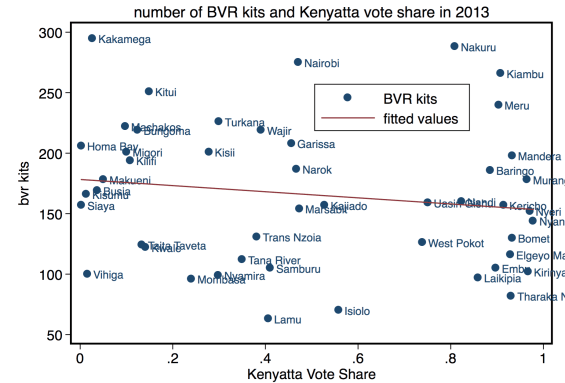
The idea that the elections can be won at the close of registration brings to mind the neutrality of the IEBC when deciding how to allocate finite resources for mass voter registration. To assess this I looked at the distribution of biometric voter registration (BVR) kits relative to a number of factors, including Kenyatta’s vote share in 2013, county area, county population, population per electoral units (wards and constituencies), and the number of electoral units.

Here are the summaries:

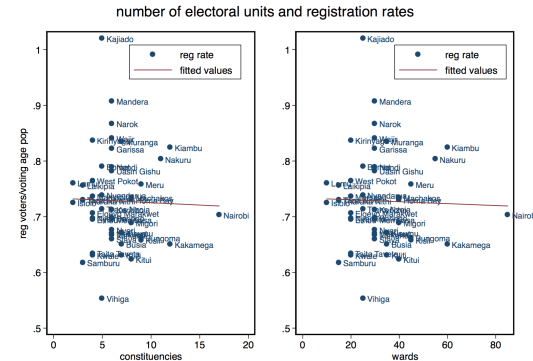
1.  Being an incumbent, it is conceivable that Kenyatta would have wanted to influence the allocation of BVR kits. But there is no obvious relationship between Kenyatta’s county-level vote share in 2013 and the distribution of BVR kits ahead of the 2017 election. The pro-Kenyatta counties of Nakuru, Kiambu and Meru that received a lot of kits also have large populations. If anything, it appears that pro-Odinga counties got more kits, perhaps a reflection of the fact they had relatively more unregistered potential voters after 2013.countykits2. The number electoral units (wards or constituencies) had no influence on the rate of voter registration in the 47 counties. In other words, it is not the case that counties which had a lot more electoral units (and therefore potential candidates) experienced greater rates of voter mobilization for registration.

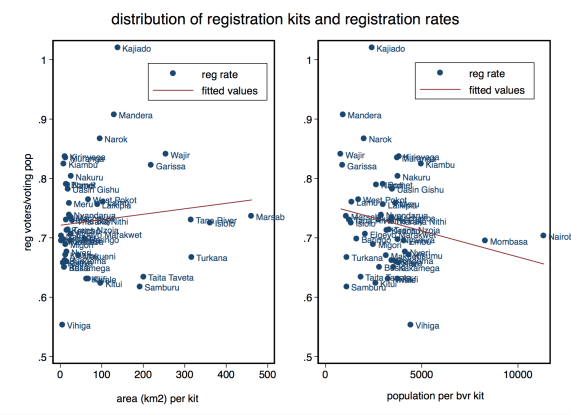
elecunits3. However, the population per electoral unit (wards and constituencies) was negatively correlated with the registration rate. In other words, more populous wards and constituencies experienced lower registration rates relative to their less populous counterparts. This makes sense, to the extent that the IEBC was targeting a specific number of BVR kits per electoral unit per county.populations4. Bigger counties with relatively smaller populations benefited from the fact that land area was a consideration in IEBC’s allocation of BVR kits.
kits

Kajiado and Vihiga counties beg explanation.

Kajiado registered more than 100% of its projected adult population (based on the 2009 census). This may be a case of massive in-migration after the 2009 census or the deliberate importation of voters for the specific purpose of influencing the outcome of intra-county elections.

Vihiga, on the other hand, stands out for its poor registration rate. It is noteworthy that Vihiga is home to Musalia Mudavadi who came third in 2013 and is now part of the NASA coalition led by Raila Odinga. Given that the mass registration exercise ended well before it was clear that Mudavadi was not running for president, the low registration rates in Vihiga raise questions about his ability to turnout the vote come August 8th.

Finally, while it is hard to discern what happened within counties — the effort of IEBC agents is unobservable — it is fair to say that political considerations do not appear to have influenced the number of BVR kits deployed to the counties for the mass voter registration exercise.

Is the government of Rwanda massaging statistics on growth and poverty reduction?

This is from the latest installment in the debate over whether Rwanda’s official statistics on economic growth and poverty reduction can be believed:

All poverty lines yield similar trends when used consistently over time, indicating that poverty increased between 5% and 7% points between 2010 and 2014. All changes are statistically significant at the 5% level.

It should be noted that our results differ from those obtained by simply updating the poverty line for inflation using CPI data, as was done by NISR in their 2016 trend report (NISR, 2016). In principle, if the data are of good quality and sufficiently disaggregated, both methods should be equivalent and should not yield significantly different results. This therefore raises questions about the quality / reliability of official CPI data, and/or the quality of price data collected by the EICV. In either case, this would undermine our ability to correctly estimate poverty levels in Rwanda. The discrepancies found here should invite us to more closely scrutinize official statistics coming out of the Rwandan statistical office. GDP growth figures appear to be incompatible with the findings of the EICV survey, given than agriculture still accounts for about one third of GDP and two thirds of the labour force.

More on this here.

The idea that Rwanda is growing without reducing poverty is concerning because it means that the implicit bargain inherent in the country’s political economy — growth in exchange for controlled political development — is not working. It is also likely that the benefits of the country’s recent impressive economic performance are accruing to only a few people, perhaps along ethnic lines. That, again, would be a source of serious concern.

If these data are to be believed, one wonders if Paul Kagame’s refusal to step down is informed by an understanding that the implicit bargain might not hold if he steps down because it was all a mirage to begin with.

More generally, what this means is that Rwanda is developing like any other poor country in which the initial beginnings of rapid growth will be accompanied by rising inequality. The singular problem for Rwanda, of course, is that its history and political economy mean that following this trajectory comes with serious risks to continued political stability.

Uhuru Kenyatta ahead of Raila Odinga in the first post-nomination poll

Ipsos just released a poll in which President Uhuru Kenyatta leads Hon. Raila Odinga 48-42% among a representative sample of voting age adults. While this is not a particularly good showing for an incumbent with a few achievements to tout, the poll confirms Kenyatta’s frontrunner status. Furthermore, a 6 percentage point lead combined with his structural advantage in the turnout game mean that if the polls do not narrow any further Kenyatta will likely win in the first round come August 8th. In 2013 most public polls consistently over-estimated Odinga’s support by about 2 percentage points by not accounting for turnout patterns.

A few things other things are worth noting from the Ipsos poll:

  1. Polls have tightened over the last few months. As Odinga consolidates the opposition, his poll numbers have converged on Kenyatta’s. This is a trend worth watching over the next few weeks.
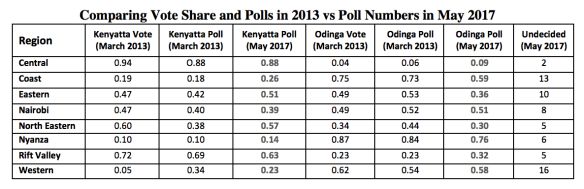
  2. The number of undecideds, especially in Coast, Eastern and Western regions, is rather high. This should worry Odinga. Again, Kenyatta has a structural advantage in the turnout game, which means that if Odinga is to have a fighting chance he must ensure that his strongholds register both high turnout rates and give him an even bigger share of their votes than in 2013. That they remain undecided does not bode well for Odinga’s chances. In the table below, Kenyatta’s poll numbers are close to his numbers both in final poll of 2013 and the official election results. Undecideds appear to be voters who sided with Odinga in 2013.Screen Shot 2017-05-31 at 9.30.40 PM.png
  3. This poll may be over-estimating Kenyatta’s support in Western region. In 2013 Kenyatta under-performed his poll numbers in Western region by a whole 29 percentage points. And so while his 23% rating in Western region may be a sign that Deputy President William Ruto’s investments are bearing fruit, I would not take these numbers to the bank just yet.
  4. Odinga has made significant gains in the Rift Valley region since 2013. One way for Odinga to force a runoff (or eke out a squeaker of a first round win) would be to peel off enough voters in from the North Rift. He appears to be doing that. His poll numbers in the region in 2013 were spot on, making his 32% rating in the region believable for now. Recent developments also suggest that he is gaining ground in Narok, Bomet, and parts of Kajiado. That should be a source of concern for the Kenyatta team.
  5. It is still a turnout game, and Odinga is trailing. The bulk of undecideds — in Coast, Eastern, and Western regions — appear to be likely Odinga supporters. While this may mean that they are likely to break for Odinga in August, it could also mean that they will remain undecided and stay home on election day. Hassan Joho, Kalonzo Musyoka/Charity Ngilu, and Musalia Mudavadi/Moses Wetangula have their work cut out for them.

While a lot may happen between now and August 8th, it is fair to say that Kenyatta is in a strong position. Odinga has several paths to victory, but success along any of those parts is dependent on the NASA coalition running a near-perfect campaign focused on both increasing turnout and running up the score in their strongholds. To this end the lack of enthusiasm in Coast, (lower) Eastern, and Western regions is definitely not a good sign.

The one thing that should worry Kenyatta is Odinga’s apparent gains in the Rift Valley region. If Odinga gains traction in Bomet, it is conceivable that he would also be able to peel off votes in Kericho. It is not that long ago that both Deputy President William Ruto had to camp in Kericho to avoid an embarrassing loss in a by-election. His preferred candidate ended up winning with 66% of the vote. In Bomet, incumbent Governor Isaac Ruto is backing Odinga. And while he will face a tough time swaying voters to Odinga’s camp, it is not far-fetched to imagine that he could bag around 40%. If the same happens in Kericho then two of the Rift Valley’s most important vote baskets will become swing. And Kenyatta would be in serious trouble.

Note: Nearly all the polls this cycle will not take into account any “likely voter models.” I will do my best to guestimate turnout rates based on passed voting patterns and other variables. 2026 out of 5484 contacted agreed to participated in this Ipsos poll.

On the Causes of Excess Female Mortality Across African States

This is from a new paper by Siwan Anderson and Debraj Ray:

In this paper, we explore how the phenomenon of missing females is distributed across Africa. We consider two age groups: zero to 14 years old, and 15 to 59 years old. With such high overall mortality rates in Africa, these two age groups comprise almost all of the excess female deaths on the continent. Overall, there are more than 1.7 million excess female deaths each year in Africa. Expressed as a fraction of the female population, the African numbers are significantly higher than their Chinese or Indian counterparts. Roughly 425,000 of these excess female deaths in Africa are in the younger age category (zero to 14 years old), while the remaining 1.3 million are in the older age category (15 to 59 years old). There is substantial regional variation in excess female mortality across the continent. In both age groupings, the largest numbers are in West Africa. In the younger age group there are almost 200,000 excess female deaths in a given year in that region, and more than 450,000 in the older age category. East Africa is next, with close to 100,000 excess female deaths at the younger ages each year, and almost 400,000 in the older age category. By comparison, North Africa has the lowest excess female mortality, with roughly 100,000 excess deaths each year across the two age categories. Although excess female mortality is extremely high in Southern Africa in the older age group, by contrast there is virtually no excess female mortality in this region for the younger age category. Likewise, relative to other regions, excess female mortality is lower in the younger age category compared with the older in East Africa.

Our methodology also allows us to explore which diseases are primarily responsible for this extreme excess female mortality across Africa. In the younger age category, almost all of these excess deaths are from infectious and parasitic diseases and respiratory infections. A primary cause of excess young female deaths is malaria, with roughly 110,000 excess female deaths from this cause alone each year. The secondary major cause is respiratory infections, with around 95,000 excess female deaths each year; then diarrhoeal diseases, with approximately 77,000 excess young female deaths each year. In the older age category, HIV is the primary killer. There are close to 800,000 excess female deaths from HIV each year across Africa, with the largest proportions found in Southern and East Africa. Maternal mortality is also a major cause, particularly in East and West Africa. There are close to 400,000 excess female deaths from this cause each year.

H/T Charles Kenny.

By the Numbers: A Look at the 2017 Presidential Election in Kenya

Kenya will hold a General Election on August 8th of this year. The national-level elections will include races for president, members of the National Assembly, and the Senate. County-level races will include those for governor (47) and members of County Assemblies (in 1450 wards).

This post kicks off the election season with a look at the presidential election. I also plan to blog about the more exciting gubernatorial races in the coming weeks.

Like in 2013, the contest will be a two-horse race between President Uhuru Kenyatta (with William Ruto as his running mate) and Hon. Raila Odinga (with Kalonzo Musyoka). The convergence on a de facto bipolar political system is a product of Kenya’s electoral law. The Constitution requires the winning presidential candidate to garner more than half of the votes cast and at least 25 percent of the votes in at least 24 counties. In 2013 Kenyatta edged out Odinga in a squeaker that was decided at the Supreme Court. Depending on how you look at it, Kenyatta crossed the constitutional threshold of 50 precent plus one required to avoid a runoff by a mere 8,632 votes (if you include spoilt ballots) or 63, 115 (if you only include valid votes cast). In affirming Kenyatta’s victory, the Supreme Court ruled in favor of the latter approach.

But despite the court’s ruling, a significant section of Kenyans still believe that Kenyatta rigged his way into office, and that Odinga should have won.

My own analysis suggests that it was a little bit more complicated. I am fairly confident that Kenyatta beat Odinga in the March 2013 election. But I do not think that he crossed the 50 percent plus one threshold required to avoid a runoff. At the same time, I am also confident that Kenyatta would have won a runoff against Odinga. All to say that I think the results in 2013 reflected the will of the people bothered to vote.

This year will be equally close, if not closer.

This is for the following reasons:

  1. Odinga has a bigger coalition: The third candidate in 2013, Musalia Mudavadi, is joining forces with Odinga this time round – as part of the National Super Alliance (NASA). Mudavadi managed to get just under 4% last time and will provide a much-needed boost to Odinga’s chances in Western Kenya and parts of the Rift Valley.
  2. Kenyatta has had a mixed record in office: The Kenyan economy has grown at more than 5% over the last four years. The same period saw massive investments in infrastructure — including a doubling of the share of the population connected to the grid and a brand new $4b railway line connecting Nairobi to the coast. However, these impressive achievements have been offset by incredible levels of corruption in government – with senior government officials caught literally carrying cash in sacks. Kenyatta is also stumbling towards August 8th plagued with bad headlines of layoffs and the ever-rising cost of living. Barely two months to the election, the country is in the middle of a food crisis occasioned by a failure to plan and a botched response that appears to have been designed to channel funds to cronies of well-connected officials.
  3. The Rift Valley: In 2013 much of the Rift Valley was a lock for Kenyatta (it is William Ruto’s political back yard). This time will be different. Parts of Ruto’s coalition in the Rift, particularly in Kericho and Bomet counties, may swing towards Odinga this year. All Odinga needs is about a third of the votes in these counties. I expect both campaigns to spend a lot of time trying to sway the small pockets of persuadable voters in these two counties.
  4. The Kenyatta Succession in 2022: In 2013 Kenyatta was elected as the head of an alliance, not a party. In 2017 he is running atop a party, the Jubilee Party (JP). It is common knowledge that JP is William Ruto’s project. Because he plans to succeed Kenyatta in 2022, he desperately needs credible commitment from Kenyatta and his allies that they will support his bid when the time comes. JP is an installment towards this goal, and is designed to allow Ruto to whip party members in line during Kenyatta’s second term (on a side note, Ruto needs to read up on the history of political parties in Kenya). But by forcing everyone into one boat, JP may actually end up suppressing turnout in key regions of the country, the last thing that Kenyatta needs in a close election.
  5. The ICC factor (or lack thereof): Because of their respective cases at the ICC, 2013 was a do or die for Kenyatta and Ruto (and their most fervent supporters). This time is different. Both politicians are no longer on trial at the ICC, and so cannot use their cases to rally voters. The lack of such a strong focal rallying point will be a test for Kenyatta’s turnout efforts.

Nearly all of the above factors sound like they favor Odinga. Yet Kenyatta is still the runaway favorite in this year’s election. And the reason for that is turnout.

As I show in the figure below, the turnout rates were uniformly high (above 80%) in nearly all of the 135/290 constituencies that Kenyatta won in 2013. Pro-Odinga constituencies had more spread, with the end result being that the candidate left a lot more votes on the table.

The same dynamics obtained at the county level (see above). In 2013 Odinga beat Kenyatta in 27 of the 47 counties. The counties that Odinga won had a total of 8,373,840 voters, compared to 5,977,056 in the 20 counties won by Kenyatta. The difference was turnout. The counties won by Odinga averaged a turnout rate of 83.3%. The comparable figure for counties won by Kenyatta was 89.7%. At the same time, where Kenyatta won, he won big — averaging 86% of the vote share. Odinga’s average vote share in the 27 counties was a mere 70%.

The same patterns may hold in 2017. The counties won by Odinga currently have 10,547,913 registered voters, compared to 7,556,609 in counties where Kenyatta prevailed. This means that Odinga still has a chance, but in order to win he will have to run up the numbers in his strongholds, while at the same time getting more of his voters to the polls. Given the 2017 registration numbers, and if the turnout and vote share patterns witnessed in 2013 were to hold this year, then Kenyatta would still win with 8,000,936 votes (51.5%) against Odinga’s 7,392,439 votes (47.6%).

The slim hypothetical margin should worry Kenyatta and his campaign team. For instance, with an 89% turnout rate and an average of 85% vote share in the 27 counties Odinga won, and holding Kenyatta’s performance constant, the NASA coalition could best Jubilee this August by garnering 8,921,050 votes (55.4%) vs 7,191,975 (44.6%).

Kenyatta is the favorite to win this August on account of incumbency and Jubilee’s turnout advantage. But it is also the case that the election will be close, and that even a small slip up — such as a 3 point swing away from Jubilee between now and August 8th — could result in an Odinga victory.
Is Asia Aging Prematurely?

This is from the FT:

China’s working-age population peaked in 2011 but its per capita income was just 20.7 per cent of the US level. Thailand was a little wealthier, at 28.9 per cent, when its working-age share peaked in 2013, but Vietnam was far poorer still, at 10.4 per cent of the US level, when it reached the same point a year later. Malaysia, Indonesia, India and the Philippines are projected to be somewhat better off when they reach peak working-age share, probably between 2020 and 2056, but still some way below the income levels reached in the west, as the third chart shows.

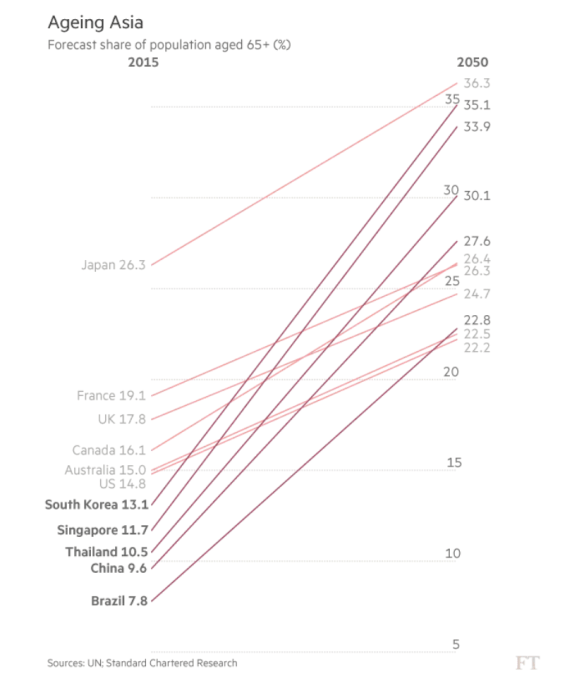
In February of this year, projections by Standard Chartered suggested that, by 2050, the likes of South Korea, Singapore, Thailand and China would have a higher share of pensioners in their population than most developed countries, depicted in the second chart [see below].

Screen Shot 2017-05-17 at 10.25.56 AM.png

These are pretty sobering figures. Basically (East) Asia’s dependency ratios will quickly begin to look a lot more like what obtains in low-income as opposed to high and upper middle income states. And that means a stagnation or even decline in per capita income.

It will be interesting to see how these countries — most of which have historically been averse to immigration — will deal with this demographic challenge.

In addition to the obvious economic challenges, Asian countries will also have to figure out how to take care of the medical needs of an aging population that will likely be living longer.

More on this here.

On Obsolescing Bargains: Hoima-Tanga Pipeline Edition

This is from the East African in March:

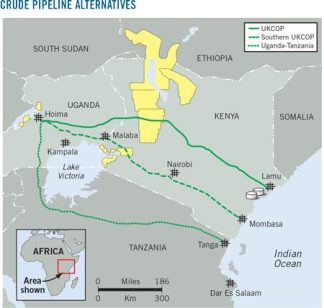
The incentive that among other things lured Uganda to choose the southern route is the tariff of $12.2 per barrel of oil that Uganda will pay to move its crude oil through Tanzania, which Ms Muloni says was “the best we got.”

pipeline

Source: Oil & Gas Journal

The East African has learnt that in a bid to hijack the deal from Kenya, which also discovered oil in the northern region, Tanzanian officials were willing to throw sweeteners into the deal, which included free land and a fair tariff.

But, after getting the deal, Tanzanian officials started raising doubts over the project’s benefits to Dar es Salaam, citing a number of issues, such as the fact that in Tanzania land belongs to the government, so Uganda did not have to compensate any landowners, hence an increase in the tariff to a figure that The East African could not establish, was seen as a fair deal for Dar.

I hope Ugandan negotiators are aware that Tanzania’s bargaining position will get even stronger after the 1445km pipeline is built.

On Uganda’s Textile Sector

This is from The Economist:

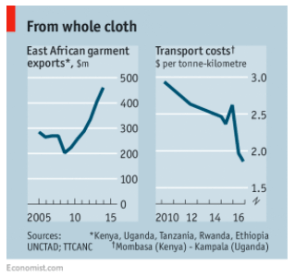
Uganda’s main advantages, for the moment, are cheap cotton and labour, and preferential access to American and European markets. When exporting to the rich world “Africa has an 18-35% duty advantage over any other continent”, says Nick Earlham, a shareholder in WUCC and in Fine Spinners. “It’s very competitive.”Screen Shot 2017-05-04 at 1.13.26 PM

Textile workers in Kampala earn about $85 a month, compared with $150 in Kenya and $108 in Vietnam, never mind up to $700 in China. But these savings are offset by problems in almost every other sphere. Power cuts keep plunging the factory into darkness, and an erratic supply of steam to the dyeing machines makes it hard to ensure that each batch of fabric looks alike.

Textiles appear to be a low hanging fruit as far as creating mass employment in African states is concerned. And, at least for now, they will remain immune from the threat of mechanization:

Robots are not yet much good at fiddly sewing jobs on floppy fabric; less than 0.1% of the world’s industrial robots are in the clothing trade.

More on this here.

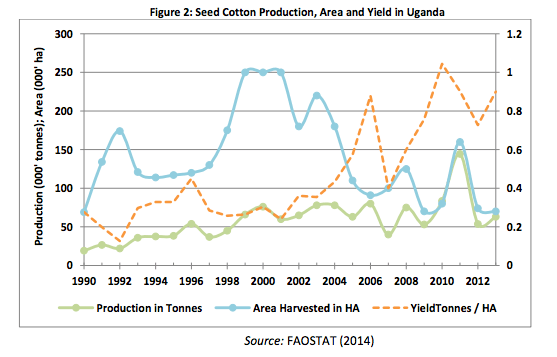
Lastly, while production levels have not increased significantly over the last decade, FAO data (see below) do suggest a non-trivial increase in productivity (yield/ha) in Uganda’s cotton sector. This outcome could be a result of a myriad causes, but it is in line with recent research by Bates and Block (2013) showing increased agricultural productivity in African states that experienced real exposure to competitive electoral politics.

Screen Shot 2017-05-04 at 1.50.16 PM.png

Is Civil War in Africa Unique?

Paul Staniland raises important questions in his review of Philip Roessler’s latest book (highly recommended):

I just finished reading Philip Roessler’s excellent book for my graduate Civil War seminar. Already a fan of his 2005 piece on electoral violence, I learned a lot from the new book and highly recommend it. But, just as when reading major work by Will Reno, Reno and Chris Day, Jeremy Weinstein, Paul Collier, Jeffrey Herbst, and others, I had the reaction that “This looks nothing like the places I study.” At least in the stylized world of African politics presented in these projects (I have no idea if this is accurate), Hobbesian insecurity preys on all in the absence of any real institutions, ethnic balancing and calculation dominates any other form of politics, and regimes are held in place by fluid, shifting alignments with “Big Men” rooted in local power bases.

As a result, we get shambolic and weak central regimes prone to either coups or revolts, and rebels easily bought off by patronage or co-optation. Weinstein highlights the inability of ideological rebels to overcome waves of material resources that eliminate discipline or politics, Roessler’s regimes are simply what Skocpol calls an “arena” for political competition between social actors rather than possessing any institutions or interests autonomous from social forces, and Reno’s civil wars (with the exception of “reform rebels”) are simply a grim game of bargaining over patronage between states and insurgents that are more similar than different.

Is Africa that different?

Roessler, indeed, argues that Africa has a “unique institutional structure” in which external conflicts are rare and internal disorder common. If Africa is indeed unique, it is hard to know how arguments rooted in the African context can travel beyond Africa.

Read the whole thing here.

I would argue that there is not a uniquely African civil war story. Weak states everywhere, including in Africa, are gonna weak state.

A more useful analytical delineation is what Staniland suggests:

At minimum, I’m becoming increasingly convinced that research on civil war needs to become at least partially bifurcated into work on its dynamics in very weak states (the representation of African conflicts dominant in the literature, plus Afghanistan and a few others) versus those in medium-capacity states (India, Colombia, Indonesia, Russia, etc) that possess large, centrally controlled conventional an

Think of the Nigerian Civil War between 1967-1970. The Biafra War involved a relatively strong state facing a relatively well-organized and disciplined secessionist army — much in the mold of middle income conflicts. In the same vein, countries like Kenya and Ethiopia have managed to quell rebellions in Mt. Elgon & the south coast, and in the Ogaden, respectively, in ways that would look very familiar to Staniland.

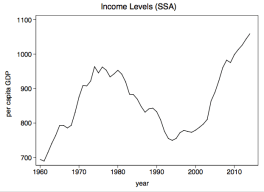
Completely anarchic conflicts involving collapsing states and incoherent hyper-localized rebellions — your stereotypical African conflict, if you will — are a unique historical experience rooted in the states that did really fall apart in the late 1980s to early 1990s (pretty much in the midst of Africa’s continental economic nadir). It is instructive that these states were concentrated in the Mano River region and Central Africa, some of the regions worst affected by the socio-political challenges of Africa’s lost long decade (1980-1995). income

And given recent economic trends in Africa (see image), it is not surprising that conflicts are becoming rarer in Africa (much in line with Fearon and Laitin). I would also expect markedly different kinds of conflicts should they emerge. There is a reason Boko Haram has never posed an existential threat to the Nigerian state, very much in the same way that India’s Maoist rebels are a peripheral matter.

I always remind my students that the Africa they know is more often than not the Africa that existed between 1980 and 1995. We all need to update.

On the Haitian Revolution

This is from Michel-Rolph Trouillot’s Silencing the Past: Power and Production of History:

The Haitian revolution therefore entered history with the peculiar characteristic of being unthinkable even as it happened. Official debates and publications of the times, including the long list of pamphlets on Saint-Domingue published in France from 1790 to 1804, reveal the incapacity of most contemporaries to understand the ongoing revolution on its own terms. They could read the news only with their ready-made categories, and these categories were incompatible with the idea of a slave revolution [p. 73]

The discursive context within which news from San-Domingue was discussed as it happened has important consequences for the historiography of Saint-Domingue/Haiti. If some events cannot be accepted even as they occur, how can they be assessed later? In other words, can historical narratives convey plots that are unthinkable in the world within which these narratives take place? How does one write a history of the impossible?

As the power of Louverture grew, every other party struggled to convince itself and its counterparts that the achievements of black leadership would ultimately benefit someone else. The new black elite had to be, willingly or not, the pawn of a “major” international power. Or else, the colony would fall apart and a legitimate international state would pick up the pieces. Theories assuming chaos under black leadership continued even after Louverture and his closest lieutenants fully secured the military, political, and civil apparatus of the colony….. [p. 94]

I read Silencing the Past right after reading C. L. R. James’ The Black Jacobins, and strongly recommend reading both together.

As I read both books I couldn’t help but wonder why my high school history had nothing on the Haitian revolution (which proves Trouillot’s point). It seems like the Haitian revolution, even if in sanitized form, would have been a good fit with the sanitized versions of the Mau Mau insurgency and the Algerian and Malaya wars that I was exposed to as a teenager.

More broadly, it seems like the teaching of decolonization in Kenya could benefit from more Haiti and Fanon, side by side with Mandela, Gandhi, and MLK. It is not a stretch to imagine that the threat of violence made the successes of the Mandelas of history more likely. To talk about the ANC without mentioning Umhonto we Sizwe is to stick one’s head in the sand.

Cash and Markets in Development

This is from a story in Kenya’s Standard Newspaper:

Martin Wepukhulu is a small-holder farmer in Trans Nzoia County, popularly described as Kenya’s breadbasket. To produce a two-kilogramme tin of maize known as gorogoro here, he spends about Sh25 on land preparation, seeds and fertilisers on his one-acre farm.

Some 270 kilometre away in Turkana County, one of Kenya’s poorest counties, is Loseny Nguono, a goat keeper, with two wives and 13 children. Turkana is one of the 23 counties affected by drought which has left close to 4 million people in danger of starvation.

Loseny receives Sh8,000 after every two months from the national government through the national safety net programme. He is willing to pay Martin a decent Sh70 for his gorogoro of maize. Unfortunately, neither Martin nor Loseny will get his wish. A reclusive government, ruthless cartels, dilapidated roads and marauding bandits conspire to ensure that while Martin sells his cereals at a low of Sh40, Loseny buys it at a high of Sh150.

Read the whole thing here.

It is great that Loseny has cash; and that unconditional cash transfers for social protection are increasingly becoming a mainstream policy option (notice that the story doesn’t even acknowledge the awesomeness of this reality). But the other lesson that we can learn from the story is that in order to get Loseny out of poverty we need good roads, properly functioning markets, and security. All these are public goods that must be provided through collective action, above and beyond the improvements in Loseny’s private consumption.

Glencore buys out Dan Gertler, Israeli businessman accused of bribing DRC’s President Joseph Kabila

It’s hard to imagine a more fitting embodiment of the sad story of economic vandalism in the DRC than the friendship between Israeli businessman Dan Gertler and President Joseph Kabila. Regular readers know that Gertler’s pillage of the DRC is a pet topic on this blog – see here, here, here and here, for example.

Now FT’s  has yet another story on how mining giant Glencore has been forced to buy out Gertler over accusations of bribery:

After years of doing business together in one of the world’s poorest countries, Glencore has dissociated itself from Dan Gertler, an Israeli mining tycoon implicated in the payment of bribes to the ruler of the Democratic Republic of Congo.

Glencore’s announcement last month that it would pay $534m to Mr Gertler to buy him out from their shared prize assets in the DRC — two giant copper mines — is designed to insulate the London-listed mining cum trading behemoth from the fallout of a widening corruption investigation involving the Israeli businessman, say people who have followed the saga. The decision by Ivan Glasenberg, Glencore’s chief executive, highlights the risks of doing business in the resource-rich, war-torn central African country, where Mr Gertler wields influence by virtue of his close friendship with Joseph Kabila, the DRC president.

Settlement documents released in September by US authorities in a scandal involving Och-Ziff, the New York hedge fund, alleged that an “Israeli businessman” — whose description clearly matches Mr Gertler — had paid bribes to Mr Kabila in order to obtain special access to mining rights in the DRC.

One banker who does dealmaking in the mining sector and owns Glencore shares says the company’s purchase of Mr Gertler’s stakes in the two DRC copper mines is defensive. “Buying out Gertler is primarily about detoxification for Glencore,” he adds. “The Och-Ziff investigation in the US has made it very risky to have clear ties to him.”

More on this here. Definitely worth a quick read.

President Joseph Kabila was paid $7m in bribes. Dan Gertler’s buyout is worth $534m in cash, paid by Glencore.

Intrahousehold Inequality Across Income Levels: Evidence From Nutrition Data

Antipoverty policies in developing countries often assume that targeting poor households will be reasonably effective in reaching poor individuals. This paper questions this assumption, using nutritional status as a proxy for individual poverty. The comprehensive assessment for Sub-Saharan Africa reveals that undernourished women and children are spread widely across the distribution of household wealth and consumption. Roughly three-quarters of underweight women and undernourished children are not found in the poorest 20 percent of households, and around half are not found in the poorest 40 percent. The mean joint probability of being an underweight woman and living in the poorest wealth quintile is only 0.03. Countries with higher overall rates of undernutrition tend to have a higher share of undernourished individuals in nonpoor households. The results are consistent with evidence of substantial intrahousehold inequality.

…. the paper has provided a comprehensive study for 30 countries in Sub-Saharan Africa. We find a reasonably robust householdwealth effect on individual undernutrition indicators for women and children. Nonetheless, on aggregating across the 30 countries studied here, about three-quarters of underweight women and undernourished children are not found in the poorest 20% of households when judged by the household wealth index in the Demographic and Health Surveys.

That’s Caitlin Brown, Martin Ravallion, and Dominique van de Walle in a new World Bank working paper.