African Country Names Explained

placenames.png

The etymology of Kenya is still being resolved. Indeed even the pronunciation isn’t clear. Most people I know say “Kenya.” But others (like my dad and older Kenyans) say “Key-nya.”

A friend of the blog writes on twitter:

[N]ot sure whether ‘White’ is a solid translation of ‘nyaga’. Not unreasonable to choose ‘shining’ or ‘shimmering’ or similar. (*My* preferred translation is ‘Lord of Brightness’ for ‘Mwene Nyaga’ — a reasonable compromise, or so I like to think.)

H/T Rachel Strohm.


Tyler Cowen Interviews Chris Blattman

Listen to the entire interview here.

Some interesting observations from Chris:

On cash transfers:

What we found is, the initial result after two and four years was like other places seeing big advances in incomes. People get cash. They’re poor. They couldn’t invest in some of their ideas, but they had good ideas, and so they take off.

Now what we’ve seen is, essentially, they’ve converged with the people who didn’t get the cash. The people who didn’t get the cash have caught up because they saved and accumulated slowly and got up to the point where they have the same levels of success.

They converged to a good level. But this means that cash transfers are much more of a temporary acceleration than they are some sort of permanent solution to poverty.

On Botswana’s economic growth miracle:

There’s a few pat stories that say, “Well, they idiosyncratically established a parliamentary government before they discovered their diamonds and, through some magical set of circumstances, maintained this good governance. And the diamonds fed growth and prosperity.”

But that doesn’t seem very persuasive. There’s another story that’s waiting to be told, and I don’t know the answer to it.

On the correlation between stateness and development:

First, my personal experience, whether it’s the little regression I get to run by working in places as diverse as Liberia and Uganda, in Ethiopia and Colombia, that correlation is more apparent than any other correlation.

Why do I think it’s there? I think it’s there because partly it’s a proxy for a general level of social organization that we, as a society, have figured out a way to solve certain collective action problems, that we’ve figured out a way to make certain types of collective decisions in a way that does not have to devolve into conflict. And as a result, we’re able to, on some sense, do everything more effectively — it’s like a general-purpose technology.

Conversational Chris comes off as a much broader thinker than some of his famous papers let on. He is also genuinely committed to knowing the contexts within which he works — which, in my view, is the key reason why his works on violence stand out in the literature.

I hope he is still considering writing a book.

Is Ethiopia in the midst of a green revolution?

This is from Bachewe and co-authors in World Development:

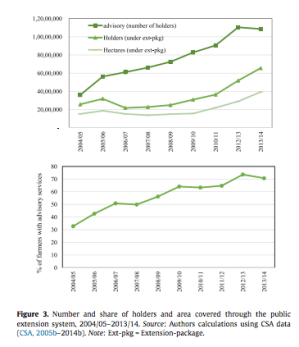
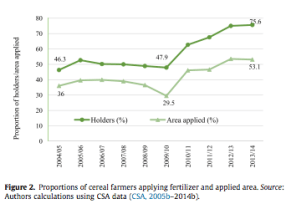
Screen Shot 2018-03-14 at 8.34.44 AMDespite significant efforts, Africa has struggled to imitate the rapid agricultural growth that took place in Asia in the 1960s and 1970s. As a rare but important exception, Ethiopia’s agriculture sector recorded remarkable rapid growth during 2004–14. This paper explores this rapid change in the agriculture sector of this important country – the second most populous in Africa. We review the evidence on agricultural growth and decompose the contributions of modern inputs to growth using an adjusted Solow decomposition model.Screen Shot 2018-03-14 at 8.35.03 AM We also highlight the key pathways Ethiopia followed to achieve its agricultural growth. We find that land and labor use expanded significantly and total factor productivity grew by about 2.3% per year over the study period. Moreover, modern input use more than doubled, explaining some of this growth. The expansion in modern input use appears to have been driven by high government expenditures on the agriculture sector, including agricultural extension, but also by an improved road network, higher rural education levels, and favorable international and local price incentives.

The improvement in agricultural productivity was driven, in part, by deliberate state investment in agriculture:

Ethiopia is one of only four African countries to have implemented the CAADP agreement of a 10% target of annual government expenditures going to agriculture over the 2003–2013 period.

… The GoE has for a long time put agriculture at the center of its national policy priorities. The Agriculture Development Led Industrialization (ADLI) strategy was formulated in the mid-1990s to serve as a roadmap to transform smallholder agriculture in the country. Rural education and health, infrastructure, extension services, and strengthening of public agricultural research were among its top priorities.

These gains are remarkable (if we can trust the state statistical agency data used in the analysis). They are also likely not replicable in other countries across the Continent on account of the high variance in state capacity in the region.

For instance:

[while the] Comprehensive Africa Agriculture Development Programme (CAADP) proposed that African countries allocate 10 percent of their total annual budgets toward boosting agricultural productivity…, only 13 countries [have] signed the CAADP compact (Benin, Burundi, Cape Verde, Ethiopia, The Gambia, Ghana, Liberia, Mali, Niger, Nigeria, Rwanda, Sierra Leone, and Togo).

And out of these 13 only Cape Verde, Ethiopia, Ghana, and Rwanda seem like they have the capacity to translate state fiscal outlays into real productivity gains in agriculture.

Read the whole paper here.

The human toll of state violence in Kenya

This is from Human Rights Watch:

Human Rights Watch research since August, when the first vote was held, has found that police and armed gangs killed more than 100 people during Kenya’s prolonged elections period. Human Rights Watch and Amnesty International found in a joint report in October that at least 67 people were killed countrywide during the first round of voting in August, most of them either shot or beaten to death by police. During the second election, Human Rights Watch documented 37 more killings, most by police, in Nairobi’s Embakasi, Kawangware, Dandora, Mathare, Kibera, Kangemi, Kariobangi, and Riverside neighborhoods. Armed gangs killed some people they identified by tribe as likely opposition supporters.

Find the whole (harrowing) report here.

Police brutality has become so normalized in Kenya that a couple of days ago officers allegedly chased a university student leader into a farm and executed him in full view of witnesses. No one has resigned. The matter is under “investigation.”


Can fascists take over America?

Tyler Cowen thinks they can’t:

American fascism cannot happen anymore because the American government is so large and unwieldy. It is simply too hard for the fascists, or for that matter other radical groups, to seize control of. No matter who is elected, the fascists cannot control the bureaucracy, they cannot control all the branches of American government, they cannot control the judiciary, they cannot control semi-independent institutions such as the Federal Reserve, and they cannot control what is sometimes called “the deep state.” The net result is they simply can’t control enough of the modern state to steer it in a fascist direction.

This yields a new defense of Big Government, which is harder to take over, and harder to “turn bad,” than many a smaller government. Surely it ought to give us pause that the major instances of Western fascism came right after a time when government was relatively small, and not too long after the heyday of classical liberalism in Europe, namely the late 19th century. No, I am not blaming classical liberalism for Nazism, but it is simply a fact that it is easier to take over a smaller and simpler state than it is to commandeer one of today’s sprawling bureaucracies.

This argument is only moderately convincing. The bureaucratic argument is pretty weak historically. In fact, there is work that suggests that high levels of social capital and the presence of a rationalized bureaucracy made it easy for the Nazis to take over. The argument would have been stronger if Cowen focused on the ways in which the federal system and the decentralization of hard power in America provides real barriers to countrywide fascistic rule (but he is an economist, so “size of government” is a readily available metric).

The other weakness in the argument is that Cowen sounds like he has in mind “Rule of Law Fascists” (at least at the beginning). But by definition, these chaps would probably engage in a lot of extra-constitutional means of gaining and maintaining power. And at that point, the only stumbling bloc would be the hard power dispersed in the states.

American has a fairly decentralized system of internal projection of coercive capacity (police units are run by states, counties, and cities). These security units could be commandeered by would-be dissenters to challenge a fascist in Washington (states would presumably also race to control all the American military’s weaponry within their borders). America is also too culturally heterogenous to enable a quick takeover by fascists. The fascists would first have to kill a significant number of not only non-European-Americans (going by the demographics of current American fascists) but also a lot of European-Americans before they could install their rule. In the process of doing so, they would begin to undermine the very ethnic and cultural basis of their fascistic rule.

A high level of ethnic (and ideological) heterogeneity would therefore mitigate against a rapid rise and consolidation of fascist rule.

Finally, while the risk of an outright fascist takeover is remote, the likelihood of ever-spreading pockets of fascism in the American state is very real. Here, too, decentralization plays a role. Because of America’s highly decentralized coercive capacities, pockets of unchecked predatory authoritarianism (fascism-lite, if you will) continue to exist throughout the country — see here, here and here. These pockets persist, in part, because the federal government is considered to be fairly faithful to the ideals of the American constitution. So while fascists may not take over the federal government, they can certainly control local police departments, or even pockets of the federal bureaucracy.

The role of elites in development (Danish Edition)

Kenya’s founding president, Jomo Kenyatta, often reminded Kenyan elites of their roles as living examples of material “development” to the peasantry. Contra Oginga Odinga — who wanted to empower the masses through land redistribution, Kenyatta believed that an elite-driven developmental agenda was the quickest way to end the scourges of poverty, illiteracy, and disease in Kenya (yes, he had very selfish reasons for holding this belief. But that is beside the point).

Turns out he was onto something.

This is from a paper by Jensen et al. on the dairy industry in Denmark:

We explore the role of elites for development and in particular for the spread of cooperative creameries in Denmark in the 1880s, which was a major factor behind that country’s rapid economic catch-up. We demonstrate empirically that the location of early proto-modern dairies, so-called hollænderier, introduced onto traditional landed estates as part of the Holstein System of agriculture by landowning elites from the Duchies of Schleswig and Holstein in the eighteenth century, can explain the location of cooperative creameries in 1890, more than a century later, after controlling for other relevant determinants. We interpret this as evidence that areas close to estates which adopted the Holstein System witnessed a gradual spread of modern ideas from the estates to the peasantry. Moreover, we identify a causal relationship by utilizing the nature of the spread of the Holstein System around Denmark, and the distance to the first estate to introduce it, Sofiendal. These results are supported by evidence from a wealth of contemporary sources and are robust to a variety of alternative specifications.

We thus demonstrate econometrically that the pattern of adoption of cooperative creameries in Denmark followed the introduction of proto-modern dairies by agricultural elites on estate farms. In the Duchies of Schleswig and Holstein, ruled by the King of Denmark in personal union until 1864 when they were lost to Prussia, an intensified crop rotation system with an important dairy component was developed on the large manorial estates known as Koppelwirtschaft in German, or kobbelbrug in Danish. It became the dominant field system in the Duchies in the 1700s, and included unprecedentedly large herds of milch cows and the invention of an innovative new centralized system of butter production, the hollænderi, with unparalleled standards of hygiene and equipment (Porskrog Rasmussen 2010a). These innovations – collectively known as the above mentioned ‘Holstein System’ when the crop-rotation was combined with the dairy unit – came relatively late to Denmark, but when they did they gradually transformed Danish agriculture.

Denmark’s current status as an ‘agricultural superpower’ , dominated by massive firms such as Arla (a dairy cooperative) and Danish Crown (a food, especially meat, processing firm previously also a cooperative until 2010), is usually traced back to the aforementioned developments in the 1880s. As we will discuss in more detail below, at this point a new technology, the steam-powered automatic cream separator made it possible to use milk which had been transported over long distances to be processed in a central production facility, and the voluntary associations of Danish peasants, the cooperatives, sprang up to take advantage of this possibility. Thus, modern Denmark emerged based on a democratic, cooperative countryside, providing something of a role model to other agricultural countries around the world.

The whole paper is worth reading, as it provides a rather interesting rebuttal (if I may call it that) to the core ideas about the long-run effects of inequalities in initial endowments in Engerman and Sokoloff (on Latin America) as well as Banerjee and Iyer (on India):

By contrast, we stress that agricultural elites may spread knowledge, which then subsequently aids development in the agricultural sector. In other words, our work suggests that agricultural elites may also be knowledge elites, who facilitate later development. Recent work by Squicciarini and Voigtländer (2016) demonstrates that knowledge elites played a significant role in the industrialization of France by e.g. running businesses themselves or exchanging knowledge with entrepreneurs. Our work emphasizes the importance of knowledge spill-overs and agricultural enlightenment (Mokyr 2009, ch. 9), and shares some similarities with Hornung’s (2014) work on high-skilled immigration of Huguenots into Prussia. He shows that this led to higher productivity in the textile sector and interprets this as evidence of an effect of diffusion of technology. We focus on agricultural elites and their impact on the part of the agricultural sector that led to an economy-wide take-off.

The key difference in Denmark, of course, was that the social conditions permitted easy diffusion of ideas and practices from the knowledge elites to the masses, despite the inequalities in initial endowments. The situation might be different, for ex when race, ethnicity, or caste gets in the way.

Xi’s power grab in China is a big deal

Regularized and predictable change of leadership is perhaps the most important indicator of political development. It doesn’t matter if such changes occur through popular elections (as in electoral democracies), boardroom meetings (in party dictatorships), or through inheritance (as in monarchies). Predictability provides stability and allows for the cultivation of elite consensus over a system of rule. It also provides the background conditions necessary for the rule of law to emerge. A situation in which rules change with rulers is hostile to constitutionalism.

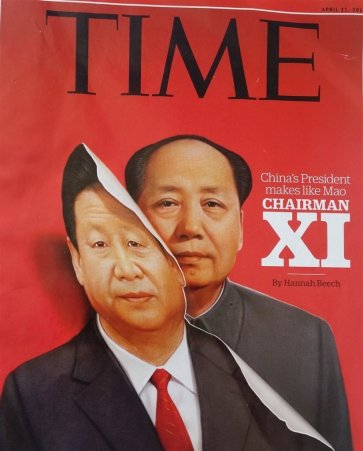
jinpingThis is precisely why life presidencies are sub-optimal. Long tenures eventually convince even the most democratic of leaders that they are above the law. They freeze specific groups of elites out of power. And remove incentives for those in power to be accountable and to innovate.

For a while China seemed to have turned this corner, having imposed term limits on its state presidents. But President Xi Jinping has thrown that consensus out the window with the announcement that he plans to scrap term limits and presumably stay on as president indefinitely. 

This is a big deal. Xi has revealed to us that he is no different than Yoweri Museveni.

Who would have guessed that in the 21st century we would be back to a situation in which the world’s biggest economy has life presidents, and occasionally goes through unpredictable transfers of power? Certainly, the coup risk in China is likely to go up under a life presidency. And the demonstration effect to other autocracies will be huge. Remember that even Vladimir Putin had to engage in questionable institutional jujitsu by allowing his wingman to be president in order not to flout the Russian constitution.

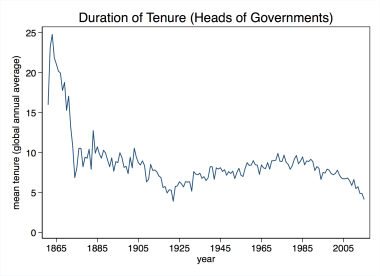
global_tenuremean.pngXi’s China is a reminder of that political development is not uni-directional. It is also a caution against trust that elites’ material interests are a bulwark against would-be personalist dictators. China’s economy is booming (albeit at a slower rate of growth), and continues to mint dollar billionaires. Yet the country’s political and economic elites appear helpless in the face of a single man who is bent on amassing unchecked power (the same happens in democracies with “strong western institutions”, too).

Globally, the annual average of the number of years in office for heads of governments has been on decline since the mid-1980s (see graph). Perhaps we were due for a correction, like happened in the mid-1920s. May be this time we will be lucky enough to avoid the messes that followed in the subsequent two decades (the fact that China appears to be a revisionist world power is not a great sign).

Finally, it is remarkable that even after being around for thousands of years China hasn’t figured a system of stable, regularized transfer of power that lasts for centuries. May be it is the curse of being a big country. Or may be this is just how politics works. It really does put in perspective the achievements of a number of African countries that appear to have consolidated term limits within a few decades of existence.

Labor is (relatively) very expensive in Africa: the case of teachers

This is from Justin Sandefur over at CGD:

Teachers in poor countries earn far more, in relative terms, than teachers in the OECD—and several recent studies suggest their pay isn’t linked to skills or performance. But we also have growing evidence that high-quality teachers generate huge economic returns. The question is how to ensure high pay attracts high quality.

…. This may come as a bit of a surprise to many rich-country readers. There’s no doubt that teachers in, say, India earn much less than teachers in Ireland, but relative to context, they tend to be very well paid. Dividing by per capita GDP is a rough and ready way to put salaries in context. With the help of my research assistant Mallika Snyder, we pulled together teacher salaries from as many countries as possible and ranked them in terms of their ratio to per capita GDP.

DWj6q4JX4AAN3kA.png

And this is from a World Bank report:

After controlling for a number of factors—such as income per capita, cost of living, firm size, and sector of activity— we see that labor costs in Africa are at least 10 percent higher than they are in East Asia, while South Asia retains its strong comparative advantage over Africa with around 40 percent lower labor costs.

….. in nominal terms, without controlling for any other factors—the South and East Asian regions enjoy a labor cost advantage over Africa of 25 percent and 60 percent, respectively.

This is why you should holiday in Kenya

This Is My Kenya || A Backdrop Production || 2017 from Backdrop on Vimeo.


The absurdity of Cameroon’s Paul Biya

This is from the organized crime and corruption reporting project (OCCRP):

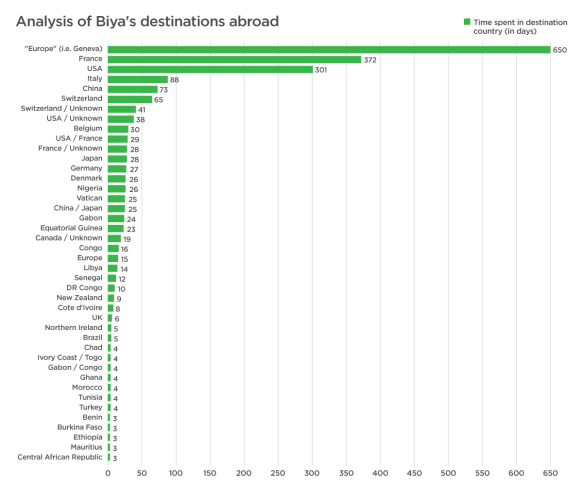
An investigation supported by the Organized Crime and Corruption Reporting Project (OCCRP) gathered information about the president’s travels from 35 years of editions of the daily government paper, the Cameroon Tribune. They show that, over that time, Biya has spent at least four-and-a-half years [abroad] on his “brief private visits.” This total excludes official trips, which add up to an additional year. In some years, like 2006 and 2009, Biya has spent a third of the year out of the country.

And here is a breakdown of Biya’s destinations over the last three and a half decades. It is almost as if Biya is a colonial governor of Cameroon, a Fanonian caricature.
Paul-Biya-Chart-A2

How does Biya pay for all this travel (estimated to be at least $185m in total)?

….. According to the International Monetary Fund, more than $300 million of the revenue of Cameroon’s national oil company in 2017 was not accounted for. The president has oversight over the company, whose oil sales, according to a leaked US diplomatic cable published by WikiLeaks, have historically been used as a slush fund.

Needless to say, the fascination with Geneva leaves little time for Biya to actually govern.

When Biya lands in Yaoundé, he also meets his government — at the airport. Formal ministerial councils are organized infrequently, every year or two at the most. But while Biya has used public funds to sustain a bureaucracy of 65 ministers and state secretaries, he mostly governs by decree or through a handful of laws sped through a rubber-stamp parliament.

Biya signs a flurry of acts between each of his trips. For example, in 2017, he signed a dozen laws — the entire legal output for that year – in a couple of days. It took him just three days to sign the entire year’s decrees.

Strong leadership can make a big difference in states with weak bureaucracies. But unfortunately for Cameroon, for 35 years it has been saddled with both an absentee landlord of a president and a barely coherent public service.

An enduring puzzle is why Cameroonian elites haven’t moved to come up with a more economically efficient means of keeping Biya in power and luxury. For instance, they could make him King, and have him sign decrees whenever he likes, but also have a Prime Minister that is responsible to a parliament and accountable to the people. Not that this would magically improve the quality of governance, but at a minimum, would likely introduce coherence within the public service (unless, of course, all of Cameroon’s elites simply want to appropriate public resources and spend their time in Geneva).

A response to this might be that elites in Cameroon are actually fine, constantly scheming and fighting for favor with Biya and access to governance rents.

But this still leaves open the question of why they wouldn’t want a more predictable means of accessing governance rents — that is not subject to the whims of Biya (who shuffles and jails ministers with wanton abandon). In any case, an elite-level collusion outcome — like the one described above — would create opportunities for the expansion of the pie beyond just oil and other natural resource sectors.

All to say that we should probably be spending more time exploring the seeming lack of elite-level political innovation across Africa (and Political Development more generally).

How robust are media freedoms in Kenya?

Here is a possible answer from a Tanzanian cartoonist living in Kenya:

DWgKrJJXUAAd2ID

You can find other works by Godfrey Mwampembwa here.

For more on media freedoms in Kenya see here.

On the Odingas and Kenyattas of Kenya

This is from Jina Moore (who is doing a great job as East Africa bureau chief).

Jaramogi Oginga Odinga, the father of Raila Odinga, negotiated independence with the British. The colonial rulers wanted Mr. Odinga to lead the new Kenya, but Mr. Odinga had other ideas: He demanded Mr. Kenyatta’s freedom — and his appointment as Kenya’s first head of state.

“Kenyatta would not have been released, and he wouldn’t have been made prime minister, if it hadn’t been for Odinga’s backing,” said Daniel Branch, a professor of history at the University of Warwick and an expert on post-colonial Kenyan politics. “The two men always admired each other.”

Willy Mutunga, who was chief justice of the Supreme Court from 2011 to 2016, believes Mr. Odinga was motivated by more than mere admiration. “I think he genuinely believed that the country was going to be better off with somebody who had become a legend,” he said.

And so, in 1964, when Kenya became a republic, Jomo Kenyatta became its president, and Jaramogi Odinga vice-president.

The piece is worth reading. I liked the bits about the Odinga/Kenyatta conflict over land redistribution.

It would be interesting to think of the counterfactual: What if Odinga/Kaggia had won over Kenyatta/Mboya and redistributed all the land? What kind of Kenya would have emerged? Would it have been more stable and prosperous than present day Kenya? Was this a feasible option given the preferences of Whitehall? What would have been the political and human costs?

My (positivist) take is that most people under-estimate the important role that the “willing buyer willing seller” mantra played in facilitating elite-level buy-in into the Kenya Project (state-building and elite-level stability). It’s not just Kenyatta and his co-ethnics that got land. Lots of elites from other communities in the districts got land, too, and a chance to earn rents. For example, as part of his coup-proofing strategy, Kenyatta bought off the officer class in the armed forces (mostly composed of non-co-ethnics) with land. Kenyatta’s cabinets reflected this political economy reality, too. All the major districts had a representative.

On Zuma’s Exit in South Africa

Sisonke Msimang has a nice take over at FP:

Zuma was elected president of the ANC in December 2007 in a bitter and bruising battle against Mbeki, the man who had sacked him just a few years earlier. The following year, the ANC recalled Mbeki, triggering his resignation as president of the country.

Zuma bested his opponent in 2007 by gathering a coalition of the wounded. At the time, there were various factions within the ANC that felt aggrieved by Mbeki’s leadership style and by his economic conservatism. Many on the left within the party believed that in their haste to appease the markets and encourage international investment, the ANC’s leaders had conceded too much terrain to big business in the years following apartheid.

Zuma was known as an affable but flawed man. Union leaders and young radicals opposed to Mbeki — men such as Julius Malema, who was then the head of the ANC’s Youth League, and Zwelinzima Vavi, who headed the Congress of South African Trade Unions at the time — saw the man they were installing as malleable. They hoped Zuma would promote pro-labor and pro-poor policies, so they struck a Faustian bargain. Despite his obvious personal shortcomings, and the significant political liabilities he carried, they agreed to put him in power if he allowed them to run economic policy.

Being an economic conservative, albeit without Mbeki’s professorial demeanor, I am curious to see how President Cyril Ramaphosa will navigate popular demands for a renegotiation of the post-apartheid settlement which he helped midwife. Also, as corruption in South Africa did not begin with Zuma (or the end of apartheid), it will likely not end with his departure. Perhaps the biggest challenge ahead for the ANC will be to temper expectations. If Ramaphosa is seen to be too close to South Africa’s economic elite, it might elicit a populist backlash with dire economic and social consequences for South Africans. 

Here’s is Zuma’s resignation letter.

Interesting claims by Noam Chomsky regarding “Third World” intellectuals

A friend of the blog responded with this in an email:

This is an interesting take on the insularity of French intellectualism and French cultural ideology. Would like to hear more about this.
But after speaking about European intellectualism with such specificity, its unfortunate how he then goes and paints “Third World” intellectualism with such a broad stroke. His generalizations of “Third World” intellectualism follow some well worn paths of Europeans bemoaning the “mimicry” of European culture by citizens of the colonial/post-colonial world. He also seems to be saying that people of the “Third World” can’t be afforded the luxury to be  foucauldians or comparative literary scholars because they need to take up The Struggle!
After all, Edward Said was a comparative literary scholar. His work has mattered pretty profoundly.

Kenya: Flower Garden of the World

This is from CNN:

If you were the lucky recipient of a bunch of fragrant roses this Valentine’s Day, it’s likely that they came from Kenya.

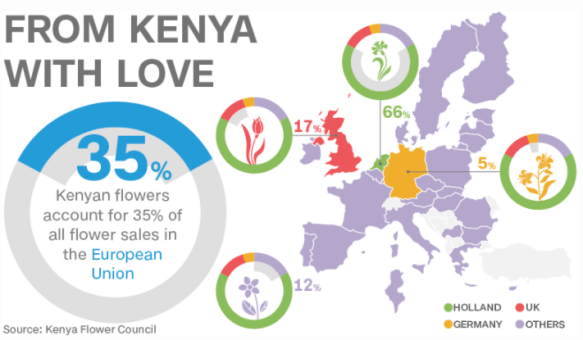
The country is the third largest exporter of cut flowers in the world, accounting for around 35% of all sales in the European Union. Famed for being long-lasting, Kenya’s roses, carnations and summer flowers are also popular in Russia and the U.S. where last week several growers showcased their blooms at the World Floral Expo in Los Angeles.

Screen Shot 2018-02-14 at 6.27.57 PM.png

Here is MR: