A call for “politically robust” evaluation designs

Heather Lanthorn cites Gary King et al. on the need for ‘politically robust’ experimental designs for public policy evaluation:

scholars need to remember that responsive political behavior by political elites is an integral and essential feature of democratic political systems and should not be treated with disdain or as an inconvenience. instead, the reality of democratic politics needs to be built into evaluation designs from the start — or else researchers risk their plans being doomed to an unpleasant demise. thus, although not always fully recognized, all public policy evaluations are projects in both political science and political science.

The point here is that what pleases journal reviewers is seldom useful for policymakers.

H/T Brett

UK passes bill to honour pledge of 0.7% foreign aid target, and a note on SDGs

The Guardian reports:

The international development bill passed its third reading in the House of Lords on Monday and will now receive royal assent. Britain met the 0.7% target for the first time last year when it spent £11.4bn – or 0.72% of its GNI – on overseas aid.

The 0.7% commitment was established by the UN in 1970. In 2013, only five other countries – Sweden, Norway, Luxembourg, Denmark and the United Arab Emirates – had met or exceeded the 0.7% aid spending target. The Netherlands had consistently met the target, but fell short in 2013.

All well and good.

The question, though, is what proportion of the 0.7% will finance various jobs programs for UK (and other Western) nationals working in the global development industrial complex (or in other sectors that benefit from tied aid) versus actually going to poverty alleviation in the developing world.

Source: Daily Nation

Source: Daily Nation

And speaking of the global development industry, here’s a nice quote from the Economist newspaper on SDGs:

Developing countries seem to think that the more goals there are, the more aid money they will receive. They are wrong. The SDGs are unfeasibly expensive. Meeting them would cost $2 trillion-3 trillion a year of public and private money over 15 years. That is roughly 15% of annual global savings, or 4% of world GDP. At the moment, Western governments promise to provide 0.7% of GDP in aid, and in fact stump up only about a third of that. Planning to spend many times the amount that countries fail to give today is pure fantasy.

The backers of the SDGs concede from the outset that not all countries will meet all the targets—an admission that robs the goals of the power to shame. The MDGs at least identified priorities and chivvied along countries that failed to live up to their promises; a set of 169 commandments means, in practice, no priorities at all.

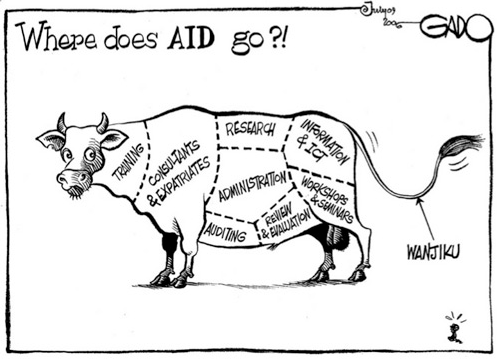
A set of 169 commandments also means fundraising opportunities for everyones’ pet issue. But it also means extra meetings, workshop, and clueless tied aid expats consultants for developing country Civil Servants to deal with; and little time for the boring things that actually contribute to sustainable improvement of human welfare.

Battle Hymn of the Research Experts (circa 1959)

The poem was published anonymously in the Northern Rhodesian Journal (in present day Zambia) in 1959.

Some talk of race relations, and some of politics,
Of labour and migrations, of hist’ry, lice and ticks,
Investments, trends of amity
And patterns of behaviour
Let none treat us with levity
For we are out to save ‘yer.

When seated in our library-chairs
We’re filled with righteous thought’ho,
We shoulder continental cares

Tell settlers what they ought to,
We’ll jargonize and analyse
Frustrations and fixations,
Neuroses, Angst, and stereotypes
In structured integration.

Strange cultures rise from notes and graphs
Through Freud’s and Jung’s perception
Despite your Ego’s dirty laughs
We’ll change you to perfection,
We’ve read Bukharin, Kant, and Marx
And even Toynbee’s stories
And our dialect’cal sparks
Will make exploded the Tories.

Rhodesians hear our sage advice
On cross-acculturation,
On inter-racial kinship ties
And folk-away elongation,
On new conceptual frame works high
We’ll bake your cakes of custom,
And with a socialising sigh
We’ll then proceed to bust ‘em.

Our research tools are sharp and gleam
With verified statistics,
Our intellectual combat team
Has practiced its heuristics
From value judgements we are free,
We only work scientific
For all-round global liberty
and Ph.D.s pontific.

Source: Jim Ferguson’s must read Expectations of Modernity, p. 30

Kenya’s Milk Consumption is the Highest in the Developing World

Last year the French company Danone (maker of Activia yogurt) bought a 40% stake in the Kenyan dairy firm Brookside, a sign of the growing importance of the dairy market in the wider eastern Africa region. But the story doesn’t end with the big household names. Smallholder farmers are also getting a piece of the dairy bonanza in Kenya:


HT Sarora Dairies

On a related note, here is how a company in China is helping industrialize the country’s dairy sector:

A milk scandal erupted in China in 2008 when the industrial chemical melamine was found in dairy products nationwide. While many Chinese dairy companies faced huge losses or bankruptcy as a result, one small firm, Dairy United, accelerated its development. Dairy United is one of the fastest-growing and most innovative Chinese dairy producers, one that features an unusual organizational structure and business model. Unlike most corporate and cooperative dairies that purchase cows on the market, Dairy United leases dairy cows from local farmers, giving it access to its primary asset without a large up-front investment, and letting the firm grow its dairy herds with newborn heifers. In return, farmers receive fixed payments biannually, but relinquish control rights and residual claims to the firm. Thus, Dairy United’s leasing is helping transform Chinese milk production from a backyard, labor-intensive activity to a more industrialized mode of farming. The case is particularly interesting for understanding applications of agency theory in agribusiness.

That is according to a new paper in the American Journal of Agricultural Economics (which I hope chaps at the Ministry of Agriculture in Nairobi subscribe to).

Private security guards outnumber the police and army in South Africa

South Africa fact of the day:

In 2013, it was reported that there were 400,000 security guards in South Africa – more than the numbers of police and army combined. Some of the people setting up private security companies are ex-police or ex-military, and the guards are often well armed and trained in how to use automatic rifles and handguns.

Also, in case you missed it, here is the video footage of the SABC reporter who was robbed this week on live TV in Jozi outside a hospital.

[youtube.com/watch?v=WDCrp5wjr1s]

More on crime in South Africa here.

Residents of Johannesburg also worry about not having enough bike lanes. One wonders whether fixing the security situation by addressing the root causes of crime ought to precede any public expenditure on enabling people to bike outside – it’s easier to rob cyclists than motorists, no?

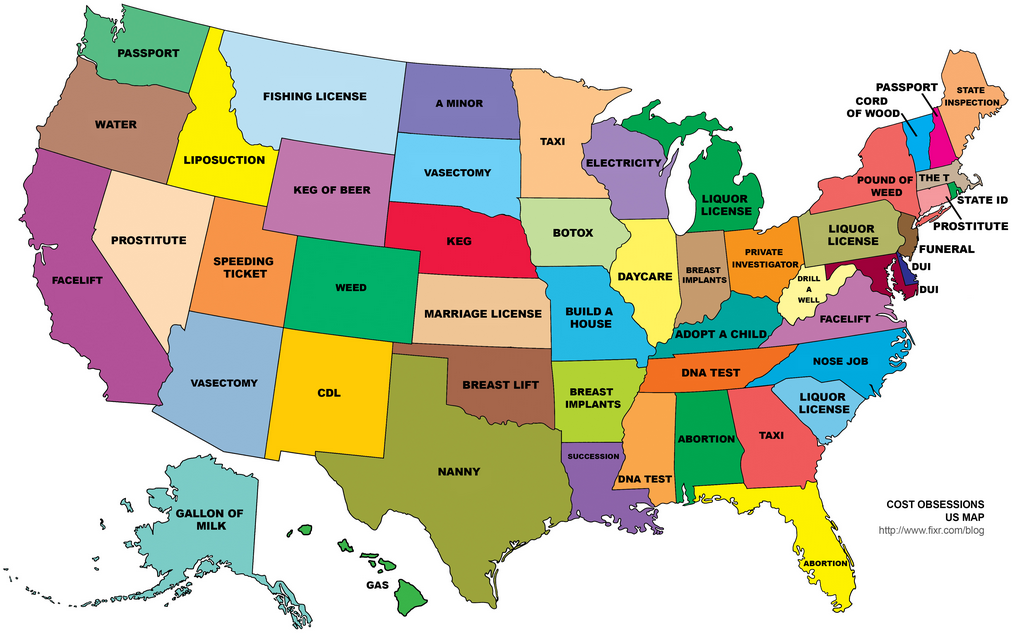
Interesting map of what cost each American state is obsessed with

The map was generated using data from Google autocomplete results.Screen Shot 2015-03-13 at 9.13.12 AM

H/T Marginal Revolution

Hundreds of South African Mercenaries Fighting Boko Haram

The New York Times reports:

Hundreds of South African mercenaries and hired fighters of other nationalities are playing a decisive role in Nigeria’s military campaign against Boko Haram, operating attack helicopters, armored personnel carriers and fighting to retake towns and villages captured by the Islamist militant group, according to senior officials in the region.

The Nigerian government has not acknowledged the presence of the mercenaries, but a senior government official in northern Nigeria said the South Africans — camped out in a remote portion of the airport in Maiduguri, the city at the heart of Boko Haram’s uprising — conduct most of their operations at night because “they really don’t want to let people know what is going on.”

This does not look good for the $2.3-billion-per-year Nigerian military. It also shows a complete lack of tact on the part of the Goodluck Jonathan administration. I mean, how hard could it have been to launder the South African mercenary involvement through some AU joint task force?

The way I see it, the problem here is not that Nigeria is using foreign fighters (even the mighty U.S. uses mercenaries, and as Tolu Ogunlesi writes in FT, the tide is turning against Boko Haram). The problem is in how they are being used. Is their use short-circuiting accountability chains between Nigerians affected and their government? How is it affecting civilian-military relations? And what will be the long-run consequences on the professionalization of the Nigerian military?

Obama Speaks in Selma, Alabama

[youtube.com/watch?v=gvAIvauhQGQ]

Pockets of Poor Governance and Police Brutality in Liberty-Crazed America

Alex Tabarrok over at MR calls it The Ferguson Kleptocracy:

You don’t get $321 in fines and fees and 3 warrants per household from an about-average crime rate. You get numbers like this from bullshit arrests for jaywalking and constant “low level harassment involving traffic stops, court appearances, high fines, and the threat of jail for failure to pay.”

And Ben Staples at the Times calls it The Ferguson Nightmare:

Even relatively routine misconduct by Ferguson police officers can have significant consequences for the people whose rights are violated. For example, in the summer of 2012, a 32-year-old African-American man sat in his car cooling off after playing basketball in a Ferguson public park. An officer pulled up behind the man’s car, blocking him in, and demanded the man’s Social Security number and identification. Without any cause, the officer accused the man of being a pedophile, referring to the presence of children in the park, and ordered the man out of his car for a pat-down, although the officer had no reason to believe the man was armed. The officer also asked to search the man’s car. The man objected, citing his constitutional rights. In response, the officer arrested the man, reportedly at gunpoint, charging him with eight violations of Ferguson’s municipal code. One charge, Making a False Declaration, was for initially providing the short form of his first name (e.g., “Mike” instead of “Michael”), and an address which, although legitimate, was different from the one on his driver’s license. Another charge was for not wearing a seat belt, even though he was seated in a parked car. The officer also charged the man both with having an expired operator’s license, and with having no operator’s license in his possession. The man told us that, because of these charges, he lost his job as a contractor with the federal government that he had held for years.

One of the weirdest things about all this is that the DOJ report outlined what was already common knowledge to most Americans without blinkers on; and that almost the entire country reacted to the report with collective indifference. Talk of an empathy gap.

This is how the mayor of Ferguson, who is STILL in office, reacted to the DOJ report:

“What they’ve shown is that it has happened. Now, how often has that happened? I don’t know. Their assertion is it happens regularly. Based on what? I’m not sure yet  ……….. Do they have a statistic that tells me that they’ve examined every arrest that we’ve made for the past four years and that half, or all, or 10 percent, or 5 percent are unconstitutional or without cause? They do not have that. They have not examined at that level that I know of at this point.”
On Contracts and Motorcycle Taxi Markets in Benin and Togo

In the motorcycle-taxi market in most Sub-Saharan African countries, the relation between vehicle owner and driver is characterised by a principal-agent problem with the following features: the owner cannot observe the final output of the driver and therefore cannot condition a wage on it, and higher effort from the driver depreciates the motorcycle. These two feature simply that it is in the owner’s best interest that the driver exerts as little effort as possible while still leasing the motorcycle from him. The problem with low effort implementation is that the motorcycle will not generate enough revenue. I analyse the contractual arrangements between owners and the drivers in this market using survey data from four cities in Togo and Benin. Evidence suggests that the quest for trust through kinship between owner and driver may explain the prevalence of a contract that induces drivers to exert excessive effort, leading to adverse outcomes like traffic accidents.

That is Moussa Blimpo in a new cool paper in the Journal of African Economies.

One of the questions the paper addresses implicitly is whether trust necessarily leads to better development outcomes (you’ve seen those cross-country regressions with trust as an independent variable…)

……. in the presence of trust, people tend not to sign formal contracts that define residual rights and the actions to be taken in different expected situations. For example, if the owner and the driver are family members, they will be unlikely to draft a contract that caters to litigation, given that it is socially unacceptable to take a legal action against family.

What this means is that sub-optimal contracting and economic outcomes in developing countries may not be due to a general notion of lack of trust, but rather the lack of a specific kind of trust, let’s call it civic trust. This is the kind of trust that is infused with a healthy dose of skepticism and accompanied by explicit contracting under the shadow of credible enforcement by a third party, the state.

How to write about Africa in one picture

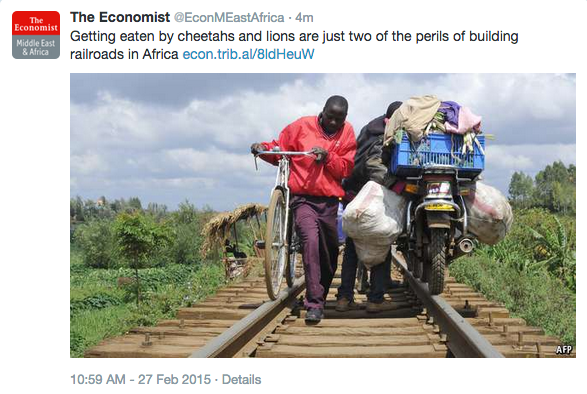
This is a story about Kenya building the first new railroad since the British built the old one more than a century ago. The new line goes through a National Park. A watchman was attacked by a cheetah. No one was mauled by lions. The attempts to link the current project to the Man Eaters of Tsavo trope is noted, but that happened a century ago when the lion population in the Protectorate was still quite big, and rhinos charged mail cars.Screen Shot 2015-02-26 at 11.33.38 PM

The rest of the story is here. Please skip through the Conrad-esque first paragraph.

Achebe (on Conrad’s racism) and Binyavanga (on how to write about Africa) should be required reading before some of these correspondents (and the social media interns) are inflicted on the world.

Africa’s Billionaires in 2014

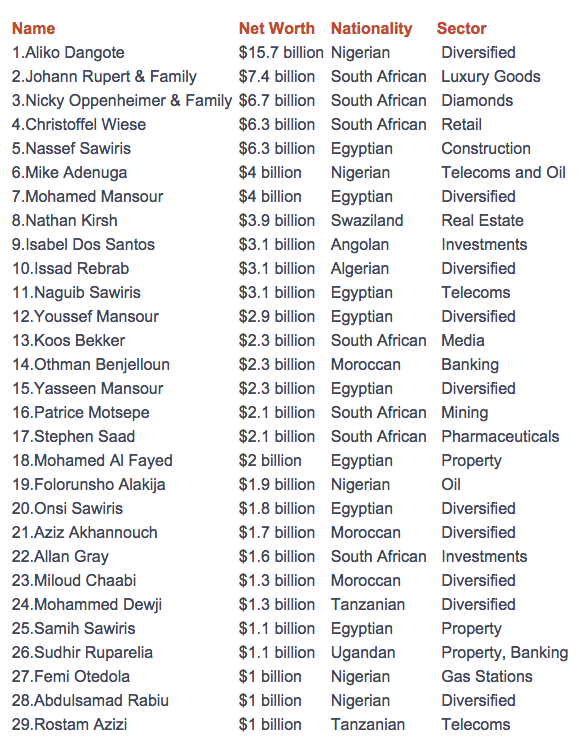
Only 9 out of 54 African countries are represented on the 2014 Forbes billionaires list. There are certainly more than 29 dollar billionaires on the Continent (most of the rest being in politics). Let’s consider this list as representative of countries in which (for whatever reason) it is politically safe to be publicly super wealthy – which in and of itself says a lot about how far Nigeria has come.

Screen Shot 2015-03-03 at 12.24.39 PM

Source: Forbes

Some will look at the list and scream inequality. I look at the list and see the proliferation of centres of economic and political power. And a potential source of much-needed intra-elite accountability in African politics. For more on this read Leonardo Arriola’s excellent book on the role of private capital in African politics.

See also this FT story on the impact of currency movements on the wealth of Nigeria’s super rich. Forbes also has a great profile of Aliko Dangote, Africa’s richest man.

Quick links

1. “Shame on me: Why it was wrong to cost the Millennium Development Goals” : Shanta Devarajan, Chief Economist for MENA at the Bank, on why he thinks that costing the MDGs may have “helped shift attention away from what is needed to reach the goals, and hence contributed to the perpetuation of poverty.”

2. Is teaching in college no longer a middle class job?

3. Dark Leviathan: How even the deep web, in desperate need to signal credibility, cannot escape the need for the “law merchant” (and eventually the state, or some generalizable norms a la Avner Greif).

4. The American South, on the map and in the mind.

5. Doing a book tour in China (with a censor in tow).

Kenyatta to burn 15 tonnes of ivory in an admission of failure to end poaching

The Daily Nation reports:

President Uhuru Kenyatta will Tuesday become the third president in Kenya’s history to set ablaze 15 tonnes of elephant ivory to mark the World Wildlife Day.

I hope this doesn’t become a thing that every president does over the duration of their tenure (well, by definition, if it is we’ll eventually run out of elephants).

Also, burning 15 tonnes of ivory sounds like such a waste. Can’t we just pile them up as a monument? A reminder each year – as the pile grows – of our collective failure to stop poaching? Just a thought.

Happy Wangari Maathai Day. Happy Wildlife Day.

Fact: 15 tonnes of ivory is worth about USD 28.3m in China.

Rating Kenya’s Presidents

Jomo Kenyatta’s regime was corrupt, illiberal and competent. Moi’s was corrupt, illiberal and mediocre. Kibaki’s was corrupt, liberal and competent. So, Moi scores zero out of three. Jomo scores one out of three. Kibaki scores two out of three. Now it adds up!

Jubilee’s [Uhuru Kenyatta] stock has fallen not just because it is seen as corrupt, but because it comes across as also illiberal and incompetent. Like Moi’s regime, it scores zero out of three.

….. Which is more harmful to society, mediocrity or corruption? Mediocrity is by definition below average. It stands to reason that all other things equal, mediocrity is more costly than corruption.

It goes without saying that a corrupt mediocracy is even more deleterious. When mediocre rulers are also corrupt even their corruption is mediocre. Because they are unable to generate sufficient returns, they eat into the capital. That’s what the decay of our infrastructure during Moi was — they ate the capital.

What’s more, what mediocre corrupt leaders steal they squander. Mobutu’s billions have never been traced.

That is the ever-insightful Kenyan economist David Ndii writing in the Daily Nation.

And of course Kibaki was the best president Kenya ever had. He went to Mang’u High School (along with many other key people in his government).

But on a more serious note, can Kenyatta’s administration be redeemed?

I think so. Part of the problem has been the total breakdown of constructive communication between the moderate elements in Kenyan society and State House. The ensuing siege mentality at State House has left the president open for capture by the thuggish elements that are rapidly criminalizing the Kenyan state. But progressive Kenyans need not concede the presidency to these corrupt, incompetent and illiberal characters. There is still room for constructive engagement.

Unlike Moi President Kenyatta appears to have an instinct to delegate (some say he is clueless at Government). The challenge is how to make sure he delegates to the right people.