Tanzania suspends construction of $10b Bagamoyo port

An agreement for the initial development of the Bagamoyo Port Project was signed in March 2013 during the visit of the Chinese President Xi Jinping as part of the Tsh1.28 trillion infrastructure package deals. The agreement specified that $500 million would be designated for port financing for the year of 2013 to allow the project to start.

Tanzania and Kenya are locked in a competition for the title of gateway to East and Central Africa, and so far Kenya is winning. Transportation costs on the southern corridor are almost 1.5 times those on Kenya’s northern corridor. Bagamoyo was supposed to take the fight to Mombasa (and Lamu). Now Dodoma will focus on upgrading the ports in Dar and Mtwara (and Tanga).

The cancellation of the project is a reasonable policy move. The cost would’ve severely stressed Tanzania’s fiscal position; and the 20m container capacity was a little too ambitious, to say the least.

Also, this development probably increases the probability that Uganda’s oil pipeline to the coast will be routed through Kenya (see here and here).

On oil and political risk in Uganda

The problem Uganda now faces has been made possible by the Bilateral Investment Treaty signed in 2000 with the Netherlands. According to the treaty, all Dutch investors in Uganda have the right to pursue arbitration before the World Bank court if they feel treated unfairly. The French company Total Uganda registered itself as a Dutch company.

This is known as the Dutch Sandwich; you put a Dutch company in between and then you become a Dutch investor. Which turns the treaty into a tool to drag a state before a tribunal of three men in Washington, having a commercial background and the ability to award billion dollar fines, without a possibility to appeal. If Uganda is condemned to a compensation but refuses to pay, the company has the right to seize Ugandan assets in the world.

…. A new interactive map made by Dutch journalists, with all known ISDS cases in the world, shows that ISDS is mainly used against developing countries. Sometimes because they clearly behaved badly towards an investor, but in other cases it’s more likely that it is used as a bargaining tool and a threat by multinational companies for better deals. Litigation costs amount to 8 million dollars on average, calculated the Organisation for Economic Co-operation and Development.

More on this here.

Total Uganda (or is it Total Netherlands?) is probably trying to dodge taxes in Uganda. But the Ugandan government lacks the means to effectively counteract this since it insists on keeping the details of its production sharing agreement with the French Dutch company secret. So there’s that.

The OAU is dead, long live the AU

On Friday, the African Union approved draft plans to send troops to the conflict-ridden Burundi even without permission from Bujumbura in what could be a historic move to stop the country’s impending implosion.

The move by the AU Peace and Security Council reached on Friday despite initial opposition from the Burundi delegation invoked a rarely-used clause in AU Constitutive Act.

Article 4(h) of the AU Constitutive Act provides for sending of troops to a member country under circumstances of war crime, genocide or crimes against humanity without that country’s permission.

More on the African Union’s 5000 strong force for Burundi here. The actual AU resolution establishing the African Prevention and Protection Mission in Burundi (MAPROBU) is available here. Paul D. Williams, an associate professor of international affairs at George Washington University, parses the text of the AU communique here.

This semester I taught a class on intra-Africa IR, mostly looking at economic and security cooperation from 1963 to the present. One of the issues we wrestled with in the class was whether the AU was any different from the OAU, despite the language of Article 4(h). The OAU was notoriously ineffectual in dealing with conflict in Africa, on account of its many non-interference clauses.

Doubts about the AU and its ability to effectively originate an intervention in the face of intra-state conflicts were reinforced by:

(i) its continued commitment to the “equality” of member states (no regional hegemons — like Nigeria, Ethiopia, or South Africa — were given any formal status of first among equals);

(ii) the the deliberate weakening of the Peace and Security Council (PSC) — which has no permanent membership (5 elected for 3 years, 10 for 2 years);

(iv) the fact that the chairmanship of the PSC rotates monthly (by country name alphabetical order), giving any one chair hardly any time to develop the connections required for effective operations of such a sensitive post in a major IO;

(v) the structure of the regional distribution of seats on the PSC which incentivizes a sub-regional logic of seat allocation, as opposed to actual efficiency of the PSC.

It is therefore interesting that 4(h) was today invoked to justify intervention in Burundi, without the direct consent of Bujumbura (Nkurunziza may yet save face by inviting the AU mission under 4(j)).

Also interesting is the fact that the troops will be under the banner of the East African Standby Force (EASF) and not the AU. This will expose the actual operations of the mission to the same EAC politics that I outlined in an earlier post here (for the two of you out there who care to know, the different (sub)regional standby forces actually have formal relationships with the AU, so they are not totally run by the sub-regional RECs but can be seen as a practical first step in the aspirational goal of a continental standby force, someday).

Who said intra-African IR is boring (or does not exist)?

Also, watch out for a draft paper on the politics of intra-Africa IR soon…

Why isn’t the East African Community doing more on Burundi?

The situation in Burundi is deteriorating, fast.
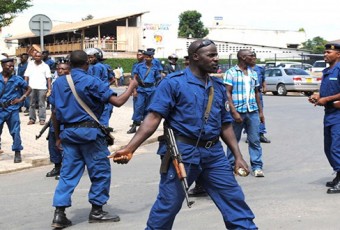
Armed-forces-in-Burundi-340x230There are strong signs of ethnic violence. More than 300 people have been killed since President Pierre Nkurunziza successfully violated term limits to stay in office for a third term early this year. The ensuing violence has forced over 220,000 to flee the country, while scores remain displaced internally. Over the last week alone more than 80 people have been murdered in what is increasingly looking like a civil war rather than mere civil unrest met with heavy-handed repression. The African union has used the word “genocide” in reference to the Burundian situation.

For a background on the current Burundian crisis see here, here, here and here.

So given the clear evidence that things are falling apart in Burundi, why isn’t the East African Community (EAC) doing more to de-escalate the situation?

The simple answer is intra-EAC politics (which serve to accentuate the body’s resource constraints).

The EAC is a five-member (Burundi, Kenya, Tanzania, Rwanda and Uganda) regional economic community (REC) that is arguably the most differentiated REC in Africa. Based in Arusha, Tanzania, it is a relatively robust institution replete with executive, legislative and judicial arms.

Like is the case for most African RECs, the EAC member states conceded precious little sovereignty to Arusha. For example, the  EAC treaty does not directly empower the REC to intervene in a member country even in cases of gross violations of human rights (like is currently happening in Burundi). So far regional cooperation within the EAC has mainly focused on economic issues that do not pose substantial threats to sovereignty. It is for this reason that the EAC has avoided any kind of direct intervention in Burundi to end what is a singularly political crisis — both within Burundi and at the regional level.

That said, Article 123 of the EAC treaty provides a loophole for intervention.

The Article stipulates that the purpose of political cooperation among EAC member states is to, among other things: (i) strengthen the security of the Community and its Partner States in all ways; and (ii) preserve peace and strengthen international security among the Partner States and within the Community. In my view these clauses mandate the EAC to protect both the internal security of Burundi as well as intra-EAC security.

It is important to note that so far the norm has been to treat vagueness in African REC treaties as a call to inaction. But vagueness also provides willing interveners with a fair amount of latitude over interpretation. Furthermore, since 2000 the trend within African RECs has been to dilute the infamous OAU non-intervention clauses (see the AU treaty, for example) especially with regard to security matters.

It is not hard to see how the conflict in Burundi poses a clear and present danger to both Burundi’s internal security as well as peace and security within the EAC.

We know from history that an all out civil war in Burundi would threaten the security of the region. Burundi’s ethnic make up roughly mirrors that of Rwanda. Ethnic conflict in Burundi would inevitably elicit an intervention from Rwanda, thereby regionalizing the conflict (with an almost guaranteed knock on effect in eastern DRC). In addition, even though Kagame may not be a fan of Nkurunziza, he lacks the moral authority to criticize him given recent moves to scrap term limits in Rwanda.

If Rwanda (overtly) intervenes in Burundi, it is not clear which side Tanzania — a critical player — would take (especially because of the implications for the stability of eastern DRC). Kigali and Dodoma do not always see eye to eye. In addition, the new Tanzanian president, John Magufuli, is not particularly close to his Kenyan counterpart on account of his closeness to Kenyan opposition leader Raila Odinga. This may limit the possibility of collective action on Burundi by the EAC’s two leading powers.

And then there is Uganda. President Yoweri Museveni is currently the designated mediator in the Burundian negotiation process. But he is currently preoccupied in his bid to win an nth term in office (who’s counting?) His legitimacy as a mediator is seriously in question on account of his political record back home. Recall that the proximate cause of the current crisis in Burundi was Nkurunziza’s decision to violate term limits. Museveni scrapped term limits in 2005 and has systematically squeezed the Ugandan opposition into submission through heavy handed tactics that are direct violations of human rights.

Sadly for Burundians, the current state of inter-state relations within the EAC is strongly biased against any robust intervention to stop the violence that is increasingly becoming routine. Nkurunziza knows this, and will likely try to make an end run on his perceived political opponents before the wider international community begins to pay closer attention.

Lastly, the other possible interveners — the  UN and the EU — are also not likely to intervene in Burundi any time soon, despite the country’s heavy dependence on foreign aid. Europe is hobbled by the ongoing refugee crisis and the war on ISIS. As for the UN, it increasingly launders its interventions through region or sub-regional IOs (see for example AMISOM in Somalia, under the AU). This kind of strategy requires a willing regional partner, something that is lacking in the case of the EAC (or the AU for that matter).

In the next few weeks there will probably be attempts at mediation and calls for a ceasefire. But my hunch is that things are likely to get much worse in Burundi in the short term.

Stanford Biz School Seed Transformation Program is seeking applicants from East Africa

Do you run an SME? Are you interested in training and mentorship? Then apply for Stanford’s STP.

The Stanford Seed Transformation Program addresses the needs of founders/senior leaders in developing economies who lead growing, small to medium sized enterprises.

The STP curriculum is customized to address the needs of founders and senior leaders of small and medium sized companies who are committed to growing their businesses.

Over a period of six months, you will attend four highly interactive sessions—each lasting one week. Sessions cover tools and methodologies that you will use to grow and transform your business.

For example, you will learn about Design Thinking—an innovative problem-solving approach refined by Stanford faculty and its alumni—that is invaluable for identifying new products and services for your customers.

STP topics include leadership training, strategy, organizational design, business model development, operations, accounting, marketing, finance/investing, value chain innovations, governance, business ethics, and product and service innovations. 

You can apply here.

Some Africanist inside baseball

Image

Screen Shot 2015-12-01 at 8.58.24 PM

Uganda Election Humour (Or Not)

Image

ugandaelection

The Kenyan Army’s Criminal Racket in Somalia

Quoting from a new report from the Journalists for Justice project:

With the death toll from al-Shabaab attacks inside Kenya rising to over 400, Journalists for Justice felt that the task of examining whether Operation Linda Nchi is actually delivering was overdue. This study looks at the conduct of KDF forces in two areas: 1) sugar smuggling and financial enabling of al-Shabaab and, 2) human rights violations.

This report presents the findings of several months of research in Somalia in Kismayo and Dhobley and inside Kenya in Liboi, Dadaab, Garissa and Nairobi. A desktop review, encompassing UN monitoring reports, academic studies, African Mission in Somalia (AMISOM) communication and media reports was followed by one-on-one interviews with over 50 people with intimate knowledge of KDF activities, including serving senior KDF officers, UN officials, western intelligence officials, members of parliament, victims of KDF human rights violations inside Somalia, journalists, doctors, porters at the charcoal stockpiles, drivers on the sugar routes and middlemen in the Dadaab camp.

…. JFJ research suggests that both KDF, the Jubaland administration of Ahmed Madobe and al-Shabaab are all benefitting from shares in a trade that is worth, collectively, between $200 million and $400 million.

More on this here.

For more on the challenges facing Kenya’s security operation in Somalia see here.

Picture of the Month

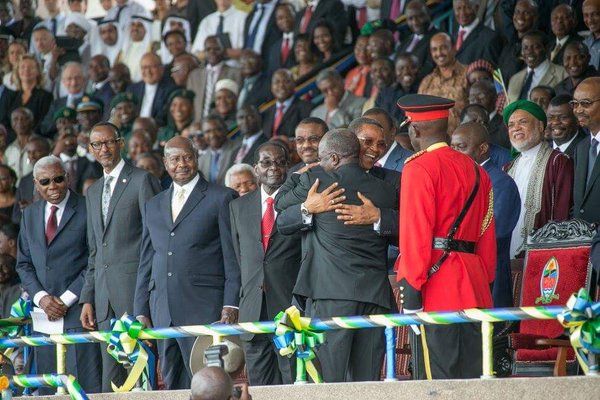
Mugabe, Museveni, and Kagame — seen here witnessing the handover of power in Tanzania — are de facto presidents for life.tzpic

Does Kenya have too many MPs?

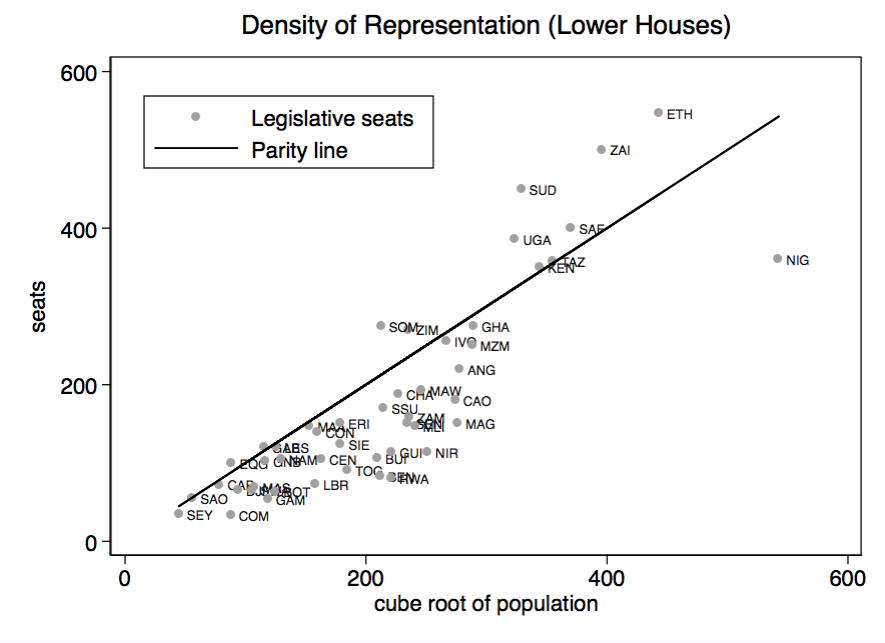
An article in the Daily Nation asked this provocative question. In the article, the author examined the cost per capita of legislatures in several countries; and concluded that legislatures in OECD democracies tend to be relatively more representative (seats/million people) as well as cost effective (per capita cost per seat) than their counterparts in the developing world.

Of course, linking per capita income to the density of representation has its pitfalls. An assumption that countries with smaller economies should have smaller assemblies, regardless of population size, implicitly undervalues the political voice (and rights) of citizens of poor countries. At the same time, setting an arbitrary upper bound on the remuneration of legislators (and general resourcing of legislatures) has the potential to limit the continued professionalization of legislatures in emerging democracies. Under-resourced legislatures find themselves in a bad equilibrium of high turnovers, weak institutionalization (lack of experience), inability to check the executive or effectively legislate, and a whole lot of dissatisfied voters who invariably choose to go with erstwhile challengers.

How to break out of this bad equilibrium is one of the key questions I grappled with in my book, Legislative Development in Africa. But I digress…

legseatsThe standard metric in Political Science for comparing the density of representation was developed by Rein Taagepera in the early 1970s. The Taagepera formula predicts that assembly sizes tend to approximate the cube root of the total population of states. In the dissertation I looked at how African states faired according to this metric (see figure) and found that the vast majority of countries on the Continent have relatively smaller assemblies than would be predicted by their population sizes (the figure only captures the sizes the lower houses). Somalia, Uganda, Sudan, the DRC, South Africa, and Ethiopia are the clear outliers. Incidentally, Kenya’s National Assembly is right on the parity line.

The usefulness of this metric (at the national level) diminishes beyond a certain population size. For countries with hundreds of millions of people or more, it makes more sense to apply the formula with respect to sub-national assemblies, if they exist. This is for the simple reason that beyond a certain number of seats the legislature would become too big to reasonably be able to conduct its business (see Nigeria).

Presidential Salaries in Africa

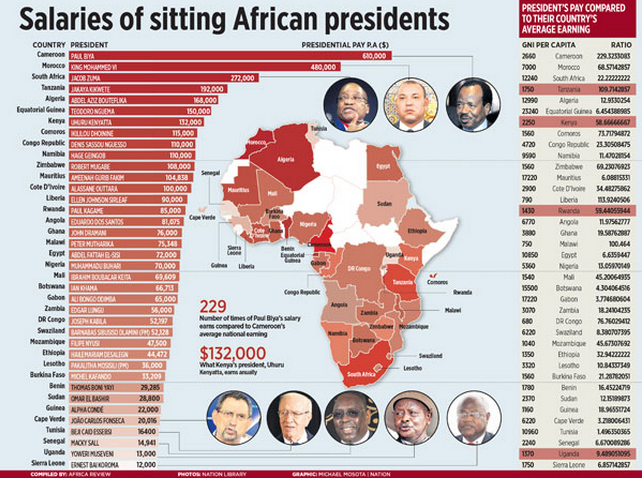
Paul Biya of Cameroon earns $610,000 per annum, 229 times the earnings of the average Cameroonian.* Screen Shot 2015-07-22 at 10.31.57 PM

Think about it for a second: Paul Biya earns $210,000 more than Barack Obama.

Notice that these figures do not include all manner of allowances.

Source: Daily Nation

*Note that the interns at the Daily Nation mixed up Mauritania and Mauritius. The CNN bug is contagious.

A slightly different story on administrative unit proliferation

The emerging stylized story about administrative unit proliferation in the developing world is that it is often a result of political machinations by national and local elites intent on creating new units for marginalized groups and for the ruler to buy votes; and that such proliferation only serves to re-centralize actual power — see for example these really cool papers by Grossman and Lewis (on the specific case of Uganda), Mai Hasssan (on the use of new districts to buy votes in Kenya) and Kimuli Kasara (also on how heightened electoral competition after 1992 accelerated the process of administrative unit proliferation in Kenya).

But there is also a slightly different, and in some ways complementary, story.

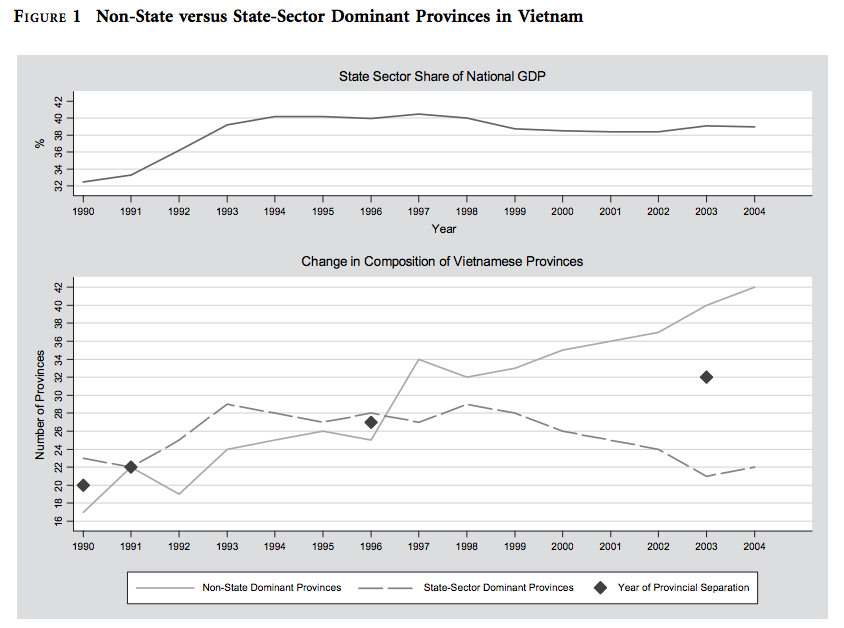
Regarding the creation of new provinces in Vietnam, Edmund Malesky notes:Screen Shot 2015-07-09 at 12.30.20 PM

The timing of provincial separations after Party Congresses, the dominance of Non-state Provinces despite little change in national output, and the decisive political outcome of this dominance at the 2001 Party Congress bolster the argument that reformers had an explicit electoral strategy in calling for the splitting of provinces in 1996. By creating new Non-state Provinces, modernizers believed they could influence the outcomes of future CCOM debates about
grand strategies and smaller NA debates about implementation of these new policies. While rhetorically it was easier to argue for new provinces based on efficiency, it would seem they were studying maps of
district economic composition and creating new reform-oriented
provinces out of SOE-dominated areas.

The key difference between administrative unit proliferation in Vietnam and Uganda (and Kenya before 2010) is the electoral connection (an aspect that, in my view, is missing in the current literature). Because the provinces had votes (in party congresses and plenums), the creation of new Vietnamese provinces had significant implications for the de facto distribution of power in both Hanoi and the periphery (and in Malesky’s story, made reforms possible). Provincial splits in Vietman were therefore not just about patronage and marginalized groups, but also about securing a win for the reformist bloc at the centre.

This might not be the case in countries where new units can be created without altering the balance of power in the party congress or parliament — either because such action does not create new electoral districts; or the president gets to nominate or can credibly influence the election of the representatives of the new districts. For this reason, I would predict that Kenya, Nigeria, and South Africa (whose subnational units are electorally significant and have a fair amount of fiscal autonomy) are unlikely to create new primary subnational units willy-nilly.

The Crisis in Greece (Lessons for the EAC and UEMOA)

Screen Shot 2015-06-28 at 10.06.13 PM

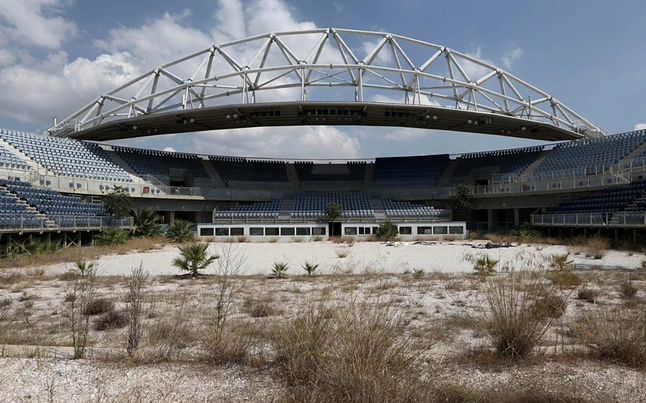
An abandoned venue from the 2004 Athens Olympics. Source: Guardian.

Greece is on the brink of a financial disaster. Banks and the stock market are closed. Capital controls have been imposed. The country will hold a referendum on July 6th, which could decide whether Greeks keep the euro or go back to using drachmas.

There’s not been a shortage of analyses of Grexit. From adoration of its game theorist Finance Minister, Yanis Varoufakis; to this odd piece in the Journal that says “Greek Prime Minister Alexis Tsipras began leaning toward a risky referendum after creditors covered his proposed policies in red ink” (incidentally, marking papers in red can “damage students”). Barry Eichengreen blames the current crisis on political incompetence – on the part of both Greece and its eurozone creditors, with more blame on the latter. See here for a concise take on Greek fiscal history over the last four decades.

I hope folks at the EAC and UEMOA, the two entities most likely to realize monetary unions, are following the events in Greece closely. The big question on their minds should be: can there be a stable monetary union on the Continent without a fiscal and political union?

Lastly, regardless of how the next few days and the referendum play out, I hope Tsipras’ move will embolden leaders in the developing world to democratize their relationship with the IMF, the Bank, and other creditors. A reasonable democratic involvement in such matters would not just be an easy way to default and blame it on democracy. It would also incentivize creditors against lending money to governments like Greece’s. Obviously voters should not be allowed to decide whether or not they pay their debts (we know how that’d turn out), but they should be consulted before being saddled with crushing debt.

Quick thoughts on presidential term limits and the political crisis in Burundi

The president of Burundi is about (or not) to join the list of African leaders who have successfully overcome constitutional term limits in a bid to hang on to power. Currently (based on observed attempts in other African countries and their success rate) the odds are roughly 50-50 that Mr. Pierre Nkurunziza will succeed. The last president to try this move was Blaise Compaore of Burkina Faso who ended up getting deposed by the military after mass protests paralyzed Burkina’s major cities.

Successful term limit extensions have so far happened in Burkina Faso (first time), Cameroon, Chad, Djibouti, Gabon, Guinea, Namibia, Togo, and Uganda. Presidents have also tried, but failed, to abolish term limits in Burkina Faso (second time), Malawi, Niger, Nigeria, Senegal, Zambia. Countries that are about to go through a term limit test in the near future include Angola, Burundi, Republic of Congo (Congo-Brazzaville), the Democratic Republic of Congo (DRC), Liberia, Rwanda, and Sierra Leone. Heads of State in Benin, Cape Verde, Ghana, Kenya, Mali, Mozambique, Sao Tome e Principe, Tanzania, and Namibia (after Nujoma) have so far obeyed term limits and stepped down at the end of their second constitutional terms.

To the best of my knowledge only Sudan, The Gambia, Equatorial Guinea, and Eritrea have presidential systems without constitutional term limits. Parliamentary systems in South Africa, Lesotho, Swaziland, Ethiopia, and Botswana do not have limits, although the norm of two terms exists in Botswana and South Africa (and perhaps soon in Ethiopia?).

So what we see in the existing data is that conditional on *overtly* trying to scrap term limits African Heads of State are more likely to succeed than not (9 successes, 6 failures). However, this observation doesn’t tell us anything about the presidents who did not formally consider term limit extensions. For instance, in Kenya (Moi) and Ghana (Rawlings), presidents did not initiate formal debate on the subject but were widely rumored to have tried to do so. So it’s probably the case that presidents who are more likely to succeed self-select into formally initiating public debate on the subject of term limit extension, thereby tilting the balance. And if you factor in the countries that have had more than one episode of term-limited presidents stepping down, suddenly the odds look pretty good for the consolidation of the norm of term limits in Sub Saharan Africa.

I wouldn’t rule out, in the next decade or so, the adoption of an African Union resolution (akin to the one against coups) that sanctions Heads of State who violate constitutional term limits.

So will Nkurunziza succeed? What does this mean for political stability in Burundi? And what can the East African Community and the wider international community do about it? For my thoughts regarding these questions check out my post for the Monkey Cage blog at the Washington Post here.

Correction: An earlier draft of this post listed Zimbabwe as one of the countries without term limits. The 2013 Constitution limits presidents to two terms (with a minimum of three years counting as full term (see Section 91).

Kenya: Five Things About Al-Shabaab and the Somalia Question

Early Thursday morning militants from the al-Shabaab terror group stormed Garissa University College in Kenya and killed at least 147 students. The second worst terror attack in Kenya’s history lasted 13 hours and was made excruciatingly horrific by the fact that many of the victims remained in communication with their loved ones until the very last moments. Unbearable images of young students laying dead in their own pools of blood in classrooms will forever be etched in Kenyans’ memories. The attack echoed the September 21, 2013 Westgate Mall terror attack that killed 67 people. After Westgate many Somalia analysts insisted that such daring missions were the kicks of a dying horse, and cited successes by AMISOM and AFRICOM in taking back territory from al-Shabaab and decapitating the organization through drone strikes against it leadership.

Following Garissa, it might be time to reconsider this persistent narrative and overall Somalia policy in the Eastern African region. Here are my thoughts:

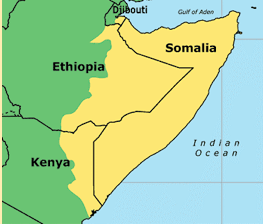
Screen Shot 2015-04-03 at 9.51.35 AM1. Regional powers do not want a powerful central government in Mogadishu: Since independence several governments in Somalia have espoused a dream of re-uniting all the Somali lands and peoples in eastern Africa (under “Greater Somalia,” see map). That includes parts of Ethiopia, Kenya, Djibouti, and more recently the breakaway regions of Somaliland and Puntland. A strong central government in Mogadishu would most certainly revive this old irredentist dream, despite the fact that the irredentist dreams of Somalia’s pre-Barre governments and the costly wars with Ethiopia (and proxy wars with Kenya as well thereafter) were the beginning of the end of stability in Somalia. Nairobi and Addis are acutely aware of this and that is part of the reason Kenya has for years maintained a policy of creating an autonomous buffer region in southern Somalia – Jubaland. The problem, however, is that a weak Mogadishu also means diffused coercive capacity and inability to fight off breakaway clans, militias, and terror groups like al-Shabaab.

The situation is complicated by the fact that Ethiopia and Kenya do not see eye to eye on the question of Jubaland. Addis Ababa is worried that a government in Jubaland dominated by the Ogaden clan could potentially empower the Ogaden National Liberation Front (ONLF), a separatist Somali insurgent group it has fought in its southeastern Ogaden Region.

2. The African Union and its regional partners do not have a coherent game plan for Somalia: To a large extent, African governments fighting under AMISOM are merely carrying water for Western governments fighting jihadist elements in Somalia. The West pays and provides material and tactical support; and the West calls the shots. Ethiopia and Kenya have some room to maneuver, but overall policy is driven by AFRICOM and the Europeans. The lack of local ownership means that African troops, especially the Kenyan and Ugandan contingents, are in the fight primarily for the money. Kenyan generals are making money selling charcoal and smuggling sugar (the UN estimates that al-Shabaab gets between US $38-56m annually from taxing the charcoal trade). The Ugandans are making money with private security contracts dished out to firms with close ties to Museveni’s brother. Only the Ethiopians appear to have a clear policy, on top of the general international goal of neutralizing al-Shabaab so that they do not attack Western targets.

What kind of settlement does Kenya (and Ethiopia) want to see in Somalia? (See above). What does the West want? What do Somalis want? Are these goals compatible in the long run?

3. The internationalization of the al-Shabaab menace is a problem: Western assistance in fighting al-Shabaab and stabilizing Somalia is obviously a good thing. But it should never have come at the cost of unnecessary internationalization of the conflict. Al-Shabaab has been able to get extra-Somalia assistance partly because it fashions itself as part of the global jihad against the kafir West and their African allies. Internationalization of the conflict has also allowed it to come up with an ideology that has enabled it to somehow overcome Somalia’s infamous clannish fractionalization (although elements of this still persist within the organization). Localizing the conflict would dent the group’s global appeal while at the same time providing opportunities for local solutions, including a non-military settlement. AMISOM and the West cannot simply bomb the group out of existence.

4. Kenya is the weakest link in the fight against al-Shabaab: Of the three key countries engaged in Somalia (Ethiopia, Kenya, Uganda), Kenya is the least militarized. It is also, perhaps, the least disciplined. According to the UN, Kenyan troops are engaging in illegal activities that are filling the coffers of al-Shabaab militants (charcoal worth at least $250 million was shipped out of Somalia in the last two years). Back home, Nairobi has allowed its Somalia policy to be captured by a section of Somali elites that have other agendas at variance with overall national policy. The Kenya Defense Force (KDF) risks becoming a mere pawn in the clannish struggles that straddle the Kenya-Somalia border. It is high time Nairobi reconsidered its Somalia policy with a view of decoupling it from the sectional fights in Northeastern Province. The first step should be to make the border with Somalia real by fixing customs and border patrol agencies; and by reining in sections of Somali elites who continue to engage in costly fights at the expense of ordinary wananchi. The government should adopt a strict policy of not taking sides in these fights, and strictly enforce this policy at the County level.

5. Kenya will continue to be the weakest link in the fight against al-Shabaab: Of the countries in Somalia Kenya is the only democracy with a government that is nominally accountable to its population and an armed force with a civilian leadership. This means that:

(i) Generals can run rings around State House and its securocrats: Unlike their counterparts in Uganda and Ethiopia, the Kenyan generals do not have incentives to internalize the costs of the war in Somalia. The cost is mostly borne by the civilian leadership. They are therefore likely to suggest policies that primarily benefit the institution of the military, which at times may not be in the best interest of the nation. And the civilian leadership, lacking expertise in military affairs, is likely to defer to the men in uniform. The result is makaa-sukari and other glaring failures.

(ii) Kenyan internal security policies are subject to politicization: With every al-Shabaab attack (so far more than 360 people have been killed) Kenyans have wondered why Ethiopia, which is also in Somalia and has a large Somali population, has remained relatively safe. My guess is that Ethiopia has done better in thwarting attacks because it has a coherent domestic security policy backed by unchecked coercion and surveillance of potential points of al-Shabaab entry among its Somali population.

Now, Kenya should not emulate Ethiopia’s heavy-handed tactics. Instead, focus should be on an honest assessment of how internal security policies in Mandera, Garissa, Wajir, Kwale, Kilifi, Mombasa, Nairobi, and elsewhere are playing into the hands of al-Shabaab. What is the best way to secure the “front-line” counties that border Somalia? What is the role of local leaders in ensuring that local cleavages and conflicts are not exploited by al-Shabaab? How should the security sector (Police and KDF) be reformed to align its goals with the national interest? What is the overarching goal of the KDF in Somalia and how long will it take to achieve that goal? How is the government counteracting domestic radicalization and recruitment of young Kenyan men and women by al-Shabaab?

These questions do not have easy answers. But Kenyans must try. The reflexive use of curfews and emergency laws, and the blunt collective victimization of communities suspected to be al-Shabaab sympathizers will not work.

I do not envy President Uhuru Kenyatta: Withdrawing from Somalia will not secure the homeland. Staying the course will likely not yield desired results given the rot in KDF and the internal politics of northeastern Kenya. Reforming the police and overall security apparatus comes with enormous political costs. A recent shake up of security chiefs and rumors of an impending cabinet reshuffle are signs that Kenyatta has realized the enormity of the insecurity situation in the country (and overall government ineffectiveness due to corruption). But will Kenyans be patient and give him the benefit of the doubt? Will the president be able to channel his laudable nationalist instincts in galvanizing the nation in the face of seemingly insurmountable security threats and ever more corrupt government officials?

Meanwhile 2017 is approaching fast, and if the situation doesn’t change Mr. Kenyatta might not be able to shrug off the title of “Goodluck Jonathan of the East.”

For the sake of Kenyan lives and the Jamuhuri, nakutakia kila la heri Bwana Rais.