Big vs. Small Development

The Economist raises an interesting question regarding approaches to “development,” claiming that the recent race for the World Bank presidency represented a contest between two broad approaches:

Michael Woolcock, a World Bank staffer, suggests that two rather different models of development have been pitted against one another in the contest for president. On the one hand is what he calls Big Development, whose aim is the transformation of entire countries through investments in national education, justice and public health. Governments are essential to Big Development because they are responsible for the overall policy. And the World Bank is pre-eminently a Big Development institution.

On the other hand is Small Development. “Inspired less by transformational visions of entire countries,” Mr Woolcock argues, “and more by the immediate plight of particular demographic groups (AIDS orphans, child soldiers, ‘the poor’) living in particular geographic places (disaster zones, refugee camps, urban slums), Small Development advocates focus not on building systems in the medium run but on compensating for the failure of systems in the short run. ‘Development’ thus becomes an exercise in advocacy, in accurate targeting, in identifying particular ‘tools’ that ‘work’”.

In this scheme of things Mrs Okonjo-Iweala, the former finance minister, represented Big Development; Dr Kim, a public-health advocate, Small. Dr Kim was almost certainly picked because of his passport. But if his background is any guide, his tenure as chief is likely to shift the bank more towards Small Development. Whether that is a good thing on balance remains to be seen.

I take the side of Big Development (if such a dichotomy actually exists) because of my beef with “pro-poor development” as it is currently practiced  (more on this here).

Development is a giant coordination game with a million moving parts. This makes it much harder to coordinate on “scalable” “tools that work” at the micro-level. Indeed, no one has any idea what these tools really do. In addition, focus on “tools” casts the problem of underdevelopment as a technical one that can be fixed by “experts.”

This approach misses the point by miles.

This and this (highly recommended, a cogent critique of Big Development) and this are some of the reasons wby.

Talking real development

It is an upper-middle-class, industrialized-country fiction to romanticize life on a small farm. Economic development and food security lie in industrialized agriculture, and this is why I continue being interested in agricultural value chains. My thinking on this has also been reinforced by my recent reading of Jane Jacobs’ The Economy of Cities, in which she posits that agricultural development came as a consequence of urbanization, and not the other way around.

That is Marc on his blog here.

Reading Marc’s post reminded me of my beef with anti-poverty development as it is currently practiced. For instance, the humanitarian instincts behind giving poor slum dwellers loans to start businesses may be noble, but the impact of these projects are ambiguous (Not forgetting the recent trends in Venture Capital firms making money from high interest rates on the poor).

Such projects, for the most part, serve little more than giving the poor comfort in their poverty. Yes, there are a few success stories, but for the vast majority life remains precariously close to abject destitution. Self-employment is a risk that should not be forced on those at the very bottom of the economic ladder in developing countries.

Such palliative measures should never distract from the main task of long-term job creation.

The growing disillusionment with the long-term developmental effects of micro-finance should force development experts to think of creative alternatives.

What could be an alternative?

Well, for starters it might be more beneficial to boost the capacity of banks to give loans to mid-size businesses that have the technical and managerial capacity to scale up their operations and thus create more jobs. Corporate finance in most of the developing world has no “middle class.” Nearly all the players are big firms. Mid-size firms simply cannot keep up with the high interest rates and collateral requirements. Yet these are the firms that have the potential to grow and create more jobs.

This move smells of trickle down economics, but it is not. Poverty alleviation requires massive amounts of job creation. Making the poor self-employed distracts from the bigger problems of non-industrialization and lack of formal-sector jobs.

It is also bad for political development because it provides Hirschman’s exit option for millions of economically disaffected citizens of the developing world.

Check out Blattman’s blog on a related post on NGO activism in the developing world.

double standards

The Times has a nice story on Obiang’s Equatorial Guinea that is worth reading:

Officially and unofficially, Americans do business with one of the undisputed human rights global bad boys, Equatorial Guinea, Africa’s fourth biggest oil exporter. Its widely criticized record on basic freedoms has offered little barrier to broad engagement by the United States, commercially or diplomatically.

American oil companies have billions of dollars invested here. One American diplomat, using language that makes human rights advocates fume, praised the “mellowing, benign leadership” of the dictator in power for more than 30 years, Teodoro Obiang Nguema Mbasogo, in 2009 cables released by WikiLeaks. And a leading American military contractor with strong Pentagon ties has a multimillion-dollar contract to protect his shores and help train his forces.

You may recall that Obiang’s son was recently reported to have ordered a $380M luxury yacht. The Obiang’s and their backers continue to run the central African country like a personal possession.

According to the Guardian:

President Obiang, who has ruled since seizing power in 1979, has decreed that the management of his country’s $3bn a year in oil revenues is a state secret. That is why it is difficult to say for sure exactly how he comes to have about $700m in US bank accounts. But the president’s son gave an insight into his salary in an affidavit filed with the Cape high court in South Africa in August, as part of a lawsuit against him over a commercial debt.

On paper Equatorial Guinea is richer than most middle income countries. In reality, however, most of the 676,000 Equatorial Guineans live in poverty. The story of Equatorial Guinea is almost personal. Every time I post on Obiang’s inept rule I can’t stop wondering: How hard can it be to run a country of only 676,000 with over 3 billion in annual revenue?

Like the Times article points out, outsiders like the US government and foreign oil companies deserve to be called out over the goings on in Equatorial Guinea.

That said, the lion’s share of the blame is on Obiang’ and his backers. As far as I know none of the foreigners involved in the country held a gun to his head and asked him to siphon off billions of his country’s revenue to foreign bank accounts.

More on the Times story here.


second hand clothes

Thanks to a view from the cave I just found out that there is an Oxfam study out there on the effects of second hand clothes (SHC) in the African markets. The findings are largely predictable: the poor benefit from the trade, the trade has created opportunity for fraud and most importantly, it has contributed to the death of local textile industries. The big question then is how to transition from the over-reliance on SHC.

In my view textiles is a sector in which countries would be justified in going nationalist and financing or facilitating the financing of local firms and industries. It is unacceptable that up to 90% of Ghanaians buy second hand clothing despite high unemployment and abundant cotton in the West African region.

Here are some snippets from the Oxfam paper:

The trade has clear consumer benefits. This is especially in countries with low purchasing power, and for poorer consumers, though in many sub-Saharan African countries it seems that almost ALL socio-economic groups are choosing to buy SHC. …. over 90% of Ghanaians purchase SHC.

The trade supports thousands of livelihoods…. These include jobs in trading, distributing, repairing, restyling and washing clothes. Oxfam’s research in Senegal estimates that 24,000 people are active in the sector in that country…. 1,355 people work in formal sector textile/clothing in Senegal.

SHC trade in recipient countries is mainly informal and is poorly regulated. In some instances it has facilitated considerable customs fraud, as new clothing imports have been passed off as used clothing.

A note on economic development

“I think we have gone too far in the pro-poor direction…… we don’t necessarily have trade-offs. Factories are pro-poor.” Chris Blattman, Yale University

I am on record as not being too enthusiastic about “pro-poor growth” as it is currently practiced. Loans to the poor and other approaches that completely bypass those with a higher probability of succeeding at creating big business – the educated and middle class – will at best only keep the poor afloat and at worst divert resources from much needed long-term investment. I am not saying that the educated have a monopoly on entrepreneurship. All I am saying is that what we want is to create sustainable jobs. This requires scale. And scale comes with big business and industry.

Blattman neatly summarizes this point:

The difference between a country with $1,500 and $15,000 of income a head a head is simple: industry. All the microfinance and microenterprise programs in the world are not going to build large firms and import technology and provide most people with what they really want: a stable job, regular wages, and a decent work environment.

More on this here.

Liberian politics gone awry

Scholars of historical institutional economics place a lot of emphasis on cognitive states and beliefs about how the world works as central to understanding the evolution and persistence of good institutions. Countries that have emerged out of abject poverty also happen to be those that managed to harness technology and rational-scientific knowledge for the public good.

It is therefore disheartening to read that in Liberia politicians engage in acts that belong in the pre-modern era. Whether they do it merely to instill fear in their opponents or actually believe in what they do is secondary. These acts are simply intolerable.

The Economist reports:

In a case dating from March last year, due to come to court soon, a pregnant woman and her unborn baby were killed and body parts taken. Vials of blood were reportedly found in the house of a senior official in Maryland, a south-eastern county where superstitious beliefs are strong. But reports of such killings come from all over. And traditional “heart men” now include criminals who trade body parts for cash.

Liberia’s long civil war made such things seem less gruesome. In 2008 Milton Blahyi, a former warlord, admitted to eating children’s hearts before going into battle. Along with wearing female wigs and going naked, the practice was believed to bring victory.

More on this here.

A related story from last year can be found here.

the central african republic, forever failing

update: For a history of the CAR read this: History of CAR

The Central African Republic (CAR) is perhaps the biggest joke as far as states within the international system go. Francois Bozize, the Gabon-born dictator that currently runs it, has failed to meet even the barest of needs of his countrymen. The IRIN reports:

“There is plenty of fertile land in the region [south east of CAR] but violence is interfering with traditional ways of life such as agriculture, hunting and fishing, with farmers often afraid to stray far from town to work their fields for fear of attack. This has reduced production, pushing up prices to the point at which not everyone can afford to buy food, even when it’s available,” said Christa Utiger, the International Committee of the Red Cross (ICRC) economic security coordinator for the CAR.

4.8 million people live in the country. A person born in the CAR can expect to live to be 50. The literacy rate is a woeful 49%. Per capita income (PPP) is US$ 700 (yes, PPP). Gold and timber are the main export earners, with the vast majority of people living on subsistence agriculture. 16% of CAR’s children under 5 are acutely malnourished. Rebel groups, including Uganda’s Lord’s Resistance Army routinely use CAR’s territory as launching bases. The only people who appear to be benefiting from the existence of CAR as a country are the thugs who run it, from David Dacko, to the self-proclaimed Emperor Bokassa to Francois Bozize.

the cost of malaria, and the continent’s disease burden

Academics have already established that the economic costs of malaria and Africa’s general disease burden are not trivial. Think of lots of man-hours wasted due to illness and government expenditures on medication, time and money that could be used to build roads and what not.

To illustrate the point, not anyone is immune from Malaria. Drogba, the illustrious Ivorian forward, got malaria and had to take a few days off from his duties at the London club, Chelsea.

“He has this virus and, obviously, he lost power and training.”

“He lost his condition. He’s had treatment and now he’s OK. He’ll come back immediately in the best condition.”

africa in the news

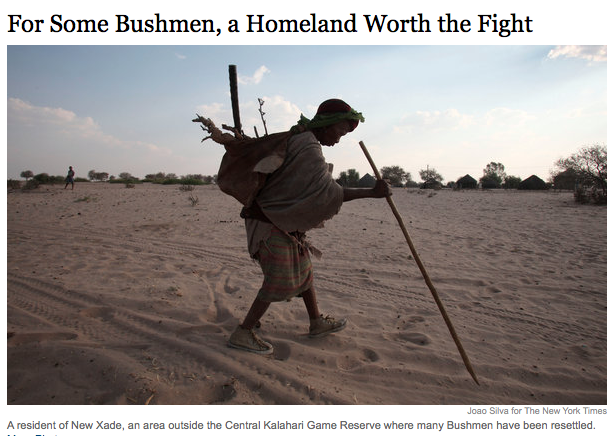
Forget about the elections in Tanzania or the Ivory Coast. What matters for the American audience as far as news from Africa go are human interest stories such as this one which made it to the front page of the New York Times.

I echo the point of the Times piece. It really sucks being a hunter-gatherer in Botswana. And by extension, it really sucks being a citizen of Chad, Niger, Uganda or any one of the 40 other countries that make up sub-Saharan Africa. Despite the “good news” (see earlier post below) things are really bad on the Continent.

Africa deserves all the bad press it gets. Period. The only problem is that Africans have not been able to participate effectively in the discourse on their continent or attempted to contextualize the bad press. The continent long lost the game of framing the narrative.

pourism is not restricted to the developing world

Pourism, aka poverty porn, is not restricted to the third world. In the West it is cheaper than having to buy a plane ticket, among other expenses, to go visit people villages in Rwanda or Kenya. You can get it all online.

the mdgs

Since everyone is currently talking about the MDGs and how they may or may not be achieved on time here is a nice piece from Bill Easterly.

According to an Oxfam study, eliminating US cotton subsidies would “improve the welfare of over one million West African households – 10 million people – by increasing their incomes from cotton by 8 to 20 per cent”.

I may not always agree with Bill but I think his basic approach to development is spot on. Just like in most human endeavors (politics, economics, sports) systems based on human goodwill are bound to fail while those based on self-interestedness thrive. There is no magic bullet in development, but there is definitely a better approach than is currently being employed. Lets not forget that aid is supposed to eventually lead to self-reliance.

It is already clear that the goals will not be met by their target date of 2015. One can already predict that the ruckus accompanying this failure will be loud about aid, but mostly silent about trade. It will also be loud about the failure of state actions to promote development, but mostly silent about the lost opportunities to allow poor countries’ efficient private business people to lift themselves out of poverty.

Bono has a slightly less realistic more hopeful take on the progress towards achieving the MDGs.

Urban Poverty

This is the kind of story that makes you sick in the stomach. The story is about the plight of women in Nairobi’s slums and focuses on one Ms Kambura:

In 2006, she was gang-raped by four men who infected her with the Aids virus, hardy 100 metres from her one-room home. She had gone to the “toilet” in Athara, one of the open fields that residents of this informal settlement run to for lack of sanitary facilities. It was 8pm, but for residents here, that is late enough to be mugged, raped, even killed by gangs that roam the slums.

Kenyan urban poverty is a tinderbox waiting for a lighter, especially in light of the ever rising income disparities in major towns and cities.

In related news, the business pages of the Nation report that despite the downturn in the housing markets in the developed world home markets in places like Kenya, and Nairobi in particular, are still lucrative.

Currently, the rental market in Kenya is facing an upward pressure as a result of a rising middle class.The demand is believed to be higher than the supply of housing units. Statistics from the government and private sector players indicate that the annual demand for housing in Kenya stands at 150,000 units.This demand far outstrips the supply, which is estimated at about 35,000 units a year. The index shows that investing in Kenya’s housing industry has better returns than in the United States and the United Kingdom.

I wonder if the people at the city councils of Nairobi and other cities ever think of how they could exploit this huge gap between demand and supply to provide housing for their residents and make profits while at it – profits that they can then steal 20% of (if they REALLY have to) instead of resorting to rent-seeking practices like inflating the cost of cemeteries.

economic history… and some people’s lived experience

I am currently doing some research on the economic history of medieval Europe and came across an interesting quote from one Francesco Guicciar commenting on 16th century Spain:

... poverty is great here, and I believe it is due not so much to the quality of the country as to the nature of the Spaniards, who do not exert themselves; they rather send to other nations the raw materials which grow in their Kingdom only to buy them back manufactured by others, as in the case of wool and silk which they sell to others in order to buy them back from them as cloths of silk and wool

The quote reminded me of the thoughts I have whenever I buy Nescafe in Kenyan supermarkets or read about Nigeria importing refined petroleum products.

Obiang is back in the news

The diminutive dictator Brig. Gen. (ret.) Teodoro Obiang Nguema Mbasogo, president of  Equatorial Guinea since 1979, is back in the news. After the UNESCO fiasco which nearly earned him the title of clown of the month of June Obiang is back again in the news, this time with an American PR agent. The Times reports that Mr. Obiang is attempting to “recast his reputation as a corrupt, repressive leader in a more progressive mold.” His agent, Mr. Davis even told journalists that “If there are political prisoners and no substantive charges against them, they will be freed.”Yeah right.

I suggest that Mr. Davis and his client start by reining in on the playboy son of the president, Little Teodoro. The younger Obiang’s lavish extravagance explains why Equatorial Guinea, a country with a per capita income of US $ 36,600 and a population of just over 0.5 million, has a life expectancy of 43 years, with 77% of its citizens living below the poverty line as of 2006.

The ONE question Obiang should be asked the next time he meets the press is: how hard can it be to run a country of 500,000 people with ALL that money?

failed states index

Foreign Policy, in its July/August issue has 2010’s failed states index. The Continent has 12 of the top 20 worst performers on this index, with Somalia, Chad, Sudan, Zimbabwe and the DRC being in the top five respectively. Kenya is 13th on this index, performing worse than Niger, Guinea-Bissau and Sierra Leone, among other basket cases. The substantive meaning of the rankings aside (I’d rather be in Kenya than in Sierra Leone on any day), the index is a grim reminder of how badly governed the Continent is. The best ranked mainland African state is Ghana, at number 54. Mauritius leads the Continent at number 30, out of 177.

Also in the FP issue is an exposé of Bozize’s Central African Republic. I used to think that he was doing a relatively good job. Turns out he is full of bucket-loads of horse manure:

“Bozizé has fared no better than his predecessors, ruling a territory the size of Texas with a GDP significantly smaller than that of Pine Bluff, Arkansas.”

And don’t miss out on Ayittey’s ranking of the world’s worst dictators. Our good friend Rob is second only to the crazy guy who runs North Korea.

Lastly, I must say something about my favorite punching bag Idriss Deby’s Chad. Idriss Deby is a study in ineffectual leadership and is on the list of Africa’s many ‘wasted dictatorships.’ In 2006 he successfully conned his way out of the World Bank brokered plan to use revenue from the Chad-Cameroon pipeline to reduce poverty among his country’s extremely impoverished 10.3 million souls. He now uses most of Chad’s oil revenue to fund his poorly-run security forces that remain vulnerable to any rebel group that can land its hands on a technical. But with over 1.5 billion barrels in reserves and a world thirsty for oil, it appears that this Zaghawa “warrior” is here to stay, his incompetence notwithstanding.

The HDI numbers tell it all. The literacy rate in Chad is at a dismal 25%. Life expectancy stands at 48 years. 80% of Chadian’s live on less than a dollar a day. The growth rate of the economy, -1% last year, -0.2% in 2008 and 0.6% in 2007, cannot keep up with the population growth rate of more than 2% (despite a rather high infant mortality rate of 97 deaths/1000 live births) – which means that Chadians’ living standards will continue to decline into the foreseeable future.  The bulk of Chadians (more than 80%) make do with subsistence agriculture. Oil, cotton, cattle and gum arabic are the country’s main export commodities.

sources: FP and The CIA World Factbook