Links I liked

I just discovered Chri’s Blog on Madagascar and other Africa-related issues.

For those with a flavor of finance and capital markets and the political economy of development be sure to read Frontier Markets.

Germany is on the hunt for the UN security council seat in Africa.

And lastly, Justice – Uganda style:

Vice president upsets the president during tenure, president fires vice after election. Former vice gets accused of corruption. President declares former vice innocent, but leaves the matter up to the “independent” Inspectorate of Government. Here’s a quote from the president:

“What I know is that there was a power struggle between Bukenya and some businessmen but I found no merit in the case. But since the Inspectorate of Government is an independent body, let them investigate thoroughly.”

Yeah right.

Rants and Raves / Thoughts on the African Union

The African Union (AU) has had a rough few months. The diplomatic failures in Zimbabwe, Cote d’Ivoire, and Madagascar exposed the organization’s incompetence. The misguided anti-ICC crusade continues to cement the image of the organization as nothing more than a club of out-of-date and tone deaf autocrats. To many observers, calls for “African  Solutions to African Problems” amid all this failure has been seen as a cover of impunity and mediocre leadership on the African continent.

It says a lot that the current chairman of AU is President Theodore Obiang’ of Equatorial Guinea; a man who leads an oil-rich country of under 0.7 million people, with a per capita income of more than 30,000; but with more than 70% of its population living on less than $2 a day.

The epitome of the organization’s woes was the total snub it got from NATO before the military campaign against Libya’s Gaddafi, one of the AU’s main patrons. The AU was created by the Sirte Declaration, in Libya. Mr. Gaddafi’s influence ranged from his “African Kings” caucus (in which he was the King of Kings) to investments from Libya’s Sovereign wealth fund. I bet Gaddafi had a hand in the organization’s green flag.

So what ails the African Union?

The AU’s problems are legion. In my view, the following are some of the key ones.

  1. Lack of a regional hegemon(s): The AU faces massive collective action problems. With no regional hegemon(s) to act as the rudder of the organization, most of the organization’s resolutions are not worth the paper they get written on. The rotating chairmanship is a distraction from the real leadership needed in the organization. For instance, I had to google it to find out who’s currently in charge of the presidency of the EU (Poland). Everybody knows that France and Germany run the EU. Their word has gravitas in the Union. In the AU on the other hand, there is no leader. Could it be Navel-gaving South Africa or serially under-performing Nigeria?
  2. Too much political control: Most successful international organizations, despite having political principals, tend to have technical agents that are to some extent shielded from the principals. The AU is political through and through. The key decision-making body is the assembly of heads of state. The council of ministers does nothing. And the commission is all bark and no bite. Cronies of dictators staff most of the key positions in the organization.
  3. Disconnect from the masses: Most Africans have no idea what exactly the AU does. What is the point of the organization? Is it to preserve Africa’s borders? Is it to defend the likes of Gaddafi when the ICC’s Mr. Ocampo comes calling? Giving the people a voice in the Union might force the organization to do the people’s bidding, instead of being a protector of impunity in the name of African sovereignty.

What would reforming the AU entail?

  1. Radical restructuring: Like all inter-state organizations, the AU’s leadership should reflect regional power differences. The current assembly – in which Chad has the same power as Nigeria – makes no sense. There should be a smaller assembly of sub-regional representatives (West – Nigeria; East-Ethiopia; North – Egypt; and South-South Africa) with veto power and the mandate to implement the organization’s resolutions.
  2. Competent staffing: The practice of presidents appointing their sisters-in-law as AU representatives should go. An injection of competent expertise into the organization would go a long way in making it appear to be a more politically independent, competent and respectable organization.
  3. Direct elections to the AU parliament or no parliament at all: Instead of having the members’ parliaments elect representatives to the AU parliament, there should be direct elections. If that cannot happen then the parliament should be scrapped all together. A toothless and unrepresentative parliament is a waste of resources.
  4. Constructive and focused engagement with the rest of the world: Who is the AU chief foreign policy person? Are there permanent representatives in Beijing, Brussels, Brasilia, New Delhi and Washington? Why aren’t they trying to initiate a collective bargaining approach when dealing with these global powers (even if it is at the sub-regional level)? And what with the siege mentality? Not every condemnation of African leaders’ incompetence and mediocrity is a neo-colonial conspiracy, you know. For instance, instead of whining against the ICC’s Africa bias, the AU should clean up its own house. It doesn’t matter that George Bush is not being tried for crimes against Iraqis. The last time I checked none of the leaders of Switzerland was being tried for crimes committed in the German cantons.
  5. A more consistent commitment to progressive ideals: The AU is the only organization in the world that includes in its charter the provision to intervene in its member countries under the principle of responsibility to protect. If the AU were slightly more serious, the disasters in Zimbabwe, Cote Ivoire and Madagascar could have been nipped in the bud. As things stand it is only tiny Botswana that keeps shouting about the organization’s commitment to proper governance and responsibility to protect.

I am not a fan of the idea of the United States of Africa. That said, I believe that a regional organization like the AU can be a force for good. But in order for it to fulfill its purpose, it has to change. The change must reflect the regional power balance; it must increase the competence quotient in the AU and it must increase the voice of the average African within the organization.

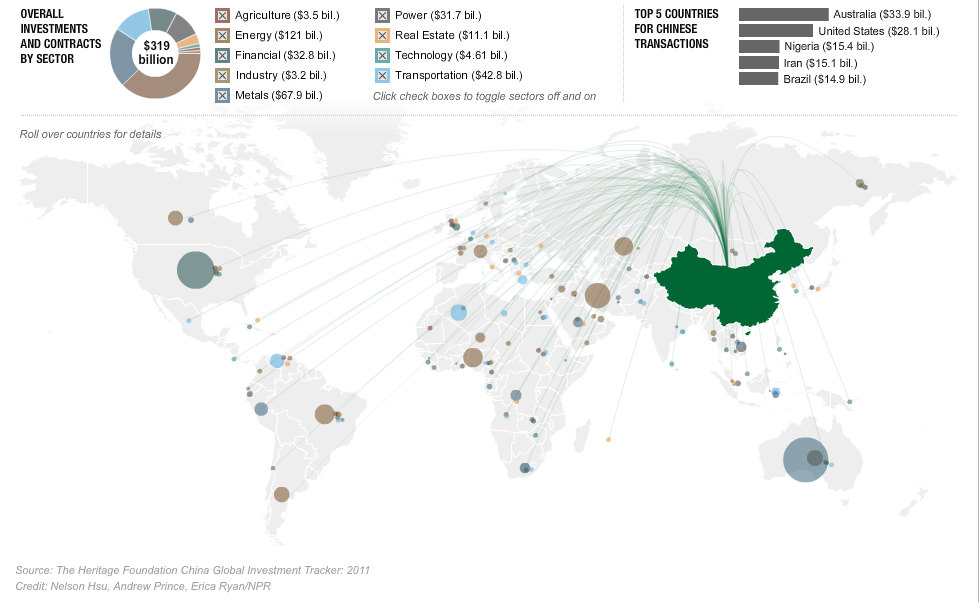
Graphical Illustration of China’s global reach

NPR has this cool graphic on China’s global investments [click on image to enlarge].

Notice that Nigeria is among the top destinations of Chinese investments.

In my alternate universe Abuja (the undisputed regional hegemon) is stable and uses this, and the fact that it is also among the most important sources of US-bound crude oil, as leverage to nudge the two biggest global powers in the direction of a more stable and coherent Africa policy.

More on this here.

Failed states index out, the usual suspects top the list

FP has the annual list of failed states. The Continent has a heavy presence on the list, with the usual suspects like Somalia, Sudan, Chad, Niger and Central African Republic, among the top failures. Also on the list are otherwise stable places like Uganda, Nigeria, Kenya, Ethiopia, among others.

The list is, in some sense, a reminder that several states out there are in dire straits. Insecurity and poverty continue to be a daily experience of far too many people. But it also raises methodological questions regarding the rankings. Some of the rankings certainly do not make any substantive sense and merely feed into alarmist stereotypes we already have of certain countries or regions of the world.

Methodological issues aside, the list is yet another reminder that despite the recent surge in Afro-optimism, a lot still needs to be done in order to improve the human condition in Africa, among other regions of the world.

selective unconditional convergence and growth

Rodrik has a finding that reinforces the importance of politics and other macro conditions for economic development. He points out the existence of the paradox of unconditional convergence at the industry level but not at the national level. Rodrik stresses the importance of structural change that channels labor into the right industries. To this we should add political change that provides certainty and the requisite legal and physical infrastructure for economic growth.

Industries that thrive in poorly run places – like telecoms, banks and construction firms in Nigeria or Kenya’s retail giants – do so despite their governments. Non-existent roads, underdeveloped railway systems, sporadic and expensive electricity, bad schools, legal uncertainty and massive amounts of political risk all serve to limit the extent to which within-industry gains can be extended to other sectors.

The massive uptake of mobile telephones across Africa suggests that consumerism in SSA is alive and well, just under-exploited. Sectors like textiles, agriculture and construction remain largely untouched because of cheap imports and bad regulation.

Development is a complex enterprise that requires massive amounts of (implicit) coordination. There has to be a link between California’s Silicon Valley, Massachusets’ Route 128 and New York’s Wall Street, in addition to other growth clusters. In this game synergy is King. The provision of the legal, human capital and physical infrastructure to facilitate coordination of this scale is largely dependent on well-functioning governance structures.

Here’s Rodrik.

Poor countries have access to new technologies already developed elsewhere so should grow more rapidly than richer economies. This is one of the implications of standard growth models, as well as of common sense.

But in reality, there is no automatic tendency for economic “convergence” among countries at different levels of income. Convergence depends instead on a number of additional determinants. It is only those developing nations with the “appropriate” preconditions – for example, adequate schooling or physical investment – that manage to absorb new technologies sufficiently rapidly and therefore to catch up. In the language of growth economics, there is conditional convergence, but not unconditional convergence.

When we look at the same question at the level of individual industries rather than countries a surprising finding emerges. Suppose we focus on, say, plastics, furniture, or the auto industry in developing countries. Does productivity in these (and other) industries experience automatic convergence with the technological frontier? Or is convergence once again conditional, depending on a host of country-level variables?

The interesting (and I think new) finding is that productivity convergence appears to be unconditional at the industry level – at least for manufacturing industries and for the period since the 1980s.
africa’s Middle class

Elizabeth Dickinson at FP reports:

Given all this, perhaps the only thing about Africa that isn’t changing quickly is our perceptions of it. There’s an image impressed in all of our minds of a starving child, symobilizing an impoverished continent. If that was ever true, this is an excellent reminder that today, it’s at most a snapshot. Yes, there’s great human suffering and it’s not hard to find. But Africa as a whole is becoming a middle class continent.

It is hard to completely buy Dickinson’s optimism given the fact that Somalia, the DRC, Chad, Central Africa Republic, Sudan, among others are still far from being stable polities. The precarious nature of the stability in the more stable African states such as Uganda, Kenya, Ethiopia, Rwanda e.t.c. are also cause for concern.

That said, the reality is that there are many Africas. Those who fail to internalize that fact continue to do so at their own peril. Just ask the Indians and the Chinese.

goodluck jonathan poised to win nigeria’s election

The Daily Nation reports:

Nigerian President Goodluck Jonathan has taken a wide lead in elections in Africa’s most populous nation, results showed today, putting him on a possible course for a first-round victory.

Millions of voters turned out for Saturday’s election as Africa’s most populous country bid to put years of rigging and badly flawed ballots behind it and hold the cleanest polls for head of state in nearly two decades.

Observers gave the polls an initial thumbs up, but concerns were raised over regional divisions, a scenario many analysts had hoped to avoid in a country as fractious as Nigeria, roughly split between Christians and Muslims.

Results from 30 states showed Jonathan had won 20, while ex-military ruler Muhammadu Buhari had nine and the former head of the anti-graft agency, Nuhu Ribadu, had one state.

Mr. Jonathan’s cross-national victories are a good omen for Nigerian unity moving forward. Now the big question is how Mr. Jonathan and the PDP will govern. Top on the agenda will be Nigeria’s energy problems. Sub Saharan Africa’s largest oil producer also happens to be one of its biggest importers of refined oil products. No new refineries have been built in the country in ages. The country also suffers frequent power outages despite the fact that millions of cubic metres of gas get flared in its oil fields daily. About 23 billion cubic metres get flared annually in Nigeria (second only to Russia).

That is 23 billion cubic metres of gas that can be harnessed for power production or LPG.

Africa needs zuma (to have a coherent foreign policy)

This week the Economist rightly called out South African president Jacob Zuma on his country’s lack of a coherent foreign policy. South Africa was reborn in 1994 with the moral authority and international goodwill to be Africa’s shining light in the world. Instead, under Mbeki and now Zuma, the country has squandered all that away.

Mbeki did it with his intransigence against reason on the issue of HIV/AIDS and support of Robert Mugabe in Zimbabwe. Mr. Zuma is doing the same with his support for Mugabe and equivocal pronouncements against other murderous tyrants on the Continent. Since his election he has not spoken strongly against any injustices or electoral fraud on the Continent; this task has been left to Ian Khama, president of tiny but relatively prosperous Botswana.

Sub-Saharan Africa is desperately in need of a regional hegemon to help it chart a coherent path in global politics. Latin America has Brazil. South Asia has India. East Asia has China. Even Europe has Germany. In Africa, Nigeria (pop. 150+m), South Africa (~40m, biggest economy), Ethiopia (85m) and the Democratic Republic of Congo (~70m) – all potential regional leaders – have woefully underperformed.

Nigeria is Nigeria. Ethiopia is dirt poor and needs to clean its own mess, Somalia’s and Eritrea’s, before it can venture further afield. The DRC is struggling to keep itself afloat. South Africa, by far, has the capacity and the requisite soft power to take up the job of regional guiding light. The country is slated to become a BRIC country soon, making the BRICS (Brazil, Russia, India, China and South Africa).

It is a shame that Mr. Zuma has chosen to abdicate his role as the Continental leader. He alone, among the members of the Continent’s club of kleptocratic autocrats (a.k.a AU), has the clout to stand up to the evils we continue to see in Cote d’Ivoire, Darfur, Zimbabwe and elsewhere.

Will Bashir pay for “losing the south”?

Omar Bashir faces a tough few days ahead. More than 99% of Southern Sudanese voted for secession in the just concluded referendum, effectively guaranteeing the split of Africa’s biggest country in July of this year. Many in the North blame Bashir for losing the South. The waves of protests in the Middle East following the Jasmine Revolution in Tunisia is adding fuel to the flames. The Independent reports:

Violent clashes broke out at two Khartoum universities yesterday as heavily armed police surrounded stone throwing students. Social media groups similar to those used elsewhere in the Arab world to mobilise protesters have started to mushroom in northern cities.

One of them calling itself “Youth for Change” has attracted 15,000 members to its Facebook page. “The people of Sudan will not remain silent anymore,” it says. “It is about time we demand our rights and take what’s ours in a peaceful demonstration that will not involve any acts of sabotage.”

Security forces arrested Hussein Khogali, the editor of al-Watan newspaper, whom they accuse of orchestrating the online protests.

And in other news, the African Union summit opened on Sunday with the Ivory Coast top of the agenda. The Continental club of autocrats body agreed to set up a five member panel to continue negotiations with Laurent Gbagbo, the Ivorian president who lost an election but refuses to step down. Also on the AU’s agenda is Kenya’s misguided attempts at battling the ICC through threats of en masse pullouts from the Rome treaty by African countries.

The failure to force Gbagbo out of power and the ill-fated fights with the ICC are additions to the litany of failures that make most on the Continent question the relevance of the AU. In my opinion regional bodies are only as strong as their dominant members. With South Africa continuing to be disinterested in regional matters and Nigeria being Nigeria the AU is guaranteed to remain rudderless into the foreseeable future.

Achebe’s take on the trouble with nigeria

Chinua Achebe has an editorial piece in the NY Times on the prospects for economic and political development in Nigeria. Below is an excerpt that I think applies to most of Sub-Saharan Africa.

During the colonial period, struggles were fought, exhaustingly, on so many fronts — for equality, for justice, for freedom — by politicians, intellectuals and common folk alike. At the end of the day, when the liberty was won, we found that we had not sufficiently reckoned with one incredibly important fact: If you take someone who has not really been in charge of himself for 300 years and tell him, “O.K., you are now free,” he will not know where to begin.

This is how I see the chaos in Africa today and the absence of logic in what we’re doing. Africa’s postcolonial disposition is the result of a people who have lost the habit of ruling themselves, forgotten their traditional way of thinking, embracing and engaging the world without sufficient preparation. We have also had difficulty running the systems foisted upon us at the dawn of independence by our colonial masters. We are like the man in the Igbo proverb who does not know where the rain began to beat him and so cannot say where he dried his body.

HT Erin.


ushering in the new year

Happy new year to all readers.

2011 will be a crucial year for a few countries on the Continent. On January 9th Southern Sudan will vote for secession, creating the newest state in the world. The aftermath of that might be all out war with North Sudan (over borders and oil) and/or civil war in the south (ethnically motivated warfare over control of the new state). That is what most analysts predict. I think there is a glimmer of hope for peace due to heavy Kenyan investment in the south and the desire to build, link and orient the new nation towards the East African Community. Watch this space as it all unfolds.

Uganda will hold elections on February 18th. Yoweri Museveni will win big and dig in even more now that Uganda has oil in the west of the country. Also bolstering Mr. Museveni’s hold on power will be the LRA’s delusional insurgency in the north of the country and the continuing war on terror in the horn of Africa – Uganda’s troops form the core of the African Union (AU) forces in Somalia. Mr. Museveni has been in power since 1986.

The other major election will be in Nigeria, the continental behemoth in the west. President Goodluck Jonathan is favored to win, but his victory will most certainly be tainted with chaos and irregularities.

Other countries holding elections in the new year are Central African Republic, Benin, Madagascar, Cape Verde, Chad, Djibouti, Niger and Liberia.

Electoralism remains largely dysfunctional and inconsequential in Africa because of a myriad of structural impediments (poverty, weak institutions, monarchical presidentialism, etc). In the recent past events in Kenya, Zimbabwe and Cote d’Ivoire have shown how far the Continent is from being a liberal democratic paradise (may be democracy is not for everyone at all times?). 2011’s elections will no doubt fail to buck the trend.

more from wikileaks

The Guardian reports:

The oil giant Shell claimed it had inserted staff into all the main ministries of the Nigerian government, giving it access to politicians’ every move in the oil-rich Niger Delta, according to a leaked US diplomatic cable.

Nice. Friedman was right. Firm’s only social responsibility should be to make profits. Forget about the population and the destroyed lives.

Also,

US diplomats fear that Kenya could erupt in violence worse than that experienced after the election in 2008 unless rampant government corruption is tackled.

America asked Uganda to let it know if its army intended to commit war crimes based on US intelligence – but did not try to prevent war crimes taking place.

Washington’s ambassador to the troubled African state of Eritrea described its president, Isaias Afwerki, as a cruel “unhinged dictator” whose regime was “one bullet away from implosion”.

Still (im)patiently waiting for the stuff on the Kenyan elections in 2007.

And lastly,

Apparently based on a conversation with Johnnie Carson, the US assistant secretary of state for African affairs, it said: “China is a very aggressive and pernicious economic competitor with no morals. China is not in Africa for altruistic reasons. China is in Africa for China primarily.”

Yeah right. Because the US involvement in Africa since the 1960s has been any different. At least the Chinese do not bother to be janus-faced about it [ok, that is a little too harsh, but you get my point].

The Gambia, Iran, Nigeria and the confusion over arms

Remember the story about the mysterious cache of arms found in Lagos Port, Nigeria? Well, turns out the story goes beyond Nigeria. FP reports that there is reason to believe that the arms from Iran were destined for The Gambia. Authorities in Banjul expelled the Iranian officials in the country, increasing speculation that the arms were meant for rebel groups linked to last year’s coup attempt against President Yahya Jammeh who by the way, cures AIDS on Thursdays.

Just as Libya is retreating from its bad habit of financing and arming rebellions all over the Continent Tehran appears poised to assume this role, especially in Muslim sub-Saharan Africa. There is not a clear strategic reason for this kind of involvement by Iran in The Gambia, although theories abound out there. To add to these, I think it might be that someone within the Iranian government is involved in the global drugs trade and wanted to use The Gambia as a transit to Europe. On November 19th Nigeria discovered US$ 10 million worth of heroine shipped from Iran.

West Africa plays a major role in the global drugs trade. Barely afloat West Africa states, particularly Guinea and Guinea-Bissau, are key transit points for drug shipments from Latin America and Asia into Europe.

frustrations of the african intellectual

William Easterly on Aid Watch captures the frustrations of African intellectuals and their continued neglect by both the aid industry and their home governments.

African intellectuals continue to be on the periphery of the discourse on African socio-economic development. The independence leaders jailed, killed or exiled many of them, leading to fifty years of disastrous misrule and general mediocrity from Dakar to Mogadishu, Khartoum to Jo’burg. The current crop of autocrats and pretend-democrats did not learn a thing from the last half-century and continue to opt for career poverty-voyeurs development experts from donor countries instead of their own people who may have greater incentives to see their homeland match the achievements of the newly emerging states of Brazil, India and China.

goodluck jonathan announces his candidacy on facebook

Nigerian President Goodluck Jonathan has announced that he shall be running for president in next year’s general election, according to a post on his facebook page. Apparently the good sir takes social media seriously:

While some observers were surprised that Mr Jonathan had used Facebook to announce his candidacy, he said in July that comments on his page had influenced him in overturning his ban on the national football team . . . . . . . . . “People may scoff, but we take the interactions seriously, we track the [Facebook] feedback,” a presidential adviser told the Reuters news agency.

It will be interesting to see how the rank and file of the PDP reacts to this announcement. Under the party’s implicit North-South agreement the next president has to come from the North. Mr. Jonathan is a southerner.