Kenyan politician John Michuki dead at 80

John Michuki, MP for Kangema is dead at 80. The late Michuki was a Kenyan politician that many learned to love (and sometimes love and hate). As Transport Minister he brought sanity to the rowdy matatu sector with the much-loved “Michuki Rules”. As Minister for the environment he cleaned up Nairobi River.

His less illustrious contribution was in the security ministry. It is under his watch that the Standard Media group was raided by masked thugs under the pretext that they were about to publish information that would have “impinged on the person of the president.” It later emerged that the media house had information about alleged illegal dealings by a woman rumored to be an illegitimate daughter of president Kibaki. The war on the Mungiki sect was also carried out under his watch – with numerous allegations of extrajudicial killings of hundreds of young men.

The son of a paramount chief, Michuki was among the group of super-wealthy conservative elites who at independence took over power and managed to quiet the more radical elements of the independence movement. Under their watch Kenya emerged as a capitalist enclave even as its many neighbors flirted with communism and African Socialism, with disastrous consequences. For better or worse, Kenya benefited from this “home guard generation” (see Bates 1989, for instance; for a different view see AfriCommons).

The Kenyan political scene will sorely miss Mr. Michuki’s straight talk and ability to deliver. He was among a handful of government officials that actually stood for what they believed, and he had results to back up all his talk. As the Nation reports:

Michuki gained the reputation of being a “ruthless” and efficient manager, who is widely acknowledged as being among the best performing ministers in President Kibaki’s government.

May he rest in peace.

Kenyan Intervention in (al-Shabab dominated) Southern Somalia

The ICG has an excellent new report on the state of the the Kenyan military intervention in Somalia.

The pressing issues raised in the report include economic, political and social concerns:

The slow pace of the military operation and the high cost of keeping troops in the field are the main reasons behind Nairobi’s desire to operate under AMISOM command. The treasury would then not have to pay the full cost of the campaign. It is estimated that Linda Nchi is costing the government at least KSh 210 million ($2.8 million) per month in personnel costs alone in a year of a record KSh 236 billion ($3.1 billion) budget deficit. If the interven- tion’s cost is not contained, already high inflation will spiral, and local discontent could become more serious…..

The intervention in Somalia is likely to have a complex impact on Kenyan Somalis’ political positions, because their attitude toward it is not straightforward. The government’s desire to establish a buffer zone between the border and the rest of Somalia privileges the Ogaden, the majority Kenyan-Somali clan. The possibility of a semi-autonomous state in the south of Somalia politically dominated by Ogaden may not be favoured by the minority, marginalised clans of north-eastern Kenya, such as the Ajuran and Degodia…..

Views within the ethnic Somali and wider Muslim community regarding the war are mixed but predominantly critical. Even those now mildly supportive could easily become hostile, especially if things go badly wrong, and civilian deaths mount. The notion that the war is popular within the Muslim community is wishful thinking, and the potential to exacerbate already worrying radicalisation in the country is very real. The police and other security services have shown some restraint in bigger cities, but there have been numerous reports of abuses in North Eastern Province.

Innovation in Kenya

The Kenyan tech industry just got another boost, this time from the global phone maker Nokia. The Sunday Nation reports:

Nokia plans to make Nairobi its global hub for research and investment for the India, Middle East and Africa region.

The move is a big win for the country which will serve as a nerve centre for Nokia’s global research activities, bringing together application developers, businesses and software engineering eco-system from around the world.

The company has research facilities in 13 locations worldwide, and Nairobi will be its nerve centre.

The Nairobi Nokia Research Center (NRC) located at the Nairobi Business Park along Ngong Road previously served the African region only.


More on the politics of the ICC decision in Kenya

Here is an excerpt of a piece I have written over at African Arguments:

“While it might be too early to ascertain the full political impact of the ICC’s ruling, there is no doubt that it will provide a real test to Kenyan institutions – especially the judiciary. The courts will have to decide, amid intense political pressure, whether or not the accused are fit to hold public office and by extension whether those that want to can run for president.  Ultimately, however, a lot will turn on the decisions made by President Kibaki. Will he stand by his trusted lieutenants in Muthaura and Kenyatta or will he bow to public pressure and ditch them in an attempt to secure his legacy?”

More on this here.

ICC Kenya case ruling and its consequences

That the ICC’s website crashed an hour before the ruling was given underscores the importance of today’s ICC ruling.

In the end it emerged that charges against Deputy Prime Minister Uhuru Kenyatta, Head of Civil Service Francis Muthaura, MP William Ruto and radio Presenter Joshua Sang were confirmed. Former police commissioner Husein Ali and MP Henry Kosgey will walk, at least for now.

The political implications of the decision will be huge.

Firstly, President Kibaki must decide whether or not to retain two of his most trusted lieutenants in the government (Messrs Kenyatta and Muthaura) even as they face charges with regard to the death of 1300 Kenyans and the displacement of hundreds of thousands. Should the president decide to stand with them I suspect that soon the courts will have to decide whether these two are fit to hold public office.

Remember that Kenya has a resurgent judiciary eager to stamp its authority as an independent institution. There will be intense political pressure from Civil Society groups to see the two step aside.

Equally interesting will be whether the Independent Electoral and Boundaries Commission will allow Ruto and Kenyatta to run for president in light of these developments. Again, the case might go all the way to the Supreme Court. The Kenyan constitution has a clause banning those accused of certain crimes from holding public office. The vagueness of the wording in the constitution will give the courts discretion in reaching a verdict. I suspect some activism here was well.

Secondly, Ruto and Kenyatta will find it hard to sell their candidacy to Kenyans ahead of the general elections later this year. As the process continues, it will be hard for both (whether guilty or not) to hide from the gruesome crimes that were committed in 2007-08. I therefore doubt the viability of either one running for president at the top of a ticket. If they want to be on a winning team in this year’s election they must be part of a coalition.

But coalition building will be hard. For one, cracks are already appearing in either camp. Ruto recently got kicked out of a party he tried to commandeer after defecting from ODM. Mr. Kenyatta is also facing a simmering insurgency within his Central Kenya camp. The other thing is that the Kenyan economic and political upper class has revealed a willingness to throw the two under the bus if they become too much of a baggage. It is telling that a group of Central Kenyan tycoons have started warming up to Prime Minister Raila Odinga, the man to beat in this year’s general election.

I expect a flurry of press conferences to follow shortly. But I must go to bed for now. It is 3:15 AM…

Justice, the ICC and Kenyan Politics

A panel of judges at the ICC will issue their ruling tomorrow afternoon on whether or not six accused Kenyans will stand trial. The six include two declared presidential candidates. Either way the ruling will have a non-trivial impact on the pursuit of justice for the victims of the 2007-08 post-election violence (PEV). It will also significantly shape the politics of coalition building in this year’s general elections.

Because of the ICC process, the Kenyan justice system has put on ice its own process of holding the perpetrators of the PEV to account. A non-confirmation of the charges against at least some of the six co-accused will add the 2007-08 PEV to the long list of crimes against Kenyans, many of which have been committed by the high and mighty, that have gone unpunished.

Justice is political. Therefore, there is no doubt that if the process of prosecuting the crimes committed in the PEV returns to Kenya none of the big fish will be held accountable. That is the sad truth.

This is why despite the noisy political environment, a majority of the PEV victims (and other Kenyans) still back the ICC process. At the very minimum they want justice to appear to be served.

At the moment the problem of justice remains a worry largely monopolized by the 300,000 or so Kenyans in IDP camps and the relatives of the over 1,300 who were killed. [The media and the political class are squarely to blame for this shameful situation.] For the rest of the country, focus has shifted to the politics of the general elections due later this year. To this we now turn.

Two of the accused, William Ruto and Uhuru Kenyatta have declared their interest in the presidency. Mr. Kenyatta is currently the second most preferred presidential candidate after Prime Minister Raila Odinga. Mr. Ruto, while not as popular nationally, still commands a sizeable chunk of the votes in the country’s most populous province – the Rift Valley. The Rift Valley has also been the hotbed of political violence in country’s history, most of it over land.

A confirmation of the charges will seriously dent the presidential ambitions of Messrs Ruto and Kenyatta. It will make it harder for either of them to sell their candidacy outside of their immediate ethnic constituency. It will also give their opponents (and there are plenty) an opportunity to hold themselves as the clean candidates that ought to succeed Kibaki. Needless to say, a non-confirmation would bolster the duo’s campaigns. What will this mean for the general election?

It is common knowledge that the man to beat in the 2012 election will be Mr. Odinga. The two scenarios above will impact the outcome of the election mainly through their influence on the coalition building abilities of the anti-Odinga crowd.

More on this tomorrow in reaction to the ICC ruling.

Institutions and Political Change in Kenya

These are interesting times in Kenya. The Deputy Chief Justice and Vice President of the Supreme Court, Nancy Baraza, stands to lose her job for harassing a female security guard on New Year’s Eve.

Ms Baraza’s ordeal is interesting because it captures the momentous changes taking place in Kenya’s institutions of governance. The idea that a public official of such high stature could get in trouble for the “simple act” of threatening a security guard was laughable only a few years ago. Not long ago Kenya was divided between wananchi (loosely translates to citizens) and wenyenchi (owners of the country), the latter being virtually above the law. That has since changed. Even the president has in the recent past been forced to reconsider his actions whenever they were deemed to be in contravention of the supreme law of the land.

But the progression towards this state of affairs has not been straightforward – which is why I think that the Kenyan case is a good lesson in contemporary evolution of limited government.

Academic discussions of limited government revolve around the question of how to achieve credible commitment among the veto players within a polity. That is, how competing factions within the state can agree to a modus operandi that makes their interactions predictable and objectively justifiable based on a predefined idea of what actions are legitimate. The most common way to do this is usually to have institutions of state defined in constitutions and to regularly elect public officials.

But as Stasavage has argued, the mere existence of institutions and veto players is not a sufficient condition for credible commitment. There must be a guarantee that specific important veto players will have de facto veto power. In other words, it matters that various factions within society CAN balance each other.

How does this map onto the Kenyan case?

Contrary to the popular view, the story does not begin with the 2007-2008 post-election violence and the formation of the Grand Coalition Government. The story begins with the pro-capitalist policies of president Kenyatta that created room for the emergence of a wealthy upper class within Kenyan society. At the beginning, this class was totally dependent on the state for its reproduction. But over time, segments of the class acquired independence. Under Moi and now under Kibaki there is a sizeable chunk of the economic upper class that makes its money without a personalist connection to the state [You have to take my word on this, for now.]

The fact that both Odinga and Kibaki have had public fall-outs with wealthy co-ethnics who have then decamped to the other side is illustrative of this fact.

It is this emergence of “independent wealth” that provided the foundation of the strong opposition that emerged after Moi retired. Led by Raila Odinga and his allies, these politicians had the money and social capital to challenge the president and his men on equal terms. That is why when stuff hit the fan in 2007-08 Kibaki had no option but to agree to share some of his power with Odinga. The two men knew that neither of them could win the game of “my street against your street.”  It is also why the negotiated settlement that is Kenya’s new constitution was an exercise in give and take, with an absurd emphasis on procedure and self-executing clauses.

The implementation of the new constitution has not been any different. Which takes us back to Ms Nancy Baraza.

It is common knowledge that Ms Baraza was not an establishment appointment to the Supreme Court. She was part of the civil society coup in judicial appointments which also included the Chief Justice. Having “lost the court” the establishment ensured it had control by insisting on maintaining control over the Director of Public Prosecutions and the Attorney General. The establishment also controls the Police Force. Their challengers (who are no angels themselves) had the goodwill of civil society and big enough constituencies in key organs of the state – including the military. They also had a plurality in parliament.

So when Baraza got in trouble due to what appears to be a lapse in judgment, the establishment saw a chance to get her out. But they had to do it within the bounds of due process. And so they have been quick at it. The police (whose top brass will be fired soon by a panel laden with civil society types) conducted a quick investigation and concluded that the DCJ had a case to answer. The Judicial Service Commission has since arrived at the same conclusion, and recommended the Justice’s suspension to the president. The process has thus far been transparent, with very few questioning the legitimacy of the inquiry into the behavior of Ms Baraza.

Meanwhile the civil society has been dead quiet. Many fear that their hard fought gains of having two of their own (The Chief Justice and his deputy) in the Supreme Court will be eroded after Ms Baraza’s departure. I bet that when the dust settles and the debate over who should replace Baraza gets heated civil society (and the Odinga camp) will want to replace her with one of their own. It will be interesting to see if the establishment will move to alter the balance of power by challenging this implied consensus.

The long and short of it all is that it matters that competing forces in society credibly balance each other. In those countries (like in most of Sub-Saharan Africa) where presidents and their men have overwhelming power advantages over their opponents, it will be doubly hard for limited government to come about. If the Kenyan experiment succeeds it will be proof that you need not have an inter-ethnic love-fest or the lack of factions for limited government to emerge.

This is mostly a story about the Kenyan political and economic elites. What about the wananchi/masses? That will be the subject of a future post.

Kenya’s stalled operation in Somalia

The East African reports:

There are four major factors that have bogged down the military campaign. They are: Lack of finances to run a long-drawn war; the differences between interested parties over whether to divide Somalia into autonomous regions or maintain one united country; differences over the option to engage Al Shabaab in a political dialogue, and the ambivalence of Somalia’s President Sheikh Shariff Ahmed.

Kenya’s intention has always been to create an autonomous region in southern Somalia to act as a buffer to the chaotic mix that is central Somalia. The plan has apparently become even more ambitious:

Kenya is proposing the division of Somalia into eight autonomous regions: Central region or Hiran; Somaliland; Puntland; Bay Bakool; Jubaland; Shabelle; Gedo and Mogadishu, commonly known as Banadir.

But it is increasingly becoming apparent that the cost and politics of such an operation may not be as palatable as the planners had initially thought.

President Sheikh Shaiff’s ambivalence is intended for the domestic audience and also motivated by his desire to concentrate power in Mogadishu (he dislikes the idea of autonomous regions proposed by Kenya).

The first source of ambivalence is reasonable. No president wants to be in support of a foreign invasion that occasionally results in the death of innocent citizens. I hope the Kenyan commanders, under AMISOM or not, do not pay too much attention to his flip flopping on how to engage the al-Shabab.

The second is not. Two decades of warfare have made it clear that trying to solve Somalia’s problems from Mogadishu may not be a good idea. The only way that might happen is through a force like the Islamic Courts Union. But the international community will not allow a pure military solution, given the human rights implications.

Perhaps it is time a decentralized peace initiative got underway.

Finally, it is encouraging that after weeks of pro-war jingoism the news media in Nairobi have begun to question the execution of the war in Somalia. More public discussion about the logic and cost of the war needs to take place in order to keep both the generals and politicians on the straight and narrow.

More on this here.


Happy Jamuhuri Day to all the Wananchi out there!

Kenya is 48, with a lot to celebrate. Happy Jamuhuri Day!


Live blogging the Kenya National Dialogue and Reconciliation Conference

Here is a link to the live stream.

I will post my own comments on the day’s proceedings later tonight.

Tough trying to be good in a bad neighborhood

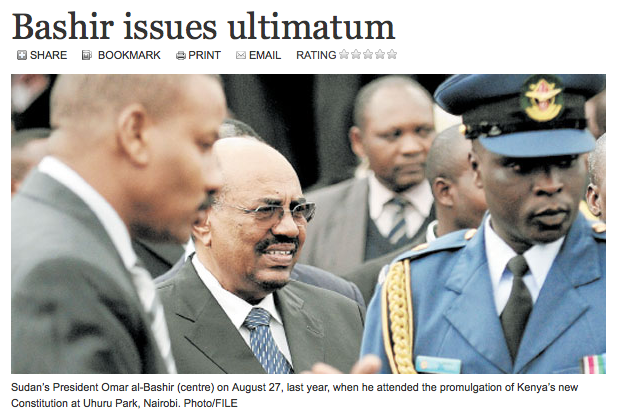
A few days ago a Kenyan judge ordered the government to arrest Sudanese President Omar al-Bashir if he ever sets foot in Kenya. Mr. Bashir has an outstanding arrest warrant against him from the ICC for crimes against humanity committed since 2003 in Darfur.

The ruling has since metastasized into a full blown diplomatic row; Khartoum expelled the Kenyan ambassador before rescinding the expulsion, and is now threatening to cut all trade ties with Kenya, expel Kenyans living in Sudan and deny any planes leaving or going to Kenya from flying in its airspace – if the government does not take back the ruling in two weeks.

The diplomatic row aside, the case has implications for the reform process in Kenya. The case is a test of the depth of the Kenyan judiciary’s new found independence from the executive.

According to Khartoum:

“al-Bashir expects Nairobi to scrap the arrest warrant within the next two weeks and not simply file an appeal.”

That is not how the judicial process works in a democracy. The executive cannot just scrap a judicial ruling. Within Kenya, for the sake of precedence the government must be seen to be complying with court rulings. The Chief Justice has already warned the executive against ignoring the court ruling saying that

“If a country chooses to live by anarchy, it must be ready to face the consequences of disregarding the law.”

It remains unclear what the executive will do given Khartoum’s two week ultimatum. Disregarding the court ruling will come with consequences for the individuals involved – in particular the Foreign Minister and the Commissioner of Police.

Kenyan Court Orders Bashir Arrest, Sudan Expels Kenyan Ambassador

UPDATE:

The BBC reports:

Sudan ordered the expulsion of the Kenyan ambassador after a Kenyan judge issued an arrest warrant for Sudan’s President Omar al-Bashir, Sudan’s foreign ministry has said.

Mr Bashir is wanted by the International Criminal Court (ICC) for alleged war crimes in Darfur.

Sudan has ordered the Kenyan ambassador to leave the country within 72 hours.

It has also ordered the Sudanese ambassador in Kenya to return to Khartoum.

*************************************************************

A Kenyan court has issued an arrest warrant for Sudan’s President Omar al-Bashir over alleged war crimes in Darfur.

The ruling came after Kenya allowed Mr Bashir to visit in August in defiance of an International Criminal Court (ICC) warrant for his arrest.

The judge said he should be arrested if he “ever set foot in Kenya” again, the AFP news agency reports.

Kenya is a signatory to the treaty which established the ICC in 2002.

The new Kenyan constitution requires that the government implements its international treaty obligations. The ruling, though without much bite – I doubt Bashir will need to be in Kenya any time soon, has immense symbolism in the region.

It also matters for Kenyan domestic politics. Presently, a few high ranking Kenyan politicians – including the Finance minister, two former ministers and former police boss – are on trial at the ICC for crimes against humanity. The accused await judgment on the admissibility of their cases later this year or early next. The Bashir ruling means that if the charges against the “Ocampo Six” are confirmed but the government drags its feet in implementing an arrest warrant then the courts will step in.

More on the Bashir case here and here.

In other news, Uganda and Tanzania have rejected Khartoum’s petition to join the East African Community, citing “several issues like their democracy, the way they treat women and their religious politics.” Yeah right.

donkey markets and the al-shabab

Kenya’s invasion of al-Shabab held parts of Somalia has inadvertently elevated the demand for donkeys. Because of the rains (making the use of vehicles a nightmare) and a desire to disguise their transportation of arms, the al-Shabab have resorted to the use of donkeys.

The BBC reports:

In his latest series of tweets, the Kenyan military spokesman said that the price of donkeys had risen from $150 (£100) to $200 following the increased al-Shabab demand for the animals.

“Any large concentration and movement of loaded donkeys will be considered as al-Shabab activity,” he wrote, suggesting they would be targeted by Kenyan firepower.

“Selling Donkeys to al-Shabab will undermine our efforts in Somalia,” he continued.

Somalis’ improvisation in warfare is well known. The technical (which has been ubiquitous in Libya in recent months) is their key contribution to military technology, and has been the go to battle wagon in many civil wars since the early 1990s.

More on donkey markets  here.

Quick hits

Jesus! Good intentions are not enough. (Properly regulated) Markets rule.

Kenya and Eritrea appear to be on a collision course. The Horn might get a little bit hotter in the next few months.

Some insights into politics and development in Nigeria. I hold the minority opinion that Nigeria might yet surprise those short selling it at the moment. The political situation is almost good enough. Remember, all you need (at least for the initial stages of growth) is predictability, not Sweden’s institutions.

AFRICOM has a blog. The posts are sporadic but it’s worth checking out once in a while.

To all the Wananchi out there