Fighting Corruption in Nigeria (Your Uncle is a Crook!)

naijacorruption

This approach to fighting corruption goes against the lessons in Peter Ekeh’s delineation between “primordial” and “civic” publics in Nigeria. According to Ekeh one’s uncle may be corrupt in the civic public, but as long as he provides benefits and adequately “shares” in the primordial public he can remain in good standing within his community.

That said, the strategy might work if every Nigerian credibly promises to expose their uncle who’s corrupt but pretends to be an international businessman. The Nigerian government could nudge Nigerians in the right direction by actually prosecuting and jailing the country’s corrupt uncles and aunts.

What roughly $470m of borrowed money gets you in Nigeria vs Ethiopia

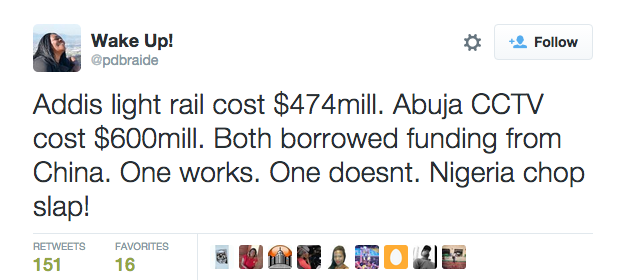
Ethiopia and Nigeria both borrowed roughly the same amounts of money from China’s EXIM Bank for massive infrastructure investments. The former sought to transform its capital’s transit system with a light rail ($475m); the latter tried to boost security in its capital by installing security (CCTV) cameras ($470m).

The outcomes of the two projects are an indication of what will be the impact of China’s ongoing infrastructure projects in much of SSA. Some countries because of the specificities in their domestic political economy are using borrowed money to deliver on actual tangibles — dams, power lines, stadia, housing projects, railway lines, roads, et cetera (corruption plays a role, but projects get completed). Yet others are accruing loans (albeit on concessionary terms) simply to treat the cash injections in the same manner that political elites have treated windfalls from mineral resources in decades past.

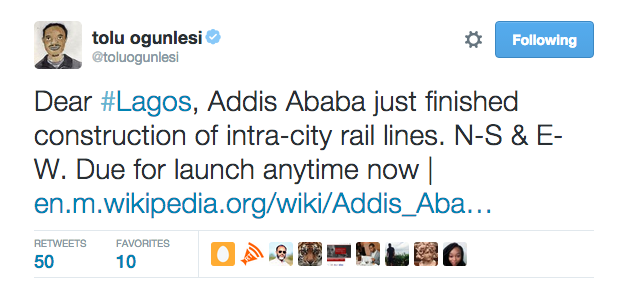
Ethiopia just opened its new light rail system in Addis. Nigeria’s CCTV project was a major flop. Of course this fact was not lost on a section of Nigerians on twitter:

Screen Shot 2015-09-21 at 3.04.19 PM

Screen Shot 2015-09-21 at 3.06.44 PM

How to increase mass employment in Nigeria (and other developing countries)

David Mckenzie of the Bank writes:

The modal firm size in most developing countries is one worker, consisting of only the owner of the firm. Amongst the firms that do hire additional workers, most hire fewer than ten. In Nigeria survey data indicate that 99.6 percent of firms have fewer than 10 workers. This is in sharp contrast to the United States, where the modal manufacturing firm has 45 workers. Are there constrained entrepreneurs in developing countries with the ability to grow a firm beyond this ten worker threshold? If so, this raises the questions of whether such individuals can be identified in advance, and of whether public policy can help them overcome these constraints to firm growth.

In an attempt to figure out if policy can help grow firms in developing countries, Mackenzie evaluated a program in Nigeria that awarded 1,200 winners about $50,000 each (out of an initial application pool of 24,000; the top 6000 applicants were in the study). See a summary here. And the paper is available here.

………. winning this competition has large positive impacts on both applicants looking to start new firms as well as those aiming to expand existing firms. Three years after applying, new firm applicant winners were 37 percentage points more likely than the control group to be operating a business and 23 percentage points more likely to have a firm with 10 or more workers, while existing firm winners were 20 percentage points more likely to have survived, and 21 percentage points more likely to have a firm with 10 or more workers. Together the 1,200 winners are estimated to have generated 7,000 more jobs than the control group, are innovating more, and are earning higher sales and profits.

Two quick thoughts. First, this is a really cool finding that should get African central bankers excited about how the financial sector can be put to use in boosting mass employment. Second, it is a caution against the odd idea prevalent in development programs of trying to turn poor people into entrepreneurs (see below). The best solution to poverty is jobs. Entrepreneurship is a risk that shouldn’t be imposed on people with already super slim margins of error in terms of income security. As Mckenzie rightly observes:

The results of this evaluation show that a business plan competition can be successful in identifying entrepreneurs with the potential to use the large amounts of capital offered as prizes, and that these individuals appear to be otherwise constrained from realizing this potential. The prize money generates employment and firm growth that would not have otherwise happened. However, the results also highlight the difficulties of picking winners. Conditional on reaching the semi-finalist stage, neither the scores for the business plans, nor individual and business characteristics have much predictive power for predicting which firms will grow faster or benefit most from the program. This remains an area for active research, but also highlights the inherent riskiness of entrepreneurial activity.

A slightly different story on administrative unit proliferation

The emerging stylized story about administrative unit proliferation in the developing world is that it is often a result of political machinations by national and local elites intent on creating new units for marginalized groups and for the ruler to buy votes; and that such proliferation only serves to re-centralize actual power — see for example these really cool papers by Grossman and Lewis (on the specific case of Uganda), Mai Hasssan (on the use of new districts to buy votes in Kenya) and Kimuli Kasara (also on how heightened electoral competition after 1992 accelerated the process of administrative unit proliferation in Kenya).

But there is also a slightly different, and in some ways complementary, story.

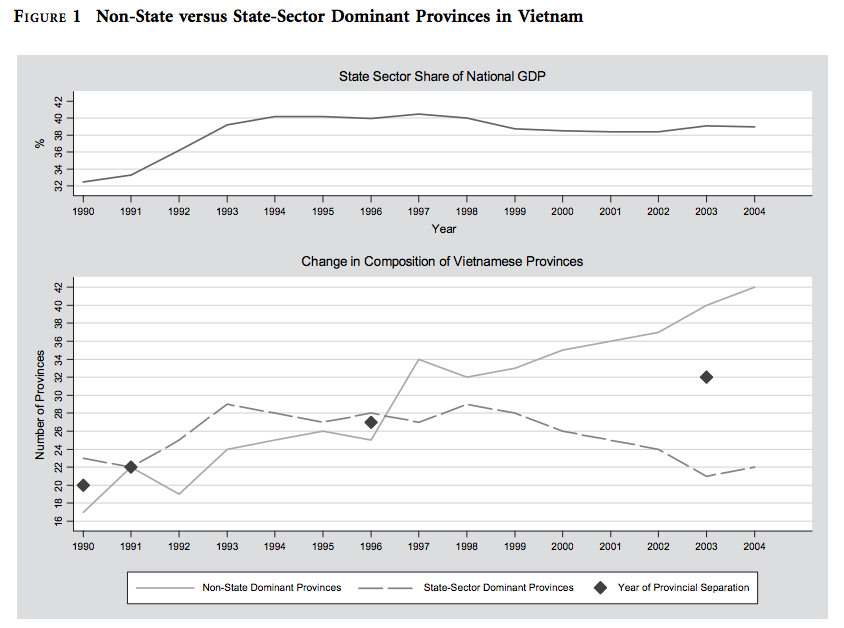
Regarding the creation of new provinces in Vietnam, Edmund Malesky notes:Screen Shot 2015-07-09 at 12.30.20 PM

The timing of provincial separations after Party Congresses, the dominance of Non-state Provinces despite little change in national output, and the decisive political outcome of this dominance at the 2001 Party Congress bolster the argument that reformers had an explicit electoral strategy in calling for the splitting of provinces in 1996. By creating new Non-state Provinces, modernizers believed they could influence the outcomes of future CCOM debates about
grand strategies and smaller NA debates about implementation of these new policies. While rhetorically it was easier to argue for new provinces based on efficiency, it would seem they were studying maps of
district economic composition and creating new reform-oriented
provinces out of SOE-dominated areas.

The key difference between administrative unit proliferation in Vietnam and Uganda (and Kenya before 2010) is the electoral connection (an aspect that, in my view, is missing in the current literature). Because the provinces had votes (in party congresses and plenums), the creation of new Vietnamese provinces had significant implications for the de facto distribution of power in both Hanoi and the periphery (and in Malesky’s story, made reforms possible). Provincial splits in Vietman were therefore not just about patronage and marginalized groups, but also about securing a win for the reformist bloc at the centre.

This might not be the case in countries where new units can be created without altering the balance of power in the party congress or parliament — either because such action does not create new electoral districts; or the president gets to nominate or can credibly influence the election of the representatives of the new districts. For this reason, I would predict that Kenya, Nigeria, and South Africa (whose subnational units are electorally significant and have a fair amount of fiscal autonomy) are unlikely to create new primary subnational units willy-nilly.

Nigerian President Goodluck Jonathan’s Concession Speech

I thank you all for turning out en-masse for the March 28 General Elections.

I promised the country free and fair elections. I have kept my word. I have also expanded the space for Nigerians to participate in the democratic process. That is one legacy I will like to see endure.

Although some people have expressed mixed feelings about the results announced by the Independent National Electoral Commission (INEC), I urge those who may feel aggrieved to follow due process based on our constitution and our electoral laws, in seeking redress.

As I have always affirmed, nobody’s ambition is worth the blood of any Nigerian. The unity, stability and progress of our dear country is more important than anything else.

I congratulate all Nigerians for successfully going through the process of the March 28th General Elections with the commendable enthusiasm and commitment that was demonstrated nationwide.

I also commend the Security Services for their role in ensuring that the elections were mostly peaceful and violence-free.

To my colleagues in the PDP, I thank you for your support. Today, the PDP should be celebrating rather than mourning. We have established a legacy of democratic freedom, transparency, economic growth and free and fair elections.

For the past 16 years, we have steered the country away from ethnic and regional politics. We created a Pan-Nigerian political party and brought home to our people the realities of economic development and social transformation.

Through patriotism and diligence, we have built the biggest and most patriotic party in Nigerian history. We must stand together as a party and look to the future with renewed optimism.

I thank all Nigerians once again for the great opportunity I was given to lead this country and assure you that I will continue to do my best at the helm of national affairs until the end of my tenure.

I have conveyed my personal best wishes to General Muhammadu Buhari.

May God Almighty continue to bless the Federal Republic of Nigeria.

Source: The Daily Post

Africa’s Billionaires in 2014

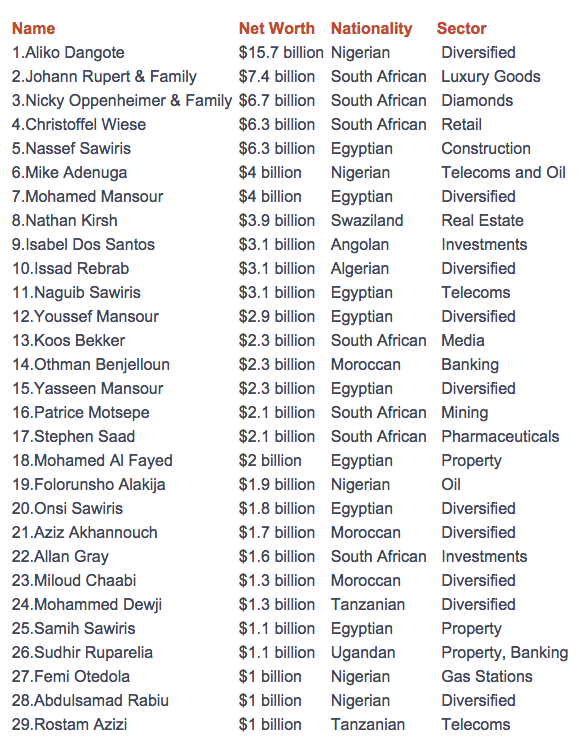
Only 9 out of 54 African countries are represented on the 2014 Forbes billionaires list. There are certainly more than 29 dollar billionaires on the Continent (most of the rest being in politics). Let’s consider this list as representative of countries in which (for whatever reason) it is politically safe to be publicly super wealthy – which in and of itself says a lot about how far Nigeria has come.

Screen Shot 2015-03-03 at 12.24.39 PM

Source: Forbes

Some will look at the list and scream inequality. I look at the list and see the proliferation of centres of economic and political power. And a potential source of much-needed intra-elite accountability in African politics. For more on this read Leonardo Arriola’s excellent book on the role of private capital in African politics.

See also this FT story on the impact of currency movements on the wealth of Nigeria’s super rich. Forbes also has a great profile of Aliko Dangote, Africa’s richest man.

The Anatomy of Tax Evasion in Africa

Africa Confidential has a great piece analyzing leaked documents from PwC, the professional services firm, showing the various arrangements that enable multinational companies to evade taxes in Africa. You can read the whole piece here (gated).

  • One of the measures PwC advised multinationals to take was to create a wholly-owned Luxembourg-based subsidiary which would hold the rights to intellectual property used by the rest of the group. The rest of the group would then pay licensing fees to the Luxembourg-based subsidiary which, by agreement with the authorities, would be granted tax relief of up to 80%……
  • A second tax avoidance mechanism simply involved the companies becoming incorporated in Luxembourg. In 2010, Luxembourg concluded an agreement with several companies of the Socfin (Société financière) agribusiness group, which was founded during the reign of Belgian King Leopold II by the late Belgian businessman Adrien Hallet. The companies chose Luxembourg as their base and made an agreement under which their dividends were subject to a modest 15% withholding tax, a lower figure than those in force where their farms are located (20% in Congo-K and Indonesia, 18% in Côte d’Ivoire).
transfer-pricing

The art of hiding profits

Altogether, Socfin subsidiaries in Africa [in Sierra Leone, Nigeria, Liberia, Cote d’Ivoire, and Cameroon] and Indonesia produced 123,660t. of rubber and 380,770t. of palm oil in 2012. The combined turnover of its main African subsidiaries reached €271 mn. in 2013. The list also includes the 100%-owned Plantations Socfinaf Ghana Ltd. (PSG) and Socfin-Brabanta (Congo-Kinshasa). Socfin also holds 88% of Agripalma in São Tomé e Príncipe and 5% of Red Lands Roses (Kenya).

  • A third mechanism involves cross-border lending within a group of companies. Companies registered in Luxembourg are exempt from tax on income from interest.

According to the Thabo Mbeki High Level Panel report between 1980 and 2009 between 1.2tr and 1.4tr left Africa in illicit flows. These figures are most likely an understatement. Multinationals, like the ones highlighted by Africa Confidential, accounted for 60% of these flows.

Alex Cobhan, of the Tax Justice Network, has a neat summary of the various components of illicit financial flows (IFFs) and how to measure them. He also proposes measures that could help limit IFFs, including: (i) eliminating anonymous ownership of companies, trusts, and foundations; (ii) ensuring that all bilateral trade and investment flows occur between jurisdictions which exchange tax information on an automatic basis; and (iii) making all multinational corporations publish data about their economic activity and taxation on a country-by-country basis.

Alex Cobham blogs here.

The Choices in the Nigerian Election

Alex Thurston over at Sahel Blog has an excellent take on the credentials of the two leading candidates in the Nigerian election – the incumbent President Goodluck Jonathan and challenger Muhammadu Buhari. Thurston, in particular, cautions against simplistic narratives about either candidate that only serve to distract from the universe of issues at stake in this election:

In much international coverage of the race, whether by non-Nigerian journalistsor Nigerians speaking to international audiences, the two candidates have been presented in crude and one-dimensional ways. The narrative at work in such commentaries says that Jonathan is a bumbler – a nice guy perhaps, but ultimately an “accidental president” who is in over his head, too incompetent to deal with problems like corruption or the violence caused by Boko Haram in the northeastern part of the country. Meanwhile, the same narrative tells us that Buhari is a thug – an essentially military man whose record is fatally tarnished by his regime’s actions in the 1980s, and whose prospects for winning the presidency have grown only because of Nigerians’ anxieties about Boko Haram. The narrative goes on to say that Nigerians face two very bad choices for president – perhaps implying that “the devil they know” is the better choice.

The rest of the blog post is here (highly recommended).

In related news Nigeria’s INEC on Tuesday announced that it had hit a 75% PVC issuance rate (or around 52 million people) to the almost 67 million registered voters. This included an average issuance rate of 76% in the three states worst hit by the Boko Haram insurgency (Yobe, Adamawa, and Borno).

Making Sense of the Decision to Postpone Nigeria’s February 14 Elections

Last Saturday Nigeria’s electoral management body (INEC) postponed the February 14th national elections to March 28th. State elections were also moved from February 28th to April 11th. The official account is that INEC reached the decision after it became clear that the military would not guarantee security on election day (and therefore needed six weeks to pacify the northeast before reasonably peaceful elections could take place).

The head of INEC, Attahiru Jega, was categorical that “for matters under its control, INEC is substantially ready for the general elections as scheduled, despite discernible challenges being encountered with some of its processes like the collection of Permanent Voter Cards (PVCs) by registered members of the public.”

Naturally, the postponement raised a lot of questions.

Boko Haram has been terrorizing Nigerians for the better part of six years. It is therefore a little odd that the military suddenly found the magic formula to quell the insurgency in exactly six weeks. Why now?

Reactions from several commentators questioned the intentions of the Nigerian military, and by extension, of the Goodluck Jonathan Administration.

  • At the New Yorker Alexis Okeowo wonders why after six years the government has suddenly found the will and power to neutralize Boko Haram in six weeks. She argues that negative sectional politics prevented Jonathan, a southerner, from extinguishing the Boko Haram before the insurgency (mainly concentrated in the northeast) got out of hand. Okeowo also pours cold water on any hopes that a Buhari presidency would be any better for either Nigerian democracy or nation-building.
  • Tolu Ogunlesi at FT invokes the events of 1993 – that saw Moshood Abiola robbed of the presidency after an election – in arguing that the postponement might, among other things, be a sign of both a resurgence of the Nigerian military and an attempt by the same to prevent Buhari (who is perceived to harbor intentions of reforming the military) from becoming president.
  • Both Karen Attiah (Washington Post) and Todd Moss (CGD) see in the postponement a risky gamble by Jonathan and the military that might pay off (and result in a reasonably acceptable conduct of elections in six weeks) or completely backfire and mark the beginnings of a period of political instability in Nigeria.
  • Alex Thurston over at Sahel Blog notes that while the Jonathan campaign has praised INEC’s decision, the Buhari camp has expressed “disappointment and frustration [with] this decision.” But at the same time Buhari urged all Nigerians not to take any actions that might further endanger the democratic process in the country. Whether the opposition will heed Buhari’s call will crucially depend on the outcome of the March 28th contest.
  • Chimamanda Adichie, writing in the Atlantic, terms the postponement “a staggeringly self-serving act of contempt for Nigerians” that unnecessarily introduces even greater uncertainty into Nigeria’s political climate [ incidentally, following the postponement Nigeria’s overnight lending rate soared to 100 pct and the Naira hit 200 against the US dollar on Tuesday].

At face value, INEC’s decision seems reasonable. The security situation in the northeast makes it impossible to conduct a credible election. Plus, given Nigeria’s election law, it’s probably in the interest of the opposition candidate, Muhammadu Buhari, for elections to be conducted in the northeast (the winner needs a plurality of votes, and at least 25% in two thirds of the states and Abuja). The decision is also squarely constitutional. Like most Commonwealth states, election dates in Nigeria are not constitutionally fixed, and can be moved by the EMB. The only constraint on INEC is that elections must be head by April 29th, a month ahead of the constitutionally-mandated handover date of May 29th. Lastly, postponement buys INEC more time to issue permanent voter cards (PVCs). As of February 4th, only 44 out of 68.8 million potential voters had been issued with a PVC, a requirement to be able to vote (Lagos, a Buhari stronghold, had an issuance rate below 40%). These reasons might explain Buhari’s reluctant acceptance of the INEC decision.

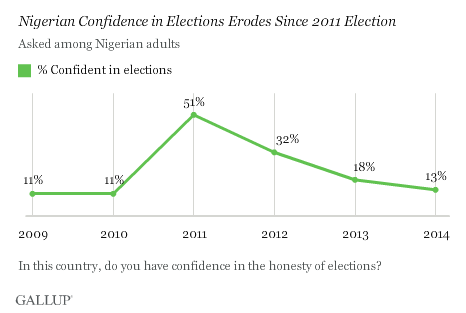
That said, the timing of the postponement and the manner in which it was done are suspect. The Nigerian security establishment understood the challenge that Boko Haram posed with regard to the conduct of peaceful elections years in advance. So why act a week before the election? In addition, it was quite clear that the directive did not come from the generals per se, but from Aso Rock via the national security adviser Mr. Sambo Dasuki. The result is that the military has come off as an interested player in the election. At the same time, Mr. Dasuki’s involvement has dented (even if just slightly) INEC’s credibility as an independent arbiter in the process. As is shown below, Nigerians’ trust of the electoral process is already very low.
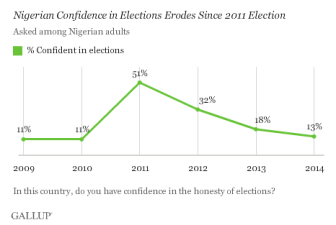
Confidence in the integrity of Nigerian elections

Confidence in the integrity of Nigerian elections

For the incumbent Goodluck Jonathan, the postponement presumably buys more time to try and dampen Buhari’s momentum. Some have argued that it also allows him to device ways of ensuring a victory, whether through clean means or not. My take on this is that this strategy will probably backfire. First, it signals to voters weakness and unfair play – things that might anger fence-sitters and make them break for Buhari come March 28th. Second, the election monitoring literature tells us that smart incumbents rig elections well in advance. This is for the simple reason that election day rigging (or rigging too close to the election) is often a recipe for disaster (see Kenya circa 2007).

These elections will be the closest in Nigeria’s history. The polls are essentially tied. The current postponement will no doubt raise the stakes even higher ahead of March 28th. Furthermore, the shenanigans of the past week will increase pressure on INEC to conduct clean elections, especially in the eyes of Buhari supporters.

Ultimately the folly of the postponement may be that it has raised the bar too high for INEC. Nigeria might find itself in a bad place if Buhari loses an election marred by chaos and irregularities.

Is Nigeria’s Economy Overrated?

Here is Izabella Kaminska of the FT:

Source: Financial Times

Source: Financial Times

On the surface, Nigeria’s oil sector has dropped in significance to a mere 13% of real GDP, while the services sector has climbed to 40% in real terms. Yet, the reality is that it is the country’s oil revenues that have supported growth and, to a large extent, maintained social order. Without oil, both would fall apart; government spending would be much smaller, interest rates much higher, and the currency’s valuation much lower.

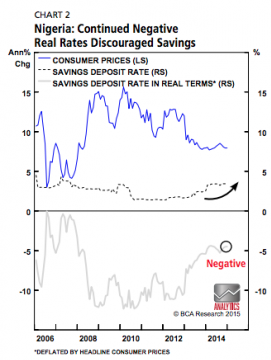
….. the country’s domestic savings rate, at a measly 20 per cent of GDP, is extremely low for a developing economy at this stage. A key reason being the government’s inability to tame chronically high inflation, meaning bank deposits have earned negative real interest rates for most of the past decade.

More on this here (HT Tyler Cowen).

And by the way, on this score Nigeria is not alone.

In an instance of the triumph of hope over experience The Economist recently pronounced the end of the resource curse in Africa. I do not completely buy their argument. Yes, growth and investment across the Continent may no longer be tightly coupled with natural resource cycles. But from Ghana, to Zambia, macro-economic stability (and important aspects of social spending) are still very tightly tied to movements in the global commodity markets.

Furthermore, many of these countries have recently re-entered the global debt markets partly backed by primary commodities as surety. The same applies to debts owed to Beijing. Last year alone foreign debt issues in the region exceeded $6.5b. As I argued in June of 2013, we might be entering another pre-1980s debt bubble.

Tanking crude prices have put Angola on the ropes. The country recently slashed $14b of previously planned spending. The Cedi and Kwacha took a nosedive (26% and 13%, respectively) last year because of sagging commodity prices (gold and copper) and government deficits (fueled by the expectation of future commodity bonanzas, especially in the case of Ghana whose debt to GDP ratio is now a staggering 65%). Even well-balanced Kenya (also a recent eurobond issuer) has had to go to the IMF for a precautionary loan against currency-related shocks in the near future. The current situation has prompted ODI to warn that:

The exchange-rate risk of sovereign bonds sold by sub-Saharan African governments between 2013 and 2014 threatens losses of $10.8 billion, equivalent to 1.1 percent of the region’s gross domestic product, the ODI said. While Eurobonds are typically issued and repaid in dollars, the depreciation of local currencies in 2014 makes it harder for governments to repay them.

All this brings to the fore SSA’s biggest challenge over the next two decades: How to carry out massive investments in infrastructure and human capital, while at the same time maintaining a sustainably balanced macro environment that is conducive to long-term saving.

On the upcoming Nigerian elections

On February 14 Nigerians will go to the polls in what is arguably the most important election in the world this year. Here is a (small) collection of things you need to read before then:

1. Alex Thurston has a great backgrounder for CSIS on the upcoming Nigerian elections. Want to know about the coalitions angling for power in Abuja and state capitals all over Nigeria and how ongoing political maneuvers will impact the outcome of the presidential election? Then click here.

2. Earlier this month Nigerian journalist Tolu Ogunlesi wrote an excellent piece for FT that emphasized the fact that this will be Nigeria’s closest and most unpredictable election yet (a point echoed by Zainab Usman, a Nigerian DPhil Candidate at Oxford, over at African Arguments). The level of competition will no doubt put pressure on INEC, and the losing candidate, to ensure that the legitimacy of the process is not tarnished, regardless of the outcome.

3. Brookings has a nice summary of some of the key political and policy issues at stake in this year’s election.

4. In the only detailed forecast that I have seen ahead of the election, DaMina Advisors project that APC’s Rt. Gen. Muhammadu Buhari will win with 51% of the vote (and get 25% in at least 27 states). There have not been any reliable polling data coming out of Nigeria in this election cycle, so take DaMina’s projections with a Naija size grain of salt.

5. And lastly, here is an op-ed from the former Governor of the Central Bank of Nigeria, Charles Soludo, on the economic dimension of this year’s election, as well as incumbent Goodluck Jonathan’s many failures.

If you have suggestions on interesting analyses ahead of the election please do share in the comments section.

Africa’s First City

National Geographic has a fascinating take on Lagos. And since we are just under two months to the next Nigerian elections, here is my favorite paragraph:

When I asked Kola Karim if the federal government’s sorry reputation made Western investors wary of doing business in Lagos, the worldly CEO elaborately dismissed it as a nonissue. Companies partnered with companies, not with bureaucrats, he maintained. “What does government do for you anyway, apart from charging you more taxes?” he said. “Look, it’s not about who rules anymore. Lagos is a train that has left the station. And you can only slow it down—you can’t stop it. So it doesn’t matter who comes next. This is the fun of democracy! It’s not about [President] Goodluck Jonathan! It’s about progress! Forget politics!” [More here]

From a political economy standpoint, one of the most fascinating things to happen in Africa over the last decade or so has been the quiet property rights revolution. In Nigeria, and a few other African countries, millionaires and billionaires have come out of the woodwork, willing to have their estimated net worth published in Forbes and other similar magazines for all to see. Very few of them have been politicians. Yes, many made their money in no small measure because of their political connections. But the fact that they no longer feel the need to hide their wealth from the ever changing political class means a lot.

It means that entrepreneurship and politics are getting decoupled in Africa’s biggest and most important economies. This transition is important because it will allow the magic of specialization to flourish. For instance, Dangote must be a savvy entrepreneur. But I doubt that he would have created as many jobs across the Continent if he also had to worry about running Abuja.

Also, it matters that Forbes’ Africa list is increasingly dominated by politically relevant high net worth individuals, as opposed to “apolitical” migrant businesspeople. Dangote is Nigerian “through and through.” When the going gets tough, he is more likely to voice his concerns than simply exit. The chaps in Abuja can’t simply revoke his visa or work permit. His political views therefore matter a lot.

One hopes that at some point Nigeria’s Dangotes will start investing in higher quality political talent to ease the cost of doing business and improve human welfare through greater investment in public goods.  But of course there is another possible equilibrium path in which they decide that low quality political talent is what’s best for their business prospects.

Either way I hope to visit Lagos soon.

Working With the Grain in Development

I finally got to reading Brian Levy’s Working With the Grain. It is easily the most underestimated development book of 2014, and should be read alongside William Easterly’s Tyranny of Experts (which it both complements and pushes back against). Like Easterly, Levy worked at the Bank and has insightful case studies and anecdotes from South Korea, to Ethiopia, to Bangladesh, among other countries. The book’s main thrust is that approaches to interventionist development policy ought to internalize the fact that:

… Successful reforms need to be aligned with a country’s political and institutional realities. For any specific reform, an incentive compatible approach begins by asking, who might be the critical mass of actors who both have standing and a stake in the proposed arrangements – and so are in a position to support and protect them in the face of opposition? [p. 142-3]

From a policy perspective, Levy tackles the relationship between governance, regime types, and development head on. How do you deal with the Biyas, Kagames or Zenawis of this world if you deeply care about [both] the material aspects of human welfare – roads, hospitals, schools, electricity, etc., [and] political freedoms and inclusive institutions?

Screen Shot 2014-12-17 at 12.32.06 PM

Levy’s answer is that development experts should work with the grain, focusing on incrementally solidifying past gains in specific agencies and issue areas, instead of engaging in epic battles against ill-defined and equally poorly understood “bad institutions” and evils like “corruption.” He aptly points out that you do not need the full set of the “good governance” bundle in order to continue chugging along on the path to economic prosperity.

In other words, we don’t have to put everything else on pause until we get the institutions right (or topple the bad guys). It is not an all or nothing game. His argument is persuasive (“good governance” has failed as a prescriptive remedy for underdevelopment), albeit at the cost of casting the immense toll of living under autocratic regimes as somewhat ineluctable on the road to economic prosperity. But at least he dares to challenge conventional approaches to governance reform that have at best failed, and at worst distracted governing elites from initiatives that could have worked to improve human welfare in developing countries.

As I read the book I wondered what Levy might think of the current state of development research. We are lucky to live in an age of increasing appreciation for evidence-based policy development, implementation, and evaluation. However, the resulting aura of “objectivity” in development research often leaves little room for politics, and its inefficiencies and contextual nuances. Sometimes the quest for generalizability makes us get too much into the weeds and forget that what is good for journal reviewers seldom passes the politicians’ (or other influential actors’) incentive compatibility test, rendering our findings useless from their perspective.

It is obvious, but worth reiterating, that the outcomes we can quantify, and therefore study, do not always overlap with the most pressing issues in development or policies that are politically feasible.

Perhaps this is a call for greater investment in public policy schools (not two-day capacity building workshops) in the developing world that will train experts to bridge the gap between academic development research and actual policy formulation and implementation (talking to policymakers makes your realize that this gap is wider than you think). Linking research findings to actual policy may sound easy, but you only need to see a “policy recommendations” section of a report written by those of us in the academy to know that it is not.

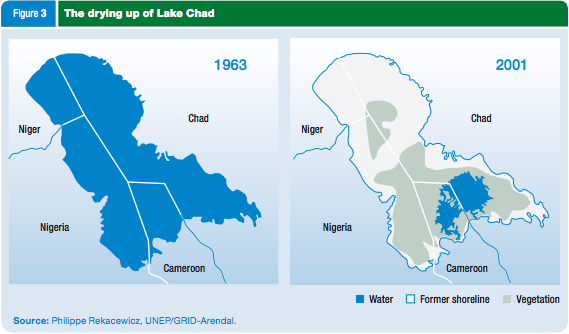
The disappearing Lake Chad, 1963-2001


I have been looking at the African Development Bank’s long term strategy (available here) and one of the figures that caught my eye was the extent to which Lake Chad has shrunk over the last 50 years. Wow.

Image

Africa’s newfound love with creditors: Bond bubble in the making?

I know it is increasingly becoming not kosher to put a damper on the Africa Rising narrative (these guys missed the memo, H/T Vanessa) but here is a much needed caution from Joe Stiglitz and Hamid Rashid, over at Project Syndicate, on SSA’s emerging appetite for private market debt (Africa needs US $90b for infrastructure; it can only raise $60 through taxes, FDI and concessional loans):

To the extent that this new lending is based on Africa’s strengthening economic fundamentals, the recent spate of sovereign-bond issues is a welcome sign. But here, as elsewhere, the record of private-sector credit assessments should leave one wary. So, are shortsighted financial markets, working with shortsighted governments, laying the groundwork for the world’s next debt crisis?

…….Evidence of either irrational exuberance or market expectations of a bailout is already mounting. How else can one explain Zambia’s ability to lock in a rate that was lower than the yield on a Spanish bond issue, even though Spain’s [which is not Uganda…] credit rating is four grades higher? Indeed, except for Namibia, all of these Sub-Saharan sovereign-bond issuers have “speculative” credit ratings, putting their issues in the “junk bond” category and signaling significant default risk.

The risks are real, especially when you consider the exposure to global commodity prices among the ten African countries that have floated bonds so far – Ghana, Gabon, the Democratic Republic of the Congo, Côte d’Ivoire, Senegal, Angola, Nigeria, Namibia, Zambia, and Tanzania.

In order to justify the exposure to the relatively higher risk and lending rates on the bond market (average debt period 11.2 years at 6.2% compared to 28.7 years at 1.6% for concessional loans) African governments must ensure prudent investment in sectors that will yield the biggest bang for the buck. And that also means having elaborate plans for specific projects with adequate consideration of the risks involved.

Here in Zambia (which is heavily dependent on Copper prices), the Finance Minister recently had to come out to defend how the country is using the $750 million it raised last year on the bond market (2013-14 budget here). Apparently there was no comprehensive plan for the cash so some of the money is still in the bank awaiting allocation to projects (It better be earning net positive real interest).

“They are fighting each other. By the time they have projects to finance, they will have earned quite a lot of interest from the Eurobond money they deposited. So, all the money is being used properly,” he [Finance Minister] said.

Following the initial success the country’s public sector plans to absorb another $4.5b in debt that will raise debt/GDP ratio from current ~25% to 30%. One hopes that there will be better (prior) planning this time round.

Indeed, last month FT had a story on growing fears over an Emerging (and Frontier) Markets bond bubble which had the following opening paragraph:

As far as financial follies go, tulip mania takes some beating. But future economic historians may look back at the time when investors financed a convention centre in Rwanda as the moment that the rush into emerging market bonds became frothy.

The piece also highlights the fact that the new rush to lend to African governments is not entirely driven by fundamentals – It is also a result of excess liquidity occasioned by ongoing quantitative easing in the wake of the Great Recession.

I remain optimistic about the incentive system that private borrowing will create for African governments (profit motive of creditors demands for sound macro management) and the potential for this to result in a nice virtuous cycle (if there is one thing I learned in Prof. Shiller’s class, it is the power of positive feedback in the markets).

But I also hope that when the big three “global” central banks start mopping up the cash they have been throwing around we won’t have a repeat of the 1980s, or worse, a cross between the 1980s (largely sovereign defaults) and the 1990s (largely private sector defaults) if the African private sector manages to get in on the action.

African governments, please proceed with caution.