The dangers of simplistic single narratives

As Stearns argues in this excellent book, the causes of the conflicts in eastern DRC are multiple and complex. Yet simple narratives in the media and among aid workers and advocacy groups have tried hard to reduce these causes to a fight over minerals; and similarly the consequences as mass rape of women and young girls (remember the video cameras fiasco??). In reality the story is more complex than this.

Here is a quote from a good paper on the international community’s responses to the Congo (DRC) conflicts by Severine Autesserre in the latest edition of African Affairs:

“These narratives focus on a primary cause of violence, illegal exploitation of mineral resources; a main consequence, sexual abuse of women and girls; and a central solution, extending state authority. I elucidate why simple narratives are necessary for policy makers, journalists, advocacy groups, and practitioners on the ground, especially those involved in the Congo. I then consider each narrative in turn and explain how they achieved prominence: they provided straightforward explanations for the violence, suggested feasible solutions to it, and resonated with foreign audiences. I demonstrate that the focus on these narratives and on the solutions they recommended has led to results that clash with their intended purposes, notably an increase in human rights violations.

The international actors’ concentration on trafficking of mineral resources as a source of violence has led them to overlook the myriad other causes, such as land conflict, poverty, corruption, local political and social antagonisms, and hostile relationships between state officials, including security forces, and the general population. Interveners have singled out for support one category of victims, sexually injured women and girls, at the expense of others, notably those tortured in a non-sexual manner, child soldiers, and the families of those killed.”

The paper is a grim reminder that “fixing the Congo”  – whatever that means – will take a long time. More on this here.
Waiting for Kabila to be Charlemagne

Joseph Kabila was sworn in today as President of the DRC following disputed elections last month. The main opposition has vowed to not recognize him as the legitimate president and are planning street protests. Some analysts believe that there will be blood in the streets of Kinshasa and other major urban centers.

If you think for a moment about the size and diversity of the DRC it becomes clear how hard it will be for the incorrigibly inept enormously challenged Joseph Kabila to be the one to drag the DRC out of its 50 year tailspin.


Democratic Republic of Congo

The truth be told, Mr. Kabila would not do any better running a village mboga kiosk. He is not an autocrat in the mold of Kagame, Zenawi, Museveni or even Sankara. He is closer to Samuel Doe, Bokasa and Valentine Strasser, ineffectual at best and outright disastrous at worst.


$500 million, and for what?

Congolese go to the polls on Monday, the 28th of November. The result of the election is almost a foregone conclusion. Incumbent president Joseph Kabila looks set to win another term in office – another 5 years to continue the mismanagement of the DRC’s resources through shady mining deals.

According to the Economist:

Whatever the result, doubts about the election’s fairness will persist, not least because of a perception that the electoral commission’s head is a friend of the president. Logistical problems are also ubiquitous, despite an election budget of $500m or so. As well as 11 presidential candidates, 18,000 hopefuls, including several pop stars and a rebel leader accused of ordering the rape of more than 300 women in eastern Congo last year, are contesting 500 seats in parliament. Some of the ballots will exceed 50 pages, which will surely daunt even the minority of voters who can read.

(Read the whole piece here)

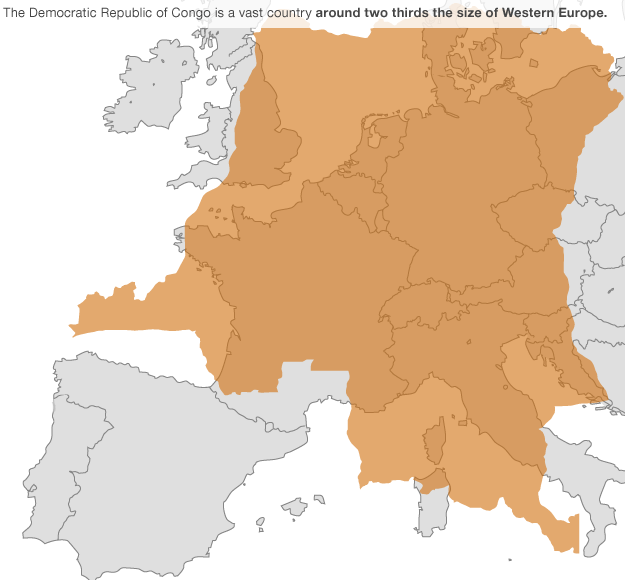
If I were in charge of the promotion of democracy in the DRC I would push for a system of staggered elections, both nationally and at the provincial level. I would also try and broker a deal to create a government of national unity in Kinshasa (representing the provinces) and competitive elections at the provincial level. In my view, the longer that everyone keeps pretending that the Congo – with its 70m+ and landmass the size of Western Europe – can be run by a single central government in Kinshasa – the longer it will take to put the country on the path of institutional development that will be conducive to long run economic growth.

Centralized state development definitely makes sense for smaller African states (think of the infamous trio of the Mano River basin). But if you are the DRC, capacity development in the capital must necessarily be accompanied by the strengthening of institutions at the provincial level – with more emphasis, in my view, on the latter than the former.

The number one problem facing the DRC right now is woeful state incapacity. It is doubtful that elections alone will force politicians’ hand in the right direction.

For more on the elections follow Congo Siasa.

Mining and Voting in the Congo

Elections in the DRC have come to be marked by a fire sale of state assets. A recent report by the UK parliament estimates that the government may have lost up to $5.5 b due to undervaluation of these state assets before sale.

No prizes for guessing where part of the difference in these sales go.

The whole situation is pretty stinky:

The IMF has asked the government to clarify several obscure contracts signed by Gécamines, which suggests that state assets have been sold for absurdly low prices…….. This would put the loss to the state at $870 mn.

The Chief Executive of Gécamines, Albert Yuma Mulimbi, has refused all requests, from the Mines Ministry to the IMF and others, to publish the controversial contracts, claiming that as a private company it is not obliged to, even though the state owns all its shares. The government has instructed Yuma, we understand, not to provide the information.

More on this here and here.

The other dimension of the (origins of) Congolese Conflict

UPDATE: Stay updated on the run-up to the elections in the DRC here.

**************************************************

In reaction to Dodd-Frank many in the blogosphere, including yours truly, have insisted that the problem in eastern Congo is not a law enforcement problem but a governance problem whose solution must come primarily from Kinshasa.

Often ignored is the regional dimension of the conflict.

The involvement of Rwanda and Uganda in eastern DRC (in the first and second Congo wars) have been excellently documented in Dancing in the Glory of Monsters (the author also blogs at Congo Siasa).

The invading forces may have left, but the geopolitical posturing remains and has consequences for the flow of arms and mushrooming of militias in the region.

Here’s a short documentary on the same.

This is not to simply vilify Uganda and Rwanda – one could argue that the presence of rebels from both countries in the Congo provided legitimate grounds for an invasion.

The point here is that the regional dimension of the conflict should not be ignored even as we insist that attention should shift to Kinshasa in an attempt to provide a lasting end to the conflict in eastern DRC.

quick hits

Mau Mau veterans allowed to sue the UK government for atrocities committed during Kenya’s independence rebellion. The court might have just opened a pandora’s box for a whole lot of lawsuits.

Kim on the ongoing protests in Malawi. Kenya’s Daily Nation reports that at least 12 people have died in the protests over the last two days.

Pardhan on the limits of the NGO movement in global development.

Some cool graphics showing the cellular connection map of the US.

The US will, after all, be sending humanitarian aid to Al-Shabab controlled areas suffering the ongoing famine in Somalia. I hope this does not turn into a farcical repeat of Ethiopia in the 1980s. Back then food aid was used as a weapon of war by both government and Meles Zenawi’s rebel forces.

Lastly, remember Glencore? The firm that has been involved in not so clean mineral deals in the DRC? Well, they are now in South Sudan. I hope Juba doesn’t go this route. You can’t stay clean while playing with someone covered in mud.

Quick hits

1. If you don’t have a summer reading list already, Blattman has one for you. The list is obviously not exhaustive, but two pressing titles I might add are Avner Greif’s Institutions and the Path to the Modern Economy and Gerschenkron’s Economic Backwardness in Historical Perspective.

2. In yet another not so nice chapter in the relationship between the Angolans and Congolese, Angola has deported thousands of Congolese. According to IRIN:

The expulsions are symptomatic of the tense relations between Luanda and Kinshasa, rooted in disputes over border demarcation and natural resources. Angola’s alleged loss of hundreds of millions of dollars in revenue due to the unauthorized artisanal exploitation of diamonds is a particular bone of contention.

3. Michelle Obama is in Africa on one of those first lady gigs. Many Africa watchers have complained that the visit does not have any real policy agenda beyond the usual talking points.

I agree.

But I would also like to point out that the failure of Africa to reap an Obama dividend is not just because of the State Dept.’s indifference to Africa but also because Africa lacks a coherent voice in Washington. Is there an Africa lobby? What does it do?

Instead of a calculated strategic response to the election of the first US president of African descent the Continent has swung from euphoria to disappointment over the fact that manna did not fall from heaven.

4. Lastly, the fortunes of the AU force in Somalia appear to be on an upswing. Now if only Somali politicians can get their act together and form a stable government.

conflict minerals in the congo

As is now common knowledge, the mineral glut in the DRC has been more a source of pain rather than gain. Minerals have financed both corrupt governments and their cronies in Kinshasa and marauding rebel groups in the ungoverned corners of the vast country.

To over-simply the issue, reforms will have to tackle both angles of the problem, i.e. both Kinshasa and the plethora of armed groups will have to come clean with regard to the extraction and sale of mineral resources. Kinshasa’s hoarding of all the benefits from the trade provides a perverse legitimacy for armed groups to continue their illicit activities.

Jason Stearns, the author of Dancing In the Glory of Monsters [I highly recommend the book], has a post on the complexities surrounding conflict minerals in the DRC.

First, “cautious” is the operative word. The Congolese export ban (September 2010 – March 2011) and the US electronic industry’s embargo of untraced minerals (April 2011 – present) have caused major job losses in the Kivus, as well as played into the hands of a select elite of military commanders, including ICC-indictee Bosco Ntaganda. It is, however, important to point out that neither initiative was caused directly by the Dodd-Frank legislation in the US. Rather, the export ban was decreed by the Congolese presidency, while the industry embargo was an aggressive interpretation of the US legislation. Dodd-Frank call for companies to carry out due diligence and to report their findings; the OECD guidelines call on companies to minimize the risk of financing armed groups.

Secondly, the Malaysia Smelting Corporation (MSC), which I had reported as having signed a deal for the largest tin mines in the Kivus, has not yet officially concluded a deal. A large Congolese delegation visited Malaysia earlier this year, and MSC and their Belgian partners Traxys then came to meet with President Kabila. A “confidentiality agreement” was signed with MSC regarding the Sakima concessions in Maniema, a good place to start as most of the mines there are removed from the main areas of conflict. In addition, MSC has not yet given $10 million for certification an tracing schemes, although the mining minister says they have agreed to fund these initiatives.

More on this on Jason’s blog here.

quick hits

The long awaited discussion about the real content of higher education in Africa is underway. Be a part of it.

The DRC is getting ahead of itself with elections. One wonders whether holding elections is the wisest thing to do right now. Wars raging in the east. A country the size of western Europe but with the most rudimentary infrastructure. Loads of mineral wealth that create a few billionaires – most of them non-Congoleses – while the real Congolese starve or eke out a living with one eye on the lookout for marauding rebels and government forces thugs. The DRC is one big mess in need of radical clean up. Kabila simply will not do it. But he will win these elections for sure. And that means more instability in the great lakes region.

I just found out that I shall be in Zambia for the election campaigns – elections due in October – so watch this space for stuff on Zambian politics this August and September.

And lastly, China is upping its involvement in the Kenyan economy. According to Business Daily:

Several Chinese manufacturers are already setting up local production plants in Kenya, shifting from the previous strategy in which they supplied the domestic consumer market with goods imported from their home country.

More jobs = lower infant mortality rates. Everybody wins.

from the annals of history

One insurgent movement within the country lingers from the 1964-65 wave of rebellions. Localized in the Fizi-Baraka area by Lake Tanganyika, this group – known in recent years as the Parti de la Revolution (PRP) – achieved notoriety in 1975 by kidnapping four Stanford students from a zoological research station in Tanzania. Its composition is ethnically restricted to Bembe, though its leader, Laurent Kabila, is a Shaba Luba. The movement now has only a few hundred followers, and has no possibility of enlarging its base of operations.

That was Crawford Young writing in Foreign Affairs in 1978.

In 1997 Laurent Kabila, backed by Rwanda, Burundi, and Uganda, was in charge of a much stronger force and marched from the east of the DRC (then Zaire) into Kinshasa. After the overthrow of Mobutu Laurent Kabila was sworn in as president, only to be assassinated in 2002 and succeeded by his adopted son, Joseph Kabila. The younger Kabila continues to face a simmering insurgency in the east of the country.

Karl Marx once noted that history repeats itself, the first time as tragedy, the second time as farce. President Kabila’s continued ineptitude may be watering the seeds of his own ouster by rebels from the east in a farcical repeat of history.

Africa needs zuma (to have a coherent foreign policy)

This week the Economist rightly called out South African president Jacob Zuma on his country’s lack of a coherent foreign policy. South Africa was reborn in 1994 with the moral authority and international goodwill to be Africa’s shining light in the world. Instead, under Mbeki and now Zuma, the country has squandered all that away.

Mbeki did it with his intransigence against reason on the issue of HIV/AIDS and support of Robert Mugabe in Zimbabwe. Mr. Zuma is doing the same with his support for Mugabe and equivocal pronouncements against other murderous tyrants on the Continent. Since his election he has not spoken strongly against any injustices or electoral fraud on the Continent; this task has been left to Ian Khama, president of tiny but relatively prosperous Botswana.

Sub-Saharan Africa is desperately in need of a regional hegemon to help it chart a coherent path in global politics. Latin America has Brazil. South Asia has India. East Asia has China. Even Europe has Germany. In Africa, Nigeria (pop. 150+m), South Africa (~40m, biggest economy), Ethiopia (85m) and the Democratic Republic of Congo (~70m) – all potential regional leaders – have woefully underperformed.

Nigeria is Nigeria. Ethiopia is dirt poor and needs to clean its own mess, Somalia’s and Eritrea’s, before it can venture further afield. The DRC is struggling to keep itself afloat. South Africa, by far, has the capacity and the requisite soft power to take up the job of regional guiding light. The country is slated to become a BRIC country soon, making the BRICS (Brazil, Russia, India, China and South Africa).

It is a shame that Mr. Zuma has chosen to abdicate his role as the Continental leader. He alone, among the members of the Continent’s club of kleptocratic autocrats (a.k.a AU), has the clout to stand up to the evils we continue to see in Cote d’Ivoire, Darfur, Zimbabwe and elsewhere.

remembering lumumba

Hochschild, author of King Leopold’s Ghost, has an editorial in the Times in honor of Patrice Lumumba, the firebrand Congolese independence leader who was assassinated 50 years ago. His death, amid the chaos of the Katanga secession, marked the beginning of the hellish catastrophe that was the land of Mobutu Sese Seko, and latterly the Kabilas.

Throughout Africa, Lumumba remains a celebrated hero. The many Lumumbas across Eastern Africa are a testament to this fact.

Whether the same would be true had he actually lived to run the vast Central African state is another question altogether. As noted by Adam Hochschild in his piece:

“Patrice Lumumba had only a few short months in office and we have no way of knowing what would have happened had he lived. Would he have stuck to his ideals or, like too many African independence leaders, abandoned them for the temptations of wealth and power? In any event, leading his nation to the full economic autonomy he dreamed of would have been an almost impossible task. The Western governments and corporations arrayed against him were too powerful, and the resources in his control too weak: at independence his new country had fewer than three dozen university graduates among a black population of more than 15 million, and only three of some 5,000 senior positions in the civil service were filled by Congolese.”

quick hits

The Christian Science Monitor reports on the robbery that most African governments (in this case in the DRC) continue to visit upon their people, unabated. Some of the deals they make sound so bad they’d embarrass a two year old.

Gertler was just 27 when he first became involved in the Congo in 2000, obtaining a monopoly of diamond exports (worth around $600 million) in return for $20 million. He had previously been involved in diamonds in Angola and he is the grandson of Moshe Schnitzer, the founder of the Israel Diamond Bourse. He is now one of the richest Israelis.

Industry insiders, however, suggest that the last big round of mining concession acquisitions happened just before the last elections and helped the president raise funds for his expensive campaign. The next elections are in 2011.

More on this here.

Also, Tech crunch has a nice piece on how the future belongs to the global south

bemba’s case begins at the icc

Jean-Pierre Bemba is the ICC’s highest profile defendant yet (The other big names from the Continent’s conflicts have been tried under the UN special tribunals for Rwanda and Sierra Leone). The former Vice President of the DRC is on trial for crimes against humanity and war crimes, including rape, murder and pillage, in the Central African Republic (CAR).

Typical of most African conflicts which are labeled “civil” but are in actual sense international wars,  the DRC’s civil war extended beyond its borders. Bemba’s militia – The Movement for the Liberation of Congo (MLC) – was used by its backers in the Central African Republic to put down a rebellion in the south of CAR.

The ICC has many failings. But its deterrent effect is beginning to take hold. Justice is political, no illusions about that. However, the court’s activities provide a guarantee that in some cases, once in a while, the voice of the voiceless men, women and children who bear the brunt of the Continent’s conflicts will be heard.

The BBC has more on this.

The democratic republic of congo

Just in case you forgot, the Kivus are still on fire. Thousands of people remain displaced. Dozens routinely get killed and raped by both government and rebel forces, and sometimes even by UN peacekeepers. Things are crazy bad out there.

Meanwhile, Kabila and his cabal in Kinshasa remain as ineffectual as ever with no apparent strategy or plan, not just for the Kivus, but for the whole country.

The ICG has this nice report on the Congo. People may not agree on the priorities and approaches of resolving the conflict in the Kivu’s, but this report provides a good background for those who are new to the conflict.

Also check out this Report on the Congo from the Congressional Research Office.