How to achieve energy security for growth in Africa

This post originally appeared on the AfDB’s Integrating Africa Blog where yours truly is a regular contributor.

According to a recent survey by Ernst & Young, 44% of businesspeople in Africa identified inadequate infrastructure as one of the key constraints to doing business in the region.  This means that as Africa continues to grow in the next two decades, infrastructure development must top the investment agenda. General infrastructure development will be especially crucial as African economies undergo structural transformation from being primarily resource-driven to having bigger manufacturing and service sectors. Indeed Ernst & Young estimates that in 2012 43.1% of investments in capital in Africa went to manufacturing as opposed to 12% that went to the extractive sector. 

A key area that will require greater and smarter investment to fuel the region’s economic growth will be the energy sector. 

Everyone knows about the energy woes of many an African country – from Nigeria’s infamous generators to the total lack of functional national grids in some African states. A few countries have initiated plans to boost their energy sectors through investment in power generation (Ethiopia’s 6000MW Great Renaissance Dam on the Blue Nile), oil refining (Angola’s planned 200,000 bbl/day refinery in Lobito), and aggressive prospecting for fossil fuels (especially in eastern and southern Africa). Despite these national efforts, for African states to ensure energy security for their growing economies, they must also think regional (and to some extent continental) when developing their respective energy sectors. As intra-Africa trade grows in the next two decades, there will be pressure to integrate energy markets as well. 

The reasons for a regional/continental approach to energy sector development are twofold. Firstly, investment outlays in energy infrastructure development are often prohibitively expensive (because their viability relies on economies of scale), thus necessitating the pooling of resources. Ethiopia’s newest dam, for instance, will cost $4.7 billion. Not many African countries can afford such massive investments on one project. 

Secondly, there is the issue of markets. With 12% of the world’s population, Africa consumes a meager 3% of the world’s electricity. Of this 75% takes place in North Africa (33%) and South Africa (45%). The remainder is shared out among the rest of Sub-Saharan African states. Furthermore, electricity connectivity on the continent remains relatively low, with rates averaging 43% (North Africa stands at 99%, with the other sub-regions between 12-44%).

This means that for projects like Ethiopia’s to make sense, access to international markets must be guaranteed. A key part of the Ethiopian project is the planned interconnector line linking the power station to the Kenyan grid. Joint investment and taking advantage of economies of scale will also help lower the cost of power in Africa. At present the average tariff per kilowatt-hour in the region is US $0.14, compared to US $0.04 in Southeast Asia. It is estimated that investing in regional grids and hydropower will save the region up to $2 billion annually. This is music to the ears of sugar millers, cement manufacturers and many small factory owners across the continent. 

Existing and Planned Power Pool Connections in Africa

Source: Niyimbona, P, UN Economic Commission for Africa; Note: There are additional planned lines connecting Ethiopia to Sudan and Kenya, respectively, not shown on the map.

With this in mind, African states have begun the process of integrating their power sector infrastructure, via regional power pools (see map above of existing and planned power interconnector links). The South African Power Pool (SAPP, established in 1995); North African power pool (COMELEC , 1998); West African Power Pool (WAPP, 2000); the Central African Power Pool (CEAPP, 2003); and the East Africa Power Pool (EAPP, 2005) are all initiatives to establish regional power markets and help harmonize energy policy. 

The COMELEC sub-region (27.4 GW, largely thermal, in 2009) has the highest connectivity and the best infrastructure. The region is also linked to the Middle East via the Egypt-Jordan interconnector line and Europe via the Morocco-Spain line (part of the future Mediterranean Electricity Ring, MEDRING). SAPP, with a capacity of 50GW (78.4% coal; 20.1% hydro; 4% nuclear and 1.6% diesel), is next in terms of infrastructure development.  The remaining pools have 13 GW in the WAPP; 29 GW in the EAPP. There is a plan to link the EAPP to states outside of East Africa as part of COMESA. The 19-state COMESA bloc has an installed capacity of 52MW (69% thermal and 30% hydro) and has since 2009 initiated a process to harmonize regulation and energy policy.   In terms of regional (intra-power pool) trade in power, SAPP is ahead with 7.5%, WAPP 6.9%, NAPP 6.2%, EAPP 0.4% and CAPP 0.2%.  Clearly, there is a lot of room for improvement in levels intra-pool trade in power. 

All these developments are encouraging. But a lot more needs to be done. For starters African states must work harder to harmonize their energy policies. This will necessarily involve greater liberalization of their power sectors, especially with regard to power generation and distribution. There is also an urgent need to invest in interconnector infrastructure to ensure that power can be transmitted efficiently to market. In the Day Ahead Market (DAM) of SAPP, for instance, trading is limited by between 40-50% of the potential level due to lack of efficient transmission capacity. Lastly, there will be a need to connect the regional power pools. This will reduce their overreliance on regional “anchor” economies (the best example of this is SAPP’s overreliance on ESKOM of South Africa, which has its own integrated resource plan). It will also create even bigger markets, including potentially the Middle East and Europe.  

Ultimately, whether or not the dream of regional and continental power interconnectivity is achieved will depend on politics. Unfortunately, so far things do not look good. Almost a decade after the idea of regional power pools set in, governments are yet to harmonize their power sector regulatory policies. In many countries state monopolies dominate, with attendant inefficiencies. And across the continent power supply master plans are still very nation-centric and under the tight control of local vested interests. Moving forward, the challenge will be to convince governments and stakeholders (private sector and consumers alike) of the benefits of having an Africa-wide power market – which will necessarily require the liberalization of national power sectors. The alternative will be more roundtable discussions and promises of policy harmonization that never get fulfilled. 
How Eastern Africa can avoid the resource curse

This post originally appeared on the African Development Bank’s Integrating Africa Blog, where yours truly is a regular contributor. 

Eastern Africa is the new fossil fuel frontier (for more check out this (pdf) Deloitte report). In the last few years Kenya, Uganda, Tanzania and Mozambique have discovered large quantities of commercially viable oil and gas deposits, with the potential for even more discoveries as more aggressive prospecting continues. There is reason to be upbeat about the region’s economic prospects over the next three decades, or at least before the oil runs out. But the optimism must be tempered by an acknowledgement of the dangers that come with the newfound resource wealth. Of particular concern are issues of governance and sound economic management.

We are all too aware of the dangers of the resource curse. This is when the discovery and exploitation of natural resources leads to a deterioration of governance, descent into autocracy and a fall in living standards. Associated with the resource curse is the problem of the Dutch disease, which occurs when natural resource exports (e.g. oil and gas) lead to an appreciation of the exchange rate, thereby hurting other export sectors and destroying the ability of a country to diversify its export basket. The new resource-rich Eastern African states face the risk of having both problems, and to avoid them they must cooperate.

In many ways Eastern African states are lucky to be late arrivals at the oil and gas game. Unlike their counterparts in Western and Central Africa, nearly all of them are now nominal electoral democracies with varying degrees of institutionalized systems to ensure transparency in the management of public resources. Across the region, the Big Man syndrome is on the decline. But challenges remain. Recent accusations of secrecy, corruption and bribery surrounding government deals with mining companies suggest that there is a lot of room for improvement as far as the strengthening of institutions that enforce transparency (such as parliaments) is concerned. It is on this front that there is opportunity for regional cooperation to improve transparency and resource management.

While it is easy for governments to ignore weak domestic oversight institutions and civil society organizations, it is much harder to renege on international agreements and treaties. A regional approach to setting standards of transparency and accountability could therefore help ensure that the ongoing oil and gas bonanza does not give way to sorrow and regret three decades down the road. In addition, such an approach would facilitate easier cross-border operations for the oil majors that are currently operational in multiple countries, not to mention drastically reduce the political risk of entering the region’s energy sector. It would also leave individual countries in a stronger bargaining position by limiting opportunities for multinational firms to engage in cross-border regulatory arbitrage.

The way to implement regional cooperation and oversight would be something akin to the African Peer Review Mechanism, but with a permanent regional body and secretariat (perhaps under the East African Community, EAC). Such a body would be mandated to ensure the harmonization of laws to meet global standards of transparency and protection of private property rights. The body would also be mandated to conduct audits of national governments’ use of revenue from resources. The aim of the effort would be to normalize best practices among states and to institute a global standard for states to aspire more – more like the way aspirations for membership in the European Union has been a catalyst for domestic reforms in the former Yugoslavia and Eastern Europe.

Regional cooperation would also provide political cover to politicians with regard to economically questionable fuel subsidies. The realities of democratic government are such that politicians often find themselves forced to concede to demands for fuel subsidies from voters. But history shows that more often that not subsidies come at an enormous cost to the economy and instead of benefitting the poor only benefit middlemen. In addition, as the case of Nigeria shows, once implemented such policies are never easy to roll back both due to politics and the power of entrenched interests. Regional agreements capping any fuel subsidies at reasonable levels would be an excellent way to tie politicians’ hands in a credible manner, while at the same time providing them with political cover against domestic criticism.

Beyond issues of governance, there is need for cooperation on regional infrastructure development in order to reap maximum value for investment and avoid unnecessary wastes and redundancies. Landlocked Uganda and South Sudan will require massive investments in infrastructure to be able to access global energy markets. The two countries’ oil fields are 1,300 km and 1,720 km from the sea through Kenya, respectively. One would hope that as these projects are being studied and implemented, there will be consideration for how to leverage the oil and gas inspired projects to cater to other exports sectors – such as agriculture, tourism and light manufacturing – as well. KPMG, the professional services firm, recently reported that transportation costs eat up as much as 20 per cent of Africa’s foreign exchange earnings.  There is clearly a need to ensure that the planned new roads and railways serve to reduce the cost of exports for all outward oriented sectors in the region. Embedding other exports sectors (such as agriculture, timber, domestic transport, etc.) in the process of developing new transportation infrastructure will minimize the likelihood of their being completely crowded out by the energy sector.

In isolation, each country’s resource sector policy is currently informed by domestic political economy considerations and regional geo-politics. There is an emerging sense of securitization of resources, with each country trying to ensure that the exploitation of its resources does not depend too much on its neighbours. Because of the relatively small size of the different countries’ economies, the risk of ending up with economically inefficient but expensive pipelines, roads and railways is real. South Sudan is currently deciding whether to build a pipeline through Kenya (most likely), through Ethiopia, or stick with the current export route for its oil through Sudan (least preferred due to testy relations). For national security and sovereignty reasons, Uganda is planning on a 30,000-barrel per day refinery in Hoima, despite warnings from industry players that the refinery may not be viable in the long run. Some have argued for the expansion of East Africa’s sole refinery in Mombasa to capture gains from economies of scale, an option that Uganda feels puts its energy security too much in Kenya’s hands.

In the meantime, Kenya and Tanzania are locked in competition over who will emerge as the “gateway to Eastern Africa,” with plans to construct mega-ports in Lamu and Tanga (Mwambani), respectively. While competition is healthy and therefore welcome, this is an area where there is more need for coordination than there is for competition among Eastern African governments. The costs involved are enormous, hence the need for cooperation to avoid any unnecessary redundancies and ensure that the ports realize sufficient returns to justify the investment. Kenya’s planned Lamu Port South Susan Ethiopia Transport Corridor (LAPSSET) project will cost US $24.7 billion. Tanzania’s Mwambani Port and Railway Corridor (Mwaporc) project will cost US $32 billion.

Chapter 15 of the EAC treaty has specific mandates for cooperation in infrastructure development. As far as transport infrastructure goes, so far cooperation has mostly been around Articles 90 (Roads), 91 (Railways) and 92 (Civil Aviation and Air Transport). There is a need to deepen cooperation in the implementation of Article 93 (Maritime Transport and Ports) that, among other things, mandates the establishment of a common regional maritime transport policy and a “harmonious traffic organization system for the optimal use of maritime transport services.”

The contribution of inefficient ports to transportation costs in the regional cannot be ignored. Presently, the EAC’s surface transportation costs, associated with logistics, are the highest of any region in the world. According to the African Development Bank’s State of Infrastructure in East Africa report, these costs are mainly due to administrative and customs delays at ports and delays at borders and on roads. Regional cooperation can help accelerate the process of reforming EAC’s ports, a process that so far has been stifled (at least in Kenya) by domestic political constituencies opposed to the liberalization of the management of ports. The move by the East African Legislative Assembly to pass bills establishing one-stop border posts (OSBPs) and harmonized maximum vehicle loads regulations is therefore a step in the right direction.

Going back to the issue of governance, more integrated regional cooperation in the planning and implementation of infrastructure development projects has the potential to insulate the projects from domestic politics and patronage networks that often limit transparency in the tendering process. Presently, Uganda is in the middle of a row with four different Chinese construction firms over confusion in the tendering process for a new rail link to South Sudan and port on Lake Victoria. The four firms signed different memoranda with different government departments in what appears to be at best a massive lapse in coordination of government activities or at worst a case of competition for rents by over-ambitious tenderpreneurs.  This does not inspire confidence in the future of the project. A possible remedy to these kinds of problems is to have a permanent and independent committee for regional infrastructure to oversee all projects that involve cross-border infrastructure development.

In conclusion, I would like to reiterate that Eastern Africa is lucky to have discovered oil and gas in the age of democracy, transparency and good governance. This will serve to ensure that the different states do not descend into the outright kleptocracy that defined Africa’s resource sector under the likes of Abacha and Mobutu in an earlier time. That said, a lot remains to be done to ensure that the region’s resources will be exploited to the benefit of its people. In this regard there is a lot to be gained from binding regional agreements and treaties to ensure transparency and sound economic management of public resources. Solely relying on weak domestic institutions and civil society organizations will not work.

Why are Kenyan politicians politicizing the military?

Botswana, Gabon, Kenya, Malawi, Namibia, South Africa, Swaziland, Tanzania, Zambia and Zimbabwe are the only continental sub-Saharan African states to have never experienced military rule. Each country has managed to do so via well orchestrated coup-proofing strategies of ethnic balancing and material payoffs to the men and women with the guns and tanks. 

Kenya, in particular, has perfected this art. Because of its fractious ethnic politics, ethnic balancing within the officer corps has been key to Kenya’s coup-proofing. Kenyatta (who spoke Kikuyu) had a bit of a hard time in the beginning with a Kamba and Kalenjin speakers dominated military but eventually succeeded in having his co-ethnics in key positions. But before he did so he ensured Kikuyu dominance over the paramilitary force, the General Service Unit (GSU) to balance the military. Through the 60s and 70s, Kenyatta ensured that the GSU and police could handle their own against the military in case stuff hit the fan. Moi continued along this path, so much so that for a while in the media the typical accent of a security officer – whether police or military – became an accent from the North Rift. Under Moi the Kenyan army became “Kalenjin at the bottom, Kalenjin at the middle, and Kalenjin at the top.”

Beyond the ethnic balancing, Kenya has also coup-proofed by keeping the generals wealthy and OUT OF POLITICS – at least not overtly. The generals in Kenya are probably some of the wealthiest on the Continent. I went to high school with the son of an Air Force Major General whose family was always taking foreign trips to exotic places and always made a big splash on visiting days. The only estimates I could find are from the 1960s when nearly “two thirds of the military budget went to pay and allowances, most of it to officers.” A lot of them also got free land for cash crop farming and lucrative business deals (some illegal) from the Kenyatta and Moi governments. Keenly aware of West Africa’s junior officer problem following 1981 Moi extended land grants to junior officers as well. 

But despite their importance as leaders of a key national institution, most Kenyans, yours truly included, do not know much about the top generals in the army. The one chief of staff that I remember hearing a lot about in my childhood days was Gen. Mahmood Mohamed, the man who played a big role in quelling the 1982 coup attempt. For the most part I only saw these guys in the media on national holidays when they rode on the president’s Land Rover. 

In other words, I think it is fair to say that, contrary to arguments made by N’Diaye, for the most part the Kenyan military has historically been fairly professionalized and depoliticized relative to other countries in the neighborhood. There is no evidence to suggest that ethnic balancing has severely interfered with the process of professionalization. Kenyan presidents’ preferred agents for dirty political work have always been the intelligence service, the police and paramilitary units, but never (to the best of my knowledge) the military. Indeed the US and British militaries have had very close technical cooperation with the Kenyan military through training, material assistance and more recently joint operations, resulting in a relatively highly trained force that has for the most part stayed clear of politics.  

But this consensus appears to be slowly eroding. Before the 2013 General Elections the former Prime Minister Raila Odinga accused the military and the intelligence service of colluding with his opponent, Uhuru Kenyatta, to rig the presidential election. And now the heads of the military and intelligence service are reportedly contemplating suing a former aide to Mr. Odinga for defamation. Increasingly, the military is being dragged down to the level of the marionette-esque GSU and Police, perennial hatchet men for whoever occupies State House.

This cannot end well. 

Coup proofing is hard. And the thing with coups is that once the genie is out of the box you can’t take it back. Coups just breed more coups.

This is why the generals must be left fat and happy and in the barracks, or busy keeping the peace (and hopefully not facilitating charcoal exports) in Somalia’s Jubaland State. Do your ethnic balancing and all, but by all means KEEP THEM OUT OF POLITICS (I am glad the current Defense Minister has no political constituency).

The last thing Kenya needs is a Zimbabwe situation in which there is open bad blood between the military and the opposition. 

Plus Kenya, based on its per capita income, ethnic politics, and minimal experience with genuine democratic government, is still not beyond the coup trap to be able to safely play politics with the military. If you doubt me, go find out the last time Brazil, Thailand and Turkey had generals in charge. 

Nairobi to Lusaka, Part II

Dar es Salaam is a pleasant town in late June. I had only been there once before, back in 2011 when I stayed for a day and a half to catch the Tazara. I didn’t like it then because of the heat and humidity (humidity is up there with cats – I am allergic – on the list of things I cannot stand). But this time round it was nice, I managed to walk around town marveling at the pillars of concrete and glass that are rising up in every corner of the city. The construction boom puts even Nairobi to shame, enough to make me think that the suggestions that Tanzania may soon eclipse Kenya as the place where all the action is in East Africa are not that far fetched after all (see image and this piece).  Image

My only complaint was that a prime section of the beach front still remains under-utilized, although this might be because of the presidential palace nearby. I hear you can’t drive there at certain times of the day (Stop channeling Mugabe, Bwana Kikwete. Also, let Chadema be). Oh, and I did manage to drive on the Kibaki road. I thought it was a new road, but it is not. Sections of it are actually pretty bad. Apparently, the Tanzanian government is planning an upgrade soon. I also drove past Mwalimu Nyerere’s home. It made me respect the man even more.

I arrived in Dar late on Tuesday night after many hours of travel by bus. On Thursday morning I was scheduled to continue with the second leg of the journey to Lusaka. I was at the bus stop by 5:45 AM, still sleepy. I had stayed up late the previous night, watching the Confederation Cup matches of the day, reading and writing my Saturday column. I fell asleep as soon as I got to my seat.

Image

Dar’s public housing units. For a moment I thought that the choice of color was meant to discourage applicants. Until I saw the pink public housing headquarters. Some of the units are in really nice parts of town.

The bus left the station promptly at 6:15 AM. Tanzania is huge. From Dar es Salaam to the Tunduma border is about 931 kilometres. The drive to the Zambian border took a total of 16 hours.

As I said in the previous post on this trip, I regretted taking the bus. If you want to travel overland between Dar and Lusaka, take the train. It is a million times more pleasant. There is a restaurant and a bar (that serves Tusker) on the train. There are bathrooms. And you have a bed. Plus the train is just slow enough that you can read and truly appreciate the empty Tanzanian countryside.

But the trip wasn’t all gloomy. The scenery was still enjoyable. Sections of Tanzania are quite hilly, with amazing views of cliffs and rivers and rock formations. At some point past Iringa I saw what seemed to be the biggest tree plantation in the world. For miles and miles all I could see were rows and rows of trees. And when there were no trees there were rows and rows of sisal. Someone is making bank off the land in that part of the country.

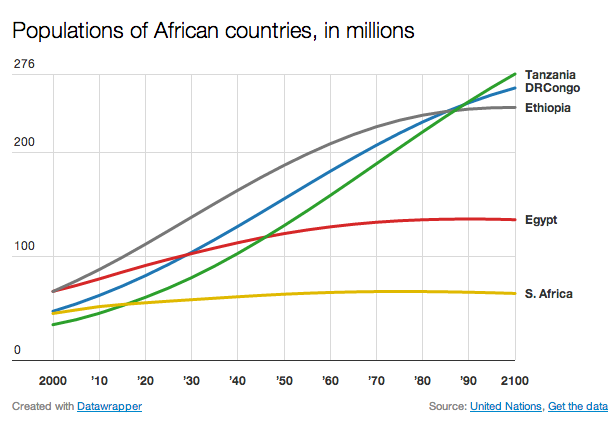
Also, western Tanzania is a lesson on how hard it is to achieve economic development in the context of a sparsely populated country. Such situations make it impossible to reach everyone with the grid and water pipes. Either the government has to wait for demographics to work its magic (again, see figure above – and be sure to check out this story on the Africa-driven demographic future of the world) or provide smart incentives to accelerate the process of urbanization.

For those who went to high school in Kenya, journeying by land through Tanzania reminded me of Ken Walibora’s Siku Njema. I felt like I was retracing the steps of Kongowea Mswahili. Some day I would like to go back and spend some time in Morogoro and Iringa. By the way, Siku Njema is by far the best Swahili novel I have ever read (which reminds me that it has been eight years since I read a Swahili novel. Suggestions are welcome, preferably by Tanzanian authors). It is about time someone translated it into English for a wider audience.

We reached Tunduma some minutes past 10 PM. The border crossing to Nakonde on the Zambian side was closed. Some passengers on the bus left to rent out rooms for the night. I decided to tough it out on the bus with the crew and a few other guys. Desperate for something warm to eat, I had chicken soup and plain rice for dinner. The “restaurant” reminded me of the place in Tamale, Ghana where Vanessa and I got food poisoning two months earlier. But I was desperate. I quickly ate my hot soup and rice and hoped for the best.

ImageI crossed the border early in the morning on foot. The bus had to wait in line for inspection and to pay duty for its cargo (It is at this point that I learned that the bus was actually going all the way to Harare in Zimbabwe). I am usually very careful with money changers, but perhaps because of my tiredness and lack of sleep the chaps in Nakonde got me.

If you ever cross to Nakonde on foot wait until you are on the Zambian side to exchange cash at the several legit forex stores that line the streets.

The bus finally got past customs at noon (on Friday). In Nakonde we waited for another two hours for more passengers and cargo.

I took the time to get some food supplies. Lusaka was another 1019 kilometres away. 

By this time I was dying to have a hot shower and be able to sleep in a warm bed. It was cold. Like serious cold. And Lusaka was still another 14 hours away.

I slept lightly through most of the 14 odd hours. In between I chatted with two Kenyan guys that were apparently immigrating to South Africa, with little more than their two bags. They said that this was their second attempt. The previous time they found work in Lusaka and decided to stay for a bit before going back to Nairobi. They were part of the bulk of passengers from Nakonde who were going all the way to Harare. Apparently, this is the route of choice for those who immigrate from eastern and central Africa into South Africa in search of greener pastures.

Before it got dark we saw several overturned trucks on the road. I slept very lightly, always waking up in a panic every time the driver braked or swerved while overtaking a truck just in time to avoid oncoming traffic. My only source of comfort was the fact that the driver was a middle aged man, most likely with a family to take care of and therefore with a modicum of risk aversion.

I arrived in Lusaka at around 4 AM, more than three days and 2871 kilometres since leaving Nairobi.

I said goodbye to my two Kenyan countrymen and rushed out of the bus as soon as I could. On the way to my hotel I couldn’t stop thinking how much I would like to read an ethnography of the crew of the bus companies (and their passengers and cargo) that do the Dar to Harare route.

At Lusaka Hotel that morning I had the best shower I had had in a very long time. And slept well past check out time. I had two months of fieldwork and travel in Zambia to look forward to.

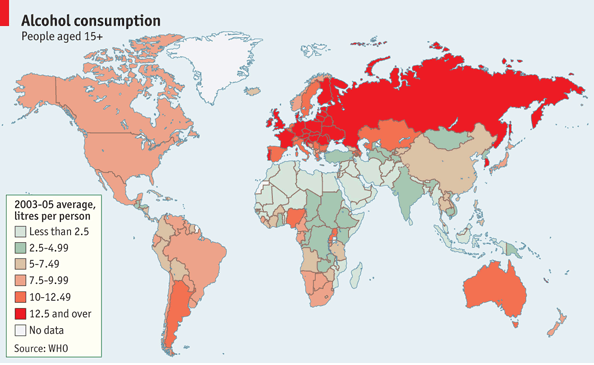
So Tanzanians drink more than Kenyans?

Kenyans pride themselves in their ability to consume machozi ya simba (lion’s tears) and have a good time, more so than their regional neighbors, especially the polite Tanzanians to the south. But the data, at least between 2003-05, says something different. Kenyans drink the least in the EAC (which is a testament to the strong conservative undercurrents in Kenyan society despite the outward liberalism that we (almost exclusively Nairobians) all like to wear on our sleeves).

Image
Source: The Economist
It is also in Kenya that there is an anti-drinking law forbidding the sale of alcohol before 5 PM on weekdays and 2 PM on weekends and after 11 PM. Of course the law is almost never enforced and seems to only benefit the police whenever they need extra cash from bar operators. That said, sections of Kenyan society have a serious drinking problem that the government continues to ignore at enormous social and economic cost. Incidentally, like all good Commanders in Chief, ours is no stranger to booze, although he must’ve ditched the habit now that he is lives in the House on the Hill.

Africa’s newfound love with creditors: Bond bubble in the making?

I know it is increasingly becoming not kosher to put a damper on the Africa Rising narrative (these guys missed the memo, H/T Vanessa) but here is a much needed caution from Joe Stiglitz and Hamid Rashid, over at Project Syndicate, on SSA’s emerging appetite for private market debt (Africa needs US $90b for infrastructure; it can only raise $60 through taxes, FDI and concessional loans):

To the extent that this new lending is based on Africa’s strengthening economic fundamentals, the recent spate of sovereign-bond issues is a welcome sign. But here, as elsewhere, the record of private-sector credit assessments should leave one wary. So, are shortsighted financial markets, working with shortsighted governments, laying the groundwork for the world’s next debt crisis?

…….Evidence of either irrational exuberance or market expectations of a bailout is already mounting. How else can one explain Zambia’s ability to lock in a rate that was lower than the yield on a Spanish bond issue, even though Spain’s [which is not Uganda…] credit rating is four grades higher? Indeed, except for Namibia, all of these Sub-Saharan sovereign-bond issuers have “speculative” credit ratings, putting their issues in the “junk bond” category and signaling significant default risk.

The risks are real, especially when you consider the exposure to global commodity prices among the ten African countries that have floated bonds so far – Ghana, Gabon, the Democratic Republic of the Congo, Côte d’Ivoire, Senegal, Angola, Nigeria, Namibia, Zambia, and Tanzania.

In order to justify the exposure to the relatively higher risk and lending rates on the bond market (average debt period 11.2 years at 6.2% compared to 28.7 years at 1.6% for concessional loans) African governments must ensure prudent investment in sectors that will yield the biggest bang for the buck. And that also means having elaborate plans for specific projects with adequate consideration of the risks involved.

Here in Zambia (which is heavily dependent on Copper prices), the Finance Minister recently had to come out to defend how the country is using the $750 million it raised last year on the bond market (2013-14 budget here). Apparently there was no comprehensive plan for the cash so some of the money is still in the bank awaiting allocation to projects (It better be earning net positive real interest).

“They are fighting each other. By the time they have projects to finance, they will have earned quite a lot of interest from the Eurobond money they deposited. So, all the money is being used properly,” he [Finance Minister] said.

Following the initial success the country’s public sector plans to absorb another $4.5b in debt that will raise debt/GDP ratio from current ~25% to 30%. One hopes that there will be better (prior) planning this time round.

Indeed, last month FT had a story on growing fears over an Emerging (and Frontier) Markets bond bubble which had the following opening paragraph:

As far as financial follies go, tulip mania takes some beating. But future economic historians may look back at the time when investors financed a convention centre in Rwanda as the moment that the rush into emerging market bonds became frothy.

The piece also highlights the fact that the new rush to lend to African governments is not entirely driven by fundamentals – It is also a result of excess liquidity occasioned by ongoing quantitative easing in the wake of the Great Recession.

I remain optimistic about the incentive system that private borrowing will create for African governments (profit motive of creditors demands for sound macro management) and the potential for this to result in a nice virtuous cycle (if there is one thing I learned in Prof. Shiller’s class, it is the power of positive feedback in the markets).

But I also hope that when the big three “global” central banks start mopping up the cash they have been throwing around we won’t have a repeat of the 1980s, or worse, a cross between the 1980s (largely sovereign defaults) and the 1990s (largely private sector defaults) if the African private sector manages to get in on the action.

African governments, please proceed with caution.

Nairobi-Lusaka by road, Part I

Image

The towering Uhuru Heights under construction in Dar es Salaam combines office space with residential apartments

Lusaka must be the only African capital (or major city) that is not a frenzied construction site. No new major roads are being constructed downtown. My quick look only found two new constructions of tall-ish buildings downtown. Lusaka feels really sleepy compared to the three other African capitals/major cities that I have been to in the last three months  – Dar es Salaam, Nairobi, Accra. Dar es Salaam, in particular, is impressive. The city is constructing a rapid bus transportation system with a dedicated lane. Citywide construction of “office space cum residential apartments” mark the landscape promising a rich experience of downtown living for city residents in the near future (I wish Nairobi did more of this….)

The guy who runs the place I am staying at in Lusaka tells me that the only construction going on in town is of shopping malls and expensive residential houses that no one will afford. President Michael Sata, he argues, is bent on turning Zambia into Zimbabwe.

Michael Sata (a.k.a King Cobra) may not go the way of uncle Bob in Zim but he is definitely not the hope for change that Zambians voted for back in 2011. The growth in the economy (6% on average in the last decade, 7.3% last year) is barely trickling down and the ruling PF seems too preoccupied with killing the opposition to care. The old duo of  Scott and Sata seem out of ideas on how to translate the country’s economic growth into wider socio-economic transformation.

Indeed the African Development Bank in its latest report on the Zambian economy noted that “Zambia has yet to achieve significant gains in social and human development. The poverty headcount remains high, with about 60% of the population still living below the poverty line.” The economy is imbalanced, heavily dependent of capital-intensive copper mining that it barely taxes (80% of exports, but paltry a 6% of revenue).

I was first here two years ago for reconnaissance research and have come back for more work. The pace is a nice change from Nairobi. It is also warmer than Nairobi at this time of the year (well at least before nightfall) – just after three years in California and seven months in Nairobi and I have become a little soft on cold weather (Moving to Chicago this fall will be fun!!)

This time round instead of doing air (Nairobi-Dar), rail (Dar-Kapiri) and road (Kapiri-Lusaka), I decided to do it all by road. This turned out to be a terrible idea.

Image

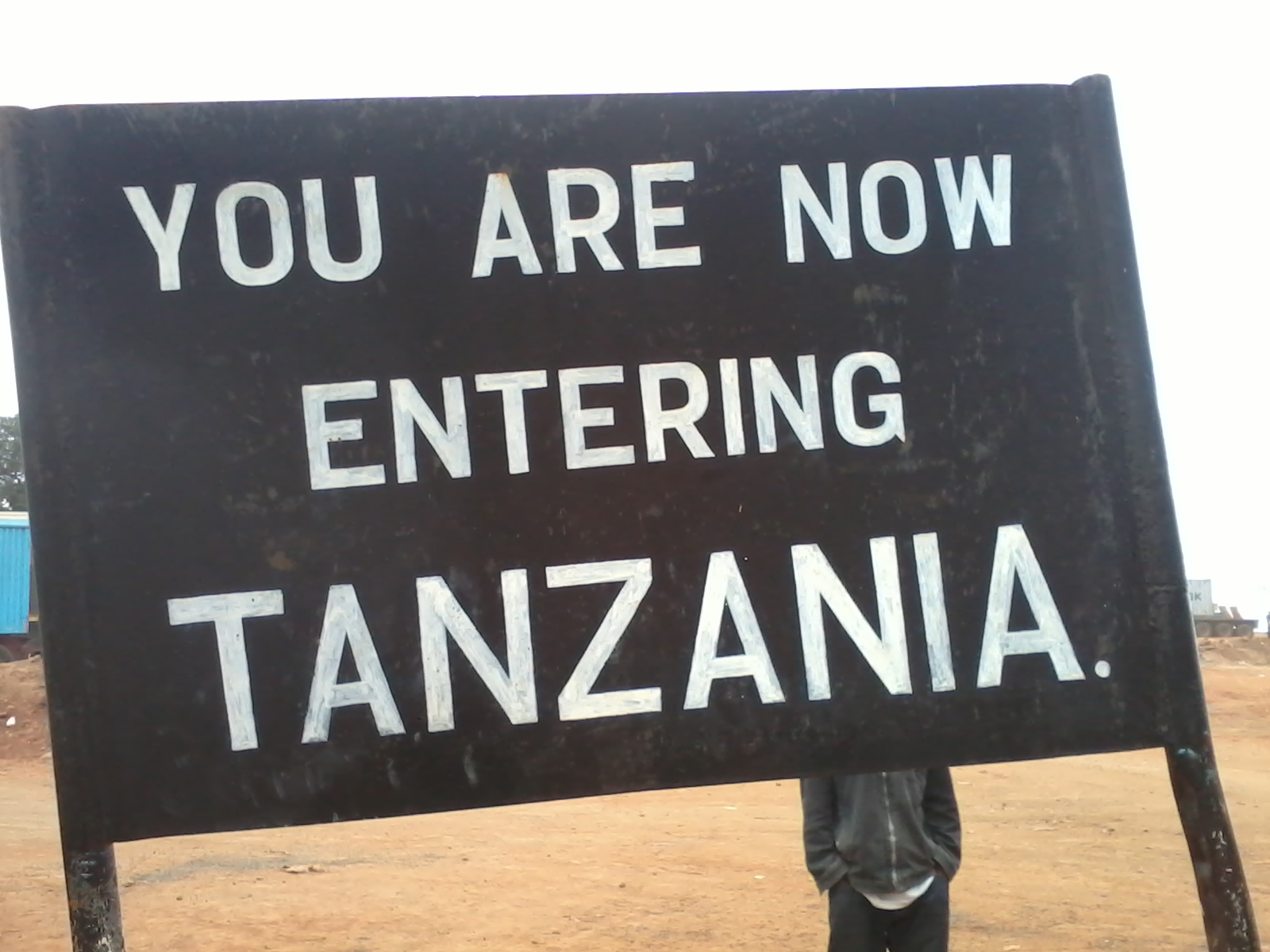
Sign post on the Tanzanian side of Namanga

Leaving Nairobi was itself an adventure. Despite Vanessa’s well-intentioned “alarm clock” calls to make sure I was up and ready by 5 AM, I missed my bus (I also missed my bus the first time, which is why I flew to Dar es Salaam). However, this time round it was my dad who was dropping me off and because he is a lot more daring that me and my brother, he decided to chase the bus (we were barely five minutes late, thank you very much Nairobi traffic at 5:45 AM). We did not catch my bus (Dar Express), but caught up with its competitor (name withheld for legal reasons, see below) after it had been stopped by the traffic police on Mombasa road for lack of a passenger license (it had a cargo license). Let’s just say that I was mightily impressed by my dad’s driving skills. I wish I were as daring.

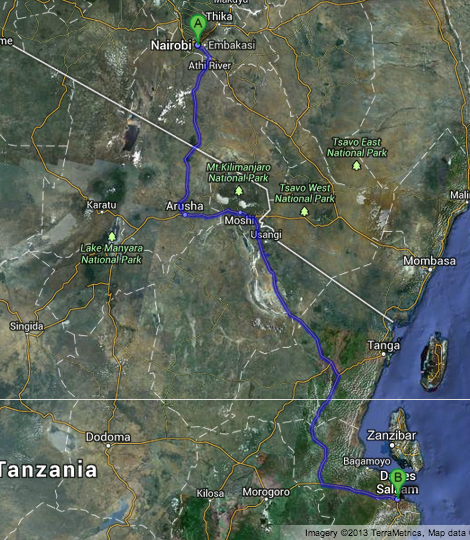
So after the police got their cut (which I later found out was Kshs 5000, about US $60) we set off on the journey to Dar. The conductor on the new bus was kind enough to give me a free ride to Namanga (only Tanzanians can do this!!!) with hopes of catching up with Dar Express – in the end we did not, and I had to pay Kshs 2000 for the rest of the journey. The last time I was on the Nairobi-Arusha road was in 2009 when it was all no more than a dirt track that left you caked in thick red-brown dust. Now it is all paved. Nairobi-Namanga took a dizzying three hours. Just over an hour and a half after that we were in Arusha. After Arusha we sped to Moshi where we were caught up in the Prime Minister’s motorcade as he went to the city referral hospital to visit victims of the recent bombing at an opposition rally in Arusha (Arusha is the Chadema (Tanzania’s main opposition party) stronghold; but even in Dar the few people I spoke to about politics did not have nice things to say about the CCM government, especially with regard to rising inequality and corruption – yeah, I just totally Tom-Friedmanned that one).

Image

The 922 kilometer (573 miles) Nairobi-Dar road

I must say that the Nairobi-Dar road is impressive. Save for about one hour total of patches that were still being done about two hours outside of Moshi, most of the road is paved. Sometimes I forget how massive (and hence empty) Tanzania is. Namanga-Arusha is marked by flat plains, rolling hills and mountains. In the plains cattle rearing appeared to be the economic mainstay (unfortunately, with school age kids herding tens of cattle and sheep – wake up, Tanzania ministry of education). The hilly and mountainous areas mostly have maize and coffee. After the hills there are vast sisal plantations that stretch from horizon to horizon. Arusha and Moshi are the only big towns on the Namanga-Dar route. I particularly like Moshi (or may be I just don’t like touristy, expensive Arusha). It is a town with character, combining a provincial feeling with urban comforts. It also has some nice public monuments.

I rarely see weigh bridges on Kenyan roads (besides the infamous two in Gilgil and on Mombasa road) but in Tanzania they are plenty. And they are not just for the trucks, but also cater for passenger buses. Most of the trucks on the route were connecting Uganda, Rwanda, Burundi and the eastern DRC to the port in Dar. The passengers on the bus consisted of businesspeople (mostly Kenyans and Congolese), random travelers like myself, and tourists (most of who alighted at Arusha). On the Kenyan side, between Nairobi and Namanga we had a total of 5 police stops. On the Tanzanian side between Namanga and Dar there were 6 police stops and about 4-5 weigh bridge stops – the Tanzanians definitely police their roads more keenly. The police on the Tanzanian side were on the lookout for khat/miraa (illegal in Tanzania, and a beloved commodity of truckers) from Kenya and other contraband. True to EAC hospitality, I did not have any problems with immigration at Namanga (unlike in Nakonde, Zambia) or at any of the police check points (officers came on board to check passports). Talking to Tanzanians reminded me of just how bad Kenyan Swahili is – we must sound to Tanzanians like the Congolese sound to us whenever they speak whatever it is they call Swahili (*ducks and runs*).

The bus arrived in Dar es Salaam about 20 hours after leaving Nairobi (Not bad for a US $42 ticket), despite having been made to believe that the trip would take 13 hours. It didn’t help that I ignored Vanessa’s advice to pack food, hoping to buy stuff on the road – the first food stop was six hours into the trip, I had not had breakfast. Exhausted, hungry and mad at myself for taking the hard way to Dar I decided to get a room at the Peacock Hotel. It is not fancy (probably a 4 star?) but it has hot water, the rooms are spacious, and there’s fast internet. They also have a nice restaurant downstairs (Tausi) and are within walking distance to the port and other sites of interest in Dar – a Subway, Indian restaurant, the national library, banks, etc.

I had a day to burn in Dar reading, writing and walking around in readiness for the second leg of my trip to Lusaka, again by road.

Sparse blogging over the next few weeks

Dear readers, the dissertation, work and life have conspired to keep me away from blogging. As such posts will not be as frequent as usual over the next few weeks.

Also, Vanessa and I will be in Zambia for work (and hopefully travel) for much of the summer (ahem, Southern winter), so expect travel posts to  dominate once blogging resumes.

In the meantime you can read my Saturday op-eds in the Standard (www.standardmedia.co.ke).

Some thoughts on Kenyan MPs and their salaries

Update: Sarah Serem and the SRC appear to be backtracking and are now “open to dialogue” with MPs over their pay.

******************************************

“False standards are set with salary scales for MPs, Ministers and top civil servants that the country cannot possibly afford in a time when examples not of extravagance but of austerity and sacrifice should be set. In 1963 MPs earned K£ 620 a year [in present terms about Ksh 89,704.34 a month].

This was increased to K£ 840 then to K£ 1200 a year [about Ksh 173,619.53 a month in present terms], making three increases and a doubling of salary in less than three years (And the K£ 100 a month is augmented by a daily sitting allowance, plus mileage and other allowances). Junior Ministers earn K£ 2260 a year. The President’s salary has been fixed at K£ 15,000 a year tax free and including other emoluments……. In six months an MP receives more money than the average peasant earns in half a life-time.”

That is Oginga Odinga writing in his autobiography Not Yet Uhuru.

As Kenyan MPs prepare to adopt a report this afternoon that will allegedly give the Parliamentary Service Commission legal cover to grant them a 59% pay rise, we should remember that this is not a new phenomenon. Top public officers in Kenya, and in particular MPs, have always been remunerated well relative to the country’s per capita income.

Activists block the entrance to the National Assembly in protest at MPigs' greed

Activists block the entrance Parliament in Nairobi with a sow and piglets in protest at the greed of “MPigs”

I must admit that as a researcher on legislatures in Africa, and Kenya and Zambia in particular, the issue of how to look at MPs’ salaries is not a straightforward one. On the one hand it is absolutely obscene that in a poor country like Kenya MPs make more than their counterparts in far much wealthier countries in Western Europe. But on the other hand I also realize the importance of shielding the House from the influence of money bags from State House. Poorer paid parliamentarians across the Continent (including in “shining star” Ghana) live and work at the mercy of the executive. It is no coincidence that Barkan and colleagues concluded in Legislative Power in Emerging African Democracies that Kenya has the strongest legislature in the region.

The ratio of the president’s pay to MPs’ is instructive. Back in the sixties, the president made 12.5 times what the MPs made. That ratio has since shrunk to less than 2.5.

As Oloo Aringo passionately argued in the late 1990s and early 2000s, the high pay of Kenyan MPs is partly responsible for the rise in legislative power in Kenya (Part of my work in the dissertation, among other things, will be to convince you that this is true – that relative pay of MPs matters. Stay tuned). In the present Kenyan case there is an argument to be made for the Salaries and Remuneration Commission (SRC) to review the salaries of all State Officers; and to bump MPs higher up the totem pole (by cutting the pay of other state officers) than where they are right now as far as their pay is concerned. Ms Serem’s first stop should be the numerous seminars,workshops & capacity building obsessed talking shops independent constitutional commissions that continue to drain the exchequer with nothing to show for their work (OK, I’ll admit that some of the commissions are useful).

Kenyan MPs should definitely not get a pay hike. But the fight against greed in the august House should not be overdone, lest we end up with a weak parliament at the mercy of State House. This is the balancing act that I hope will inform the SRC commissioners’ actions as they try to tame our MPigs’ Honorable Members’ appetite.

Which way forward for Kenya’s Civil Society?

It is no secret that the candidature of Raila Odinga had the backing of the largely progressive Civil Society Organizations (CSOs) in Kenya. Odinga’s loss to Uhuru Kenyatta, someone they considered an unelectable ICC suspect, was their loss too. In addition, both during the campaigns and after the election, CSOs in the country found themselves on the defensive against charges of being stooges of Western donors and institutions (including the ICC) out to subvert Kenyas sovereignty. An ill-advised move by Western embassies to show their hand in the contest backfired spectacularly and provided more ammo for the anti-CSO brigade. An even bigger problem for Kenyan CSOs was that at some point in the election cycle they lost the support of a sizable chunk of the middle class. The feeling of betrayal was hard to miss. The very people they had fought for had rejected their cause.

Kenya’s upwardly mobile middle class was desperate to get past the election, peacefully. Many took to heart the Peace Brigade’s PSAs that blanketed the airwaves in the run-up to and after the election. This lay the groundwork for everyone to “accept [the results] and move on,” no uncomfortable questions asked. The media too played ball, glossing over even the most glaring of irregularities in the IEBC’s tallying process. Indeed up to date none of the major media houses has seriously reported on the delayed release of constituency-level vote tallies for the National Assembly races. Reports in a section of the print press suggest the IEBC is “reconciling the presidential results and those of other positions. Over a million votes must be reconciled with others….” The silence from the major media houses on this issue is all part of accepting the official outcome of the election and moving on.

Recent discussions on the opinion pages here suggest that the chasm between the middle class and CSOs might be widening. Kenyan CSOs have been tagged as gratuitous rubble rousers intent on scaring away investors. Mention of their Western “puppet masters” has now become a must in the media when covering CSO activities. Even the recent protest against demands by Kenyan parliamentarians to increase their pay has not escaped the question of whether it is yet another plot by neocolonial schemers. The attacks have now extended to the social sphere as well. Exploiting Kenyas social conservatism, some have accused progressive CSOs of colluding with foreigners to destroy the country’s moral fabric with liberal and anti-African, atheist values. In their minds Civil Society has become “Evil Society.”

The resulting situation raises important questions regarding the future of CSOs in Kenya. Can they remain relevant without the support of the middle class? What tactics must they adopt to survive in the current political landscape? When did the rain start beating Kenyan CSOs and how can they regain the allegiance of a wide section of the middle class?

The Civil Society movement in Kenya was born out of the clamor for political space and greater civil rights during the height of Moi’s single party rule. As such, most Kenyan CSOs have always had an anti-government streak, with an inherent predisposition “to speak truth to power.” This was a strategy that worked well in fighting a widely unpopular government. And then Kenya changed. The Kibaki administration robbed Civil Society of quite a few luminaries that earned their badges of honor in the fight for the Second Liberation. Once in power these individuals faced different incentives. Many felt that it had now become their turn to eat.

The 2007-08 post-election violence weakened CSOs further by bringing to the fore ethnic divisions that existed among them. Come 2012-13 the ethnic chasm became even wider. And the ranks of CSOs thinned even more. The middle class also got alienated by a movement that seemed (fairly or not) more concerned about the past and intangible rights at time when the Kibaki boom years had given the middle class a glimpse of new economic possibilities. The mood had changed. Some suggested that Kenya had “too much democracy” that would stand in the way of development.

In a twist of irony Kenyan CSOs and the political left are a victim of their own success. Much of the Kenyan middle class, for better or worse, have since become convinced that the fight for political rights and space had been won. After all Kenya now has a new constitution; the devolved system of government is being implemented; and we no longer have an imperial presidency. For many middle class Kenyans, it is now time to focus on winning the economic fight and achieving the Kenyan dream. Many Kenyans are persuaded to believe that their own economic success is hinged on general investor confidence, and that the country needs to project an image of peace and stability.

Throughout the election cycle, no one wanted to let the ghosts of 2007 forestall Kenya’s quest to regain its place as the oasis of peace and stability in the region. The allure of 10% annual growth rates and the promise of Vision 2030 have proven very hard to resist. Many cling to the hope that mega infrastructure projects – including LAPSSET, the Thika Super Highway, and new cities and gated communities –  are about to catapult Kenya into middle-income status. Under these conditions, the ideology of peace, stability and public order was an easy sell.

In light of these developments, in order for progressive CSOs to remain relevant to the middle class they must adopt tactics that are in line with middle class aspirations. The confrontational tactics that were successful in the past will probably no longer work. I have no doubt that the government will opportunistically continue to react to public demonstrations in a manner to provoke riots that will then be labeled as anarchic and a threat to public order. Shop owners, small business operators and much of the middle class, all averse to public disorder, will no doubt nod in agreement. Despite the challenges, it should not be lost on those involved that in order to guarantee their continued survival and ability to check the government Kenyan CSOs must reengage their middle class allies. The moderating effect of the middle class will also serve to make CSOs more attractive to the wider public. As a first step CSOs must formulate a strategy that is less confrontational and more in tune with the emergent focus on the economy.

This is not to say that public demonstrations should cease to be a tactic used by CSOs in Kenya. Far from it. Public demonstrations are the best way to get the publics attention. The recent anti-parliamentarians protest, complete with a sow and its litter, was very successful in catching public attention. But such public stunts must be backed by deliberate formal engagement with the relevant authorities. This is because for a section of the public Kenya is now supposedly a nation of laws and institutions in which public protests are not allowed. All aggrieved parties should go to court where decision-making is sanitized, with minimal risk of scaring away the all-important investors. On this score both the government, wary of the unpredictable nature of unchecked public demonstrations, and the development-hungry middle class seem to be reading from the same script.

The imperative to play within the institutional framework will necessarily require CSOs to become even more institutionalized. Many Kenyan CSOs will soon be forced to morph into full fledged professional Think Tanks that can credibly address the middle class desire for economic progress, while at the same time continuing to hold those in power politically accountable. This is a lesson that I hope CSOs got from the last election.

Their skeletal operations and poor strategic judgment – which also extended to Odinga’s party – might have cost them an election that was theirs to lose. They appeared to not have done their homework when confronted with the media savvy and incredibly moneyed Kenyatta campaign. It is now well known that Odinga did not have agents in key polling stations. When the IEBC’s tallies became suspect they did not have their own numbers to report, even as they were disputing the IEBC’s tallies. Such sloppiness betrayed both a party and its CSO allies that lacked organizational competence and took too much for granted. This has to change. In this new game only those that have institutional and organizational depth will effective compete. The era of “capacity building” seminars and workshops is gone.

In addition, those in the middle class that support the incumbent government should be persuaded to form their own CSOs. The idea of CSOs being a preserve of the progressive movement in Kenya should be a thing of the past. Vigorous debate ought to be encouraged among CSOs representing both sides of the political divide. That is the mark of a true democracy. Such an eventuality would make incumbent governments and their supporters less hostile to CSOs in general. It would also force a situation in which “incumbent” CSOs, as part of a wider community of activists, felt the need to provide well argued justifications for government action and policies.

These are interesting times in Kenyan politics. Pocketbook issues are rising faster and faster up the list of Kenyans’ concerns. For now this shift in public mood appears to have been at the expense of concern over political rights. This means that in order to remain relevant, especially in the eyes of the middle class, Kenyan CSOs must change tactics and address Kenyans’ economic needs as much as their political needs. Activism, as we know it, must be backed by more institutionalized Think Tanks that can competently play the new institutional game. There is also a need for greater democracy among CSOs by encouraging the growth organizations that support the incumbent government. This will serve to further institutionalize and professionalize both the development of public policy and the conduct of politics in Kenya. It will also guarantee much-needed cooperation between Civil Society and the middle class. Merely accepting the present estrangement and moving on is not an option.

Petro-Politics in East Africa

Is LAPSSET under threat? May be.

The Economist reports:

The Lamu pipeline makes the most economic sense for all involved. But failure to work together may doom it. National and personal interests trump regional co-operation and commercial logic. In Uganda Mr Museveni is keen to settle his legacy as the champion of a strong nation, building vast refineries and spiting the tiresome Kenyans. South Sudan is fixated on warding off the north at the expense—it seems—of almost everything else. Ethiopia sees a chance to steal Kenya’s thunder, too. “It’s every guy for himself,” says an oil executive wryly. “And I thought the private sector is rough.” Pipeline politics makes a mockery of the East African Community, a bloc dedicated to regional co-operation. All but one of the countries are members or aspire to join.

Of late, a new momentum behind the oil push is being felt. The Ugandan government is in final production talks with three oil companies. Executives from Tullow, Total and the China National Offshore Oil Corporation (better known as CNOOC), as well as local civil servants, conferred with Mr Museveni at his farm near the Rwandan border in late April. In June South Sudan will finish a feasibility study for the Ethiopian pipeline to Djibouti, after which it has said it will make a decision on export routes. “Everything is up in the air,” says a diplomat. Kenyan and Ethiopian officials, as well as oil-company representatives, have been scurrying to Juba to make their case. Pagan Amun, who leads South Sudan’s talks with the north, is said to be keen to ditch the Lamu pipeline.

My guess is that Nairobi, for historical reasons, will prevail in Juba. Plus Juba and Addis are not the best of buddies, despite recent warm relations. Mengistu was a key ally and supplier of SPLM before he was overthrown by Meles and his army. The departure of Meles may have made things a little better. Time will tell. Uganda will most likely construct a mini-refinery as it is not integral to the implementation of LAPSSET.

Tribe, Nation or Literacy?

Tanzania’s founding president Julius Nyerere famously described Kenya as a vulgar, capitalist “man eat man society” – to which Kenya’s then Attorney General Charles Njonjo retorted that, in contrast, Tanzania was a “man eat nothing society.” At the time Tanzania had embarked on a program of African Socialism – Ujamaa – backed by a language policy that put a lot of emphasis on Kiswahili as the national language. As Ted Miguel has argued inTribe or Nation?(pdf)this was a great strategy in nation building. But was it economically beneficial in the long run?

For now the answer is probably no.

The legacy of Tanzania’s language policy has been that English language instruction only begins to be done seriously in high school. Obviously, four years are simply not enough to master a language, let alone sit a major national examination in that language. The result has been an astonishingly high failure-rate in the national end of high school exams in Tanzania. Earlier this year 60% of high school (Form Four) students failed, prompting jokes like “I’m a rocket scientist in Tz” on this side of the border. In reality even fewer made the cutoff to get a place in institutions of higher learning. In addition, a recent survey done by Twaweza, an education Think Tank, found that 72% of sampled primary school kids and 66% of high school students could not do second grade maths. English reading and comprehension was equally bad.

It goes without mention that the state of Tanzania’s education system has serious implications for human resource development in the country. The impending commodities boom in many parts of the country will certainly not benefit locals if workers have to be imported. Tanzania cannot effectively transform itself into a 21st century economy without a drastic improvement in its education system. Oddly enough, despite its obvious shortage of human capital, Tanzania is the most restrictive state with regard to labor mobility in the East Africa Community (EAC). Dodoma is especially hostile to Kenyan workers that it sees as a threat to local workers (Kenyans and their alleged aggressiveness rudeness have jokes about Tanzanians’ work ethic….. I should add though that Tanzanians tend to be stereotyped unfairly, both at Mang’u and in New Haven I went to school with some very smart and hardworking Tanzanians).

In the final analysis, although Kenya’s post-independence education and language policy left us with a ‘tribe eat tribe’ legacy, it allowed the country’s education system to focus on English language instruction from early on, and a chance to develop a relatively more globally competitive human resource base. Nation building may have taken a hit in the process but I would argue that internal economic ties – the result of man eat man competition – have now made it such that the Kenyan nation-state will only get stronger. The challenge for Tanzania is to ensure that nation building does not limit the development of a globally competitive human resource capacity.

Since the announcement of the high school exam results earlier this year the country (Tanzania) has been debating possible avenues of reform. Better teacher training, more books and equipment and more teachers have been cited as possible remedies. Strategic review of the country’s language policy should also be put on the table.

In my opinion the EAC should adopt a language policy in which our history, social and religious studies and civics are taught in Swahili while everything else is taught in English. This would not be a selling out to a foreign language (with due respect to Ngugi) but an investment in global competitiveness. Many decades down the road, once we have universal literacy in both English and Kiswahili, we can have a full switch to universal Kiswahili language instruction in all subjects.

Georgetown MSFS Launches New Africa Scholarship

The application deadline is January 15, 2014. Spread the word.

Starting in fall 2014, the Master of Science in Foreign Service (MSFS) at Georgetown University is offering a full- tuition scholarship for a talented graduate student from sub-Saharan Africa.

Image

MSFS is a two-year, full-time graduate degree program in international affairs. Students will take courses in international relations, international trade, international finance, statistics and analytical tools and history. In addition, students choose an area of concentration such as International Relations and Security, International Development or International Business.

The Economic Consequences of the Kibaki Presidency

Emilio Mwai Kibaki steps down as president next Tuesday a satisfied man.

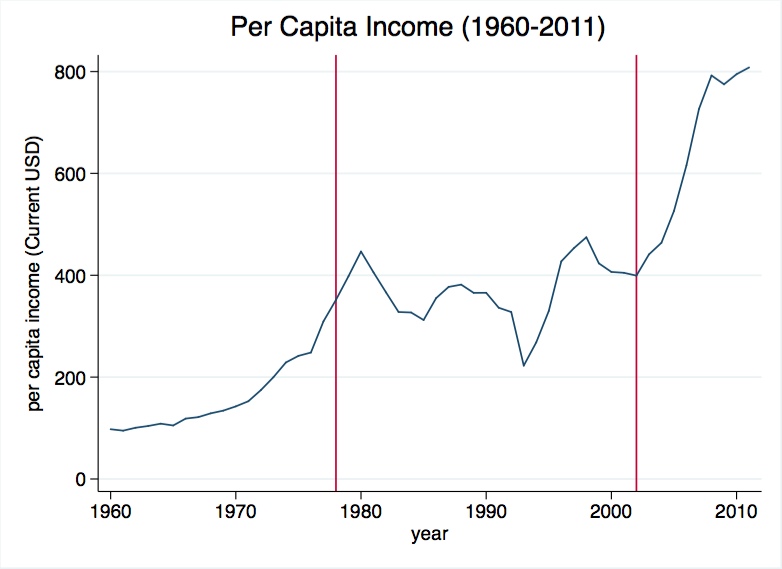
His legacy as the man who rejuvenated the Kenyan economy after decades of malaise under President Daniel Arap Moi is secure. His signature achievements were investments in infrastructure and the freeing up of political space.

As president he was the Delegator in Chief.

His biggest failure was the disastrous 2007 general election. Many believe he unfairly robbed outgoing Prime Minister Raila Odinga of victory. Following the election violence erupted in the country in which 1300 people died and 300,000 were displaced from their homes. Many of the displaced are yet to return to their land and homes 5 years later.

When all is said and done Mr. Kibaki’s record on the economic front stands out. The question of how equitable the growth was under his watch is up for debate – many think it wasn’t. What is unassailable is just the sheer amount of wealth that was created during his 10 years in State House.

Hongera Mzee. Ji-enjoy in retirement (although I think your retirement package is totally ludicrous).

Image1963-1978: Jomo Kenyatta

1978-2002: Daniel Toroitich Arap Moi

2003-2013: Emilio Mwai Kibaki

2013-       : Uhuru Muigai Kenyatta

Supreme Court confirms election of Uhuru Kenyatta

Uhuru Muigai Kenyatta has just been confirmed validly elected as president by the Supreme Court.

Earlier this month runner-up Raila Odinga had filed a petition challenging the declaration of Mr. Kenyatta as winner of the presidential election.

image

Mr. Kenyatta will be sworn in on April 9th.

The unanimous court decision was delivered in under twelve minutes shortly after 5 PM. The Chief Justice promised a detailed ruling within two weeks.

Following the court decision Mr. Odinga held a press conference and accepted the ruling, after which he wished Mr. Kenyatta well.

Most Kenyans breathed a sigh of relief after the orderly conclusion of this year’s presidential election contest.

A post mortem of the election and why exactly Odinga lost coming soon….