Big vs. Small Development

The Economist raises an interesting question regarding approaches to “development,” claiming that the recent race for the World Bank presidency represented a contest between two broad approaches:

Michael Woolcock, a World Bank staffer, suggests that two rather different models of development have been pitted against one another in the contest for president. On the one hand is what he calls Big Development, whose aim is the transformation of entire countries through investments in national education, justice and public health. Governments are essential to Big Development because they are responsible for the overall policy. And the World Bank is pre-eminently a Big Development institution.

On the other hand is Small Development. “Inspired less by transformational visions of entire countries,” Mr Woolcock argues, “and more by the immediate plight of particular demographic groups (AIDS orphans, child soldiers, ‘the poor’) living in particular geographic places (disaster zones, refugee camps, urban slums), Small Development advocates focus not on building systems in the medium run but on compensating for the failure of systems in the short run. ‘Development’ thus becomes an exercise in advocacy, in accurate targeting, in identifying particular ‘tools’ that ‘work’”.

In this scheme of things Mrs Okonjo-Iweala, the former finance minister, represented Big Development; Dr Kim, a public-health advocate, Small. Dr Kim was almost certainly picked because of his passport. But if his background is any guide, his tenure as chief is likely to shift the bank more towards Small Development. Whether that is a good thing on balance remains to be seen.

I take the side of Big Development (if such a dichotomy actually exists) because of my beef with “pro-poor development” as it is currently practiced  (more on this here).

Development is a giant coordination game with a million moving parts. This makes it much harder to coordinate on “scalable” “tools that work” at the micro-level. Indeed, no one has any idea what these tools really do. In addition, focus on “tools” casts the problem of underdevelopment as a technical one that can be fixed by “experts.”

This approach misses the point by miles.

This and this (highly recommended, a cogent critique of Big Development) and this are some of the reasons wby.

Is regionalism helping the East African Community

Evidence seems to suggest it is:

Trade between the EAC countries almost doubled from $2.2 billion in 2005 to $4.1 billion in 2010, although regional trade with the rest of the world expanded faster, meaning that the relative share of intra-EAC trade has stayed around 21 per cent since 2005 [The African Average is 11 %]. “Europe enjoys 64 per cent internal trade; our 21 per cent is better than we thought, but we have to make efforts to do better,” said Betty Maina, chairperson of the Kenya Association of Manufacturers.

Kenya still remains the biggest economy in the region, although some convergence is definitely likely to happen in the next decade or so given the large hydrocarbon discoveries in Uganda and off the Tanzanian coast.

The region’s oil consumption rose from 96,000 barrels per day in 2003 to 144,000 barrels per day in 2010, with Kenya consuming more than all the other EAC countries put together. East Africa now accounts for 10 per cent of all mobile subscribers in Africa, with the number of mobile subscribers surging from just three million in 2002 to a staggering 64 million in 2010.

More on this here.

More on Obama’s WB President Nomination

Source: Wikipedia

Nigerian Ngozi Okonjo-Iweala is definitely the dream candidate for the Bank. But the realities of U.S. domestic politics and foreign policy concerns are stacked against her nomination to the presidency of the Bank. It will be hard for the U.S. to selflessly relinquish an important tool of foreign policy and influence in the Bank’s presidency.

If Obama backs down, he will be criticized for being soft in the face of international pressure. If he nominates a non-American, he will still be criticized as an apologist for those who hate America (real or imagined) and a believer in American decline.

Obama’s incentive is to get his nominee become World Bank President. Full stop.

Source: Wikipedia

So far those rooting for Ngozi (including yours truly) have questioned Jim Yong Kim’s credibility (he is/was not a fan of neo-liberalism) and competence (he is not an Economics PhD; but a mere MD, PhD) as World Bank president.

You can get Kim’s co-authored book here (or your local library; $97 is a bit pricey), it is on my to-read list (A review of the book is available here).

Here is quoting a post over at the Duck of Minerva for a more balanced take:

If Dr. Kim criticized the growth agenda of the structural adjustment era, so what? This has all become mainstreamed into the Bank’s own philosophy of pro-poor growth.Does it take a PhD in Economics to run the World Bank successfully? If selected, Dr. Kim would be the leader with the most hands-on development experience that the Bank has ever possessed. He would be as or more experienced in the field as serious contenders that were mooted in advance like Susan Rice, Hillary Clinton, or Pepsico CEO Indra Nooyi (ok, maybe Larry Summers knows more but Summers always know more than anybody). As Daron Acemoglu and Jim Robinson pointed out on their blog [Why Nations Fail]: “Perhaps all of Mr. Kim’s critics prefer the status quo where the World Bank is run by ex-warmongers (Robert McNamara), bankers (James Wolfensohn) or career civil servants (Robert Zoelick). Wait wasn’t that the World Bank that they loved to criticize?”

Adding that:

You don’t have to denigrate Dr. Kim to praise the other candidates. The strongest case is that while Dr. Kim is a good candidate, Dr. Okonjo-Iweala is the dream candidate. She’s from a large developing country, knows the issue well, understands the complex world of global finance, and is intimately familiar with the culture and organization of the Bank. And, for her supporters, the changing nature of the international system has made this practice of the U.S. having the automatic right to appoint the Bank’s president an anachronism.

A note from Mr. Development Man

Perhaps after experiencing a Bill Easterly moment, a friend of mine (grad student here at Stanford) had this on his facebook wall:

“Hello, my name is Mr. Development Man. I know Africa so much!! I went there one summer and stayed with an NGO. I talked to my servant cook who served me food, so I know African workers. I read a few books written by white Americans about Africa, and remembered their big words. So I know African ideology. African prostitutes talked to me at my hotel poolside, so I know about relationships in Africa. I took pictures of kids at the orphanage, so I know how Africans suffer.

My conclusions: Africans are corrupt. The place is poor because of poor policies. And my knowledge can help them. If they just listened to my smart American knowledge — obtained from the 2 months at the NGO, my white man books, my prostitutes, my few words with my servant cook — they would develop!! Why don’t they listen to me?? I can help them…Stubborn, corrupt African politicians…

Signed, Mr. Development Man. Remember, I am here to help you Africa!!”

I have a sense that Mr. Development Man’s note is directed at both development practitioners and academics alike. Let us all take heed.

Chad, who is into short stories and is also a late night radio DJ, wrote this Letter to Mr development man on the dynamics of the love-hate relationship between donors and aid recipients.

H/T Chad.

The Extramarital Origins of Poverty and dictatorship?

Polygyny is widespread across many human societies….

Yet in much of the world, particularly the wealthier parts, monogamy — albeit with cheating around the edges — has flourished. Why? The article says the answer lies in the “group selection” advantages conferred by the one-wife norm, which reduces the pool of men who can’t find any wife at all, making them less likely to become socially alienated and violent. And the practice helps the elite, too: “By shifting male efforts from seeking wives to paternal investment, normative monogamy increases savings, child investment and economic productivity.”

It is important to note that:

The authors stress that it is not only monogamy that causes cultures to flourish but any “polygyny-inhibiting” cultural practices. That would include Islam’s restrictions on the number of wives men can take (four, the authors say).

In conclusion the authors note that:

it is worth speculating that the spread of normative monogamy, which represents a form of egalitarianism, may have helped create the conditions for the emergence of democracy and political equality at all levels of government. Within the anthropological record, there is a statistical linkage between democratic institutions and normative monogamy. Pushing this point, these authors argue that dissipating the pool of unmarried males weakens despots, as it reduces their ability to find soldiers or henchman.

The entire paper (click here) has more nuance than this summary depicts. You may not agree with all the implications of the findings (I for one remain dubious, I couldn’t help but suspect potentially serious cases of omitted variable bias), but it is definitely worth a read.

HT WSJ Blog here.

Projects Without Development

Guest Post by Erin Pettigrew (PhD Candidate, Stanford University)

       Naked Palm Trees and Other Failed Development Projects in Senegal

La Pointe des Almadies is Dakar’s wealthiest neighborhood and it teems with expat NGO workers and the palaces of government officials. Recently, the construction of an immense statue, “The African Renaissance Monument”, a 27 million dollar project commissioned by Senegal’s president, Abdoulaye Wade, has transformed the neighborhood’s landscape. The imposing bronze figure of a muscled man, one arm protectively wrapped around a woman, the other triumphantly holding up his infant child, sits atop a hill overlooking the city.
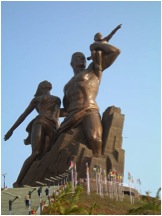
Source: Wikipedia

The statue and Wade’s current projects for the construction of the “Seven Wonders of Dakar” (a section of the capital which will include a  new National Theater, Museum of Black Civilization, National Library; the School of Fine Arts and the School of Architecture and Music Palace) are seen as wastes of government money spent to satiate the President’s desire for a legacy rivaling Senghor or even the grand public projects of France under past presidents Chirac and Mitterand.  Growing discontent with Wade’s attempts to stay in power past the current two-term limit and with what is perceived to be his inability to ensure reliable infrastructure to his country’s population has culminated at times with criticism of “The African Renaissance Monument”.

Most of Dakar’s neighborhoods experience daily power outages and terrible traffic due to poorly maintained and inadequate roads. However, Wade has somehow scraped together enough money to build bronze statues and to build a second national theater to replace the centrally-located and historical Théâtre Daniel Sorano in downtown Dakar.

I am not an expert in development. I am a historian whose interest in West Africa began as a Peace Corps Volunteer in neighboring Mauritania but I have found myself progressively less optimistic about prospects for change in the daily lives of most West Africans I know. On a recent research trip to the northern Senegalese city of Saint-Louis, I was struck with how much more run-down the city seemed to me than it had my first time there in 2003. While Saint-Louis can be picturesque from afar, with its 350 year-old colonial facades built on its central island, the reality is that its infrastructure is disintegrating.
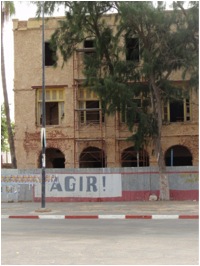
A government building in Saint-Louis (picture by Erin)

Despite the presence of NGOs (visible by the many white SUVs and walled compounds marked by their painted slogans of “Espoir” and “Aide”), it’s hard to see signs of successful projects.  As I walked through the city, I couldn’t help but notice numerous failed plans. I passed dead trees protected by reed fencing where someone had thought plantings along the streets of a popular neighborhood would be a good idea. Talibés (students, or little boys sent out to beg for money and food by some unscrupulous marabouts) are an ever-present part of Saint-Louis streets despite heavy investment by NGOs to provide the boys with reliable food and housing. The shores of the city are lined with old tires, plastic bags, and fish remains.

As I looked in at a dark closet where thousands of colonial documents sit waiting to be organized and made accessible to the public, the regional archivist also told me that plans to build a much needed space to securely house the country’s archives had been shelved years ago in favor of the construction of the Piscine Olympique, Dakar’s largest swimming pool.

Riding in a crowded bush taxi and hitting the crawl of traffic on the way back to Dakar, I couldn’t help but wonder what prevents these initial investments in tree plantings, child welfare protection and road construction from being maintained. From this perspective, much of the failure of such development projects seems to be explained by a lack of investment in the maintenance of current projects.  Perhaps this can be explained by the framework of funding and the reluctance on the part of donors to provide for anything other than new projects. (After all, it’s much more exciting to say that Dakar will benefit from a new, state-of-the-art performance space than the rehabilitation of its old theater space.) Or maybe funding agencies and donors find it difficult to collaborate on projects such that one agency might undertake an initial trash clean-up while another would ensure that a second clean-up is planned a month later.

Possibly there is also a lack of coordination between funding agencies and local governments who, once the preliminary heavy investment has been made by development agencies, could then continue the programs with less funding but with longer term results. Projects initiated by African governments also need to consist of more than an initial flood of money but should also include funding to be set aside for the continued and regular maintenance of such projects so that they remain relevant and useful.

Dakar (picture by Erin)

To emphasize this point and to return to my original starting point of La Pointe des Almadies, one only need to look at the pathetically barren palm tree trunks lining Dakar’s prettiest drive from downtown to the “Renaissance” statue that overlooks the Atlantic Ocean.  Abdoulaye Wade requested the planting of hundreds of palm trees along this drive to welcome delegates of the Organization of the Islamic Conference who met in Dakar in 2008. Now, three years later, the majority of these tress are simply reminders of another failed project. Inadequately or never maintained, the trunks stick out of the ground, their tops bare and exposed, they stand isolated and quivering no longer serving a purpose.

I’m sure they looked beautiful in the first weeks they were planted but have become symbols of the emptiness of similar endeavors. I know that there are successfully sustained projects out there but it’s difficult not to feel disheartened by the many visibly failing projects aimed to satisfy a short-term goal or donor stipulations rather than the actual needs of a struggling population.

Erin Pettigrew is currently conducting dissertation research in Senegal and Mauritania.
Talking real development

It is an upper-middle-class, industrialized-country fiction to romanticize life on a small farm. Economic development and food security lie in industrialized agriculture, and this is why I continue being interested in agricultural value chains. My thinking on this has also been reinforced by my recent reading of Jane Jacobs’ The Economy of Cities, in which she posits that agricultural development came as a consequence of urbanization, and not the other way around.

That is Marc on his blog here.

Reading Marc’s post reminded me of my beef with anti-poverty development as it is currently practiced. For instance, the humanitarian instincts behind giving poor slum dwellers loans to start businesses may be noble, but the impact of these projects are ambiguous (Not forgetting the recent trends in Venture Capital firms making money from high interest rates on the poor).

Such projects, for the most part, serve little more than giving the poor comfort in their poverty. Yes, there are a few success stories, but for the vast majority life remains precariously close to abject destitution. Self-employment is a risk that should not be forced on those at the very bottom of the economic ladder in developing countries.

Such palliative measures should never distract from the main task of long-term job creation.

The growing disillusionment with the long-term developmental effects of micro-finance should force development experts to think of creative alternatives.

What could be an alternative?

Well, for starters it might be more beneficial to boost the capacity of banks to give loans to mid-size businesses that have the technical and managerial capacity to scale up their operations and thus create more jobs. Corporate finance in most of the developing world has no “middle class.” Nearly all the players are big firms. Mid-size firms simply cannot keep up with the high interest rates and collateral requirements. Yet these are the firms that have the potential to grow and create more jobs.

This move smells of trickle down economics, but it is not. Poverty alleviation requires massive amounts of job creation. Making the poor self-employed distracts from the bigger problems of non-industrialization and lack of formal-sector jobs.

It is also bad for political development because it provides Hirschman’s exit option for millions of economically disaffected citizens of the developing world.

Check out Blattman’s blog on a related post on NGO activism in the developing world.

Quick hits

Texas in Africa’s review of Fighting for Darfur.

Blattman on economic growth and development.

The long arms of the Rwandan state?

The Zambian elections will be close. Last time round the opposition leader lost by a mere 3% (I will be there for the campaigns this summer).

And lastly, Kenya’s trillion-shilling proposed budget. High on development expenditure but could it crowd out the private sector?


Trends on Aid, Growth and Government Spending in Africa

Data from the Penn Tables

The graph shows average growth rates, government expenditure as a fraction of GDP and foreign aid as a fraction of GDP in Sub-Saharan Africa since 1960. Both the growth and aid trends are encouraging. Growth has been positive since the mid-1990s and aid seems to be trending downward in the long-run. It is also apparent that the African growth tragedy was to a large extent confined to the disaster periods that were the “lost decade” of the 1980s (caused by the oil shocks, commodity bursts, debt crises and SAPs) and civil wars era of the early 1990s.

Despite the ongoing crises like this, this and this, the region as a whole appears to be experiencing an economic upswing. In the coming decade, the Economist projects that 7 out of 10 of the fastest growing economies in the world will be African.

institutions, culture and economic development

I am currently taking a class taught by Avner Greif, an economist/economic historian at Stanford in the tradition of New Institutional Economics. The class introduces ideas about economic development from a perspective that does not get much attention from economists, i.e. culture and its impact on long-run institutional development.

In one of the readings Tabellini argues that:

Well functioning legal institutions breed good values, since legal enforcement is particularly relevant between unrelated individuals. …… better informal enforcement sustained by ongoing relations in a closed network may be counterproductive for values.

Thus, the model predicts that clan based societies develop very different value systems compared to modern societies that rely on the abstract rule of law.

That’s in The Scope of Cooperation.

The paper provides a model of the recursive interaction between good institutions and culture. The scope of cooperation and interaction matters for institutional and economic outcomes. Clannishness, whether in Southern Italy or Mogadishu, is bad for economic development.

But you need a functional state system for people to be able to even contemplate abandoning the insurance scheme that is the clan. The model predicts two steady-state equilibria. Institutionally speaking, you are either Botswana or Chad.

property rights and economic development in africa

Forget (almost) everything else. The trouble with African economies is simply and squarely the lack of property rights protection. It still beats me why the African political elite have failed at instituting even intra-elite property rights protection. The fact that the African political elite – who also happen to be the wealthiest people on the Continent – cannot invest in their own countries has resulted in massive capital flight. The quote below says it all.

Speaking at the New Partnership for African Development (NEPAD) meeting in Abuja, Nigeria, in December 2003, the former British secretary of state for international development, Lynda Chalker, noted that 40 percent of the wealth created in Africa is invested outside the continent.

And this is only what gets counted. Although obviously the upper bound, recent revelations of Mubarak’s wealth (between 20 -70 billion) may be an indication of the amount of personal wealth stashed overseas by long time autocrats like oil-rich Angola’s Edwardo do Santos, Equatorial Guinea’s Obiang’ and Sudan’s Bashir, among others.

The contrast is that:

In corrupt societies in Asia, such as Indonesia, Bangladesh and Pakistan the citizens still prosper because the corrupt elite keep their money at home. They invest in new mobile phone network, build private hospitals and tourist hotels (here).

In short, elite political instability and distrust in Africa is one of the key reasons why the region remains poorer than any other in the world.

A note on economic development

“I think we have gone too far in the pro-poor direction…… we don’t necessarily have trade-offs. Factories are pro-poor.” Chris Blattman, Yale University

I am on record as not being too enthusiastic about “pro-poor growth” as it is currently practiced. Loans to the poor and other approaches that completely bypass those with a higher probability of succeeding at creating big business – the educated and middle class – will at best only keep the poor afloat and at worst divert resources from much needed long-term investment. I am not saying that the educated have a monopoly on entrepreneurship. All I am saying is that what we want is to create sustainable jobs. This requires scale. And scale comes with big business and industry.

Blattman neatly summarizes this point:

The difference between a country with $1,500 and $15,000 of income a head a head is simple: industry. All the microfinance and microenterprise programs in the world are not going to build large firms and import technology and provide most people with what they really want: a stable job, regular wages, and a decent work environment.

More on this here.

quick hits

The Christian Science Monitor reports on the robbery that most African governments (in this case in the DRC) continue to visit upon their people, unabated. Some of the deals they make sound so bad they’d embarrass a two year old.

Gertler was just 27 when he first became involved in the Congo in 2000, obtaining a monopoly of diamond exports (worth around $600 million) in return for $20 million. He had previously been involved in diamonds in Angola and he is the grandson of Moshe Schnitzer, the founder of the Israel Diamond Bourse. He is now one of the richest Israelis.

Industry insiders, however, suggest that the last big round of mining concession acquisitions happened just before the last elections and helped the president raise funds for his expensive campaign. The next elections are in 2011.

More on this here.

Also, Tech crunch has a nice piece on how the future belongs to the global south

emerging africa

I have read the book, met the author and will be writing a review soon. In the book Steven Radelet makes the important point that African countries are not born equal. About half of sub-Saharan African countries have, since the mid 1990s, have shown signs of preconditions for take off. The stars in the book are the usual suspects, Ghana, Mauritius, Botswana. The suckers are mostly Sahelian and central African.

An abbreviated version of the book appears in the Journal of Democracy.

kenya: a model of conservative revolution?

An ambitious project is in the works to build a new city from scratch in Kenya, a sign that things are indeed changing in the economic engine of the wider eastern African region. The stock market voted for the new constitution with a bullish run on the eve of the ratification of the document. Investments in property – the property class has outdone most asset classes in the last two years – serve as a sure marker that Kenyans are confident in government’s commitment to protection of property rights. I am one of those who remain optimistic that Kenya is on the verge of take-off. And here is why.

Not long ago the idea of a cabinet minister resigning in Kenya was a pipe dream. Even more improbable was the idea of parliament defying the president. But these days ministers resign and the Kenyan parliament routinely defies State House. More importantly, the august house has continued its march towards independence from the executive – both functionally and financially. By controlling their own budget and calendar and building a functioning committee system, members of The House have acquired enough muscle to expose lapses in the management of public affairs – including the present scandals involving the Kenyan foreign ministry and the Nairobi City Council.

The biggest question, however, is whether the reforms embodied in the new constitution will last. My answer is yes they will, for two reasons. Firstly, the reforms are not as radical as some commentators think they are. The Kenyan establishment still stands to gain the most from the institutional reforms embodied in the new constitution. Land ownership, taxation, regulation of business, among other topics of interest to the elite are still firmly in the hands of the conservative centre and their provincial allies. Secondly, the emerging culture of bargaining, as opposed to Nyayo era “wapende wasipende (like or not) politics,” provides opportunities for amicable settlement of disputes resulting in self-reinforcing deals. No single political grouping can force its will on Kenyans. Mr. Kenyatta needed to only convince the Kiambu mafia for his policies to fly. Moi only needed a small group of collaborators. The new dispensation, however, requires that a significant number of elites, with varied political interests, buy into an idea before it can fly. This is progress. It is stable and sustainable progress.

Kenya’s dark hour in early 2008 was an eye-opener to the political and economic elite. The more than 1300 deaths will forever be a reminder of the evils of strongman rule. The broader legacy of the 2007 election will however be positive. The elections showed the core conservative establishment that they cannot run the country on their own, and that the peripheral elites also have significant de facto political power. By forcing the elite into agreeing to a self-enforcing arrangement, the regrettable events of 2007-08 facilitated elite compromises culminating in their new Kenyan constitution. The yet to be established supreme court will provide the final piece of the foundation needed for sustained institutional development in a predictable environment. Paradoxically, the biggest plus of Kenya’s new constitution is its conservative bent. And for that reason it will endure beyond the current teething phase. A more radical document would have been eviscerated just as the Kenyatta and Mboya amendments decimated Kenya’s independence constitution.