linking climate change to poor women in the developing world

They do not drive SUVs. Some have never even seen a light bulb. But according to research one of the most effective ways of preventing climate change is to ensure that poor women in the developing world do not have a lot of children.

Because of their advertised positive impact, I used to be a proponent of population control family planning programs in the developing world. And then I saw the data and changed my mind. Reducing the number of people being born in the developing world will not reduce the effects of climate change. What needs to happen is a change in consumption habits in the West and among the upper classes in the developing world. The poor too need to stop cutting down trees for charcoal. But we should not push them into having less children and make it a climate change issue. They are not responsible. Those responsible should change their consumption habits and perhaps invest in providing alternatives to charcoal for the poor.

from the archives…

Robert Mugabe might have pulled off the biggest prank of all time. When he came to power in Zim in 1980 (up until things started falling apart in the southern African country in the mid 90s) many saw him as a responsible gradualist reformer. Then he changed, perhaps back to his real nature. Here is a quote from Newsweek in a March 20th 1978 publication that depicts uncle Bob as we know him today. He may have given up on Marxism but ZANU-PF rules Zim:

Robert Mugabe told Newsweek’s Raymond Carroll and Lynn James he would fight on to make Rhodesia a Marxist “one-party state.”


the cost of malaria, and the continent’s disease burden

Academics have already established that the economic costs of malaria and Africa’s general disease burden are not trivial. Think of lots of man-hours wasted due to illness and government expenditures on medication, time and money that could be used to build roads and what not.

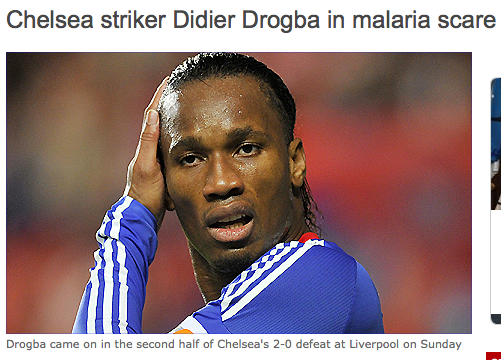
To illustrate the point, not anyone is immune from Malaria. Drogba, the illustrious Ivorian forward, got malaria and had to take a few days off from his duties at the London club, Chelsea.

“He has this virus and, obviously, he lost power and training.”

“He lost his condition. He’s had treatment and now he’s OK. He’ll come back immediately in the best condition.”

bribing Bashir in order to let the southerners go

The BBC reports that the US government is willing to strike Sudan off the list of state sponsors of terrorism if the Bashir regime allows the independence referendum in South scheduled for early January.

Sudan has an oil-based relationship with China which has made it hard for the US and other Western states to use the usual coercive mechanisms via the security council. Southern Sudanese politicians have vowed to secede in January referendum or no referendum. East African countries, including Kenya and Uganda have expressed a strong preference for Southern independence.

africa in the news

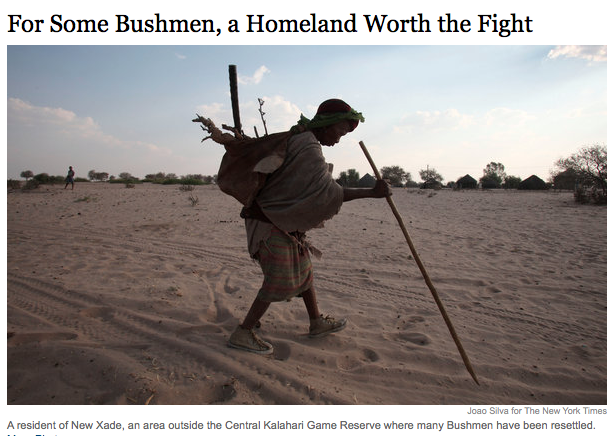
Forget about the elections in Tanzania or the Ivory Coast. What matters for the American audience as far as news from Africa go are human interest stories such as this one which made it to the front page of the New York Times.

I echo the point of the Times piece. It really sucks being a hunter-gatherer in Botswana. And by extension, it really sucks being a citizen of Chad, Niger, Uganda or any one of the 40 other countries that make up sub-Saharan Africa. Despite the “good news” (see earlier post below) things are really bad on the Continent.

Africa deserves all the bad press it gets. Period. The only problem is that Africans have not been able to participate effectively in the discourse on their continent or attempted to contextualize the bad press. The continent long lost the game of framing the narrative.

the good news from africa, and their implications

The photo in the flyer says it all:

John Prendergast with two anonymous African children

John Prendergast is Jesus the bearer of good news and presumably a savior, through his tireless advocacy work, of the many African victims of fate, their governments and endless conflicts. It must feel good being the anonymous kids being used to massage a humanitarian worker’s ego in flyers like this one.

Mr. Prendergast, co-founder of the enough project, gave a talk this afternoon (I only attended the first part of the talk because of TA duty) at Stanford on the positive developments on the Continent and the state of the conflicts in central Africa. For more of what he does see Texas in Africa.

interesting links

The Economist has a nice chart showing a cross-section of states and their performance as far as human development goes. Kudos to Benin for doing a good job of improving its human resources. And shame to the tail-enders on the chart on the right hand side.

I just watched this interesting video from the MIT World video archives. Jump to about the 1hr mark to hear his take on African states and their development prospects.

Lastly, Aid Watch has a post on childhood development. For those (Kenyans) out there who think that having the primary school exams determine a kids future is wrong, think again. Everything might be determined at the kindergarten level.

corruption in Kenya

People who swindle government “should not be alive.” Those are President Kibaki’s own words, the strongest statement yet in a season rocked with one corruption scandal after another. The president has already lost two cabinet ministers over corruption. The Kenya Anti-Corruption Commission is believed to be investigating up to four other ministries.

Tanzania elections

There are no surprises expected from the general elections in Tanzania, held on Sunday. The electoral body has not declared the presidential results yet (leading to reported riots) but no one expects Jakaya Kikwete to lose to Chadema’s Willibrod Slaa. Chama Cha Mapinduzi (CCM), the hegemonic party that has ruled Tanzania since unification, is also expected to maintain its majority in parliament.

More on this as soon as the final official figures become available. Mr. Kikwete won 80% of the vote in 2005.

kenya: a model of conservative revolution?

An ambitious project is in the works to build a new city from scratch in Kenya, a sign that things are indeed changing in the economic engine of the wider eastern African region. The stock market voted for the new constitution with a bullish run on the eve of the ratification of the document. Investments in property – the property class has outdone most asset classes in the last two years – serve as a sure marker that Kenyans are confident in government’s commitment to protection of property rights. I am one of those who remain optimistic that Kenya is on the verge of take-off. And here is why.

Not long ago the idea of a cabinet minister resigning in Kenya was a pipe dream. Even more improbable was the idea of parliament defying the president. But these days ministers resign and the Kenyan parliament routinely defies State House. More importantly, the august house has continued its march towards independence from the executive – both functionally and financially. By controlling their own budget and calendar and building a functioning committee system, members of The House have acquired enough muscle to expose lapses in the management of public affairs – including the present scandals involving the Kenyan foreign ministry and the Nairobi City Council.

The biggest question, however, is whether the reforms embodied in the new constitution will last. My answer is yes they will, for two reasons. Firstly, the reforms are not as radical as some commentators think they are. The Kenyan establishment still stands to gain the most from the institutional reforms embodied in the new constitution. Land ownership, taxation, regulation of business, among other topics of interest to the elite are still firmly in the hands of the conservative centre and their provincial allies. Secondly, the emerging culture of bargaining, as opposed to Nyayo era “wapende wasipende (like or not) politics,” provides opportunities for amicable settlement of disputes resulting in self-reinforcing deals. No single political grouping can force its will on Kenyans. Mr. Kenyatta needed to only convince the Kiambu mafia for his policies to fly. Moi only needed a small group of collaborators. The new dispensation, however, requires that a significant number of elites, with varied political interests, buy into an idea before it can fly. This is progress. It is stable and sustainable progress.

Kenya’s dark hour in early 2008 was an eye-opener to the political and economic elite. The more than 1300 deaths will forever be a reminder of the evils of strongman rule. The broader legacy of the 2007 election will however be positive. The elections showed the core conservative establishment that they cannot run the country on their own, and that the peripheral elites also have significant de facto political power. By forcing the elite into agreeing to a self-enforcing arrangement, the regrettable events of 2007-08 facilitated elite compromises culminating in their new Kenyan constitution. The yet to be established supreme court will provide the final piece of the foundation needed for sustained institutional development in a predictable environment. Paradoxically, the biggest plus of Kenya’s new constitution is its conservative bent. And for that reason it will endure beyond the current teething phase. A more radical document would have been eviscerated just as the Kenyatta and Mboya amendments decimated Kenya’s independence constitution.
Quick hits

If I were the president of the DRC, I would be seriously researching how Charlemagne did it (the medieval King ruled over a land mass the size of the DRC), how Brazil did it (their green revolution was a success) and how Vietnam is doing it (some people call it little China). I can bet my grad school stipend for next quarter that the younger Kabila has no local brain trust (who needs one if the Brussels boys can jet in and out of Kinshasa with copious amounts of “advice” on development??). The lets-just-stay-afloat-with-foreign-aid paradigm that informs governance in Africa is a guarantee that 50 years from now Africa will still be the poster child for bad governance and socio-economic underdevelopment.

Also, I just discovered a blog by The Bank’s chief economist for Africa region. Check it out (via Blattman).

Lastly, Wronging Rights has a post on the series of post by Texas in Africa on how social science works.

Quick note: wetangula resigns

Kenyan foreign minister Moses Wetangula has resigned over corruption allegations. Mr. Wetangula’s ministry was exposed to have engaged in fraudulent property deals in foreign capitals to the tune of Kshs. 1.1b (US $13.75 m).

More at the Daily Nation.

health and governance conference at Stanford

This weekend the Stanford Student Forum for African Studies is hosting a conference on health and governance in sub-Saharan Africa. If you are in the bay area feel free to show up for any of the panel discussions.

More information here.

million dollar beds and lumbering in Madagascar

The BBC reports that the illegal logging of wood in Madagascar is increasing the risk of extinction of certain endangered tree species.  Already the felling of ebony, pallisander and rosewood is illegal in Madagascar. However, enforcement of this law continues to be hampered by the absence of a functional legitimate state in the island country off the coast of eastern Africa. Madagascar has been plagued by political instability since Andry Rajoelina, former DJ and mayor of Antananarivo, seized power in a coup last year.

Most of the wood finds it way to the US, Europe and China and is used among other things to make million dollar beds in China.

Esther Passaris for Nairobi Mayor

Now that the rather shady corrupt Nairobi mayor, Councillor Majiwa of Baba Dogo, is facing criminal charges, perhaps it is time Nairobians had a sober discussion about what sorts of people should be mayor. Being the engine of the Kenyan economy, the city ought to be better run. Instead of the thuggish types that have dominated City Hall in the past, the ministry of local government should on restricting mayorship to qualified and corruption free individuals. In other countries former mayors are decent enough to dream of running for president, and some have succeeded at it. I doubt if the likes of Mr. Majiwa even qualify to be heads of village barazas.

It is for this reason that I choose to beat the debe, so to speak, in favor of Esther Passaris. Ms. Passaris has run a (as far as I know) clean business and created the Adopt-A-Light brand which must be doing well going by its coverage.Ms. Passaris is also the founder of the One in a Million charity initiative.

It would help to have, for a change, a mayor who can construct a coherent sentence and competently run the beautiful city in the sun. I believe Ms. Passaris is more than capable of doing this, and more. I hope (perhaps foolishly so) that Hon. Musalia Mudavadi shares this view….