drug trafficking and african politics

UPDATE: Obama names Harun Mwau as a drug kingpin.

President Obama, in a letter to the US Congress, named a prominent Kenyan member of parliament and one of the wealthiest Kenyans, Harun Mwau, as a drug kingpin. Mr. Mwau is a renowned Kenyan businessman with links to container depots, retail and banking interests, among other investments.

I am still waiting for official reaction from the Kenyan government on the Obama letter to the US Congress.

Kenya, Gambia, Ghana, South Africa, Guinea-Bissau, Guinea. All these countries have experienced allegations that people high up in government – sometimes individuals very close to the heads of state – are involved in drug trafficking. Africa is a major transit point for drugs from Latin America and Asia into Europe.

The latest news on this subject is the jailing of Sheryl Cwele, the wife of South Africa’s intelligence minister. Ms Cwele was found guilty of recruiting women to smuggle drugs in and out of the country. It is hard to imagine that the intelligence minister was not aware of the fact that his wife was a drug trafficker.  Cwele refuses to resign.

In the recent past a woman close to President Mwai Kibaki of Kenya was allegedly linked to a ring of East European drug traffickers. The murder of President Joao Vieira of Guinea-Bissau was also thought to be connected to a dispute involving Latin American drug lords. Ghana’s President Atta Mills has publicly admitted that it is hard to deal with the problem of drug trafficking because powerful people in the country’s security apparatus are involved.

The South African, Kenyan and Ghanaian cases are particularly alarming. Most people would imagine that only incorrigibly inept kleptocracies such as Jammeh’s Gambia or Vieira’s Guinea-Bissau would engage in drug trafficking. If better run places with stronger states cannot tackle drug trafficking who will?
africa’s Middle class

Elizabeth Dickinson at FP reports:

Given all this, perhaps the only thing about Africa that isn’t changing quickly is our perceptions of it. There’s an image impressed in all of our minds of a starving child, symobilizing an impoverished continent. If that was ever true, this is an excellent reminder that today, it’s at most a snapshot. Yes, there’s great human suffering and it’s not hard to find. But Africa as a whole is becoming a middle class continent.

It is hard to completely buy Dickinson’s optimism given the fact that Somalia, the DRC, Chad, Central Africa Republic, Sudan, among others are still far from being stable polities. The precarious nature of the stability in the more stable African states such as Uganda, Kenya, Ethiopia, Rwanda e.t.c. are also cause for concern.

That said, the reality is that there are many Africas. Those who fail to internalize that fact continue to do so at their own peril. Just ask the Indians and the Chinese.

quick hits

The long awaited discussion about the real content of higher education in Africa is underway. Be a part of it.

The DRC is getting ahead of itself with elections. One wonders whether holding elections is the wisest thing to do right now. Wars raging in the east. A country the size of western Europe but with the most rudimentary infrastructure. Loads of mineral wealth that create a few billionaires – most of them non-Congoleses – while the real Congolese starve or eke out a living with one eye on the lookout for marauding rebels and government forces thugs. The DRC is one big mess in need of radical clean up. Kabila simply will not do it. But he will win these elections for sure. And that means more instability in the great lakes region.

I just found out that I shall be in Zambia for the election campaigns – elections due in October – so watch this space for stuff on Zambian politics this August and September.

And lastly, China is upping its involvement in the Kenyan economy. According to Business Daily:

Several Chinese manufacturers are already setting up local production plants in Kenya, shifting from the previous strategy in which they supplied the domestic consumer market with goods imported from their home country.

More jobs = lower infant mortality rates. Everybody wins.

fuel shortage in kenya: kibaki administration on the spot

The Kenyan government is frantically trying to avert strikes and demonstrations over the rapidly rising cost of living.

State House and Agip House certainly don’t want a repeat of the recent events in Uganda where inflation demonstrations have turned bloody.

Mr. Atuoli, the number one Kenyan trade unionist, has given the government a three-week strike notice if things do not change. Trade Unions in Kenya are demanding a 60% rise in the minimum wage to just over US $150 a month. Presently that figure stands at around US $94.

The government is also on the spot over corruption and mismanagement of the oil sector. According to the Daily Nation:

Since October last year, the ministry of Energy introduced regulations prohibiting imports of oil outside the ministry of energy-coordinated Open Tender Supply system (OTS).

Under this system, all oil imported into the country, including fuel headed for neighbouring Uganda and Rwanda, must come into the country by one ship, imported by one player and shared by the rest according to market share.

With private imports by individual marketers restricted, all players must patiently wait to get supplies from the next OTS tender, even when their customers want more.

The only exception are the rare cases where politically-favoured  importers are allowed to bring in product from outside the system.

Access to the only pipeline is regulated by an ullage committee under the oversight of the ministry of Energy.

Yet another case of a few Kenyans making loads of chapaa on the backs of regular wananchi.

And speaking of the apparently invincible incompetence of the Kenyan government, dozens of Kenyans were killed by Ethiopians in what the area MP characterized as a regular rite of initiation (“It is in their tradition. After circumcision you must look for a Turkana to prove your manhood.” [Video: 1.53] I say WTF!!!!!!!). The attacks occurred not far from a police post. Such attacks are regular in northern Kenya, a region that might as well be part of Chad as far as Nairobi is concerned. Someone in the Internal Security Ministry is not doing his job.


Malema on trial

The video is worth watching. The lawyer cross-examining Malema actually makes the buffoon leader of the ANC youth league seem sane.

The South African land issue is a Zimbabwe waiting to happen. The sooner everyone accepts the truth the better.

Malema’s buffoonery is founded on real grievances about the distribution of productive land in South Africa. The more responsible elements in the ANC and those that benefited from decades of Apartheid disenfranchisement should wake up and smell the rooibos.

ht Eric Mibuari

The Mail & Guardian is reporting that the trial of ANC Youth League leader Julius Malema for hate speech is entering its second week. Malema is charged with hate speech for singing the South African struggle song “Dubul’ibhunu,” which translates to “Shoot the Boer.” Malema maintains that he has the right to sing the song, chanting the controversial lyrics at the courthouse.

This case is interesting because struggle music is a major part of South African culture, particularly black South Africans. The Boers participated in the oppression of black South Africans, even though they maintain that they are ethnically and culturally different from Afrikaners.

more on this here.

mbeki’s take on the ivorian crisis

Ouattara’s victory over Gbagbo in Cote D’Ivoire is quickly generating winner’s remorse. The coalition of disparate rebel forces that united to oust Gbagbo is already breaking apart. Just this past week Ibrahim Coulibaly, a rebel commander, was killed after he refused to obey Ouattara’s order to disarm his units. Mr. Ouattara himself is facing the sisyphean challenge of cleaning up the mess from the decade long civil war and the recent onslaught on Abidjan amid economic decline and divisions within his own coalition. Supporters of Mr. Gbagbo are also not yet into the idea of having the northerner running the show. Over 40% of Ivorians, most of them southerners, voted for Gbagbo.

In the wider region, many see the heavy French involvement in the whole situation as suspect. Thabo Mbeki, the former president of South Africa, had this to say in a piece posted on the FP website:

France used its privileged place in the Security Council to position itself to play an important role in determining the future of Côte d’Ivoire, its former colony in which, inter alia, it has significant economic interests. It joined the United Nations to ensure that Ouattara emerged as the victor in the Ivorian conflict.

This addressed the national interests of France, consistent with its Françafrique policies, which aim to perpetuate a particular relationship with its former African colonies. This is in keeping with remarks made by former French President François Mitterand when he said, “Without Africa, France will have no history in the 21st century,” which former French foreign minister Jacques Godfrain confirmed when he said: “A little country [France], with a small amount of strength, we can move a planet because [of our]…relations with 15 or 20 African countries…”

Mbeki has a point.

That said, I don’t totally buy into the idea that the West, or any other outsider for that matter, should keep out of Africa’s affairs. Isolationism (caused by the great sand wall that is the Sahara) has not served Africa well in the past. Africa needs more trade and involvement  in international politics. Both acts necessarily require international involvement in Africa.

So to the likes of Mbeki I say, the trick is not to require the West or East or even the Emerging South to benevolently stay out of Africa’s business. Rather, African states should develop their own capacities to deal with the reality of world politics: Strong states will always prey on weak ones. If you do not want to be preyed upon, you have to get your act together. Stephen Waltz in his seminal work titled Theory of International Relations writes:

Weakness invites control; strength tempts one to exercise it, even if only for the “good” of other people.

The problem of exploitative international involvement in Africa is sustained primarily by the persistence of inept kleptocratic leadership in the region.

To go ahead and grant these dictators immunity from international pressure would be a most undesirable outcome. People like Idriss Deby, Paul Biya, Theodore Obiang, among others, should not be given space. Dictators do not have internal affairs.

It is a pipe dream to continue nurturing and protecting mediocre leadership all over Africa while expecting the strong nations of the world to benevolently keep off. It is the mismanagement of Africa by its leaders that creates fertile grounds for self-interested international preying involvement by the likes of France – with disastrous consequences for the local populations.


this is how museveni treats the opposition in uganda

Uganda is experiencing hike in food and fuel prices – partly because of the rise in global oil prices but also because of “election money.” The Ugandan opposition has been organizing “walk to work” protests against the government’s inability to tackle inflation. In this video, the main opposition leader in Uganda gets to experience the full force of Museveni’s thugs security forces.

Museveni’s rule in Uganda will only get stronger because of the recent discovery of oil in the country. So much for someone who 25 years ago when he first assumed power was seen to represent a new crop of African leaders who were poised to usher in the era of African prosperity. Increasingly in Museveni I see a bungling but eloquent Paul Biya with a touch of faux egalitarianism.

remembering J.M. Kariuki

J. M. Kariuki was murdered by government unknown operatives in 1975. One of his more famous speeches goes to the heart of Kenya’s problem…

A small but powerful group of greedy, self-seeking elite in the form of politicians, civil servants, and businessmen has steadily but very surely monopolized the fruits of independence to the exclusion of the majority of the people – we do not want a Kenya of 10 millionaires and 10,000,000 beggars.

I believe firmly that substituting Kamau for Smith, Odongo for Jones and Kiplangat for Keith does not solve what the gallant fighters of our uhuru considered an imposed and undesirable social injustice.

This is a deplorable state of things. Nepotism and tribalism have set in …. These are evil and must be condemned in no uncertain terms. We must all join hands to eliminate them and restore credibility to our public life. We must strive to ensure that the next generation will not blame us for having failed to correct the strains of public life.

the million-shilling goat question

What is the Ugandan government doing trading in goats?

At least 30,230 goats belonging to government are unaccounted for, according to an investigation by the Auditor General’s Office, which expressed concerns about the possibility of a major scam involving officials in the Ministry of Agriculture.

The missing goats were meant for the implementation of a Shs6.7 billion pilot breeding project for strategic export under President Museveni’s poverty reduction programme in Sembabule District. The Support for Export Breeding and Production Project was to benefit more than 100 farmers.

Records show that the Project received Shs800 million from government in the financial year 2004/2005 for infrastructure development and purchase of the first lot of goats. However, only 3,023 Mubende goats were procured and were not distributed to farmers at the time due to lack of sufficient funds.

At a cost of about Shs 1 million per goat, it’s estimated that taxpayers could have lost more than 302.3 million for the missing goats. Parliament’s Public Accounts Committee (PAC) Vice Chairperson Oduman Okello (Bukedea) said the committee will open fresh investigations into the circumstances under which the goats disappeared from the farm and who were the officials responsible for the loss.

More on this here.

african presidents and the “elites” around them

This is the first of many installments on African presidents. I am currently researching the nature of presidential power in Africa.

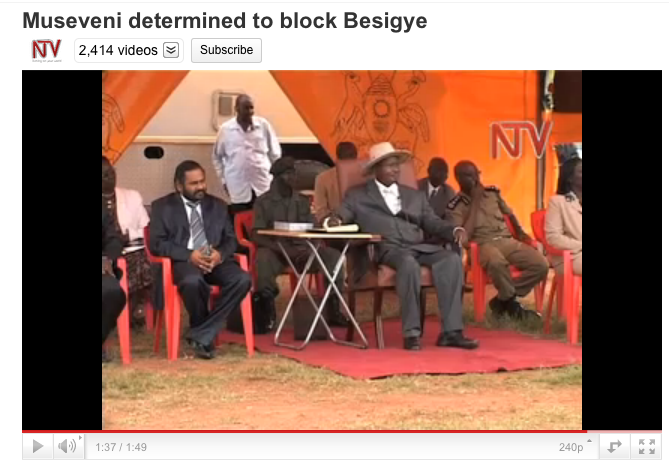
First on the list is Yoweri Museveni of Uganda. Mr. Museveni has been in power since 1986 and is pretty much convinced that he is God’s gift to Uganda has just won another 5-year term in office. The picture below is a screen shot from a recent tour of an area of Kampala to launch a cooperative society.

More Village Chief than President

Notice the state and size of the presidential “red carpet.” Also, everyone but the president has to make do with plastic chairs. This picture, in many ways, is a metaphor for most African societies. In many countries only the “Big Man” gets to sit on the “carpet” while everyone else has to languish in the dust, including elites around the president.

This state of affairs creates perverse incentives that are inimical to economic growth. If I am an elite – even one who is close to the president – why should I invest in creating a carpet of my own if I know that the president will take it away? The result is poverty and material want that extends to the heart of power and elite-dom.

In a way EVEN the political elite in Uganda are poor. They may have some wealth stashed abroad but their realized standard of living within Uganda is not elite. If they get sick they have to fly to Kenya, South Africa [who’s elites have done slightly better at local accumulation] or further afield for treatment. Oftentimes even their 4X4 vehicles get stuck on the non-existent roads that they have refused to build and maintain. A mastery of the art of surviving [living day by day] is not restricted to the hoi polloi. Even the elite lack the requisite stability to escape the surviving mentality, even though they may not necessarily be surviving materially.

This is the reality for most of the Continent.

Next time, something on the false largesse of the likes of the late Omar Bongo Ondimba (the very short guy in the middle of the crowd in this video)

the lion and the panda: still working on the relationship

The ambiguities in China’s relationship with Africa have created fertile ground for politicians. Opposition parties, especially in southern Africa, frequently campaign on anti-China platforms. Every country south of Rwanda has had acrimonious debates about Chinese “exploitation”. Even in normally calm places like Namibia, antipathy is stirring. Workers on Chinese building sites in Windhoek, the capital, are said to get a “raw deal”. In Zambia the opposition leader, Michael Sata, has made Sino-scepticism his trademark.

Much of this is wide of the mark. Critics claim that China has acquired ownership of natural resources, although service contracts and other concessions are the norm. China is also often accused of bringing prison labour to Africa—locals assume the highly disciplined Chinese workers in identical boiler suits they see toiling day and night must be doing so under duress.

Even so, the backlash is perhaps unsurprising. Africans say they feel under siege. Tens of thousands of entrepreneurs from one of the most successful modern economies have fanned out across the continent. Sanou Mbaye, a former senior official at the African Development Bank, says more Chinese have come to Africa in the past ten years than Europeans in the past 400. First came Chinese from state-owned companies, but more and more arrive solo or stay behind after finishing contract work.

Many dream of a new life. Miners and builders see business opportunities in Africa, and greater freedom (to be their own bosses and speak their minds, but also to pollute). A Chinese government survey of 1,600 companies shows the growing use of Africa as an industrial base. Manufacturing’s share of total Chinese investment (22%) is catching up fast with mining (29%).

That is the Economist reporting on the ever-growing Sino-African relationship. The main takeaway point is that Africa is increasingly becoming a manufacturing base for Chinese companies. With that comes transfer of technology, development of local expertise, increased competition and exposure to what’s happening outside the continent. In a few decades Chinese labor will get too expensive to support a robust export-oriented economy. That, coupled with increased domestic consumption in China will provide a good chance for African countries to finally begin their own move towards export-oriented industrialization and service provision.

Mr. Jonathan will need all the luck he can muster

GADO

This cartoon by the Daily Nation’s GADO pretty much summarizes what lies ahead for President Goodluck Jonathan of Nigeria.

signs of grand corruption in the kenyan treasury

Every year, the Treasury presents the Controller and Auditor-General a revenue statement, disclosing details of revenues received on income tax, VAT and corporation taxes.

The accounts for all revenue categories are kept separately. The gist of the new report by Mars Group is that the Auditor has discovered several cases where records of revenues received by KRA does not tally with what was actually received by the Treasury.

There are also cases where accounts of revenues banked at the Central Bank differ from the records kept by the receiver of revenues.

Where there are material differences, what the Auditor-General has been doing has been to exclude such revenue categories from the general certificate issued to the Treasury at the end of the year.

Is it just a matter of sloppy accounting? We all know that accounts which cannot reconcile are a recipe for irregular dealings.

That is Kisero writing in the Daily Nation. I am trying to get a soft copy of the actual report from the Mars Group. More on this soon.

quick hits

Ugandan walk to work protests continue, despite the arrest of key opposition leaders.

Mutiny spreads in Burkina Faso. Compraore has been in power since 1987 after he ousted Thomas Sankara.

Benin’s Yayi Boni might have stole his way into a second term. I hope he is not planning on extending the presidential term limit in Benin.

goodluck jonathan poised to win nigeria’s election

The Daily Nation reports:

Nigerian President Goodluck Jonathan has taken a wide lead in elections in Africa’s most populous nation, results showed today, putting him on a possible course for a first-round victory.

Millions of voters turned out for Saturday’s election as Africa’s most populous country bid to put years of rigging and badly flawed ballots behind it and hold the cleanest polls for head of state in nearly two decades.

Observers gave the polls an initial thumbs up, but concerns were raised over regional divisions, a scenario many analysts had hoped to avoid in a country as fractious as Nigeria, roughly split between Christians and Muslims.

Results from 30 states showed Jonathan had won 20, while ex-military ruler Muhammadu Buhari had nine and the former head of the anti-graft agency, Nuhu Ribadu, had one state.

Mr. Jonathan’s cross-national victories are a good omen for Nigerian unity moving forward. Now the big question is how Mr. Jonathan and the PDP will govern. Top on the agenda will be Nigeria’s energy problems. Sub Saharan Africa’s largest oil producer also happens to be one of its biggest importers of refined oil products. No new refineries have been built in the country in ages. The country also suffers frequent power outages despite the fact that millions of cubic metres of gas get flared in its oil fields daily. About 23 billion cubic metres get flared annually in Nigeria (second only to Russia).

That is 23 billion cubic metres of gas that can be harnessed for power production or LPG.