Africa’s budding narco-states?

UPDATE:

The Kenyan Prime Minister just admitted to the presence of drug money in Kenyan politics. Huge. Also, check the UNODC’s drug trafficking patterns for East Africa.

Also, does anyone out there have a copy of the report on drug trafficking in Kenya? Care to share?

****************************************

I have written before about the growing problem of drug-trafficking that is creating new problems for already fragile African states.

Of note is the fact that the problem is not just limited to the usual suspects – weak or failing states – but also extends to countries that most would consider to have it together, like Ghana, South Africa and Kenya.

According to Reuters, “cocaine moves through West Africa” while “heroin transits through the eastern part of the continent.”

The most alarming thing about this new trend is that in most of these African countries drug-trafficking happens with the consent of those in government.

For instance, in Guinea the son of former president Conte was for a long time a leading drug kingpin. In Guinea-Bissau President Vieira’s and Gen. Na Waie’s deaths in March of last year were a result of drug-related feuds. In Ghana President Atta Mills has lamented that the drug lords are too powerful to rein in. In Kenya, a woman (rumored to be) close to the president and other elites have been linked to the drug trade. Indeed on June 1st President Obama listed a sitting Kenyan Member of Parliament (Harun Mwau) as a global drug kingpin.

In South Africa former Chief of Police, Jackie Selebi, was jailed for 10 years in 2010 on drug charges. More recently the wife of the South African Intelligence Minister (Sheryl Cwele) was found guilty of having connections to the illicit trade. In 2009 a Boeing 727 crashed and was later set ablaze by suspected drug traffickers in Mali. The plane is believed to have been a drug cargo plane from Latin America destined for Europe. Other African states whose drug connections have also come to light include The Gambia (where rumors abound that President Jammeh is himself involved in the trade in drugs and arms in collusion with the Bissauian army) and Mozambique (H/T kmmonroe). You can find related news stories here and here.

Clearly, this is a real problem that if not nipped in the bud has the potential of growing to Mexican proportions, especially considering the already low levels of state capacity in most of Africa.

The Global Commission on Drug Policy also addresses this issue in their newly released report:

In just a few years, West Africa has become a major transit and re-packaging hub for cocaine following a strategic shift of Latin American drug syndicates toward the European market. Profiting from weak governance, endemic poverty, instability and ill-equipped police and judicial institutions, and bolstered by the enormous value of the drug trade, criminal networks have infiltrated governments, state institutions and the military. Corruption and money laundering, driven by the drug trade, pervert local politics and skew local economies.

A dangerous scenario is emerging as narco-traffic threatens to metastasize into broader political and security challenges. Initial international responses to support regional and national action have not been able to reverse this trend. New evidence suggests that criminal networks are expanding operations and strengthening their positions through new alliances, notably with armed groups. Current responses need to be urgently scaled up and coordinated under West African leadership, with international financial and technical support. Responses should integrate
law enforcement and judicial approaches with social, development and conflict prevention policies – and they should involve governments and civil society alike.
Call for papers

The Black Atlantic: Colonial and Contemporary Exchanges
2011 Annual Meeting of the Stanford Forum for African Studies
Stanford University, California
October 28-29, 2011

The Stanford Forum for African Studies (SFAS) invites proposals for papers by graduate students, scholars, and faculty on the topics of slavery, migration and the African Diaspora, and how each of these affect social, economic, and political development in Africa in the past and present. Interested participants should submit abstracts by email to stanfordfas@gmail.com. Please also include your name, affiliation and contact details. DEADLINE: June 10, 2011 (extended from June 1st)

This interdisciplinary conference aims to examine the vestiges of the slave trade, along with the resulting economic and cultural exchanges, both within and from Africa. Scholars and activists have traditionally addressed matters relating to economic inequality, hierarchical racial segregation and ideology, and the transfer of cultural realities presented in art, music, and rituals, to mention a few major topics. Consistent with the theme of exploring the triangular interaction (involving Europe, Africa and the Americas) of the Black Atlantic, the symposium seeks to shed light on the effect of forced and voluntary migration on identity and culture, on social, economic, and political development in Africa and in the African Diaspora. We are soliciting proposals that combine insights, methods, and research from both the social sciences and the humanities, including the fields of anthropology, art history, economics, history, literature, political science, and psychology among others.

Topics of interest include, but are not limited to:
· Identity formation in the Diaspora
· The spread and influence of African culture, art, and music
· The role of technology in connecting migrants to their home countries
· Regional integration and the economic effects of migration within Africa
· Brain drain out of Africa
· Migration and its relation to political and economic development in Africa
· Europe and its acknowledgment of the slave trade
· The role of remittances in modern day Africa
· The slave trade present in literature and/or music

Here is our website.

All politics is local, and more

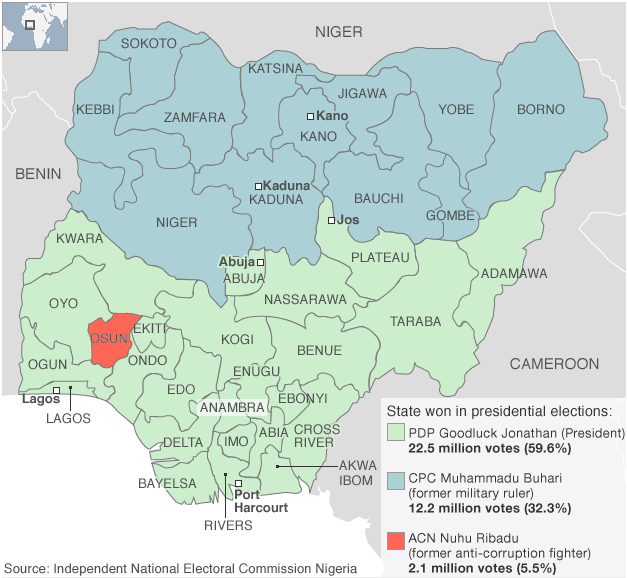
Many have seen the BBC map below of the outcome of the just-concluded Nigerian presidential elections. The south voted for incumbent Jonathan while the north went for Buhari.

The state elections were a different kettle of fish. In these elections the president’s party – the PDP – held its own in the north. Available results show that PDP candidates won in Bauchi, Kaduna, Niger, Gombe, Kebbi, Jigawa, Kano and Buhari’s home state Katsina – in total eight out of the 12 states shaded blue in the picture above.

How is this possible, given the clear north-south divide in the presidential vote?

The answer to this question is threefold (and is here).

First, all politics is local. Given that both the PDP and CPC rode on personality politics with little ideological differentiation, once the presidential race was settled the game reverted back to local personality politics. PDP bigwigs could therefore hold their own in most of these states based on their own local connections.

Second, it could be due to the sequencing of Nigerian elections. In Nigeria, the gubernatorial elections take place weeks after the presidential election. Because patronage politics is the only real game in town, the rational thing for voters to do is pick the president’s man for governorship. This way one can increase the probability that pork will flow to one’s state when President Jonathan sets out to reward those who voted for him and the PDP.

Third, Jonathan might have panicked about having lost the north in the presidential election and therefore put extra effort into winning as many gubernatorial races as he could in the north in order to guarantee his administration a sense of national legitimacy.

In a sense the gubernatorial results are encouraging. It is calming to know that there are powerful local elites in northern Nigeria who are willing and able to work with Jonathan to help Nigeria realize its potential.

Can the fight against aids be won?

There is hope that the fight against AIDS can be won.

Over the last 30 years the disease has killed millions and created millions of orphans.

It’s lasting impact persists in lost human capital and reduced labor productivity (see paper on this here). But if the optimism of the Economist (and they are not known for their love of the bright side of things) is anything to go by, things might be changing for the better.

The 30th anniversary of the disease’s discovery has been taken by many as an occasion for hand-wringing. Yet the war on AIDS is going far better than anyone dared hope. A decade ago, half of the people in several southern African countries were expected to die of AIDS. Now, the death rate is dropping. In 2005 the disease killed 2.1m people. In 2009, the most recent year for which data are available, the number was 1.8m. Some 5m lives have already been saved by drug treatment. In 33 of the worst-affected countries the rate of new infections is down by 25% or more from its peak.

Even more hopeful is a recent study which suggests that the drugs used to treat AIDS may also stop its transmission (see article). If that proves true, the drugs could achieve much of what a vaccine would. The question for the world will no longer be whether it can wipe out the plague, but whether it is prepared to pay the price.

More on this here.

Cleaning up the filth in FIFA

You know things are bad when even American academics who are not into football get all worked up about the sport and its governing body FIFA.

Here’s FP’s Drezner (have you read his zombie book yet?):

A few thoughts.  First, what kind of election process is it when the scandal-beseiged incumbent is the only friggin’ candidate?  Bear in mind this is the same Sepp Blatter who declared that FIFA was much more transparent than the IOC — which is kinda like Frederick’s of Hollywood claiming that they’re classier than Victoria’s Secret.

Second, widening the vote to all members won’t necessarily stop corruption — if the International Whaling Commission is any guide, it will simply expand the number of actors who could be bribed.

Third, any anti-corruption campaign depends on Blatter…. If only Blatter had been caught groping a chambermaid — then there would be some real reform!

Like many out there I hoped that Blatter would step down after the corruption scandals that happened on his watch came to light. His hanging on reflects badly on the Great Sport.

I am a little bit surprised though by the uproar generated by the bribery allegations within FIFA. It’s like everyone had no idea what was going on in FIFA and its member FAs. The organization’s member FAs – from Italy to Nigeria to Thailand – routinely get caught in all sorts of corruption allegations (remember Italian match fixing?).

FIFA is only as good as its national member FAs and the regional confederations. I hope that when the cleanup begins it will not end in Zurich but will extend to national FAs and confederations as well.

Happy Madaraka Day!

Happy Madaraka Day to all fellow Kenyans back home and around the world. Hongera!

Najivunia kuwa mkenya.

quick hits

What disasters reveal. Excellent read. From disasters we get to know more about the societies that experience them. Perhaps the glaring international example of this was the difference in destruction and response to the earthquakes in Haiti and Chile. Haiti’s non-existent state capacity was exposed for the whole world to see.

Facebook diplomacy.

Are freedom and democracy (really) on the decline? (unfortunately gated)

Why we have college. This article reminded me of a conversion I had with my dad back in college. At the airport in Nairobi on my way back to New Haven he insisted that I should learn a “trade” in college. This meant either Engineering or Medicine. Political Science and/or Economics did not count. The humanities were not even an option. My dad and I have since reconciled our minor differences over my career choice. And I am  glad I chose academia (especially now that I am done with comprehensive exams and all).

double standards

The Times has a nice story on Obiang’s Equatorial Guinea that is worth reading:

Officially and unofficially, Americans do business with one of the undisputed human rights global bad boys, Equatorial Guinea, Africa’s fourth biggest oil exporter. Its widely criticized record on basic freedoms has offered little barrier to broad engagement by the United States, commercially or diplomatically.

American oil companies have billions of dollars invested here. One American diplomat, using language that makes human rights advocates fume, praised the “mellowing, benign leadership” of the dictator in power for more than 30 years, Teodoro Obiang Nguema Mbasogo, in 2009 cables released by WikiLeaks. And a leading American military contractor with strong Pentagon ties has a multimillion-dollar contract to protect his shores and help train his forces.

You may recall that Obiang’s son was recently reported to have ordered a $380M luxury yacht. The Obiang’s and their backers continue to run the central African country like a personal possession.

According to the Guardian:

President Obiang, who has ruled since seizing power in 1979, has decreed that the management of his country’s $3bn a year in oil revenues is a state secret. That is why it is difficult to say for sure exactly how he comes to have about $700m in US bank accounts. But the president’s son gave an insight into his salary in an affidavit filed with the Cape high court in South Africa in August, as part of a lawsuit against him over a commercial debt.

On paper Equatorial Guinea is richer than most middle income countries. In reality, however, most of the 676,000 Equatorial Guineans live in poverty. The story of Equatorial Guinea is almost personal. Every time I post on Obiang’s inept rule I can’t stop wondering: How hard can it be to run a country of only 676,000 with over 3 billion in annual revenue?

Like the Times article points out, outsiders like the US government and foreign oil companies deserve to be called out over the goings on in Equatorial Guinea.

That said, the lion’s share of the blame is on Obiang’ and his backers. As far as I know none of the foreigners involved in the country held a gun to his head and asked him to siphon off billions of his country’s revenue to foreign bank accounts.

More on the Times story here.


Judges reject kenya’s bid to stop icc case

The government of Kenya has lost in its bid to convince the ICC that it has the political will and capacity to try key perpetrators of the 2007-08 post-election violence (PEV). Kenya had asked for six months to get its justice system in order and convince the ICC that it could bring to book those who planned and carried out the murder of over 1300 people and the displacement of hundreds of thousands in 2007-08. More on this here.

The Kenyan political elite find themselves in a pickle. Less than two years ago parliament thought that they could punt on addressing the PEV by deferring the cases to the ICC. It turns out Ocampo and the court were actually serious. Realizing this, they (the Kenyan gov.) attempted to hurriedly create a local process with the hope of persuading the court to stop the proceedings at the Hague.

But even a blind sheep could see through the government’s insincere attempts to clean up the judiciary or “investigate” the key suspects.

The Kenyan civil society remains adamant that the government has neither the capacity nor political will to prosecute the crimes committed in relation to the 2007 general elections.

Now the clock is ticking. With parliament and the Kenyan legal epistemic community largely in charge of naming the new judges that will staff the supreme court (and the wider judiciary) the accused and their political godfathers are in a panic. They must try and clean up shop under the current system or they will lose big, soon. Realizing the gravity of the situation, the same ethnic chiefs demigods politicians who were running around screaming “sovereignty” and “neo-colonialism” have since gone silent.

The Kenyan case has also generated a lot of heat with regard to the geopolitics of the ICC.

Many in Kenya and across Africa have (sometimes rightfully) criticized the ICC. But in my view it remains to be a necessary institution in the fight against impunity and murderous dictatorship on the Continent. (Pardon the phrase) We cannot throw out the baby with the bath water.

Let’s not kid ourselves. Without the ICC the families of those women and children that were burnt alive in a Church in Kiamba, Eldoret or those killed in retaliatory attacks in Naivasha will never get justice. That is the reality.

Remember, more Kenyans were killed in the months before the elections of 1992 and 1997 than in 2007-08 and yet the Kenyan political class merely pushed the unbearable truth under the rug. Also of note is the fact that the present anti-ICC crusade comprises those suspected to have financed opposite sides of the PEV.

The situation is a grim reminder of the Swahili proverb that says when the elephants fight it is the grass that suffers.

To those who talk of the ICC’s infringement on African nations’ sovereignty I’d like to pose a question: Who’s sovereignty is being violated? Is it al-Bashir’s or the Darfuris?; is it the Central Africans’ or Jean Pierre Bemba’s?; is it the Kenyans’ across the Rift Valley or the sovereignty of the Ocampo six?

Who will stop khartoum?

It appears that the war between north and south Sudan is inevitable. The north overran the disputed town of Abyei last week and now is angling to take over two border states. The Times reports:

Now, according to a letter from the Sudanese military’s high command, the northern army, in the next few days, plans to take over Blue Nile and Southern Kordofan states, two disputed areas with a long history of conflict that are still bristling with arms.

Analysts, local leaders and Western diplomats fear that if the northern army carries through on its threat to push out or forcibly disarm the thousands of fighters allied to the south in these two areas, it could set off a much bigger clash between the northern and southern armies, who have been building up their arsenals for years in anticipation of war.

Malik Agar, Blue Nile’s governor, said Sunday night that northern forces had recently moved “dangerously close” to the bases of southern-allied fighters and that he didn’t think the southern-allied forces would surrender.

A part of me still thinks that Bashir’s sabre-rattling is designed for the northern public. After all he will go down in history as the president who lost the south. In order to avoid immediate ouster he must, at least, pretend to put up a fight. My other side, however, thinks that Bashir (and his generals) might actually want war. Oil and water are on the line.

So how can a war be avoided?

Right now everyone appears to be looking in the direction of the UN for help. But the UN is busy putting out fires elsewhere, not least in Darfur where Khartoum’s forces keep firing at UN helicopters.

That Khartoum would let the south go peacefully was always a long shot. Many analysts had predicted that the north would either finance mini-rebellions in the south or go for a full blown war. It appears that Khartoum is going for both.

South Sudan does not need this war. The whole country has less than 200 Kilometres of paved road, among other mind-boggling underdevelopment records. Its human capital development is lagging behind the regional average by decades. A sustained war would take away vital resources from much needed development work.

Which brings me back to the title of this post. Many a time I have lamented at Africa’s lack of a regional hegemon. A hegemon that would take the mantle of regional conscience and policeman. A regional power that would put out fires even when the UN and the global powers that be were too busy (like they are now) or just plain indifferent (remember the mid-1990s?).

If it occurs the north-south war will be bloody and dirty (read land mines, more child soldiers, crimes-against-humanity tactics). As many as hundreds of thousands of people could die. Millions will be affected. It will also mean more light arms in an already volatile region, not to mention potential for spillovers into ongoing insurgencies in The DRC, Chad, Uganda and Ethiopia. Who will stop Omar al-Bashir and his generals?


A medieval sociology of IR

HT Melissa.

I found this rather fun to read. Here is my favorite bit of it all:

Like medieval priests, or oratores, the formal theorists in international relations claim special access to divine knowledge, available not through observation of the corrupt and impure world but though revelation and contemplation of the perfection of the divinity. Highly respectful of learning and abstract debate, the high formal theorists do no work whatsoever, other than to study the sacred dogma and refine ever more minutely the laws and teachings of the Holy Theory. Their debates on such arcane questions as, “How many angels can dance on the head of a subgame perfect equilibrium?” can get quite heated, but remain largely incomprehensible and irrelevant to the laity. Their function is to reveal the will of God to the lesser mortals, and to guide them in walking the correct path towards rational choice.

food for thought

UPDATE: Gelman responds with the question: Why are there IRB’s at all?

Ted Miguel and other similarly brilliant economists and political scientists (in the RCT mold) are doing what I consider R&D work that developmental states ought to be doing themselves. Sometimes it takes intensive experimental intervention to find out what works and what doesn’t. The need for such an approach is even higher when you are operating in a low resource environment.

That said, I found the points on this post from monkey cage (by Jim Fearon of my Dept.) to be of great importance:

Why is there nothing like an IRB for development projects?   Is it that aid projects are with the consent of the recipient government, so if the host government is ok with it then that’s all the consent that’s needed?  Maybe, but many aid-recipient governments don’t have the capacity to conduct thorough assessments of likely risks versus benefits for the thousands of development projects going on in their countries.  That’s partly why they have lots of aid projects to begin with.

Or maybe there’s no issue here because the major donors do, in effect, have the equivalent of IRBs in the form of required environmental impact assessments and other sorts of impact assessments.  I don’t know enough about standard operating procedures at major donors like the World Bank, USAID, DFID, etc, to say, really.  But it’s not my impression that there are systematic reviews at these places of what are the potential political and social impacts of dropping large amounts of resources into complicated local political and social situations.

You can find the rest of the blog post here.

Look here for more information on RCTs.

perspective

UPDATE: According to the Economist: In Nigeria “Parliamentarians are paid up to $2m a year—legally.”

Kenyan Members of Parliament take home US$ 174, 400 a year (about on par with US rank and file congresspeople. Cabinet Ministers make even more).

Their Ghanaian counterparts make US$ 24,000.

Although there might be an upside in paying the Kenyan MPs this much money (see below), it’s hard to ignore doubts about The ethical suitability of such lavish pay for public servants in a country where almost half the country lives below the official poverty line.

whiggish history of kenya

The caution in the title of this post applies.

A few good things have happened in Kenya since 2001:

  1. The powers of the presidency have been dispersed. Many tend to forget that Kibaki inherited the same powers as Moi. The only difference was that by 2002 the elites around the president had accumulated enough wealth to make theirs an oligarchical dictatorship rather than the one man show that were the 24 years of baba na mama (dad and mon) Nyayoism.
  2. Parliament has become strong. Kenyan MPs are among the highest paid in the world. Their incomes are comparable, if not better than, what US congress people make. In PPP terms the Kenyan parliament is a mint. MPs obscene incomes have bought them some independence from the executive. Now they run their own committee systems and routinely defy the executive. A few months ago the chief of Gen. staff Gen. Kianga appeared before the committee on defense and foreign relations to explain reports of corruption in procurement. I wonder what Moi thought about this.
  3. The civil service is no longer the place for have beens. The Business Daily reports that since Kibaki took over top civil servants have been making good money, sometimes even better than comparable individuals in the private sector. This is good in two ways. Firstly, it stanches the much maligned hemorrhaging of talent to the NGO sector. Secondly, it encourages the development of a talented and well connected epistemic community of technocrats. The politicians might think that they are merely providing goodies for their relatives in the civil service, but they are also laying the foundation of a well connected class of bureaucrats that in the future will lead to a more professional civil service.
  4. The judiciary is being cleaned up. This will take time, but the signs appear to be in the right direction.

All four mean that, in Kenya, it is no longer possible for a single individual or faction to run things with a wapende wasipende (like it or not) mentality. The sprouts of limited government are beginning to emerge.

Of course all this could go up in smoke in next year’s general election.

I wouldn’t short Kenya, though. The remarkable speed with which it rebounded after 2007 and the nature of reforms and negotiated settlements that emerged from the tragedy suggest a more lasting steady state. The Kenyan-model of power sharing could only work in Kenya because both parties could not govern alone.

blurring the line between church and state

The Catholic Church has urged Parliament to interrogate the moral values and family principles of two judicial nominees before approving them.

The Church came short of rejecting the nomination of Dr Willy Mutunga and Ms Nancy Barasa for the positions of Chief Justice and Deputy Chief Justice respectively, over questions raised about their controversial moral standing.

“The excessive emphasis on academic excellence and radical reformism is not sufficient. Justice fundamentally involves moral order,” said the Church in a statement signed by all the bishops and read by Cardinal Njue.

That is Cardinal John Njue as quoted in the Kenyan daily the Standard.

As part of the implementation of the new constitution the Judicial Service Commission recently nominated Willy Mutunga, a card carrying liberal and reformer. Many in the Kenyan right, including the Church, have come out against Dr. Mutunga – some even pandering to Kenya’s overall conservatism by claiming that Dr. Mutunga might be gay (notice Njue’s comment about “moral order”). Weird stuff.

A part of me thinks that the church is being used by people who know they will lose big time if Kenya’s judiciary gets cleaned up. This talk of morality is horse manure mere hot air. Dr. Mutunga is not a threat, at all, to the country’s conservative character – wrongly conceived or not. He is, however, a nightmare from hell for those who have benefited from corruption since 1963.

The church was on the wrong side of the constitutional debate in 2010 – and lost. It appears that they have not woken up to reality yet. Kenya is changing. If it wants to remain relevant it must change, too.