The Extramarital Origins of Poverty and dictatorship?

Polygyny is widespread across many human societies….

Yet in much of the world, particularly the wealthier parts, monogamy — albeit with cheating around the edges — has flourished. Why? The article says the answer lies in the “group selection” advantages conferred by the one-wife norm, which reduces the pool of men who can’t find any wife at all, making them less likely to become socially alienated and violent. And the practice helps the elite, too: “By shifting male efforts from seeking wives to paternal investment, normative monogamy increases savings, child investment and economic productivity.”

It is important to note that:

The authors stress that it is not only monogamy that causes cultures to flourish but any “polygyny-inhibiting” cultural practices. That would include Islam’s restrictions on the number of wives men can take (four, the authors say).

In conclusion the authors note that:

it is worth speculating that the spread of normative monogamy, which represents a form of egalitarianism, may have helped create the conditions for the emergence of democracy and political equality at all levels of government. Within the anthropological record, there is a statistical linkage between democratic institutions and normative monogamy. Pushing this point, these authors argue that dissipating the pool of unmarried males weakens despots, as it reduces their ability to find soldiers or henchman.

The entire paper (click here) has more nuance than this summary depicts. You may not agree with all the implications of the findings (I for one remain dubious, I couldn’t help but suspect potentially serious cases of omitted variable bias), but it is definitely worth a read.

HT WSJ Blog here.

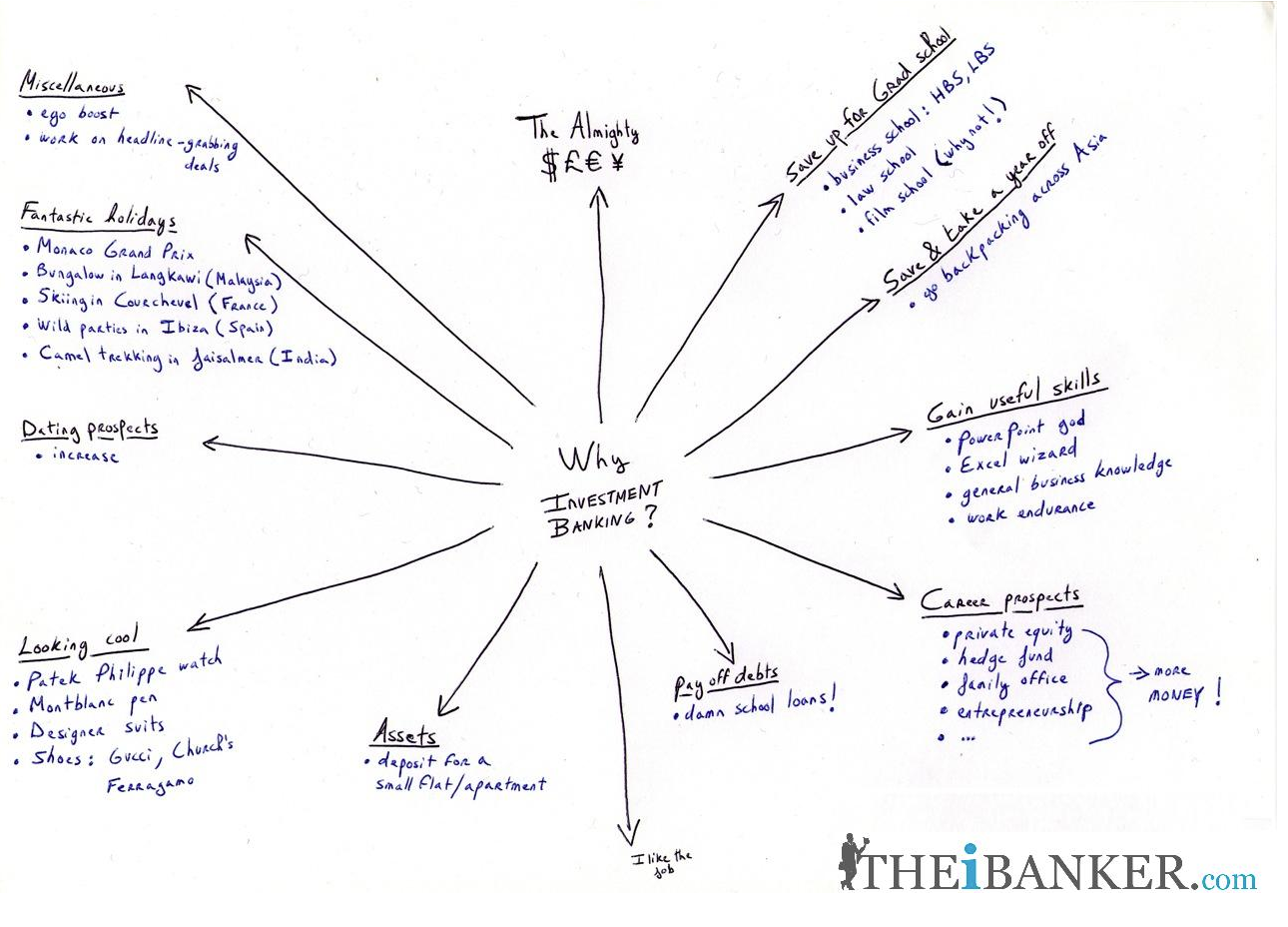
Why go into investment banking (as opposed to grad school)?

Davos envy and Romney’s income in the last two years (and tax rate) have got quite a few people thinking and talking about the morality and usefulness of the financial sector. The odd thing, however, is that ever more brilliant college leavers (including from my alma mater) continue to be attracted to the financial sector and not the real economy (there was a brief decline after the 2008 recession but it appears that the trend is picking up again?

So why do college graduates want to be on the street or racking up lifetime miles in consulting? The simple answer is that returns are great, as shown in this illustration from theiBanker.

HT FTAlphaville.

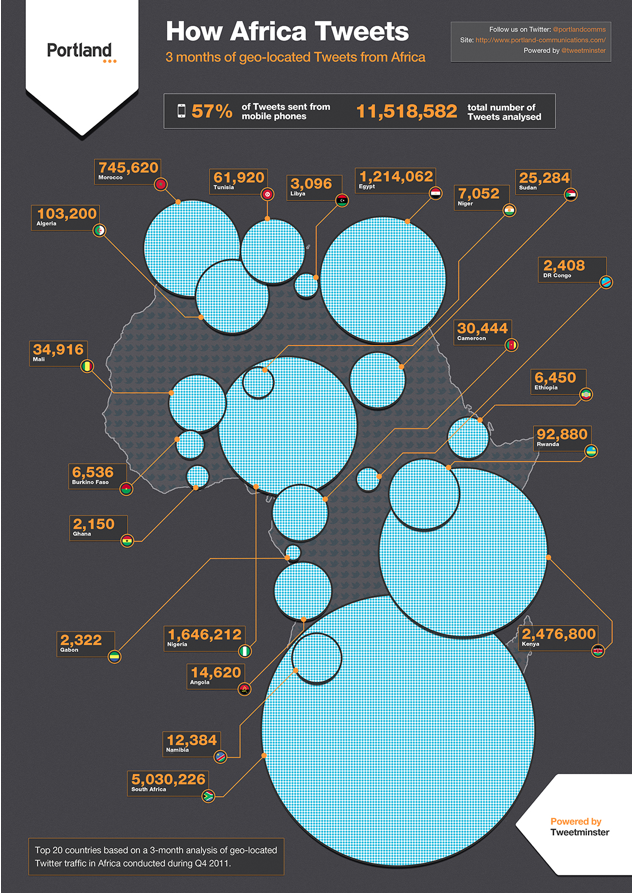
How Africa Tweets

Click on image to enlarge.

Just out of curiosity I did a quick calculation of per capita tweets based on the figures from Portland Communications. The biggest difference between the two rankings is Gabon. My guess is that the rather slight variation in the right and left columns (especially for the top ten) is a reflection of the fact that about 57% of tweets geolocated in the region are from the ever ubiquitous cell phones.

Ghana’s ranking on either column was rather surprising.

Top 20 (by volume) Top 20 (per capita)
South Africa
Kenya
Nigeria
Egypt
Morocco
Algeria
Rwanda
Tunisia
Mali
Cameroon
Sudan
Angola
Namibia
Niger
Burkina Faso
Ethiopia
Libya
DR Congo
Gabon
Ghana
South Africa
Kenya
Morocco
Egypt
Nigeria
Rwanda
Tunisia
Namibia
Algeria
Mali
Cameroon
Gabon
Sudan
Angola
Niger
Libya
Burkina Faso
Ghana
Ethiopia
DR Congo

More on this hear.

HT Jason Stearns.

Wade of Senegal insists on third term

UPDATE: The BBC reports that riots erupted in Dakar after a court in Senegal declared President Wade eligible to run in next month’s general election. President Wade will be seeking a third term in office.

More on this hear.

*********************************************

It looks like Senegalese may be forced to live with their country’s model of soft authoritarianism with reasonable levels of political competition for a few more years….

FT reports:

He may be at least 86 years old with 11 years as president behind him, but Abdoulaye Wade, Senegal’s president, says “he does not feel his age”, and is determined to serve another term and preside over a “generational transition” before retiring.

“In Africa we do not reason in terms of age. You find village chiefs who are 100 years old. So long as you have your wits about you, in African tradition age has advantages: wisdom (for example).” After seeing off rival veterans in polls scheduled for February 26 he would be the “last barracuda among the little fish”, he predicted in an interview in Dakar.

Senegal’s constitutional court will decide on Friday if the President can indeed run for a third term. Mr. Wade pins his hopes on legal gymnastics, insisting that the constitutional term limits enacted during his first term in office only went into force at the beginning of his second term.

Perhaps anticipating the outcome of the court ruling, the government has instituted a five-day ban on public protests beginning tomorrow (Thursday 26/1/2012). The opposition has vowed to carry on with protests should the five-judge panel of the constitutional court approve of Wade’s candidacy.

Many suspect that Wade’s insistence on running for reelection this year is part of an elaborate plan to have his unpopular son, Karim, succeed him. Karim unsuccessful tried to become Mayor of Dakar, the capital, in 2009. He is presently a “super minister” in his father’s government, overseeing dockets as diverse as energy and power, international cooperation, regional development, aviation and infrastructure.

The truth be told, the fact that Wade could even contemplate a third term is an indictment of the Senegalese opposition. They have consistently failed at uniting against Wade and have been more than willing to be bought off. Mr. Wade is well aware of this and did pass a law which permits the President of Senegal to be elected with only 25% of the vote.

It is still possible that the unpopular Mr. Wade may lose even if he gets his way in the courts.

More on the FT report here.

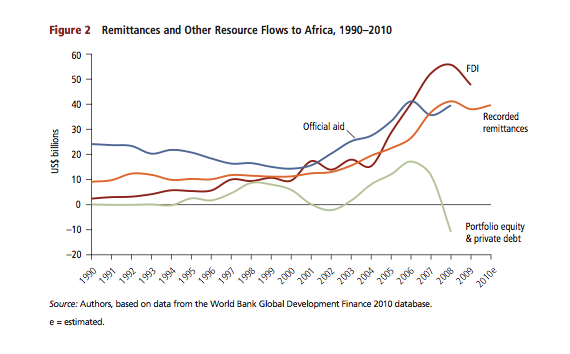
Resource flows in Africa

According to this figure FDI and recorded remittances appear to be trending in the right direction. Official aid and portfolio equity and private debt are not.

For more on this check out the World Bank’s new book (digital copy) on how Africa can leverage immigration to boost its growth prospects.

It’s important to remember that while overall these numbers may look encouraging, the problem of illicit capital outflows still plagues Sub-Saharan Africa (and other developing regions); and serves as an impediment to growth. Between 1970-2008 the region hemorrhaged an average of over $22b annually. Various studies (including this one) estimate that the private wealth held by Africans in tax havens and other shady depositories abroad may be upwards of $270b.

More on the politics of the ICC decision in Kenya

Here is an excerpt of a piece I have written over at African Arguments:

“While it might be too early to ascertain the full political impact of the ICC’s ruling, there is no doubt that it will provide a real test to Kenyan institutions – especially the judiciary. The courts will have to decide, amid intense political pressure, whether or not the accused are fit to hold public office and by extension whether those that want to can run for president.  Ultimately, however, a lot will turn on the decisions made by President Kibaki. Will he stand by his trusted lieutenants in Muthaura and Kenyatta or will he bow to public pressure and ditch them in an attempt to secure his legacy?”

More on this here.

ICC Kenya case ruling and its consequences

That the ICC’s website crashed an hour before the ruling was given underscores the importance of today’s ICC ruling.

In the end it emerged that charges against Deputy Prime Minister Uhuru Kenyatta, Head of Civil Service Francis Muthaura, MP William Ruto and radio Presenter Joshua Sang were confirmed. Former police commissioner Husein Ali and MP Henry Kosgey will walk, at least for now.

The political implications of the decision will be huge.

Firstly, President Kibaki must decide whether or not to retain two of his most trusted lieutenants in the government (Messrs Kenyatta and Muthaura) even as they face charges with regard to the death of 1300 Kenyans and the displacement of hundreds of thousands. Should the president decide to stand with them I suspect that soon the courts will have to decide whether these two are fit to hold public office.

Remember that Kenya has a resurgent judiciary eager to stamp its authority as an independent institution. There will be intense political pressure from Civil Society groups to see the two step aside.

Equally interesting will be whether the Independent Electoral and Boundaries Commission will allow Ruto and Kenyatta to run for president in light of these developments. Again, the case might go all the way to the Supreme Court. The Kenyan constitution has a clause banning those accused of certain crimes from holding public office. The vagueness of the wording in the constitution will give the courts discretion in reaching a verdict. I suspect some activism here was well.

Secondly, Ruto and Kenyatta will find it hard to sell their candidacy to Kenyans ahead of the general elections later this year. As the process continues, it will be hard for both (whether guilty or not) to hide from the gruesome crimes that were committed in 2007-08. I therefore doubt the viability of either one running for president at the top of a ticket. If they want to be on a winning team in this year’s election they must be part of a coalition.

But coalition building will be hard. For one, cracks are already appearing in either camp. Ruto recently got kicked out of a party he tried to commandeer after defecting from ODM. Mr. Kenyatta is also facing a simmering insurgency within his Central Kenya camp. The other thing is that the Kenyan economic and political upper class has revealed a willingness to throw the two under the bus if they become too much of a baggage. It is telling that a group of Central Kenyan tycoons have started warming up to Prime Minister Raila Odinga, the man to beat in this year’s general election.

I expect a flurry of press conferences to follow shortly. But I must go to bed for now. It is 3:15 AM…

Justice, the ICC and Kenyan Politics

A panel of judges at the ICC will issue their ruling tomorrow afternoon on whether or not six accused Kenyans will stand trial. The six include two declared presidential candidates. Either way the ruling will have a non-trivial impact on the pursuit of justice for the victims of the 2007-08 post-election violence (PEV). It will also significantly shape the politics of coalition building in this year’s general elections.

Because of the ICC process, the Kenyan justice system has put on ice its own process of holding the perpetrators of the PEV to account. A non-confirmation of the charges against at least some of the six co-accused will add the 2007-08 PEV to the long list of crimes against Kenyans, many of which have been committed by the high and mighty, that have gone unpunished.

Justice is political. Therefore, there is no doubt that if the process of prosecuting the crimes committed in the PEV returns to Kenya none of the big fish will be held accountable. That is the sad truth.

This is why despite the noisy political environment, a majority of the PEV victims (and other Kenyans) still back the ICC process. At the very minimum they want justice to appear to be served.

At the moment the problem of justice remains a worry largely monopolized by the 300,000 or so Kenyans in IDP camps and the relatives of the over 1,300 who were killed. [The media and the political class are squarely to blame for this shameful situation.] For the rest of the country, focus has shifted to the politics of the general elections due later this year. To this we now turn.

Two of the accused, William Ruto and Uhuru Kenyatta have declared their interest in the presidency. Mr. Kenyatta is currently the second most preferred presidential candidate after Prime Minister Raila Odinga. Mr. Ruto, while not as popular nationally, still commands a sizeable chunk of the votes in the country’s most populous province – the Rift Valley. The Rift Valley has also been the hotbed of political violence in country’s history, most of it over land.

A confirmation of the charges will seriously dent the presidential ambitions of Messrs Ruto and Kenyatta. It will make it harder for either of them to sell their candidacy outside of their immediate ethnic constituency. It will also give their opponents (and there are plenty) an opportunity to hold themselves as the clean candidates that ought to succeed Kibaki. Needless to say, a non-confirmation would bolster the duo’s campaigns. What will this mean for the general election?

It is common knowledge that the man to beat in the 2012 election will be Mr. Odinga. The two scenarios above will impact the outcome of the election mainly through their influence on the coalition building abilities of the anti-Odinga crowd.

More on this tomorrow in reaction to the ICC ruling.

Institutions and Political Change in Kenya

These are interesting times in Kenya. The Deputy Chief Justice and Vice President of the Supreme Court, Nancy Baraza, stands to lose her job for harassing a female security guard on New Year’s Eve.

Ms Baraza’s ordeal is interesting because it captures the momentous changes taking place in Kenya’s institutions of governance. The idea that a public official of such high stature could get in trouble for the “simple act” of threatening a security guard was laughable only a few years ago. Not long ago Kenya was divided between wananchi (loosely translates to citizens) and wenyenchi (owners of the country), the latter being virtually above the law. That has since changed. Even the president has in the recent past been forced to reconsider his actions whenever they were deemed to be in contravention of the supreme law of the land.

But the progression towards this state of affairs has not been straightforward – which is why I think that the Kenyan case is a good lesson in contemporary evolution of limited government.

Academic discussions of limited government revolve around the question of how to achieve credible commitment among the veto players within a polity. That is, how competing factions within the state can agree to a modus operandi that makes their interactions predictable and objectively justifiable based on a predefined idea of what actions are legitimate. The most common way to do this is usually to have institutions of state defined in constitutions and to regularly elect public officials.

But as Stasavage has argued, the mere existence of institutions and veto players is not a sufficient condition for credible commitment. There must be a guarantee that specific important veto players will have de facto veto power. In other words, it matters that various factions within society CAN balance each other.

How does this map onto the Kenyan case?

Contrary to the popular view, the story does not begin with the 2007-2008 post-election violence and the formation of the Grand Coalition Government. The story begins with the pro-capitalist policies of president Kenyatta that created room for the emergence of a wealthy upper class within Kenyan society. At the beginning, this class was totally dependent on the state for its reproduction. But over time, segments of the class acquired independence. Under Moi and now under Kibaki there is a sizeable chunk of the economic upper class that makes its money without a personalist connection to the state [You have to take my word on this, for now.]

The fact that both Odinga and Kibaki have had public fall-outs with wealthy co-ethnics who have then decamped to the other side is illustrative of this fact.

It is this emergence of “independent wealth” that provided the foundation of the strong opposition that emerged after Moi retired. Led by Raila Odinga and his allies, these politicians had the money and social capital to challenge the president and his men on equal terms. That is why when stuff hit the fan in 2007-08 Kibaki had no option but to agree to share some of his power with Odinga. The two men knew that neither of them could win the game of “my street against your street.”  It is also why the negotiated settlement that is Kenya’s new constitution was an exercise in give and take, with an absurd emphasis on procedure and self-executing clauses.

The implementation of the new constitution has not been any different. Which takes us back to Ms Nancy Baraza.

It is common knowledge that Ms Baraza was not an establishment appointment to the Supreme Court. She was part of the civil society coup in judicial appointments which also included the Chief Justice. Having “lost the court” the establishment ensured it had control by insisting on maintaining control over the Director of Public Prosecutions and the Attorney General. The establishment also controls the Police Force. Their challengers (who are no angels themselves) had the goodwill of civil society and big enough constituencies in key organs of the state – including the military. They also had a plurality in parliament.

So when Baraza got in trouble due to what appears to be a lapse in judgment, the establishment saw a chance to get her out. But they had to do it within the bounds of due process. And so they have been quick at it. The police (whose top brass will be fired soon by a panel laden with civil society types) conducted a quick investigation and concluded that the DCJ had a case to answer. The Judicial Service Commission has since arrived at the same conclusion, and recommended the Justice’s suspension to the president. The process has thus far been transparent, with very few questioning the legitimacy of the inquiry into the behavior of Ms Baraza.

Meanwhile the civil society has been dead quiet. Many fear that their hard fought gains of having two of their own (The Chief Justice and his deputy) in the Supreme Court will be eroded after Ms Baraza’s departure. I bet that when the dust settles and the debate over who should replace Baraza gets heated civil society (and the Odinga camp) will want to replace her with one of their own. It will be interesting to see if the establishment will move to alter the balance of power by challenging this implied consensus.

The long and short of it all is that it matters that competing forces in society credibly balance each other. In those countries (like in most of Sub-Saharan Africa) where presidents and their men have overwhelming power advantages over their opponents, it will be doubly hard for limited government to come about. If the Kenyan experiment succeeds it will be proof that you need not have an inter-ethnic love-fest or the lack of factions for limited government to emerge.

This is mostly a story about the Kenyan political and economic elites. What about the wananchi/masses? That will be the subject of a future post.
Guinea Bissau President is Dead, succession still unclear

Bacai Sanha, President of Guinea-Bissau has died in a Paris hospital.

Mr. Sanha was elected president in July 2009 following the assassination of former president Joao Bernardo Vieira by elements in the military.

Guinea Bissau has in the recent past experienced drug-trafficking-related political instability. Mr. Vieira’s murder was linked to a dispute between him and his military chief over drug connections. Last month’s arrest of  the head of the navy on suspicion of plotting a coup was also drug related. It remains unclear whether Mr. Sanha’s succession will follow constitutional channels or whether the military will take over.

More on this soon.

KCPE Results to be released Wednesday

The Kenyan ministry of education will release the results of this year’s Kenyan Certificate of Primary Education (KCPE) exam. At the end of primary school all students sit the national exam to determine which high schools they will attend.

For the first time, in the announcement will be ranked by Kenya’s 47 counties. In the past wealthier and more urban areas of the country have done better than poorer rural areas. For many critics the current education system in Kenya serves little more than replicate the existing class structure – with wealthier kids doing better in primary school, going to better high schools and then getting subsidized university education. Most poor students – the vast majority of KCPE candidates – never make it beyond high school.


Senegal and Mauritania

Dear readers, apologies for the sparse postings over the last several days (Yours truly is traveling in Senegal and Mauritania).

For the last three days I have been in Dakar. I must say that I love this town. I mean, the whole place needs a massive paint job and a few repairs here and there. But it also has an enchanted old town feel to it. Although on the water, it at once also has an inland town mood. The people are friendly, but not too laid back.

Tomorrow I head out to Rosso, a town in the north on the Mauritanian border. I am looking forward to the trip and hope to write something more detailed about my impression of Senegal thereafter. I will also keep you posted on how things are in Mauritania, where I hope to do a lot more traveling than I have done in Senegal.

One more thing, the people of Dakar appear to really not like their president, Abdoulaye Wade. All over town there is graffiti asking the president to leave. Elections are due next year in February and the president maintains that he will run for reelection despite being term limited. Just yesterday he rebuffed calls from a number of prominent people, including Kofi Annan, asking him not to do so. Whatever happens this will be a critical election to determine whether Senegal will continue to maintain its slightly constrained but largely respectable and competitive political environment or veer off in the direction of a less freer society.

Study: College football team wins, male students’ grades drop

Quoting Ezra Kline’s Wonkblog:

“A team of University of Oregon economists probes one of life’s age-old questions: Is there a relationship between academic gender gaps and a university’s football team’s performance?

The answer looks to be yes. In a National Bureau of Economic Research paper this month, economists Jason Lindo, Issac Swenson and Glen Waddell tracked how much female students at the University of Oregon were outperforming male students on grade point averages. They then mapped that against the number of wins the school’s football team had that season. And they found that, when the Oregon Ducks did better, the male students did worse.”

Would be interesting to see how Stanford undergrads have done in the last couple of years when one Andrew Luck has shown the world to not only respect but also FEAR THE TREE.

More on this here.

Waiting for Kabila to be Charlemagne

Joseph Kabila was sworn in today as President of the DRC following disputed elections last month. The main opposition has vowed to not recognize him as the legitimate president and are planning street protests. Some analysts believe that there will be blood in the streets of Kinshasa and other major urban centers.

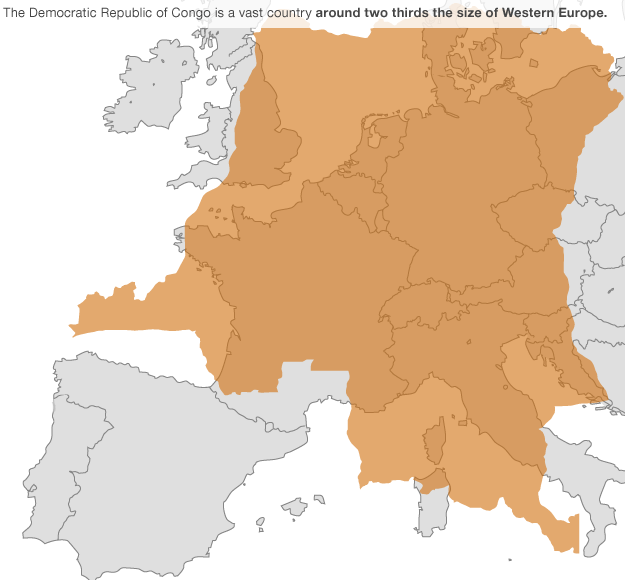
If you think for a moment about the size and diversity of the DRC it becomes clear how hard it will be for the incorrigibly inept enormously challenged Joseph Kabila to be the one to drag the DRC out of its 50 year tailspin.


Democratic Republic of Congo

The truth be told, Mr. Kabila would not do any better running a village mboga kiosk. He is not an autocrat in the mold of Kagame, Zenawi, Museveni or even Sankara. He is closer to Samuel Doe, Bokasa and Valentine Strasser, ineffectual at best and outright disastrous at worst.


Kenya’s stalled operation in Somalia

The East African reports:

There are four major factors that have bogged down the military campaign. They are: Lack of finances to run a long-drawn war; the differences between interested parties over whether to divide Somalia into autonomous regions or maintain one united country; differences over the option to engage Al Shabaab in a political dialogue, and the ambivalence of Somalia’s President Sheikh Shariff Ahmed.

Kenya’s intention has always been to create an autonomous region in southern Somalia to act as a buffer to the chaotic mix that is central Somalia. The plan has apparently become even more ambitious:

Kenya is proposing the division of Somalia into eight autonomous regions: Central region or Hiran; Somaliland; Puntland; Bay Bakool; Jubaland; Shabelle; Gedo and Mogadishu, commonly known as Banadir.

But it is increasingly becoming apparent that the cost and politics of such an operation may not be as palatable as the planners had initially thought.

President Sheikh Shaiff’s ambivalence is intended for the domestic audience and also motivated by his desire to concentrate power in Mogadishu (he dislikes the idea of autonomous regions proposed by Kenya).

The first source of ambivalence is reasonable. No president wants to be in support of a foreign invasion that occasionally results in the death of innocent citizens. I hope the Kenyan commanders, under AMISOM or not, do not pay too much attention to his flip flopping on how to engage the al-Shabab.

The second is not. Two decades of warfare have made it clear that trying to solve Somalia’s problems from Mogadishu may not be a good idea. The only way that might happen is through a force like the Islamic Courts Union. But the international community will not allow a pure military solution, given the human rights implications.

Perhaps it is time a decentralized peace initiative got underway.

Finally, it is encouraging that after weeks of pro-war jingoism the news media in Nairobi have begun to question the execution of the war in Somalia. More public discussion about the logic and cost of the war needs to take place in order to keep both the generals and politicians on the straight and narrow.

More on this here.