Lest we forget…

There was a time when Somalia was different…

Democracy is also a deeply rooted Somali political principle which, I suspect, continues much as usual in the more remote parts of the nomadic interior. How long it will be before it reasserts itself in the central political life of the state remains to be seen.

We are still waiting.

For an account of the politics of the Siad Barre coup of 1969 check out Lewis (1972)

Kenyan politician John Michuki dead at 80

John Michuki, MP for Kangema is dead at 80. The late Michuki was a Kenyan politician that many learned to love (and sometimes love and hate). As Transport Minister he brought sanity to the rowdy matatu sector with the much-loved “Michuki Rules”. As Minister for the environment he cleaned up Nairobi River.

His less illustrious contribution was in the security ministry. It is under his watch that the Standard Media group was raided by masked thugs under the pretext that they were about to publish information that would have “impinged on the person of the president.” It later emerged that the media house had information about alleged illegal dealings by a woman rumored to be an illegitimate daughter of president Kibaki. The war on the Mungiki sect was also carried out under his watch – with numerous allegations of extrajudicial killings of hundreds of young men.

The son of a paramount chief, Michuki was among the group of super-wealthy conservative elites who at independence took over power and managed to quiet the more radical elements of the independence movement. Under their watch Kenya emerged as a capitalist enclave even as its many neighbors flirted with communism and African Socialism, with disastrous consequences. For better or worse, Kenya benefited from this “home guard generation” (see Bates 1989, for instance; for a different view see AfriCommons).

The Kenyan political scene will sorely miss Mr. Michuki’s straight talk and ability to deliver. He was among a handful of government officials that actually stood for what they believed, and he had results to back up all his talk. As the Nation reports:

Michuki gained the reputation of being a “ruthless” and efficient manager, who is widely acknowledged as being among the best performing ministers in President Kibaki’s government.

May he rest in peace.

The dangers of simplistic single narratives

As Stearns argues in this excellent book, the causes of the conflicts in eastern DRC are multiple and complex. Yet simple narratives in the media and among aid workers and advocacy groups have tried hard to reduce these causes to a fight over minerals; and similarly the consequences as mass rape of women and young girls (remember the video cameras fiasco??). In reality the story is more complex than this.

Here is a quote from a good paper on the international community’s responses to the Congo (DRC) conflicts by Severine Autesserre in the latest edition of African Affairs:

“These narratives focus on a primary cause of violence, illegal exploitation of mineral resources; a main consequence, sexual abuse of women and girls; and a central solution, extending state authority. I elucidate why simple narratives are necessary for policy makers, journalists, advocacy groups, and practitioners on the ground, especially those involved in the Congo. I then consider each narrative in turn and explain how they achieved prominence: they provided straightforward explanations for the violence, suggested feasible solutions to it, and resonated with foreign audiences. I demonstrate that the focus on these narratives and on the solutions they recommended has led to results that clash with their intended purposes, notably an increase in human rights violations.

The international actors’ concentration on trafficking of mineral resources as a source of violence has led them to overlook the myriad other causes, such as land conflict, poverty, corruption, local political and social antagonisms, and hostile relationships between state officials, including security forces, and the general population. Interveners have singled out for support one category of victims, sexually injured women and girls, at the expense of others, notably those tortured in a non-sexual manner, child soldiers, and the families of those killed.”

The paper is a grim reminder that “fixing the Congo”  – whatever that means – will take a long time. More on this here.

Kenyan Intervention in (al-Shabab dominated) Southern Somalia

The ICG has an excellent new report on the state of the the Kenyan military intervention in Somalia.

The pressing issues raised in the report include economic, political and social concerns:

The slow pace of the military operation and the high cost of keeping troops in the field are the main reasons behind Nairobi’s desire to operate under AMISOM command. The treasury would then not have to pay the full cost of the campaign. It is estimated that Linda Nchi is costing the government at least KSh 210 million ($2.8 million) per month in personnel costs alone in a year of a record KSh 236 billion ($3.1 billion) budget deficit. If the interven- tion’s cost is not contained, already high inflation will spiral, and local discontent could become more serious…..

The intervention in Somalia is likely to have a complex impact on Kenyan Somalis’ political positions, because their attitude toward it is not straightforward. The government’s desire to establish a buffer zone between the border and the rest of Somalia privileges the Ogaden, the majority Kenyan-Somali clan. The possibility of a semi-autonomous state in the south of Somalia politically dominated by Ogaden may not be favoured by the minority, marginalised clans of north-eastern Kenya, such as the Ajuran and Degodia…..

Views within the ethnic Somali and wider Muslim community regarding the war are mixed but predominantly critical. Even those now mildly supportive could easily become hostile, especially if things go badly wrong, and civilian deaths mount. The notion that the war is popular within the Muslim community is wishful thinking, and the potential to exacerbate already worrying radicalisation in the country is very real. The police and other security services have shown some restraint in bigger cities, but there have been numerous reports of abuses in North Eastern Province.

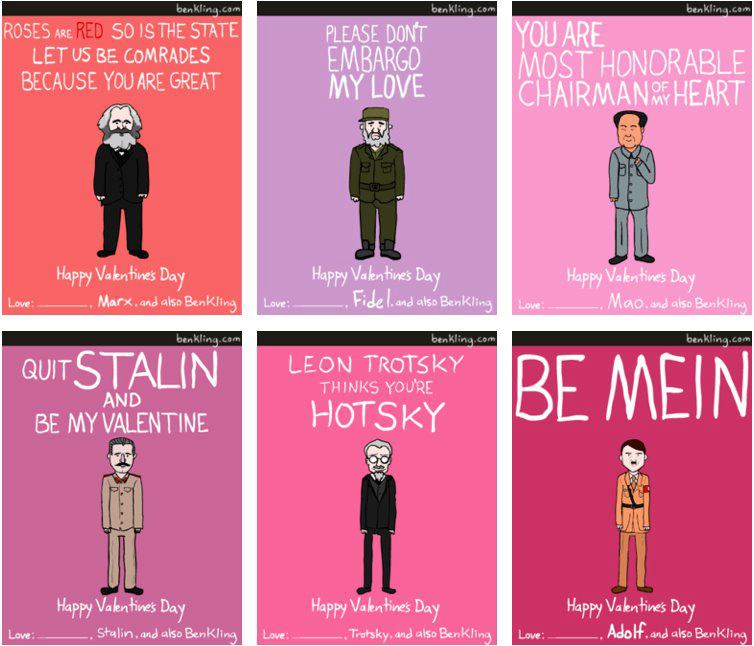
14th of February Edition

Click to enlarge.

Source: http://benkling.tumblr.com/

H/T Paul G.

College Memes Edition

It’s a rainy Monday in Palo Alto..

More on this here.

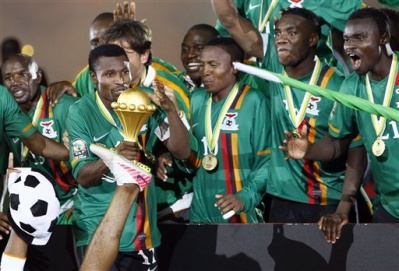
Zambia’s Chipolopolo win the Africa Cup of Nations

Congratulations to the Chipolopolo and their fans all over the world!

Source: Jakarta Post

Innovation in Kenya

The Kenyan tech industry just got another boost, this time from the global phone maker Nokia. The Sunday Nation reports:

Nokia plans to make Nairobi its global hub for research and investment for the India, Middle East and Africa region.

The move is a big win for the country which will serve as a nerve centre for Nokia’s global research activities, bringing together application developers, businesses and software engineering eco-system from around the world.

The company has research facilities in 13 locations worldwide, and Nairobi will be its nerve centre.

The Nairobi Nokia Research Center (NRC) located at the Nairobi Business Park along Ngong Road previously served the African region only.


A note from Mr. Development Man

Perhaps after experiencing a Bill Easterly moment, a friend of mine (grad student here at Stanford) had this on his facebook wall:

“Hello, my name is Mr. Development Man. I know Africa so much!! I went there one summer and stayed with an NGO. I talked to my servant cook who served me food, so I know African workers. I read a few books written by white Americans about Africa, and remembered their big words. So I know African ideology. African prostitutes talked to me at my hotel poolside, so I know about relationships in Africa. I took pictures of kids at the orphanage, so I know how Africans suffer.

My conclusions: Africans are corrupt. The place is poor because of poor policies. And my knowledge can help them. If they just listened to my smart American knowledge — obtained from the 2 months at the NGO, my white man books, my prostitutes, my few words with my servant cook — they would develop!! Why don’t they listen to me?? I can help them…Stubborn, corrupt African politicians…

Signed, Mr. Development Man. Remember, I am here to help you Africa!!”

I have a sense that Mr. Development Man’s note is directed at both development practitioners and academics alike. Let us all take heed.

Chad, who is into short stories and is also a late night radio DJ, wrote this Letter to Mr development man on the dynamics of the love-hate relationship between donors and aid recipients.

H/T Chad.

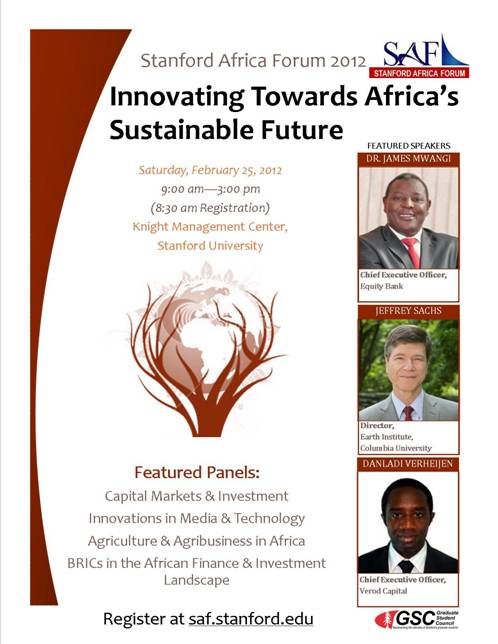
Stanford Africa Forum 2012 (Feb 25th)

Please register here.

Stanford Africa Forum 2012 (Feb 25th)

Here is introducing the annual Stanford Africa Forum:

SAF is organized by a multinational and multidisciplinary group of Stanford University students who share a common passion: a firm belief in the potential and promise of the African continent. Previous editions of the Forum have placed the spotlight on this potential and we plan to continue in this tradition with the 2012 edition.

Here is a link to the 2012 SAF Conference website. If you can make in on Feb 25th 2012 please register and show up.

In which Mitt Romney channels Downs (1957)

Sometimes politicians get out of character and reveal the naked truth about the strategic logic of hunting for votes in a two-party electoral system.

Briefly stated, the median voter rules (also check this out).

[youtube.com/watch?feature=player_embedded&v=wqyEnJ3b4Mo]

For more on this check out the piece on the Times website.

Picture of the Day

Introducing the Magdeburg Water Bridge in Germany.

Africa’s most forgotten Democrat

Who was the first leader of independent Africa who lost an election and agreed to step down?

No, it was not Mathieu Kerekou of Benin.

Because my adviser [I doubt he reads this blog] spent some of his early years in academia working and publishing on Somalia, I have been reminded quite a few times that back in 1967 Somalia’s president Aden Abdulle Osman Daar was actually the first leader of independent Africa to lose an election and agree to step down [see here].

This is a fact that many Africanists and journalists have forgotten. Please give credit where it is due.

South Africa and the AU [Rant and rave alert!!]

As you may already know South African candidate for the AU Commission Chair Nkosazana Dlamini-Zuma (ex-wife of president Zuma) failed to get elected. Instead the AU extended Mr. Jean Ping’s term till June. Ms Dlamini-Zuma intends to vie for the seat again in June.

South Africa and its backyard (SADC member states) had lobbied hard for Ms Dlamini-Zuma.

The South African Business Day reports:

Mzukisi Qobo of the University of Pretoria says: “It is clear that this is an intensely divisive campaign, and plays into the hands of those who view SA as harbouring intentions of running roughshod over other countries. Unity in the AU is a facade reinforced by a poorly conceived notion of pan-Africanism.

“Africa’s political elites still think very much in terms of regional groupings — east Africa, north Africa, southern Africa and west Africa — as well as along the colonial lines of Francophone, Lusophone and Anglophone. These are realities that are there.”

SA’s foreign policy stance has been back and forth, which may have caused more divisions with countries like Nigeria and Egypt.

 But political analyst Steven Friedman does not think policy “flip-flopping” was the reason Ms Dlamini-Zuma did not get the post. With its economic infrastructure strength, other countries feared that SA would dominate Africa politically if given a chance, he says.

To which I say, why not?

What would be so wrong with a reasonably stable and important regional player taking charge of the rudderless dictators’ club institution that is the AU? The organization’s failures in the recent past – including in Libya, Sudan, Cote d’Ivoire, Somalia, Zimbabwe, DRC, Central African Republic, etc – have been partly because no single country has managed to emerge as its de facto leader and ultimate guarantor (forget the delusional late King of Kings, he was a clown on steroids).

Instead of having a strong leadership – whether by a single country or by a group of regional representatives – the AU has opted to have weak leadership in the form of a Commission headed by nondescript individuals political lightweights unable to rally the member countries to any respectable cause. The only time the club’s dictators are ever united is when they dump on the ICC and all other manner of foreign infringement on their “sovereignty” (which to them means the right to starve, jail or murder their citizens). The existing post of a rotating presidency has also been a complete sham.

Obiang was the latest one to occupy the post. Yes, Teodoro Obiang Nguema Mbasogo of Equatorial Guinea. This guy.

May be this episode will end Pretoria’s navel-gazing and encourage it to focus on having a coherent Africa policy that will provide strong leadership for the AU.

A leaderless organization of 54 states, new $200m headquarters or not, is a useless organization.

For more on this see here and here.

Also, check out this thought-provoking piece on the symbolism of the new AU headquarters.