Capital flight continues to plague poor nations

According to the Center for International Policy:

“Exactly 10 times the $100bn spent on aid and debt write-offs by rich countries is siphoned out of developing countries, with corporations responsible for 60 per cent of that figure through a web of trusts, nominee accounts and the flagrant mispricing of goods to escape tax………

Cracking down on tax havens and the evasion of taxes by some of the world’s biggest companies is seen as the ‘missing link’ in the poverty alleviation agenda.”

This got me thinking, perhaps naively, why it is that rulers (i.e. presidents and their entourage, most of whom fuel capital flight) in the Global South cannot secure their own property rights.

It makes sense that Mobutu and Co. (perhaps the worst pilferers ever) did not invest in Zaire (presently the moribund DRC) and so siphoned (or allowed allied firms to do so) billions abroad because the country lacked attractive investment options, mostly because of weak property rights. But it is also true that throughout his over three decades in power he and his buddies were perhaps the best placed Zaireans to secure their own property rights. Why didn’t they do it?

The quick answer might be that they had a very limited subjective time horizon and lived in constant fear of coups.

Most of the arguments out there stop here. Time horizon is king. Limited time horizons are bad for long-term investment. Yada yada yada.

But shouldn’t we also expect that after say 10 years in power a leader or elite group updates and realizes that may be they are there to stay, and start laying the foundation for local use of stolen wealth? Some certainly have – Kenya’s Moi and his henchmen come to mind.

The reasons for these leaders to invest locally are legion. The state of the roads, hospitals (think of say Ugandan elites who have to fly to Kenya or South Africa for medical care), insecurity (in Kenya MPs have been attacked by armed robbers), schools, etc etc in these places make it such that an average person in say Palo Alto enjoys a much higher standard of living than some of the wealthier people in the Global South.

What is the point of living in Kinshasa with billions in Europe, and with only one life to live? At what point does it make sense to use some of the money to improve the living standards (even in the most selfish way) in the place where one actually lives?

At the very least, don’t these guys mind the very dusty roads to their residences?

PS: The local use of wealth is, of course, relative. Even Chinese leaders, despite their massive domestic investments, still stash money abroad where property rights are more secure.

The Presidential Race in Kenya’s 4th of March 2013 Election

The race to succeed President Kibaki promises to be an interesting one. All the pointers indicate that it will be a close race between the Raila-Kalonzo-Wetangula and co. faction vs. the Uhuru-Ruto-Mudavadi and co. faction. Prime Minister Raila is expected to be at the top of the ticket under an umbrella special purpose vehicle called CORD (Coalition for Reforms and Democracy). Deputy Prime Minister Uhuru Kenyatta leads his own SPV called the Jubilee Alliance. Below I give a little background information before delving into the state of the race.

Institutions Matter:

The 2011 Kenyan constitution mandates that the winning presidential candidate garner 50% + 1 of the votes cast and at least 25% of the votes in at least half of Kenya’s 47 counties. In addition, presidential candidates and their veep candidates must run on a joint ticket. Previously, the presidential candidate could promise the veep slot to any number of ethnic chiefs. The constitution also limits the president’s ability to buy support by limiting the number of cabinet slots to 22 (necessitating the creation of minimum winning coalitions).

This situation has forced Kenya’s politicians to form alliances that cross ethnic lines, a change from the past when nearly all the major ethnic groups produced their own presidential candidates. The logic of minimum winning coalitions has set in, with two main camps forming ahead of the polls – Mr. Odinga has insisted all year on the stump that this is a two horse race between him and a straw man non-reformer, and that any other candidates are mere donkeys.

In this cycle the big five (Kikuyu, Luhya, Luo, Kamba and Kalenjin, together making over 70%) are all in either CORD or the Jubilee Alliance. Continuing the Luo-Kikuyu feud that has characterized Kenya’s political history since 1966, this election will pit the son of Kenya’s first president (Kenyatta) vs. that of the first vice president (Odinga). CORD’s formateur is Odinga (a Luo) who leads the Orange Democratic Movement (ODM). Jubilee’s is Kenyatta (a Kikuyu) who is leader of The National Alliance (TNA).

It is likely that CORD will field Odinga as the presidential candidate and Vice President Kalonzo Musyoka (a Kamba) as his running mate. Jubilee is likely to field Kenyatta as the the presidential candidate and William Ruto (a Kalenjin) as his running mate. This would leave the Luhya as a big five swing group. Such a scenario favors Odinga, who is already widely popular in Western Province (Luhya-land) and sections of Rift Valley Province (Kalenjin-land). This scenario is likely, but not set in stone.

The ICC Question:

Mr. Kenyatta and Mr. Ruto are facing charges at the ICC over the post election violence that rocked Kenya in 2007-08. Back then they were in opposing parties – Mr. Ruto with Odinga in ODM and Mr. Kenyatta with Kibaki in PNU. They are both suspected to have funded gangs of rival ethnic groups (Kalenjin and Kikuyu) that committed heinous crimes including murder, rape, and arson. The international community has sent a strong signal – through Kofi Annan’s statements, threats of sanctions and the EU’s travel ban on the duo – that the two should not run for office.

The Kikuyu business elite (including cash crop farmers and horticulturalists who would be hardest hit by international sanctions) have thus been trying to prevail on Mr. Kenyatta to forgo his presidential run in favor of Mr. Musalia Mudavadi (a Luhya) – evidence suggests that this was the carrot that Uhuru and Ruto used to lure Mr. Mudavadi into their coalition. If Uhuru steps down for Mudavadi then a good chunk of the Luhya vote would depart CORD for Jubilee. But it may create room for the lesser presidential candidates from Kenyatta’s region – Martha Karua and Peter Kenneth – to get a sizable chunk of the Kikuyu vote. Plus it is unclear if Mudavadi can weather the accusations of being Kenyatta’s project on top of campaigning against the formidable Mr. Odinga. Kenyatta’s last presidential bid faltered partly because he was seen as Moi’s project.

The State of the Race:

Ipsos Synovate, a local polling company, just released a poll of adults 18+ on their preferred candidates for president. Mr. Odinga leads the pack with 34% of the respondents saying he is their preferred candidate. Mr. Kenyatta is second with 27%. Mudavadi, the other likely Jubilee candidate polls at 5%. Musyoka and Ruto poll at 3% and 2% respectively. It is important to note that it is only Mr. Odinga and Mr. Kenyatta who are presently outperforming their ethnic group size in the polls (by 21% and 2% respectively). 22% of Kenyans remain undecided. Notice that the number of undecideds is highest in provinces that lack a presidential front-runner, i.e. all except Central (Kenyatta) and Nyanza (Odinga).

click on image to enlarge.
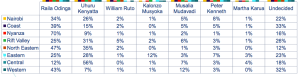
opinion polls

If Odinga eventually faces off with Kenyatta the key swing region that will determine the outcome of the election will be the Rift Valley Province. Mr. Odinga will have Nyanza, North Eastern, Western, Coast and half of Nairobi in the bag. Mr. Kenyatta will have Central, (possibly) the Rift Valley and half of Nairobi locked in. In this scenario (let’s call it scenario 1), for Mr. Kenyatta to win he would have to run the numbers in both the Mt. Kenya region (which as a whole has about 24% of voters, according to the 2009 census) and the Rift Valley Province (with 25% of voters) and get a good showing in Nairobi.  For Mr. Odinga to stop him he would need to have a respectable showing in the Rift Valley – something that he can given the fact that he has managed to keep key leaders from the region in his party, ODM. In Scenario 1 Odinga will be the favorite to win.

If Jubilee nominates Mudavadi to face Odinga, then things will get interesting (It would also potentially make for a de-ethnicized presidenital race). Key questions will be:

  1. Whether the Kikuyu would vote for Mudavadi, given that the ticket would not have a Kikuyu (with Ruto as running mate). Would they opt for other Kikuyu presidential aspirants in Martha Karua and Peter Kenneth?
  2. Whether Mudavadi would manage to unite the Luhya bloc behind him. Luhya leaders have traditionally had a hard time uniting the region to vote as a bloc. Can Mudavadi overcome the sub-ethnic divisions of the Luhya?
  3. Whether Mudavadi will be able to effectively fight the inevitable portrayal of his candidacy by the opposition as Uhuru Kenyatta’s (or Kibaki’s) project. Can Mudavadi be his own man?

If the Rift Valley, Mt. Kenya (Central and sections of Eastern) and Western vote go to Mudavadi en masse, it is hard to see how Odinga can make it to State House. In this scenario, turnout would be key. Jubilee would win by a landslide. But while this situation is likely, it’ll still be a huge gamble for Jubilee to nominate Mudavadi.

Mr. Odinga has more national appeal than his former ODM assistant Mudavadi. The latter lacks a strong political base in his home region of Western Province. Add to that the fact that he will leave the gates with the imprint of “project” on his forehead, not to mention the uncertainty over how Mt. Kenya region would vote and the election becomes a real tossup ex ante. Nominating Mudavadi to head the Jubilee ticket would be a high risk gamble for Uhuru and Ruto that would either pay off big come March 4th or hand Odinga victory on a silver platter.

The Jubilee Alliance will nominate its candidate (either Uhuru or Mudavadi) next week. CORD will name its presidential candidate (very likely to be Mr. Odinga) on the 22nd. I expect minor defections and realignments that will have a non-trivial impact on the race before then. All in all right now Odinga is a slight favorite to become the fourth president of Kenya.

 

Where do robbers choose to locate?

Rob thy neighbor appears to be the decision rule for robbers, at least in Chicago. Bernasco, Block and Ruiter, writing in the January 2013 issue of the Journal of Economic Geography, present research on robbers’ choice of crime sites:

“This article analyzes how street robbers decide on where to attack their victims. Using data on nearly 13,000 robberies, on the approximately 18,000 offenders involved in these robberies, and on the nearly 25,000 census blocks in the city of Chicago, we utilize the discrete choice framework to assess which criteria motivate the location decisions of street robbers. We demonstrate that they attack near their own homes, on easily accessible blocks, where legal and illegal cash economies are present, and that these effects spill over to adjacent blocks.”

The graph below (on p. 129 in the paper) illustrates robbers’ tendency to carry out their activities closest to where they live (for reasons why see the paper).

crime location

crime frequency and distance from robber residence

The findings are at once obvious and insightful. The insightful bit is that because of the geographic concentration of crimes and criminals, sometimes it might make more sense from the point of view of authorities to just focus on containing criminal activity within specific neighborhoods, leading to further entrenchment of a culture of crime in those neighborhoods.

If you notice,  in most places – including Nairobi – certain types of crime only get reported when they cross these implicit barriers. Otherwise, crime in bad neighborhoods becomes a case of if a tree falls in the forest.

Happy Independence Day to All Wananchi Out There!!

Kenya is 49, and with a lot to celebrate.

flag

Mahama Elected in Ghana, Opposition Challenges Results

This post has been updated.

Incumbent President John Dramani Mahama of Ghana has been declared the winner of the closely fought Ghanaian presidential election. The Ghanaian electoral management body (EMB) announced that Mahama had garnered 50.7% of the vote vs. Akufo-Addo who got 47.74%. The opposition has however refused to concede defeat, claiming that the president’s party colluded with the EMB to fix the results.

The BBC reports that police had to disperse crowds who had gathered near the EMB’s offices. Tanks remain on guard around the area. Most observers considered the elections to have been conducted in a free and fair manner.

More on the DRC

CFR has a nice interview with Jason Stearns, DRC expert and author of Dancing in the Glory of Monsters. Jason in part notes that:

This crisis has brought about a shift in international donor policy for the region, in particular criticism and financial sanctions against Rwanda, which is something that’s new. However, using aid as leverage only makes sense in the context of a larger political process. Bashing Rwanda just for the sake of bashing Rwanda is not a solution. There needs to be a comprehensive political process into which that kind of pressure can be funneled and channeled. But there is no such process at the moment. What you have are talks mediated by a regional body—the International Conference for the Great Lakes Region (ICGLR)—that has the irony of being presided over by Uganda, which is itself playing a role in the conflict by supporting the M23. These talks have been largely limited to an evaluation of the March 23, 2009 peace deal, and the potential formation of a regional military force to deal with the FDLR and M23. But the causes of the crisis run much deeper and involve the failure of local governance, the weakness of the Congolese army, and the persistent meddling of neighboring countries in Congolese affairs.

This is precisely what informs my contention that there is too much focus on the international dimension of the conflict at the expense of the kinds of reforms that Congo needs in order to improve state capacity in Sub-Saharan Africa’s biggest country.

You can’t do business, implement a human rights regime, or even pretend to have democratic governance in a stateless environment (Unless, of course, you live in a state of nature in which everyone has capacity to defend themselves against aggression by others).

Some, including very serious and influential people, think that the solution to Congo’s weakness is to plea with its neighbors not to prey on it. I disagree. I believe that the best solution ought to be the strengthening of Congo so it can deter its neighbors. The international community just wasted a good opportunity to force a cornered Kabila to agree on a peace deal that is self-enforcing, i.e., that reflects the power balance in eastern Congo.

As things stand the continuation of the power vacuum in the Kivus will continue to attract rebels, foreign-sponsored or not.

More on this here.

Also here is a  glimpse of some of the actions by Kabila and his Kinshasa cabal which make it extremely unlikely that the situation in Congo will improve under his rule.

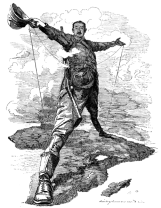
Did European Colonialism Benefit Africans?

“We find it difficult to bring the available evidence together with plausible counter-factuals to argue that there is any country today in Sub-Saharan Africa which is more developed because it was colonized by Europeans. Quite the contrary.”

That is Leander Heldring and James Robinson writing in a new paper on the negative impact of colonialism on Africa’s economic prospects.

Source: Wikipedia

Source: Wikipedia

Interesting attempt at positive analysis of a difficult subject (esp. with regard to counter-factuals), although normative undertones drive most of the analytical narrative.

The negative legacies of colonialism – despotism, negative ethnicity, aid dependence, and general underdevelopment, etc – certainly do persist.

But for those unwilling to submit to the gods of path dependence, the question remains one of how long incompetent African leaders will continue to blame outsiders for their own ineptitude. After half a century of independence, many Africans are wary of being the only ones left in the “bottom billion” once the East and South Asians climb up.

When will African leaders (and elites more generally) realize that a generator, a borehole and a septic tank, and a security guard at their mansions on dusty streets are not substitutes for well functioning power grids, water and sanitation systems, and general security?

To paraphrase Achebe, the trouble with Africa is simply and squarely a failure of leadership. There is nothing basically wrong with the African character. There is nothing wrong with the African land or climate or water or air or anything else. Even external conquest and subsequent colonialism was not unique to Africa.

H/T Chris Blattman.

State of the Presidential Race in Kenya’s 2013 Elections

UPDATE:

Since this post went up Musalia Mudavadi joined the UhuRuto coalition. This sets the stage for a real two horse race for the presidency between Raila Odinga and either Mudavadi or Uhuru Kenyatta. It is very likely that Mudavadi will run as a compromise candidate due to the charges Uhuru is facing at the ICC. This development, considering Kenya’s ethnic arithmetic, essentially gives the Uhuru camp a head start ahead of the March 2013 presidential elections. Whatever happens, this promises to be a very interesting and close presidential election.

***************************************

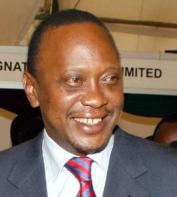
The presidential race in Kenya’s 2013 elections is beginning to take shape. Yesterday Uhuru Kenyatta and William Ruto unveiled a political pact that will see them run on a joint ticket, with Mr. Kenyatta at the top of the ticket. Messrs Uhuru and Kenyatta both have pending cases at the ICC on charges that they were behind the post-election violence that rocked Kenya in 2007; leaving 1300 death and more than 300,000 displaced. This has led some to dub their joint platform the “ICC ticket,”  since many see the union of the two as solely driven by their joint desire to earn immunity from prosecution by the ICC once they secure the presidency.

uhuru

Uhuru Kenyatta

The second big coalition will see former allies turned foes and then allies – Raila Odinga and Kalonzo Musyoka – come together. Mr. Musyoka is the sitting Vice President while Mr. Odinga is the Prime Minister. The latter is believed by many to have been the winner of the disputed 2007 presidential election. The electoral commission at the time said it did not know who won the election and declared President Kibaki reelected, sparking two months of violence across the country.

The third potential political grouping might gravitate around Odinga’s former deputy, Mr. Musalia Mudavadi. Mr. Mudavadi has been rumored to be in talks with several smaller parties, including those of Peter Kenneth, Raphael Tuju, among others.

Raila Odinga

Raila Odinga

The latest developments will make for an interesting race moving forward. The ethnic arithmetic involved – Kenyans vote largely along ethnic lines – will make for a very close race (More on this soon). Messrs Odinga and Kenyatta are the clear front-runners, with the former having a slight lead in the most recent opinion polls. The constitution requires the president elect to win 50 percent plus one votes, making it very likely that there will be a runoff between the top two contenders after the first round. The ethnic calculations makes Odinga, a Luo, the likely winner in case of a runoff (Uhuru, a Kikuyu, is the son of Kenya’s first president. The current president, Mwai Kibaki, is also a Kikuyu.) But Mr. Kenyatta might still win in the first round.

The biggest uncertainty moving forward will be the candidature of both Uhuru and Ruto. Following the opening of their cases at the ICC they had to resign as cabinet ministers. Already there is a petition in court seeking to bar them from running in the upcoming elections on grounds that their integrity is questionable. The constitution requires only individuals of the highest integrity to be eligible to run for office (It is hard to see how any Kenyan politician will avoid having at least one strike against their candidature).

The supreme court may eventually bar Uhuru and Kenyatta from running – the talk in the street is that if they are unfit to be mere cabinet ministers then they should also not occupy the two highest offices in the country. Their supporters obviously disagree. In their rallies “UhuRuto” have played the nationalist card, insisting that not foreigners (read the ICC) but Kenyans will decide who will be their next president. It is still unclear what course of action they and their supporters would take were they to be barred from running.

More on this soon.

Kerry or Rice? The View From Africa

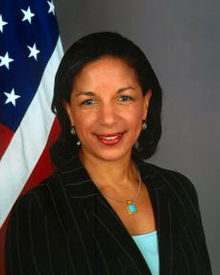
The window is closing fast on the chances of having an Africanist as US Secretary of State (Minister of Foreign Affairs). Republicans in the US Congress, human rights activists and a section of Africanists have come out in opposition to Ambassador Susan Rice. Republicans insist that she lied to Americans about the real masterminds of the attack on the US embassy in Libya that resulted in the deaths of four Americans, including the ambassador. The Africanists and human rights activists are not enthused by Ms Rice’s cozy relationship with the regimes of Paul Kagame of Rwanda and the late Meles Zenawi of Ethiopia. A section of African elites (the elitist sovereignty crowd) may also be wary of her support for interventionism on humanitarian grounds.

Source: Wikipedia

Source: Wikipedia

As things stand Pres. Obama might be forced to choose Sen. John Kerry over Ms Rice in order to avoid an unnecessary war with a section of Congress at a time when everyone and their dogs and cats should be worrying about the fiscal cliff.

John Kerry would not be a terrible choice. His past focus on drug trafficking in Latin America, free trade agreements and climate change would make him useful to Africa.

As I have written before, Africa is increasingly becoming a transit point for drugs from Asia and Latin America destined for the European market. Africa also needs more trade with the US beyond AGOA. And climate change will probably affect Africans the most since the vast majority of them depend on rain-fed agriculture and live under conditions that can least withstand natural disasters. But Kerry is not an Africa expert and has done little on the region beyond his support for the South Sudanese cause. This makes it hard to see how he will connect his global focus on these important issues to the African context.

Susan Rice on the other hand has studied Africa and has in the past shown a pragmatism that you want in the top US diplomat. Plus it helps that Ms Rice would have Obama’s ear as she is reported to be very close to the president. She has had successes at the UNSC, the highlight of which was the intervention in Libya to stop Gaddafi from butchering civilians in Benghazi. Rice is a smart straight-talker whose undiplomatic streaks can be a plus in a region full of under-achieving strongmen.

For a very long time Foggy Bottom has seen Africa through a humanitarian lens. Even Hillary Clinton, with all her awesomeness, has done little in new initiatives for Africa beyond human rights issues and a campaign that involved providing cameras for rape victims in eastern DRC. These are not unimportant issues. I am not saying that human rights catastrophes in Africa should be ignored. Just that this should not be a secretary of state’s pet project for the entire the region.

In my opinion Ms Rice’s biggest plus is that she gets one of Africa’s biggest challenges: state incapacity.

It would be nice to have a US secretary of state who takes state capacity development in the region as her pet project (and has the guts to at times subordinate democracy promotion to this project). Her praise of Kagame and Zenawi (no doubt both rabid and at times murderous autocrats) was centred around this very same idea (and to be honest, the ghosts of Rwanda circa 1994). Democracy promotion is a noble cause. But it must be done with a sober mind. The last thing you want is a procrustean approach to the promotion of rights, freedoms and liberties like we have seen in the past.

(Just for the record, I am pro-democracy and have criticized the likes of Kagame here and here, among other forums).

Anyone who reads the development reports side by side with the human rights reports from Rwanda and Ethiopia must be conflicted. I have talked to a senior opposition figure from Ethiopia who told me that she thinks the biggest challenge to fighting Meles Zenawi (at the time) is that “people see the dams and the roads.” It is hard to ignore revealed competence. I would hazard to guess that most people would rather live in autocratic Singapore than democratic Malawi. Yes, it is not an either/or argument with these regimes. All I am saying is that interventionism has to be constructive and not lead to the rolling back of hard fought gains against disease, illiteracy and poverty in these states.

As I opined following Obama’s reelection, I think that security will be at the top of the US Africa policy, of course dressed up in rhetoric about democracy and human rights. John Kerry will handle that on auto pilot. His focus will be on the Middle East and South Asia. It would have been better to have an Africanist at the helm who understands more about the continent and could sneak in a few policy agendas here and there that could make a difference on the ground. An aggressive focus on state capacity development could have been one of those policies.

This is a missed opportunity for Africa. For the first time in history Africa had a chance to have the number one American diplomat be a person who is an expert on a section of the region (Ms Rice wrote a thesis on Zimbabwe). Her defense of a couple of African autocrats aside, I think Ms Rice would have been better for Africa than John Kerry – who in all likelihood will focus on the Middle East and South Asia and continue Sub-Saharan Africa’s designation to the “humanitarianism column.”

Who is the M23?

Jason Stearns over at Congo Siasa provides a link to a backgrounder worth reading on the rebel group.

Also with regard to the M23, Onyango-Obbo of the East African has some advice for Kabila:

In the past 15 years, the Banyamulenge have fought the same fight in the DRC [ “the persecution of the Congolese Tutsis”]. Kabila can be smart, offer them a political deal and save DRC, or choose the destructive path preferred by successive Congolese governments of recent years and lose eastern DRC — or even power in Kinshasa.

Criticisms and ultimatums to the eastern DRC rebels like that issued at last week’s Kampala emergency summit, and international condemnation and sanctions, will not change that fact.

I share Onyango-Obbo’s view on this matter.

The international community’s singular focus on the humanitarian disaster in eastern DRC (caused by Rwanda’s and Uganda’s meddling) is giving Kabila a chance to kick the can down the road one more time – until the next time that a group of a few hundred men with guns chase his troops out of town and kill and rape and loot and cause all manner of harm to innocent civilians while they are at it. Then the same dance will be orchestrated – condemnations from the UNSC and bloggers, regional summits, a few resolutions that never get implemented, etc.

The present hue and cry in the media about the M23 misses the fact that you can’t simply wish away the de facto power imbalances in eastern Congo by appealing to humanitarian concerns. The woefully incompetent FARDC and the Kinshasa government cannot tackle the better organized rebels backed by more savvy armies in Uganda and Rwanda.

To end the conflict in eastern Congo Kabila must give a lot of concessions to the rebels. Without concrete concessions the conflict will merely have been postponed to a later date.

The alternative is for Kabila and his Kinshasa cronies to wake up one day and decide to lead a competent government and national armed force that will deter Rwanda, a country that is 88 times smaller with almost 7 times fewer people, from meddling within their country’s territory. That is, if they can.

Governing on the cheap in Africa

What is striking and surprising here is just how easy it can be to take over some African states, or large parts of them.  The post-independence historical record provides numerous examples where dozens or a few hundred armed men have done it.  This is generally just assumed to be the way things are in Africa, but when you think about it it is actually really puzzling.  Being the president in African countries (and many others besides) can be an incredibly lucrative deal.  Why don’t these rulers, in their own self-interest, take some of that money and use it to build crack units, presidential guards, or strong and loyal army divisions that would protect their hold on power against two dozen putchists, or a hundred or a couple thousand rebels armed with rifles and maybe some mortars?

I don’t think we have really good explanations for this in the relevant Pol Sci literatures.  Maybe the most promising hypothesis is that African presidents are so afraid of coups and attacks from inside their regime that they don’t want to support the construction of any organization that would be competent at using force.  Keeping the military weak  may lower their coup risk somewhat, but effectively trades coup risk off against higher risks of rural rebellion, insurgency, and foreign depredations such as we are seeing in Eastern Congo.

That is Jim Fearon writing over at Monkey Cage. More on this here.

Jim’s concern extends beyond security matters. Much of Africa remains under-governed in other regards as well – tax collection, garbage collection, provision of public goods like water and sanitation, roads, etc etc.

One key driver of this phenomenon, I believe, is the manner in which sectional elites (and those that they purportedly represent) are incorporated into the national system.

You see, many African national governments tend to have a president surrounded by a coalition of ethnic/sectional elites representing specific geographic regions or communities. This sort of incorporation of elites and the regions/social groups that they represent allows African central governments to govern on the cheap since as long as ethnic chief from region X can bring his people and sort of make them feel represented in the centre then the government has no reason to establish a strong presence in the chief’s homeland region (unless that region is economically viable).

A keen observer may ask why co-ethnics of these “ethnic chiefs” never demand for more from their supposed representatives at the centre.

The answer lies in the nature of citizenship in most of Africa. In many countries citizenship (and the associated claims on the state) tends to be mediated through one’s ethnic group. Talk of “our people” is common across much of the region. Even educated people have internalized the fact that you can only get jobs if a co-ethnic is in a high position in government. Everyone therefore invests in having a powerful ethnic representative at the centre that can effectively bargain with whoever is president (or in the core of the governing coalition) to get enough jobs for the boys and girls from back home.

But having such a person obviates the need for the central government to establish its presence at the local level since it is much cheaper to give the ethnic chief his own fiefdom in the name of a cabinet ministry. Barriers to entry allow for very long tenures for these ethnic chiefs thus breeding incompetence of the worst possible kind – like the case of Kenyan police officers accepting bribes from al-Shabab operatives to allow for passage of explosives destined for Nairobi.

From the president’s/government’s perspective, all you have to do to prevent an all out rebellion is be on good terms with enough of these ethnic chiefs or make it beneficial for them to live under your rule.

Seen this way, under-government is not just for the sake of coup-proofing but also an unintended consequence of the manner in which the masses and their representative elites are incorporated into the national government/state.

The best book out there that I have read on this subject is Catherine Boone’s Political Topographies of the African State. Boone is best read with Jeffrey Herbst’s States and Power in Africa, although Herbst’s conclusions are too deterministic for my liking.

Is this the beginning of the Third Congo War?

Yesterday Goma fell to the M23, a rebel group in eastern DRC with alleged links to both Rwanda and Uganda. The fall of Goma increases the likelihood of an all out war in eastern Congo that might quickly degenerate into a regional war – just like the Second Congo War was (for more on why peace failed see this ICG report).

I am on record as lacking any sympathies for the Kinshasa regime under Joseph Kabila (see here, here, and here). The horrendous situation in eastern DRC is as much his fault as it is of the alleged meddlers from Kampala and Kigali. The fact that the international community has taken to viewing the conflict as primarily regional is a mistake as it masks Kabila’s own failings in improving governance in the eastern DRC . It also gives him a chance to continue free riding on MONUSCO’s presence in the region.

Sadly, the international community appears set to waste this latest crisis by issuing statements and imposing sanctions which will only tackle the symptoms rather than the real problems behind the conflict. As the ICG argues:

If international donors and African mediators persist in managing the crisis rather than solving it, it will be impossible to avoid such repetitive cycles of rebellions in the Kivus and the risk of large-scale violence will remain. Instead, to finally resolve this conflict, it is essential that Rwanda ends its involvement in Congolese affairs and that the reconstruction plan and the political agreements signed in the Kivus are properly implemented.
For these things to happen Western donors should maintain aid suspension against Rwanda until the release of the next report of the UN group of experts, in addition to issuing a clear warning to the Congolese authorities that they will not provide funding for stabilisation and institutional support until the government improves political dialogue and governance in both the administration and in the army in the east, as recommended by Crisis Group on several previous occasions.
Over at Congo Siasa, the DRC expert Jason Stearns offers some preliminary thoughts on M23’s endgame:
In the past, I have speculated that it will be difficult for the M23 to conquer and hold territory, mostly due to their lack of manpower, which started off at around 400-700 and is probably around 1,500-2,500 now. They have been able to rely on Rwandan (and, to a lesser degree, Ugandan) firepower for operations close to the border (in particular Bunagana and Rutshuru, allegedly also this recent offensive), the farther into the interior they get, they harder it will be to mask outside involvement.
Alliances with other groups­­––Sheka, Raia Mutomboki, FDC, etc.––have acted as force multipliers, but have been very fickle, as the surrender of Col Albert Kahasha last week proved. From this perspective, the M23 strategy could well be more to nettle the government, underscore its ineptitude, and hope that it will collapse from within.
However, the recent offensive on Goma has made me consider another, bolder alternative. If the rebels take Goma, thereby humiliating the UN and the Congolese army, they will present the international community with a fait accompli. Yes, it will shine a sharp light on Rwandan involvement, but Kigali has been undeterred by donor pressure thus far, and has been emboldened by its seat on the Security Council. Also, as the looting by the Congolese army and their distribution of weapons to youths in Goma has shown, the battle for Goma is as much of a PR disaster for Kinshasa as for Kigali.

UN reports gains in the global fight against AIDS

There is more good news in the area of public health. A couple of days ago I posted on the decline of human mortality rates in the tropics. Now the UN agency for HIV/AIDS, UNAIDS, reports that HIV infection rates, especially of the mother-to-child variety, are on a downward trend.

The New York Times reports:

New infections with H.I.V. have dropped by half in the past decade in 25 poor and middle-income countries, many of them in Africa, the continent hardest hit by AIDS, the United Nations said Tuesday.

The greatest success has been in preventing mothers from infecting their babies, but focusing testing and treatment on high-risk groups like gay men, prostitutes and drug addicts has also paid dividends, said Michel Sidibé, the executive director of the agency U.N.AIDS.

Adding that:

Some regions, like Southern Africa and the Caribbean, are doing particularly well, while others, like Eastern Europe, Central Asia and the Middle East, are not. Globally, new infections are down 22 percent from 2001, when there were 3.2 million. Among newborns, they fell 40 percent, to 330,000 from 550,000.

Africa for Norway

Some light humour, because it is a nice and sunny Wednesday morning here in Nairobi and winter is about to get real for millions of hapless Norwegians.

[youtube.com/watch?gl=US&feature=player_embedded&v=oJLqyuxm96k]

More on this here.

H/T VKW

The state of the web

Internet access still relatively costliest in Africa.

source: This is Africa

I would argue, though, that in the case of Africa even as costs come down relative to per capita income, the latter has to go up as well from its present low point.