China in Kenya

Image

Increasing Chinese soft power in Africa is real.

China in Kenya

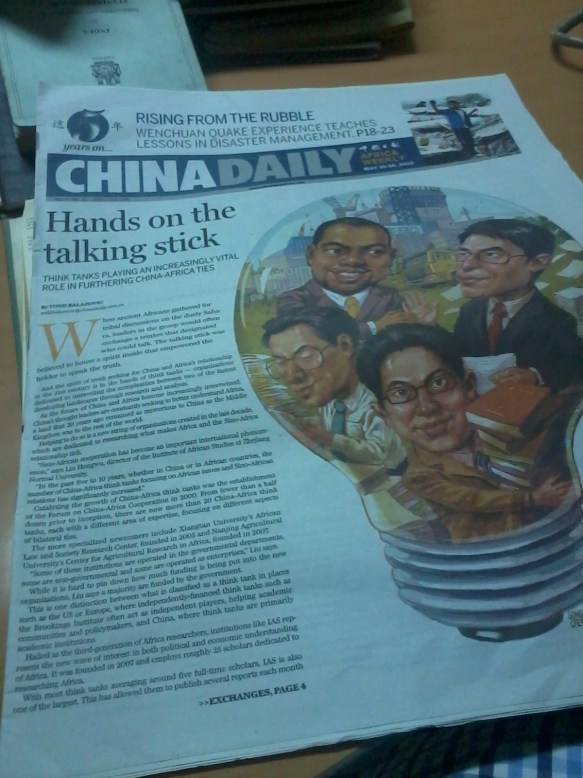
I have been spending a lot of time in government offices and libraries in Nairobi lately. One thing that struck me this morning is that China Daily now publishes an Africa Weekly magazine and that government offices in Nairobi actually subscribe to it. They do not subscribe to the IHT.

Does Chris Blattman hate state capacity?

The simple answer is NO. The long answer is below.

Blattman’s latest post decries Bill Gates’ (and much of the development community’s) focus on data gathering, and may I add, strengthening of statistics departments. He writes:

I would like to see better GDP numbers–who wouldn’t?–but it’s hard for me to see the constraint on development this revelation would relieve, and why it’s anywhere close to the top ten constraints poor countries face.

The problem with those of us in the development complex, be we academics or Presidents or foundations or NGOs, is we want the world nicely ordered with levers to pull and a dashboard to monitor. And so we put a lot of energies into levers and dashboards and monitors.

I think of poverty and political powerlessness in terms of constraints and frictions–the limitless host of things, little and big, that made it more difficult to run a business profitably or turn a profit or invent a new product or get your kid educated or select the leader who serves your interests. States and institutions and norms and technology and organizations reduce these frictions and relieve these constraints. That is the fundamental driver of development. This is the basic logic behind almost every theory of development in your textbooks, from growth models to poverty traps to everything in between.

Blattman is right that improving the capacity of statistics departments will not do much to alleviate poverty now (although as I write this in the basement of a government library in Nairobi I can’t stop thinking that stats departments need to do more). At the same time however, I would be wary of an outright dismissal of the need for better data gathering by governments, for two reasons.

Firstly, at the core of state capacity is the ability to make legible (depite Scott’s observations) the terrain over which the state claims to have dominion. Strong states are those that know your home address, the number of children you have and how much money you made last year. When governments have the capacity to get better GDP data, they will also know how many kids died or were not immunized last year, etc etc. And perhaps more importantly, they will be able to know how much you made last year and how they can get a bigger share of it. As Besley and Persson have argued, there is a strong case to be made for the centrality of public finance to development. Poor countries have small tax bases yes, but tax evasion in these countries still denies national treasuries lots of cash. And it is not just a question political will. Low capacity plays a role. Imagine trying to implement an income tax in a country of about 20 million adults but where under 4 million are in formal employment and can have their taxes withheld.

Secondly, Blattman seems to be making an argument for the private sector as a key part of greasing frictions that stifle development (which is true). But the private sector initiatives he cites can only flourish when there is strong state monitoring (with reliable data) in the background. Credit bureaus need a strong and enforceable regulatory framework. Otherwise no one will believe their credit reports. Freedom of (government) information laws are cool, but such information must first exist, and in reliable format. In other words stats departments must do their job well.

Lastly, good data also make for more informed politics. Kenya, for instance, could do with more disaggregated GDP data – by counties or lower – as it attempts to implement a devolved system of government and revenue allocation.

All this to say that when states have a handle on how much is produced, they will know how and where to get their share. And the more they demand a bigger share, the more the people will demand some of it to be returned as public goods (and these can also include reliable information that would be accessed via freedom of information laws). Yes, GDP data was invented post-WWII when some countries were already winning against poverty for decades. But even before that the more successful states were the ones that were better at information gathering. Flying blind is simply not an option for states.


Fraud and vote patterns in Kenya’s 2013 election

Update: The video link now works. Many thanks to SAIS for fixing it and letting me know.

**********************

The video below has been making the rounds in the Kenyan online community. The Daily Nation even reported on the claims by UCSD Professor Clark Gibson and James Long, Asst. Prof. and University of Washington, that President Uhuru Kenyatta may not have crossed the 50% threshold in the March 4th election. The duo conducted an exit poll (N = 6000) on election day that showed both candidates in a statistical tie at 40.9% for Odinga and 40.6% for Kenyatta. In the presentation Clark and James make the case that exit polling is superior to PVT because it is immune to things like ballot stuffing and tallying fraud. NDI sponsored ELOG conducted a PVT that confirmed the results announced by the Kenyan EMB, the IEBC.

[youtube.com/watch?v=68a3cUrq1gI&feature=youtu.be]

I do not really know what to make of this poll finding by James and Clark at the moment. I am waiting for the actual MP and Governor elections results to be published by the IEBC so I can try and see if the results in these local races were in line with the presidential results.

Resource sector accountability in Africa: The supply side story

I was recently in Ghana for some preliminary work on an evaluation project that a few colleagues at IPRE Group and I will be working on later this year. On my trip I talked to people engaged in transparency initiatives targeting Ghana’s extractive sector. Most of you probably know that Ghana is the second biggest exporter of gold in the region, after South Africa. It also recently joined the club of African oil exporters. In the recent past Ghana has been touted as a model for transparency and accountability in the resource sector (I wrote about it here). EITI commended the country for going beyond the recommended minimum reporting threshold. That said, the country still has a long way to go, especially with regard to the gold sector (most of the publicized initiatives concentrate on the oil sector, forgetting the much older gold mining sector.)

My conversations with some of the CSOs working on various kinds of transparency initiatives revealed to me that the problem of government opaqueness in reference to resource sectors is not just because of lack of political will. It is also about governments’ lack of capacity to supply accountability. Take the example of oil drilling. In order to provide transparency to its citizens the government has to have a proper revenue management system (complete with accurate models of predicted production, prices, etc); well trained technical staff that can hold their own against the savvy experts (engineers, geologists, etc) of the oil companies; and the technical means of delivering information in a digestible form to the masses. As it is in most governments, Ghana included, ministries in charge of resources are often staffed by loyal political appointees, some whom lack the technical expertise to effectively carry out their jobs.

This is not to downplay the political economy aspects of resource sector accountability. Just to say that there is a difference between Obiang’ and Mahama. For the former, technical fixes may do little to increase transparency in Equatorial Guinea’s oil sector. But for the latter, the political situation necessitates the provision of set minimum levels of accountability. So to the extent that there is a failure to do so in the case of Ghana we should not be quick to scream politics but instead also consider ways of improving the state’s capacity to supply transparency and accountability.

A look into Kenyatta’s new cabinet

President Kenyatta has announced 16 of 18 cabinet secretaries in his administration. The list of names has elicited mixed reactions. On the one hand the manner of the announcement – on the steps of State House – was different, and dignified. It was much less pedestrian than what Kenyans had become used to – presidential cabinet appointments via press releases to newsrooms. Six women made the list, including in the powerful Defense and Foreign Affairs dockets. With the exception of Balala and Ngilu, all the nominees so far are not politicians.

But on the other other hand grumblings emerged on the lack of regional (read ethnic) balance in the appointments. Kenya is an ethnically fragmented country, with 11 (out of 42) ethnic groups with populations over 1 million (Kikuyu/GEMA, Luhya, Kalenjin, Luo, Kamba, Somali, Kisii, Meru (part of GEMA), Mijikenda, Turkana, Maasai). For most of the country’s history ethnicity has been a key organizing principle of politics, with people largely voting along ethnic lines for various instrumental reasons.

So what is the ethnic breakdown of Kenyatta’s cabinet so far? Here is my guestimation based on their last names: Kikuyu (3), Kalenjin (4), Somali (3), Luo (1), Meru (1), Kisii (1), Kamba (1), Luhya (1), Arab (1). Two slots remain unoccupied.

Only two groups (Kalenjins and Somalis) are clearly overrepresented in the cabinet appointments in proportion to their relative ethnic group size in the country (Kalenjin 25% vs 13.2%; Somalis 18.75 vs 6.3%). Those groups in the top ten that are underrepresented missed their “objective proportion” of the cabinet by about one slot, on average.

On an aside, historically African presidents have actually been pretty good at ethnic balancing in the appointment of cabinet ministers – as Francois, Rainer and Trebbi show in this paper. They claim to “show that African ruling coalitions are large and that political power is allocated proportionally to population shares across ethnic groups. This holds true even restricting the analysis to the subsample of the most powerful ministerial posts. We argue that the likelihood of revolutions from outsiders and the threat of coups from insiders are major forces explaining such allocations.

If the ethnic composition of the cabinet is anything to go by, it shows the extent to which deputy president William Ruto is more of an equal than deputy to President Kenyatta. His part of the Jubilee coalition dominates the list of cabinet nominees. Or it might just be a case of Mr. Kenyatta, being president, having opted to have his half of the cabinet “represent the face of Kenya” (Kenyatta and Ruto had a 50-50 pre-election appointments sharing agreement at the formation of the Jubilee coalition).

Despite Kenyans’ relief at the end of Odinga and Kibaki’s coalition government, the era of nusu mkate might still be among us.

In related news, president Kenyatta broke one of his campaign promises by not appointing an ethnic Turkana as secretary in charge of Energy and Petroleum. Kenya’s oil discoveries have been mostly in Turkana County. The Standard reports:

Uhuru [President Kenyatta] repeated he will appoint a Turkana to head the Ministry of Energy portfolio should he take over the next Government.

Kenyatta said his Government would give first priority to locals to manage the oil resources that were discovered in the area.

“Our mandate is to ensure that every Kenyan gets equal share of national cake. But locals where such resources are found should benefit more as a right stipulated in the Constitution,” he said.

Deputy President William Ruto also broke a promise he made yesterday. He said at a presser that the cabinet will not have any politicians, yet Charity Ngilu and Najib Balala have been nominated.

Kenyatta’s Cabinet Nominees:

  1. Fred Matiang’i (Information, Communication and Technology) – Kisii
  2. Henry K. Rotich (The National Treasury) – Kalenjin
  3. James Wainaina Macharia (Health) – Kikuyu
  4. Amb Amina Mohamed (Foreign Affairs) – Somali
  5. Adan Mohammed (Industrialisation) – Somali
  6. Ann Waiguru (Devolution and Planning) – Kikuyu
  7. Davis Chirchir (Energy and Petroleum) – Kalenjin
  8. Amb Raychelle Omamo (Defence) – Luo
  9. Eng Michael Kamau (Transport and Infrastructure) – Kikuyu
  10. Phyllis Chepkosgey (East African affairs, Commerce and Tourism) – Kalenjin
  11. Prof Jacob Kaimenyi (Education) – Meru
  12. Felix Kosgey (Agriculture, Livestock and Fisheries) – Kalenjin
  13. Prof Judy Wakhungu (Environment Water and Natural Resources) – Luhya
  14. Dr Hassan Wario (Sports, Culture and Arts) – Somali
  15. Najib Balala (Mining) – Arab
  16. Charity Ngilu (Lands, Housing and Urban Development) – Kamba
  17. Ministry of Labour, Social Security and Services (Vacant)
  18. Ministry of Interior and Coordination of National Government (Vacant)
Will Kenya’s civil society survive Kenyatta’s presidency?

This is the question – what’s civil society to do if it feels so strongly about the Kenyatta regime? There’s no doubt Mr Kenyatta and his government have the support of a lot of Kenyans. That’s unarguable. But there are many Kenyans who are apathetic.

Take it from me – apathy is strongest in civil society. It’s an “existential moment” for some of the leading lights of civil society.

They feel betrayed by a population they’ve always fought for. In fact, most of the freedoms Kenyans enjoy today were made possible by civil society, including the 2010 Constitution.

Many are questioning the ability of the human rights movement to uproot embedded tribalism and the money corruption of the wealthy.

No one knows whether civil society will survive the Kenyatta regime and, if so, in what shape. We are in uncharted territory. But I can point to some possible routes. I believe Mr Kenyatta understands that his regime suffers from a “legitimacy deficit”.

That’s because of the charges against him at The Hague and the contested nature of the election. He may try to co-opt some civil society leaders into his regime to shore up his credibility.

That is the Chair of the Kenyan Human Rights Commission, Dr. Makau Mutua writing in his Sunday Column on the challenge ahead of civil society under the Kenyatta administration. He goes on to add that:

….others may accept the outcome of the election and “move on,” as has been urged. This cohort would simply go back to the trenches and continue their fight for human rights – much in the same way they did under former President Kibaki.

….there is a group that’s likely to disengage, and “divorce” the human rights movement. This chunk may “resign” from civil society. A number may even “divorce” Kenya. Some may go for further studies, or join the private sector. This group took Mr Kenyatta’s election the hardest, and cannot reconcile itself to the choice of a supposed plurality of Kenyans.

Mr. Mutua is one of the few civil society members who have come out strongly against the election of President Kenyatta. His views represent those of a significant proportion of Kenyans who feel that much of the democratic gains of the last 20 years have been lost with the election of Kenyatta and Ruto, scions of former President Moi.

The progressive forces in Kenya are presently in a state of shock. This was their election to lose. Having managed to get a favorable constitution in 2010, many had banked their hopes in Raila Odinga to implement it. Instead, Mr. Kenyatta captured the State House and control of both houses of Parliament.

Mr. Odinga’s loss has left many disillusioned with the Kenyan political system. Once again, despite valiant attempts to even the playing field, money and entrenched interests triumphed over progressive ideals. 

Museveni: UN missions stifling state capacity development in Africa

The Daily Nation reports:

Ugandan President Yoweri Museveni has said UN peacekeeping missions [especially in the DRC] are derailing efforts by African governments to end conflicts.

He criticised the UN system of peacekeeping saying: “External support by the UN makes governments lazy and they don’ t focus on internal reconciliation.”

“The mistake is internal actors with no correct vision and the UN which does not focus on internal capacity building but instead focusing on peace keeping all the time. Without the internal solutions, you can’t have peace, ” Mr Museveni said in a statement on Thursday.

Some Congolese and experts on the DRC may disagree with Museveni’s analysis but it has some truth to it. As I pointed out in an African Arguments post several months ago, there is no short cut to fixing the Congo. State capacity development must be THE overriding concern (for more on this see here and here).

Also, The International Crisis Group has a nice piece on the recent takeover of the mining town of Lubumbashi by Mai-Mai fighters. The writer notes:

Since President Joseph Kabila’s controversial election victory in November 2011, government control over DRC territory has been in drastic decline. Beyond the fall of Goma to the M23 rebellion, Kinshasa has failed to repel the activities of various other armed groups: the Mai-Mai Morgan in Province Orientale, the Ituri Resistance Patriotic Front (FRPI) and the Mai-Mai Yakutumba in South Kivu, Rayia Mutomboki in North and South Kivu, as well as the Mai-Mai Gédéon in Katanga. (On the eastern Congo armed groups, see the October 2012 briefing Eastern Congo: Why Stabilisation Failed. On the Katanga armed groups, see the report Katanga: The Congo’s Forgotten Crisis.)

Why Raila Odinga Lost

Why did Raila Odinga, the man to beat in the 2013 Kenyan presidential election, end up losing by up to 7 percentage points? Here are some quick answers:

I. Bad campaign management:

Back in 2009 James Orengo, one of Raila’s closest operatives said this about Mr. Odinga:

“Odinga has done nothing to reorganise his office to make it more effective. Odinga is a poor manager who does not follow up, and he is primarily focused on preparing for his presidential run in 2012, Orengo said. Odinga has avoided bold moves because he is hostage to his difficult political constituency”

The constituency mentioned must comprise of politicians and not the residents of Kibera because Mr. Odinga’s ODM/CORD secretariat was run by old/disconnected politicians. Yes he may have had administrators running the back office but the face of the ODM operation was one Franklin Bett, a veteran politician that elicited a lot of distrust from voters and presided over a sham of a nomination process. President Kenyatta’s Jubilee coalition was the polar opposite. Youthful Johnson Sakaja and Onyango Oloo presented a face of professionalism in the management of TNA affairs.

TNA also had a rather chaotic nomination process, but Sakaja and Oloo seemed to be in charge and gave the impression of being fair arbiters. For instance, they allowed Ferdinand Waititu, a stone thrower, to run against Evans Kidero for the governorship of Nairobi when they could have rigged in Jimnah Mbaru, a much better candidate. Over at ODM Raila Odinga’s brother and sister were fighting nasty nominations in Siaya and Kisumu respectively, which gave people the impression that the party wanted to rig in Raila’s relatives.  

Mr. Odinga’s lack of managerial abilities was also displayed in the choice of his son (Fidel) as controller of the purse for some campaign operations. An ODM operative in the Kidero campaign intimated to me that some of the money was never used and that t-shirts intended for campaigns were kept in storage in readiness for Raila’s swearing in! Mr. Odinga’s wife also ruffled a few feathers during the campaign period. The heavy visibility of his family made it much harder to avoid seeing Mr. Odinga’s campaign as a family affair. 

II. Strategic blunders: 

Raila Odinga’s campaign had several strategic blunders, going back a few years. 

  1. The Mau Forest Issue: 

    If Raila Odinga had garnered at least 20% of the vote in Kalenjin land in the Rift Valley province we may be having a different discussion today. His dismal showing in the Kalenjin heartland was partly because of his strategic myopia with regard to the eviction of squatters in the Mau forest. The cabinet, which at the time included William Ruto, Uhuru Kenyatta and Mwai Kibaki, approved the plans to preserve the Mau forest water tower by evicting those who were squatting in the protected areas. Yet, Raila Odinga managed to allow himself be left holding the political bag for the evictions (Many of those who lost land in the process were actually wealthy land owners with thousands of acres). 

    Come election time four years later, one of the issues that arose was why the poor who were evicted had not been resettled. At the time Mr. Odinga, through James Orengo, was in charge of the lands ministry. Instead of addressing the issue head on politically, the Odinga camp kept saying that treasury (run by Kenyatta then later by his allies) was witholding funds to resettle the evictees, thereby walking right into the political trap. What stopped Orengo, the lands minister, from allocating land to the evictees, thereby forcing treasury to rescind this offer or worse to evict the people from their newly allocated land? 

  2. Voter registration:

    TNA completely outmaneuvered ODM in registering voters in their strongholds. Local political analyst Mutahi Ngunyi (of the tyranny of numbers fame) was partly right when he said Kenyatta won the election on December 18, the day voter registration closed. Again here Odinga could have done better. Many youth in his strongholds did not register for lack of national identification cards. Yet Mr. Odinga controlled the ministry in charge of issuance of IDs through Otieno Kajwang’. Why didn’t Odinga mobilize his base to register?

    My theory is that his lieutenants’ incentives were misaligned with his. While Mr. Odinga needed massive grassroots mobilization, his old and disconnected close associates dreaded this. Many of them were very good at playing politics at the national stage but did very little for their constituents upcountry. Massive voter registration would have undoubtedly meant defeat for this lot (quite a few of them won nominations under dubious circumstances). Mr. Kenyatta on the other hand was less encumbered by old established politicians since he had a brand new popular party (TNA) in which everyone who wanted to be elected in central Kenya had to join.  

    The same Odinga lieutenants also appeared to be ever too eager to pursue their own interests at the expense of the former Prime Minister. Prof. Anyang’ Nyong’o threatened to fire 3,000 nurses close to the election, and called them zombies. One Jakoyo Midiwo, a vocal MP from Nyanza province and Odinga’s nephew, said that ODM had its owners and that Mr. Odinga’s brother (Oburu Odinga) was the designated nominee for governor of Siaya. He advised those who did not like this idea to look for other parties

  3. Giving up the ICC fight:

    Many analysts concluded following the election that Kenyatta and Ruto won partly because of their strategic use of the cases they face at the ICC. I hold the position that the ICC only made it more likely that Uhuru would team up with Ruto. The advantage here could have gone either way. Late last year opinion polls were still showing at least 50% of Kenyans wanting perpetrators of the 2007-08 violence to be prosecuted at the ICC. 

    Mr. Odinga could have used this to his advantage by going directly to the voters most likely to be sensitive to international trade restrictions – many of whom were in Kenyatta and Ruto’s strongholds (mostly commodity exporters) – and making the case to them that electing the duo would negatively impact their businesses. Instead he completely gave up on this and allowed Kenyatta to own the issue and set the tone on how the ICC would be talked about in the campaigns. As a result in the first debate Mr. Kenyatta masterfully neutralized the ICC cases as an issue by forcing all serious contenders on stage to denounce the trials and pledge to try the suspects of the 2007-08 violence domestically. 

III. Money:

Uhuru Kenyatta is one of the wealthiest people in Africa (probably worth hundreds of millions of dollars). He was therefore able to pour money into his campaign without reserve. Red t-shirts, caps, reflector jackets, lesos, etc were everywhere. ODM on the other hand had the reputation of being stingy throughout the campaign. They had less money to work with and even then managed to mismanage the little they had. Mr. Odinga’s dependence on wealthy party financiers may have also hampered his independence leading to the many strategic blunders he made throughout the campaign. 

IV. Demographics: 

In the final analysis democratic elections are about numbers. And sometimes a candidate just doesn’t have the numbers. Kenyans vote along ethnic lines. And on this score Mr. Kenyatta had a head start. The two core communities of the Jubilee Alliance (Kikuyu and Kalenjin) make up 36.5% of Kenyans. The two core communities in the CORD Alliance (Luo and Kamba) are only 21.1%. Add this to the fact that Mr. Kenyatta completely out-registered Mr. Odinga and also had a better turnout on voting day (I hinted at this here before the election) and it becomes clear why Mr. Kenyatta’s margin of victory was so big.  

Mr. Odinga’s party needs to do a lot of soul searching and be honest in its assessment of the conduct of the last election. They were caught flatfooted, playing the politics of yesteryears – mass rallies and whipping up emotions – instead of meticulously planning and targeting voters for registration, turnout, and with specific messages. Mr. Kenyatta, perhaps because he had a lot more to lose if he lost, or because he had a newer party with immense resources, or both, was able to do these things very well. 

Elections in Kenya will forever be different. And a lot more expensive. 


Supreme Court Judgment on the Presidential Election Petition 2013

The Kenyan Supreme Court released the full judgment (PDF) following the justices’ unanimous dismissal of Raila Odinga’s petition challenging the election of President Uhuru Kenyatta.

Below are some sections of the ruling.

This Judgment, therefore, may be viewed as a baseline for the Supreme Court’s perception of matters political, as these interplay with the progressive terms of the new Constitution. It is clear that this Judgment, just as it is important to all Kenyans in political terms, is no less important to the Court itself, in terms of the evolution of jurisprudence in the domain of public affairs. It is particularly so, in the light of Section 3(c) of the Supreme Court Act, which vests in this Court the obligation to “develop rich jurisprudence that respects Kenya’s history and traditions and facilitates its social, economic and political growth.”

…the respondents are invited to bear the evidential burden. The threshold of proof should, in principle, be above the balance of probability, though not as high as beyond-reasonable-doubt…

…the failure mainly arose from the misunderstandings and squabbles among IEBC members during the procurement process – squabbles which occasioned the failure to assess the integrity of the technologies in good time. It is, indeed, likely that the acquisition process was marked by competing interests involving impropriety, or even criminality: and we recommend that this matter be entrusted to the relevant State agency, for further investigation and possible prosecution of suspects.

In summary, the evidence, in our opinion, does not disclose any profound irregularity in the management of the electoral process, nor does it gravely impeach the mode of participation in the electoral process by any of the candidates who offered himself or herself before the voting public. It is not evident, on the facts of this case, that the candidate declared as the President-elect had not obtained the basic vote-threshold justifying his being declared as such.

As I have said before on this blog, the justices had to make both legal and political considerations with regard to this case. I am not a lawyer and cannot comment on the legal aspects of the case/ruling. With regard to the political considerations, I think the court showed its conservative hand – opting for a strategy of letting Kenya’s new institutions grow on their own without strict supervision from the courts; notice the many references to public opinion and perception in the ruling. That is how the court interprets its mandate to “develop rich jurisprudence that respects Kenya’s history and traditions and facilitates its social, economic and political growth,” I think.

Picture of the Day — Corporal Punishment in Ghanaian Schools

I am presently in Ghana on a work/fun trip and took this picture in Nkwanta, a small town in the northern part of Volta Region. It is of a bookstore that also stocks caning sticks.

Image

My partner (who knows everything Ghanaian better than I do) tells me that corporal punishment is legal in Ghana and is regulated by the Ghana Education Services. Apparently teachers are supposed to keep all records of caning incidents, noting the name, age, and reason for caning a student as well as number of lashes given (which should not exceed six). No prizes for guessing if these regulations are ever enforced.

Article 13(2) of the Children’s Act (1998) allows for “justifiable” and “reasonable” correction of a child. In the Education Act (1961), the Ghana Education Code of Discipline for second cycle school provides for caning up to six strokes by a head teacher or person authorised by the head (source).

For a comparative take, corporal punishment has been illegal in Kenya for a while, but is weakly enforced. I was caned a couple of times as a student at Mang’u High School (once for being at the canteen during sports hour and again when my whole class – the (in)famous Form II South – was caned for “misbehaving”). No one thought it worth our time to report such incidents to our parents.

President Kenyatta’s first address to a joint session of Parliament (National Assembly and Senate)

[youtube.com/watch?feature=player_embedded&v=sXAcOBho7Zo]

My favorite parts of the speech: the desire to reduce the public wage bill (over 12% of GDP); the need for JOBS (40% unemployment; 70% among youth); land reform.

Mr. Kenyatta’s coalition has majorities in both houses of parliament and so he should have a relatively easy time pushing through his rather ambitious agenda. The best indicator of his ability to do so will come soon when he announces nominees for his cabinet (they have to be approved by the National Assembly).

Documentary on the election of Uhuru Kenyatta

Zuku, an East African communications and entertainment company, made a documentary on the just concluded Kenyan election. The documentary could have been done better, but as it is provides a good depiction of the dynamics of Kenyan politics leading up to the election. 

[youtube.com/watch?v=wcC6VP-qDk0]

The Economic Consequences of the Kibaki Presidency

Emilio Mwai Kibaki steps down as president next Tuesday a satisfied man.

His legacy as the man who rejuvenated the Kenyan economy after decades of malaise under President Daniel Arap Moi is secure. His signature achievements were investments in infrastructure and the freeing up of political space.

As president he was the Delegator in Chief.

His biggest failure was the disastrous 2007 general election. Many believe he unfairly robbed outgoing Prime Minister Raila Odinga of victory. Following the election violence erupted in the country in which 1300 people died and 300,000 were displaced from their homes. Many of the displaced are yet to return to their land and homes 5 years later.

When all is said and done Mr. Kibaki’s record on the economic front stands out. The question of how equitable the growth was under his watch is up for debate – many think it wasn’t. What is unassailable is just the sheer amount of wealth that was created during his 10 years in State House.

Hongera Mzee. Ji-enjoy in retirement (although I think your retirement package is totally ludicrous).

Image1963-1978: Jomo Kenyatta

1978-2002: Daniel Toroitich Arap Moi

2003-2013: Emilio Mwai Kibaki

2013-       : Uhuru Muigai Kenyatta

Do African leaders have a voice?

That is the question asked by Africa Is A Country:

These days, well-behaved African heads of state are rewarded by Barack Obama with the chance to meet with him in groups of four and have their picture taken with him. It’s like meeting Beyonce, but you get to call it a state visit. That’s what happened on Friday when Malawi’s Joyce Banda, Senegal’s Macky Sall, Cape Verde’s José Maria Neves and Sierra Leone’s Ernest Bai Koroma were paraded before the White House press corps, sitting in star-struck silence as Barack reeled off a kind of wikipedia-level roll-call of their accomplishments. They beamed like competition winners. It was all very feudal.

….. The East African called it as they saw it: “The meeting was to reward them for their support for US interests in Africa.” Though some others wanted to be there. In Uganda, some sites were wringing their hands over why Museveni hadn’t been invited.

The post raises an important question especially with regard to the recent rise in African assertiveness. Most of this has been restricted to elite circles with regard to the ICC and general Western meddling presence on the continent. 

Among the many posts I hope to write soon – the dissertation and life permitting – is one on African IR (yes, African International Relations). For a very long time the Continent has engaged the world in disaggregated terms – mostly as a result of individual weakness. But recently some countries have realized their power (For instance Uganda and Kenya in their military and diplomatic usefulness, respectively) and are more than willing to exercise those powers. The realization of individual power has also catalyzed a tendency to use the regional bloc – the AU – as a leverage in wider international engagements (I expect Kenya’s president-elect Uhuru Kenyatta to use the AU a lot in dealing with the charges he faces at the ICC). 

And among the African elite I expect a new sense of self-confidence, with calls like these to become louder and more common. Whether the Western governments (and regular Western Africa watchers) will adapt fast enough or be caught flat-footed is still unclear, especially after the ill-considered and tactless obvious attempt to influence the outcome of the Kenyan election. Also worth considering is whether this new-found African assertiveness will result in actual progress and attempts at catching up with the developed world or turn out to be a mere echo of the empty rhetoric of African pride – a la Zaireanization – that was championed by a kleptocratic navel-gazing African elite of decades past.

William Ruto Quits as Deputy President

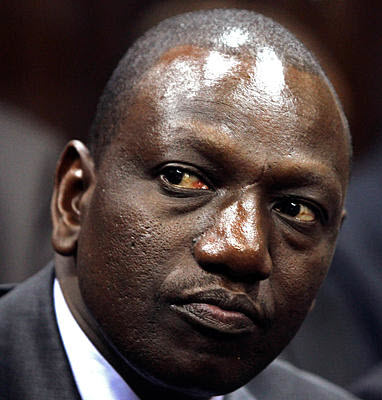
Kenya’s deputy president-elect William Samoei Ruto has resigned even before taking the oath of office.

In a terse statement Mr. Ruto cited insurmountable impending wrangles within the Jubilee Coalition (rumors abound of a March 1966-style Limuru conference to oust him) and his ongoing cases at the ICC and the courts in Kenya as reasons for his resignation.

It is also believed that Mr. Ruto felt that his job was done after he and his team of young and upcoming politicians from the Rift Valley successfully denied veteran politician Raila Odinga the presidency.

image

It is rumored that Mr. Ruto will choose the youthful Senator Kipchumba Murkomen of Elgeyo Marakwet County as his replacement. The new deputy president must be approved by Parliament before he can take office.

Despite Mr. Ruto’s stated reasons to quit the second highest office in the land, I believe that the real reason is this..

***Take note that this post was published on April 1st ***