The Development Set

A reader just reminded me of this timeless gem. It is from 1976.

Excuse me, friends, I must catch my jet
I’m off to join the Development Set;
My bags are packed, and I’ve had all my shots
I have traveller’s checks and pills for the trots!

The Development Set is bright and noble
Our thoughts are deep and our vision global;
Although we move with the better classes
Our thoughts are always with the masses.

In Sheraton Hotels in scattered nations
We damn multi-national corporations;
injustice seems easy to protest
In such seething hotbeds of social rest.

We discuss malnutrition over steaks
And plan hunger talks during coffee breaks.
Whether Asian floods or African drought,
We face each issue with open mouth.

We bring in consultants whose circumlocution
Raises difficulties for every solution –
Thus guaranteeing continued good eating
By showing the need for another meeting.

The language of the Development Set
Stretches the English alphabet;
We use swell words like “epigenetic”
“Micro”, “macro”, and “logarithmetic”

It pleasures us to be esoteric –
It’s so intellectually atmospheric!
And although establishments may be unmoved,
Our vocabularies are much improved.

When the talk gets deep and you’re feeling numb,
You can keep your shame to a minimum:
To show that you, too, are intelligent
Smugly ask, “Is it really development?”

Or say, “That’s fine in practice, but don’t you see:
It doesn’t work out in theory!”
A few may find this incomprehensible,
But most will admire you as deep and sensible.

Development set homes are extremely chic,
Full of carvings, curios, and draped with batik.
Eye-level photographs subtly assure
That your host is at home with the great and the poor.

Enough of these verses – on with the mission!
Our task is as broad as the human condition!
Just pray god the biblical promise is true:
The poor ye shall always have with you.

By Ross Coggins, from “Adult Education and Development,” September 1976. H/T @intldogooder. More here.

Development Experts and Their Biases

It is perhaps uncontroversial to suggest that World Bank staff have a different worldview from others. World Bank staff are highly educated and relatively wealthier than a large proportion of the world. However, it is interesting to note that while the goal of development is to end poverty, development professionals are not always good at predicting how poverty shapes mindsets. For example, although 42 percent of Bank staff predicted that most poor people in Nairobi, Kenya, would agree with the statement that “vaccines are risky because they can cause sterilization,” only 11 percent of the poor people sampled in Nairobi actually agreed with that statement. Overall, immunization coverage rates in Kenya are over 80 percent. There were also no significant differences in the responses of Bank staff in country offices and those in headquarters or in responses of staff working directly on poverty relative to staff working on other issues. This finding suggests the presence of a shared mental model, not tempered by direct exposure to poverty [emphasis added].

That is an excerpt from the World Development Report 2015, the section on the biases of development professionals.

One hopes that the problem highlighted by the last line is not crowded out of President Kim’s agenda at the Bank by the ongoing cost-cutting. And in case you were wondering, I don’t think flying coach and no breakfast will cut it since airports and the Mamba Points of this world are beyond the reach of most poor people. Speaking from experience, the development “expert” bubble is real, and enduring. We definitely need to do more to burst the bubble.

If field country offices are mere extensions of DC, then many development projects will continue to be variants of the proverbial solar cookers decried by Jim Ferguson in the Anti-Politics Machine. And everyone will continue to run around in circles.

Kenya Security Laws (Amendment) Bill 2014

Here is a pdf copy of the Kenya Security Laws (Amendment) Bill 2014.

The proposed amendments will, broadly speaking, curtail the freedom of speech and association, and limit media coverage of security related stories. They will also cut into the independence of the Kenya Police Service by granting the president the powers to appoint and fire the Inspector General of Police. Presently an independent commission picks a list of candidates from which the president chooses the IG. Lastly, the law promises to resurrect the position of the all powerful internal security minister with broad discretionary powers.

All in the name of keeping Kenyans safe from foreign terrorists, and themselves.

There are a few good things in the proposed law, including the sections that clarify the roles of the office of the Attorney General and the Director of Public Prosecutions (DPP); and those that limit judges’ discretion in the handling of cases involving terror suspects.

Despite the dubious constitutionality of some clauses in the bill, I bet a majority of Kenyans would support it in a poll. For that we have to thank the recent uptick in terror attacks and fatal communal conflicts. This year alone hundreds of Kenyans have died from such attacks.

That said, if you ask me the problem of insecurity in Kenya is not simply a result of restrictive laws that limit the government’s ability to pursue and prosecute criminals. It is a problem of a corrupt police force that takes bribes from petty criminals, poachers, drug dealers, and terrorists, alike. It is a problem of an increasingly unaccountable intelligence and military securocracy that is both fighting jihadists in Somalia and trafficking in charcoal and other goods, the proceeds of which benefit the same jihadists. It is a problem of an ineffectual intelligence service that instead of diligently doing its homework prefers to carry water for foreign agencies, regardless of the domestic consequences.

And finally, it is a problem of an elite political class that wants to have its cake and eat it. They want a criminal justice system that protects those who steal from public coffers but punishes chicken thieves. A system that protects poachers and drug dealers but nabs terrorists and armed robbers. At some point something will have to give.

Iko shida.

Ebola Cases Growing in Sierra Leone

According to FT:

The WHO estimates that as December 8 Sierra Leone had 7,798 registered cases, overtaking Liberia for the first time since the outbreak started. According to the Geneva-based WHO, the number of cases is still “slightly increasing” in Guinea, “stable or declining” in Liberia and “may still be increasing in Sierra Leone”.

More here.

Two Important Lessons Americans Should Learn From the Senate Torture Report

As Americans digest the contents of the just released Senate Report on CIA’s use of torture, here are two important lessons that they ought to internalize.

  1. The release of the report neither absolves America of the deeds highlighted therein, nor does it mean that such gross violations of the rights of non-Americans have ended. As Mother Jones reported back in 2012, President Obama may have ended officially sanctioned torture, but as it continued to wage the global war on terror America merely “outsourced human rights abuse to Afghanistan, Somalia, and elsewhere” through rendition programs. In addition, CFR has calculated that over the course of 500 drone strikes under both the Bush and Obama administrations 41 men were targeted, but 1147 people were killed. Dangerous terrorists should be taken out, by all means. But at some point we must begin to ask questions about what ought to constitute an upper limit of tolerable collateral damage. Especially in relation to the lives of innocent non-combatants.
  2. By outsourcing illegal practices to governments in the developing world America is contributing to the weakening of institutions of accountability in those countries and the radicalization of potential jihadists. Six months ago I argued for caution in the ongoing militarization of US-Africa relations. My worry is that many American security arrangements with African governments are designed to bypass normal democratic channels (like direct military to military cooperation) and risk creating unaccountable militaries and governments. In Kenya, for instance, it is increasingly unclear whether the military or the elected civilian administration is in charge of national security policy (especially with regard to the mission in Somalia). Nairobi has also recently been on the spotlight accused of engaging in extra-judicial killings of suspected terrorists with foreign assistance. In addition, many governments in the region that cooperate with the US have enacted sweeping anti-terror laws, many designed to also silence domestic political dissent. If it is not yet abundantly clear, it is high time American policymakers realized that unaccountable and highly securitized governments play into the hands of jihadist recruiters.

The release of the report is certainly commendable. It is a shining example of the virtues of separation of powers, something that America, more than any other nation in history, has perfected. But it is not an end in and of itself. It ought to be a first step in acknowledging that human rights do not end at the water’s edge, and putting pressure on elected officials to devise national security and foreign relations policies that respect this fact. Despite what some Americans may say, respecting the rights of non-Americans and their desire for accountable political and military institutions will not weaken America. On the contrary it will make it stronger by bolstering its soft power, and safer.

The Africanist Perspective is 7!

I started the blog seven years ago as an undergraduate in New Haven ahead of the 2007 elections in Kenya. Since then the blog has grown from a few readers a week to several thousand.

Thank you all for keeping me motivated to share my thoughts on this forum.

And of course special thanks to my better half Vanessa for the many conversations and insights that have generated many a blog post.

After the seven month hiatus I am back to blogging again. Here’s to the next seven years of blogging!

Ken

This is huge >> ICC drops case against Uhuru Kenyatta

The ICC prosecutor has dropped the charges against President Uhuru Kenyatta, citing the lack of evidence due to non-cooperation by the Kenyan government. Mr. Kenyatta stood accused of playing a significant role in the 2007-08 post-election violence in Kenya in which at least 1300 people died and over 300,000 were displaced.

Four quick observations.

  • The Kenyan case was always going to be a tough one for the ICC. Kenya is neither the DRC nor Sudan. As soon as Kenyatta got elected Brussels, London, and Washington made it clear that they would not sacrifice their economic and geopolitical interests in the wider eastern Africa region on the alter of justice. This gave Mr. Kenyatta latitude to attack the legitimacy and legality of the ICC case against him both through the African Union (AU) and Kenyan diplomatic channels. Back in Kenya witnesses disappeared or withdrew their testimonies. The Office of the Prosecutor repeatedly said that the Kenyan state refused to hand over evidence relevant to the Kenyatta case. All this while Western embassies remained quiet about the case (for fear of “losing” Kenya to China).
  • This leads me to conclude that in a perverse way, the collapse of the Kenyatta case might actually be good for the ICC. The court (and OTP) can save face by arguing that they had the authority to prosecute the case but lacked cooperation from the Kenyan state. Now, the biggest challenge for everyone involved is how to ensure that this does not get interpreted as blanket immunity for all sitting presidents who are suspected of committing atrocities against their citizens. The deterrent effect of the ICC should be preserved.
  • The collapse of the case has interesting implications for Kenya’s domestic politics. It is common knowledge that the political union between President Kenyatta and Deputy President Ruto ahead of the 2013 election was primarily driven by their ICC cases. Mr. Kenyatta’s case has collapsed. Mr. Ruto’s is ongoing. This will diminish Mr. Ruto’s bargaining power in the alliance. It will also demand for Kenyatta’s allies to walk a tight rope and ensure that they do not signal to Ruto’s supporters that they no longer need them now that Kenyatta is off the hook. Ruto’s bloc, URP, has the second largest number of MPs in the National Assembly. This will give him leverage of some sort, even as his case goes on. Simply stated, without the ICC bond, the union between Kenyatta and Ruto will become more transactional. This means that mistakes will be made, and each side will have to try hard to ensure that disagreements over specific issues do not get blown out of proportion. Knowing Kenyan MPs, this will be a tall order.
  • Lastly, now that the ICC is behind him President Kenyatta might actually seriously tackle the issue of insecurity in Kenya. It is widely known that since he took office his approach to security matters has been informed by the desire to rid his administration of anyone who might have been sympathetic to the ICC. The former chief of intelligence (who may have played a role in “fixing” both Kenyatta and Ruto) and other senior officials who may have testified against him were let go. It took the slaughter of more than 450 Kenyans at the hands of terrorists and armed bandits over the last 18 months for the president to fire the chief of Police and the Cabinet Secretary in charge of internal security. One can only hope that now Kenyans will get a more responsive security sector.

What does this mean for reconciliation in Kenya? Not much. 2007-08 shattered the myth of Kenya as a peaceful oasis in an otherwise volatile region. Kenyans are yet to comprehensively deal with the shock of seeing what neighbors could do to one another. The preferred MO has been to sweep things under the rug. That was the logic of the Kenyatta-Ruto alliance (the land issues that erupted in clashes between their respective constituencies have not been resolved). It is the same logic that drove the peace-at-all-costs campaign that stifled open discussion of contentious national issues ahead of the 2013 election.

For better or worse, Kenyans are desperate to move on past 2007-08. But the weight of historical injustices, inequalities, and the continued failure to address them are constant reminders that 2007-08 might happen again.

Taking a Break

Dear readers, you may have noticed a decline in the frequency of blogging. Work on the dissertation is taking up all my time these days. As a result I am taking a break from blogging, for now.

Many thanks,

Ken

dar2014

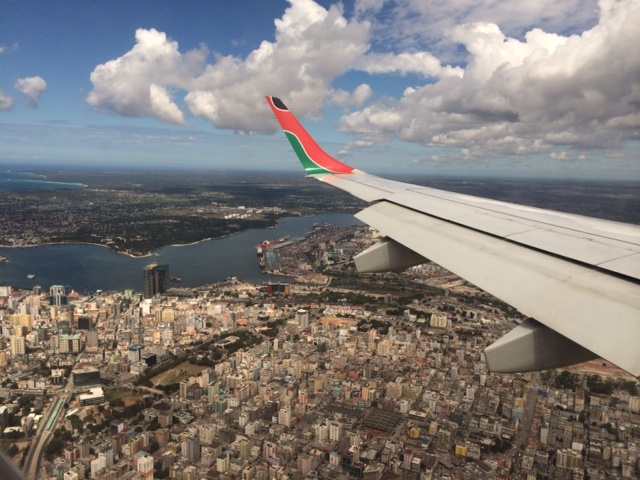
Dar es Salaam, Tanzania (summer 2014). Photo credit, Ken Opalo

Do Tough Traffic Rules Reduce Road Accidents?

The Kenyan Cabinet Secretary in charge of Transport recently announced a 22% decline in accidents on Kenyan roads in the first quarter of 2014 compared to the same period last year (resulting in 201 fewer deaths). Following the end of year holiday season uptick in road deaths (more people travel then; presumably more drink and drive as well) the government instituted strict traffic regulations, some of which have been struck down by the courts. But do these top-down rule changes work in reducing road accidents?

Probably not as well as we think, according to a new paper by Habyarimana and Jack:

This paper compares the relative impact of two road safety interventions in the Kenyan minibus or matatu sector: a top down set of regulatory requirements known as the Michuki Rules and a consumer empowerment intervention. We use very detailed insurance claims data on three classes of vehicles to implement a difference-in-difference estimation strategy to measure the impact of the Michuki Rules. Despite strong political leadership and dedicated resources, we find no statistically significant effect of the Michuki Rules on accident rates. In contrast, the consumer empowerment intervention that didn’t rely on third party enforcement has very large and significant effects on accident rates. Our intent-to-treat estimates suggest reductions in accident rates of at least 50%. Our analysis suggests that in institutionally weak environments, innovative consumer-driven solutions might provide an alternative solution to low quality service provision.

The Michuki Rules, which required retrofitting of vehicles with certain safety devices and other reforms as outlined in the net section, were widely believed to have led to an immediate and sustained improvement in the safety of Kenya’s roads. However despite this view, we find that most of the perceived effects were driven by short-run compliance costs imposed on vehicle owners and drivers, as opposed to their behavior, and that a month after the rules were introduced there was no discernible effect on insurance claims. In contrast, the consumer empowerment campaign we examine, which encouraged passengers to actively complain directly to their drivers when they felt unsafe, led to a remarkably large reduction in insurance claims of between a half and two-thirds.

Eng. Kamau and his team should take a look at this paper.

Also, the lesson here is not that we should not legislate against insanity on Kenya’s roads, just that those efforts should be complemented by a fire-alarm enforcement mechanism as opposed to using the Chai-Culture-crippled police patrol system.

Quick random hits


1. As usual, great career advice for those in the academy from Chris Blattman.

2. Boring Development asks some interesting questions re RCTs, and questions the internal validity assumption many of them trumpet. Which raises the question, if RCTs are cannot guarantee internal validity can results so obtained be useful for policy development? My general response here is that not all RCTs are useful for policy development. The obvious incentives to publish clearly skew the design and implementation of studies in a way that makes only a fraction of them useful for policymakers (the IRB process notwithstanding). But all things considered, randomistas have probably made the world a better place.

3. An unfolding case in Guinea could drastically change what is permissible in the process of acquiring concessions from dubious governments. Benny Steinmetz of BSGR bought the Simandou concession in late 2008 during the last days of the administration of ailing dictator Lansana Conte (allegedly with the help of Mr. Conte’s fourth wife). According to FT, BSGR spent a mere $160m for the rights to mine in Simandou. Less than two years later, the company sold 51% of its rights to the Brazilian mining giant Vale for $2.5 billion, $500m of which was in cash. Last week a government committee investigating the Conte-BSGR deal found evidence of corruption and recommended that BSGR and Vale be stripped of their rights to Simandou. If the ruling sticks, lots of contracts in several resource rich states in Africa will become open for legal review thereby drastically lowering the costs of renegotiation (even for the dictators who singed them).

Evidence of aid effectiveness may reduce charitable giving for some

Ever wondered why so many charitable campaigns often lack contextual information on their aid recipients? Well, it turns out charitable groups might just be responding to some of their contributors’ need for as little information as possible, the result of which are the often simplistic silly campaigns to help starving people in nameless war-torn countries in the developing world.

According to Karlan and Wood in a paper on donor responses to information on aid effectiveness (it is a direct mail experiment):

We test how donors respond to new information about a charity’s effectiveness. Freedom from Hunger implemented a test of its direct marketing solicitations, varying letters by whether they include a discussion of their program’s impact as measured by scientific research. The base script, used for both treatment and control, included a standard qualitative story about an individual beneficiary. Adding scientific impact information has no effect on whether someone donates, or how much, in the full sample. However, we find that amongst recent prior donors (those we posit more likely to open the mail and thus notice the treatment), large prior donors increase the likelihood of giving in response to information on aid effectiveness, whereas small prior donors decrease their giving. We motivate the analysis and experiment with a theoretical model that highlights two predictions. First, larger gift amounts, holding education and income constant, is a proxy for altruism giving (as it is associated with giving more to fewer charities) versus warm glow giving (giving less to more charities). Second, those motivated by altruism will respond positively to appeals based on evidence, whereas those motivated by warm glow may respond negatively to appeals based on evidence as it turns off the emotional trigger for giving, or highlights uncertainty in aid effectiveness.

They also add that:

Our finding that smaller prior donors respond to information on charitable effectiveness by donating less frequently and in smaller amounts is consistent with other research showing that emotional impulses for giving shut down in the presence of analytical information. Indeed, controlled laboratory experiments have produced insights that suggest that emotionally triggered generosity may be dampened by appeals that include statistical or deliberative information. For example, people donate less to feed a malnourished child when statistics that put this child in the larger context of famine in Africa are mentioned. 

H/T Marginal Revolution.

Meanwhile in the Central African Republic

According to Doctors Without Borders (MSF):

We are talking about up to one million IDPs and refugees, out of a population of 4.6 million. This accounts for 20% of the population, which is outrageous when we take into consideration these communities were already very fragile in a disrupted country, where health services outside Bangui would be practically non-existent if not for the presence of MSF in seven different regions. This past year has pushed the population to the edge of the abyss. The deployment of MSF has been huge, spectacular and swift in order to respond rapidly and provide emergency medical care. However the population is still in dire need of more assistance, including medical care. And above all, the population needs safety and security.

CAR is scheduled to hold elections either later this year or early next to speed up the transition to normalcy (France wants out ASAP). The hope, I presume, is that whoever wins the election will bring political order to the former Central African Empire. Fingers crossed?

On a related note, the US recently announced new military aid to Uganda, including four CV-22 Ospreys and an additional 150 Special Operation troops (to join the 100 deployed in 2011) in an effort to step up the hunt for Joseph Kony, leader of the Lord’s Resistance Army (LRA). Kony is suspected to be in hiding in the border regions CAR, the DRC, Sudan and South Sudan. Of course this rather bizarre decision (is Kony really that much of a priority right now in the Great Lakes Region?) is motivated by the need to keep the Ugandan military in top shape and ready to fight in places the US doesn’t want to set foot

What if the US and the EU also had a humanitarian equivalent of Uganda? You know, a country that could be just as well funded with cash and equipment to wade into troubled places like CAR and South Sudan and provide humanitarian assistance backed by credible firepower. What if? It might even help shore up some of the soft power the US (and the West in general) is haemorrhaging fast on account of the developmental interventions from the East in the wider region. 

Africa’s top economies

Yesterday Nigeria unveiled new GDP figures following the rebasing that catapulted the country of 170 million to become Africa’s biggest economy (GDP US$509b). Below is the ranking of the top sixteen economies in SSA. Mineral economies (10/16) still predominate (Source: The Economist).

Image

Rwanda, 20 Years On

Caution: This is not an apology for President Kagame and his autocratic tendencies that have resulted in carnage and death in the DRC, Rwanda and elsewhere.

At a conference last year a US State Department official told a group of us that Rwanda was so polarizing that even at the Consulate in Nairobi the DRC crowd did not get along well with the Rwanda crowd.

It is not surprising why that might have been the case, or why the present analysis on the commemoration of the 20th anniversary of the 1994 genocide remains polarized.
rwandainfantmort

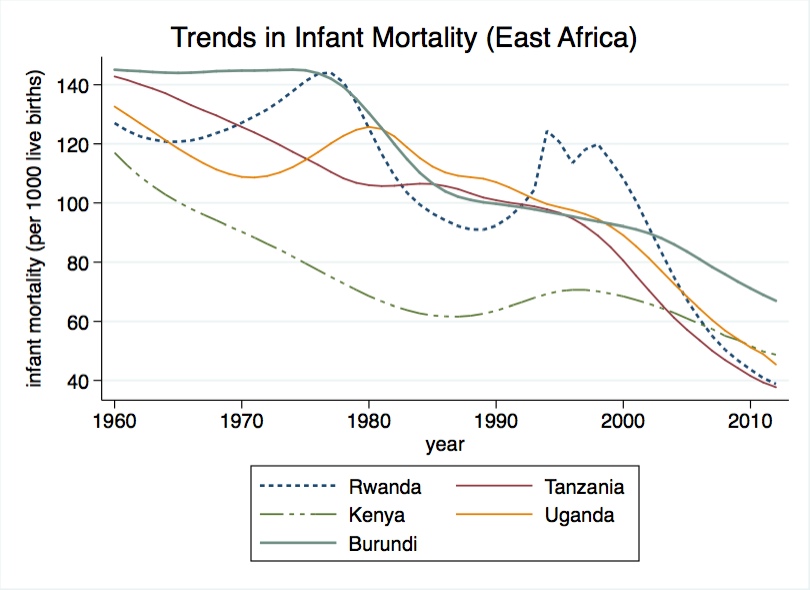
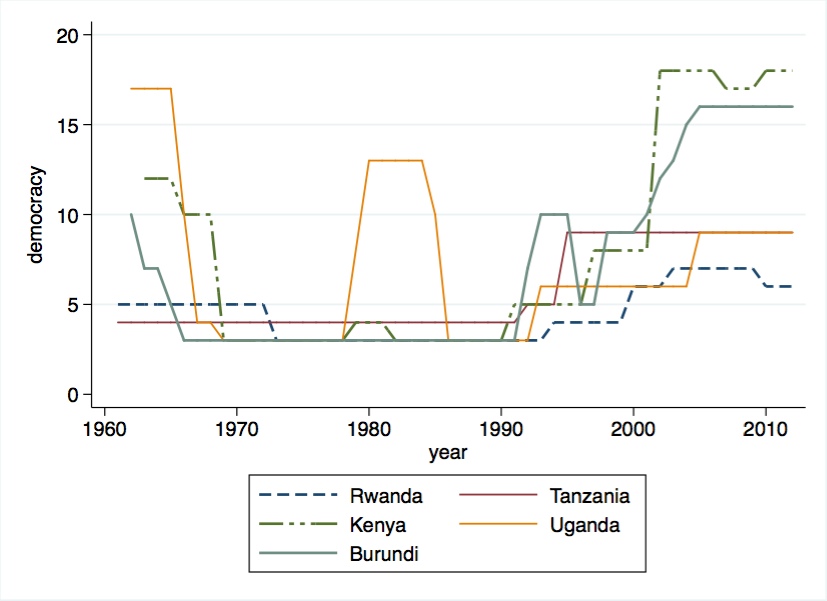
If one just looks at the improvements made in advancing human welfare since President Paul Kagame and the RPF took power (see graph, data from the World Bank) it is hard not to arrive at the conclusion that ordinary Rwandese are unambiguously better off. The country is the least corrupt in the region and has also been consistently ranked top in the ease of doing business. But there is also the side of the Kigali government that most reasonable people love to hate: the murderous meddling in the DRC and the oppression and occasional murder of dissidents at home and abroad. Those who admire what President Kagame has done tend to emphasize the former, while his critics tend to emphasize his autocratic tendencies which have made Rwanda the least democratic country in East Africa (see below, data from Polity). Many wonder if the post-1994 achievements are sustainable enough to outlast President Kagame’s rule.

So is Mr. Kagame a state-builder or your run of the mill autocrat whose achievements will vanish as soon as he relinquishes power?

ImageIn my view, I think that Rwanda is the best success story of state-building in Africa in the last 20 years. I also think that this (state-building) should be the paramount consideration for those who care about the Rwandese people and want to help them achieve greater freedoms. The fundamental problem in states like CAR, Sierra Leone or Liberia has never been the insufficiency of democracy. Rather, it has been the problem of statelessness. The contrast between Rwanda and Burundi is instructive (see both graphs, the two are neighbors with similar ethno-political histories. Rwanda has historically had a stronger state, though. See here and here). Despite the latter being the second most democratic state in the region, it has consistently performed the worst on nearly all human development indicators. Part of the reason for this is that Burundi remains a classic papier mache state confined to Bujumbura and its environs.

May be I am too risk averse. But I am scared stiff of anything that could lead to a recurrence of the horrors of the early 1990s stretching from the Mano River region to the Horn. As a result I am always skeptical of activism that takes state capacity (including coercive capacity) for granted.

With this in mind, the fight against autocratic rule in Rwanda should not come at the expense of the state-building achievements of the last 20 years. The international community and those who genuinely care about Rwandese people should be careful not to turn Rwanda into “democratic” Burundi in the name of democracy promotion. Interventions will have to be smart enough to push President Kagame and the ruling elite in the right direction, but without gutting the foundations of political order in Rwanda.

Absent a strong state (even after Kagame), the security dilemmas that occasioned the 1994 “problem from hell” would ineluctably resurface.

Lastly, I think the level of discourse in the “Rwanda Debate” could be enhanced by the extension of the privilege of nuance to the case. For example, if all we focused on were drones killing entire families at weddings in Yemen or the horror that is the South Side of Chicago we would probably get mad enough to ask for regime change in Washington. But we don’t. Because people tolerate the “complications and nuance of American politics.” The same applies to less developed countries. Politics is complicated, everywhere. And those who approach it with priors of good-or-bad dichotomies are bound to arrive at the wrong conclusions. One need not be a Kagame apologist to realize the need for a delicate balance in attempts to effect political change in Kigali.

Before you hit the comment button, notice that this is neither an apology nor an endorsement of autocracy in Rwanda. It is a word of caution regarding the choices outsiders make to accelerate political change in Rwanda.

Tyranny is not the panacea to underdevelopment. But neither is stateless democracy.

For background reading on the 1994 genocide in Rwanda see Samantha Power’s Problems From Hell; Mahmood Mamdani’s When Victims Become Killers; and Philip Gourevitch’s We Wish to Inform You That Tomorrow We Will be Killed With Our Families.
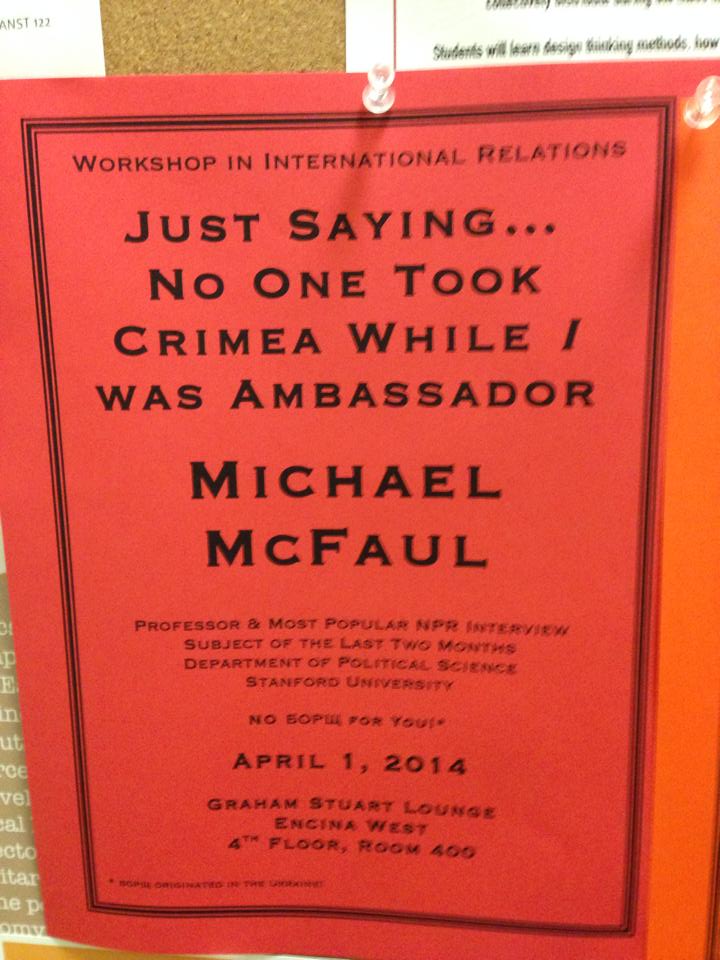
Our own Amb. Mike McFaul at the Stanford IR Workshop

No. Crimea wasn’t his McFault.

Image

H/T A. Livny.