Thoughts on the latest coup in Burkina Faso

The Daily Nation reports:

Burkina Faso’s presidential guard declared a coup Thursday a day after seizing the interim president and senior government members, as the country geared up for its first elections since the overthrow of longtime leader Blaise Compaore.

Lieutenant-Colonel Mamadou Bamba appeared on national television to declare that a new “National Democratic Council” had put an end “to the deviant regime of transition” in the west African state.

Announcing the coup, Bamba said that “wide-ranging talks” were being held to form a government leading to “inclusive and peaceful elections.” Presidential guard members linked to ex-leader Compaore had burst into a cabinet meeting Wednesday and seized acting president Michel Kafando, prime Minister Isaac Zida and two ministers. Zida was himself once an officer in Compaore’s powerful Presidential Security Regiment (RSP), before he toppled his old boss after days of street protests in October 2014.

This is the second coup in Burkina Faso in a year, sinking the country deeper into the coup trap (see here and here for brief takes on last year’s coup). Blaise Compaore’s former Chief of Staff, Gen Gilbert Diendere, has declared himself the new head of a military government in Ougadougou.

The coup raises two important questions about the transition process following last year’s coup:

  • Were elections planned too soon?
  • Was it wise for the constitutional court to completely sideline allies of Compaore from government despite the fact that they still wielded considerable de facto power (especially within the armed forces?)

Obviously the international community wanted to exit the scene as soon as possible. And elections provide a nice and easy way to do so. The practice stems from a perverse fetishization of elections as a generator of legitimacy, accountability, and stability. As a student of legislatures in Africa, one of the main takeaways from my work is that we (the international community, development professionals, academics) continue to ignore the role of intra-elite politics (and accountability chains) at enormous cost. We know that the biggest threat to rulers comes from regime insiders and fellow elites. We also know that revolutions and mass protests that topple bad leaders are rare events. So why do we continue to bury our heads in the sand and imagine that voters are the magical answer to problems of weak governance and elite political instability.

This is not to say that elections (i.e. mechanisms that reinforce vertical accountability) are completely useless. Rather, it is a reminder that elections should be designed to serve the dual purpose of keeping elites accountable and strengthening, rather than weakening, systems of intra-elite accountability. The historical experience in Africa and elsewhere and the logics of collective action demand this.
How is the world reacting to China’s rise?

China has experienced a spectacular economic growth in recent decades. Its economy grew more than 48 times from 1980 to 2013. How are the other countries reacting to China’s rise? Do they see it as an economic opportunity or a security threat? In this paper, we answer this question by analyzing online news reports about China published in Australia, France, Germany, Japan, Russia, South Korea, the UK and the US. More specifically, we first analyze the frequency with which China has appeared in news headlines, which is a measure of China’s influence in the world. Second, we build a Naive Bayes classifier to study the evolving nature of the news reports, i.e., whether they are economic or political. We then evaluate the friendliness of the news coverage based on sentiment analysis. Empirical results indicate that there has been increasing news coverage of China in all the countries under study. We also find that the emphasis of the reports is generally shifting towards China’s economy. Here Japan and South Korea are exceptions: they are reporting more on Chinese politics. In terms of global sentiment, the picture is quite gloomy. With the exception of Australia and, to some extent, France, all the other countries under examination are becoming less positive towards China.

That’s Yuan, Wang and Luo writing in a neat paper that analyzes news coverage of China in different countries.

More on this here (HT Jay Ulfelder).

On the Continent opinion survey data from a select set of countries show high favorability ratings for China — by about two thirds or more of survey respondents. The same countries have seen some decline in US favorability ratings over the last few years. As you’d expect, people’s reaction to China’s rise is based on perceptions of the potential material impact it will have on their lives. On average, the survey evidence suggests that most Africans view China’s rise as a good thing.

It is interesting that across the globe young people, on average, have a more positive view of China’s rise than older people. Younger people probably associate China more with glitzy gadgets in their pockets; and less with cultural revolutions and famine-inducing autocracy.

How to increase mass employment in Nigeria (and other developing countries)

David Mckenzie of the Bank writes:

The modal firm size in most developing countries is one worker, consisting of only the owner of the firm. Amongst the firms that do hire additional workers, most hire fewer than ten. In Nigeria survey data indicate that 99.6 percent of firms have fewer than 10 workers. This is in sharp contrast to the United States, where the modal manufacturing firm has 45 workers. Are there constrained entrepreneurs in developing countries with the ability to grow a firm beyond this ten worker threshold? If so, this raises the questions of whether such individuals can be identified in advance, and of whether public policy can help them overcome these constraints to firm growth.

In an attempt to figure out if policy can help grow firms in developing countries, Mackenzie evaluated a program in Nigeria that awarded 1,200 winners about $50,000 each (out of an initial application pool of 24,000; the top 6000 applicants were in the study). See a summary here. And the paper is available here.

………. winning this competition has large positive impacts on both applicants looking to start new firms as well as those aiming to expand existing firms. Three years after applying, new firm applicant winners were 37 percentage points more likely than the control group to be operating a business and 23 percentage points more likely to have a firm with 10 or more workers, while existing firm winners were 20 percentage points more likely to have survived, and 21 percentage points more likely to have a firm with 10 or more workers. Together the 1,200 winners are estimated to have generated 7,000 more jobs than the control group, are innovating more, and are earning higher sales and profits.

Two quick thoughts. First, this is a really cool finding that should get African central bankers excited about how the financial sector can be put to use in boosting mass employment. Second, it is a caution against the odd idea prevalent in development programs of trying to turn poor people into entrepreneurs (see below). The best solution to poverty is jobs. Entrepreneurship is a risk that shouldn’t be imposed on people with already super slim margins of error in terms of income security. As Mckenzie rightly observes:

The results of this evaluation show that a business plan competition can be successful in identifying entrepreneurs with the potential to use the large amounts of capital offered as prizes, and that these individuals appear to be otherwise constrained from realizing this potential. The prize money generates employment and firm growth that would not have otherwise happened. However, the results also highlight the difficulties of picking winners. Conditional on reaching the semi-finalist stage, neither the scores for the business plans, nor individual and business characteristics have much predictive power for predicting which firms will grow faster or benefit most from the program. This remains an area for active research, but also highlights the inherent riskiness of entrepreneurial activity.

Does Kenya have too many MPs?

An article in the Daily Nation asked this provocative question. In the article, the author examined the cost per capita of legislatures in several countries; and concluded that legislatures in OECD democracies tend to be relatively more representative (seats/million people) as well as cost effective (per capita cost per seat) than their counterparts in the developing world.

Of course, linking per capita income to the density of representation has its pitfalls. An assumption that countries with smaller economies should have smaller assemblies, regardless of population size, implicitly undervalues the political voice (and rights) of citizens of poor countries. At the same time, setting an arbitrary upper bound on the remuneration of legislators (and general resourcing of legislatures) has the potential to limit the continued professionalization of legislatures in emerging democracies. Under-resourced legislatures find themselves in a bad equilibrium of high turnovers, weak institutionalization (lack of experience), inability to check the executive or effectively legislate, and a whole lot of dissatisfied voters who invariably choose to go with erstwhile challengers.

How to break out of this bad equilibrium is one of the key questions I grappled with in my book, Legislative Development in Africa. But I digress…

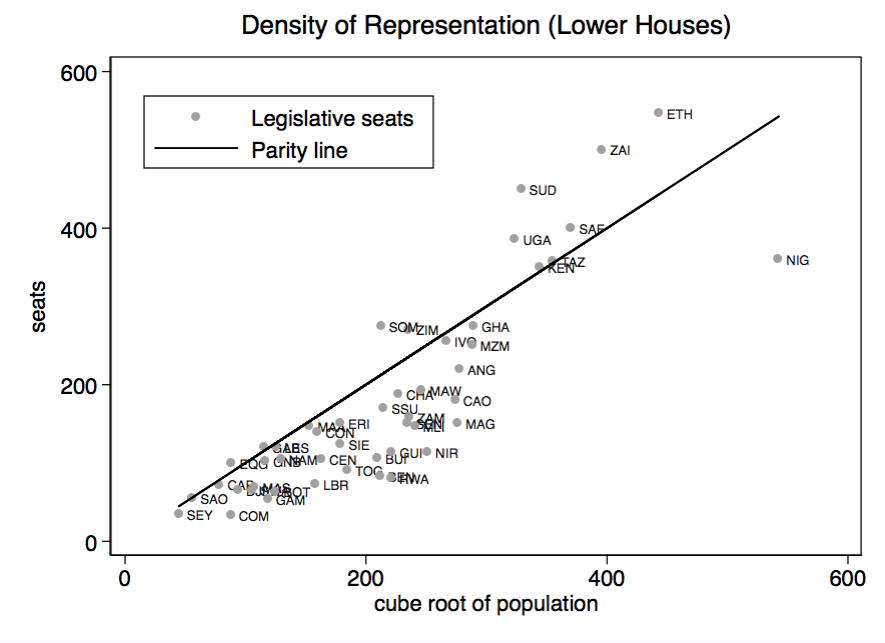
legseatsThe standard metric in Political Science for comparing the density of representation was developed by Rein Taagepera in the early 1970s. The Taagepera formula predicts that assembly sizes tend to approximate the cube root of the total population of states. In the dissertation I looked at how African states faired according to this metric (see figure) and found that the vast majority of countries on the Continent have relatively smaller assemblies than would be predicted by their population sizes (the figure only captures the sizes the lower houses). Somalia, Uganda, Sudan, the DRC, South Africa, and Ethiopia are the clear outliers. Incidentally, Kenya’s National Assembly is right on the parity line.

The usefulness of this metric (at the national level) diminishes beyond a certain population size. For countries with hundreds of millions of people or more, it makes more sense to apply the formula with respect to sub-national assemblies, if they exist. This is for the simple reason that beyond a certain number of seats the legislature would become too big to reasonably be able to conduct its business (see Nigeria).

Pepinsky on what to read in order to write a good dissertation (or book)

Yet it is only possible to read effectively if the thing you are reading is written well. That means that dissertation writers do need to write effectively. And that, in turn, requires dissertation writers to sit down and read books, not for argument, but for style and form and structure. The single most important piece of dissertation writing advice I received was to read more books, and to read them slowly and carefully while actively reflecting on style and structure. “Read this, and then write like that.”

That advice from a decade ago, coupled with several conversations over the past week, has inspired me to put together a collection of books that I think are exemplars of excellent political science writing in book format. That they all happen to be good books too is useful, but not my main point. My point in collecting them here is that these are books to read to learn how to write a good dissertation. Read these, then write like them.

More on this here (must read).

The same applies to papers. It helps to have a folder of “sample papers” to read whenever you experience writer’s block.

Thandika Mkandawire on the “Kenya Debate”

The ‘Kenya debate’ was a debate not among Kenyans but about Kenya by a group of expatriates, most of whom were temporarily resident in Kenya. This may partly explain its abrupt end. Kitching (1985) also suggests that the fact that all the protagonists viewed themselves as progressives precluded the further pursuit of the debate on how a capitalist accumulation process could be promoted.

Ouch. Kenyanists (Kenyan or not) will appreciate the zinger (please bring back economic history!) The quote is from a footnote on page 198.

Mkandawire’s paper on “Thinking About Developmental States in Africa” (not on Kenya) is a must read in any PE class on African development.

A Kenyan Scientist Joins the Worm Wars

For those new to the deworming debate, see here, here, here, here and here (Macartan’s response is worth reading in detail). The famous original deworming study was conducted in western Kenya, so it’s nice to get the perspective of Kenyan scientist Dr. Charles Mwandawiro. Dr Mwandawiro is the Chief Research Officer and Assistant Director of Partnership and Collaboration at the Kenya Medical Research Institute (KEMRI). He writes:

I have studied and seen myself the negative effects chronic parasitic worm infections have on childhood development. Children with severe or recurring infections have impaired growth and cognitive development because the worms lodge in their bodies, stealing the nutrients a child is able to take in. Heavy infections can result in serious clinical disease. To combat infection and give our children a chance at good health, many countries, including Kenya, run school-based mass deworming programmes that have been shown to be a simple and cost-effective strategy to reduce the disease burden of parasitic worms in school-age children, the group at highest risk.

Safe, low-cost drugs are available to treat intestinal worm infections and are the standard of medical care. The World Health Organization (WHO) recommends periodic mass treatment in areas where worm infections are above certain thresholds. Some have challenged this WHO policy, accepting that those who are known to be infected should be treated, but questioning whether the existing evidence base is strong enough to support mass treatment.

Let me say unequivocally: Mass school-based deworming works. Just three years ago, Kenya launched a national deworming program. Prevalence of parasitic worms has been reduced from 35% to 17% and as low as 6% right after a deworming round. Our focus in the National Deworming Programme in Kenya is on the reduction of infection and possibly even elimination of the public health threat of worms.

More on this here.

The WormWars are a fantastic lesson on the complications of policymaking. Contributors have weighed in from different perspectives: Does school-based mass deworming work in reducing the prevalence of parasitic worms?; what is the opportunity cost of deworming kids, thereby improving their developmental prospects?; Does a kid’s health trump everything?; did the Busia intervention increase school attendance?; did the authors adequately address the methodological challenges involved in the study? What is a policymaker to make of all of this?

Because of the complicated nature of the questions involved, the original study is being asked to bear more weight than it can withstand. Like Macartan, I think the focus should be on the school attendance outcomes, which was the primary goal of the original study. This, of course, does not mean we should completely disregard the very important questions relating to the health and developmental prospects of kids in locales with high prevalence rates of parasitic worms. Because of the long-term effects of malnutrition on cognitive development, it is reasonable to make the case that deworming kids should trump most competing uses of resources.

Policymakers, if you can, Please. Deworm. All. The. Kids.

H/T Chris Blattman

A Commentary on Research Priorities in Development Economics

Over at the Bank’s Future Development blog, Princeton Economist Jeffrey Hammer writes:

The Chief Minister posed serious questions that have traditionally been the bread and butter of the economics profession. Unfortunately, we are not even trying to answer them any more. The specific question was “Should I put more money into transport? Infrastructure (power, roads, water)? Law and order? Social services? Or what? And where am I going to get the money?” What questions could be more solidly part of the core of economics than these? Unfortunately none of these were even remotely the focus of the “evidence-based” policy making discussed.

Almost all of the cases analyzed were  single, simple policy “tweaks” that were, first of all, isolated from the broader market context in which they occurred and, second, had no conception of opportunity cost – what we would have to give up to pursue these things? We had an answer to “how to improve a public food distribution system” but even with a precise answer (to whether a tweak would work) we had no idea whether the substantial amount of money funding such a system is a good idea. Maybe the Chief Minister would be better off improving education or road networks or police or rural electricity. Some of these alternative policies could have more impact on food consumption than food distribution if we thought about how the world worked. Getting food to market securely (roads, better cold storage, trustworthy police and safe roads – this is Pakistan, which no one seemed to notice) may increase food availability much more than any tunnel-visioned food program Or not – maybe the food distribution system is better. We just don’t know. And none of us “experts” are trying to find out.

When someone says “we should have more “X” because we have evidence that it works”, the response should be “compared to what?” What should we cut in order to promote your particular interest? My hobby horse these days is more sanitation in South Asia. I should have to defend it against (at least) a few alternatives.

What’s your justification for your latest hobby horse?

My take on the gap highlighted by Hammer is that what is good for reviewers is seldom useful to policymakers. The incentive for academics is to publish. And this will always be reflected in the design and implementation of interventions headed by academics. This is not necessarily a bad thing [For obvious reasons we should firewall academic research from the actual process of policymaking. The latter should be the political process that it is, albeit informed by the former]. I think the widespread acceptance of rigorous evidence-based policymaking has been a net benefit for the developing world. What it means though, is that the “public sector” development research community — i.e. the IMF, the World Bank, & host country research institutes — should do more to ensure that funding for hyper-targeted interventions do not detract from broader macro research (like, when and why did the rain start beating Ghana?)

However, in the long run, developing countries will be better served by having more and more of their own/country-based politically relevant macroeconomists.

This is because answering the types of questions posed by Hammer requires one to also take a political stand (on account of a lack of consensus among economists). Economists who can’t do this will invariably resort to “technical” solutions that can be perceived as “apolitical” by both host governments and the sponsoring foreign development agencies. Again not necessarily a bad thing, just a reflection of the politics of knowledge production.

H/T William Easterly.

The potential impact of a Chinese slowdown on Africa’s economies

The FT reports:

For Africa’s non-oil exporters, the collapse in crude prices has provided a cushion. But, with many African countries import-dependent, the depreciation of currencies affects inflation and the cost of imports. It will also put a strain on those nations that have taken advantage of investors’ search for yields to tap into international capital markets.

The likes of Zambia, Ethiopia, Rwanda, Kenya, Ghana, Senegal, and Ivory Coast have all issued foreign currency dominated sovereign bonds in recent years. “In the past, foreign exchange weakness in Africa was largely shrugged off. Economies adapted and found a way to cope with it, but the recent surge in eurobond issuance has been a game-changer,” says Razia Khan, chief economist for Africa at Standard Chartered.

“Now, when currencies depreciate, external risks are magnified, public debt ratios rise, and perceptions of sovereign creditworthiness alter quite dramatically.”

Prof. Deborah Brautigam of SAIS sees the following happening:

  • Prices for African commodities will worsen, then improve. In recent years, China’s slower growth has pushed down prices for gold, crude oil, copper, platinum and iron ore. South Africa’s mining sector was expected to lose over 10,000 jobs due to lower demand
  • Africa will import even more from China. Cheaper Chinese exports will please African consumers while putting Africa’s manufacturers at a further disadvantage. There will be more pressure for tariff protections
  • [L]ow wages in Ethiopia and elsewhere had been attracting significant factory investment from China. With costs now relatively lower in China, the push to relocate factories overseas will slow. This will save Chinese jobs, but postpones Africa’s own structural transformation.

And concludes that:

In the short term it is hard to see how this devaluation can help Africa, notably its productive and export sectors.

The thing to note is that different African countries have different kinds of exposure to China. The commodity exporters (both petroleum and metals) will be hit hard. The effects will be somewhat attenuated in countries exposed primarily through Chinese FDI and infrastructure loans. Domestic fiscal reorganization and resources from the AfDB and other partners should plug a fair bit of the hole left by declining Chinese investments (although certainly nowhere near all of it). And with regard to sovereign debt, a Chinese downturn might persuade the US Central Bank to delay its planned rate hike — which would be good for African currencies and keep the cost of borrowing low.

Lastly, for geopolitical reasons I don’t see China rapidly reducing its footprint on the Continent. In any case, as Howard French makes clear in his latest book, there is a fair bit of (unofficial) private Chinese investment in Africa. Turmoil back home may incentivize these entrepreneurs to plant even deeper roots in Africa and expatriate less of their profits. The net result will be slower growth in Africa. And like in China, slower growth will challenge prevailing political bargains in democracies and autocracies alike.

Nairobi Matatu Routes on Google Maps

Screen Shot 2015-08-27 at 10.48.26 AM

A screen shot of the commute from Ongata Rongai to Kahawa West

Launching the matatu routes in Google emphasizes the need to study the informal transit networks that shuttle masses of people around in sub-Saharan Africa, southeast Asia, and south Asia. “You’re saying this is part of the system,” said Klopp. And since the GTFS data structure and the Nairobi data are open source, Digital Matatus gives other groups in Mexico City, Manila, Dhaka, China, and elsewhere a plan to collect and disseminate data on their transit. The collaboration has already received requests from around the world to map their cities.

Digital Matatus has also started talks with four more cities in Africa—Kampala, Accra, Lusaka, and Maputo—to use the same methods to map their informal mass transit systems. “So many of our problems in developing cities where you have extreme poverty and awful environmental conditions—they’re always tied in some way to the transport sector,” said Cervero. “It’s very chaotic and unmanaged, so this is a huge first step towards enhancing those services.”

People in Nairobi still use the paper maps because the matatu routes have not changed since their release, and the ultimate goal is a formal transit system with set maps, times, and prices. But hopefully “formal” will still mean you enjoy your commute with twinkling disco balls and a good beat.

Wired has the rest of the story on how this happened here.

This is a cool development that will hopefully inform Nairobi County’s infrastructure planning going forward. It should not take 2.5 hours to travel across the city from Kahawa West to Rongai, a distance of only 24 miles.

How much does it cost to construct an MDG borehole in Abuja?

The Premium Times of Nigeria reports:

Nigeria’s Millennium Development Goals (MDG) office spent N154.2 million to construct a single borehole in Abuja, in a shocking example of contract inflation that has helped undermine the country’s ability to achieve its MDG goals.

Drilling a single borehole drilling in Abuja averages N1.5 million. A hydrology firm told PREMIUM TIMES that the amount should cover drilling and casing, installation of a solar-powered submersible pump, steel tower for the tanks, tanks, pipes, joints & suckers, installation and labour.

The firm allowed an expanded estimate of N10 million if a water treatment facility is included alongside other optional accessories.

The Abuja borehole, constructed at Gwarinpa, an expansive estate in the federal capital, had no such fittings. Indeed, the borehole had long become dysfunctional and was no longer dispensing water to the residents when PREMIUM TIMES visited in June 2015.

Still, the Abuja MDG office told this newspaper it was more concerned with service delivery to the people, than the amount it takes to do so (emphasis added).

“Policy interventions are already risky in the best of circumstances”

Here’s a paragraph to ponder:

Ethnographic nuance is neither a luxury nor the result of a kind of methodological altruism to be extended by the soft-hearted. It is, in purely positivist terms, the epistemological due diligence work required before one can talk meaningfully about other people’s intentions, motivations, or desires. The risk in foregoing it is not simply that one might miss some of the local color of individual ‘cases.’ It is one of misrecognition. Analysis based on such misrecognition may mistake symptoms for causes, or two formally similar situations as being comparable despite their different etiologies. To extend the medical metaphor one step further, misdiagnosis is unfortunate, but a flawed prescription based on such a misrecognition can be deadly. Policy interventions are already risky in the best circumstances. (p. 353)

That’s from political anthropologist Mike McGovern’s review of Paul Collier’s Bottom Billion and Wars, Guns, and Votes.

Also, if you haven’t read McGovern’s Making War in Cote d’Ivoire you should. And for those interested in an ethnographic take on Sekou Toure’s attempts to modernize remake Guinea check out Unmasking the State. It starts off dense (I only read about half the book last summer while on a short trip to Conakry), but gives a good peek into the logics of rule under Toure and the reactions these elicited from Guineans.

H/T Rachel Strohm.

Fascinating case of failed Coasian bargaining

How much would you pay in order not to listen to loud street music while working in your office?

The Washington Post (our new hometown paper) has an interesting story on this:

The band’s brassy riffs at 15th Street and New York Avenue NW always delight the hordes of tourists heading toward the White House. But the very spot that’s proved so profitable for Spread Love to pull in tips has also earned it the enmity of employees at two major Washington institutions: the Treasury Department and the law firm of Skadden, Arps, Slate, Meagher & Flom.

Apparently, the economists in charge of our nation’s financial stability and the attorneys who represent many of our country’s corporate high-rollers and white-collar criminal defendants are struggling to focus inside their offices because the band is so loud. They are hearing Spread Love spreading its love too much.

So the office workers offered to pay the band $200 a week. The band members declined, saying that they typically make that amount in an hour (unverified) from tourists.

The band’s director insists that they can sell the office workers a little quiet, if the price is right (just how much do the office workers value a little quiet while working? And what’s the band members’ opportunity cost of not spreading love?)

Apparently the band’s act is totally legal, as DC’s noise regulations are subordinate to individuals’ first amendment rights.

Also, notice how in certain instances government policies can create value for specific subsets of citizens by simply allocating “property” rights.

On the failure of constitutional engineering in Burundi

Burundi’s post-conflict constitution provides a robust array of formal checks to personal rule. Article 164 mandates a 60-40 Hutu-Tutsi split in National Assembly and 50-50 split in the Senate in order to ensure that the majority Hutu (85%) do not violate the rights of the minority Tutsi (14%). The Batwa (1%) are also guaranteed representation in Parliament through special nomination. Burundi also has a proportional representation (PR) system with a closed list that requires political parties to nominate no more than two thirds of candidates from the same ethnic group. Article 257 of the constitution reinforces the principle of ethnic balance by mandating a 50-50 split in the military. Furthermore, according to Article 300 any amendment to the constitution requires an 80% super-majority in the National Assembly and two thirds of the Senate (this is why Nkurunziza failed in an attempt to amend the constitution in early 2014).

So how did Nkurunziza manage to overcome all these formal institutional checks on his power and engineer a technical third term in office? For answers see here.

Hint: elite consensus on acceptable bounds of political behavior matters a great deal. Looking back, the framers of the Burundian constitution probably should have focused on intra-Hutu balance of power as much as they did on the Hutu-Tutsi balance. Nkurunziza succeeded because not enough Hutu elites (within his own divided party) were willing to punish his blatant contravention of term limits on a questionable technicality. Perhaps they will stand up to him if he tries again in 2020.

The Obama Visit to Kenya: Four Key Issues Deserving Special Attention

This weekend Kenya is hosting the 2015 Global Entrepreneurship Summit. The chief guest at the summit is U.S. president Barack Obama. Mr. Obama is scheduled to hold bilateral talks with his host President Uhuru Kenyatta; and will also give two public speeches on the sidelines of the summit — one at Kenyatta University and another at the Moi International Sports Centre in Kasarani. Here are the things I hope Obama and his team will focus on while in Kenya:

  • Infrastructure Development and FDI: Kenya is currently in the middle of an epic infrastructure investment drive (power generation and transmission, roads, railway lines, ports, and water systems). The most impactful thing the U.S. president can do for Kenyans is to facilitate a more robust involvement by the U.S. private sector in these projects – either through private investment or PPPs (Public-Private Partnerships). And perhaps the most natural place for U.S. companies to put in even more money is Kenya’s buzzing tech scene. IBM, Intel, Google, Microsoft, and GE have led the way. More need to follow.
  • A New Approach to Civil Society Support: The Kenyan government still has a lot to do in terms of governance reforms. But the way partners like the U.S. and the EU approach the challenge needs to change. The 2010 Constitution devolved and, by a large measure, professionalized government in Kenya. Unfortunately, the Kenyan Civil Society appears to not have caught up. The same can be said about political affairs officers in various embassies in Nairobi. The new institutional game is different and favors Think Tanks with deep research benches as opposed to multipurpose activists. Support for the Kenyan Civil Society therefore needs to catch up to this reality. Project cycles need to be elongated. Also, if I were a donor with a large pot of money I would focus a lot of energy in getting governance right in a few of Kenya’s 47 counties as an example to the rest. These subnational units have substantial financial and political resources that make them ideal testing grounds for public policies. They are also sources of future national politicians.
  • Taking Security Seriously: Kenya continues to be mired in the conflict in Somalia as part of the AMISOM mission. The involvement has exposed Kenya to terror attacks by al-Shabaab – the most bloody of which was the Garissa University College attack that left 148 people dead. The U.S. has been a key partner of AMISOM, providing equipment, funds, intelligence, and air support. Given its leverage, America could do more in making sure that Kenya’s involvement in Somalia does not lead to an erosion of KDF’s professionalism. Credible reports have linked KDF officers to the smuggling of charcoal and sugar, activities that line the coffers of al-Shabaab. There is also evidence that the Generals are the ones driving Kenya’s Somalia policy, instead of elected civilians. U.S. support should be predicated on civilian control, a healthy reverence of military professionalism, and an appreciation of the local and regional consequences of American actions in Somalia. America also needs to realize that Kenya is still a young democracy struggling to consolidate rule of law. Unlawful arrests, disappearances, and executions of suspected terrorists who are Kenyan nationals must stop. The fight against al-Shabaab must not be allowed to erode hard fought gains in the quest for rule of law.
  • A Constructive Political Engagement About Reforms: The U.S. can help Kenya clean up its public sector through reforms founded on political reality. For example, presently corruption appears to be worsening in the country. This is both a function of media exposure and dispersal of power. More people in government now have access to state coffers – mainly throught the tender process (as a result tenderpreneurs abound). Corruption is also political. The president is ultimately a politician who wants to be reelected. the same applies to MPs and Governors and Senators. Many of them engage in corruption as a means of campaign finance (Harambees are expensive). Tackling corruption therefore requires more than mere moralizing about its ills on society. All involved must be willing to address the hard and uncomfortable truths about the political economy of the vice. This would mean, for instance, coming up with a way to allow politicians access to campaign money in a legal and transparent manner. It may also entail some form of amnesty for past offenders (you can’t jail the entire public service). Corruption in Kenya is not a simple law enforcement problem. The same logic applies to other reform initiatives. They are likely to succeed if grounded on political realities, instead of some notion of a moral failing among Kenyan politicians.

Here are some pieces I liked about Obama’s trip to Africa:

– Charles Kenny on why Obama is selling Africa short

– Todd Moss on Obama’s missed opportunity in Africa 

– The challenges facing power Africa in Nigeria