How did Mozambique manage to hide more than $2b in debts from the IMF?

It’s common knowledge that most developing states have data problems. But even with those priors, the revelation that Mozambique managed to hide more than $2b in undisclosed debts from the IMF for almost three years is cause for pause.

According to the FT:

Details of the previously undisclosed loans — which add about the equivalent of 10 per cent of gross domestic product to the government’s known debt burden — emerged after the “tuna” bond was restructured last month.

Of the two previously undisclosed loans confirmed last week, the first was for $622m to a state-owned company, Proindicus. The second, to another unidentified state company, was valued at more than $500m, a person familiar with the matter said.

Credit Suisse, the Swiss bank, and Russia’s VTB bank, both of which arranged the sale of the tuna bond, provided the undisclosed loans, the IMF said.

Basically Mozambique borrowed a lot of money ostensibly to set up a state-run tuna fishing company but ended up spending nearly all the money on military speed boats.

Borrowing so much money to spend on the military seems like a really REALLY bad idea.

Also, how did the IMF miss this for so long?

Public Finance is hard.

More on this here.

GiveDirectly is about to provide guaranteed basic income to 6,000 low-income Kenyans for 10-15 years

This is from Michael Faye and Paul Niehaus writing in Slate:

The organization that we founded, GiveDirectly, has decided to try to permanently end extreme poverty across dozens of villages and thousands of people in Kenya by guaranteeing them an ongoing income high enough to meet their basic needs—a universal basic income, or basic income guarantee. We’ve spent much of the past decade delivering cash transfers to the extremely poor through GiveDirectly, but have never structured the transfers exactly this way: universal, long-term, and sufficient to meet basic needs. And that’s the point—nobody has and we think now is the time to try.

… To do so, we’re planning to provide at least 6,000 Kenyans with a basic income for 10 to 15 years. These recipients are some of the most vulnerable people in the world, living on the U.S. equivalent of less than a dollar. And we’re going to work with leading academic researchers, including Abhijit Banerjee of MIT, to rigorously test the impacts.

We know that social protection played a critical role in curbing extreme poverty in much of the developed world. What GiveDirectly plans to do is a neat idea that will not only have an impact on thousands of lives but also offer loads of important lessons for much of the Global South.

Kudos to Paul and company for pulling this off!

Uganda chooses Tanzania over Kenya in pipeline deal

The Business Daily reports:

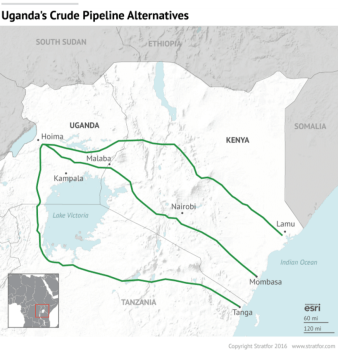
Uganda will take its oil to the market through Tanzania’s Tanga port, leaving Kenya to build its own pipeline to Lamu, if the positions taken at the just-ended talks in Kampala are maintained.

It turns out that Kenyan negotiators showed up without having done their homework. For example:

….. it has also emerged that the Kenyan officials participating in the Kampala talks may not have had all their facts right as they tried to address the concerns raised by Uganda over the northern route for the pipeline.

This is odd, given Amb. Amina Mohamed’s chops. Or should we be asking questions of the energy ministry?

Screen Shot 2016-04-16 at 5.04.17 PMUganda’s decision should be treated as new information on the capacity of the Kenyan state to execute large scale infrastructure projects. Kenya really wanted this deal, and the fact that the negotiators could not seal the deal with Uganda suggests that there is no there there as far as Nairobi’s capacity to execute on LAPSSET is concerned. This will undoubtedly impact the Kenyatta administration’s ability to originate new projects related to the $25b LAPSSET development plan.

The economics of the choice of pipeline appeared to not have mattered:

A joint pipeline between Kenya and Uganda would have had an initial throughput of 300,000 barrels per day (200,000 barrels for Uganda and 100,000 barrels for Kenya). This could have earned the pipeline companies $1.66 billion a year, which would be shared between the countries according to throughput.

…… If the two countries go for a standalone pipeline, Uganda will lose $300 million every year due to an increase of $4.07 in tariff per barrel, and Kenya will lose $250 million per year due to the increased tariff of $6.96 per barrel.

All else equal, this is probably a net positive development for the future of the East African Community (EAC). It is obviously a big financial and political loss for Kenya (and for that matter, Uganda) but it will dampen the idea of a two-speed EAC — with Kenya, Uganda, and Rwanda in the fast lane and Tanzania and Burundi in the slow lane.


Some key facts about Chinese lending to African states (new dataset)

Deborah Brautigam and collaborators are about to release a much-anticipated dataset on Chinese loans to African states. Details on the launch event at SAIS here.

And here are some key facts:

  • Who gets the Lion’s share of the Dragon’s loans?  Angola received 25% of all Chinese loans to Africa between 2000 and 2015, almost all of them backed by Angolan oil.
  • Bloomberg and Fitch, take note: Did China Eximbank really lend more than the World Bank in Africa? SAIS-CARI data shows cumulative 2001 to 2010 China Eximbank loan to Africa amount to only US$27.2 billion, not your figure of US$67.2 billion. The World Bank is still a larger lender than China Eximbank.
  • What do Chinese loans pay for in Africa? Transportation. Between 2000 and 2014, transportation received the largest share: US$23.6 billion worth.
  • What are the biggest Chinese loan-financed infrastructure projects in Africa? No. 1: Kenya’s Mombasa-Nairobi Standard Gauge Railway Phase I, funded by US$3.6 billion worth of Chinese loans; No.2: Ethiopia’s Addis-Djibouti Railway, funded at US$2.5 billion. Both were signed in 2013.

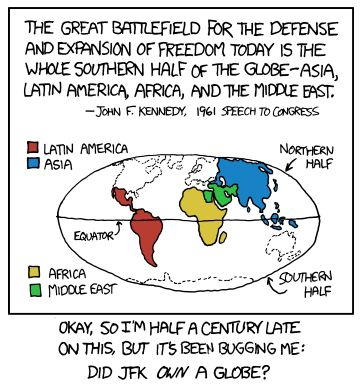
Facetious Critical Geography, JFK Edition

jfk

Source: xkcd

Social construction, yada yada yada.

And on a slightly less serious note,  did you know that it is completely artificial that we have North at the top of maps?

In which Erik Prince, of Blackwater infamy, attempts to build a private airforce

All of this reads like fiction. Like really good fiction. Except it is probably closer to the truth than not.

Here is a summary. Erik Prince, he of the Blackwater fame, basically allegedly tried to retool crop dusters into light armored fighter planes and then sell them to African governments — with at least one delivery to South Sudan. Prince currently runs Frontier Services Group, a Nairobi-based company (complete with a CSR operation in Kibera) that is registered in Bermuda and listed in Hong Kong. According to its website, the company provides services in aviation, trucking, warehousing, and maritime.

Here’s part of the fascinating story in The Intercept:

The story of how Prince secretly plotted to transform the two aircraft for his arsenal of mercenary services is based on interviews with nearly a dozen people who have worked with Prince over the years, including current and former business partners, as well as internal documents, memos, and emails. Over a two-year period, Prince exploited front companies and cutouts, hidden corporate ownership, a meeting with Russian arms dealer Viktor Bout’s weapons supplier, and at least one civil war in an effort to manufacture and ultimately sell his customized armed counterinsurgency aircraft. If he succeeded, Prince would possess two prototypes that would lay the foundation for a low-cost, high-powered air force capable of generating healthy profits while fulfilling his dream of privatized warfare.

And all this was possible, despite obvious legal questions, because everyone involved knew they could get away with it.

In Europe, it is very illegal. You are breaking a lot of laws.” He recalled one of Prince’s deputies saying that the aircraft would be used for surveillance operations in Africa and “no one there cares about certifications.”

FSG entered the Kenyan logistics market by acquiring two aviation companies, Kijipwa Aviation and Phoenix Aviation. It has since also bought a logistics firm based in the DRC (Cheetah Logistics SARL) and plans to expand further in the region. FSG’s goal in entering Kenya was to provide “passenger and freight services to multinational oil and mining companies transporting staff to remote areas such as Lokichar and Lokichoggio and other locations in East Africa.

I really hope that the regulators in the different jurisdictions where FSG operates know what they are doing.

In response to The Intercept‘s story, FSG issued this statement.

Fact of the Week: 30% of Shanghai residents are over 60

….. Shanghai has a particular problem: last year, says China Daily, it became the first city in China to pass the crippling 30 per cent mark for population aged over 60. That’s nearly twice the 15.5 per cent for over 60 population nationally in 2014, the last year for which national figures are available.

That is a lot of senior citizens. For more see this FT piece on how the state in China is trying to force children to take care of their aging parents — including using threats to deny them library access, credit, and bank accounts.

HT Howard French

Data Problems Everywhere

This is from the Economist:

GOVERNMENT statisticians shun the limelight, which only ever finds them when things go awry. So it is with India’s national bean counters, who are struggling to convince the world that an economy with idle factories, sagging exports and ailing banks grew by 7.5% in 2015, as their models purport to show. Ever since a new methodology for calculating GDP was adopted last year, India has appeared to be the world’s fastest-growing big economy, outpacing China. But scepticism about the data is growing even faster.

… Investors, at any rate, roundly disbelieve India’s growth figures. Nevsky Capital, a hedge fund, cited dodgy data from India, among other places, as a reason to shut up shop at the start of the year. Even the government’s own chief economic adviser has admitted he is sometimes flummoxed by the data. A cottage industry has sprung up to cater to the sceptics, blending various indicators of economic activity to produce new gauges of growth.

Such home-brewed statistics have been common in China for some time: Li Keqiang, now the country’s premier, admitted as a provincial governor that he all but ignored “man-made” economic statistics in favour of hard-to-fiddle data such as railway-cargo volumes, electricity consumption and loans made by banks. The Economist began publishing a “Keqiang Index” when his habits became known in 2010.

Ambit Capital, a broker based in Mumbai, now computes its own “Keqiang Index” for India, which implies a real growth rate of 5.4%. Economists at HSBC, a bank, think 5.9-6% is closer to the truth.

More on this here.

More comments on the African Academy (by Grieve Chelwa)

This is a guest post by Grieve Chelwa, UCT Economics PhD and current Post-Doctoral Fellow at the Center for African Studies at Harvard University.

Here’s Ken Opalo’s reaction to Alex de Waal’s piece on the African academy. Recall that de Waal’s piece was critical of the absence of African scholars in producing scholarship on Africa.

As I read Ken’s piece, these 3 things immediately struck me:

1. Ken says: “As a social scientist, my knowledge of Kenya is largely informed by my experience as a Nairobian. Over the years I have had to learn a lot about the rest of Kenya, in much the same way an Australian would. In doing so I incurred a lower cost than a hypothetical Australian would, for sure, but the cost was not zero. The point here is that it is not necessarily true that I have an innate ability to *know* Kenyan politics better than an Australian ever would if they invested the time and effort.”

Really, Ken? As an undergrad at the University of Zambia, I was always struck by the intimate knowledge my lecturers had of the country. The kind of knowledge outsiders could only pretend to have. Ken acknowledges that the costs of learning about Kenya differ between Kenyans and non-Kenyans – and this is precisely the point de Waal is making. Because outsiders face a higher cost, and combined with their academic privilege as gatekeepers of leading journals, the scholarship on Africa is consequently poorer than it should.

The longer Ken and I live away from “home” as we currently do, the more we become like this hypothetical Australian. I think de Waal isn’t speaking about us Ken. He’s speaking about that lady and gentleman who’ve spent a lifetime lecturing at the University of Nairobi, at the University of Zambia, at Ibadan, etc so that their costs of knowing and writing about their respective countries are now almost zero. Paradoxically, the voices of these fountains of wisdom are nowhere to be seen in the “leading” journals.

2. Ken then says: “And who is to say that I would necessarily be able to articulate a research agenda on whatever subject in Malawi better than a Southern Californian? What proportion of Kenyans can locate Bangui on a map?”

In my experience, African-based scholars, unlike their boisterous counterparts in the West, rarely pretend to be experts beyond their country of nationality. A lecturer at the University of Zambia spends most of their time thinking and writing about Zambian problems. On the other hand, it’s not unusual to see a Western scholar jumping from country to country in Africa pontificating on this or that. These are the types who describe themselves as “African Experts” on their curriculum vitaes. And by the way Ken, the typical Kenyan needn’t know where Bangui is (although I don’t doubt that they do). But the typical Kenyan academic certainly knows where Bangui is.

3. Lastly Ken says: “The problem is not that Western academics are asking the wrong questions, or that certain methodological approaches are privileged over others. The real problem is that there is a limited pool of high quality Africa-based scholars.”

Where is the evidence Ken for this often-heard (especially in the West) accusation that African scholars are low calibre? Without providing any evidence, all that you’re doing is discrediting the many teachers who’ve taught generations of African undergraduates at African universities over the years – some of these undergraduates have gone on to collect advanced degrees at some of the leading universities in the world.

The bigger problem here (and I think Godwin Murunga made this point on a thread on Nic Cheeseman‘s wall) is that African academics have given up on playing the academic arms race that’s infected the Western academy. In the same way Ken’s hypothetical Australian faces higher costs in learning about Kenya, African academics also face prohibitively higher costs in trying to publish in Western journals (they are not in the networks, desk rejected on the basis of institutional affiliation, clientelism, etc…). It’s tiring and they just don’t want to bother playing that tiring game.

Two quick reactions:

[i].   There is a lot of bad quant research on Africa out there done by fly-by-night “Africa experts” (I am talking lots and lots of silly experiments and cross-country regressions). But there is also a lot of great work that is bringing hard data (both micro and macro) to bear in answering important questions in a variety of fields. To the extent that we all acknowledge that making African states legible, through data, improves the quality of governance, then we should encourage more aspiring African scholars to acquire the tools needed to study their respective states and societies. And as a comparativist, I think that there is value in cross-country comparisons. A Zambian scholar who has studied Kenya probably gets Zambia better than one who ONLY studies Zambia. I don’t think it is wise for African academics of give up on the “tech arms race.” A diversity of skills and methodologies is good for overall knowledge production. I firmly believe that the credibility revolution in social science has left us all unambiguously better off.

[ii].  I also don’t think that pointing out the dearth of high quality research in African universities is a controversial claim. We can quibble over the politics of university rankings, the privileging of specific forms of “evidence”, et cetera, but the fact is that Africa, as a region, has very few top notch universities. This is not to say that there aren’t any centres of excellence in Nairobi, Lusaka, Cape Town, or Ibadan. My own experience tells me that a variety of factors — poor pay, insane teaching loads, consultancies, etc — make it very difficult for Africa-based academics to do research (or for that matter, to teach well). Only focusing on demand side issues without addressing the supply side ignores the basic challenge of how to improve the conduct of research in African universities. My point here is that even if we fixed the biases at leading journals Africa-based scholars would still be handicapped relative to their counterparts based in the West. These specific supply side issues matter.

Of course, underlying all this discussion is a politics of knowledge production. We live in an uncomfortable world in which scholarship on Africa by Africans is hard to come by in Western universities; and Western “experts” tend to have privileged access to policymakers on the Continent relative to Africa-based researchers. My contention is that solving this problem requires both demand and supply side solutions. Of course we should encourage Western academics to read, cite, and teach more works by Africans. And of course African governments should take their own scholars more seriously. But only focusing on the demand side problems ignores serious supply side constraints that are faced by Africa-based scholars.
 

First year of graduate school, anyone?

Screen Shot 2016-04-04 at 10.49.25 AM

H/T Morgan Hoke.

Alex de Waal on the African Academy

In a recent article Tufts’ Alex de Waal makes an important point on the nature of policy research in Africa:

……. Analysis is shaped to suit the audience, and scholars end up speaking their language. Rather than evidence-based policy, there is policy-based evidence-making [emphasis mine]. The paradigm of this is engaging with western governments, the World Bank or the United Nations. Much of the policy-related discourse on good governance, post-conflict reconstruction and development takes place in a fantasy land that exists only in the minds of international civil servants.

A little bit harsh, but not completely off the mark. As I’ve written before, we need to make a distinction between research that is meant to inform policy in specific contexts, and that which is designed to generate general knowledge (and perhaps most importantly, for reviewers). What is good for reviewers is seldom useful for policymakers.

That said, I don’t think the burden to produce policy-relevant research (for African states) should be on scholars based in the West.

Africa-based scholars are the best placed to produce policy-relevant research in their own countries. They are the ones who are best able to grapple with the policy judgement calls that often require one to take political positions. Foreign researchers have to worry about research permits (for themselves or their sponsor donor agencies) and therefore have strong incentives to recommend “politically neutral” and “technical” (read apolitical) policy solutions. Of course not every researcher conforms to the type suggested here. But there is no denying that foreign scholars face slightly different incentives than their domestic counterparts.

Where there might be some mileage on this front is with the “public sector” research arms of the World Bank and the African Development Bank.

On African academics, de Waal has this to say:

…… the structure of academic rewards and careers systematically disadvantages those who do not have the skills or capacities for this kind of high-end quantitative endeavour or have serious misgivings about it. This causes severe dissonance between actual lived experience and the academic work that is validated by universities.

… Supervisors in foreign universities rarely have the subject matter expertise, so they tend to guide students towards more theoretical approaches. Examiners and peer reviewers likewise reward and reinforce their own disciplinary biases. On the other hand, it is common to see junior Western scholars doing rather uninteresting quantitative studies or superficial case studies. Despite their shortcomings these studies are published. These scholars, then, become the group that undertakes peer review.

The African scholar of political science may be compelled to adopt a schizoid personality. To become an academic in a Western university she or he may be obliged to unlearn important knowledge, and learn frameworks and skills that are actually irrelevant to the situation at hand but are necessary for being considered a professional academic.

Here I think de Waal moves dangerously close to endorsing “African Exceptionalism.” It is almost as if the African grad student shows up in grad school imbued with unique knowledge of the Continent that is inaccessible to their potential advisers and colleagues. Also, I don’t think the study of Africa should be pigeonholed as existing outside basic rules of evidence-based policymaking and properly identified causal stories. Despite the enduring allure of the idea, Africa is not exceptional.

As a social scientist, my knowledge of Kenya is largely informed by my experience as a Nairobian. Over the years I have had to learn a lot about the rest of Kenya, in much the same way an Australian would. In doing so I incurred a lower cost than a hypothetical Australian would, for sure, but the cost was not zero. The point here is that it is not necessarily true that I have an innate ability to *know* Kenyan politics better than an Australian ever would if they invested the time and effort.

And who is to say that I would necessarily be able to articulate a research agenda on whatever subject in Malawi better than a Southern Californian? What proportion of Kenyans can locate Bangui on a map?

In my view, much of the handwringing about the methodologies employed in the study of the Continent misses the point. The problem is not that Western academics are asking the wrong questions, or that certain methodological approaches are privileged over others. The real problem is that there is a limited pool of high quality Africa-based scholars. Increasing the pool of talented Africa-based researchers would boost the variety of perspectives and methodologies employed in the study of the region — to the benefit of all involved. This can be achieved by providing better funding opportunities for African universities and incentivizing high quality research by Africa-based faculty.

Several African public figures (and associates) mentioned in the Panama Papers

The Guardian has an excellent summary of what you need to know about the Panama Papers, the data leak of the century from the Panama-based law firm Mossack Fonseca.The firms specializes, among other things, in incorporating companies in offshore jurisdictions that guarantee secrecy of ownership.

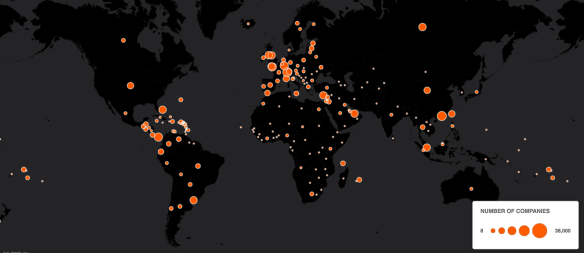
Here is a map of the companies and clients mentioned in the leaked documents (source). Apparently, the entire haul (2.6 terabytes of data) has information on 214,000 shell companies spanning the period between 1970 to 2016.

Screen Shot 2016-04-03 at 9.41.32 PM

The leaked documents show links to 72 current or former heads of state and government. So far the highest-ranking public official most likely to resign as a result  of the leak is the Prime Minister of Iceland, Sigmundur Gunnlaugsson (see story here and here)

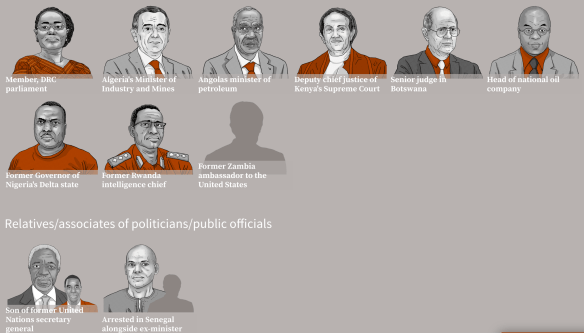
For a list of African public officials mentioned in the leaked documents see here. And I am sure we are going to hear a lot about all these rich people in developing countries.Screen Shot 2016-04-03 at 9.18.42 PM

Closer to home, the Daily Nation reports that Kenya’s Deputy Chief Justice, Kalpana Rawal, “has been linked to a string of shell companies registered in a notorious Caribbean tax haven popular with tax dodgers, dictators and drug dealers.” Justice Rawal has been dodging retirement for a while. May be after the latest revelations might find a reason to call it quits.

The ICIJ website has neat figures summarizing some of the findings from the massive data haul. Also, here is a Bloomberg story on the tax haven that is the United States. 

An airport within earshot of drums

Author Steve Almond deconstructs “Africa” by Toto.

Enjoy:

President Uhuru Kenyatta’s State of the National Address to Parliament

On Thursday President Uhuru Kenyatta presented his annual report to the joint session of Parliament. You can find the text of the speech here and the youtube clip here.

Key achievements of his administration over the last three years include (i) rural electrification (nearly all primary schools have been connected to the grid — THIS IS PRETTY BIG DEAL); (ii) the construction of a new railway line (the project is a corruption boondoggle, but the speed with which it is being carried out is stunning); and (iii) power generation.

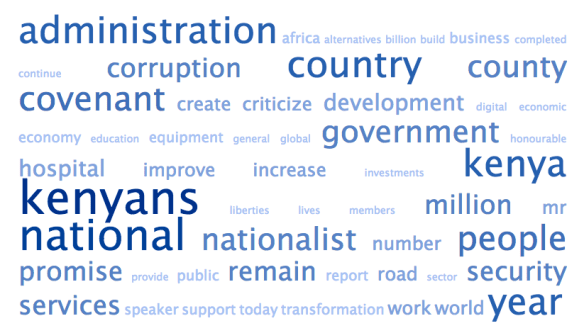
Below is a word cloud showing some of the issues the president focused on. Corruption, health (hospital), security, and general service provision were the main policy areas that the president chose to focus on.

I was surprised by the failure of “agriculture”, “land”, “education”, and “infrastructure” to make the top twenty. “Road” had a respectable show. There was also a lot of politics — mainly directed at the opposition and civil society.

Screen Shot 2016-04-01 at 4.46.04 PM

Perhaps in reaction to David Ndii’s provocative article on the failure of the Kenya Project, the president’s speech was particularly nationalist. The words “Covenant” and “Nationalist” appeared 27 and 22 times, respectively, well ahead of key policy-related terms.

I am personally worried that the word “development” outperformed “economic/economy.” I hope this is not a signal that the government views the running of the economy as a massive “development project.” We all know how those usually turn out.


How to hack a Latin American election

Bloomberg has a fascinating longread on Andrés Sepúlveda, a man who claims that he rigged elections all over Latin America for almost a decade.

Here is an excerpt:

Sepúlveda’s career began in 2005, and his first jobs were small—mostly defacing campaign websites and breaking into opponents’ donor databases. Within a few years he was assembling teams that spied, stole, and smeared on behalf of presidential campaigns across Latin America. He wasn’t cheap, but his services were extensive. For $12,000 a month, a customer hired a crew that could hack smartphones, spoof and clone Web pages, and send mass e-mails and texts. The premium package, at $20,000 a month, also included a full range of digital interception, attack, decryption, and defense. The jobs were carefully laundered through layers of middlemen and consultants. Sepúlveda says many of the candidates he helped might not even have known about his role; he says he met only a few.

His teams worked on presidential elections in Nicaragua, Panama, Honduras, El Salvador, Colombia, Mexico, Costa Rica, Guatemala, and Venezuela. Campaigns mentioned in this story were contacted through former and current spokespeople; none but Mexico’s PRI and the campaign of Guatemala’s National Advancement Party would comment.

The whole thing, to borrow from Tyler Cowen’s vocabulary, is self-recommending. I am not a Latin Americanist and so cannot vouch for the veracity of the story. But it’s definitely a fantastic read.

And of course, as happens, a multi-country story of this nature is incomplete without casual stereotyping of hackers based on nationality:

For most jobs, Sepúlveda assembled a crew and operated out of rental homes and apartments in Bogotá. He had a rotating group of 7 to 15 hackers brought in from across Latin America, drawing on the various regions’ specialties. Brazilians, in his view, develop the best malware. Venezuelans and Ecuadoreans are superb at scanning systems and software for vulnerabilities. Argentines are mobile intercept artists. Mexicans are masterly hackers in general but talk too much. Sepúlveda used them only in emergencies.