A Tentative (Mixed) Public Health Victory: The Slow Retrenchment of HIV-AIDS

This is from the Economist, on the state of the fight against HIV-AIDS.

The next UN target is that, by 2020, 90% of those infected should have been diagnosed and know their status, 90% of those so diagnosed should be on ARVs, and 90% of those on ARVs should have suppressed viral loads. That is ambitious, but history suggests those in the field will rise to the challenge.
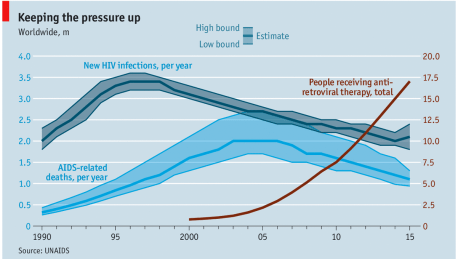
Screen Shot 2016-06-06 at 9.07.02 AM

The blue line is testament to George W. Bush’s No. 1 foreign policy success: PEPFAR.

But we should count our chickens just yet. The trends in the graph above are not uniform across the globe. As I noted in a previous post, there is quite a bit of heterogeneity both across and within countries. For example, in East Africa, Uganda is lagging Kenya and Tanzania in the quest to tame the virus (see below).

On a different note, this is yet another data point to suggest that Yoweri Museveni has hit the inflection point, and from now on all his machinations to stay in power will wipe out the achievements of his first 20 years in power.

Chinese demography fact of the week

Howard French has a fantastic piece on Chinese demographic trends over at the Atlantic. Consider this:

China today boasts roughly five workers for every retiree. By 2040, this highly desirable ratio will have collapsed to about 1.6 to 1. From the start of this century to its midway point, the median age in China will go from under 30 to about 46, making China one of the older societies in the world. At the same time, the number of Chinese older than 65 is expected to rise from roughly 100 million in 2005 to more than 329 million in 2050—more than the combined populations of Germany, Japan, France, and Britain.

And here is a summary of global population projections for perspective:

Screen Shot 2016-05-20 at 12.14.51 AM.png

The Kenyan National Assembly since 2002

From a dictatorship of one, to a dictatorship of 349. I say this is progress. Admittedly, change has been slow. But the dispersal of power is almost always a good thing.

kenyaMoi

H/T Boniface Mwangi.

Mozambique may have squandered up to $2b of borrowed money

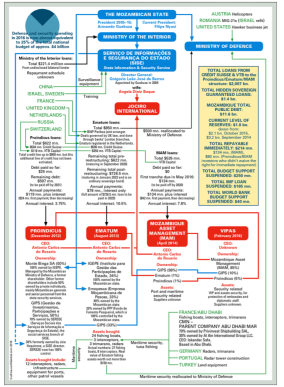
Public Finance is emerging to be one of the biggest development challenges of our age. Here’s Africa Confidential on Mozambique’s hidden loans, which may amount to more than $2b.

Screen Shot 2016-05-12 at 1.38.32 PMSources close to Rosário Fernandes, ex-head of the revenue authority, the Autoridade Tributária de Moçambique, have told us of systematic diversions of taxes straight into the pockets of the Frelimo elite, especially in the later years of President Guebuza’s term of office, when he exercised enormous patronage. Massively inflated contracts were commonplace. The latest to emerge is the extravagant, nearly complete, Bank of Mozambique building in Maputo, which boasts a helicopter landing pad on the roof. Originally estimated to cost $90 mn., the final cost is reckoned at at least $300 mn., with kickbacks and ‘commissions’ accounting for the cost inflation, say Frelimo sources.
Guebuza engaged in an ultimately doomed attempt to extend his term of office, which ended in October 2014, and this partly explains the extraordinary scale of his liberality towards loyalists, sources formerly close to him told us (AC Vol 53 No 18, The Putin option). The schemes became increasingly brazen, and the creation in 2013 and 2014 of three companies – Empresa Moçambicana de Atum (Ematum), Proindicus and Mozambique Asset Management (MAM) – was the culmination of this programme. The companies, which received the totality of the $2 bn. now owed by the state, were mainly in the field of maritime security, even though it was the intelligence and security services that provided the management. They bypassed parliament, illegally, and defence procurement, effectively privatising, as one commentator put it, national security while lining the pockets of the elite into the bargain. Yet the ill-equipped companies could not cope and quickly collapsed. Ematum, which originally claimed to be focused on tuna fishing, is no longer operating its few licensed vessels because it cannot pay salaries (AC Vol 56 No 24, Nyusi’s nightmare).

Kenya, Zambia, among others, have also borrowed enormous amounts of money that have not been properly accounted for. Several of these countries have recently gotten cover from the IMF that all is well. But the IMF has strong incentives to save face and maintain confidence that it does its job.

If Mozambique could do it, what stops more sophisticated treasuries elsewhere on the Continent?

I am increasingly convinced that Africa’s newfound love with international creditors is a bond bubble waiting to happen. The 1980s and early 1990s sucked. And we might be headed for a repeat if the African states floating eurobonds continue on the same path.

In which John Oliver channels Andrew Gelman

If you are not a regular reader of Andrew Gelman’s blog, you should become one now. And here is John Oliver poking fun at BS “scientific” studies.

Oliver even talks p-hacking, sampling biases, replication studies, external validity….

The decline of blogging

This is from Fast Company using data from Y Combinator:

Screen Shot 2016-05-05 at 12.20.05 PM

Probably a partial consequence of the bloggification of traditional news websites. The decline also reflects the initial misplaced hype about the popularity of blogs.

H/T Aubrey Hruby

Now Accepting Applications: Stanford Africa MBA Fellowship (Deadline: June 15)

This is a great opportunity for African students and young professionals interested in getting a world class MBA.

The application deadline is June 15, 2016.

The Stanford Graduate School of Business is excited to offer the Stanford Africa MBA Fellowship for the 2016-2017 application cycle. The Fellowship supports up to eight promising African students with financial need in obtaining an MBA at Stanford each year.

The Stanford Africa MBA Fellowship will provide financial support for tuition and associated fees for the two-year MBA Program (approximately $150,000).Within two years of graduating from the MBA Program, Stanford Africa MBA Fellows must return to Africa for at least two years of employment. This is an important aspect of the Fellowship because it assures that recipients will leverage their new skills to make an impact on the ground in Africa.

Details on the two-stage application process and criteria for selection are available here.

Applications are due 15 June, 2016.

Fighting Legislators

As if legislative studies wasn’t exciting enough, there is an entire website dedicated to curating clips of legislators exchanging blows while at work.

This is from Turkey (not yet on the website):

This is from India:

And this is from the Alabama Senate (in the United States):

H/T Kimuli Kasara.

This is the dumbest paragraph by Thomas Friedman you’ll ever read in your life

You can learn everything you need to know about the main challenges facing Africa today by talking to just two people in Senegal: the rapper and the weatherman. They’ve never met, but I could imagine them doing an amazing duet one day — words and weather predictions — on the future of Africa.

The title of his column in “Out of Africa: Part III.”

You can’t make this stuff up.

Younger Me: 18th century European views of Africa and Africans are sticky. This means that occasionally, even educated sophisticates like Friedman (especially as they get older), can let slip horse manure like this.

Current Me: This is racism masquerading as stylistic hyperbole. For an uncomfortably high proportion of Americans — whether educated or not, in media houses or in the seminar room — Africa is a simple place with simple people facing simple problems that require simple solutions. Africa is just different in every dimension imaginable.

Very few of these people ever updated since reading Joseph Conrad.

In order to know about Africa’s future, you don’t need to talk to someone with a sophisticated understanding of the Senegalese economy (or for that matter, Africa’s other 53 economies). Just talk to the rapper and the weatherman. Or some dude in Kibera. Or a warlord somewhere in Eastern Congo. And then pepper your story with some quotes from WENA (Western Europe, North America, and the Antipodes) diplomats.

Think about it. At least two college-educated people at the New York Times looked at this and let it through.

Also, there is a way to have an intelligent conversation about climate change in Africa without always tying it to conflict and migration to Europe.

H/T Matina Stevis.

Interesting Fact of the Month

On life expectancy on the Continent:

Malawi has led the way, with life expectancy at birth rising 42 per cent from 44.1 years in 2000 to 62.7 in 2014, according to data from the World Bank.

Zambia and Zimbabwe have both seen rises of 38 per cent over the same period, with longevity in Rwanda, Botswana and Sierra Leone up more than 30 per cent.

Uganda, Ethiopia, the Republic of Congo, Niger and Kenya have all witnessed rises of more than 20 per cent. Overall, of the 37 countries to have seen life expectancy rise by more than 10 per cent since 2000, 30 are in sub-Saharan Africa, including the 15 with the biggest gains, as the table below shows.

Not one sub-Saharan country saw life expectancy fall between 2000 and 2014.

Public health for the win.

The full FT piece is here.

What does it mean to be “tough on crime”?

This is from Alex Tabarrok over at MR:

Our focus on prisons over police may be crazy but it is consistent with what I called Gary Becker’s Greatest Mistake, the idea that an optimal punishment system combines a low probability of being punished with a harsh punishment if caught. That theory runs counter to what I have called the good parenting theory of punishment in which optimal punishments are quick, clear, and consistent and because of that, need not be harsh.

We need to change what it means to be “tough on crime.” Instead of longer sentences let’s make “tough on crime” mean increasing the probability of capture for those who commit crimes.

More on this here.

In my public policy class this semester we read the sad story of Thabo Mbeki’s capture by “dissident” scientists who sold him unconventional policy approaches to South Africa’s AIDS epidemic. The lesson was that we should always be wary of allowing experts too much leeway in deciding actual policy. This means more debate (both among experts and by the public) and routine rigorous evaluation to strengthen the quality of feedback after policy rollouts.

Social Science is awesome. And may the credibility revolution live on. But the world certainly needs more humble social scientists.

Humanity is Winning

What are the (feasible) options for stabilizing South Sudan?

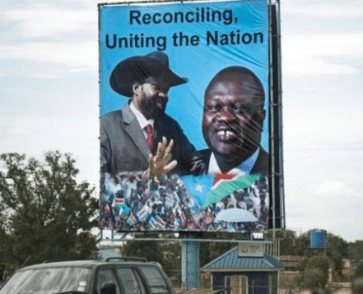
If you are following the farcical saga of the return of Riek Machar to Juba (the BBC reports that he finally landed!), here is an excellent backgrounder on the options available for stabilizing South Sudan (by Alex de Waaal).

Briefly stated:

South Sudan today is a collapsed political marketplace. The country’s political market was structured by competitive militarized clientelism for access to oil rents. Those oil rents have almost disappeared but the structure of competition is unchanged and the price of loyalty has not reduced to a level commensurate with the available political funding. The result is that political loyalty and services are rewarded with license to plunder. This is inherently self-destructive. South Sudan’s political economy is being consumed to feed its political-military elite.

How can the collapsed political marketplace be fixed?

The short term crisis could be resolved only by one of three means:

1. Buy-in: a power-sharing deal among the contenders. This was the strategy of the CPA. It was possible in 2005 because the budget was increasing by more than 25% per year. It is not possible under current conditions of austerity.

2. Victory and repression: one contender secures military domination and uses an efficient security apparatus to enforce loyalty. This is not possible because the civil war became an ethnic war, making outright victory impossible, and the army is unreformed.

3. Skilled management of the political market: the CEO negotiates a pact with the political financiers to obtain more funds and to regulate the marketplace, providing enough leeway to stabilize the situation. This remains an option but it requires skills and coordination that have been in short supply.

Screen Shot 2016-04-26 at 10.38.29 AMThe Saudis and OPEC aren’t helping with Option 1. And for the longest time I had faith in the international community’s ability to engineer and enforce Option 3. But the older I get more I think about it, the more I am convinced that autonomous recovery, i.e. Option 2 might be the best long-run solution (with important lessons from Idris Deby’s Chad noted).

Too bad there is not a single warlord in South Sudan (including President Salva Kiir) who is strong enough to become the main stationary bandit in Juba.

So Option 3 it is. But for how long?


Everything that is wrong with “voluntourism” in developing countries

Quartz has a story on White Savior Barbie, an account on Instagram that pokes fun at voluntourism in Africa.

Screen Shot 2016-04-21 at 10.55.04 AM

Savior Barbie also highlights a point that advocates and experts working on the continent have been observing for years—well-intentioned but naive volunteerism (or “voluntourism“) is at best ineffectual and at worst harmful to the developing countries it’s meant to serve. It drives an industry that sees 1.6 million people do volunteer work while on vacation every year, spending as much as $2 billion in the process. Nigerian-American author Teju Cole once dubbed this impulse the White Savior Industrial Complex.

The damage can be depressingly direct, as Jacob Kushner, a journalist in East Africa, points out in a recent editorial, “The voluntourist’s dilemma.” In South Africa, “AIDS orphan tourism,” where volunteers temporarily care for children who have lost their parents to the virus, has left children with attachment disorders and encouraged orphanages to purposefully keep them in poor conditions to attract more volunteers.

More on this here.

On a related note, there is also Humanitarians of Tinder.

Both offer lots of lessons on things not to do as you prepare to volunteer or conduct research in a developing country this summer.

HT Melissa Lee.

Sleep and Academic Performance

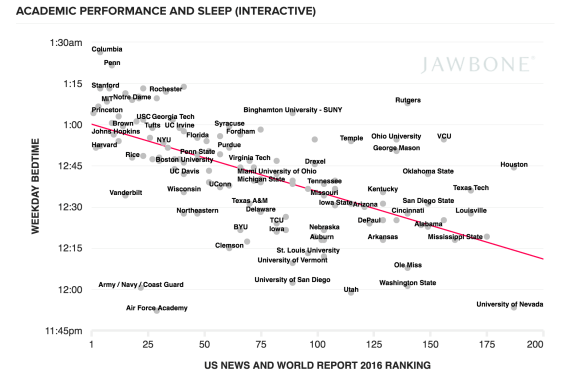
Thanks to Jawbone, writers at the Jawbone Blog looked at data on sleep patterns for tens of thousands of students at over 100 universities across the United States (for a total of 1.4 million nights). One of the findings of from the data is show below. Screen Shot 2016-04-20 at 10.47.32 PMIt is important to note that:

The relationship between these rankings and amount of sleep, however, was weak (r2 < 0.1)

So basically what’s might be happening here is that night owls at highly ranked schools have huge chunks of quality time late in the night when they are not being distracted by everyday life

(Caution: these data show interesting patterns but cannot be used to make strong causal claims without further research).

It was interesting to learn that my students go to bed at 1:10 AM and sleep for 7 hours on average.

HT Ryan Briggs.